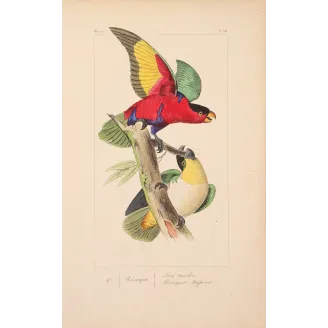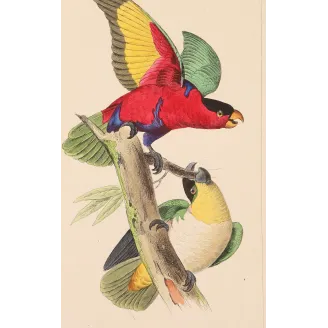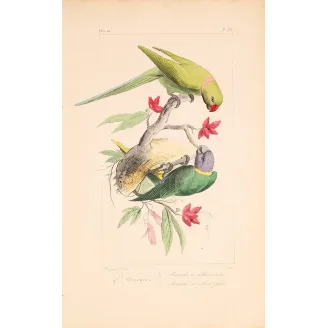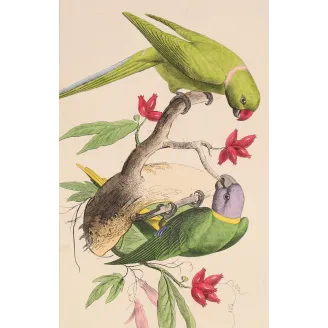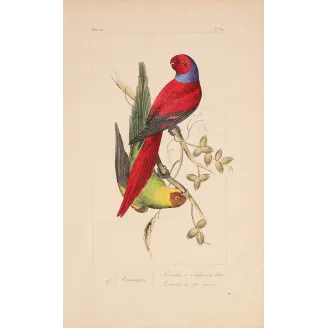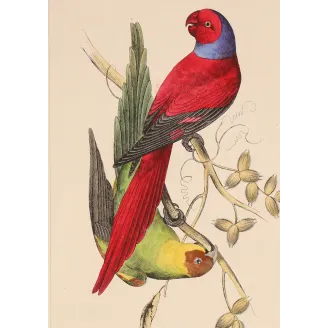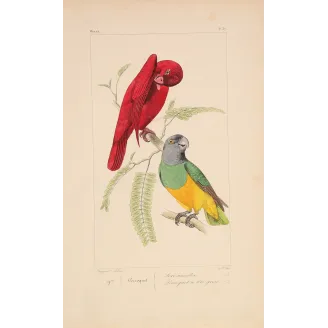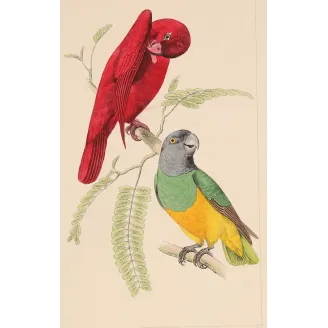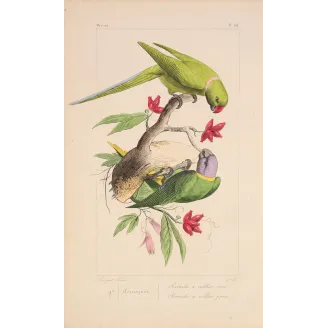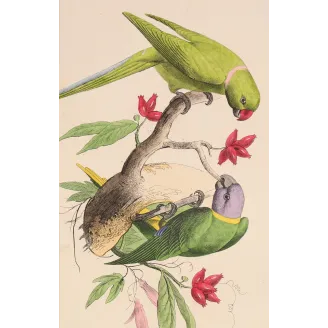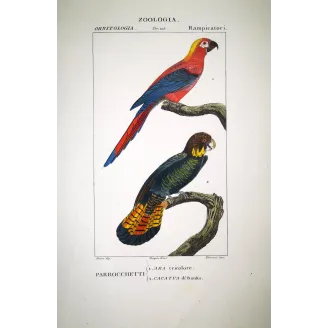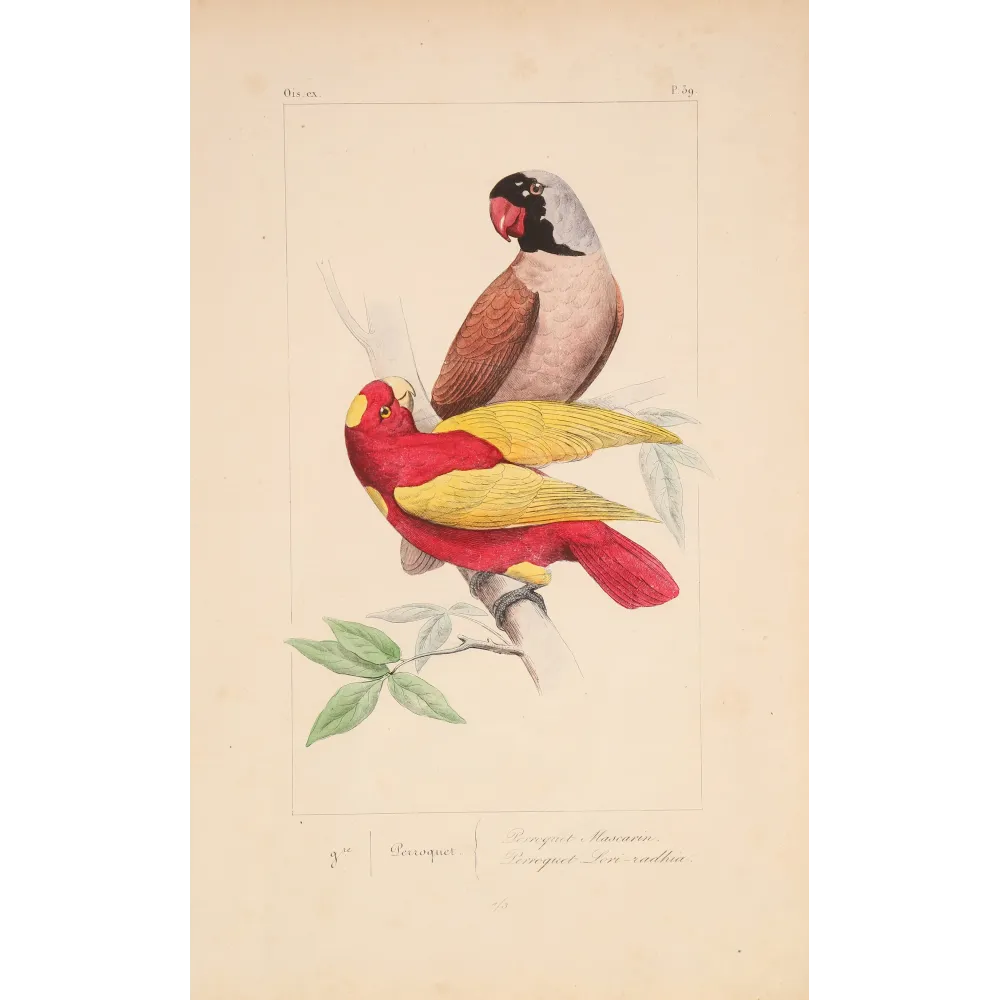
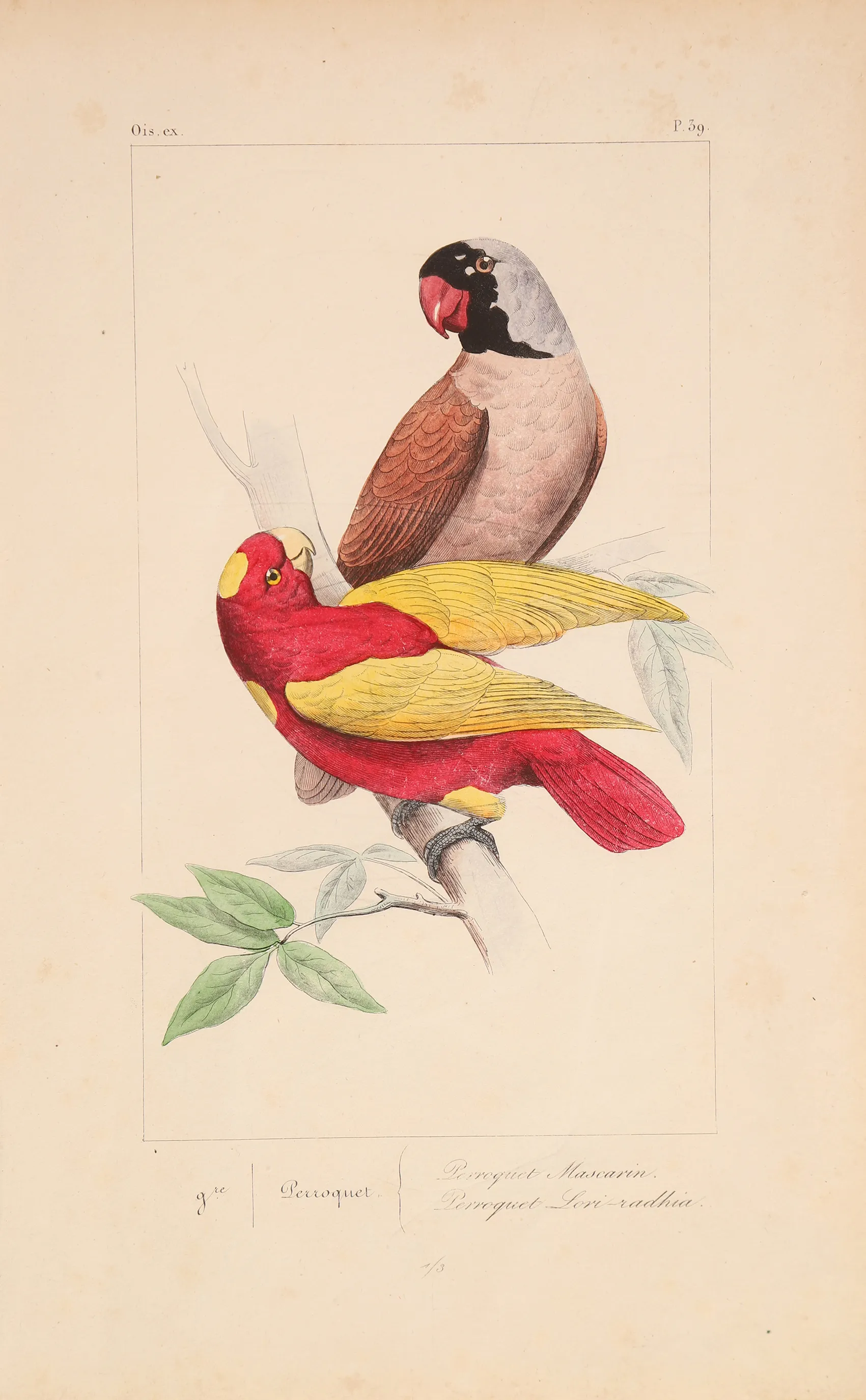
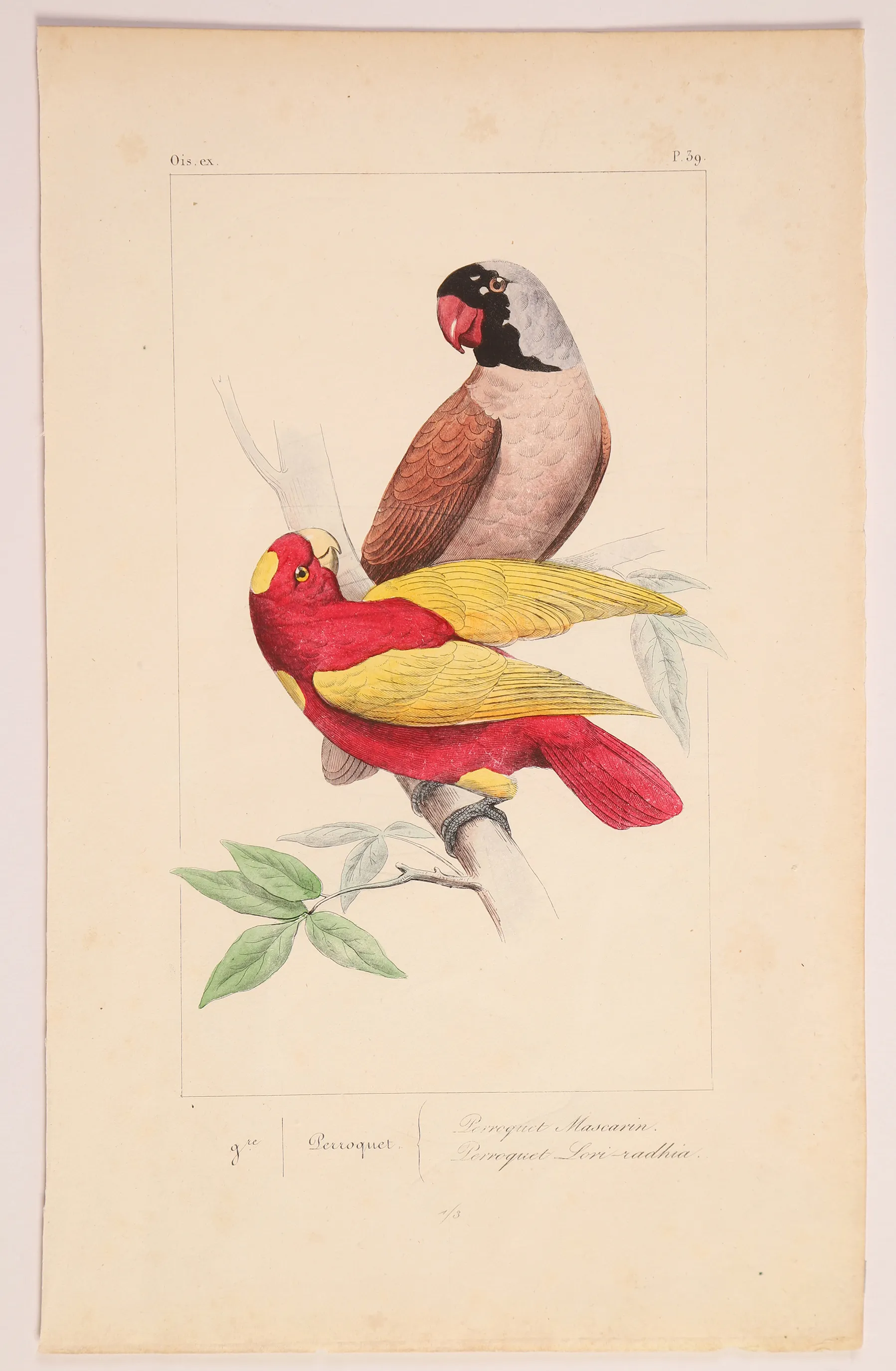
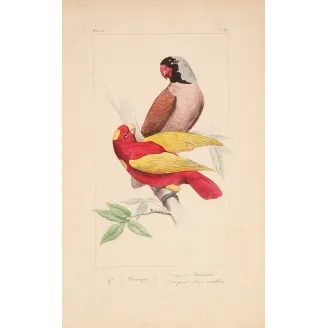
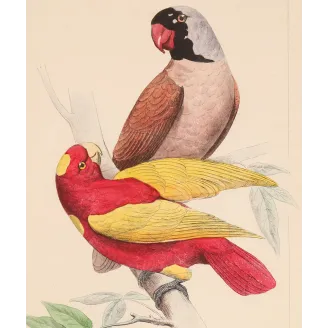
A vibrant 19th-century hand-colored engraving depicting two exotic parrots with striking red and yellow plumage contrasted by softer natural tones. A dynamic and decorative composition with strong visual presence, ideal for collectors and interior display.
 Delivery policy
Your print will be carefully prepared and shipped worldwide via trusted couriers (UPS or similar).
 Authentic antique prints
Original engravings from the 17th–19th century.
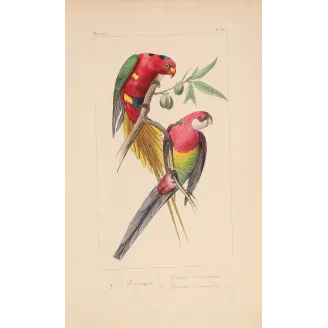
This important original first-edition plate depicts two exotic parrots from C. L. Lemaire’s Histoire Naturelle des Oiseaux Exotiques, published in Paris in 1836. The historical titles printed directly on the sheet identify the subjects as Perroquet Mascarin and Perroquet Lori-Radhia. The figures were created by Pauquet, described in the original publication as peintes d’après nature and engraved on steel.
The upper bird gives this plate exceptional historical significance. It represents the Mascarene Parrot (Mascarinus mascarin), a parrot endemic to Réunion that is now extinct. The engraving therefore preserves the image of a living species that has disappeared from the modern natural world, giving the sheet a documentary importance extending well beyond its decorative beauty.
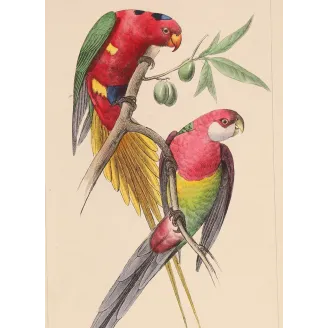
Visually, Plate P.39 is constructed through a striking contrast between the subdued upper bird and the brilliant foreground subject. Grey, brown and black establish a restrained vertical presence above, while intense crimson and broad yellow wings project strongly across the lower half of the composition.
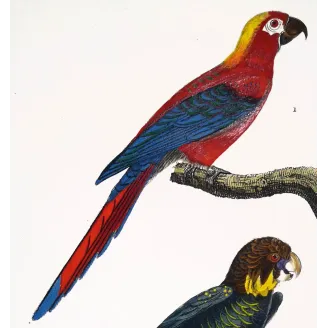
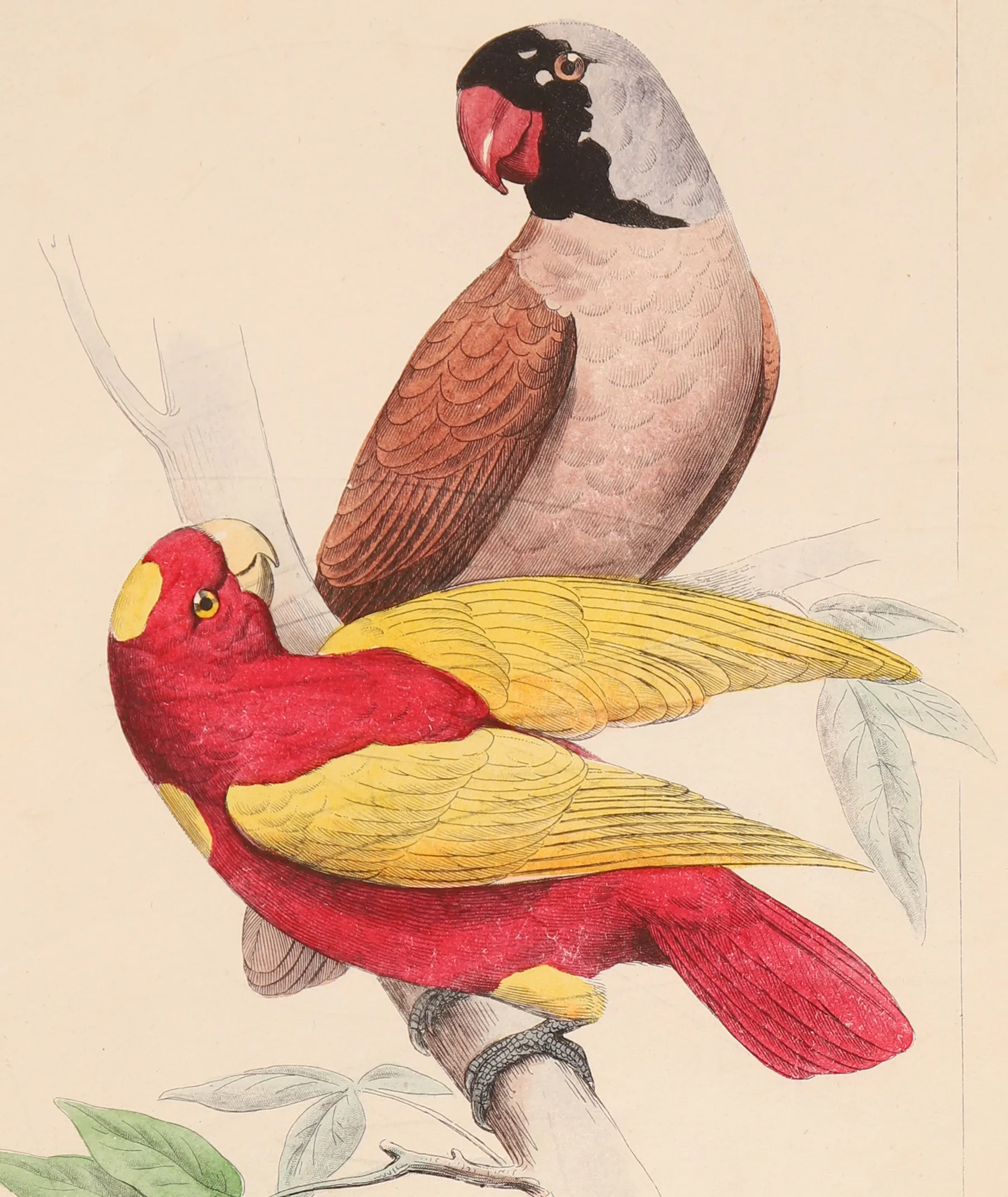
The original hand colouring remains exceptionally fresh. Direct examination reveals selective gum arabic across the yellow passages of the foreground bird. Particularly on the overlapping wing feathers, these reflective areas contribute significantly to the perception of volume, transforming broad fields of yellow into a more articulated and physically convincing structure.
The composition is built from two overlapping bodies rather than two clearly separated subjects. The Mascarene Parrot rises quietly in the background, its rounded torso and restrained palette creating a stable vertical presence. In front, the red-and-yellow parrot extends laterally across the composition, producing a much stronger sensation of projection and movement.
This relationship establishes depth without conventional landscape perspective. The upper bird remains compact and contained; the lower subject expands across the sheet through its open wing structure, elongated body and brilliant colour. Their physical overlap makes the foreground bird appear to advance towards the viewer.
Colour intensifies this spatial distinction. The Mascarene Parrot is rendered through subdued areas of brown, grey, black and soft rose, while the foreground bird combines saturated crimson with expansive yellow wing surfaces. The contrast allows both subjects to remain immediately legible while giving the lower bird extraordinary visual presence.
The vegetation remains deliberately restrained. Pale branches and softly coloured leaves provide enough natural context to anchor the birds, but nothing competes with their silhouettes or chromatic relationship.
One bird recedes through restraint; the other advances through colour and light.
The historical designation Perroquet Mascarin corresponds to the Mascarene Parrot (Mascarinus mascarin), a species endemic to the island of Réunion in the western Indian Ocean. The species is now classified as Extinct.
This status changes the way the image can be read today. For the nineteenth-century viewer, the engraving represented an exotic living bird belonging to a distant natural world. For the modern viewer, it has also become part of the surviving visual record of a species that can no longer be encountered in nature.
The lower subject is identified directly on the plate as Perroquet Lori-Radhia. This historical designation is retained here rather than imposing a modern taxonomic identification without equally secure evidence.
Preserving the original nomenclature alongside securely established modern taxonomy allows the sheet to remain faithful to its historical evidence while revealing how its scientific meaning has changed over time.
Among the surviving plates of Histoire Naturelle des Oiseaux Exotiques, P.39 carries a particular historical resonance because one of its subjects no longer exists in the living world.
Pauquet’s Mascarene Parrot was created within the visual culture of natural-history illustration: a bird presented so that its plumage, proportions and characteristic appearance could be observed, recognised and remembered. Almost two centuries later, that function has acquired an unintended significance.
The engraving no longer represents only a distant species. It preserves the visual memory of a lost one.
This transformation from scientific illustration into historical testimony gives the plate a significance independent of its decorative appeal. The image documents a form of biodiversity that has disappeared, connecting nineteenth-century observation with the modern history of extinction and environmental loss.
The foreground bird introduces a second, distinctly material dimension to the composition. Direct examination reveals selective gum arabic across its yellow passages, especially the broad overlapping wings. The glossy surface catches light differently from the surrounding matte colour and makes the individual layers of feathers more perceptible.
The visual construction can almost be read as:
overlap → contrast → projection → wing → light
Here historical significance and material sophistication coexist on the same sheet: an image preserving an extinct bird above, and below it a particularly refined example of how engraved line, hand-applied colour and selective surface enhancement could create physical volume.
Published in Paris in 1836, C. L. Lemaire’s Histoire Naturelle des Oiseaux Exotiques brought together natural-history knowledge, brilliant hand colouring and Pauquet’s remarkable ability to suggest the physical presence of the living bird. In the case of the Mascarene Parrot, that historical act of representation has acquired an additional meaning: the plate now preserves the image of a species that has disappeared from the natural world.
Histoire Naturelle des Oiseaux Exotiques: Art, Observation and the Living Bird →
The Pauquet name also belongs to a broader world of nineteenth-century natural-history illustration. Across different zoological subjects, the artists adapted their visual language to different scientific and editorial purposes — from the animated presence of Lemaire’s birds to the precise, specimen-like presentation of exotic butterflies.
Excellent condition. Direct examination of this impression shows a clean and luminous first-edition sheet with fresh, beautifully preserved original hand colouring and crisp engraved detail throughout.
Selective gum arabic remains clearly visible across the yellow passages of the foreground bird, particularly the wings. The reflective treatment enhances the differentiation and overlapping structure of the feathers and contributes significantly to their sense of volume.
Under detailed photographic enlargement, a few extremely faint shallow pressure traces can be detected across parts of the two birds. Their appearance is consistent with the light passage of a pointed writing instrument over another sheet formerly resting above the print. They carry no visible ink, graphite or other graphic residue and are effectively imperceptible to the naked eye under normal viewing conditions.
The sheet otherwise shows only minor signs of natural age and handling consistent with an original work of 1836. The central image remains bright, sharply defined and visually compelling, with generous margins and no significant defect affecting its overall presentation.
Original plate titles: Perroquet Mascarin / Perroquet Lori-Radhia
Modern identification: Mascarene Parrot (Mascarinus mascarin) — Extinct / Lori-Radhia Parrot — historical designation retained pending secure modern taxonomic identification
Conservation status: Mascarene Parrot — Extinct
Work: Histoire Naturelle des Oiseaux Exotiques
Author: C. L. Lemaire
Figures: Pauquet
Publication: Paris, Pauquet Éditeur / Debure Libraire
Edition: First edition
Date: 1836
Plate: P. 39
Technique: Original hand-colored steel engraving
Colour: Contemporary hand colouring
Surface enhancement: Selective gum arabic across the yellow areas of the foreground bird, observed by direct examination
Paper: Fine period paper
Watermark: None observed
Sheet size: approx. 23 × 14 cm
Photography: Detailed professional photographs of this individual impression are provided; additional photographs are available upon request.
Specific References
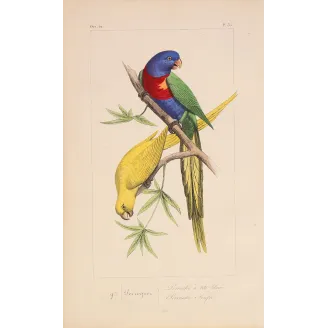
Highly decorative 19th-century engraving of exotic parakeets with vivid blue, red and yellow plumage. A striking and colorful antique bird print.
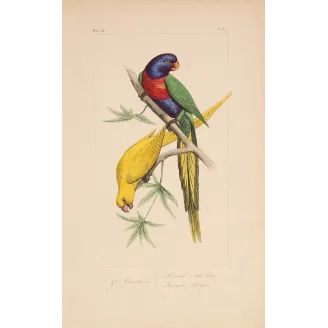
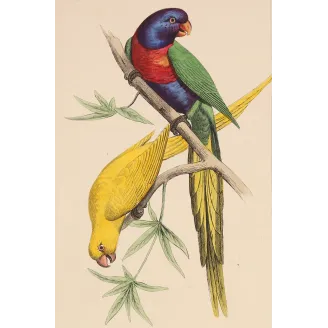
A highly dynamic 19th-century engraving depicting a tricolour lory in flight above a contrasting parakeet. The vivid interplay of red, yellow, green and blue creates a striking decorative composition with exceptional visual energy and presence.
A refined 19th-century engraving depicting two parakeets arranged in a fluid and harmonious composition. The dominant green tones, enhanced by delicate red and violet accents, create an elegant and highly decorative natural history print.
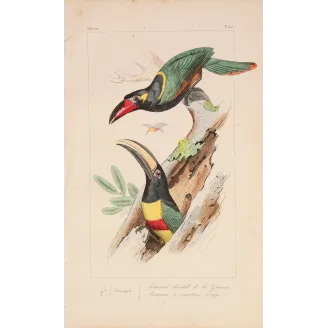
This vivid 19th-century engraving depicts two exotic aracaris, showcasing striking contrasts of green, red and yellow plumage. A highly decorative composition combining scientific observation with strong visual appeal, ideal for collectors of tropical ornithology and refined interior spaces.
A vivid 19th-century engraving depicting two exotic parakeets in a dynamic vertical composition. The intense red plumage contrasts beautifully with green and yellow tones, creating a striking decorative work with strong visual presence.
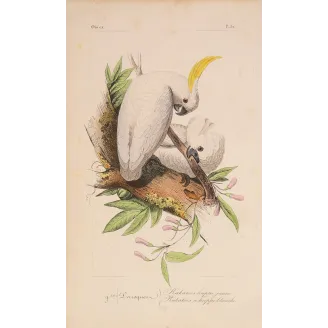
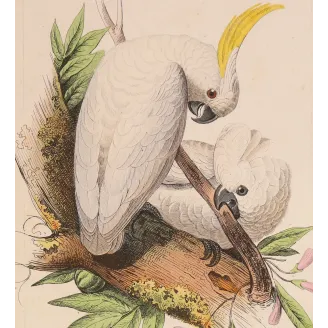
Elegant 19th-century hand-colored engraving depicting two sulphur-crested cockatoos, rendered with refined detail and soft tonal harmony. A balanced and decorative exotic bird composition ideal for sophisticated interiors.
A striking 19th-century hand-colored engraving depicting two exotic parrots in a composition of vivid chromatic contrast. The brilliant red lory and the grey-headed, yellow-breasted parakeet create a highly decorative image of strong visual presence, ideal for collectors of antique ornithological prints and refined interiors.
A striking 19th-century engraving depicting two vividly colored parakeets in a dynamic composition. The intense contrast of blue, red, green and yellow creates a highly decorative work, ideal as a focal piece in refined interiors.
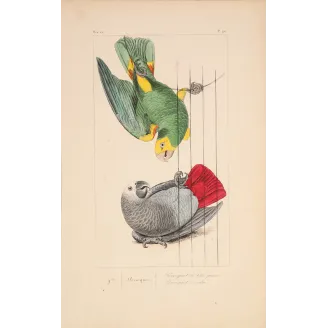
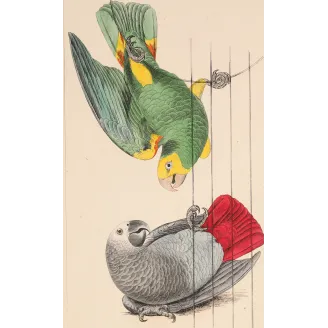
A distinctive 19th-century engraving depicting two parrots in an unusual composition, including one shown suspended upside-down. The presence of cage elements adds historical character, creating a unique and visually engaging natural history print.
A striking 19th-century engraving depicting two exotic parrots with vivid red, pink and green plumage. The composition combines strong colour contrast with elegant vertical balance, creating a highly decorative and visually impactful antique print.
Vivid 19th-century hand-colored engraving depicting two parakeets in dynamic interaction, with striking green plumage and contrasting red and violet accents. A highly decorative exotic bird composition.
Original eighteenth-century botanical engraving depicting Ilex aquifolium L., the common holly, published in Vienna as Plate 72 of Joseph Jacob von Plenck’s Icones Plantarum Medicinalium. The composition combines sharply articulated evergreen foliage, delicate pink flowers, brilliant red fruits and separate botanical details, preserved on fine laid paper with a visible partial “IV” watermark.
Refined hand-colored engraving of the Florentine iris with elegant petals and detailed rhizome structure.
Vibrant parakeets perched on branches: a scarlet macaw and a black cockatoo with yellow and red highlights.
This vivid 19th-century engraving depicts two exotic aracaris, showcasing striking contrasts of green, red and yellow plumage. A highly decorative composition combining scientific observation with strong visual appeal, ideal for collectors of tropical ornithology and refined interior spaces.
Fine 18th-century engraving of the Medlar Tree by Elisabeth Blackwell, featuring fruit, blossom, and botanical detail.
With its compound leaves and clusters of red berries, the sorb tree is rich in folk symbolism.
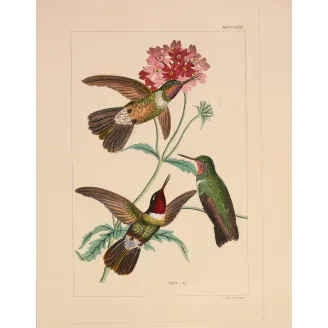
Original nineteenth-century hand-colored engraving by Ludwig Reichenbach, depicting three hummingbirds among pink blossoms. A rare later plate from the Trochilinarum Enumeratio corpus, not fully documented in the principal published index.
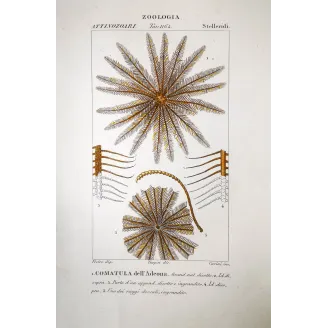
Rare 19th-century print of the feather star Comatula of the Adeona, with anatomical details.
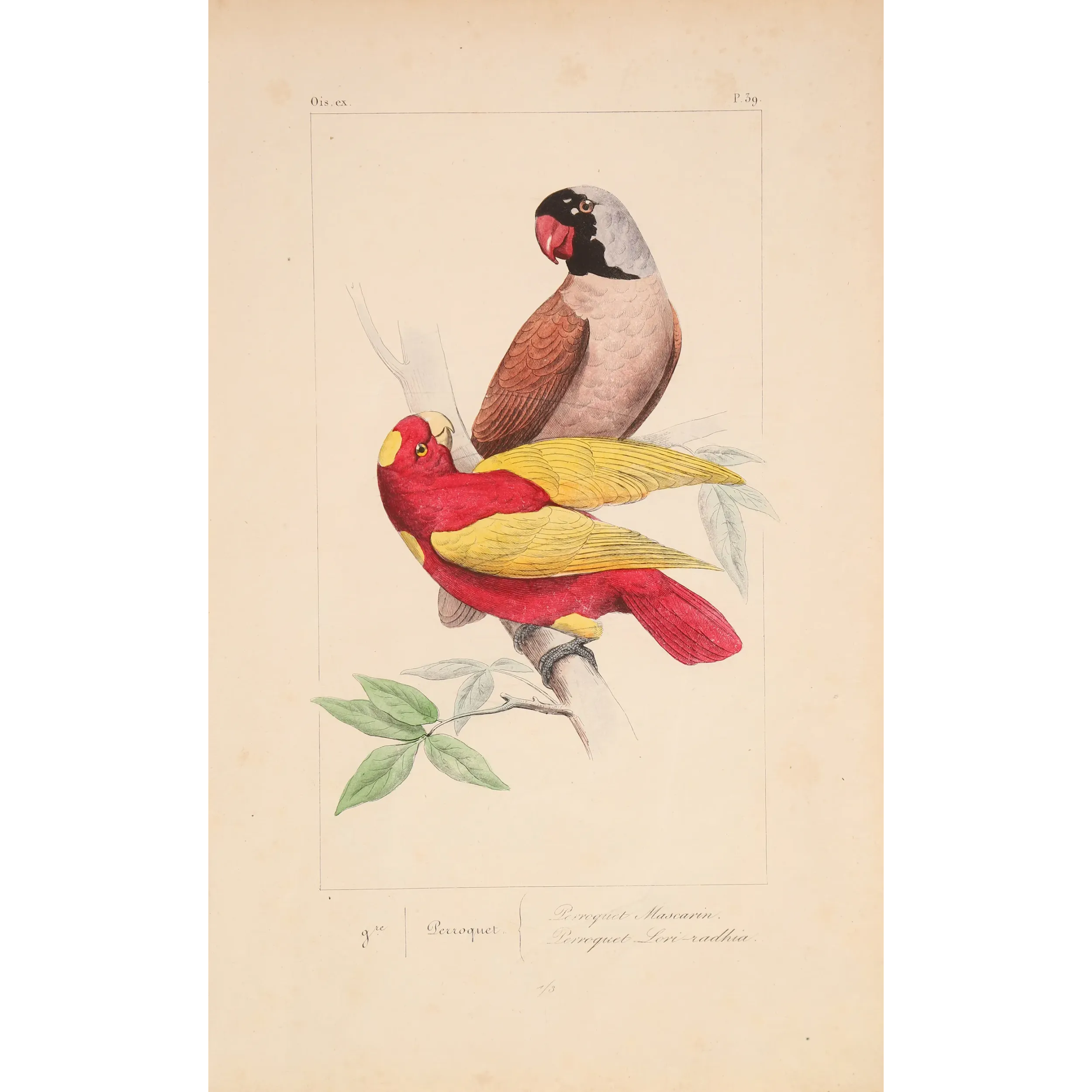
A vibrant 19th-century hand-colored engraving depicting two exotic parrots with striking red and yellow plumage contrasted by softer natural tones. A dynamic and decorative composition with strong visual presence, ideal for collectors and interior display.