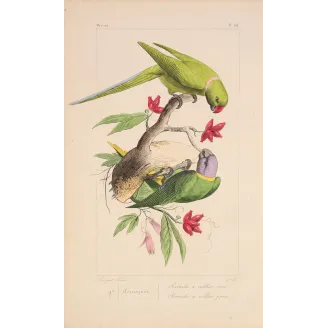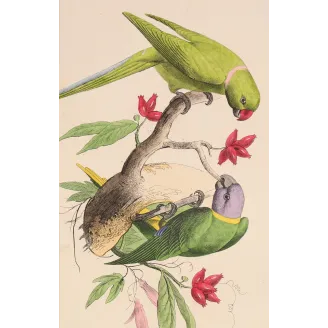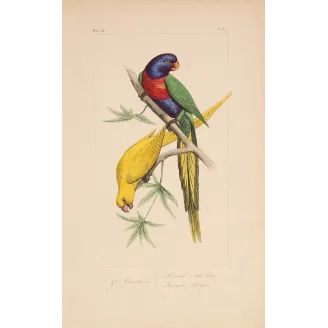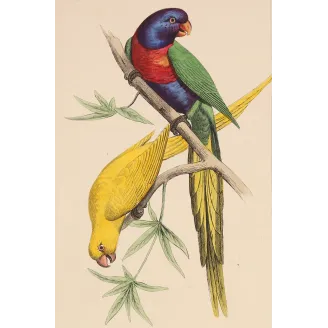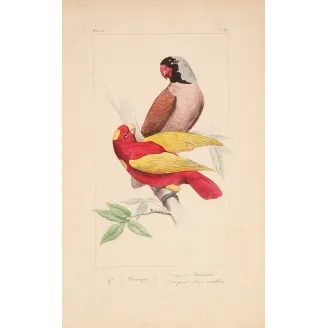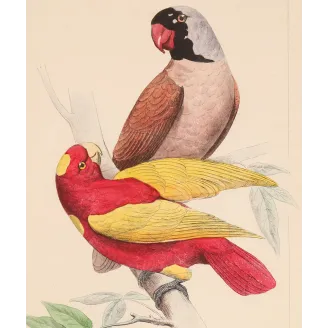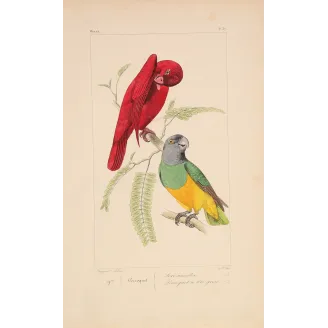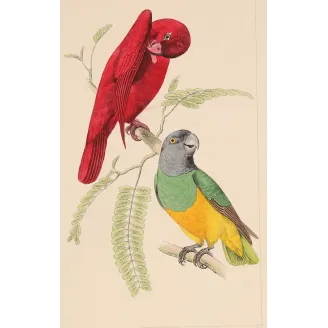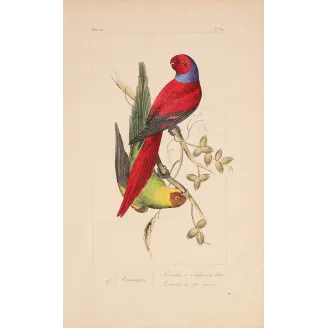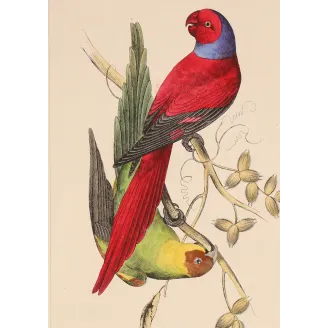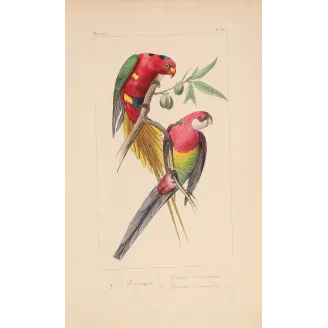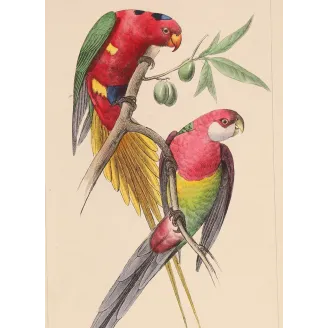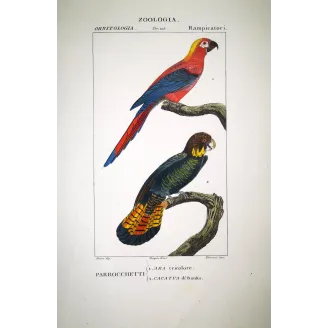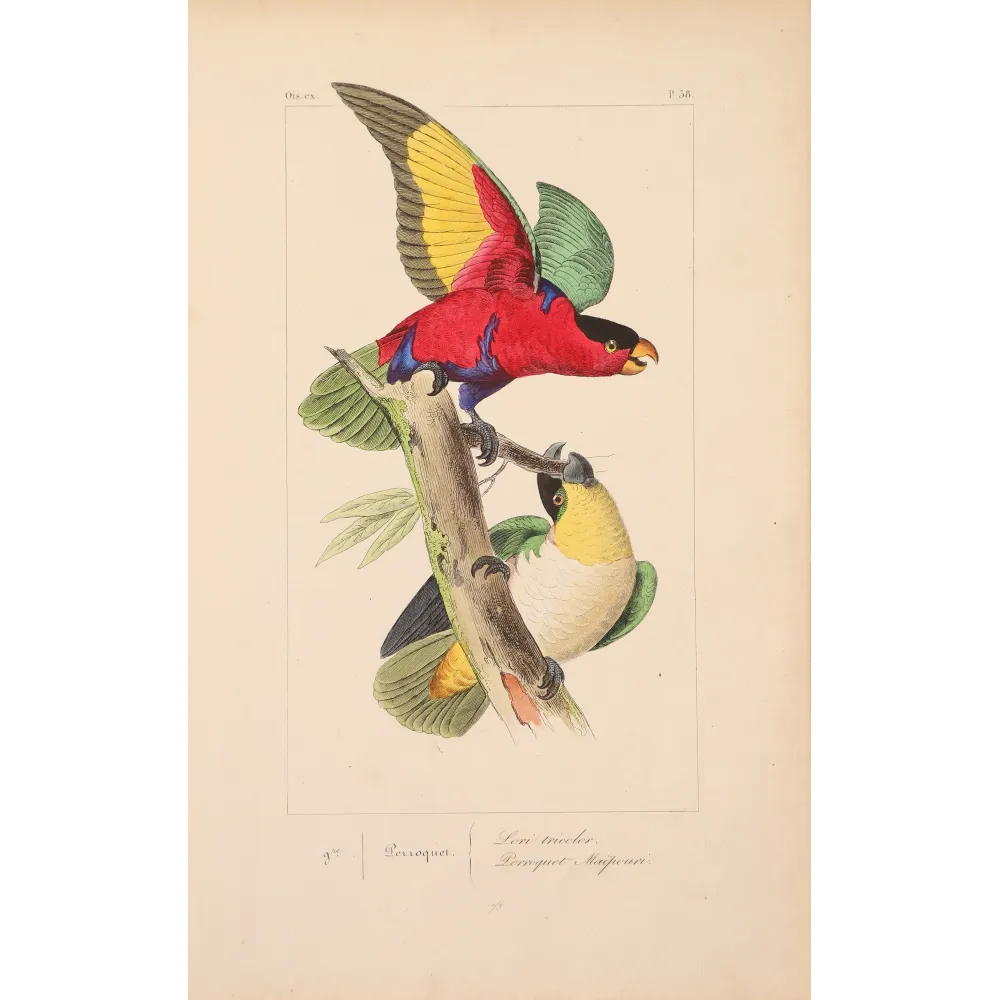
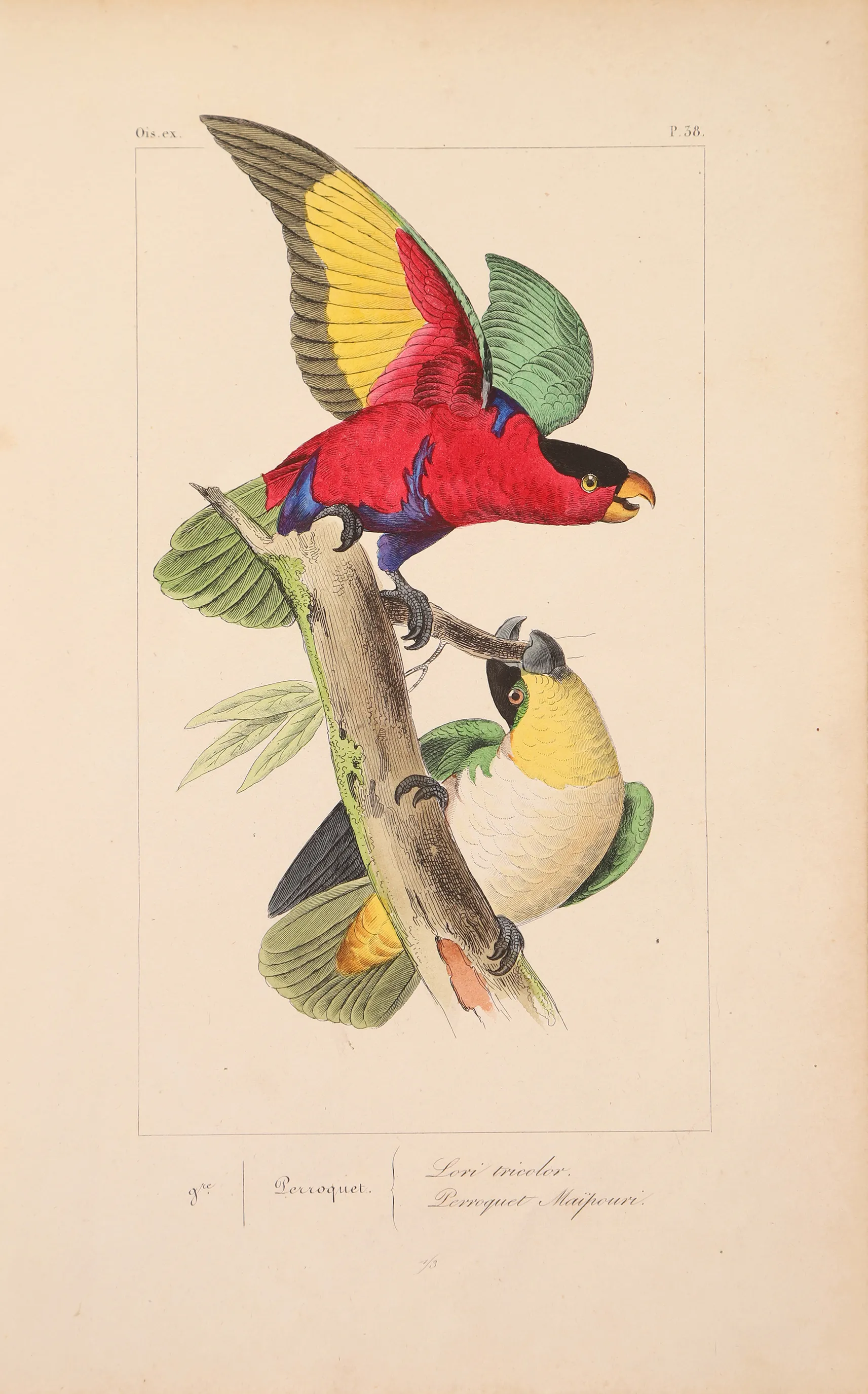
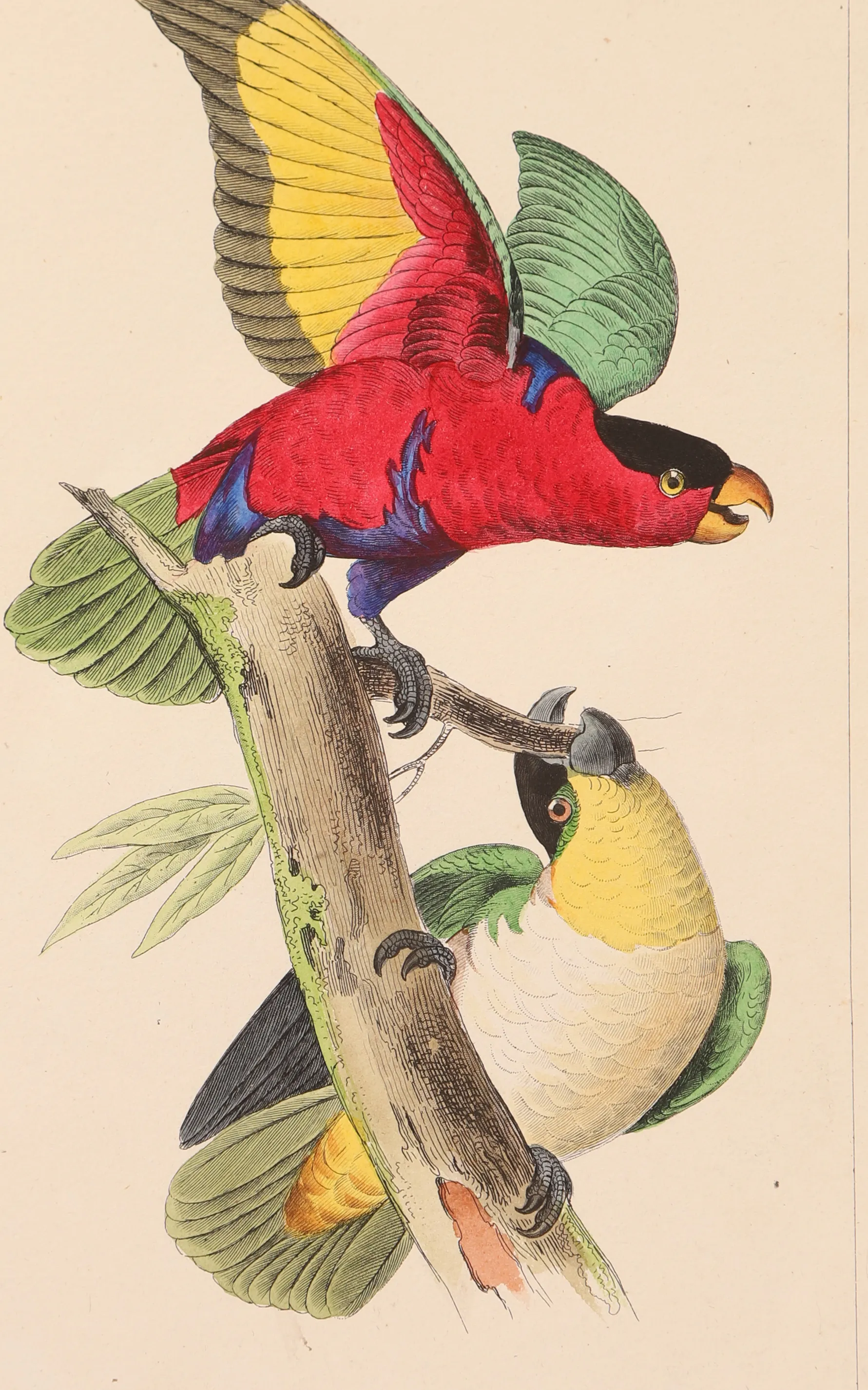
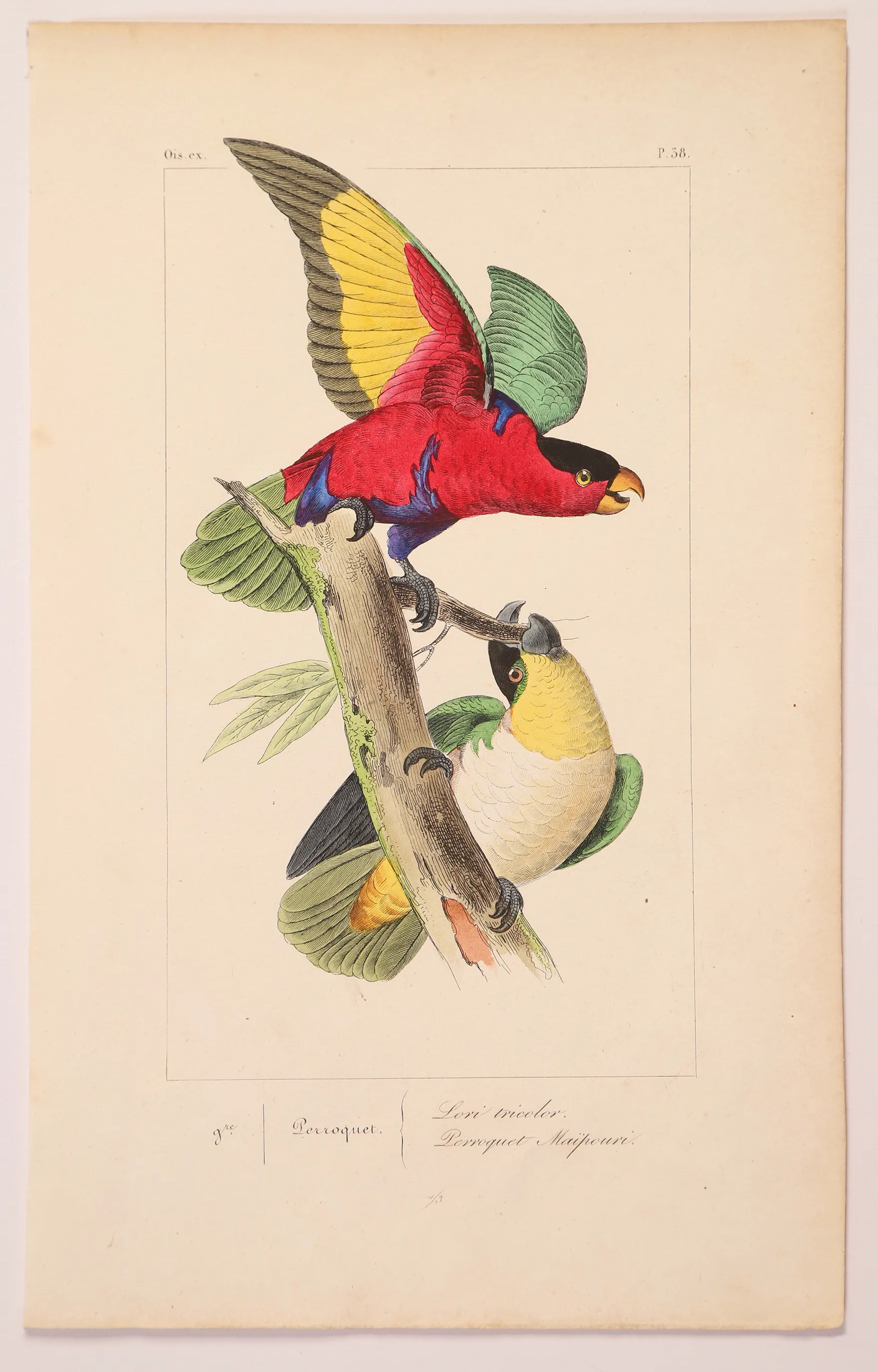
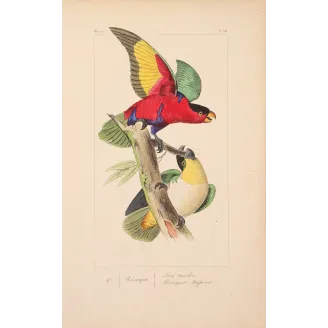
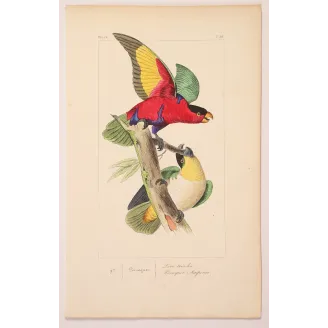
A highly dynamic 19th-century engraving depicting a tricolour lory in flight above a contrasting parakeet. The vivid interplay of red, yellow, green and blue creates a striking decorative composition with exceptional visual energy and presence.
 Delivery policy
Your print will be carefully prepared and shipped worldwide via trusted couriers (UPS or similar).
 Authentic antique prints
Original engravings from the 17th–19th century.
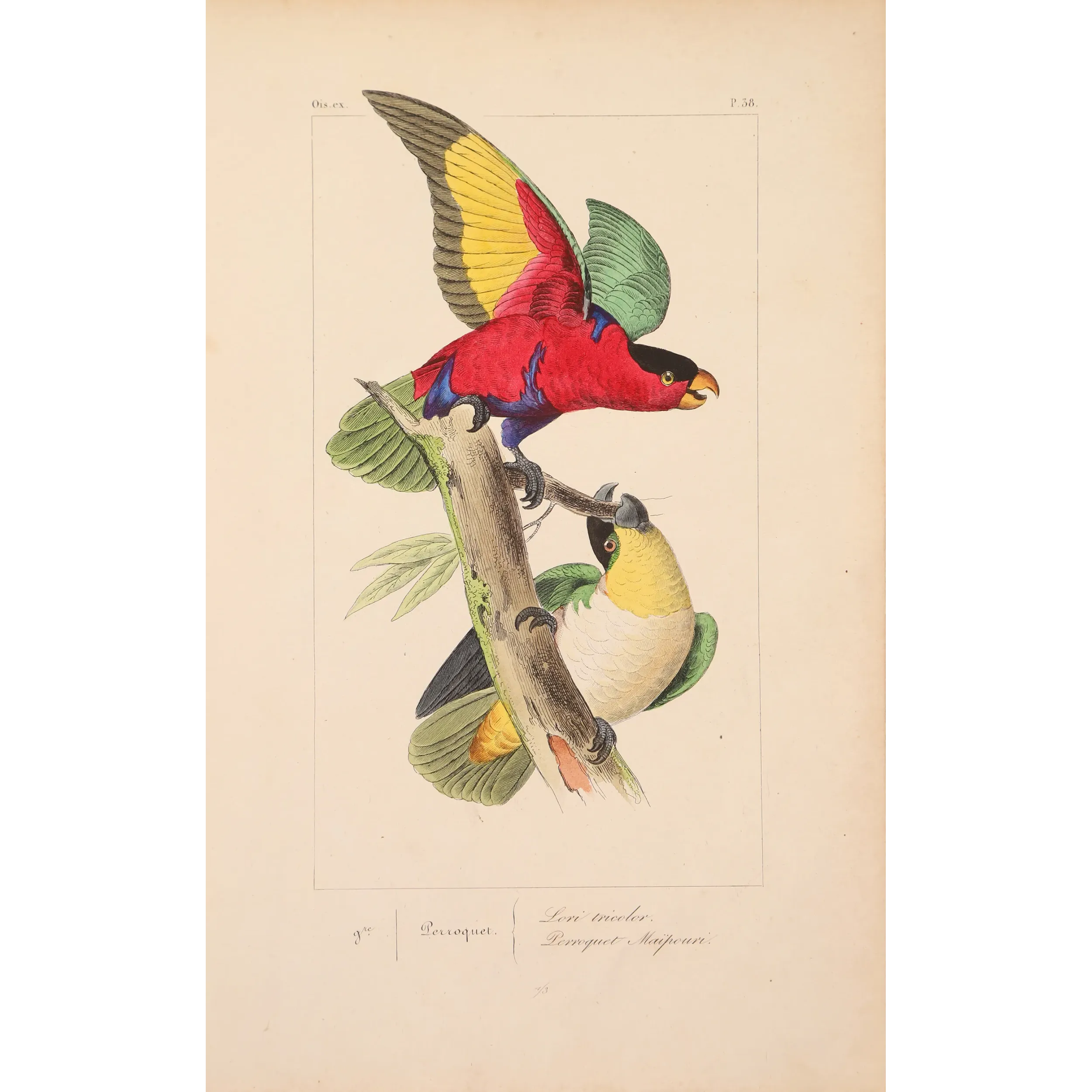
This remarkable original first-edition plate depicts two vividly coloured exotic parrots from C. L. Lemaire’s Histoire Naturelle des Oiseaux Exotiques, published in Paris in 1836. The historical titles printed directly on the sheet identify the subjects as Lori tricolor and Perroquet Maïpouri. The figures were created by Pauquet, described in the original publication as peintes d’après nature and engraved on steel.
Among the more dynamic compositions of the series, Plate P.38 transforms the vertical support of the tree into an axis around which two very different attitudes unfold. The brilliant red bird above opens its wings while shifting its weight forward, whereas the lower subject remains more compact and grounded, looking upward towards the action above.
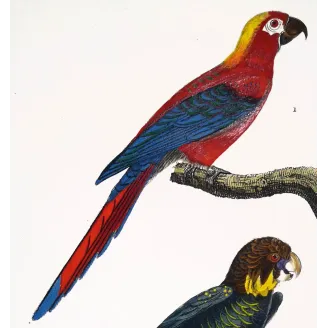
The original hand colouring remains exceptionally luminous. Direct examination of this impression reveals a highly selective use of gum arabic, concentrated not across the entire plumage but on particular lower-facing coloured surfaces. These small areas of reflected light reinforce the physical articulation of the birds without disturbing the quieter matte character of the surrounding vegetation.
The composition is organised around the strong trunk that rises through the centre of the plate. Rather than functioning simply as a perch, it becomes the stable element against which Pauquet constructs movement. The upper bird projects its body almost horizontally to the right while the wings expand in opposing directions, creating a striking sensation of momentary imbalance.
The impression of movement depends on the relationship between weight and support. The claws remain firmly engaged with the branch while the body advances beyond it; one wing rises dramatically towards the upper left, while the other curves behind the body in a contrasting direction. The bird appears suspended between stability and departure.
Below, the second parrot provides a compact counterweight. Its rounded body remains close to the trunk, yet the upward turn of the head introduces a clear visual response to the movement above. Pauquet therefore creates interaction without requiring a literal narrative: one subject generates the action, while the other visually receives it.
Colour intensifies this opposition. The upper bird is dominated by saturated scarlet, interrupted by broad passages of yellow, green and deep blue. The lower subject is quieter, combining cream, yellow and softer greens with darker accents around the head and wings. The contrast gives the upper bird immediate visual dominance while preserving equilibrium across the sheet.
The trunk remains stable; everything around it appears momentarily in motion.
The upper subject is identified directly on the plate as Lori tricolor, corresponding to the historical representation of a Tricolour Lory. Lories were among the most visually compelling exotic birds encountered by nineteenth-century European naturalists, their intense reds, greens, yellows and blues making them especially suited to richly hand-coloured natural-history illustration.
The second bird is identified on the original sheet as Perroquet Maïpouri. Because historical vernacular names do not always correspond cleanly to modern zoological nomenclature, the original designation is retained here rather than forcing an uncertain contemporary identification.
Preserving the terminology printed on the plate is important in understanding the object historically: the sheet records not only the appearance of the birds, but also the zoological language through which they were classified and communicated in 1836.
Plate P.38 offers a particularly clear example of how Pauquet could transform anatomical description into the sensation of a fleeting action. The movement does not depend on an elaborate setting, but on the relationship between grip, weight, wings and counterbalance.
The upper bird remains physically attached to the branch while almost every other element of its body suggests release. Its torso extends away from the support, the wings spread in opposite directions and the tail moves back towards the trunk. The compact lower bird then anchors the composition visually, preventing the energetic upper form from overwhelming the sheet.
The construction can almost be read as a sequence:
grip → weight → wings → counterweight → reaction
Direct examination adds another material dimension to this visual reading. Gum arabic is selectively visible on particular lower-facing surfaces: the yellow underside of the upper bird’s wing, the yellow throat of the lower subject and areas of the tails seen from below.
Rather than coating the most intensely coloured areas indiscriminately, these glossy passages create isolated points of reflection beneath the birds. The effect introduces a subtle luminosity into surfaces that would otherwise remain visually subordinate.
It would be speculative to describe this as a documented lighting programme intended by Pauquet. What can be observed with certainty is the selective material treatment of these lower-facing areas; curatorially, their reflected brilliance strengthens the sensation of volume, underside and physical movement within the composition.
Published in Paris in 1836, C. L. Lemaire’s Histoire Naturelle des Oiseaux Exotiques brought together natural-history knowledge, brilliant hand colouring and Pauquet’s remarkable ability to suggest the physical presence of the living bird. Our dedicated Historical Perspective explores how observation d’après nature, gesture and composition combine throughout the work.
Histoire Naturelle des Oiseaux Exotiques: Art, Observation and the Living Bird →
The Pauquet name also belongs to a broader world of nineteenth-century natural-history illustration. Across different zoological subjects, the artists adapted their visual language to very different purposes — from the animated presence of Lemaire’s birds to the precise, specimen-like presentation of exotic butterflies.
Excellent condition. Direct examination of this impression shows a particularly clean and luminous first-edition sheet with exceptionally vivid original hand colouring and crisp engraved detail throughout.
Selective gum arabic remains clearly visible on specific coloured surfaces, including the yellow underside of the upper bird’s wing, the yellow throat of the lower bird and areas of the tails viewed from below. These glossy passages remain well preserved, while the surrounding plumage and botanical elements retain a predominantly matte appearance.
The sheet shows only minor signs of natural age and handling consistent with an original work of 1836. The central image remains exceptionally fresh, sharply defined and visually luminous, with generous margins and no significant defect affecting the composition.
Original plate titles: Lori tricolor / Perroquet Maïpouri
Modern identification: Tricolour Lory (Lorius tricolor) / Maipouri Parrot — historical designation retained pending secure modern taxonomic identification
Work: Histoire Naturelle des Oiseaux Exotiques
Author: C. L. Lemaire
Figures: Pauquet
Publication: Paris, Pauquet Éditeur / Debure Libraire
Edition: First edition
Date: 1836
Plate: P. 38
Technique: Original hand-colored steel engraving
Colour: Contemporary hand colouring
Surface enhancement: Selective gum arabic on specific lower-facing coloured areas of the birds, observed by direct examination
Paper: Fine period paper
Watermark: None observed
Sheet size: approx. 23 × 14 cm
Photography: Detailed professional photographs of this individual impression are provided; additional photographs are available upon request.
Specific References
Vivid 19th-century hand-colored engraving depicting two parakeets in dynamic interaction, with striking green plumage and contrasting red and violet accents. A highly decorative exotic bird composition.
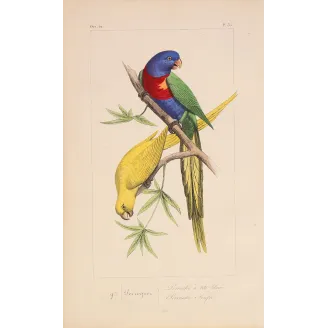
A striking 19th-century engraving depicting two vividly colored parakeets in a dynamic composition. The intense contrast of blue, red, green and yellow creates a highly decorative work, ideal as a focal piece in refined interiors.
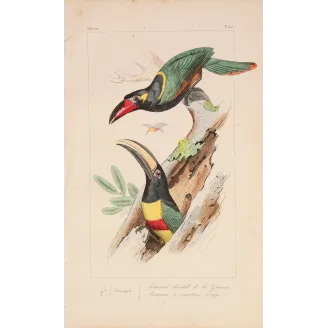
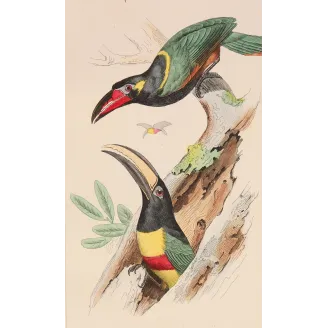
This vivid 19th-century engraving depicts two exotic aracaris, showcasing striking contrasts of green, red and yellow plumage. A highly decorative composition combining scientific observation with strong visual appeal, ideal for collectors of tropical ornithology and refined interior spaces.
A vibrant 19th-century hand-colored engraving depicting two exotic parrots with striking red and yellow plumage contrasted by softer natural tones. A dynamic and decorative composition with strong visual presence, ideal for collectors and interior display.
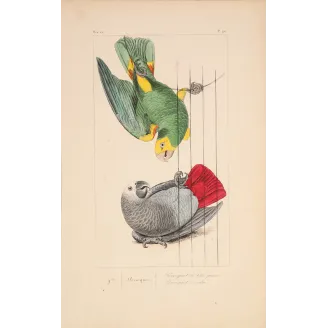
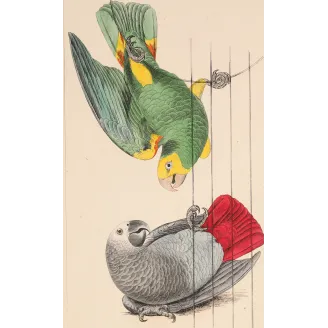
A distinctive 19th-century engraving depicting two parrots in an unusual composition, including one shown suspended upside-down. The presence of cage elements adds historical character, creating a unique and visually engaging natural history print.
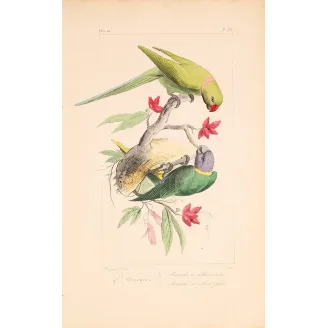
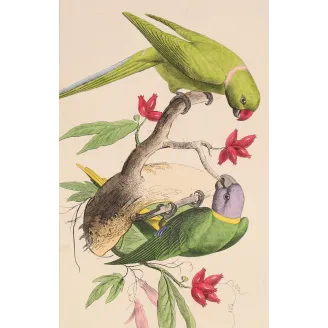
A refined 19th-century engraving depicting two parakeets arranged in a fluid and harmonious composition. The dominant green tones, enhanced by delicate red and violet accents, create an elegant and highly decorative natural history print.
Elegant 19th-century hand-colored engraving depicting two sulphur-crested cockatoos, rendered with refined detail and soft tonal harmony. A balanced and decorative exotic bird composition ideal for sophisticated interiors.
A striking 19th-century hand-colored engraving depicting two exotic parrots in a composition of vivid chromatic contrast. The brilliant red lory and the grey-headed, yellow-breasted parakeet create a highly decorative image of strong visual presence, ideal for collectors of antique ornithological prints and refined interiors.
A vivid 19th-century engraving depicting two exotic parakeets in a dynamic vertical composition. The intense red plumage contrasts beautifully with green and yellow tones, creating a striking decorative work with strong visual presence.
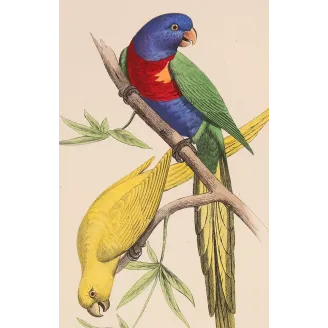
Highly decorative 19th-century engraving of exotic parakeets with vivid blue, red and yellow plumage. A striking and colorful antique bird print.
A striking 19th-century engraving depicting two exotic parrots with vivid red, pink and green plumage. The composition combines strong colour contrast with elegant vertical balance, creating a highly decorative and visually impactful antique print.
Original 19th-century hummingbird engraving depicting Cuvier’s Sabrewing (*Campylopterus cuvierii*), published by Ludwig Reichenbach for *Trochilinarum Enumeratio*. A refined composition marked *ad naturam* — drawn from life — combining scientific observation with remarkable decorative elegance.
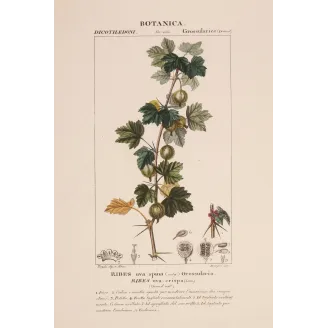
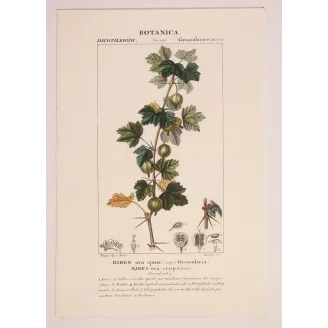
A charming depiction of *Ribes uva-crispa*, the gooseberry plant, detailed with its spiny stems and translucent green fruits.
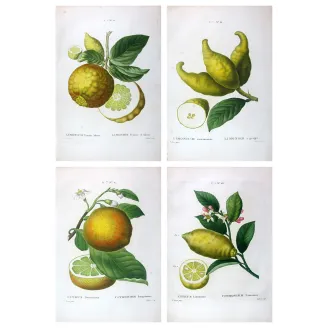
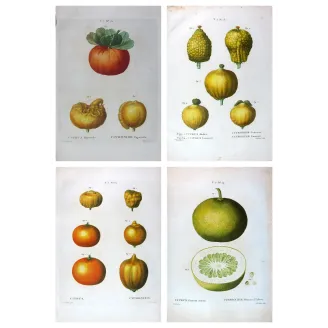
Nine original citrus engravings by Pancrace Bessa, uniting rare cedrats, sculptural lemons, and monumental Pomme d’Adam varieties into a coherent Napoleonic-era ensemble. Botanical study and refined color harmonize in a portfolio conceived to be read as a whole.
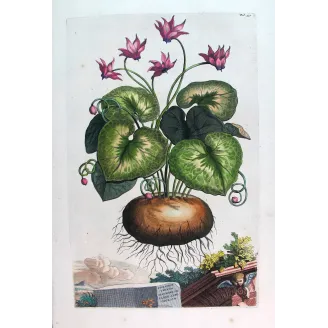
A rare 17th-century botanical engraving from Abraham Munting’s Nauwkeurige Beschryving der Aardgewassen - Phytographia Curiosa, depicting a cyclamen plant with exposed tuber, delicate pink flowers and richly patterned leaves. An expressive example of early botanical art combining scientific curiosity with striking decorative presence.
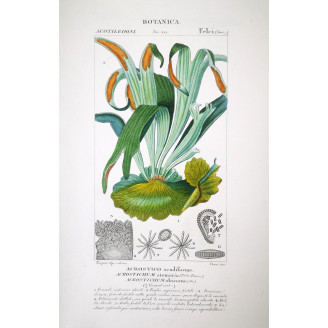
A complete set of 22 original hand-colored Engravings of ferns by Turpin, from the Dizionario di Scienze Naturali (c. 1830).
Original 1774 engraving by Jacob L'Admiral: Early Moth Stage among Willow Leaves.
Vibrant parakeets perched on branches: a scarlet macaw and a black cockatoo with yellow and red highlights.
This vivid 19th-century engraving depicts two exotic aracaris, showcasing striking contrasts of green, red and yellow plumage. A highly decorative composition combining scientific observation with strong visual appeal, ideal for collectors of tropical ornithology and refined interior spaces.
A highly dynamic 19th-century engraving depicting a tricolour lory in flight above a contrasting parakeet. The vivid interplay of red, yellow, green and blue creates a striking decorative composition with exceptional visual energy and presence.