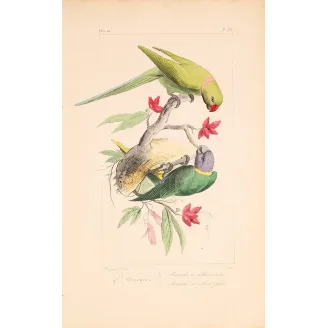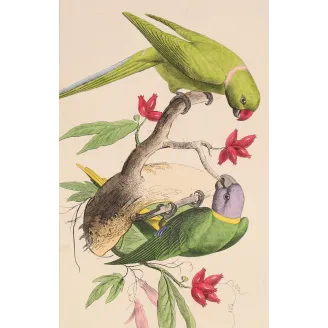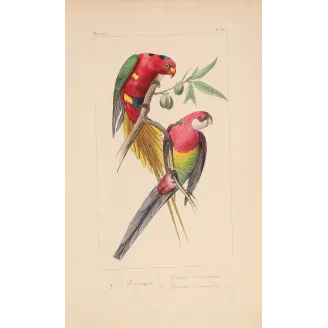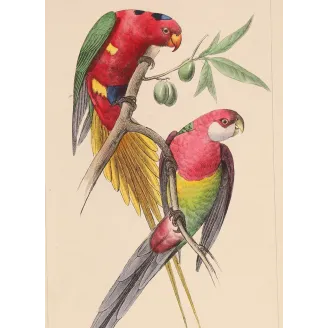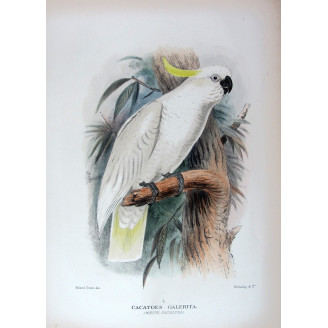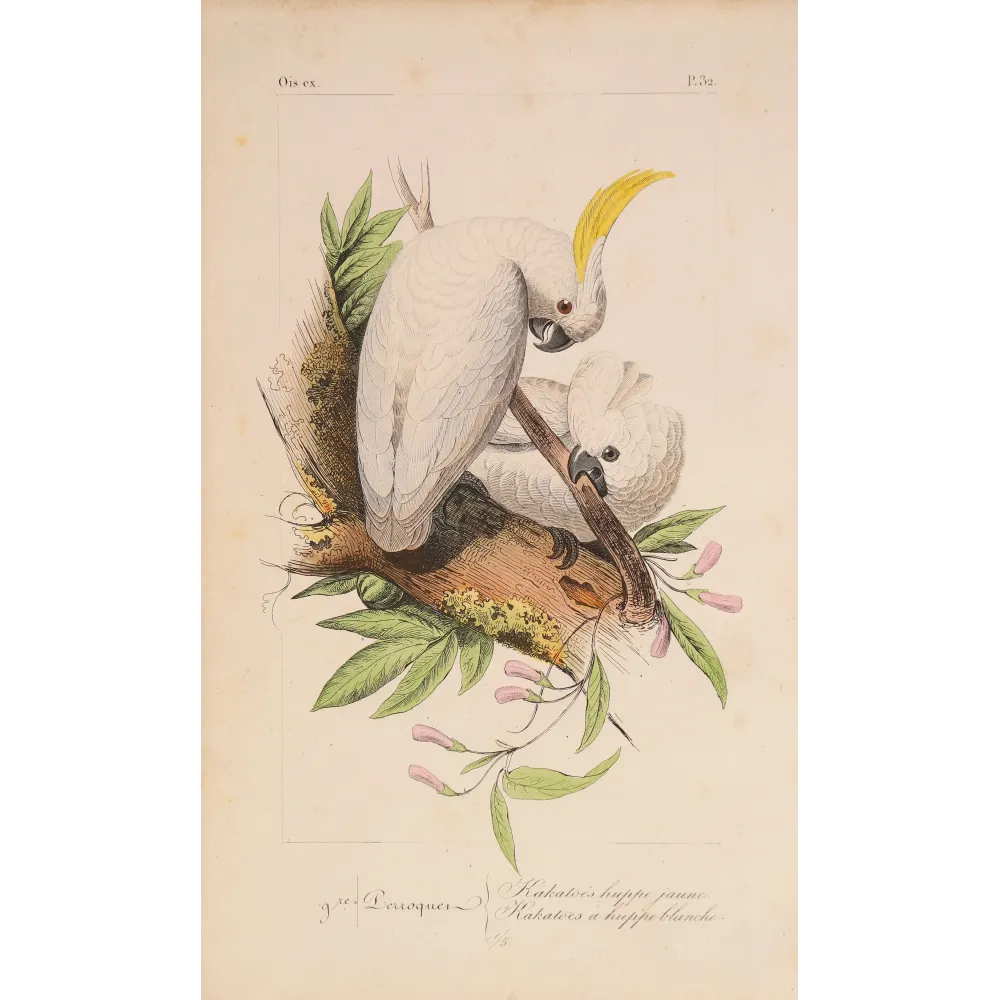
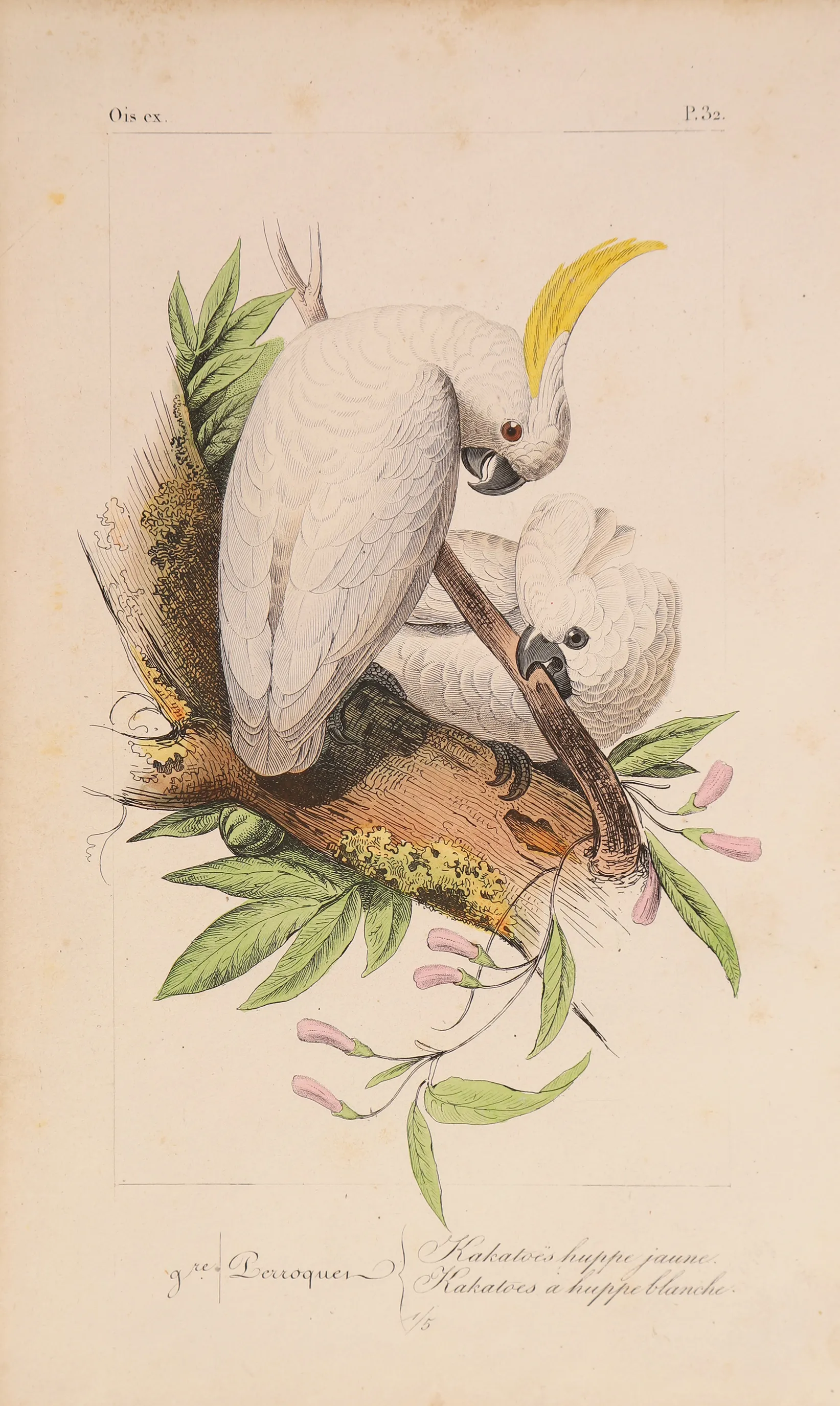
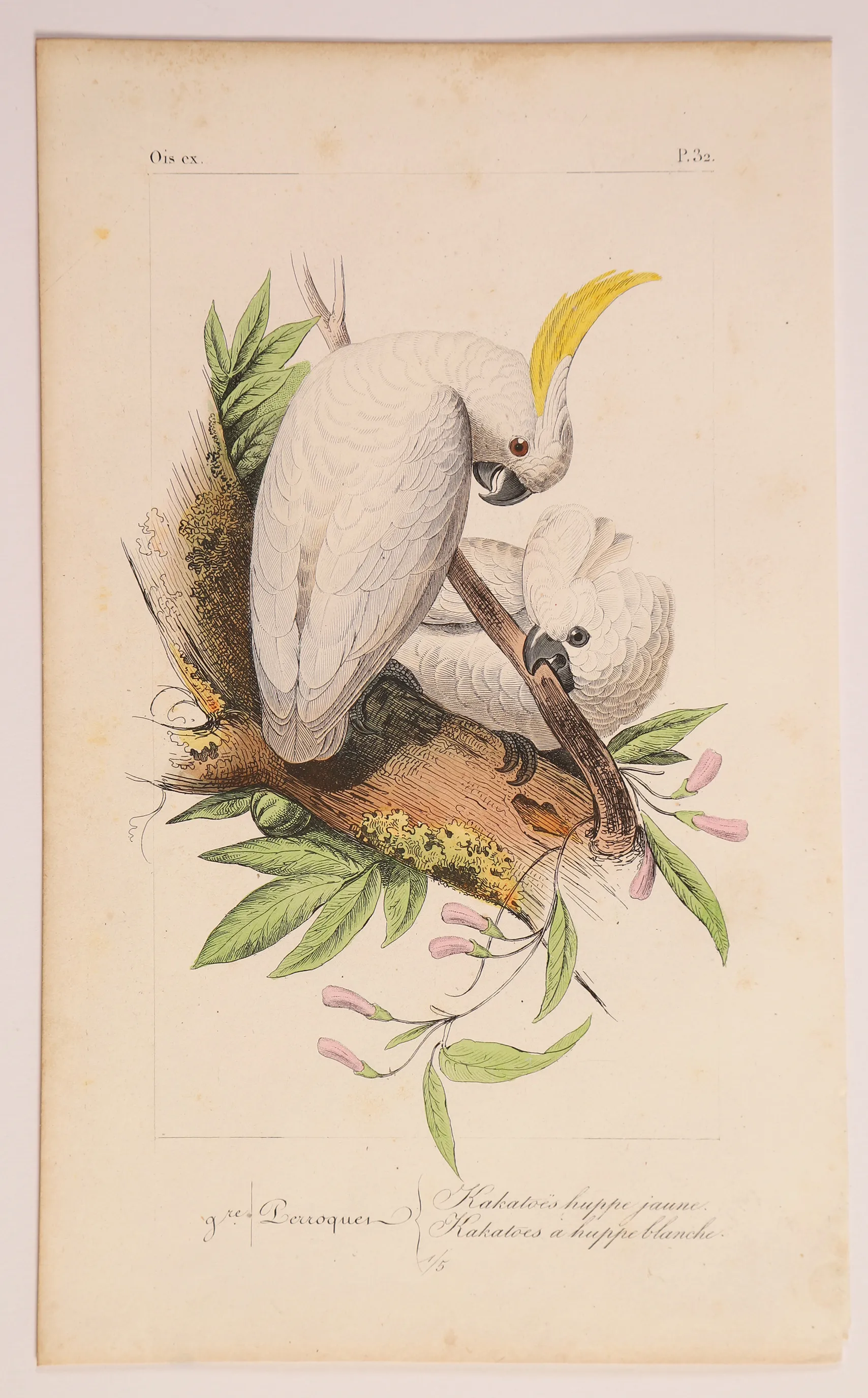
Elegant 19th-century hand-colored engraving depicting two sulphur-crested cockatoos, rendered with refined detail and soft tonal harmony. A balanced and decorative exotic bird composition ideal for sophisticated interiors.
 Delivery policy
Your print will be carefully prepared and shipped worldwide via trusted couriers (UPS or similar).
 Authentic antique prints
Original engravings from the 17th–19th century.
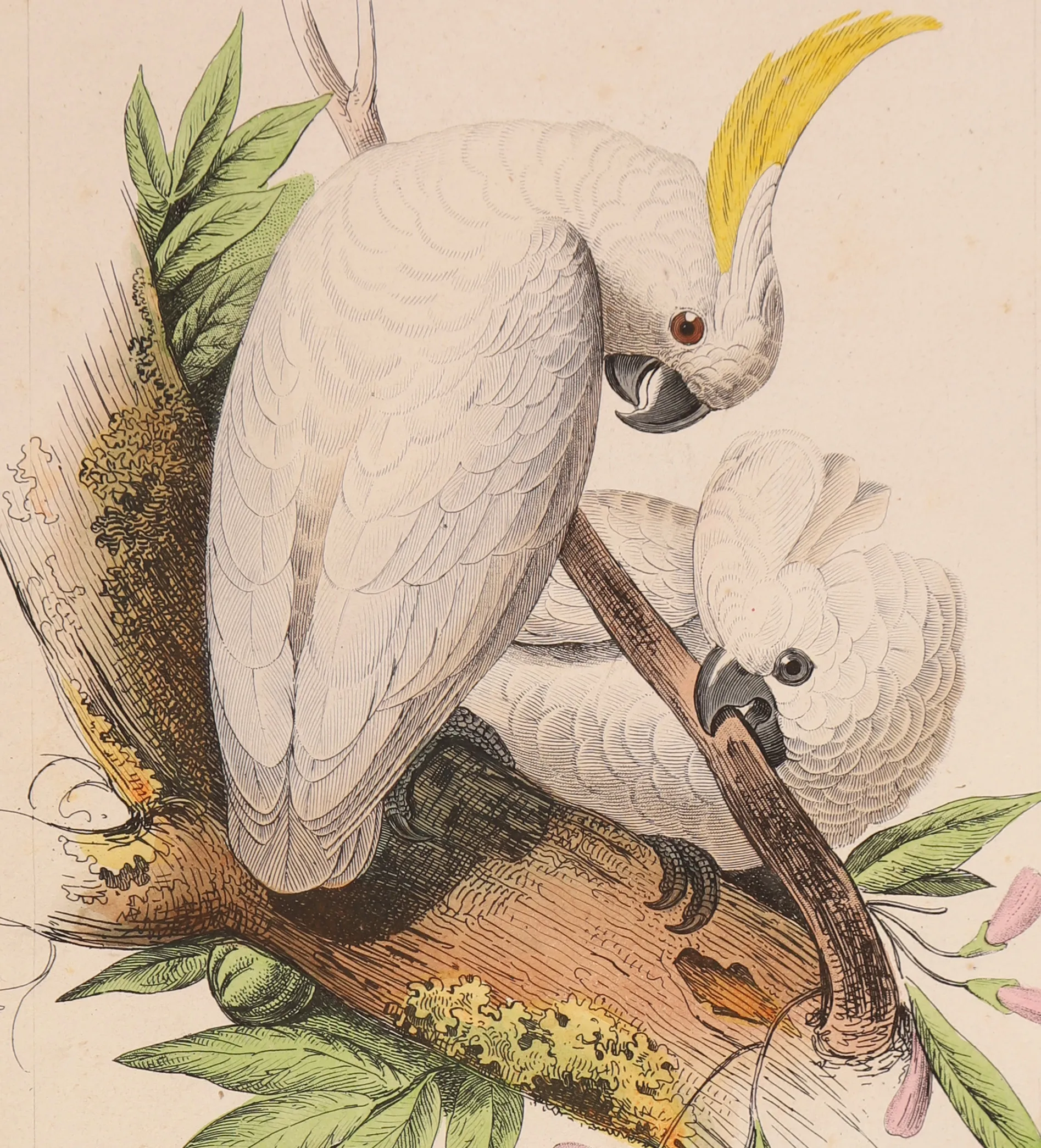
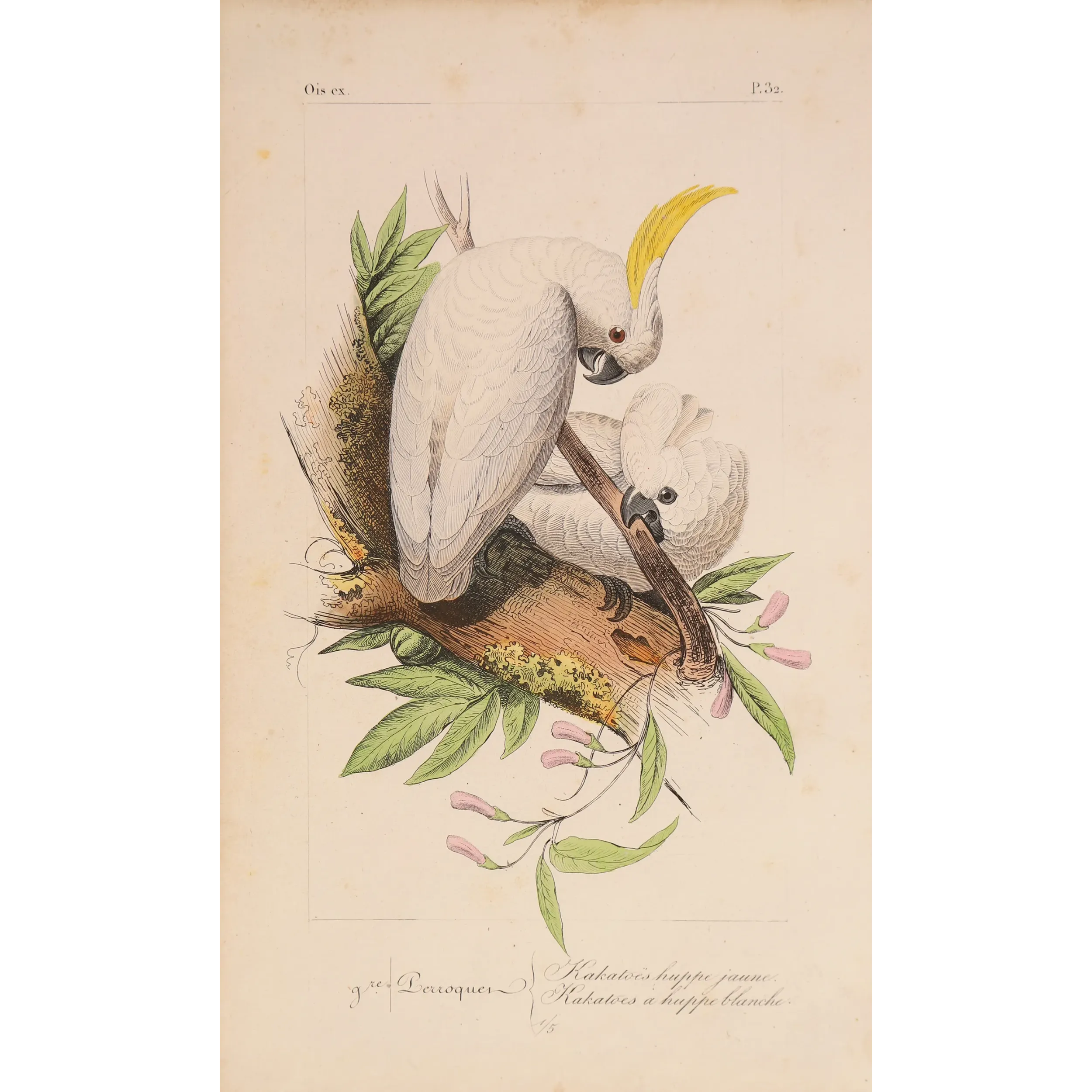
This original first-edition plate depicts two cockatoos, identified on the plate as “Kakatoes huppe jaune” and “Kakatoes à huppe blanche”, from C. L. Lemaire’s Histoire Naturelle des Oiseaux Exotiques, published in Paris in 1836. The figures were created by Pauquet, described in the original publication as peintes d’après nature and engraved on steel.
Unlike many of the intensely coloured parrots represented within the work, this plate is built around an exceptionally restrained palette. White and softly modelled ivory plumage dominate the composition, allowing engraved line, tonal modulation and posture to assume a central visual role.
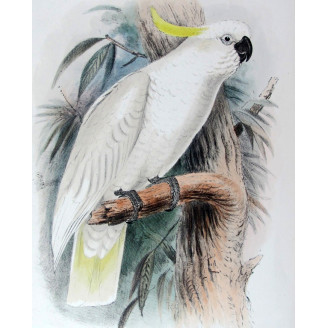
The original hand colouring remains delicate and beautifully balanced. Gum arabic is used with remarkable restraint, applied only to the yellow crest of the upper bird. This small luminous accent becomes a focal point within an otherwise predominantly matte composition, demonstrating how selectively surface finish could be used to direct the viewer’s eye.
The composition is organised around the massive diagonal structure of a tree branch, upon which the two birds occupy different spatial levels. The larger upper cockatoo bends its head towards its companion, while the second bird emerges partially from behind the branch. Their proximity creates an unusually intimate relationship between the two figures.
Because colour has deliberately been reduced, much of the visual modelling depends upon engraving. Fine sequences of curved lines describe overlapping feathers across the wings and bodies, producing volume through subtle changes in density rather than through strong areas of pigment. The white plumage therefore remains visually articulated without losing its characteristic softness.
Against this restrained tonal structure, the yellow crest of the upper cockatoo becomes extraordinarily effective. Its upward sweep interrupts the rounded silhouette of the bird and introduces both colour and direction, while the dark beaks, claws and eyes provide small points of graphic definition.
The botanical setting is equally controlled. Greens, warm browns and delicate pink blossoms frame the birds without competing with them, while the richly engraved bark introduces texture and visual weight into the centre of the composition.
The result is one of the quieter plates in the series, but also one of the most sophisticated: instead of relying upon chromatic abundance, Pauquet constructs presence through line, white space, texture and a remarkably economical use of colour.
The plate identifies its subjects using the historical French names “Kakatoes huppe jaune” and “Kakatoes à huppe blanche”. The yellow-crested bird belongs to the group of white cockatoos historically admired for the dramatic contrast between predominantly pale plumage and an expressive coloured crest.
Cockatoos became particularly compelling subjects for nineteenth-century European natural-history illustration because their distinctive silhouettes, powerful curved beaks and mobile crests made behaviour almost as important visually as plumage. In this plate, the close positioning of the two birds allows Pauquet to convey that physical and expressive character without resorting to an artificially dramatic scene.
Direct examination of this impression reveals an especially instructive detail: gum arabic has been applied only to the yellow crest of the upper cockatoo. No comparable glossy enhancement is apparent across the extensive white plumage of the birds.
This selective treatment changes the way the plate is perceived. Rather than creating an overall polished surface, the colourist concentrates reflected light within a very small area. The yellow crest consequently becomes brighter and more physically present whenever the sheet catches the light, while the surrounding plumage retains its soft matte character.
The effect is particularly sophisticated because the highlighted area occupies only a fraction of the composition. Its luminosity is nevertheless sufficient to establish a visual hierarchy:
white plumage → yellow crest → reflected light → focal presence
The plate therefore offers a revealing example of how hand colouring and surface enhancement could work together without becoming visually dominant. Here, gum arabic is not simply an embellishment: it functions as a carefully positioned instrument of light.
Published in Paris in 1836, C. L. Lemaire’s Histoire Naturelle des Oiseaux Exotiques combines natural-history observation with an unusually lively approach to the representation of birds. Pauquet’s compositions frequently move beyond the isolated specimen, using posture, balance, interaction and colour to suggest the physical presence of living subjects.
Histoire Naturelle des Oiseaux Exotiques: Art, Observation and the Living Bird →
The Pauquet name belongs to a broader world of nineteenth-century natural-history illustration. Across different zoological subjects, their visual language could shift from animated ornithological compositions to the precise presentation of individual specimens.
Very good antique condition. The original hand colouring remains delicate and well preserved, with clear engraved detail throughout and an attractive overall presentation.
The sheet shows moderate age toning, more noticeable along the upper area and outer edges, together with a small number of pale scattered spots consistent with age. These signs remain outside or discreet in relation to the principal subjects and do not materially disturb the composition.
Selective gum arabic remains visible on the yellow crest of the upper cockatoo only, preserving the subtle luminous accent intended within the otherwise predominantly matte image.
Subject: Yellow-Crested & White-Crested Cockatoos
Historical plate identification: “Kakatoes huppe jaune” / “Kakatoes à huppe blanche”
Work: Histoire Naturelle des Oiseaux Exotiques
Author: C. L. Lemaire
Figures: Pauquet
Publication: Paris, Pauquet Éditeur / Debure Libraire
Edition: First edition
Date: 1836
Plate: P. 32
Technique: Original hand-colored steel engraving
Colour: Contemporary hand colouring
Surface enhancement: Selective gum arabic on the yellow crest of the upper bird only
Paper: Fine period paper
Watermark: None observed
Sheet size: approx. 22 × 13.5 cm
Documentation: Detailed professional photographs of this individual impression are provided. Additional photographs are available on request.
Specific References
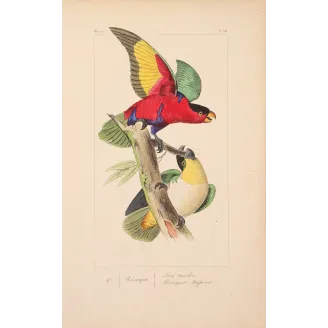
A highly dynamic 19th-century engraving depicting a tricolour lory in flight above a contrasting parakeet. The vivid interplay of red, yellow, green and blue creates a striking decorative composition with exceptional visual energy and presence.
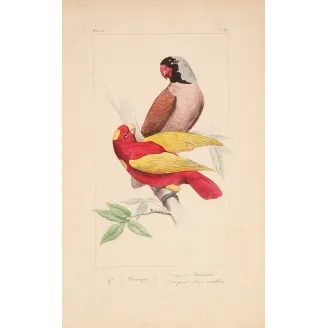
A vibrant 19th-century hand-colored engraving depicting two exotic parrots with striking red and yellow plumage contrasted by softer natural tones. A dynamic and decorative composition with strong visual presence, ideal for collectors and interior display.
A vivid 19th-century engraving depicting two exotic parakeets in a dynamic vertical composition. The intense red plumage contrasts beautifully with green and yellow tones, creating a striking decorative work with strong visual presence.
Highly decorative 19th-century engraving of exotic parakeets with vivid blue, red and yellow plumage. A striking and colorful antique bird print.
A distinctive 19th-century engraving depicting two parrots in an unusual composition, including one shown suspended upside-down. The presence of cage elements adds historical character, creating a unique and visually engaging natural history print.
A striking 19th-century engraving depicting two vividly colored parakeets in a dynamic composition. The intense contrast of blue, red, green and yellow creates a highly decorative work, ideal as a focal piece in refined interiors.
A refined 19th-century engraving depicting two parakeets arranged in a fluid and harmonious composition. The dominant green tones, enhanced by delicate red and violet accents, create an elegant and highly decorative natural history print.
A striking 19th-century engraving depicting two exotic parrots with vivid red, pink and green plumage. The composition combines strong colour contrast with elegant vertical balance, creating a highly decorative and visually impactful antique print.
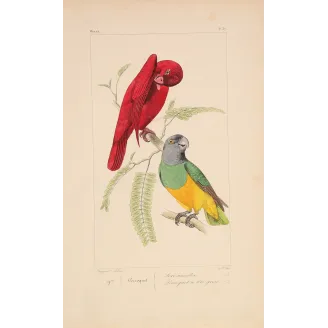
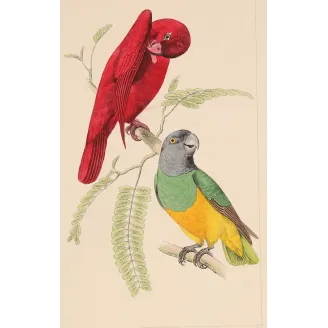
A striking 19th-century hand-colored engraving depicting two exotic parrots in a composition of vivid chromatic contrast. The brilliant red lory and the grey-headed, yellow-breasted parakeet create a highly decorative image of strong visual presence, ideal for collectors of antique ornithological prints and refined interiors.
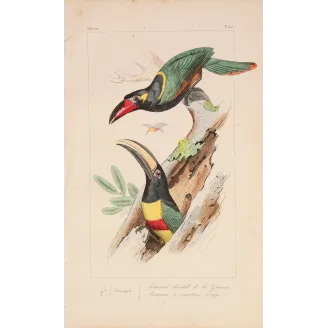
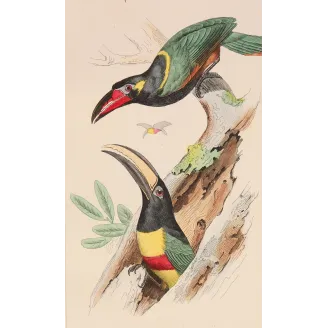
This vivid 19th-century engraving depicts two exotic aracaris, showcasing striking contrasts of green, red and yellow plumage. A highly decorative composition combining scientific observation with strong visual appeal, ideal for collectors of tropical ornithology and refined interior spaces.
Vivid 19th-century hand-colored engraving depicting two parakeets in dynamic interaction, with striking green plumage and contrasting red and violet accents. A highly decorative exotic bird composition.
Antique lithograph of the Sulphur-crested Cockatoo by Roland Green, hand-colored.
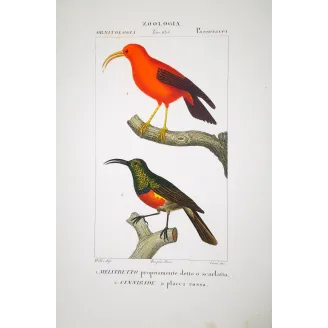
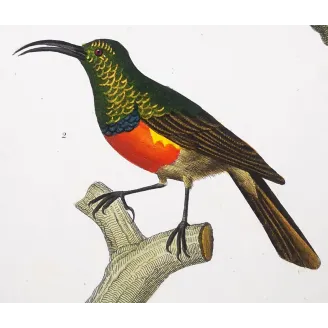
Brilliantly colored honeycreeper and sunbird illustration with tropical vibrancy, captured by Prêtre.
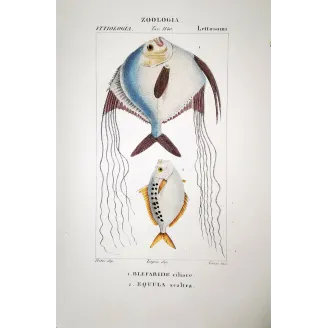
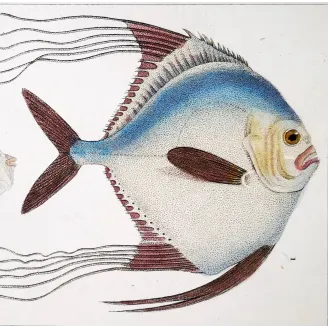
Delicate 19th-century hand-colored engraving of a ponyfish with companion species, ideal for marine-themed interiors and collectors.
Original 1835 hand-colored engraving of Nymphalis orion, drawn and engraved by Pauquet under the scientific direction of Hippolyte Lucas for Exotic Butterflies.
Original 1774 engraving by Jacob L'Admiral: Large Tortoiseshell on Sweet Cherry.
Elegant 19th-century hand-colored engraving depicting two sulphur-crested cockatoos, rendered with refined detail and soft tonal harmony. A balanced and decorative exotic bird composition ideal for sophisticated interiors.