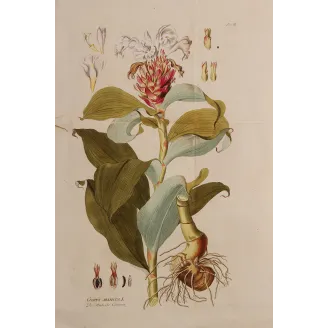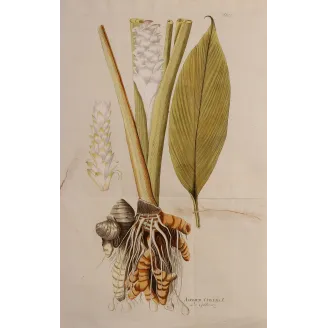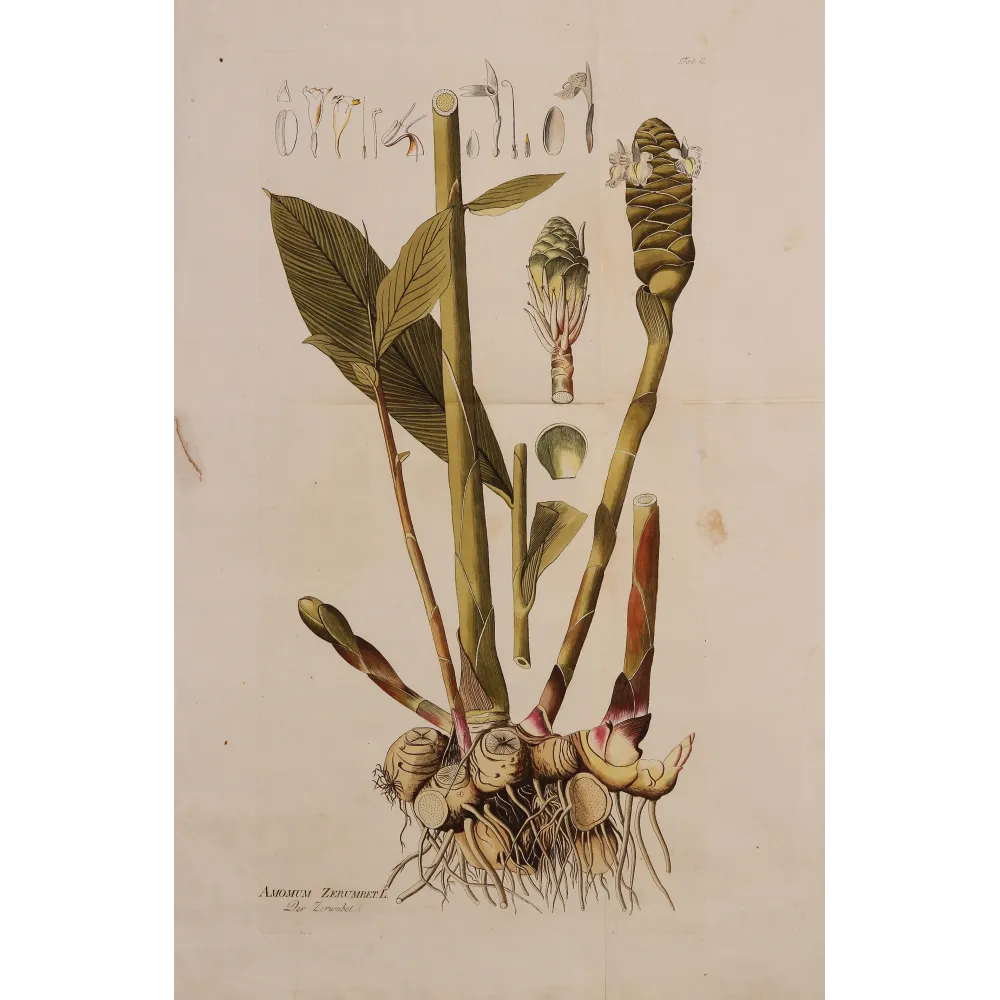
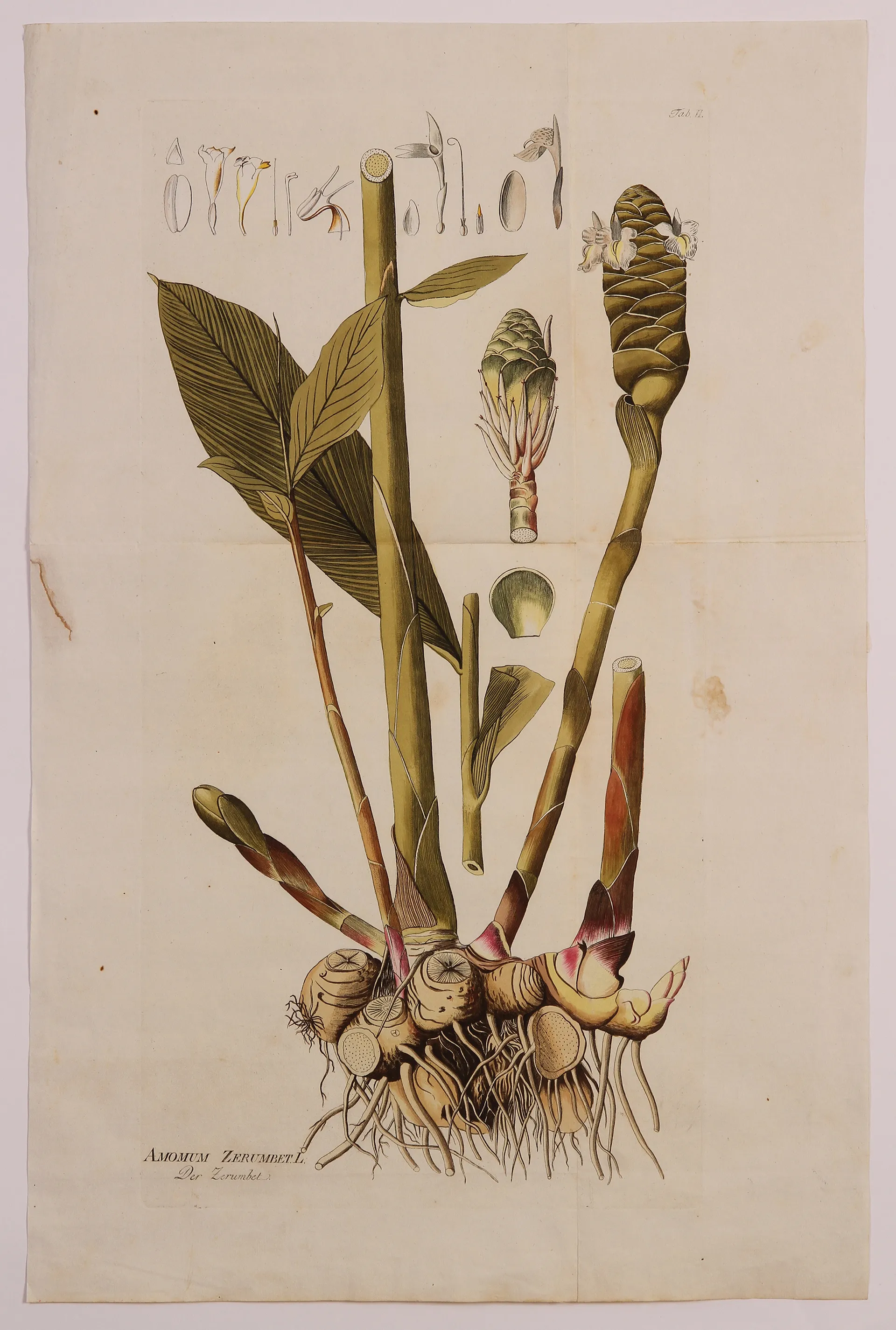
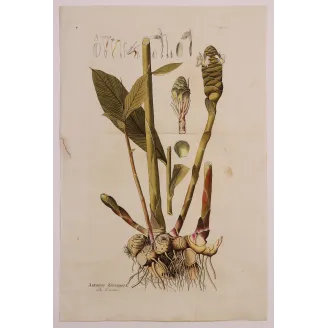
Exceptional large-format eighteenth-century botanical engraving depicting <em>Amomum Zerumbet</em> L., published as Plate II of Joseph Jacob von Plenck’s <em>Icones Plantarum Medicinalium</em>. Printed on a large folded sheet of Honig laid paper with complete watermark and contemporary hand colouring, the composition combines monumental rhizomatous structures, tall architectural stems and precisely observed analytical details. A rare large-scale Plenck Statement Piece with remarkable historical and visual presence.
 Delivery policy
Your print will be carefully prepared and shipped worldwide via trusted couriers (UPS or similar).
 Authentic antique prints
Original engravings from the 17th–19th century.
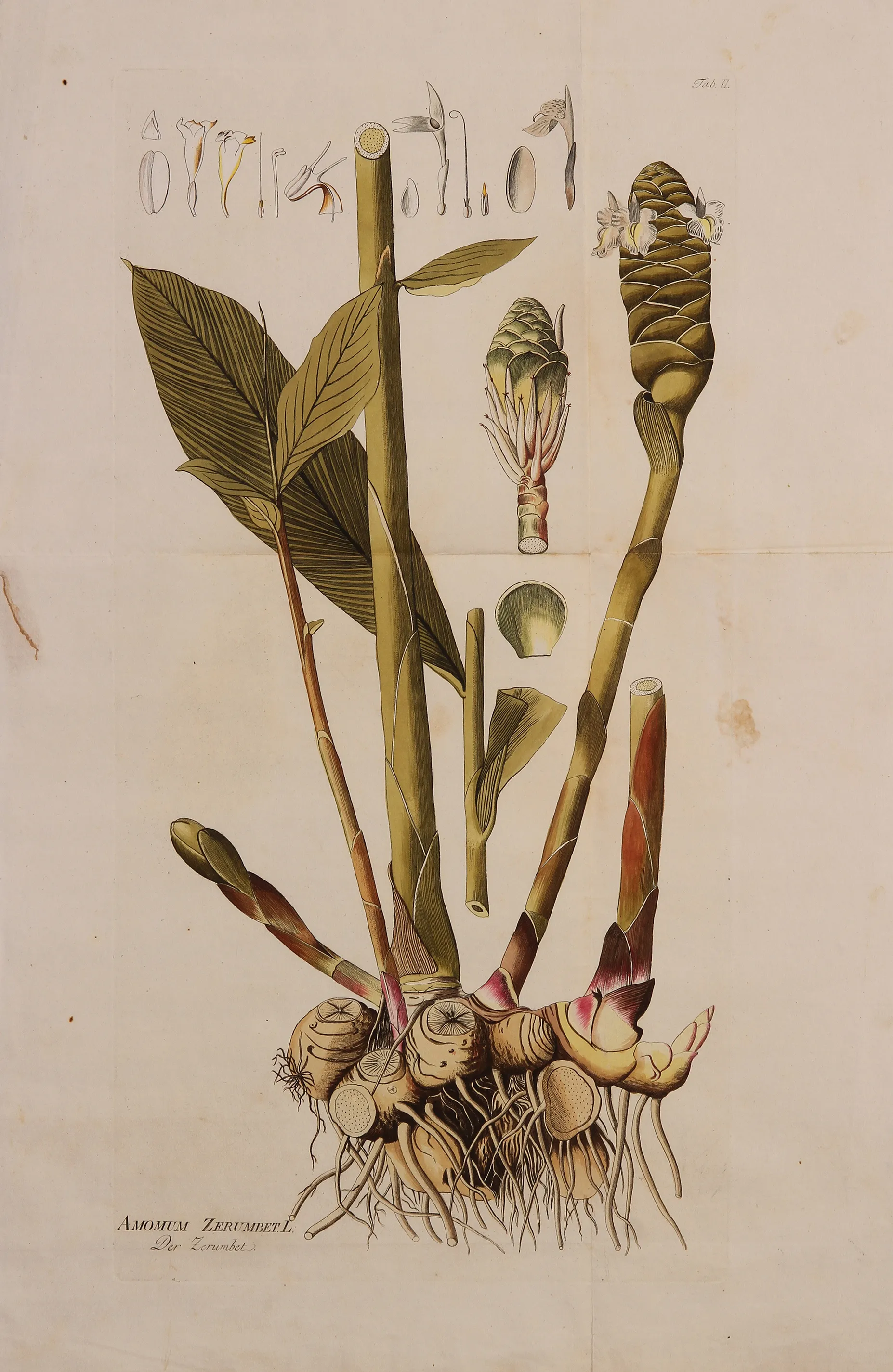
This exceptional large-format botanical engraving from Joseph Jacob von Plenck’s Icones Plantarum Medicinalium depicts Amomum Zerumbet L., published in Vienna during the late eighteenth century as Plate II of the first Centuria. Printed on an unusually large folded sheet measuring approximately 66.3 × 43.5 cm, the image belongs to the opening botanical sequence of Plenck’s ambitious medicinal plant atlas.
The composition rises from a substantial rhizomatous base into a series of tall articulated stems, broad leaves and two highly distinctive flowering structures. Across the upper part of the sheet, a sequence of enlarged botanical details isolates flowers, reproductive organs, sections and seeds, transforming the large plate into both a monumental plant portrait and a precise analytical study.
The remarkable scale gives the engraving an architectural presence: vertical stems, dense underground structures and carefully distributed analytical details occupy the sheet with a clarity and authority rarely possible within a conventional botanical folio.
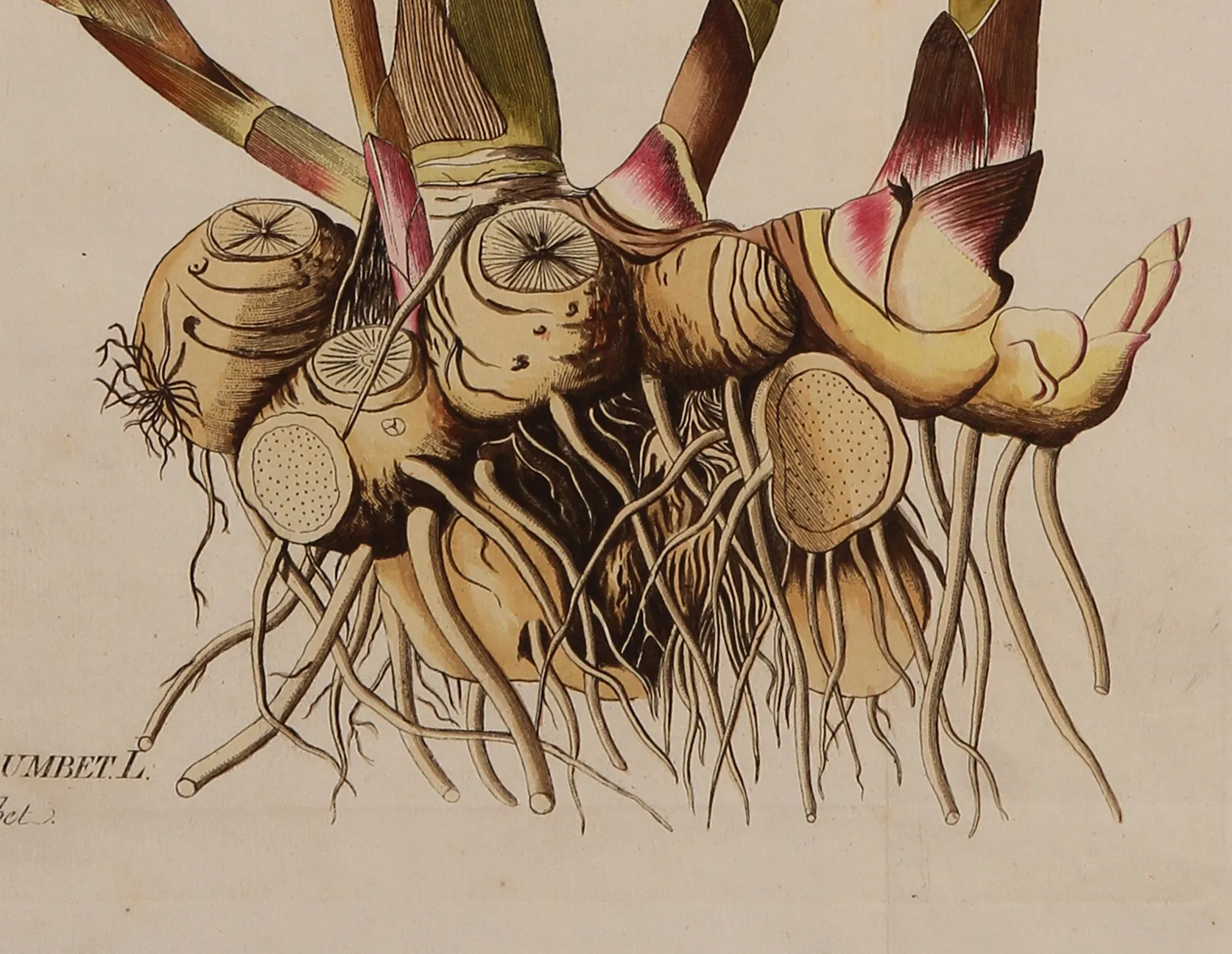
The composition is organised around a powerful contrast between vertical growth and concentrated botanical mass. At the base, a complex network of rhizomes, roots and emerging shoots forms a dense horizontal foundation from which the principal stems rise across almost the full height of the sheet.
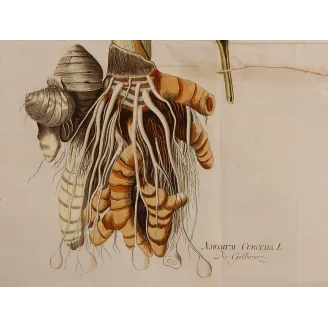
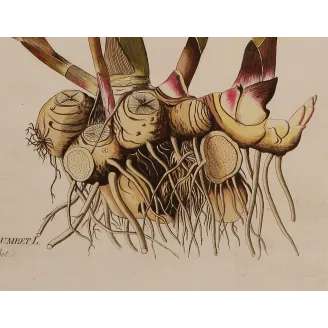
The underground structures are rendered with exceptional descriptive attention. Rounded rhizome sections overlap and interlock, their surfaces modelled through fine engraved lines and warm washes of ochre, brown, cream and muted red. Numerous roots descend and spread outward beneath them, giving the lower portion of the image an unusually convincing sense of weight and biological complexity.
Above this substantial base, the stems introduce a striking vertical rhythm. Their long, relatively uninterrupted forms create strong architectural lines across the open paper, while changes in thickness, colour and articulation prevent the image from becoming rigid. Smaller shoots emerging from the rhizome reinforce the sense of continuing growth.
The broad leaves are handled with characteristic precision. Closely spaced engraved veins define their structure, while olive, brown-green and muted yellow tones distinguish individual surfaces and suggest subtle differences in orientation. Their diagonal placement provides an important counterpoint to the dominant vertical movement of the stems.
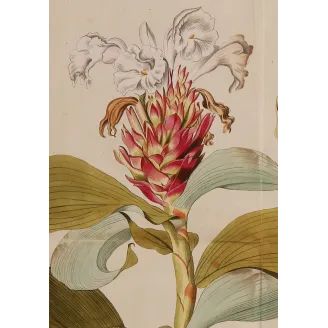
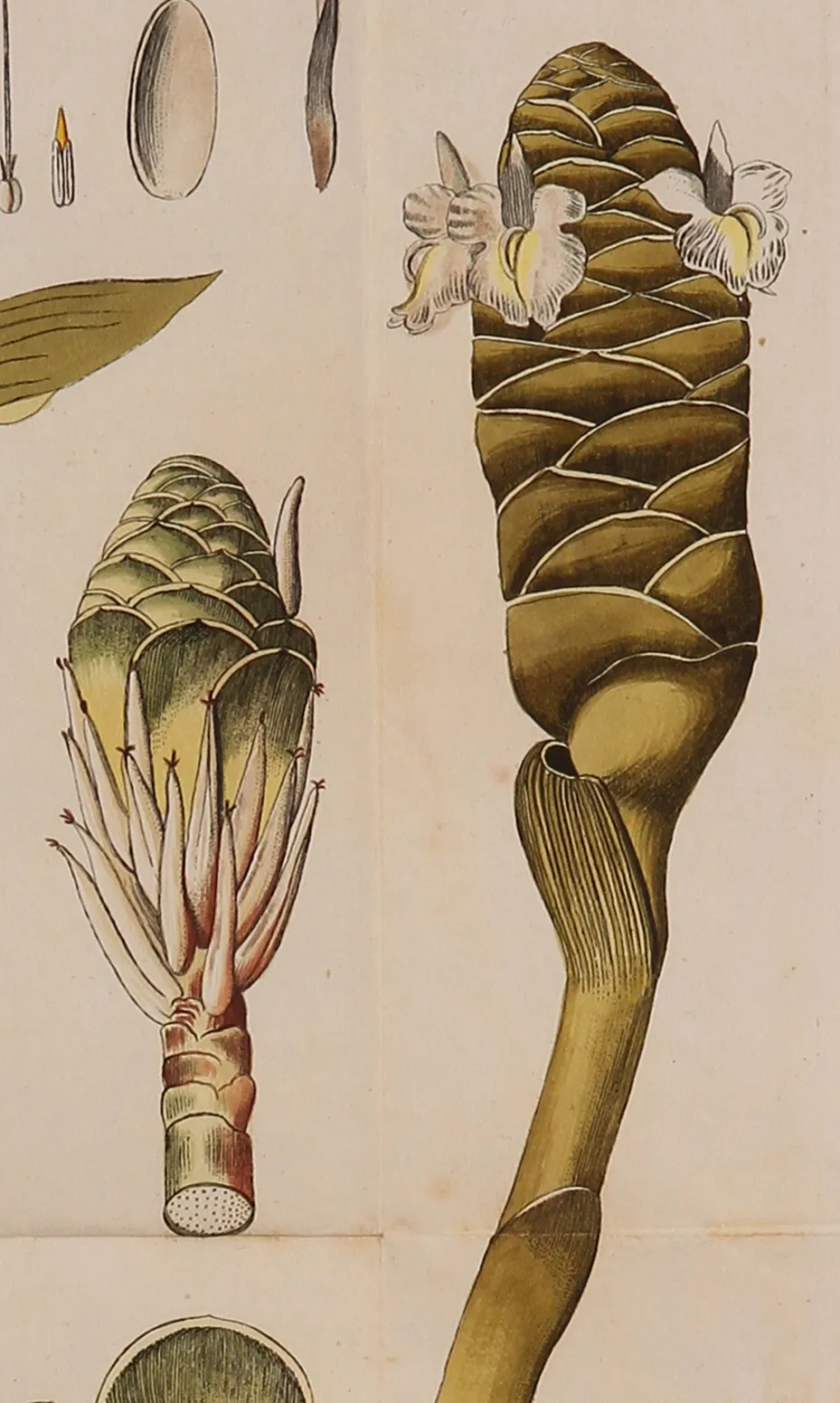
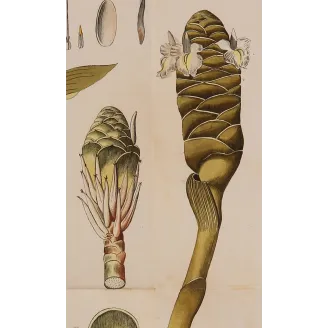
The two flowering structures on the right introduce another visual register. One is shown in an earlier developmental stage, compact and green, while the taller inflorescence reveals overlapping bracts and emerging pale flowers. Their strongly patterned surfaces create concentrated areas of detail against the quieter vertical stems.
Across the upper portion of the sheet, Plenck arranges a remarkable sequence of analytical studies. Floral parts, reproductive structures, seeds and sectional views are isolated individually, each reduced to the information necessary for recognition. Their almost diagrammatic clarity contrasts with the physical complexity of the complete plant below.
The contemporary hand colouring remains restrained and closely integrated with the engraved line. Olive and brown-green dominate the vegetative structures, while yellow, cream, muted red and subtle pink passages identify botanical transitions and reproductive details without disturbing the scientific legibility of the image.
Amomum Zerumbet is the historical botanical name used by Plenck for this rhizomatous plant within the opening sequence of Icones Plantarum Medicinalium. Like other plants historically grouped within Amomum, it belongs to the broader botanical world of aromatic and rhizomatous species associated with the order Zingiberales.
The plant develops from a substantial underground rhizome and produces upright leafy shoots together with distinctive inflorescences. These structural characteristics are precisely those emphasised in Plenck’s engraving: the image gives unusual prominence to the underground system, vegetative stems, flowering structures and isolated reproductive details.
During the eighteenth century, plants associated with ginger, cardamom and related aromatic rhizomes occupied an important position within European materia medica and botanical study. Their identification required attention not simply to flowers but also to roots, rhizomes, fruits, seeds and other structures that could distinguish superficially similar species.
Plenck’s treatment should therefore be understood within the historical scientific framework of his period. The engraving documents eighteenth-century medicinal botany and botanical classification rather than providing modern therapeutic guidance.
Joseph Jacob von Plenck conceived Icones Plantarum Medicinalium as a union of botanical instruction and refined artistic presentation. Plants were isolated against the open sheet and represented through the structures necessary for recognition, while fine copper engraving and contemporary hand colouring gave the images exceptional visual clarity.
Plate II occupies an especially significant position within that programme. It belongs to the opening botanical sequence of the first Centuria, where Plenck begins his systematic presentation with plants historically classified within the genus Amomum. From the outset, botanical organisation and visual analysis are therefore closely interconnected.
The unusual folded format gives this particular plate a dramatically expanded field of observation. Instead of compressing the specimen into a conventional folio, Plenck allows rhizome, roots, tall stems, foliage and flowering structures to unfold vertically across a sheet measuring approximately 66.3 × 43.5 cm.
The resulting composition is strikingly architectural. Long stems divide the sheet into vertical intervals, while the broad leaves introduce oblique movement and the substantial rhizomatous base provides a dense visual foundation. The plant occupies the paper not as a decorative arrangement but as a structured botanical system.
This structural clarity is reinforced by the analytical sequence at the top of the sheet. The isolated details form an almost continuous horizontal register above the complete specimen, allowing the viewer to move between the overall architecture of the plant and the minute structures required for botanical recognition.
The two inflorescences on the right are particularly important. Their different developmental states introduce a temporal dimension into the botanical description, while their overlapping bracts and emerging flowers create the most concentrated areas of pattern and detail within the otherwise strongly linear composition.
Colour is used with considerable restraint. Rather than creating a highly decorative surface, the contemporary colourist differentiates botanical structures through closely related greens, ochres, browns and muted reds. The resulting palette preserves the authority of the engraved drawing while giving the plant sufficient depth and material presence.
The large folded format is therefore essential to the identity of the work. It allows Plenck to maintain both scale and analytical precision, creating an image in which a substantial botanical specimen and an extensive sequence of scientific details can coexist without visual compression.
For the contemporary collector, this original scale produces an additional spatial quality. Once appropriately mounted and framed, the sheet has sufficient presence to operate as a major work within a substantial interior while retaining every element of its eighteenth-century material identity.
The engraving thus represents a particularly compelling intersection of scientific structure, historical craftsmanship and visual monumentality. Its strength comes not from decorative enlargement but from the unusual physical generosity Plenck gave to the botanical subject itself.
For this reason, this work forms part of Prantique’s Statement Pieces — a curated selection of original antique prints distinguished by their exceptional scale and presence within contemporary interiors.
The engraving is printed on a large sheet of fine eighteenth-century laid paper associated with the Honig papermaking tradition. Closely spaced laid lines and broader chain lines belong to the physical structure of the handmade sheet and may become visible when examined in transmitted or raking light.
A complete Honig watermark with its distinctive logo is preserved within this impression. Its presence provides valuable material evidence for the paper used in Plenck’s publication and connects the sheet with the high-quality handmade papers selected for Icones Plantarum Medicinalium.
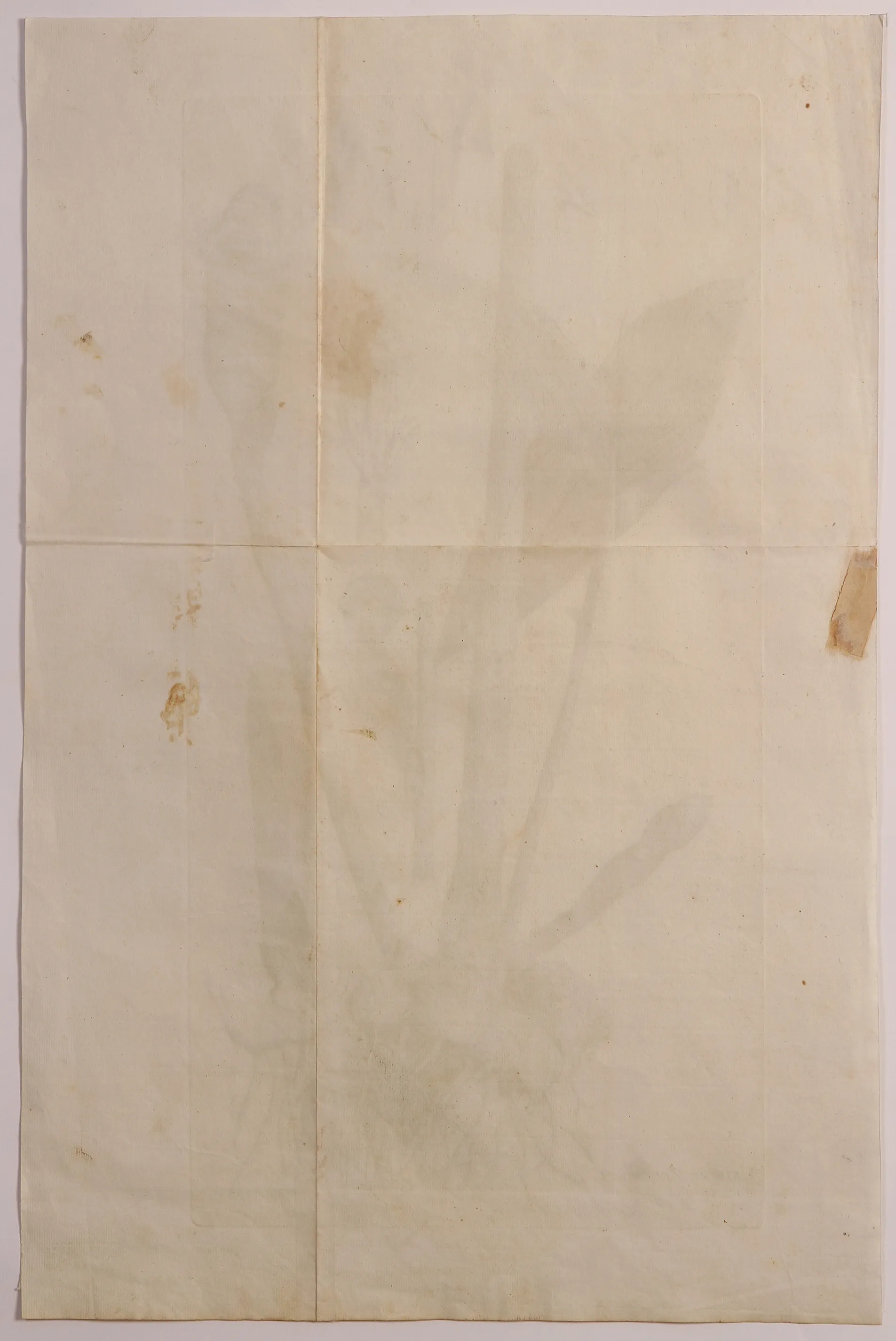
Unlike the standard-format plates within the work, this engraving was produced on an unusually large sheet designed to be folded for incorporation within the original volume. The historical vertical and horizontal folds remain clearly visible and form an intrinsic part of the original structure of the object.
When unfolded, the sheet measures approximately 66.3 × 43.5 cm. The expanded surface accommodates both the tall botanical specimen and the extensive analytical studies positioned across the upper field without sacrificing the generous margins characteristic of Plenck’s presentation.
The plate mark remains visible around the engraved field, preserving the relationship between copperplate impression and handmade paper. Together, the plate mark, complete watermark, laid structure and historical folds provide unusually rich physical evidence of the engraving’s eighteenth-century production and use.
Published in Vienna from 1788, Joseph Jacob von Plenck’s Icones Plantarum Medicinalium belongs to the great illustrated botanical projects of the European Enlightenment. It was intended to provide physicians, apothecaries and students with clear visual references for recognising plants associated with historical medicinal practice.
Each image was printed from a finely engraved copperplate and subsequently coloured by hand. Every surviving impression therefore combines the repeatable precision of printmaking with the individual judgement and craftsmanship of an eighteenth-century colourist.
Large folded plates such as this Amomum Zerumbet reveal an especially ambitious aspect of Plenck’s publication. A substantially expanded sheet allowed complex botanical structures and numerous analytical details to be represented together without reducing the clarity of either.
The complete Honig watermark, original folding structure and extensive botanical composition make this impression a particularly revealing material document of how scientific observation, handmade paper, copper engraving and contemporary colour were brought together in late eighteenth-century Vienna.
Discover how botanical observation, historical materia medica, handmade paper and contemporary colour came together in Plenck’s remarkable visual encyclopaedia.
Excellent condition. The large eighteenth-century laid sheet remains structurally sound and presents the botanical composition with excellent clarity. The engraved impression retains strong definition throughout the rhizome, roots, foliage, flowering structures and analytical studies.
The contemporary hand colouring is beautifully preserved. Olive and brown-green tones remain rich across the foliage and stems, while ochre, cream, muted red and pink passages continue to articulate the rhizome, emerging shoots and reproductive structures with excellent legibility.
The original vertical and horizontal folds associated with the large folded format remain visible. These are historical structural features resulting from the way the oversized plate was folded for incorporation within the original volume and form part of the material history of the sheet.
A light, localised age-related stain is visible within the right portion of the sheet. It remains relatively unobtrusive and does not significantly interfere with the principal botanical composition or its analytical details.
A historical repaired tear extends inward from the left margin. The repair has stabilised the affected area and does not materially compromise the botanical image. Minor additional age-related traces remain consistent with the history of a large eighteenth-century folded plate.
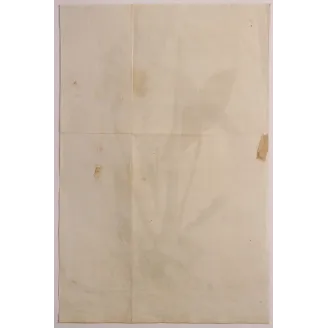
The complete Honig watermark with logo remains preserved, and the plate mark is visible around the engraved field. Overall, the impression combines excellent visual presentation, beautifully preserved contemporary colour and substantial evidence of its original paper structure and historical use. Please examine the professional high-resolution photographs of both recto and verso for a complete visual assessment.
Botanical name: Amomum Zerumbet L.
German title: Der Zerumbet
Work: Icones Plantarum Medicinalium
Author: Joseph Jacob von Plenck (1735–1807)
Artistic tradition: Viennese botanical school
Place of publication: Vienna
Date: c. 1788
Technique: Original copper engraving with contemporary hand-applied watercolour
Paper: Fine eighteenth-century laid paper associated with the Honig papermaking tradition
Watermark: Complete Honig watermark with logo
Plate mark: Visible around the engraved field
Plate: II / 2
Centuria: I
Historical classification: Classis I. Monandria — Ordo I. Monogynia
Sheet format: Large folded botanical plate
Sheet size: approx. 66.3 × 43.5 cm
Condition: Excellent condition, with original historical folds, a light localised age-related stain and a stabilised historical tear extending inward from the left margin
Curatorial classification: Statement Piece
Collector positioning: Exceptional large-format Plenck plate combining monumental scale, early placement within the first Centuria, finely articulated botanical detail and powerful graphic presence
Authenticity: Original eighteenth-century print — never a modern reproduction
```
Specific References
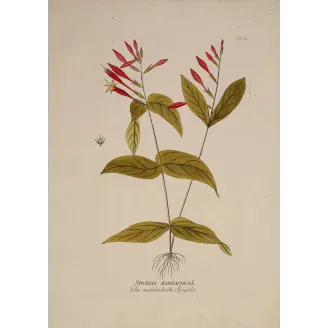
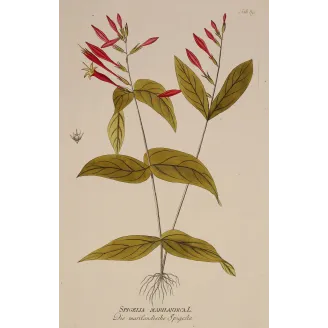
Original eighteenth-century botanical engraving depicting Spigelia marilandica L., published in Vienna as Plate 89 of Joseph Jacob von Plenck's Icones Plantarum Medicinalium. The elegant composition is distinguished by its graceful vertical rhythm, brilliant scarlet tubular flowers and refined contemporary hand colouring on fine laid paper.
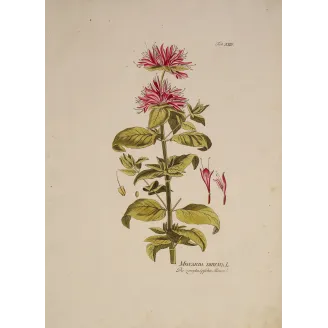
Original eighteenth-century botanical engraving depicting Monarda didyma L., published in Vienna as Plate XXIII of Joseph Jacob von Plenck's Icones Plantarum Medicinalium. This refined composition combines elegant vertical balance, delicate crimson flowers and beautifully preserved contemporary hand colouring on Honig laid paper with complete watermark.
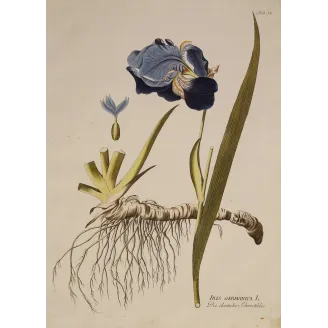
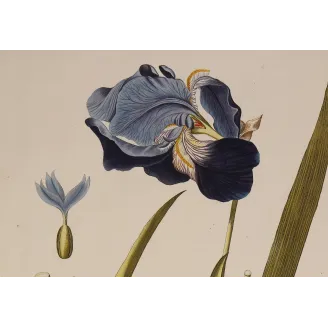
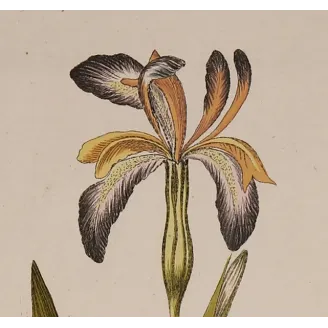
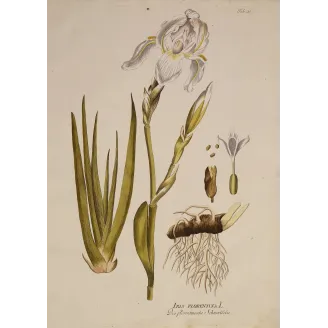
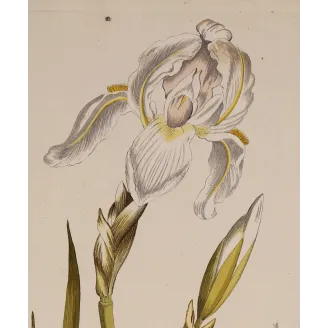
An original eighteenth-century botanical engraving depicting Iris germanica, published in Joseph Jacob von Plenck's celebrated Icones Plantarum Medicinalium. Printed on fine laid paper bearing the Honig watermark, the sheet combines scientific precision with the refined artistic craftsmanship of the Viennese botanical school.
Exceptional large-format eighteenth-century botanical engraving depicting <em>Costus arabicus</em> L., published as Plate VII of Joseph Jacob von Plenck’s <em>Icones Plantarum Medicinalium</em>. Printed on an unusually large folded sheet measuring 66.3 × 43.5 cm, the composition combines a monumental flowering specimen, extensive root and rhizome structures and finely observed botanical details with beautifully preserved contemporary hand colouring. Complete Honig watermark with logo.
Exceptional large-format eighteenth-century botanical engraving depicting <em>Amomum Curcuma</em> L., published as Plate IV of Joseph Jacob von Plenck’s <em>Icones Plantarum Medicinalium</em>. Printed on a large folded sheet of Honig laid paper with complete watermark and contemporary hand colouring, the composition combines a remarkably refined pale inflorescence, monumental foliage and an exceptionally detailed rhizomatous structure. A powerful Plenck Statement Piece preserving both extraordinary botanical clarity and the visible material history of an eighteenth-century folded plate.
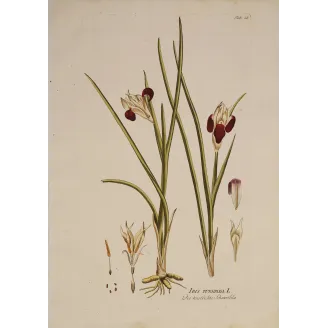
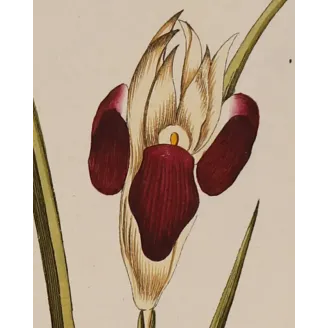
Original eighteenth-century botanical engraving depicting Iris tuberosa (Snake's Head Iris), published in Vienna by Joseph Jacob von Plenck for Icones Plantarum Medicinalium (Plate 38). This elegant composition combines two flowering specimens with finely engraved botanical details and a beautifully preserved complete Honig watermark. Contemporary hand colouring and selective gum arabic produce remarkable depth, while the velvety deep burgundy petals create one of the most refined colour harmonies within Plenck's celebrated Iris series.
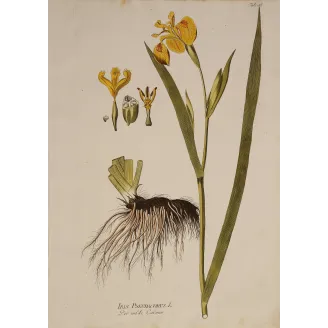
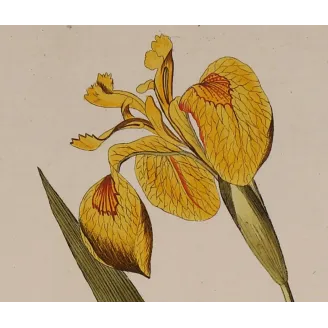
Original hand-coloured copper engraving depicting the Yellow Flag Iris (Iris pseudacorus), published by Joseph Jacob von Plenck in Vienna around 1788 for Icones Plantarum Medicinalium. A refined eighteenth-century botanical illustration distinguished by its elegant composition, beautifully engraved rhizome, luminous yellow flower, selective gum arabic highlights and excellent state of preservation.
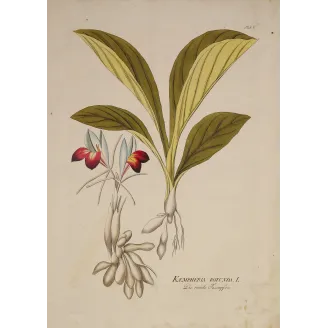
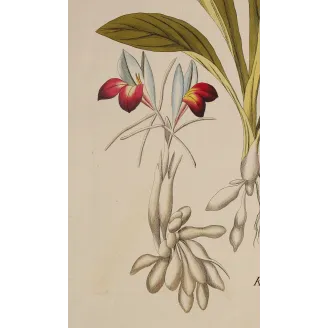
Original eighteenth-century botanical engraving depicting Kaempferia rotunda, published in Vienna by Joseph Jacob von Plenck for Icones Plantarum Medicinalium (Plate 5). The elegant composition combines broad architectural foliage, richly coloured crimson flowers and delicately modelled underground tubers, demonstrating the extraordinary refinement of Plenck's Viennese botanical school. Printed on fine Honig laid paper with visible "IV" watermark.
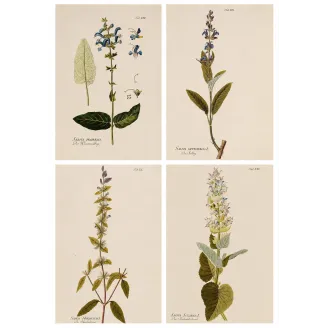
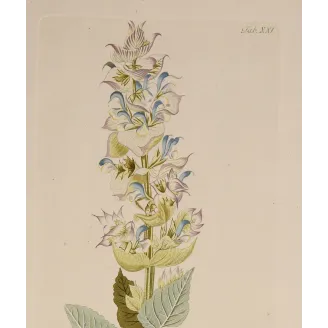
A complete four-plate botanical study devoted to the genus <em>Salvia</em>, preserved exactly as originally published within Joseph Jacob von Plenck's <em>Icones Plantarum Medicinalium</em>. Combining remarkable scientific integrity with exceptional decorative harmony, this Museum Quality Study Set represents one of the most visually refined surviving botanical sequences of the late eighteenth century.
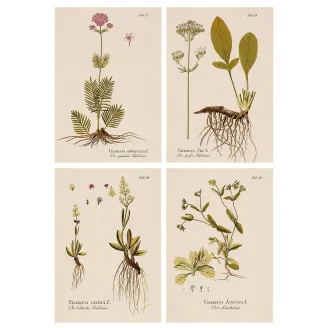
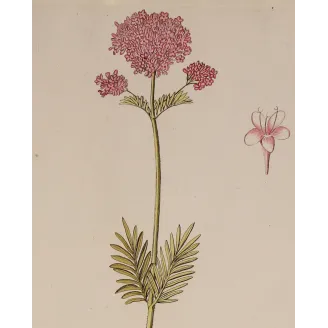
A complete four-plate botanical study devoted to the genus Valeriana, preserved exactly as originally published by Joseph Jacob von Plenck in Icones Plantarum Medicinalium. This Museum Quality Study Set combines scientific integrity, exceptional preservation and remarkable decorative harmony, offering collectors and interior designers an increasingly rare opportunity to acquire an intact eighteenth-century botanical sequence.
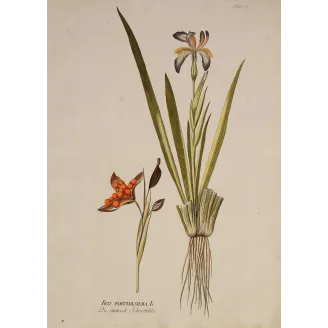
Original eighteenth-century botanical engraving depicting Iris foetidissima (Stinking Iris), published in Vienna by Joseph Jacob von Plenck for Icones Plantarum Medicinalium (Plate 37). Finely engraved and beautifully hand-coloured, the composition illustrates the flowering plant together with its open seed capsule and brilliant orange seeds, combining scientific precision with exceptional decorative elegance. Printed on fine laid Honig paper with visible "IV" watermark and excellent contemporary hand colouring.
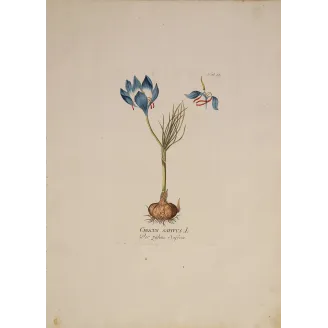
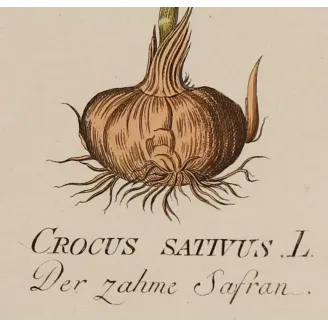
Original eighteenth-century botanical engraving depicting Crocus sativus L., the true saffron crocus, published in Vienna as Plate 32 of Joseph Jacob von Plenck's Icones Plantarum Medicinalium. This elegant composition celebrates one of history's most valuable medicinal and culinary plants through refined hand colouring, exceptional botanical clarity and beautifully preserved eighteenth-century laid paper.
An elegant original botanical engraving depicting Iris florentina, delicately hand-coloured and published by Joseph Jacob von Plenck around 1788. Printed on original laid paper with visible plate mark and exceptionally refined colouring.
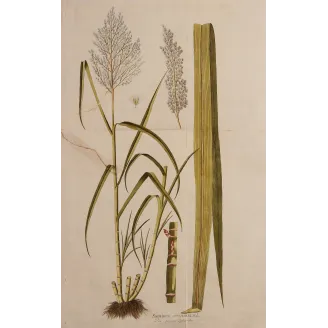
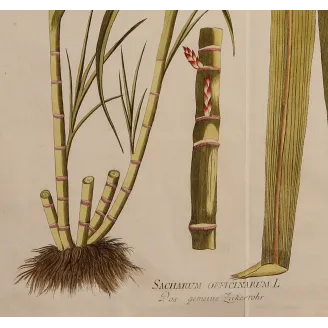
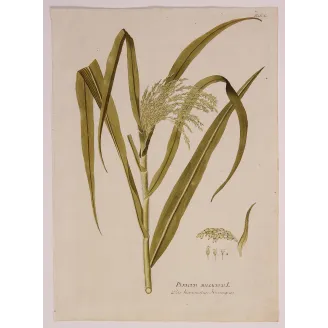
Exceptional large-format eighteenth-century botanical engraving depicting <em>Saccharum officinarum</em> L. (sugar cane), published as Plate 40 of Joseph Jacob von Plenck’s <em>Icones Plantarum Medicinalium</em>. Printed on a large folded sheet of laid paper with “IV” watermark and contemporary hand colouring, the composition combines the elegant vertical architecture of the cane with exceptionally delicate flowering panicles and a monumental isolated leaf. A distinctive Plenck Statement Piece preserving remarkable botanical clarity together with the visible material history of an eighteenth-century folded plate.
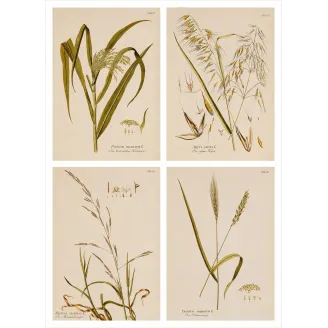
Seven-plate botanical corpus devoted to Europe's principal cereal crops, preserved exactly as originally published in Joseph Jacob von Plenck's Icones Plantarum Medicinalium. Combining scientific precision, historical significance and remarkable visual harmony, this Museum Quality Study Set documents the plants that shaped European agriculture and civilisation.
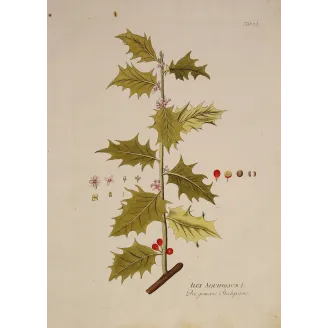
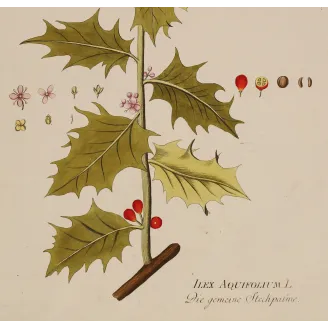
Original eighteenth-century botanical engraving depicting Ilex aquifolium L., the common holly, published in Vienna as Plate 72 of Joseph Jacob von Plenck’s Icones Plantarum Medicinalium. The composition combines sharply articulated evergreen foliage, delicate pink flowers, brilliant red fruits and separate botanical details, preserved on fine laid paper with a visible partial “IV” watermark.
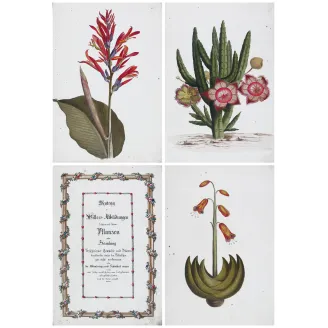
A rare set of four original 18th-century botanical watercolors, entirely hand-painted and rich in color and detail. A curated ensemble combining scientific observation with decorative elegance — perfect for refined interiors and collectors.
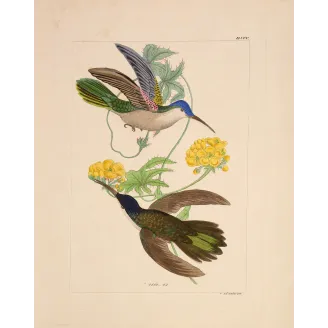
Original nineteenth-century hand-colored engraving depicting the Blue-headed Sabrewing (Saepiopterus lazulus), a tropical hummingbird illustrated by Ludwig Reichenbach in his celebrated Trochilinarum Enumeratio.
Charming pear study by Redouté, showing delicate blossom and ripening fruit. Balanced and refined.
An original eighteenth-century botanical engraving depicting Iris germanica, published in Joseph Jacob von Plenck's celebrated Icones Plantarum Medicinalium. Printed on fine laid paper bearing the Honig watermark, the sheet combines scientific precision with the refined artistic craftsmanship of the Viennese botanical school.
Original eighteenth-century botanical engraving depicting Kaempferia rotunda, published in Vienna by Joseph Jacob von Plenck for Icones Plantarum Medicinalium (Plate 5). The elegant composition combines broad architectural foliage, richly coloured crimson flowers and delicately modelled underground tubers, demonstrating the extraordinary refinement of Plenck's Viennese botanical school. Printed on fine Honig laid paper with visible "IV" watermark.
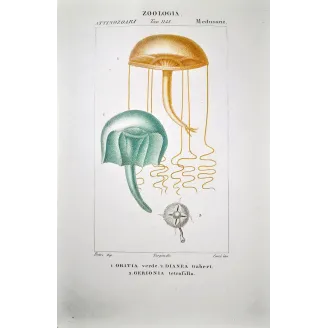
Trio of rare jellyfish types in soft tones, hand-colored lithograph by Prêtre.
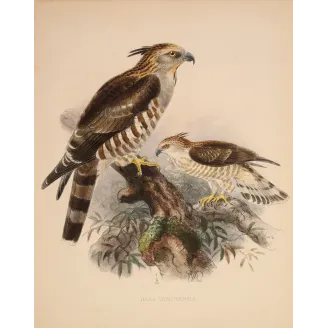
Original antique bird print depicting Baza ceylonensis (Ceylon Hawk-Eagle), illustrated by J.G. Keulemans for A History of the Birds of Ceylon. A striking Victorian ornithological lithograph featuring a refined pair of raptors with strong decorative presence.
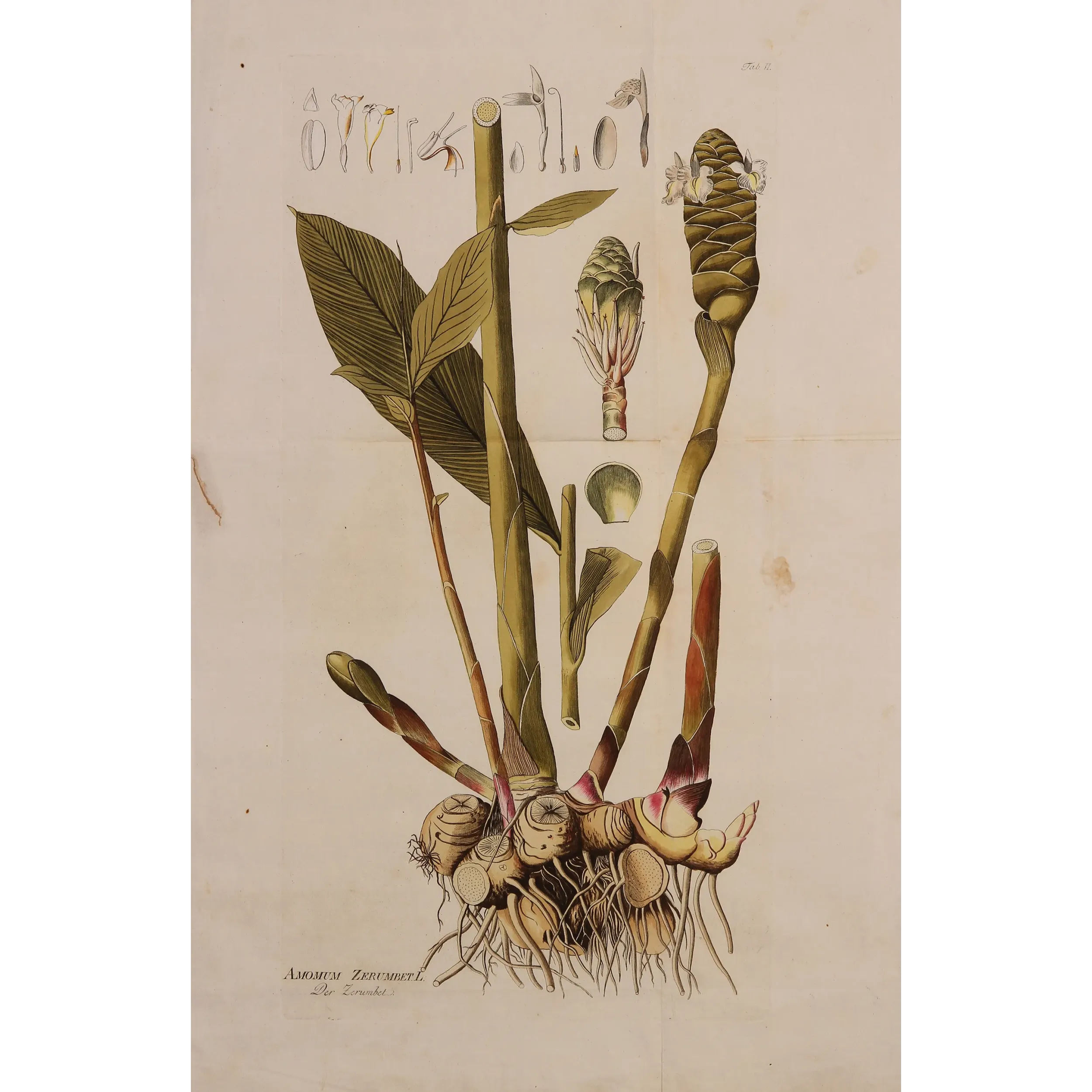
Exceptional large-format eighteenth-century botanical engraving depicting <em>Amomum Zerumbet</em> L., published as Plate II of Joseph Jacob von Plenck’s <em>Icones Plantarum Medicinalium</em>. Printed on a large folded sheet of Honig laid paper with complete watermark and contemporary hand colouring, the composition combines monumental rhizomatous structures, tall architectural stems and precisely observed analytical details. A rare large-scale Plenck Statement Piece with remarkable historical and visual presence.