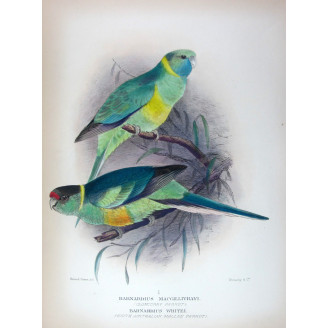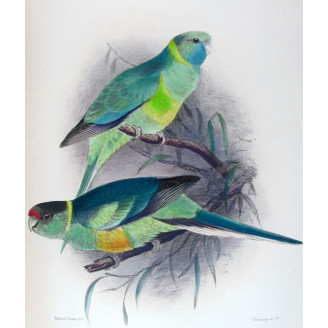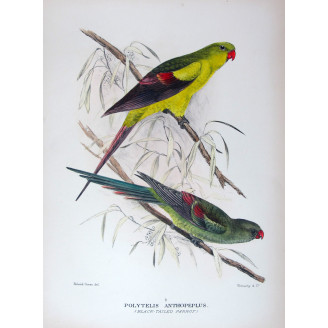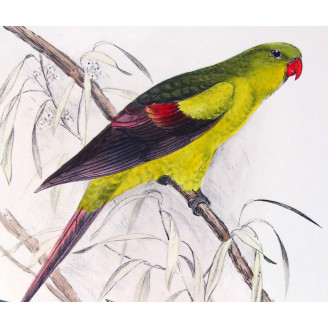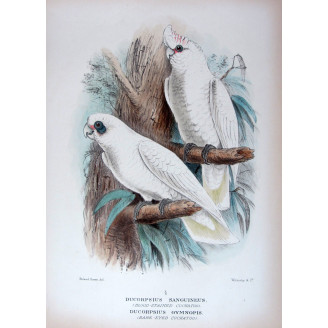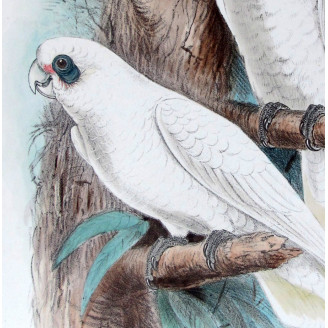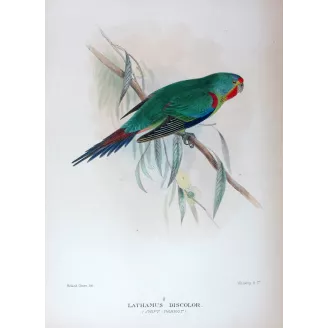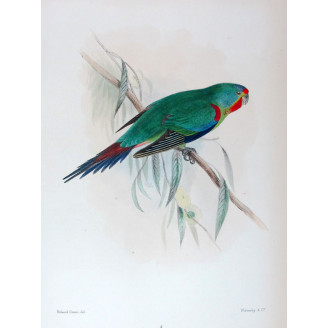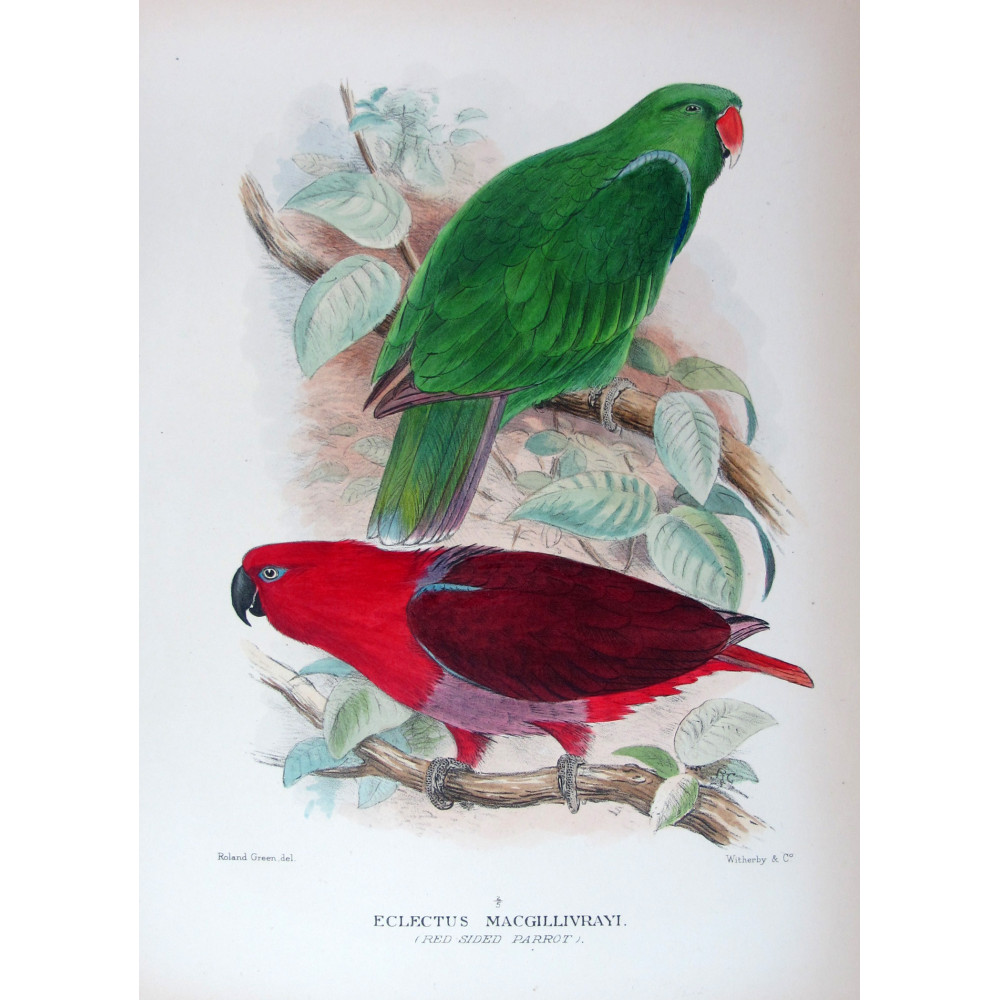
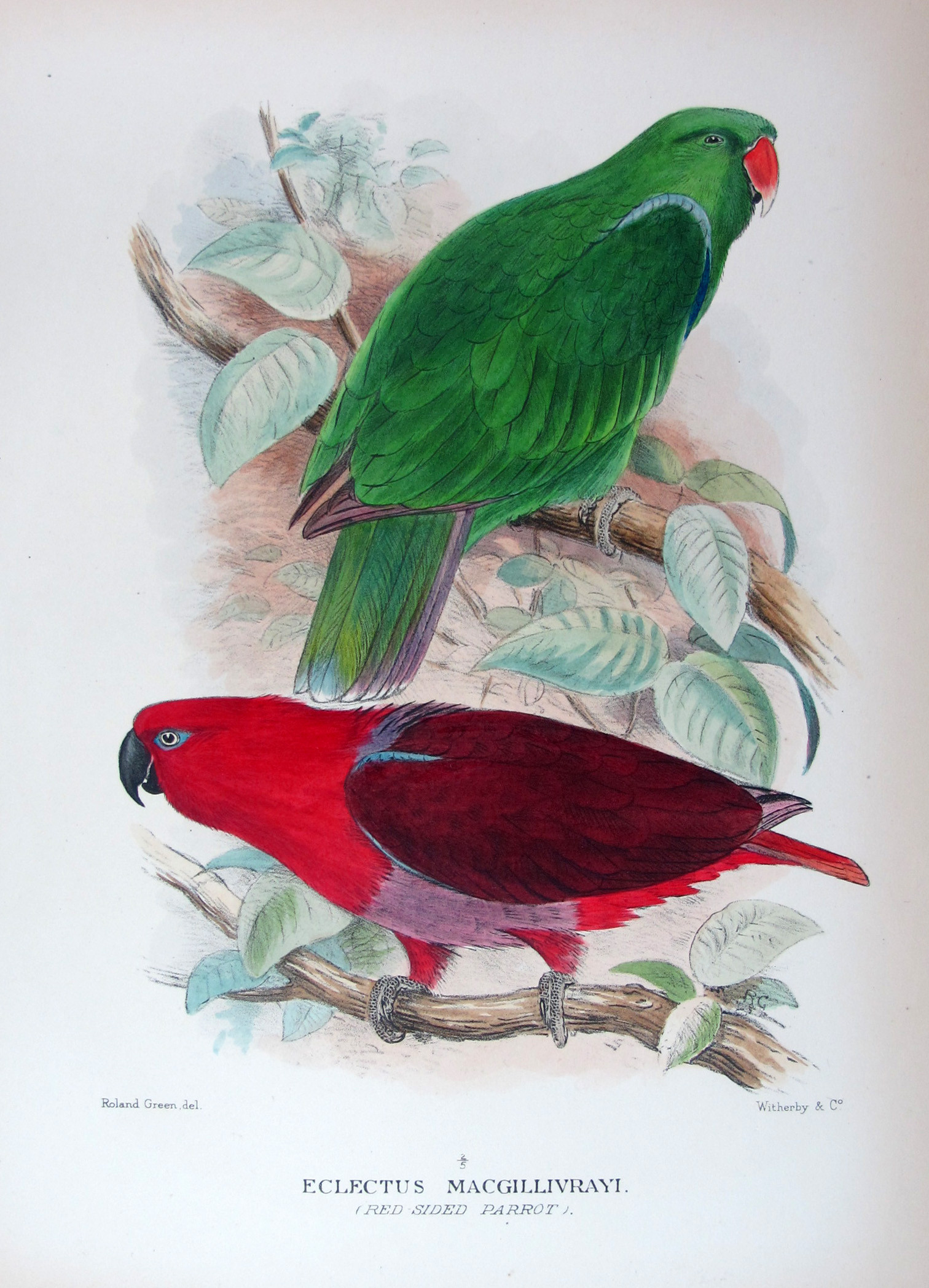
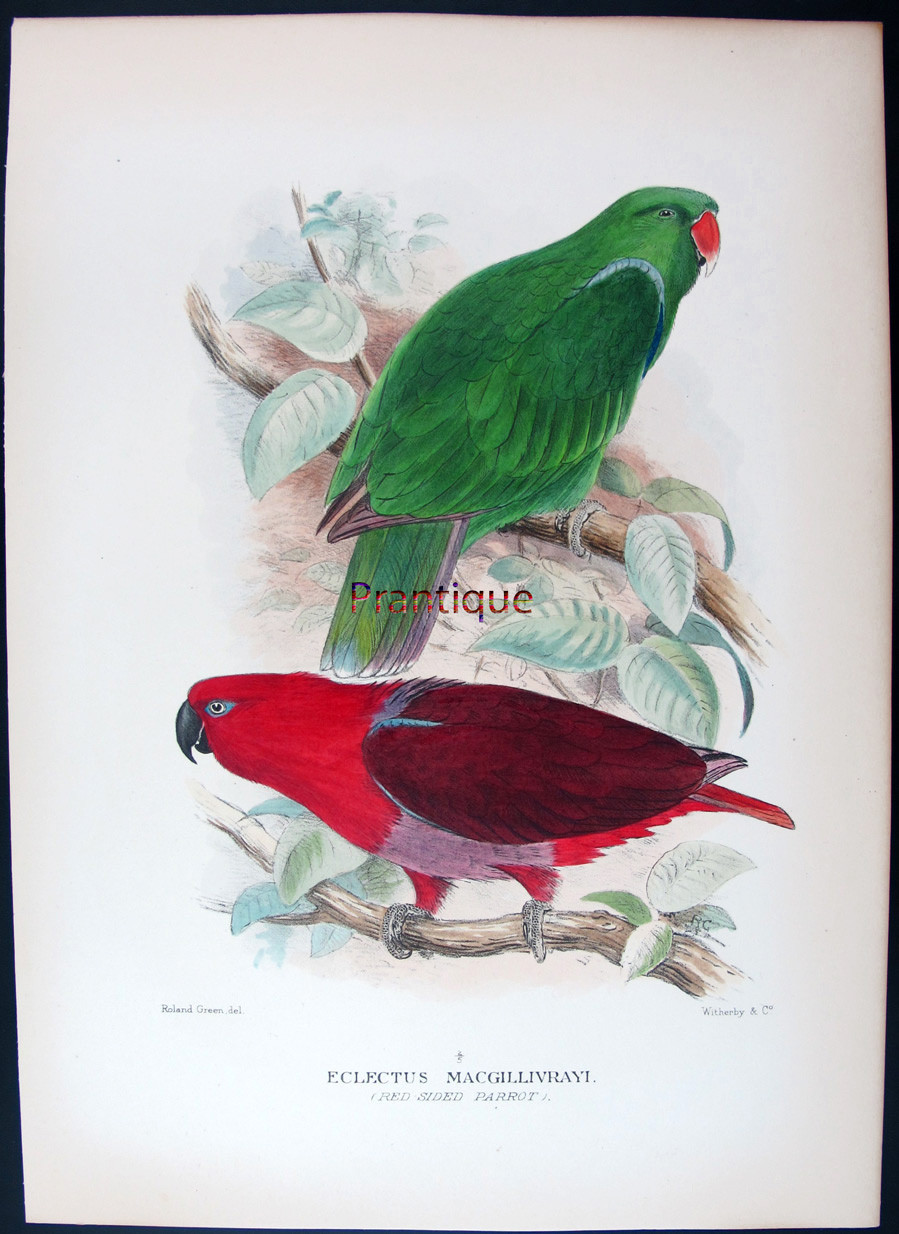
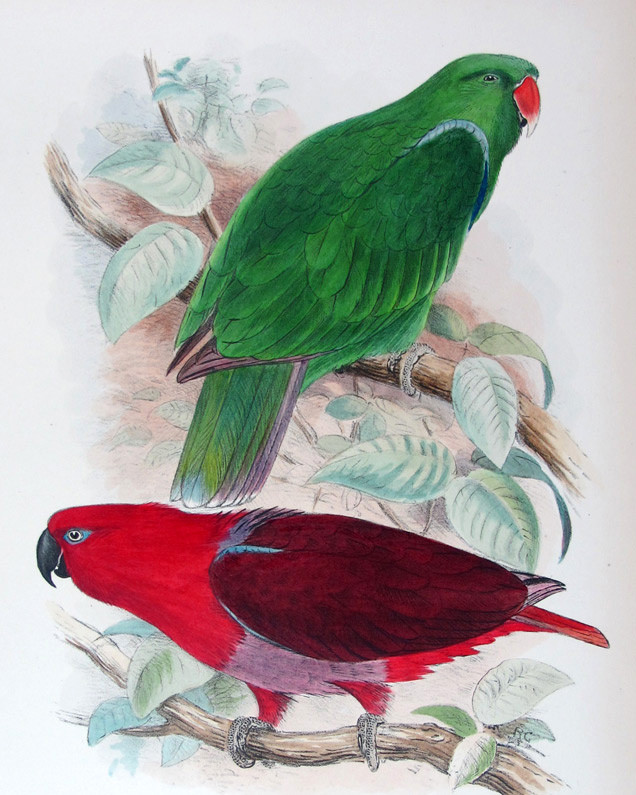

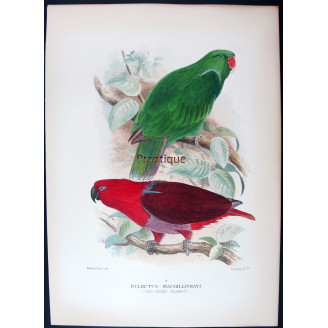
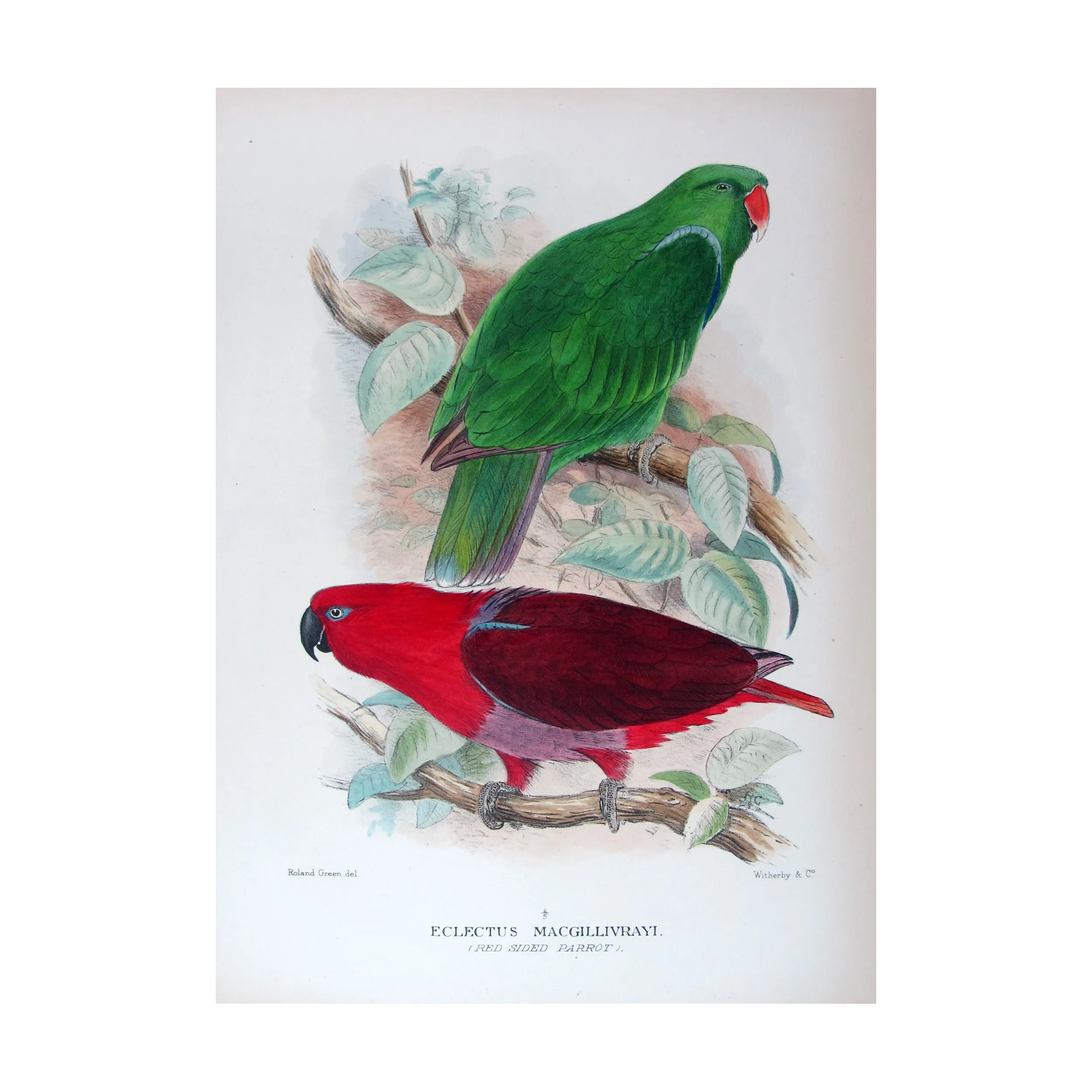
Antique lithograph of the Red-sided Parrot by Roland Green.
 Delivery policy
Your print will be carefully prepared and shipped worldwide via trusted couriers (UPS or similar).
 Authentic antique prints
Original engravings from the 17th–19th century.
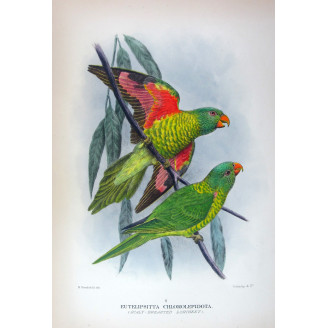
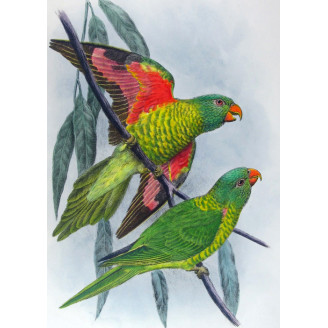
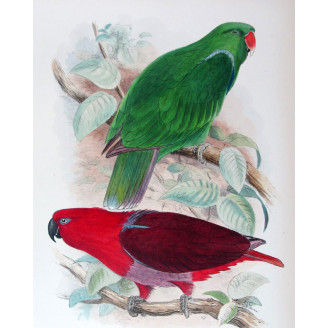
This original early twentieth-century hand-colored lithograph depicts Eclectus macgillivrayi (Eclectus Parrot), presented as a striking pair that showcases the species’ celebrated sexual dimorphism. The plate belongs to The Birds of Australia, Gregory M. Mathews’ monumental ornithological publication, illustrated here by Roland Green.
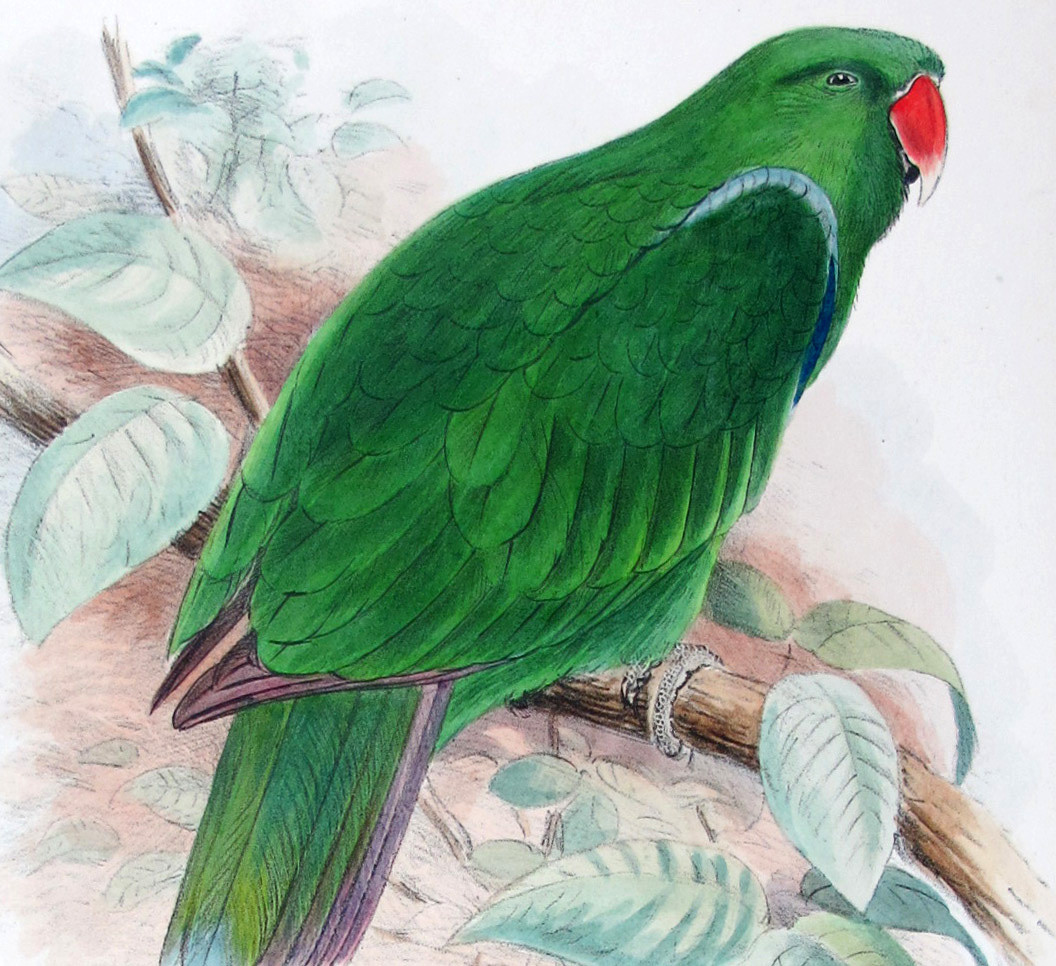
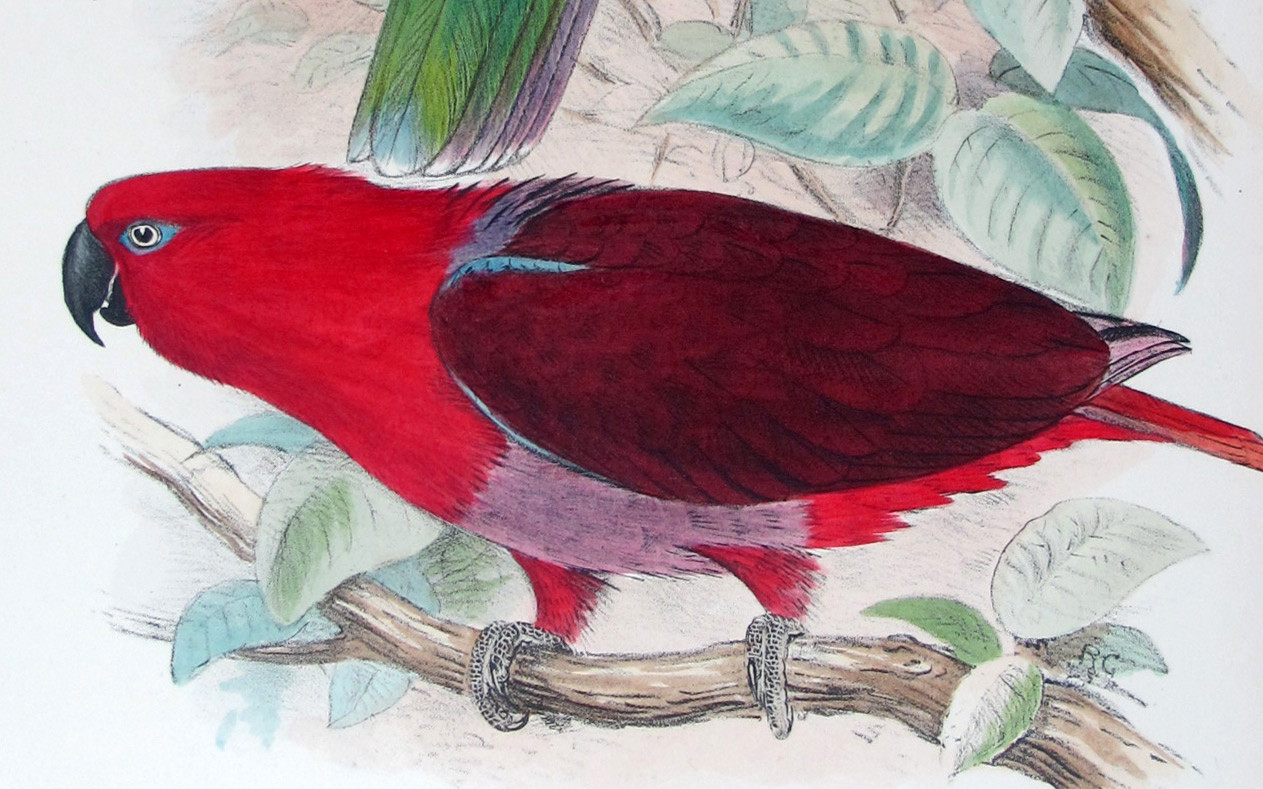
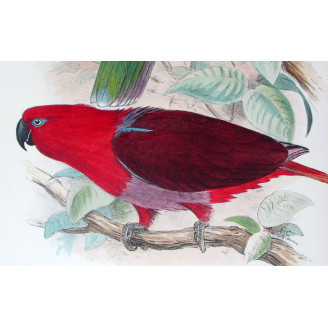
Two birds occupy the sheet in a deliberate chromatic dialogue: the male in deep emerald green with a warm coral bill, and the female in saturated crimson with violet-black wings. Their mirrored attitudes transform scientific illustration into a composition of near-modern graphic power.
— • —
Roland Green constructs the scene around contrast and balance. The male’s plumage is built from layered greens, subtly shaded to suggest feather depth without breaking the clarity of the silhouette. The female, rendered in dense crimson, introduces a dramatic mass of colour that is elegantly controlled by the dark wing field and the fine modelling around the head and beak.
The composition is unusually architectural: two bodies angled in opposing directions, held together by the branching structure and softened foliage. The background remains restrained and atmospheric, allowing the birds’ colours to dominate while maintaining refinement. It is a plate designed to read instantly at a distance—highly decorative, yet never merely ornamental.
Eclectus parrots are native to the rainforests of northern Australia and nearby islands. Their extreme sexual dimorphism—green males and red females—confused early European naturalists, who initially classified them as separate species.
By the early twentieth century, the Eclectus had become emblematic of the region’s biological distinctiveness and of the evolving precision of ornithological taxonomy. A paired depiction such as this not only aids identification, but also communicates the astonishing visual logic of nature itself.
This lithograph originates from The Birds of Australia, Gregory M. Mathews’ ambitious early twentieth-century ornithological enterprise. Conceived as a definitive scientific record, the work united rigorous taxonomy with exceptional artistic collaboration, producing one of the most authoritative visual catalogues of Australian birdlife. Explore the broader historical scope in our editorial feature: Gregory M. Mathews and The Birds of Australia .
The plate was illustrated by Roland Green, whose field-driven precision and compositional discipline are especially evident in complex subjects where colour must remain both accurate and architecturally balanced.
Very good antique condition. Fresh original hand-coloring with strong lithographic impression. Printed on fine early twentieth-century wove paper. Minor age toning slightly more visible along the outer margins, consistent with age.
For further insight into Roland Green’s contribution to ornithological illustration: Roland Green – Dynamic Vision and Field-Born Precision in Bird Art
Specific References
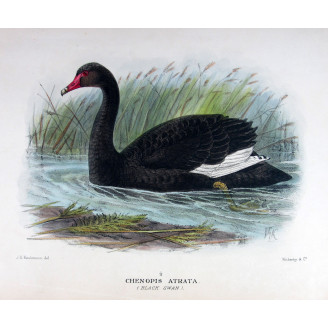
Original lithograph of the Black Swan by J.G. Keulemans (Chenopis atrata).
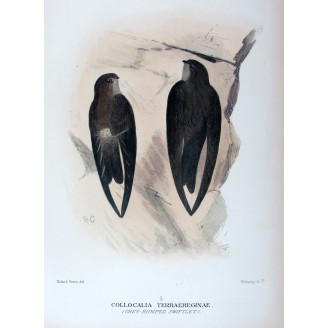
Original lithograph of the Grey-rumped Swiftlet by Roland Green from Mathews' Birds of Australia.
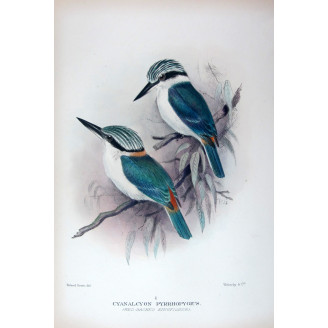
Original lithograph of the Red-backed Kingfisher (Cyanalcyon pyrrhopygus) by Roland Green
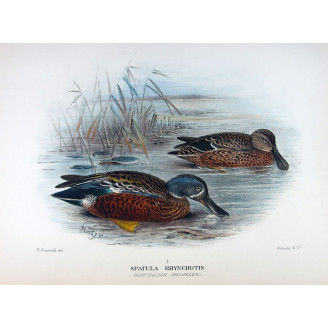
Australian Shoveler (Spatula rhynchotis) – Original antique bird print by H. Grønvold.
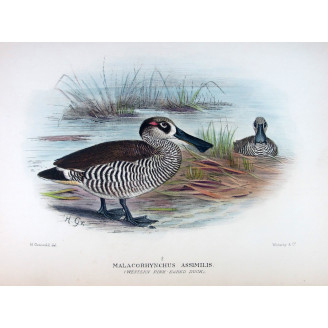
Western Pink-eared Duck (Malacorhynchus assimilis) – Original antique bird print by H. Grønvold.
Antique lithograph of the Cloncurry Parrot & South Australian Mallee Parrot by Roland Green.
Gold-breasted Lorikeet lithograph by Henrik Grønvold, dynamic dual composition.
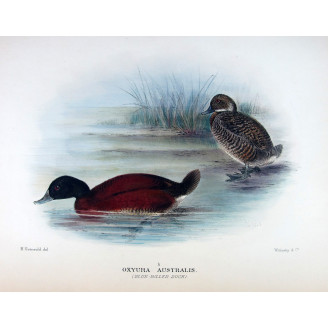
Blue-billed Duck (Oxyura australis) – Original antique bird print by H. Grønvold.
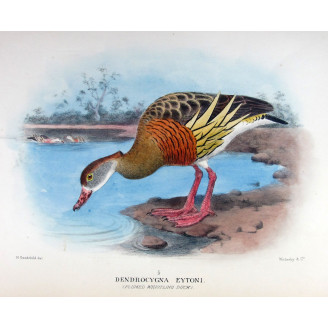
Original lithograph of the Plumed Whistling Duck by H. Goodchild (Dendrocygna eytoni).
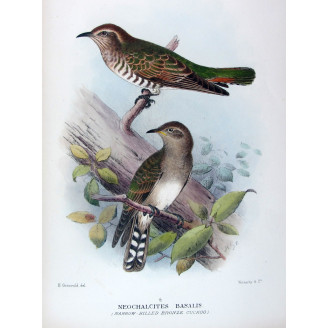
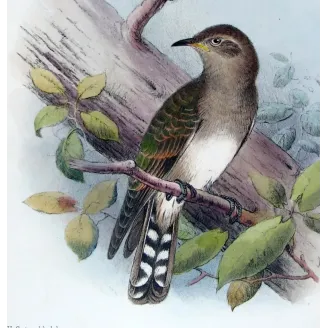
Narrow-billed Bronze Cuckoo (Neochalcites basalis) – Original lithograph by Henrik Grønvold.
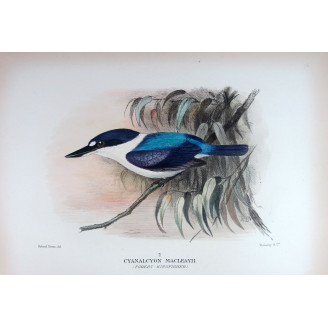
Original lithograph of the Forest Kingfisher (Cyanalcyon macleayii) by Roland Green
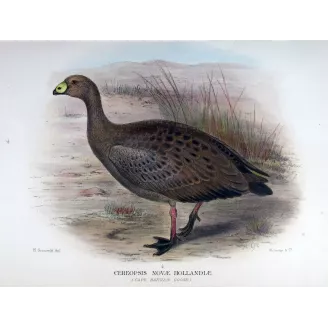
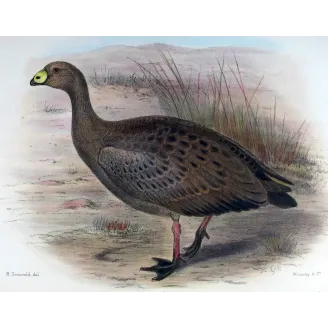
Original lithograph of the Cape Barren Goose by Henrik Grønvold (Cereopsis novæ hollandiae).
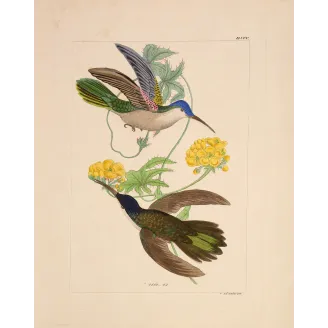
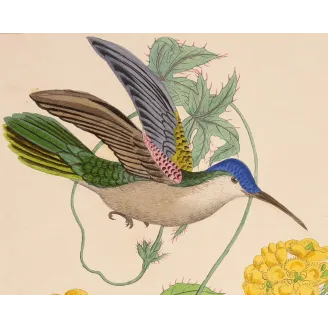
Original nineteenth-century hand-colored engraving depicting the Blue-headed Sabrewing (Saepiopterus lazulus), a tropical hummingbird illustrated by Ludwig Reichenbach in his celebrated Trochilinarum Enumeratio.
Charming pear study by Redouté, showing delicate blossom and ripening fruit. Balanced and refined.
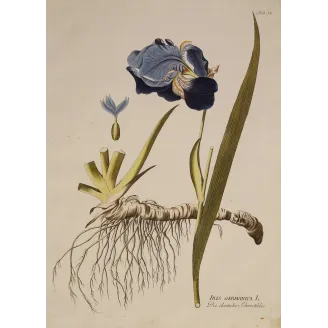
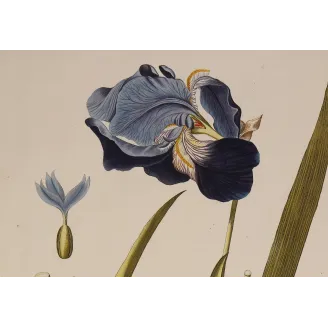
An original eighteenth-century botanical engraving depicting Iris germanica, published in Joseph Jacob von Plenck's celebrated Icones Plantarum Medicinalium. Printed on fine laid paper bearing the Honig watermark, the sheet combines scientific precision with the refined artistic craftsmanship of the Viennese botanical school.
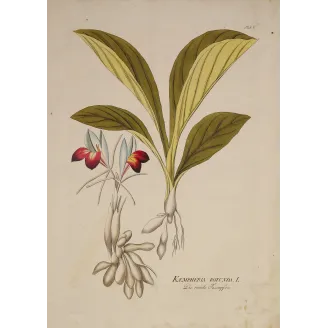
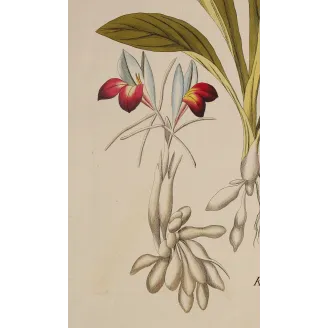
Original eighteenth-century botanical engraving depicting Kaempferia rotunda, published in Vienna by Joseph Jacob von Plenck for Icones Plantarum Medicinalium (Plate 5). The elegant composition combines broad architectural foliage, richly coloured crimson flowers and delicately modelled underground tubers, demonstrating the extraordinary refinement of Plenck's Viennese botanical school. Printed on fine Honig laid paper with visible "IV" watermark.
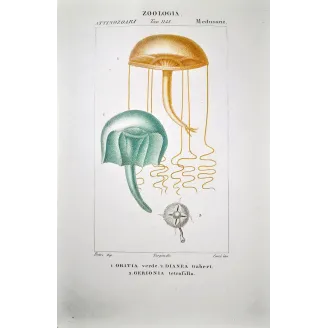
Trio of rare jellyfish types in soft tones, hand-colored lithograph by Prêtre.
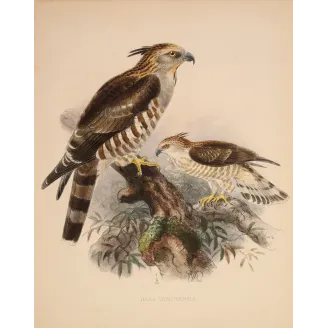
Original antique bird print depicting Baza ceylonensis (Ceylon Hawk-Eagle), illustrated by J.G. Keulemans for A History of the Birds of Ceylon. A striking Victorian ornithological lithograph featuring a refined pair of raptors with strong decorative presence.
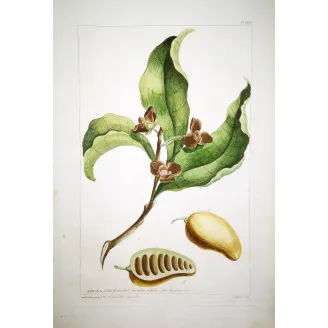
An original 18th-century hand-colored engraving depicting a Custard Apple (Annona sp.), from Philip Miller’s Figures of the Most Beautiful, Useful, and Uncommon Plants. Combining botanical precision with decorative clarity, the composition features both the plant and its distinctive fruit in sectional detail.
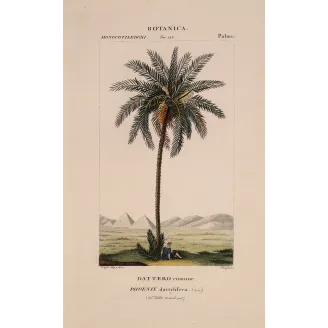
Detailed antique illustrations of the date palm tree and its floral and fruit anatomy.
Antique lithograph of the Red-sided Parrot by Roland Green.