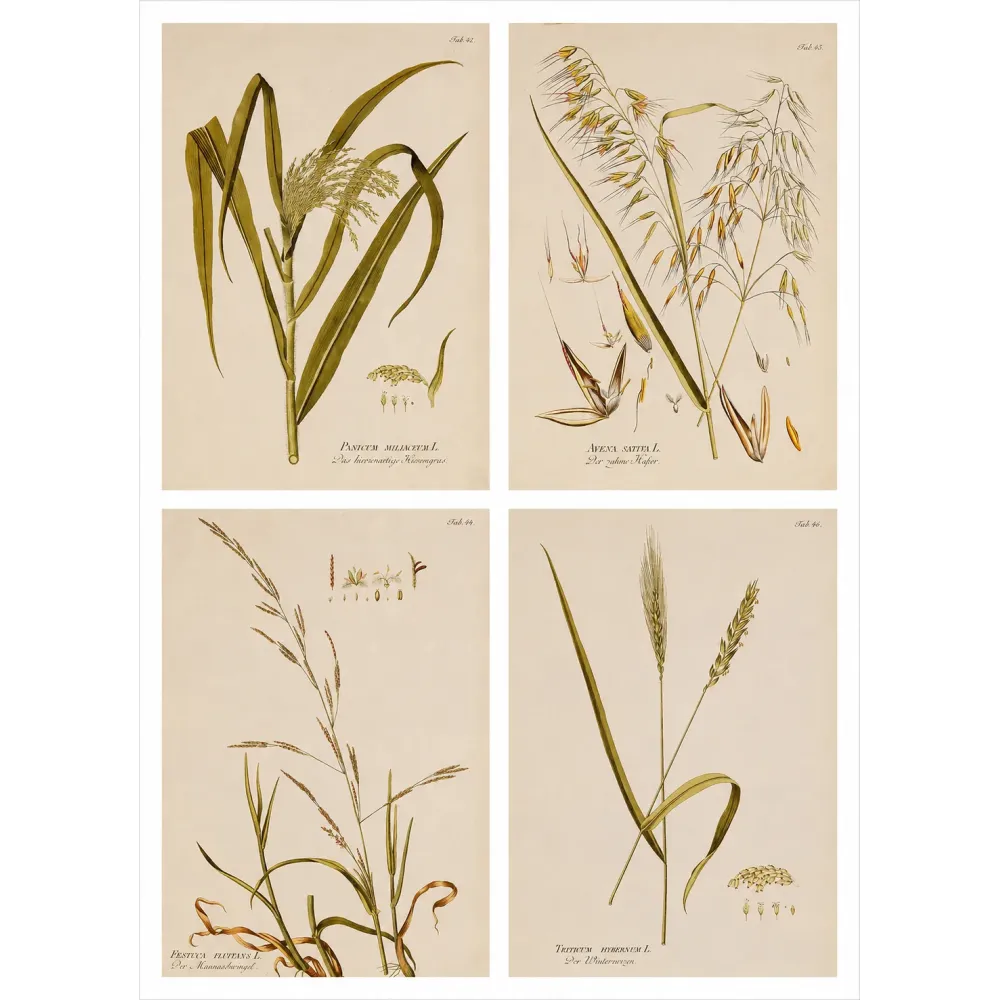
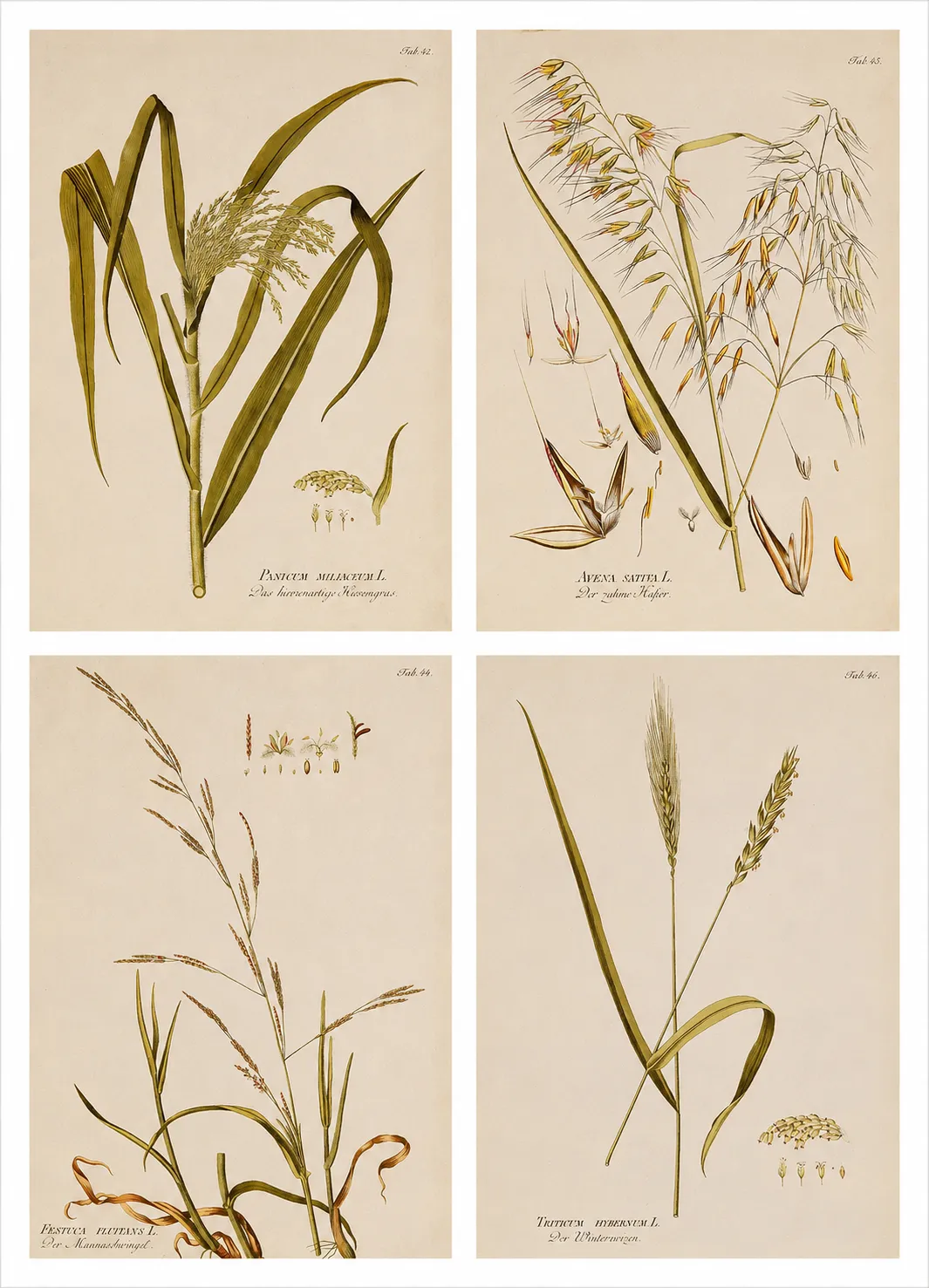
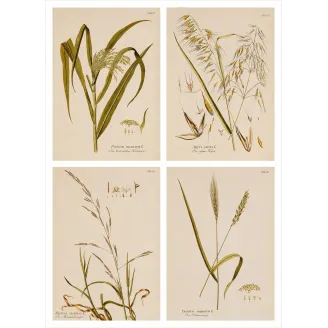
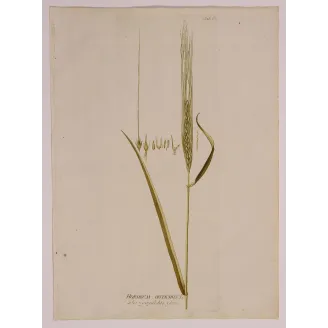
Seven-plate botanical corpus devoted to Europe's principal cereal crops, preserved exactly as originally published in Joseph Jacob von Plenck's Icones Plantarum Medicinalium. Combining scientific precision, historical significance and remarkable visual harmony, this Museum Quality Study Set documents the plants that shaped European agriculture and civilisation.
 Delivery policy
Your print will be carefully prepared and shipped worldwide via trusted couriers (UPS or similar).
 Authentic antique prints
Original engravings from the 17th–19th century.
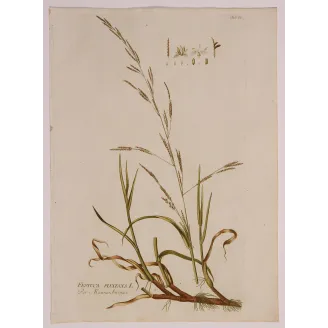
This Museum Quality Study Set brings together seven original eighteenth-century botanical engravings from a concentrated sequence within Joseph Jacob von Plenck’s monumental Icones Plantarum Medicinalium. Published in Vienna from 1788, the group preserves Plates 42 and 44–49: Panicum miliaceum, Festuca fluitans, Avena sativa, Secale cereale, Hordeum distichon, Triticum hybernum and Triticum repens.
Together they form an extraordinary visual record of grasses, cereals and cultivated plants connected with European agriculture. Millet, oats, rye, barley and wheat appear alongside related grasses whose flowering structures, roots and grains were examined with the same precision Plenck applied throughout his botanical work.
The seven sheets share generous folio dimensions, eighteenth-century laid paper, warm natural tone, refined copper engraving and luminous contemporary hand colouring. Olive greens, ochres, straw yellows and warm browns create exceptional visual coherence while allowing every plant to retain its individual character.
With watermark or countermark evidence preserved in every sheet — four complete Honig watermarks and three visible “IV” marks — together with exceptional freshness throughout, this seven-plate agricultural corpus may be confidently classified as a Museum Quality Study Set.
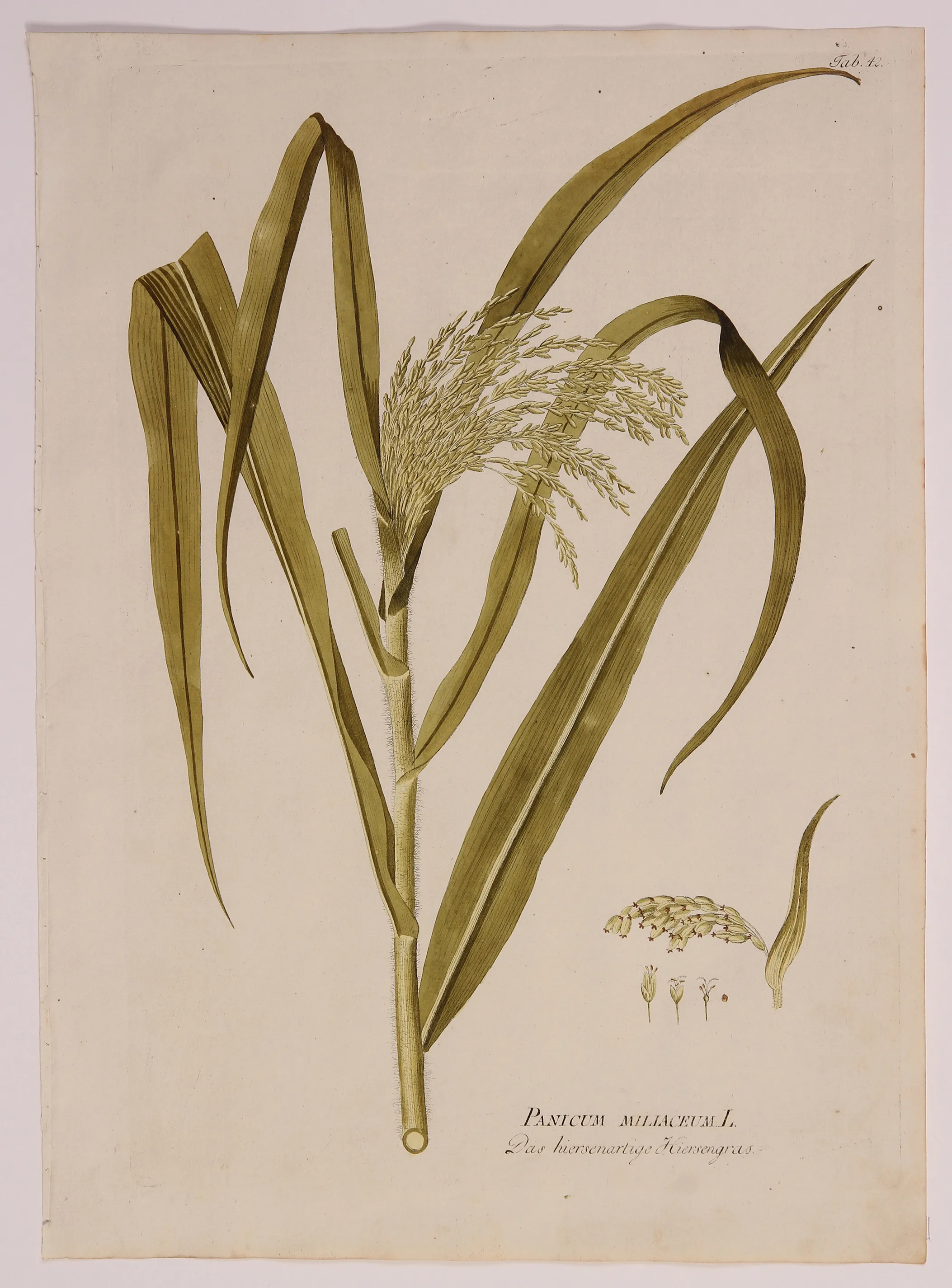
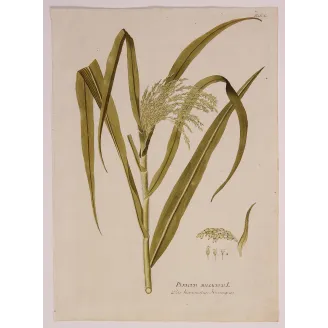
Plate 42, Panicum miliaceum, is the most monumental composition in the group. Broad arching leaves surround a dense cascading panicle articulated with extraordinary delicacy. Deep olive and yellow-green passages give the plant substantial visual weight while smaller botanical details introduce a scientific counterpoint.
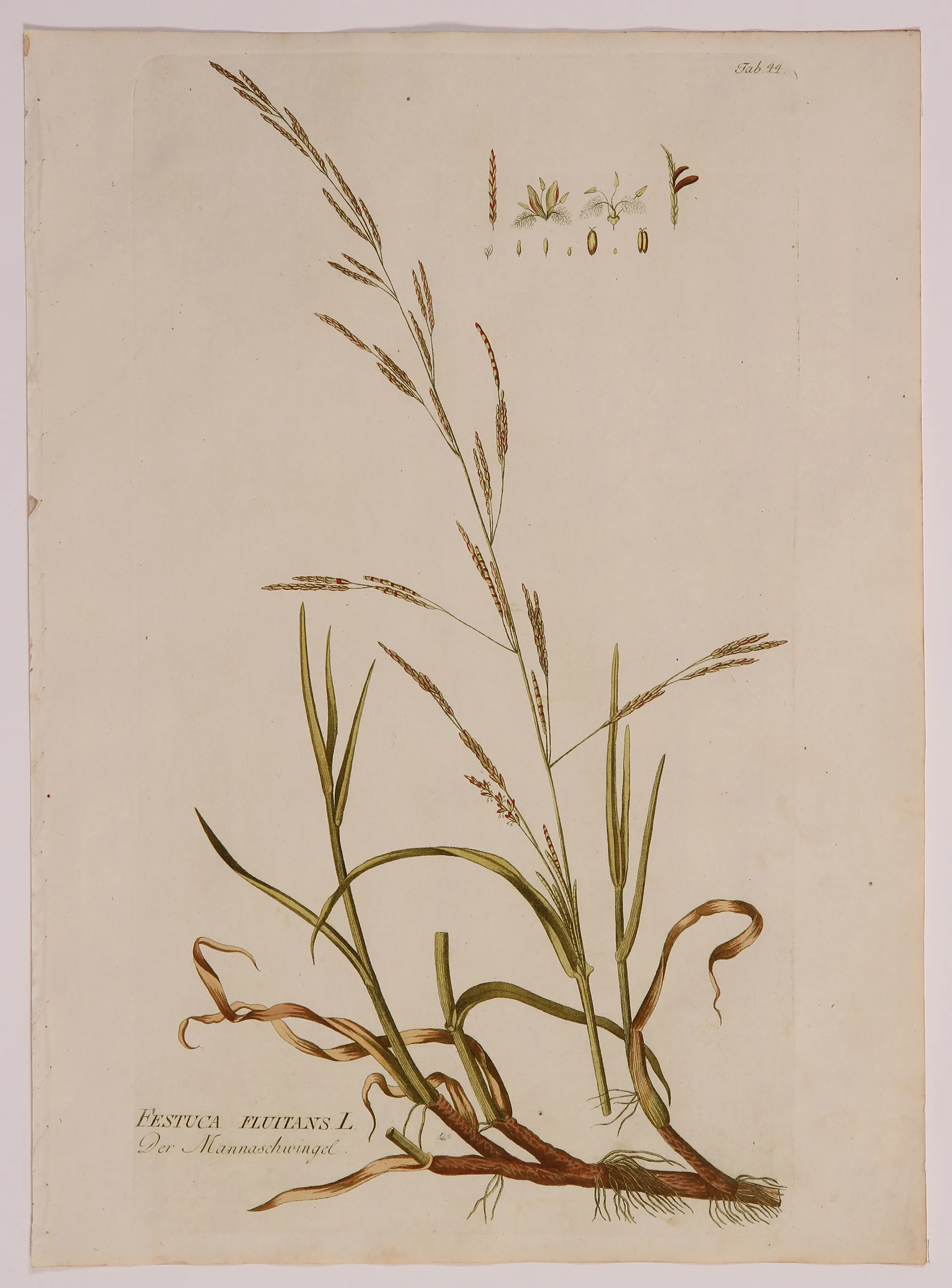
Plate 44, Festuca fluitans, develops a more linear rhythm. Slender flowering stems rise above an extensive horizontal rhizome, connecting the visible plant with its underground structure. Warm brown and reddish tones contrast with olive-green stems, while isolated details explain its reproductive morphology.
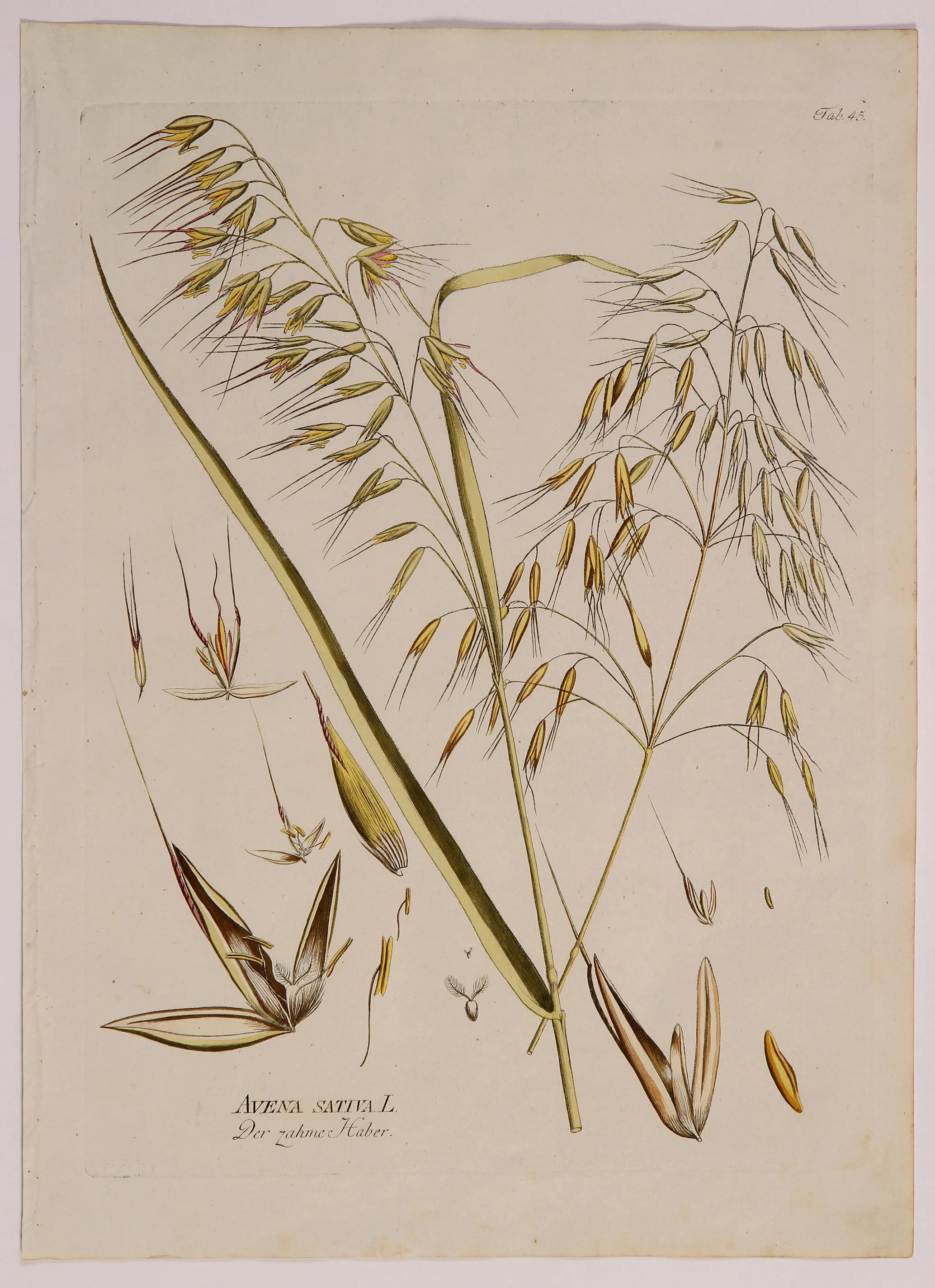
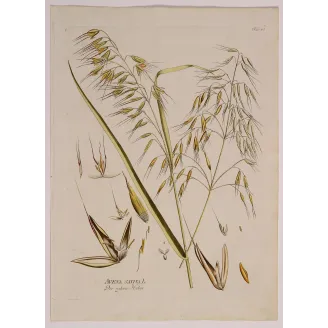
Plate 45, Avena sativa, is among the most dynamic sheets. Branching oat panicles spread across the upper field, their suspended spikelets and long awns creating exceptional movement. Enlarged studies of grains and floral structures surround the principal specimens, while olive, gold and restrained reddish accents create a particularly refined palette.
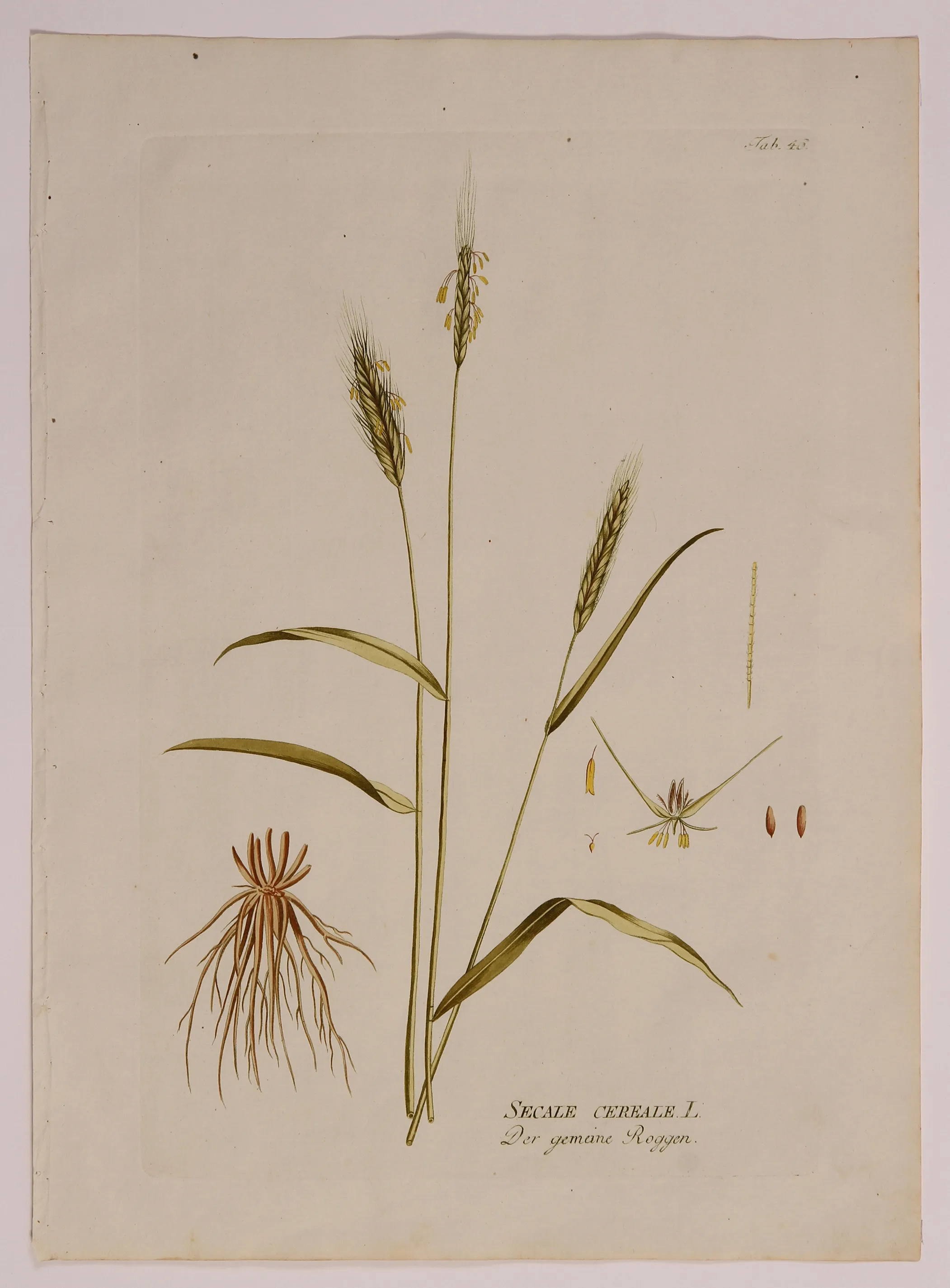
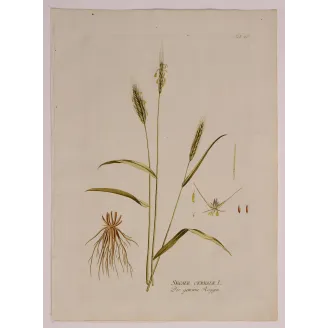
Plate 46, Secale cereale, presents rye with remarkable clarity. Three slender stems rise through the composition beside long leaves and an isolated root study. Additional reproductive details occupy the open paper, transforming the engraving into a visual explanation of the plant rather than a simple portrait.
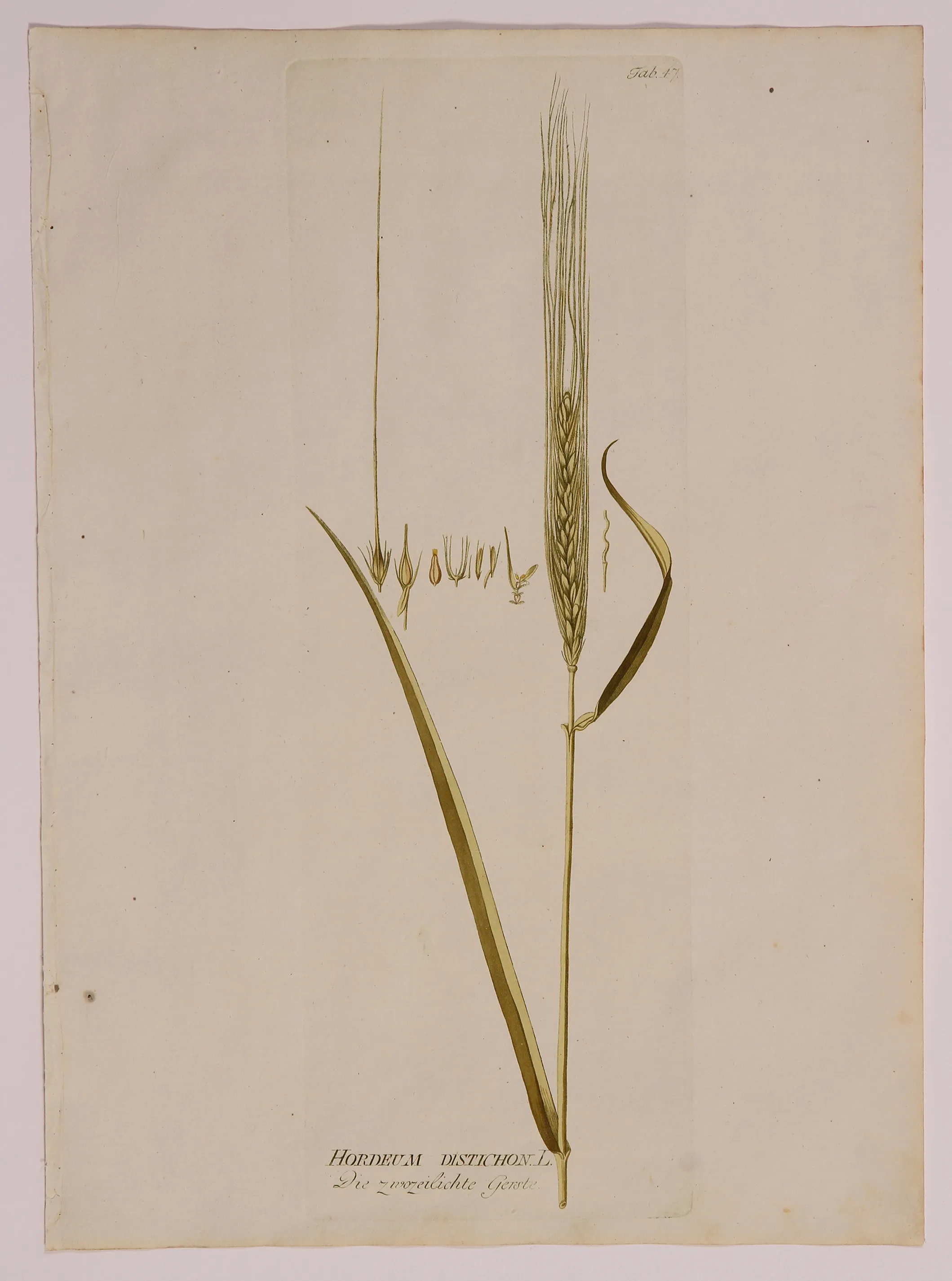
Plate 47, Hordeum distichon, is perhaps the most architectural image. A remarkably tall barley stem terminates in a compact ear with exceptionally long awns, while broad leaves counterbalance its vertical movement. The economy of the composition gives the sheet unusual presence.
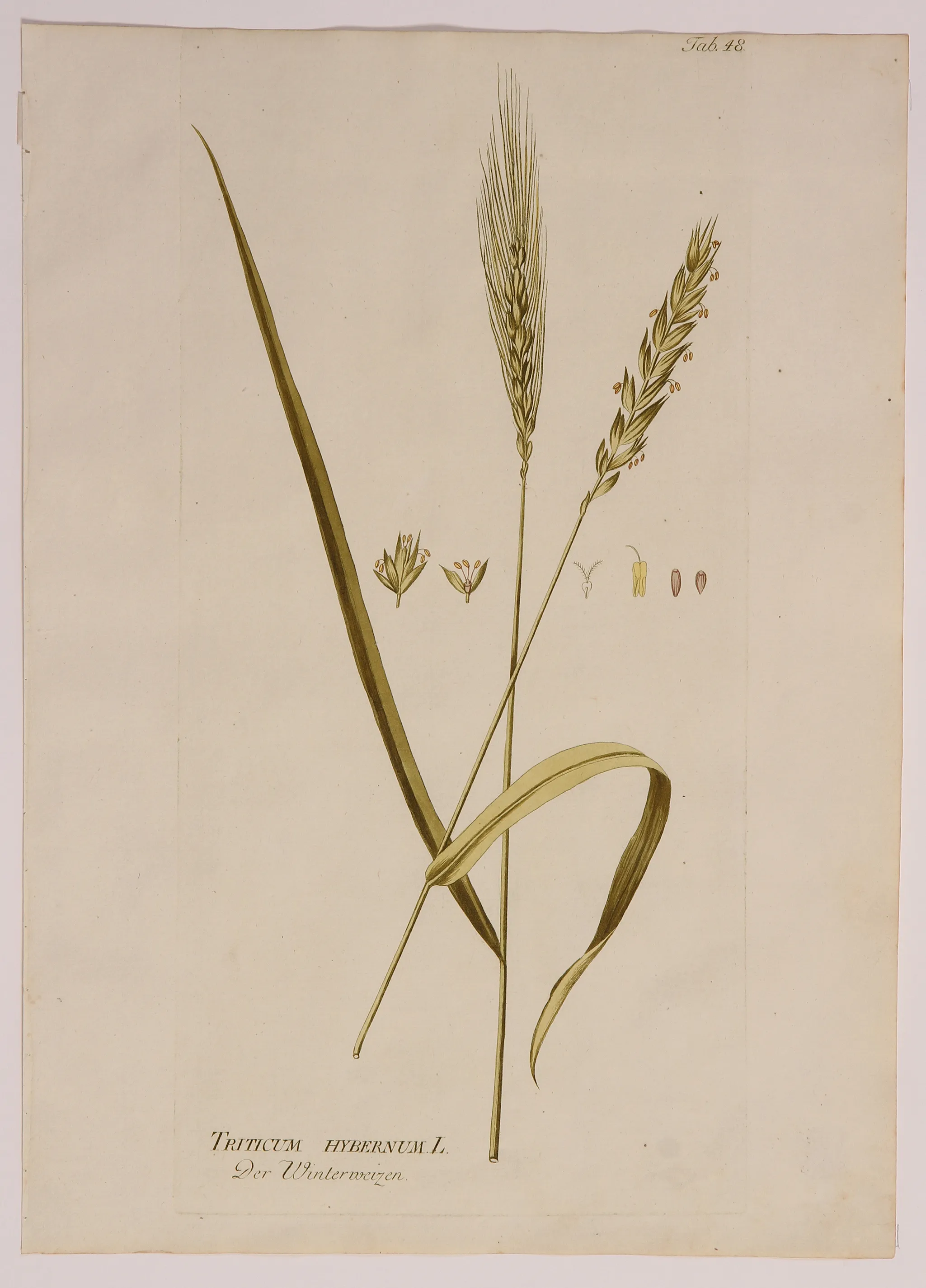
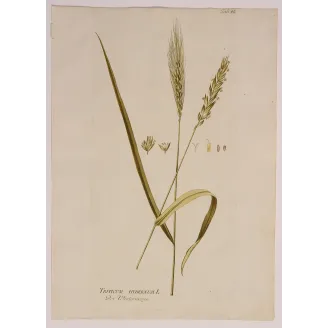
Plate 48, Triticum hybernum, offers an elegant study of cultivated wheat. Vertical and diagonal stems present the ears from different viewpoints, while long curving leaves and isolated reproductive structures create a balanced dialogue between complete specimen and analytical detail.
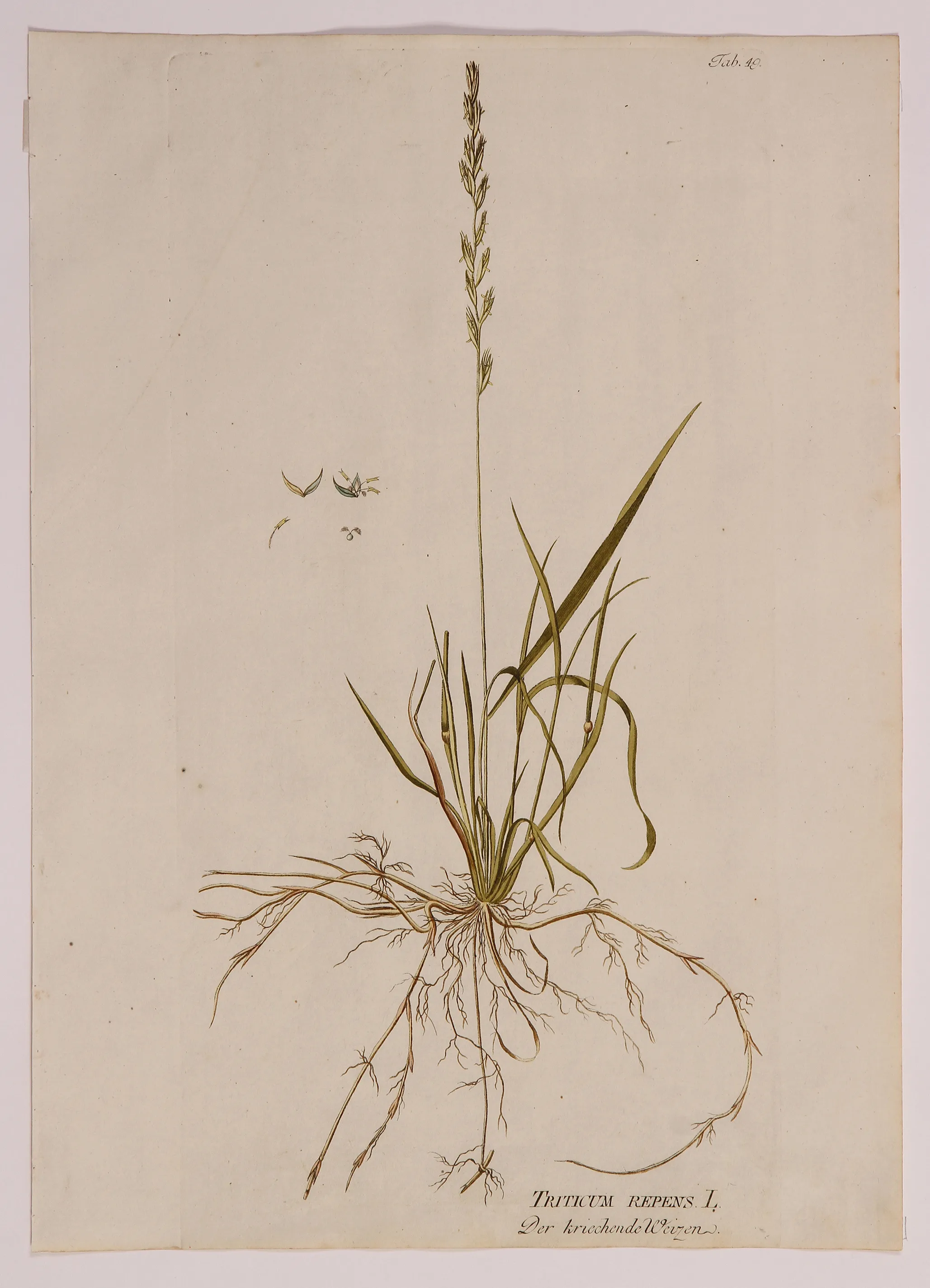
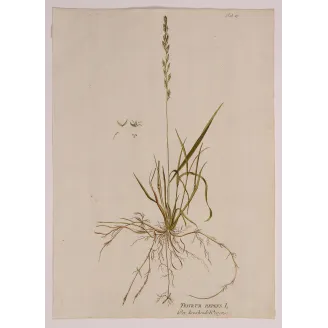
Plate 49, Triticum repens, concludes the group with an extraordinary study of underground growth. Beneath the slender flowering spike, an extensive network of creeping rhizomes and fine roots spreads laterally across the sheet, giving equal visual importance to structures normally hidden beneath the soil.
Together, the seven plates reveal an exceptional range of botanical architecture: dense panicles alternate with open branches, vertical stems with horizontal roots, and compact grain heads with broad leaves. Their unity comes not from repetition but from controlled variation within a shared eighteenth-century visual language.
The plants represented belong principally to the Poaceae, one of the most economically important botanical families in human history. Cultivated grasses transformed landscapes, supported settled communities and supplied staple foods across Europe for centuries.
Panicum miliaceum, or proso millet, is an ancient Eurasian cereal characterised by large branching panicles. Avena sativa, cultivated oat, became especially important in cooler European regions and served both human consumption and agricultural systems supporting livestock.
Secale cereale, rye, became fundamental to northern and central European agriculture because of its tolerance of colder climates and relatively poor soils. Hordeum distichon, two-row barley, belongs to one of humanity’s oldest cultivated cereal groups and historically served as food, animal feed and a raw material for brewing.
Triticum hybernum, represented by Plenck as winter wheat, records one of the principal cultivated wheat forms within eighteenth-century classification. Wheat occupied a central position in European food production and grain economies.
Festuca fluitans and Triticum repens broaden the sequence beyond staple grain crops, revealing the wider botanical context within which grasses were studied. Plenck’s emphasis on their rhizomes and roots demonstrates an interest in the complete structure and growth strategy of the plant.
Together, these engravings document plants occupying different positions within the agricultural landscape and reveal the close relationship between botanical classification, cultivation and eighteenth-century European material life.
Joseph Jacob von Plenck conceived Icones Plantarum Medicinalium as a comparative visual instrument for recognising and studying plants. Related subjects were positioned in close proximity so that differences of habit, foliage, roots, flowering and reproductive structures could be understood through direct comparison.
The present Study Set preserves seven plates from the closely organised sequence numbered 42–49. Only Plate 43, Panicum dactylon, is currently absent. The group therefore retains seven of eight consecutive sheets devoted to a remarkable concentration of grasses, cereals and agriculturally significant plants.
Their relationship is consequently historical rather than a modern association of visually similar subjects. Millet, grasses, oats, rye, barley and wheat already occupied neighbouring positions within Plenck’s eighteenth-century editorial structure.
Seen together today, they form an unusually direct visual encounter with plants underlying European agriculture. Wheat, rye, barley, oats and millet belonged to systems of food supply, brewing, animal husbandry, rural trade and everyday subsistence that shaped European landscapes and economies.
The engravings emerged during an Enlightenment culture increasingly concerned with classification, useful plants and agricultural improvement. Yet their artistic strength exceeds their scientific purpose. Each sheet transforms a grass into an individually resolved composition through changes of scale, direction, botanical detail and the distribution of untouched paper.
Panicum is broad and monumental; Festuca linear and subterranean; Avena animated and expansive; Secale analytical; Hordeum architectural; Triticum hybernum restrained and balanced; and Triticum repens dominated by the geometry of its roots.
The material consistency of the sheets strengthens this visual unity. All seven were produced for the same Viennese publication, in the same folio format and through the same refined combination of copper engraving and contemporary hand-applied colour.
Every sheet also retains watermark or countermark evidence. Four preserve complete Honig watermarks, while three retain visible “IV” marks. Paper, scale, typography, engraved language and colouring therefore connect the group through original production rather than modern decorative selection.
For an interior designer, architect or collector, the seven engravings offer a substantial installation whose coherence is historical before it is decorative. They can be presented as an extended sequence, a balanced grid or interconnected groups while preserving the visual continuity inherited from the original publication.
This Study Set is not offered as a discounted bundle. Its value lies in the preservation of seven closely related eighteenth-century engravings, their exceptional material consistency, museum-quality condition and the historical narrative that emerges when these plants of European agriculture are experienced together.
The seven engravings are printed on fine eighteenth-century laid paper associated with the Honig papermaking tradition. Closely spaced laid lines and broader chain lines belong to the structure of the handmade sheets and may become visible in transmitted or raking light.
Panicum miliaceum (Plate 42), Avena sativa (Plate 45), Hordeum distichon (Plate 47) and Triticum repens (Plate 49) each preserve a complete Honig watermark with emblem. Festuca fluitans (Plate 44), Secale cereale (Plate 46) and Triticum hybernum (Plate 48) retain visible “IV” marks.
Every sheet therefore preserves identifiable papermaking evidence. The difference between complete watermarks and lettered marks is natural to historical paper production, reflecting the position of each portion within the larger mould-made sheet subsequently used for printing.
The plate marks remain visible around the engraved fields, with one documented exception: the upper plate mark of Triticum hybernum (Plate 48) is not present. Its botanical image and overall visual integrity remain entirely unaffected.
Panicum miliaceum (Plate 42) retains a subtle horizontal printing impression. This historical production trace does not compromise the engraved image, colouring or exceptional overall quality of the sheet.
Published in Vienna from 1788, Joseph Jacob von Plenck’s Icones Plantarum Medicinalium belongs to the great illustrated botanical projects of the European Enlightenment, combining scientific observation, copper engraving and contemporary hand colouring.
Each image was printed from a finely engraved copperplate and subsequently coloured by hand, uniting the repeatable precision of printmaking with the individual craftsmanship of an eighteenth-century colourist.
Cereals occupied a unique position within European society. Wheat, rye, barley, oats and millet connected botanical knowledge directly with fields, harvests, food, markets and domestic life.
Preserved together, these seven sheets reveal how scientific meaning developed through sequence and comparison. Today, the same historical coherence gives the group an exceptional architectural presence in a contemporary interior.
Discover how scientific observation, handmade paper, copper engraving and contemporary colour came together in Plenck’s botanical masterpiece.
Museum-quality condition. All seven eighteenth-century laid-paper sheets remain structurally sound, remarkably clean and exceptionally fresh. The engraved impressions retain excellent definition, while the contemporary hand colouring preserves unusual transparency and tonal subtlety throughout the Study Set.
Panicum miliaceum, Plate 42, is exceptionally well preserved and retains a complete Honig watermark. A subtle horizontal historical printing impression is present but does not compromise the image or colouring.
Festuca fluitans, Plate 44, remains remarkably fresh and preserves a visible “IV” mark. Avena sativa, Plate 45, retains exceptional definition throughout its complex panicles and a complete Honig watermark.
Secale cereale, Plate 46, is beautifully preserved and retains a visible “IV” mark. Hordeum distichon, Plate 47, remains exceptionally clean, with its fine awns sharply defined and a complete Honig watermark preserved.
Triticum hybernum, Plate 48, is in excellent condition and retains a visible “IV” mark. The upper plate mark is not preserved, without affecting the botanical field. Triticum repens, Plate 49, is exceptionally fresh and retains a complete Honig watermark.
Only light historical traces, occasional minute spotting, marginal toning and minor age-related irregularities are visible. There are no significant abrasions, visually intrusive repairs or major defects affecting the engraved fields.
Overall, the Study Set may be described as genuinely Museum Quality. Its consistent paper tone, generous margins, refined colour and exceptional preservation give the seven sheets a remarkably unified appearance. Please examine the professional high-resolution photographs for a full visual assessment.
Study Set: Cereals & European Agriculture Study Set
Included plates: Seven original botanical engravings from the sequence 42–49; Plate 43 absent
Botanical subjects: Panicum miliaceum L.; Festuca fluitans L.; Avena sativa L.; Secale cereale L.; Hordeum distichon L.; Triticum hybernum L.; Triticum repens L.
Historical sequence: Plates 42, 44, 45, 46, 47, 48 and 49; Plate 43, Panicum dactylon, not present
Work: Icones Plantarum Medicinalium
Author: Joseph Jacob von Plenck (1735–1807)
Artistic tradition: Viennese botanical school
Place of publication: Vienna
Date: c. 1788
Technique: Seven original copper engravings with contemporary hand-applied watercolour
Paper: Fine eighteenth-century laid paper associated with the Honig papermaking tradition
Watermarks or countermarks: Complete Honig watermarks in Plates 42, 45, 47 and 49; visible “IV” marks in Plates 44, 46 and 48
Plate marks: Preserved around the engraved fields; upper plate mark not present in Plate 48
Plate numbers: 42, 44, 45, 46, 47, 48 and 49
Plant family: Principally Poaceae
Individual sheet size: approx. 44 × 33 cm
Number of sheets: 7
Condition: Museum-quality condition; exceptionally fresh, clean and consistently preserved
Curatorial classification: Museum Quality Study Set
Collector positioning: Seven surviving sheets from the closely organised sequence 42–49, preserving an exceptional eighteenth-century corpus devoted to cereals, grasses and European agricultural plants
Interior design positioning: Seven historically coordinated works sharing format, date, paper, technique and visual language; ideal for a substantial premium botanical installation
Authenticity: Seven original eighteenth-century prints — never modern reproductions
Specific References
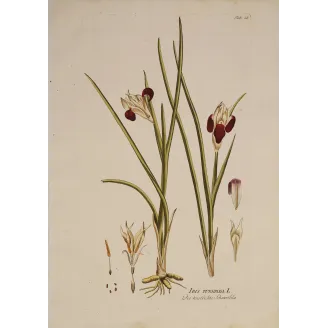
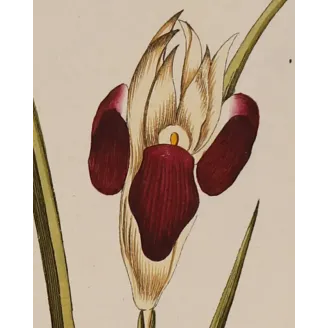
Original eighteenth-century botanical engraving depicting Iris tuberosa (Snake's Head Iris), published in Vienna by Joseph Jacob von Plenck for Icones Plantarum Medicinalium (Plate 38). This elegant composition combines two flowering specimens with finely engraved botanical details and a beautifully preserved complete Honig watermark. Contemporary hand colouring and selective gum arabic produce remarkable depth, while the velvety deep burgundy petals create one of the most refined colour harmonies within Plenck's celebrated Iris series.
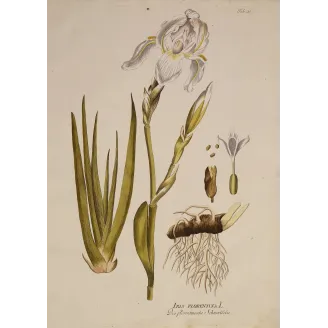
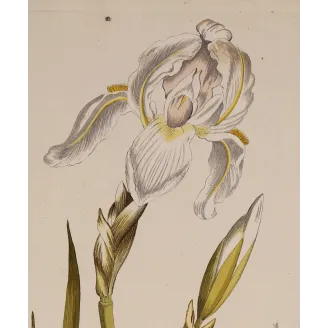
An elegant original botanical engraving depicting Iris florentina, delicately hand-coloured and published by Joseph Jacob von Plenck around 1788. Printed on original laid paper with visible plate mark and exceptionally refined colouring.
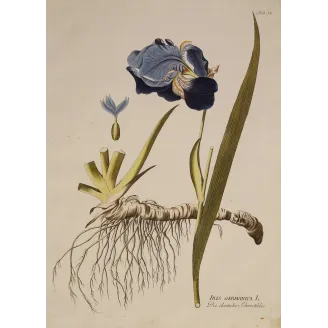
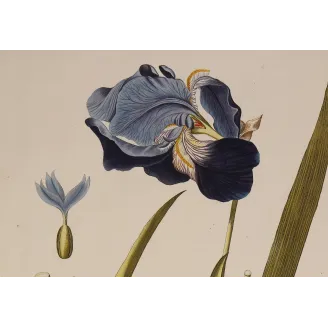
An original eighteenth-century botanical engraving depicting Iris germanica, published in Joseph Jacob von Plenck's celebrated Icones Plantarum Medicinalium. Printed on fine laid paper bearing the Honig watermark, the sheet combines scientific precision with the refined artistic craftsmanship of the Viennese botanical school.
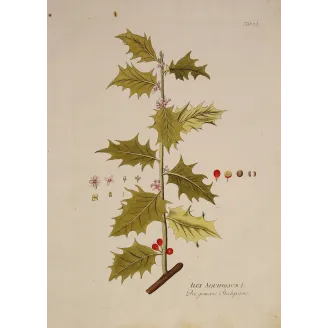
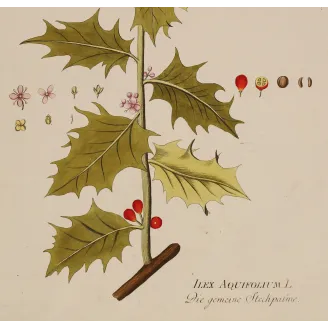
Original eighteenth-century botanical engraving depicting Ilex aquifolium L., the common holly, published in Vienna as Plate 72 of Joseph Jacob von Plenck’s Icones Plantarum Medicinalium. The composition combines sharply articulated evergreen foliage, delicate pink flowers, brilliant red fruits and separate botanical details, preserved on fine laid paper with a visible partial “IV” watermark.
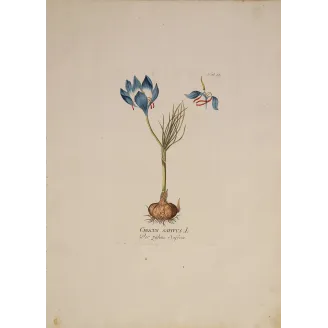
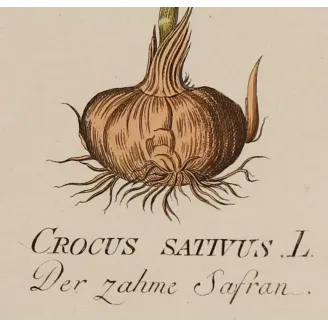
Original eighteenth-century botanical engraving depicting Crocus sativus L., the true saffron crocus, published in Vienna as Plate 32 of Joseph Jacob von Plenck's Icones Plantarum Medicinalium. This elegant composition celebrates one of history's most valuable medicinal and culinary plants through refined hand colouring, exceptional botanical clarity and beautifully preserved eighteenth-century laid paper.
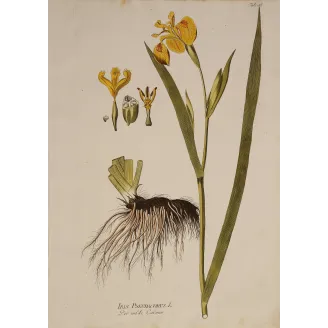
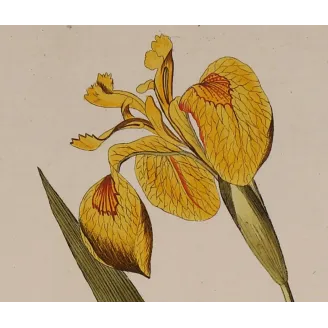
Original hand-coloured copper engraving depicting the Yellow Flag Iris (Iris pseudacorus), published by Joseph Jacob von Plenck in Vienna around 1788 for Icones Plantarum Medicinalium. A refined eighteenth-century botanical illustration distinguished by its elegant composition, beautifully engraved rhizome, luminous yellow flower, selective gum arabic highlights and excellent state of preservation.
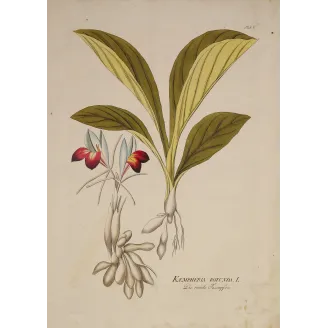
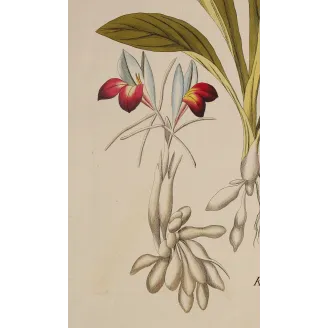
Original eighteenth-century botanical engraving depicting Kaempferia rotunda, published in Vienna by Joseph Jacob von Plenck for Icones Plantarum Medicinalium (Plate 5). The elegant composition combines broad architectural foliage, richly coloured crimson flowers and delicately modelled underground tubers, demonstrating the extraordinary refinement of Plenck's Viennese botanical school. Printed on fine Honig laid paper with visible "IV" watermark.
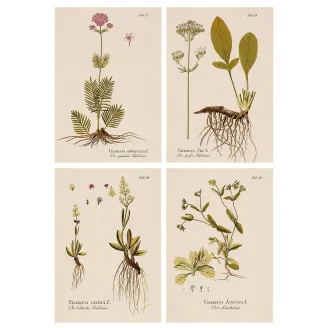
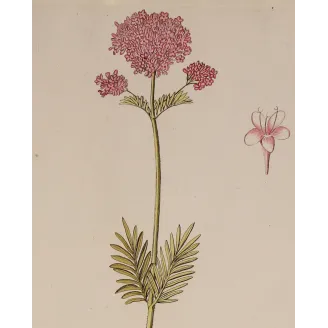
A complete four-plate botanical study devoted to the genus Valeriana, preserved exactly as originally published by Joseph Jacob von Plenck in Icones Plantarum Medicinalium. This Museum Quality Study Set combines scientific integrity, exceptional preservation and remarkable decorative harmony, offering collectors and interior designers an increasingly rare opportunity to acquire an intact eighteenth-century botanical sequence.
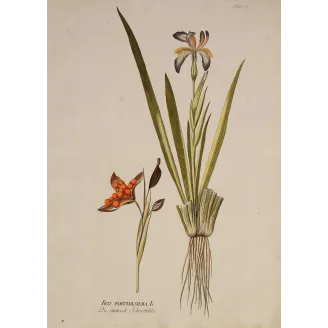
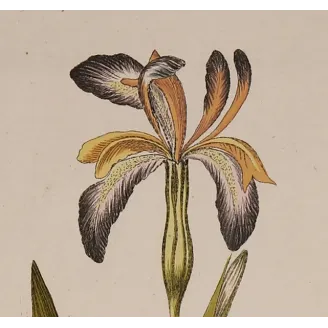
Original eighteenth-century botanical engraving depicting Iris foetidissima (Stinking Iris), published in Vienna by Joseph Jacob von Plenck for Icones Plantarum Medicinalium (Plate 37). Finely engraved and beautifully hand-coloured, the composition illustrates the flowering plant together with its open seed capsule and brilliant orange seeds, combining scientific precision with exceptional decorative elegance. Printed on fine laid Honig paper with visible "IV" watermark and excellent contemporary hand colouring.
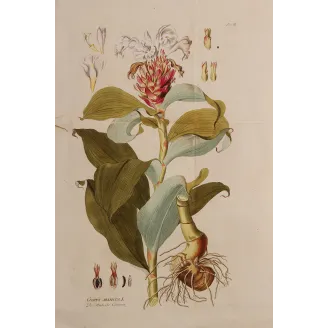
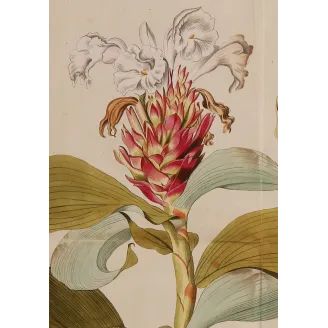
Exceptional large-format eighteenth-century botanical engraving depicting <em>Costus arabicus</em> L., published as Plate VII of Joseph Jacob von Plenck’s <em>Icones Plantarum Medicinalium</em>. Printed on an unusually large folded sheet measuring 66.3 × 43.5 cm, the composition combines a monumental flowering specimen, extensive root and rhizome structures and finely observed botanical details with beautifully preserved contemporary hand colouring. Complete Honig watermark with logo.
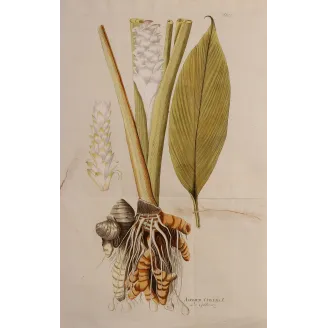
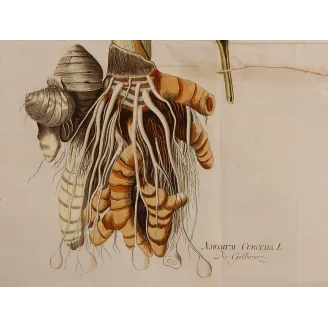
Exceptional large-format eighteenth-century botanical engraving depicting <em>Amomum Curcuma</em> L., published as Plate IV of Joseph Jacob von Plenck’s <em>Icones Plantarum Medicinalium</em>. Printed on a large folded sheet of Honig laid paper with complete watermark and contemporary hand colouring, the composition combines a remarkably refined pale inflorescence, monumental foliage and an exceptionally detailed rhizomatous structure. A powerful Plenck Statement Piece preserving both extraordinary botanical clarity and the visible material history of an eighteenth-century folded plate.
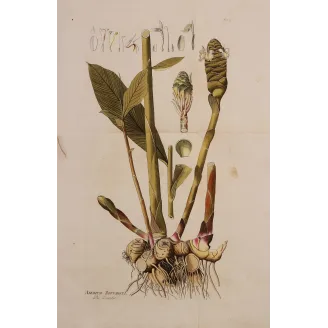
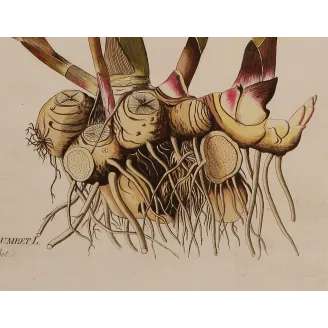
Exceptional large-format eighteenth-century botanical engraving depicting <em>Amomum Zerumbet</em> L., published as Plate II of Joseph Jacob von Plenck’s <em>Icones Plantarum Medicinalium</em>. Printed on a large folded sheet of Honig laid paper with complete watermark and contemporary hand colouring, the composition combines monumental rhizomatous structures, tall architectural stems and precisely observed analytical details. A rare large-scale Plenck Statement Piece with remarkable historical and visual presence.
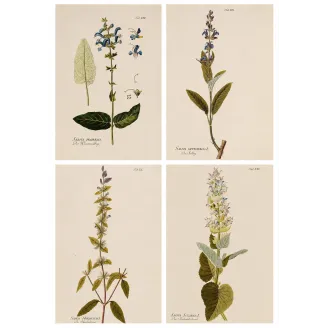
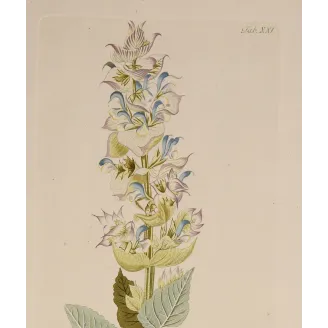
A complete four-plate botanical study devoted to the genus <em>Salvia</em>, preserved exactly as originally published within Joseph Jacob von Plenck's <em>Icones Plantarum Medicinalium</em>. Combining remarkable scientific integrity with exceptional decorative harmony, this Museum Quality Study Set represents one of the most visually refined surviving botanical sequences of the late eighteenth century.
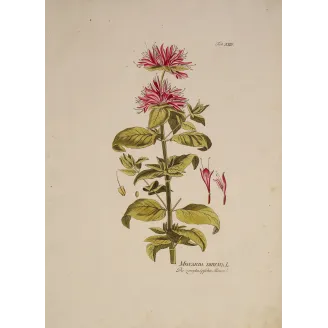
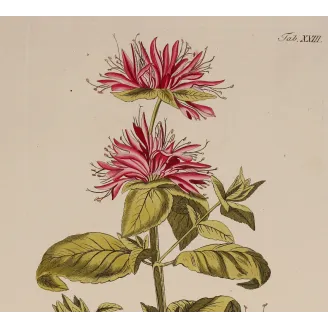
Original eighteenth-century botanical engraving depicting Monarda didyma L., published in Vienna as Plate XXIII of Joseph Jacob von Plenck's Icones Plantarum Medicinalium. This refined composition combines elegant vertical balance, delicate crimson flowers and beautifully preserved contemporary hand colouring on Honig laid paper with complete watermark.
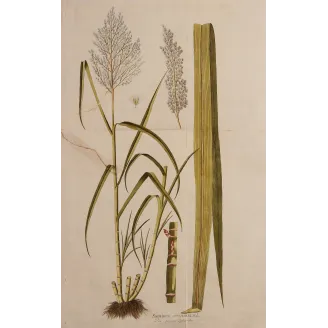
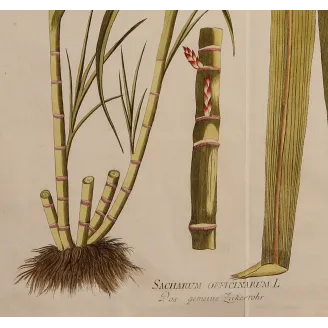
Exceptional large-format eighteenth-century botanical engraving depicting <em>Saccharum officinarum</em> L. (sugar cane), published as Plate 40 of Joseph Jacob von Plenck’s <em>Icones Plantarum Medicinalium</em>. Printed on a large folded sheet of laid paper with “IV” watermark and contemporary hand colouring, the composition combines the elegant vertical architecture of the cane with exceptionally delicate flowering panicles and a monumental isolated leaf. A distinctive Plenck Statement Piece preserving remarkable botanical clarity together with the visible material history of an eighteenth-century folded plate.
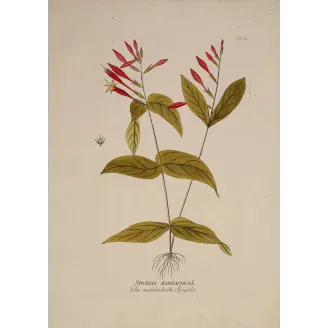
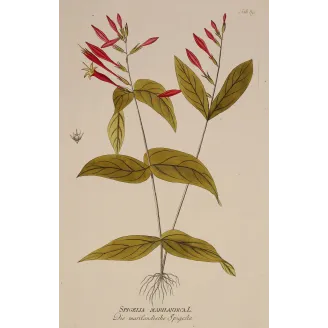
Original eighteenth-century botanical engraving depicting Spigelia marilandica L., published in Vienna as Plate 89 of Joseph Jacob von Plenck's Icones Plantarum Medicinalium. The elegant composition is distinguished by its graceful vertical rhythm, brilliant scarlet tubular flowers and refined contemporary hand colouring on fine laid paper.
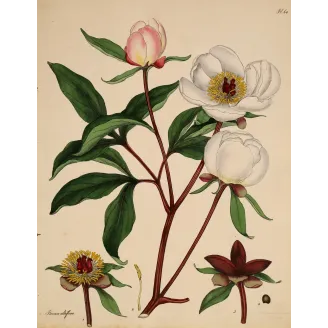
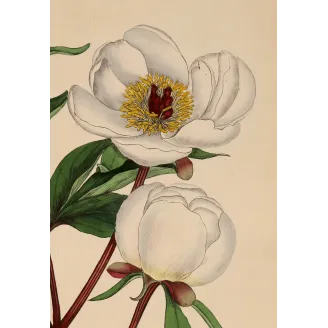
An exceptionally refined original hand-coloured engraving depicting the White Peony, published by Henry Charles Andrews in The Botanist's Repository in 1799. Delicate grey modelling, luminous white petals and beautifully preserved gum arabic finishing make this one of the finest botanical plates of the series.
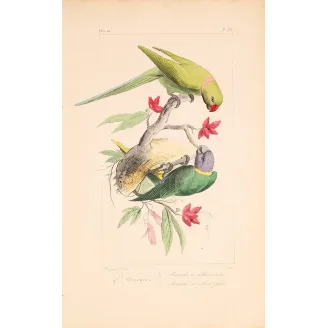
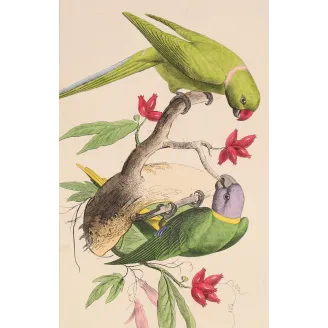
A refined 19th-century engraving depicting two parakeets arranged in a fluid and harmonious composition. The dominant green tones, enhanced by delicate red and violet accents, create an elegant and highly decorative natural history print.
Original nineteenth-century hand-colored engraving depicting the Jamaican Mango (Anthracothorax mango), a striking tropical hummingbird illustrated by Ludwig Reichenbach in his celebrated Trochilinarum Enumeratio.
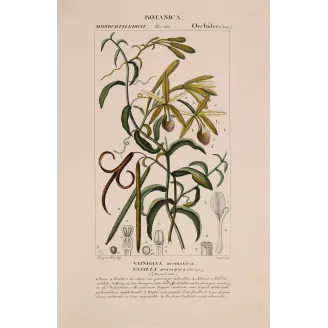
Delicate orchid illustration showing flower, pod and internal anatomy of vanilla.
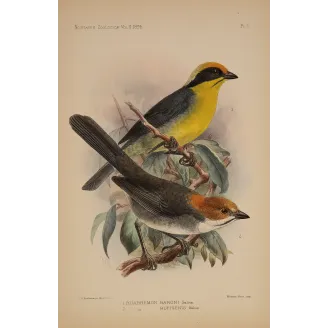
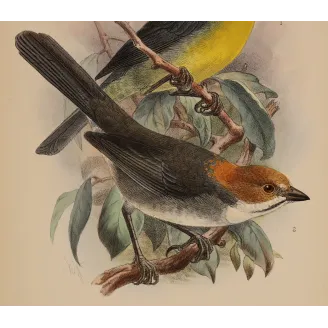
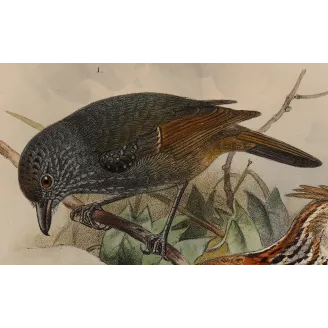
Original hand-coloured lithograph by John Gerrard Keulemans from Novitates Zoologicae, Volume II, Plate I, published in 1895. The composition depicts two Peruvian Andean brushfinches against a restrained botanical setting, with selective gum arabic highlights around the eyes and across parts of the upper bird’s wings. Printed by Mintern Bros. on substantial wove paper and preserved in very good condition.
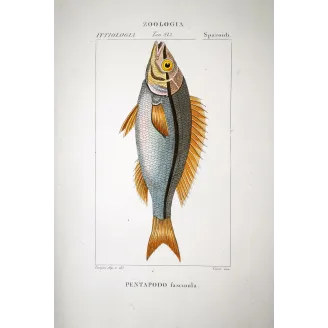
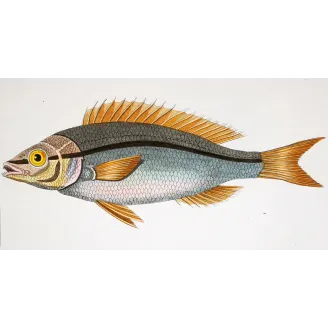
Elegant Pentapodus fish with shimmering orange-silver tones and refined aquatic poise.
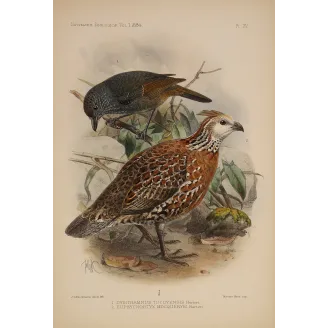
Original hand-coloured lithograph by John Gerrard Keulemans from Novitates Zoologicae, Volume I, Plate XV, published in 1894. The composition presents a Venezuelan White-streaked Antvireo above a richly patterned Crested Bobwhite, using vertical placement to suggest two distinct ecological levels within the same natural environment. Selective gum arabic remains visible on the pupils of both subjects and more extensively across the plumage of the lower bird. Printed by Mintern Bros. on substantial wove paper and preserved in very good condition.
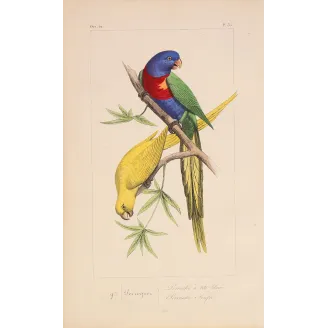
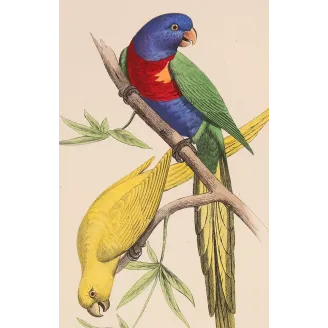
Highly decorative 19th-century engraving of exotic parakeets with vivid blue, red and yellow plumage. A striking and colorful antique bird print.
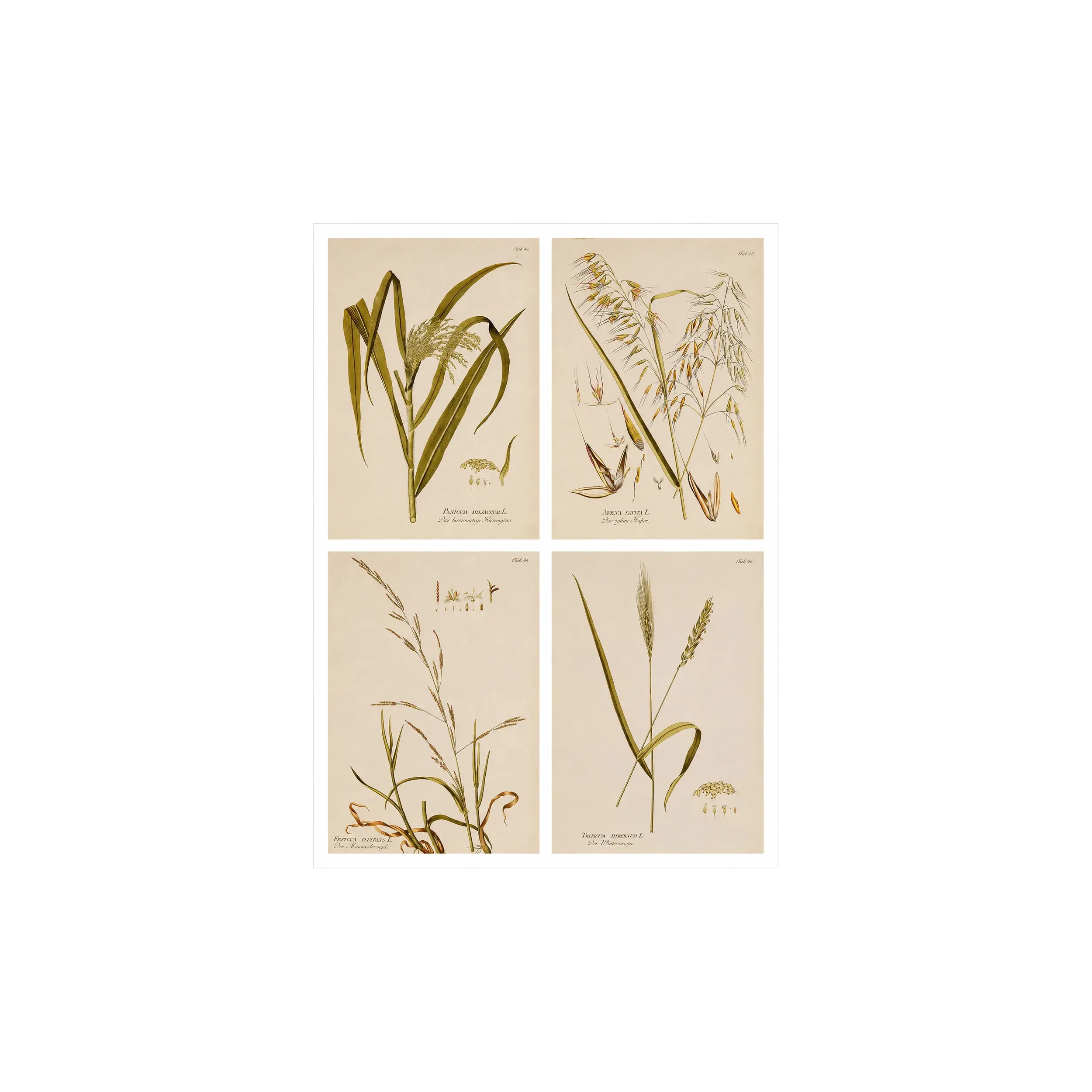
Seven-plate botanical corpus devoted to Europe's principal cereal crops, preserved exactly as originally published in Joseph Jacob von Plenck's Icones Plantarum Medicinalium. Combining scientific precision, historical significance and remarkable visual harmony, this Museum Quality Study Set documents the plants that shaped European agriculture and civilisation.