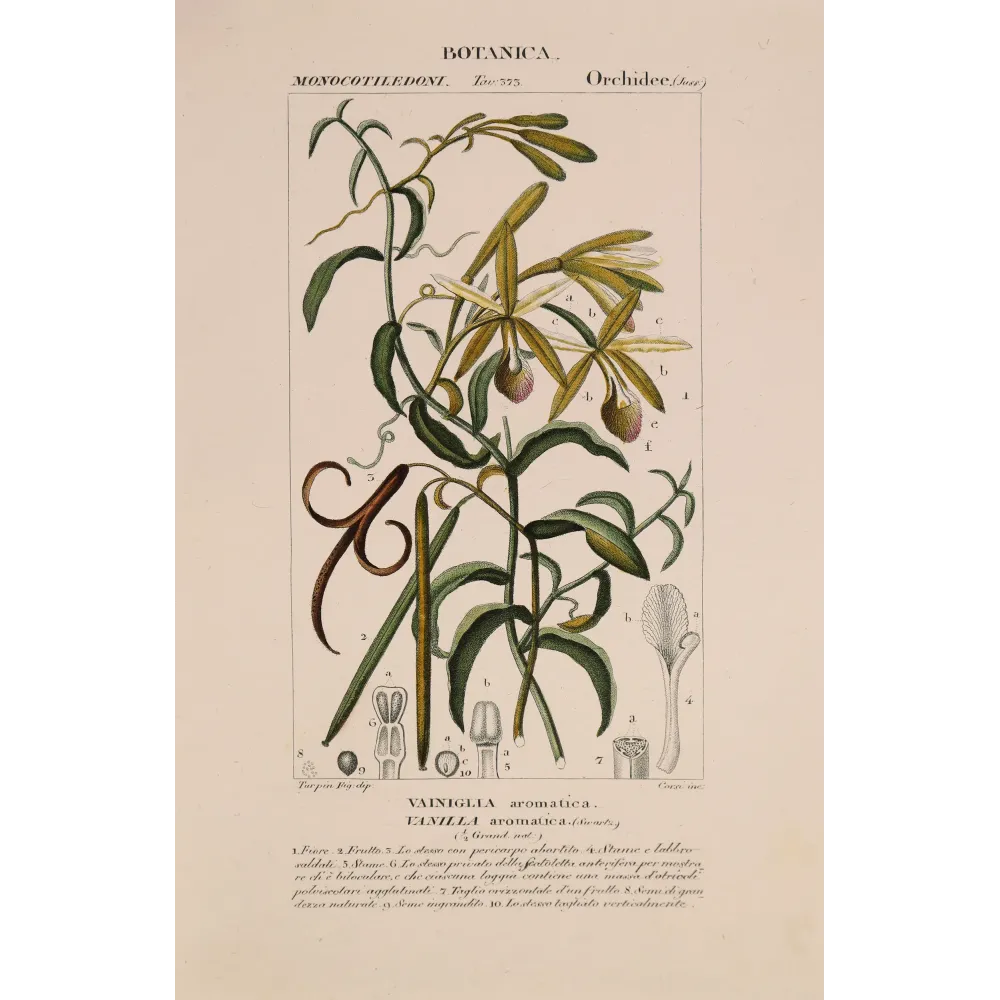
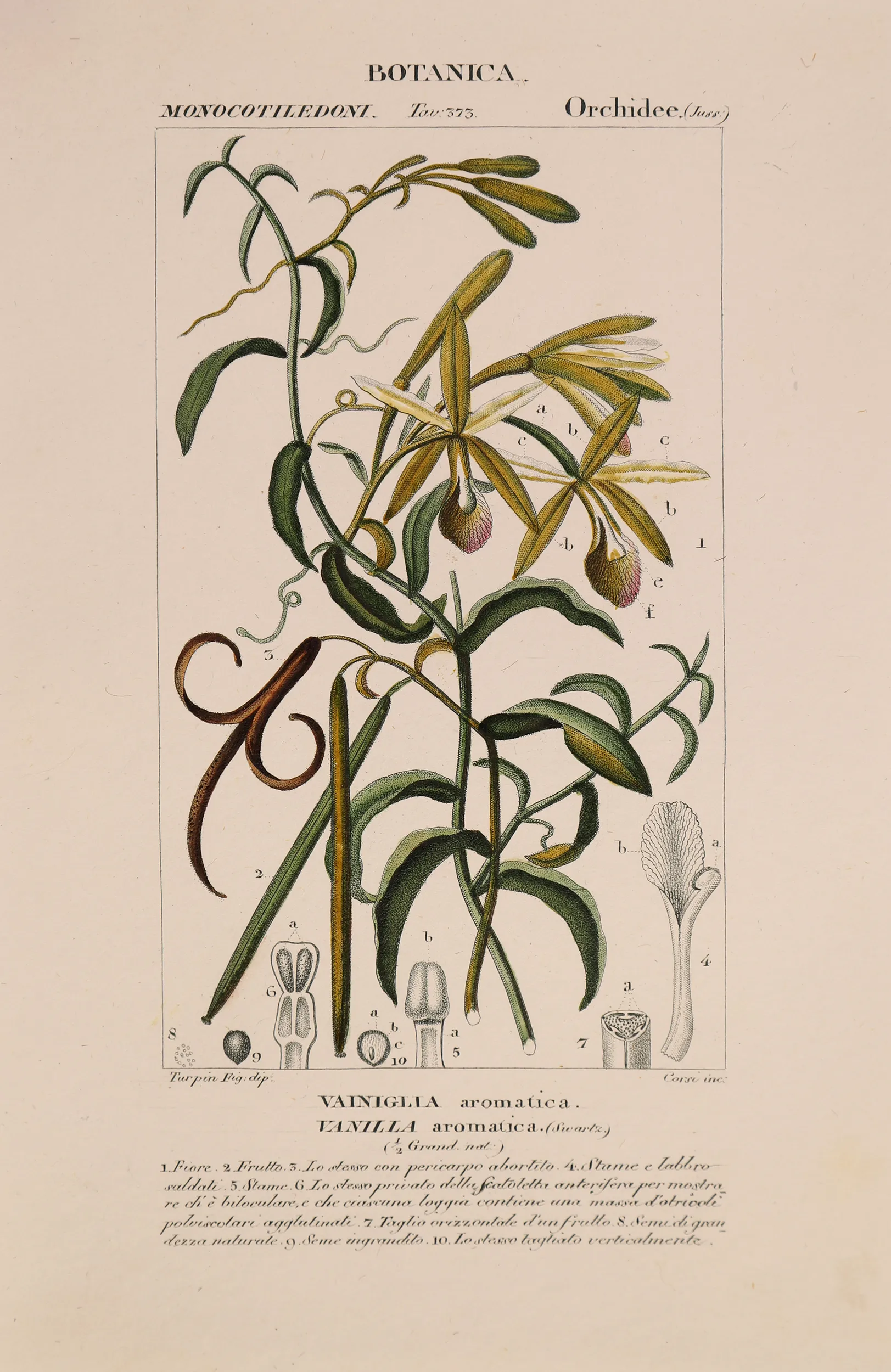
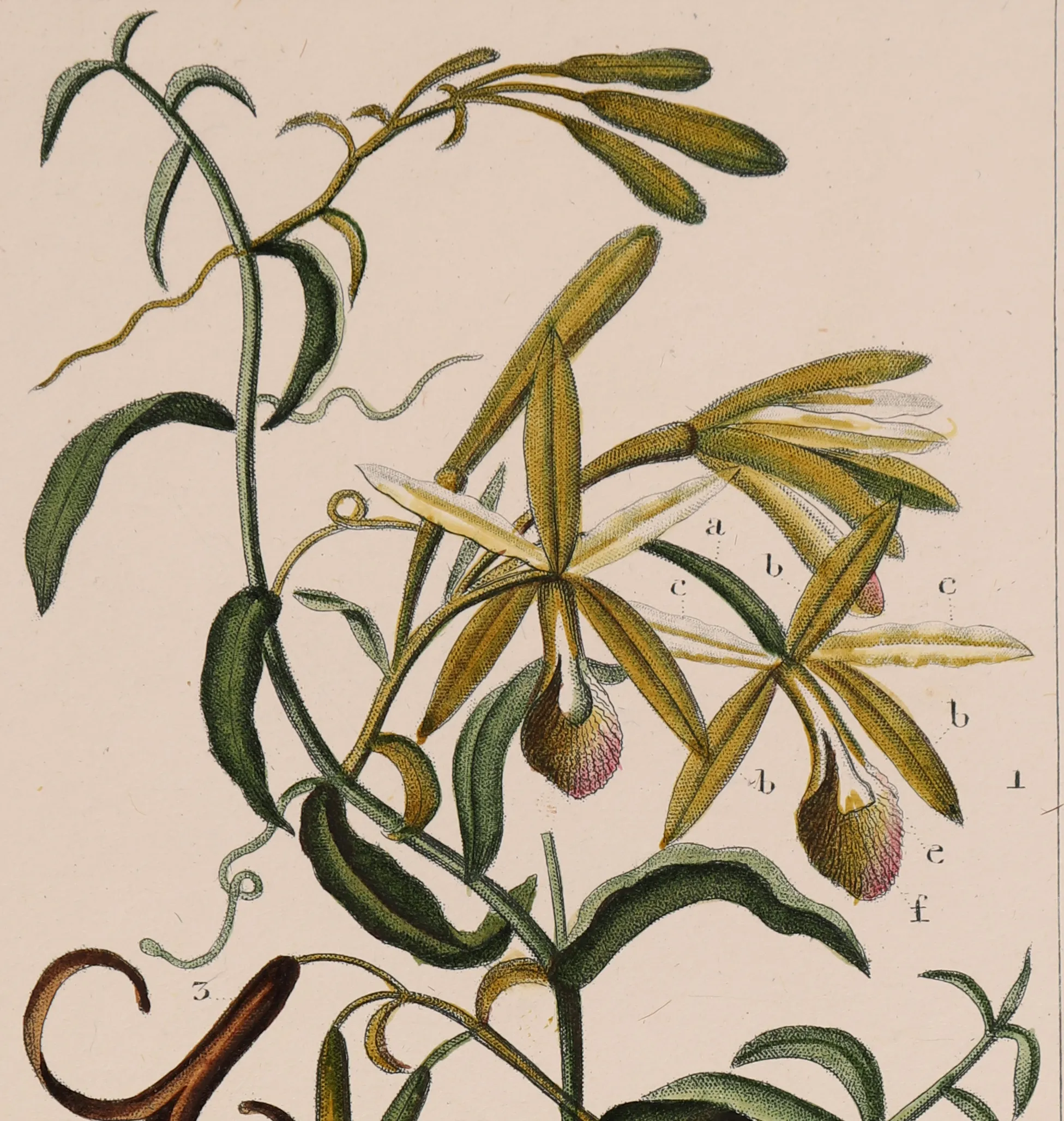
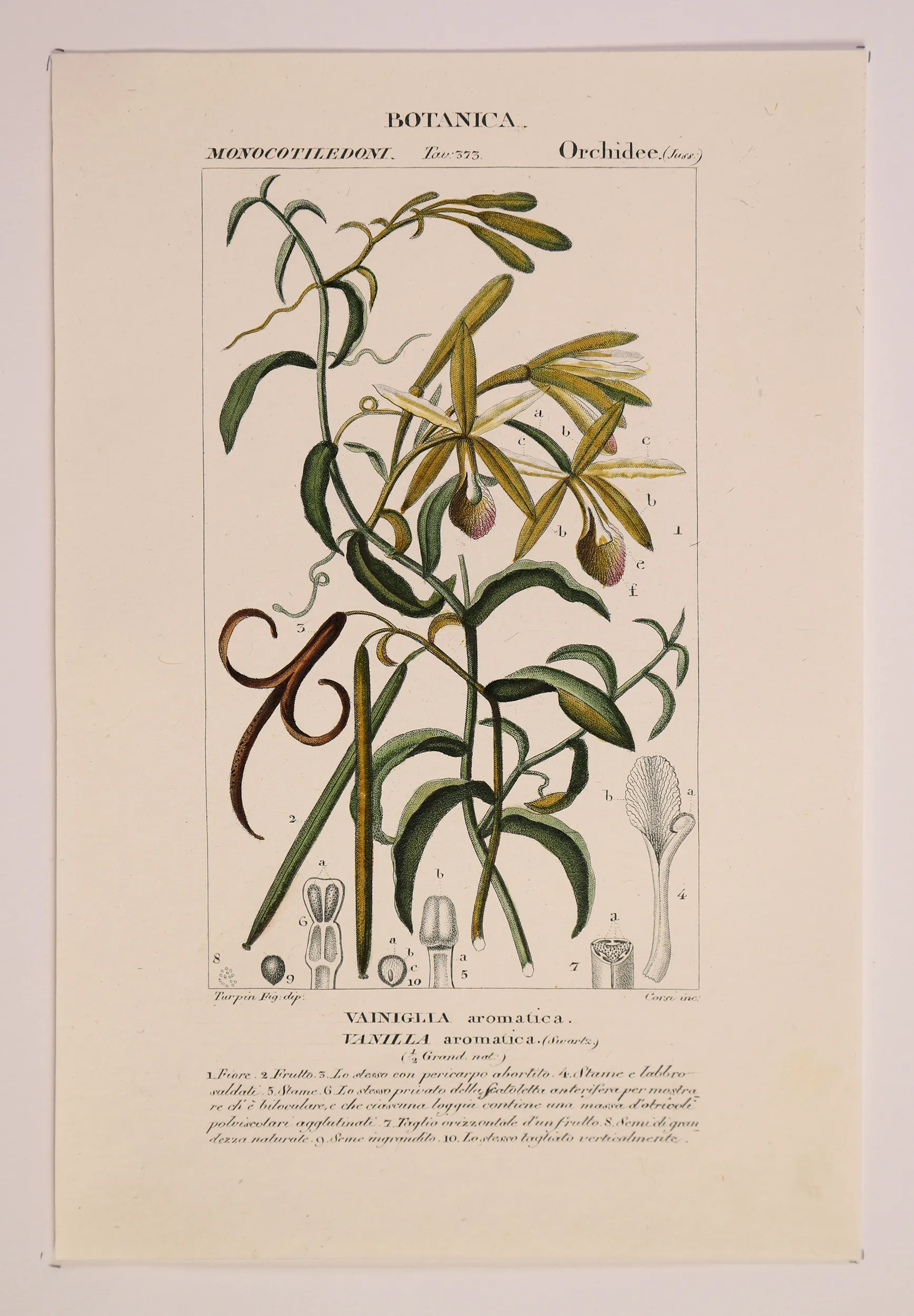

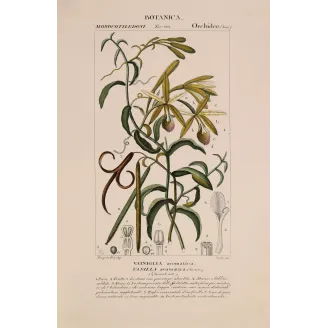
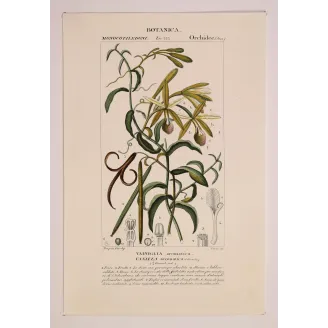
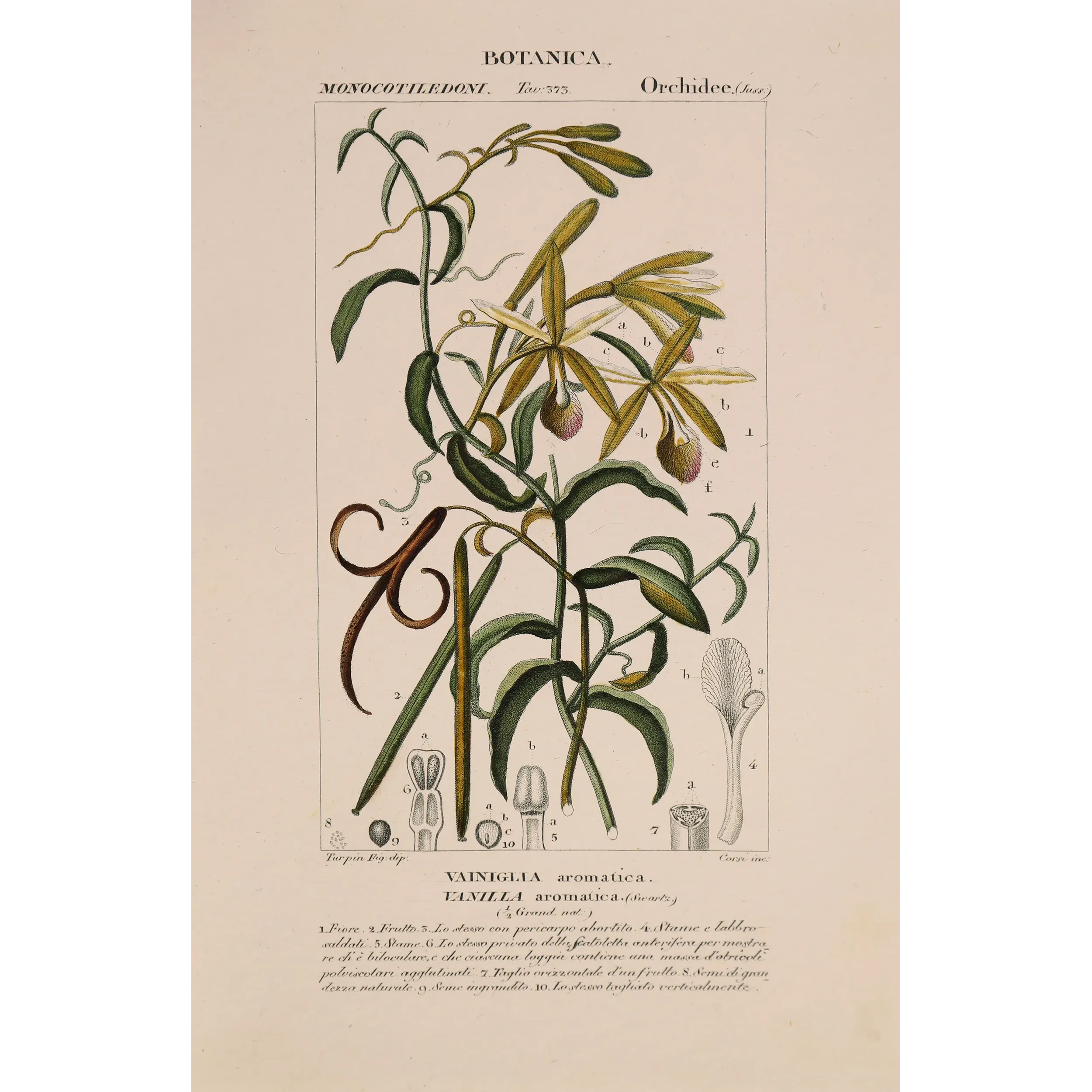
Delicate orchid illustration showing flower, pod and internal anatomy of vanilla.
 Delivery policy
Your print will be carefully prepared and shipped worldwide via trusted couriers (UPS or similar).
 Authentic antique prints
Original engravings from the 17th–19th century.
This refined engraving presents Vanilla aromatica, a species historically associated with the vanilla orchid. The plate combines flowering structure, elongated fruit pods and analytical dissections, offering a complete botanical study of one of the most valued aromatic plants in global trade.
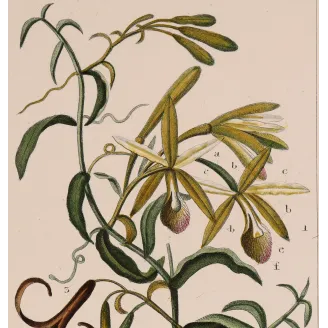
Turpin’s composition is both graceful and systematic. The sinuous climbing stem introduces movement, while the star-like yellow-green blossoms radiate outward with delicate symmetry. The pendant fruit pods — rendered with subtle shading — provide visual weight and establish vertical balance within the sheet.
The engraving belongs to the Italian edition of the Dizionario di Scienze Naturali (Florence, Battelli press), an early nineteenth-century encyclopedic work dedicated to documenting the natural world with scientific discipline and refined engraving technique.
— • —
The plate unfolds along an elegant vertical axis, echoing the climbing habit of the orchid itself. The elongated leaves create a rhythmic progression, while the blossoms introduce a luminous chromatic focal point. The curved tendrils and arching stem soften the geometry, giving the composition a refined organic fluidity.
The lower analytical figures — reproductive structures, sectional views and seed detail — reinforce scientific credibility without compromising aesthetic harmony. The controlled hand-colouring enhances tonal variation, particularly within the petals and fruit pods, maintaining clarity and restraint.
Vanilla aromatica belongs to the orchid family (Orchidaceae), one of the most diverse and botanically complex plant families. Native to tropical regions of the Americas, vanilla became a prized commodity in Europe from the seventeenth century onward, valued for the aromatic compound vanillin contained within its cured seed pods. Unlike most orchids, the vanilla plant produces an elongated fruit of significant commercial importance, though its cultivation historically required specific pollination conditions that limited production outside its native habitat. By the early nineteenth century, when this engraving was produced, naturalists were still refining their understanding of orchid reproductive mechanisms, making such analytical studies particularly significant. The vanilla orchid thus occupies a unique position at the intersection of botany, global commerce and sensory culture — a plant whose scientific fascination matched its economic and culinary prestige.
This plate forms part of the historic Dizionario di Scienze Naturali, once preserved within a noble library and today housed in the Sacchetti Collection. Each engraving reflects a period in which scientific scholarship was supported by exceptional artisanal execution — from the precision of the engraved copperplate line to the luminous hand-colouring applied individually to every sheet.
Such works were conceived not merely as decorative images, but as authoritative visual instruments of knowledge. To explore the broader story of these rare prints and their refined provenance, we invite you to read our editorial feature “Not Just Another Print”.
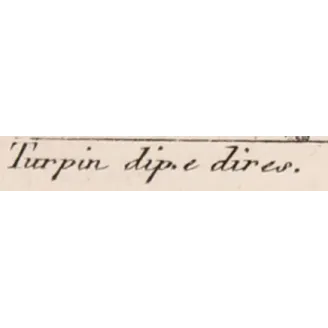
The engraving is in excellent antique condition. The sheet presents clean margins and a clear impression. The paper is smooth early nineteenth-century wove paper (non-laid). No watermark has been observed. The original hand-colouring remains fresh and well preserved. The engraved credit “Turpin dis.” is present, confirming the original drawing by Pierre Jean François Turpin.
For further context on Pierre Jean François Turpin and his contribution to nineteenth-century botanical science, see our editorial feature:
Pierre Jean François Turpin – The Botanical Illustrator of Natural Harmony
Specific References
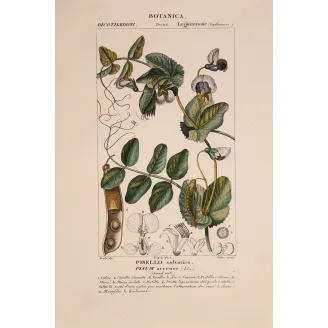
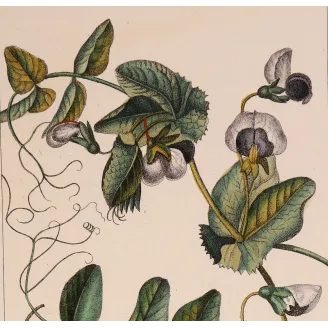
Colorful botanical illustration of Pisum arvense, wild pea, engraved by Turpin.
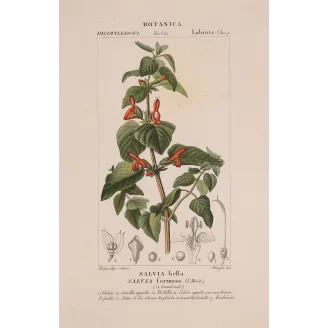
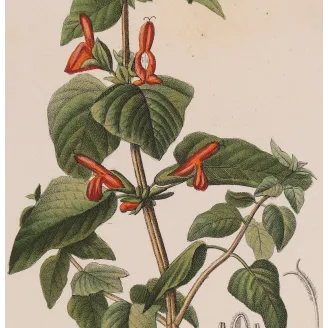
Vivid botanical plate of Salvia formosa, with striking red-orange tubular flowers.
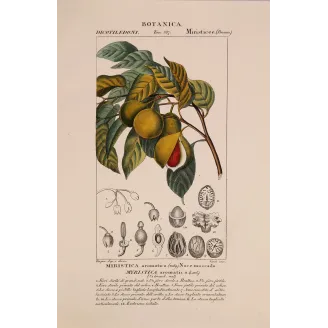
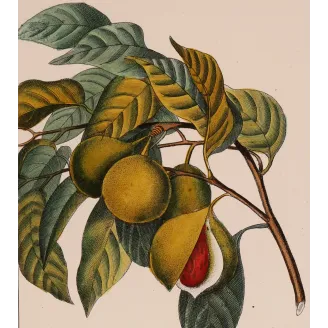
Striking botanical print of nutmeg fruit with cutaway sections and seed structure.
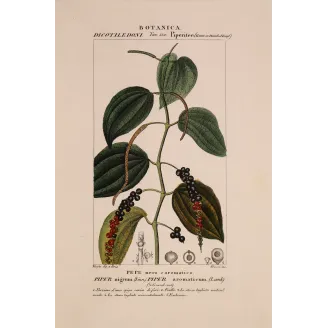
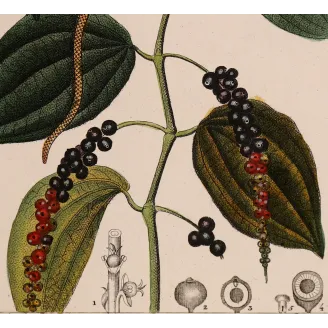
Detailed depiction of the black pepper vine with fruiting spikes and leaves.
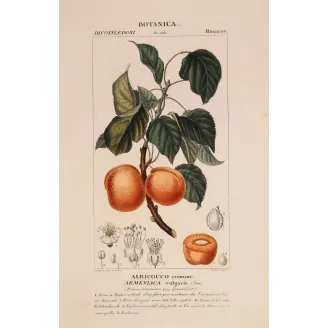
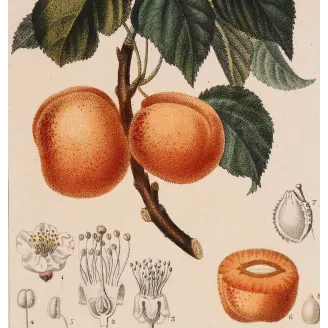
Original 19th-century botanical engraving of the common apricot, showing its velvety orange fruits and lush green leaves, rendered with great naturalistic balance.
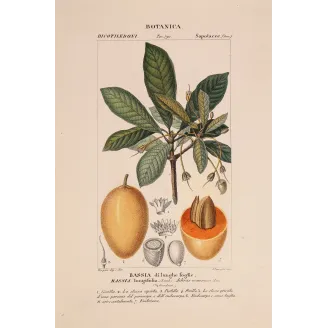
A rare depiction of *Bassia longifolia*, showing its elongated leaves and fruit sections in precise scientific detail and soft hand-colored tones.
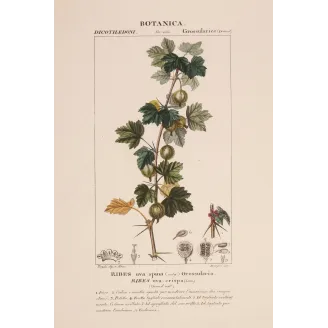
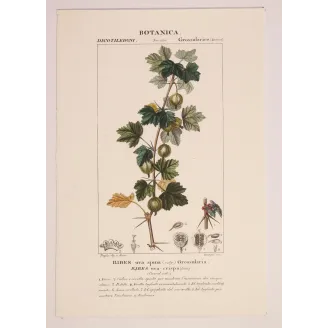
A charming depiction of *Ribes uva-crispa*, the gooseberry plant, detailed with its spiny stems and translucent green fruits.
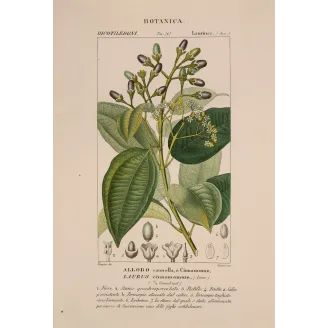
Elegant illustration of Laurus cinnamomum, showing leaves, flowers and seeds.
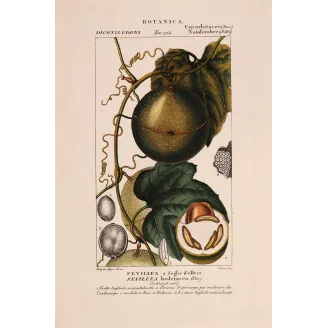
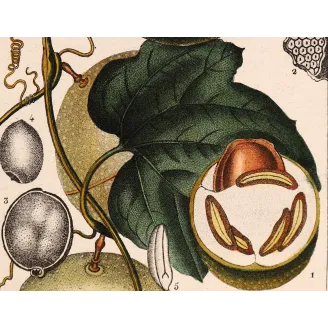
A coordinated pair of engravings depicting *Fevillea hederacea*, with intricate tendrils and elegant fruit structure, hand-colored with precision.
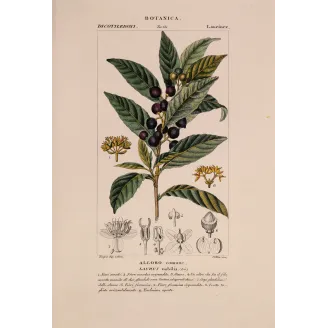
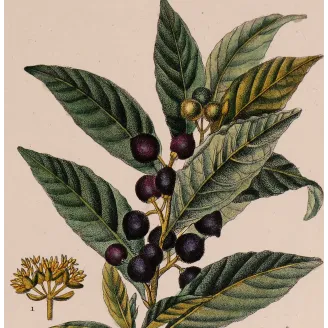
Graceful composition of bay laurel with fruits, blossoms, and internal flower structure.
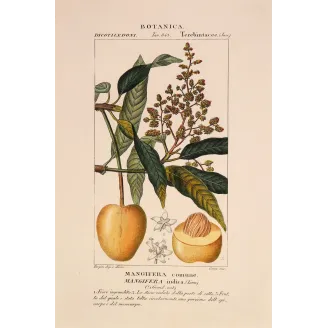
Vibrant hand-colored depiction of *Mangifera indica*, the mango tree, highlighting its lush leaves, golden fruit, and floral details.
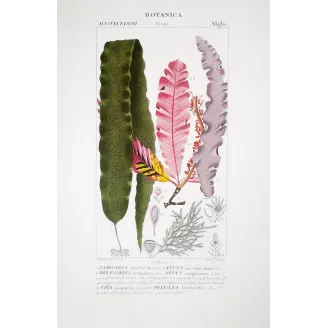
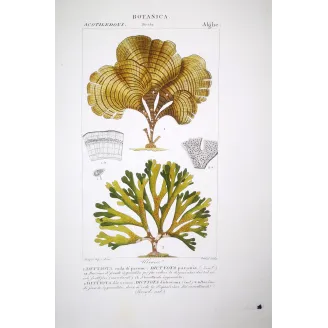
A unique lot of 7 hand-colored antique prints depicting various species of algae, illustrated by Turpin and Prêtre.
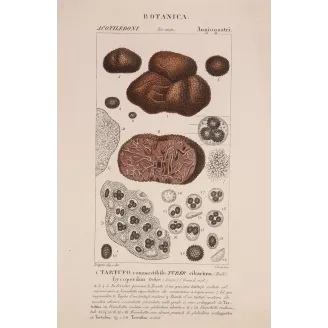
Unusual and fascinating botanical study of truffle morphology, rich in scientific detail.
Delicate orchid illustration showing flower, pod and internal anatomy of vanilla.