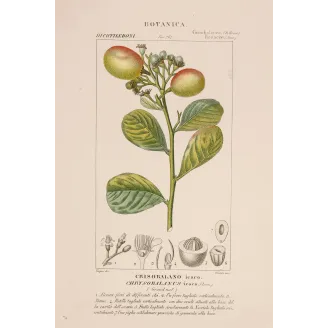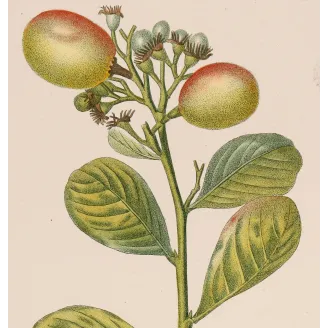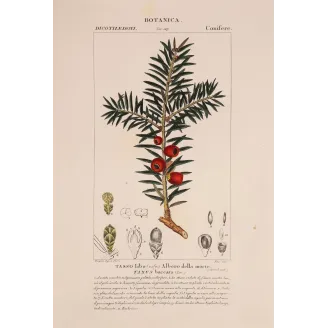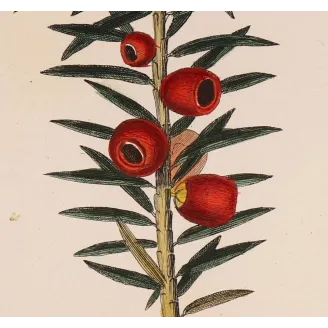
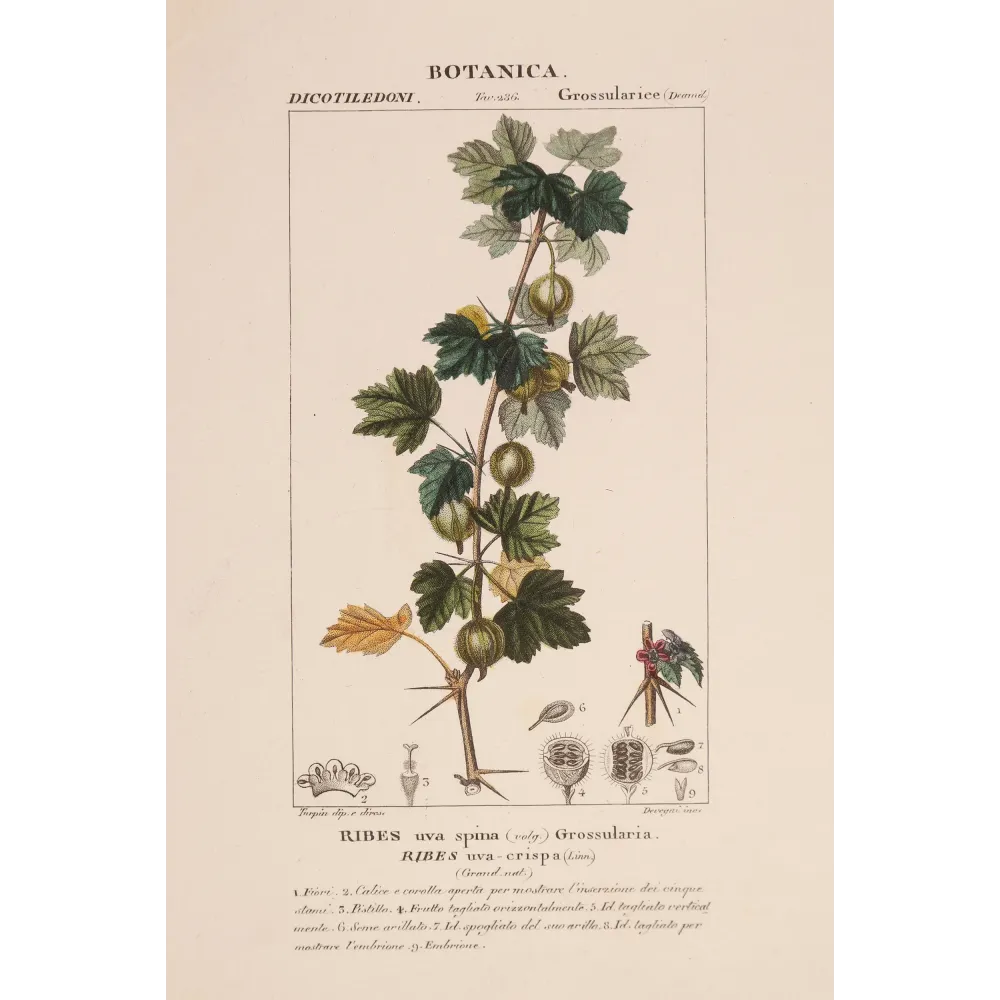
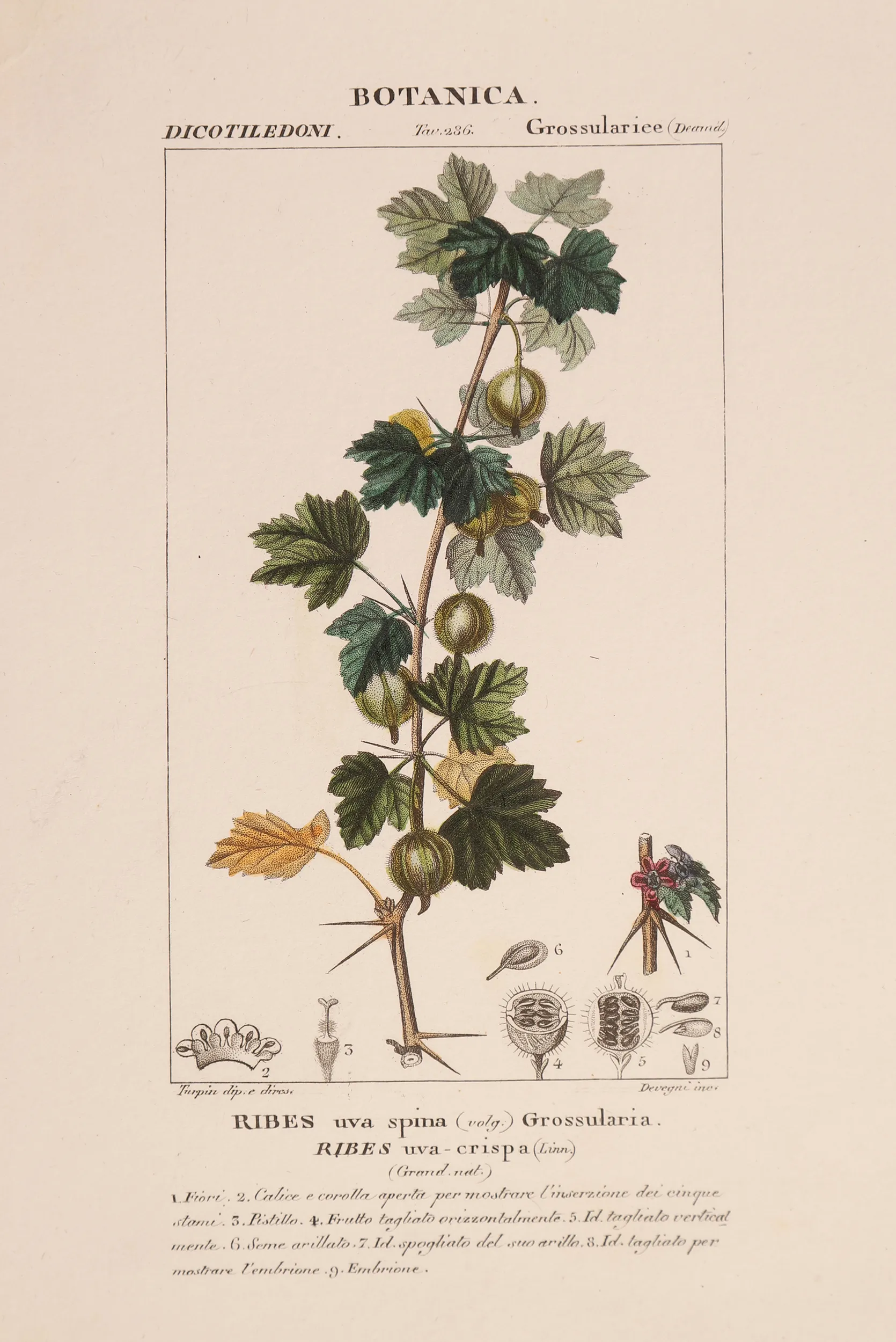
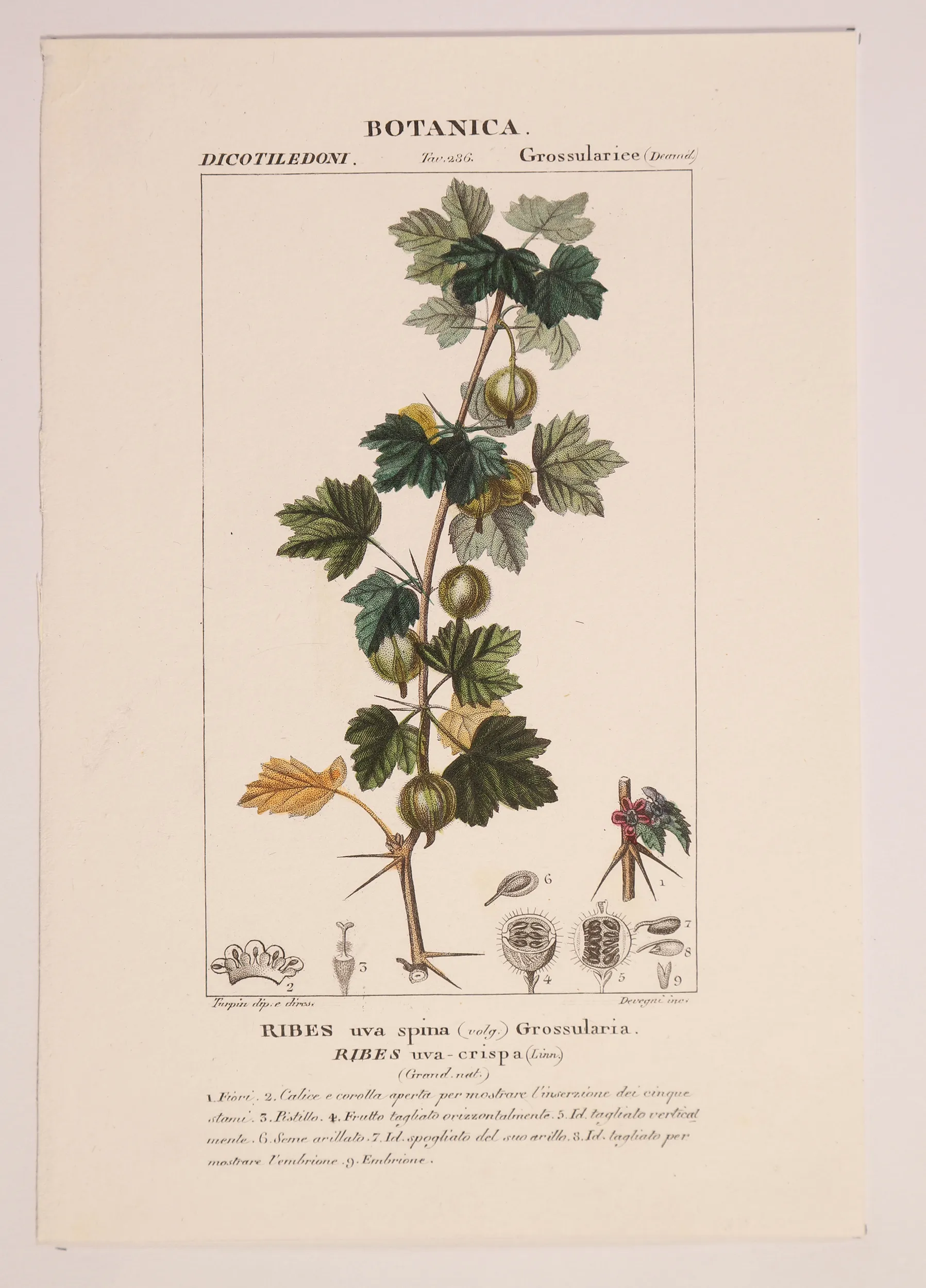

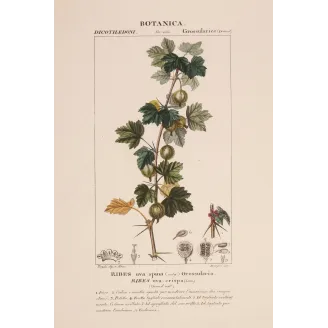
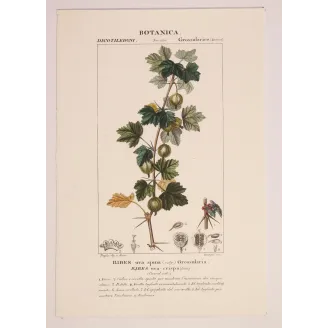
A charming depiction of *Ribes uva-crispa*, the gooseberry plant, detailed with its spiny stems and translucent green fruits.
 Delivery policy
Your print will be carefully prepared and shipped worldwide via trusted couriers (UPS or similar).
 Authentic antique prints
Original engravings from the 17th–19th century.
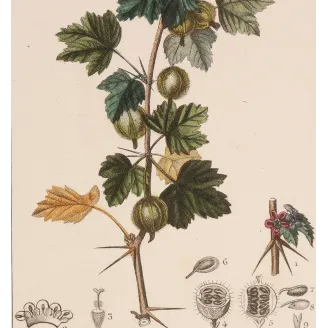
This original hand-colored engraving depicts Ribes uva-crispa, commonly known as gooseberry. The plate presents a fruiting branch complete with mature and developing berries, accompanied by detailed botanical studies of flower, calyx, and seed.
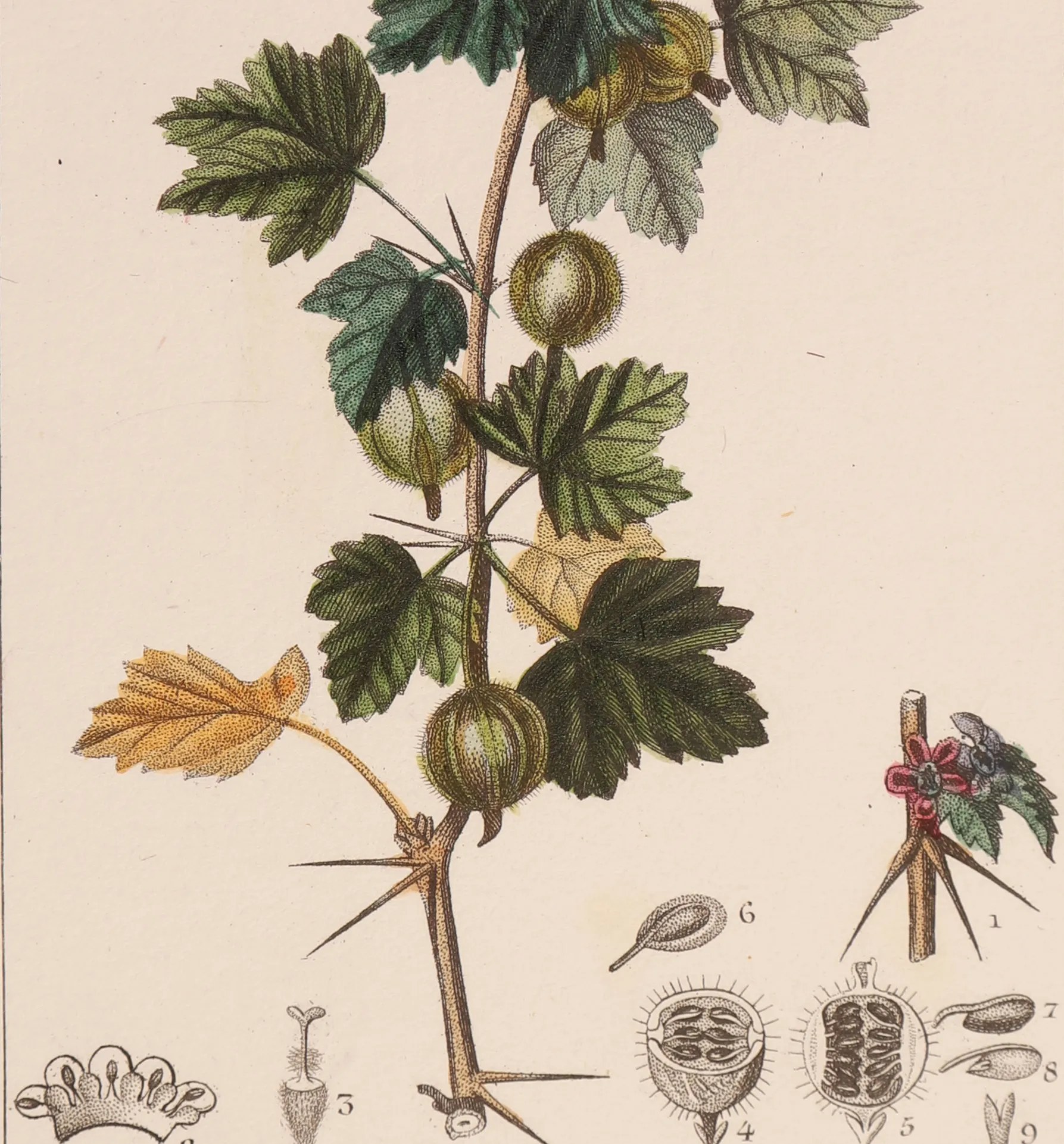
The rounded, translucent green fruits are rendered with subtle vertical striping and fine stippling, conveying their delicate skin and internal tension. The serrated leaves, articulated with careful tonal modulation, frame the composition with measured density, while the visible thorns introduce structural rhythm and realism.
The engraving belongs to the Italian edition of the Dizionario di Scienze Naturali (Florence, Battelli press), one of the most ambitious early nineteenth-century encyclopedic publications devoted to systematic natural history.
— • —
The composition emphasizes vertical progression along the thorned stem, with fruit placed at rhythmic intervals. The restrained palette—cool greens, muted yellows, and subtle browns—creates a sober, almost northern European atmosphere distinct from the saturated tones of tropical species.
The botanical diagrams below reveal internal structure with analytical precision. Turpin’s disciplined linework ensures that the subject retains scientific authority while preserving decorative balance.
Ribes uva-crispa has long been cultivated throughout Europe, particularly in Britain, France, and the Low Countries. During the eighteenth and nineteenth centuries, gooseberry cultivation became associated with garden societies and amateur horticulture, reflecting the growing Enlightenment interest in systematic plant breeding.
Unlike many exotic fruits recorded in early nineteenth-century botanical literature, the gooseberry represents domestic agriculture and rational improvement. Within Turpin’s visual corpus, it stands as a reminder that natural history documented not only distant tropical species, but also the everyday fruits that shaped European gardens and rural economies.
This plate forms part of the historic Dizionario di Scienze Naturali, once preserved within a noble library and today housed in the Sacchetti Collection. Each engraving embodies a period when scientific documentation required both intellectual rigor and artisanal mastery — from the engraved copperplate line to the individually applied hand-colouring.
To explore the refined provenance of these works, we invite you to read our editorial feature “Not Just Another Print”.
The engraving is preserved in excellent antique condition. The sheet presents clean margins and a crisp, well-defined impression. The original early nineteenth-century smooth wove paper remains stable and evenly toned. No watermark has been observed. The hand-colouring retains clarity, particularly in the layered foliage and the delicate translucency of the fruit.
For further context on Pierre Jean François Turpin and his contribution to nineteenth-century botanical science, see our editorial feature:
Pierre Jean François Turpin – The Botanical Illustrator of Natural Harmony
Specific References
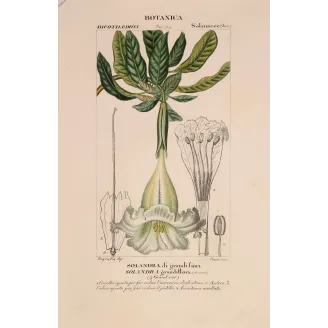
Beautiful antique flower print of Solandra, with large trumpet-shaped bloom.
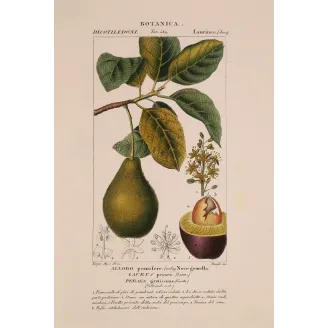
Botanical plate of avocado with whole fruit, seed, and internal anatomy.
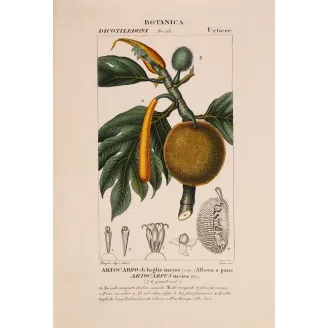
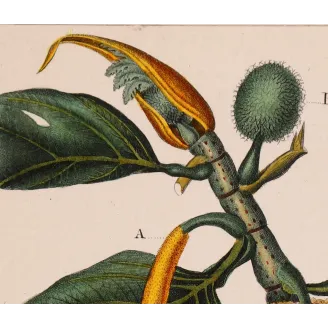
An extraordinary 19th-century engraving of *Artocarpus incisa*, the breadfruit tree, showcasing its bold leaves and unique fruit texture.
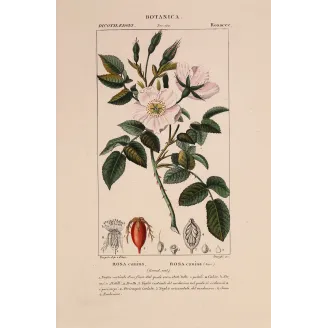
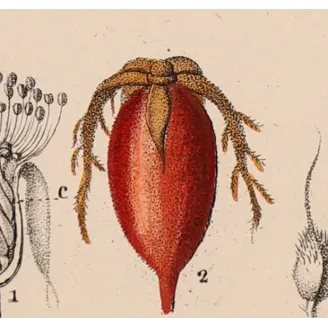
Delicate dog rose flower with soft pink petals and fine botanical details.
Elegant hand-colored botanical engraving of *Chrysobalanus icaco*, showing the round fruits and smooth glossy leaves in rich natural hues.
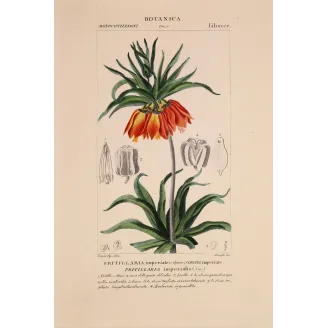
Striking antique print of Fritillaria imperialis with bright orange crown flowers.
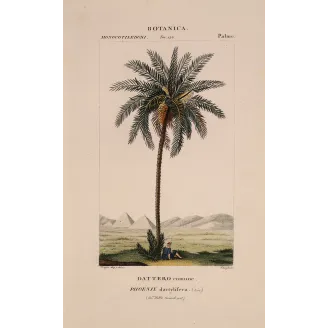
Detailed antique illustrations of the date palm tree and its floral and fruit anatomy.
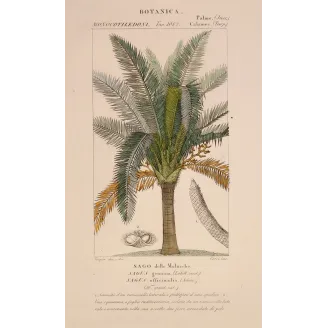
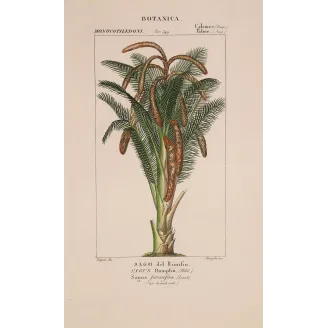
A pair of plates dedicated to the sago palm tree and its structural details.
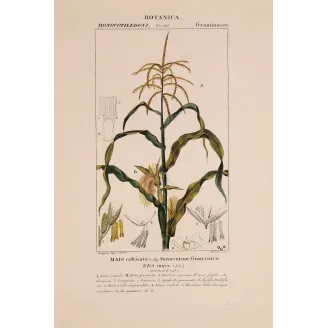
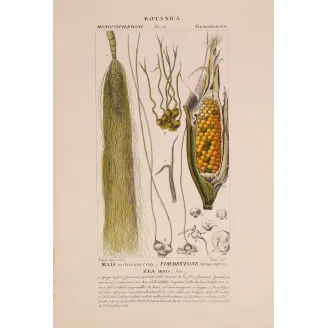
Double plate of cultivated maize (Zea mays) from Turpins botanical series.
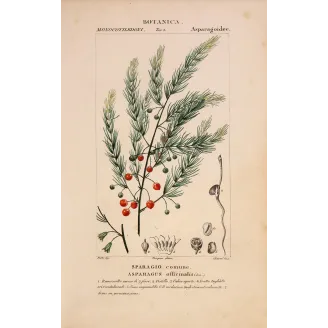
Botanical print of Asparagus officinalis by Turpin, featuring vivid orange berries.
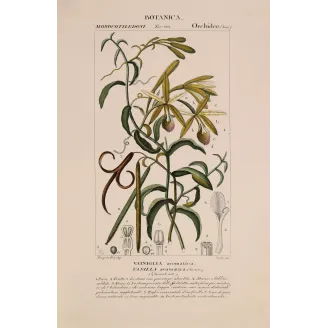
Delicate orchid illustration showing flower, pod and internal anatomy of vanilla.
Elegant hand-colored plate of the juniper plant with berries and cone structure.
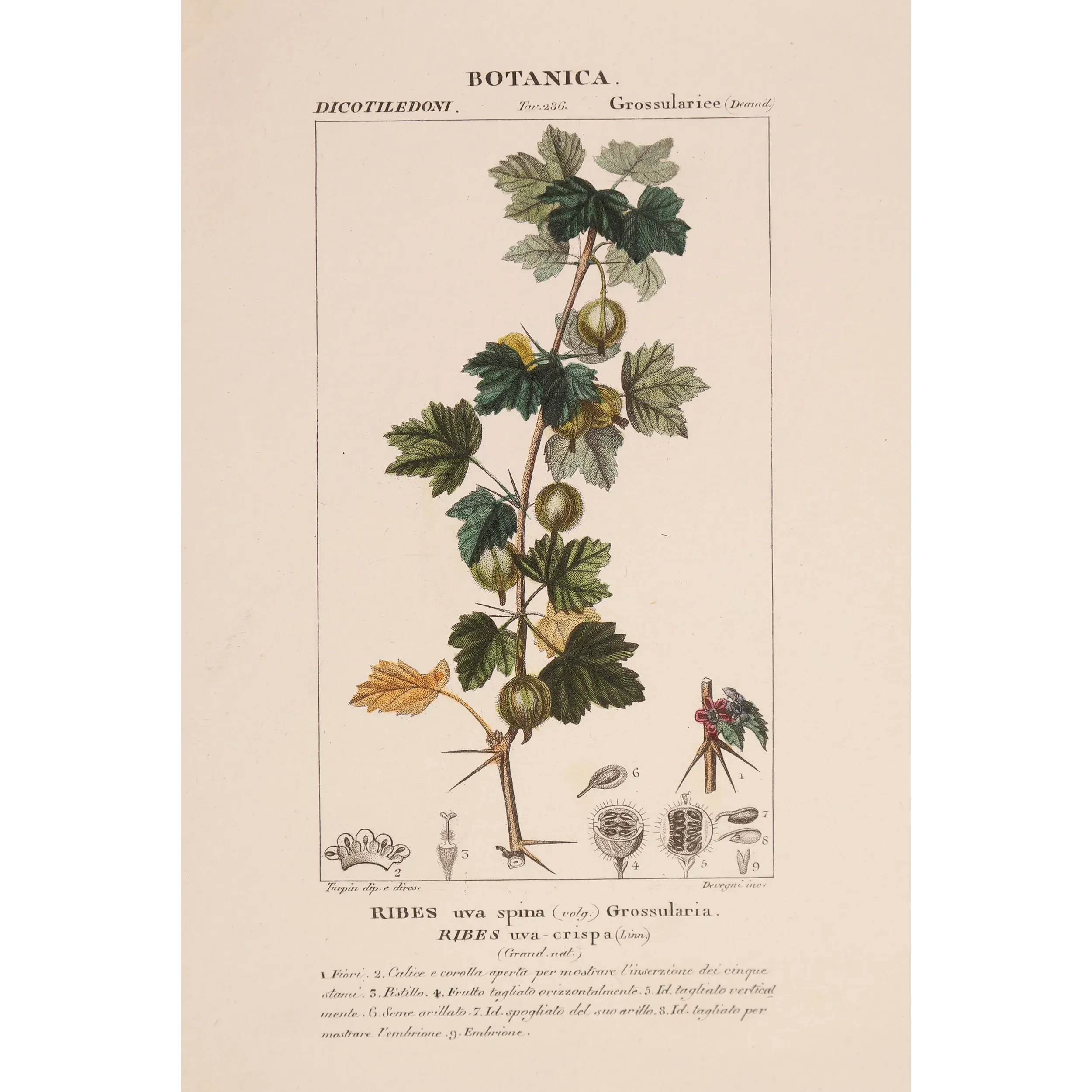
A charming depiction of *Ribes uva-crispa*, the gooseberry plant, detailed with its spiny stems and translucent green fruits.