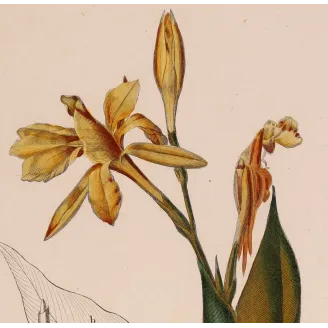
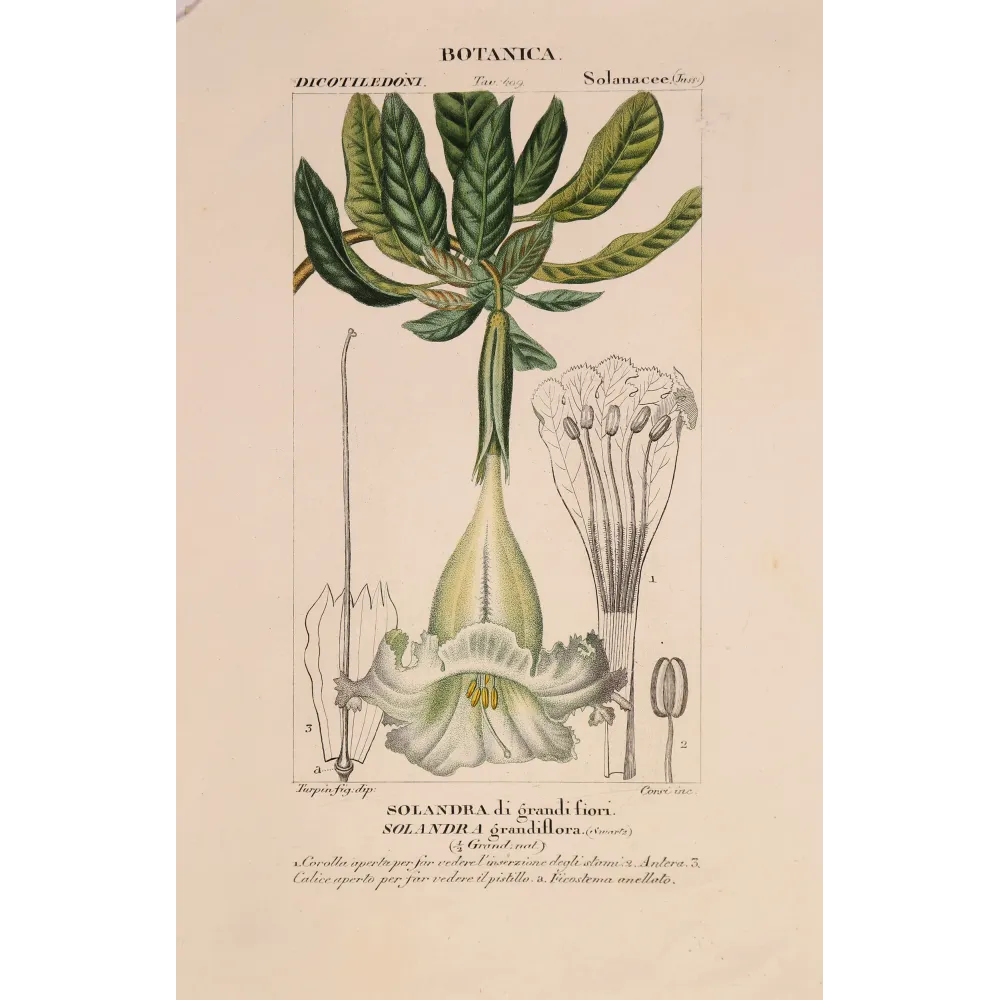
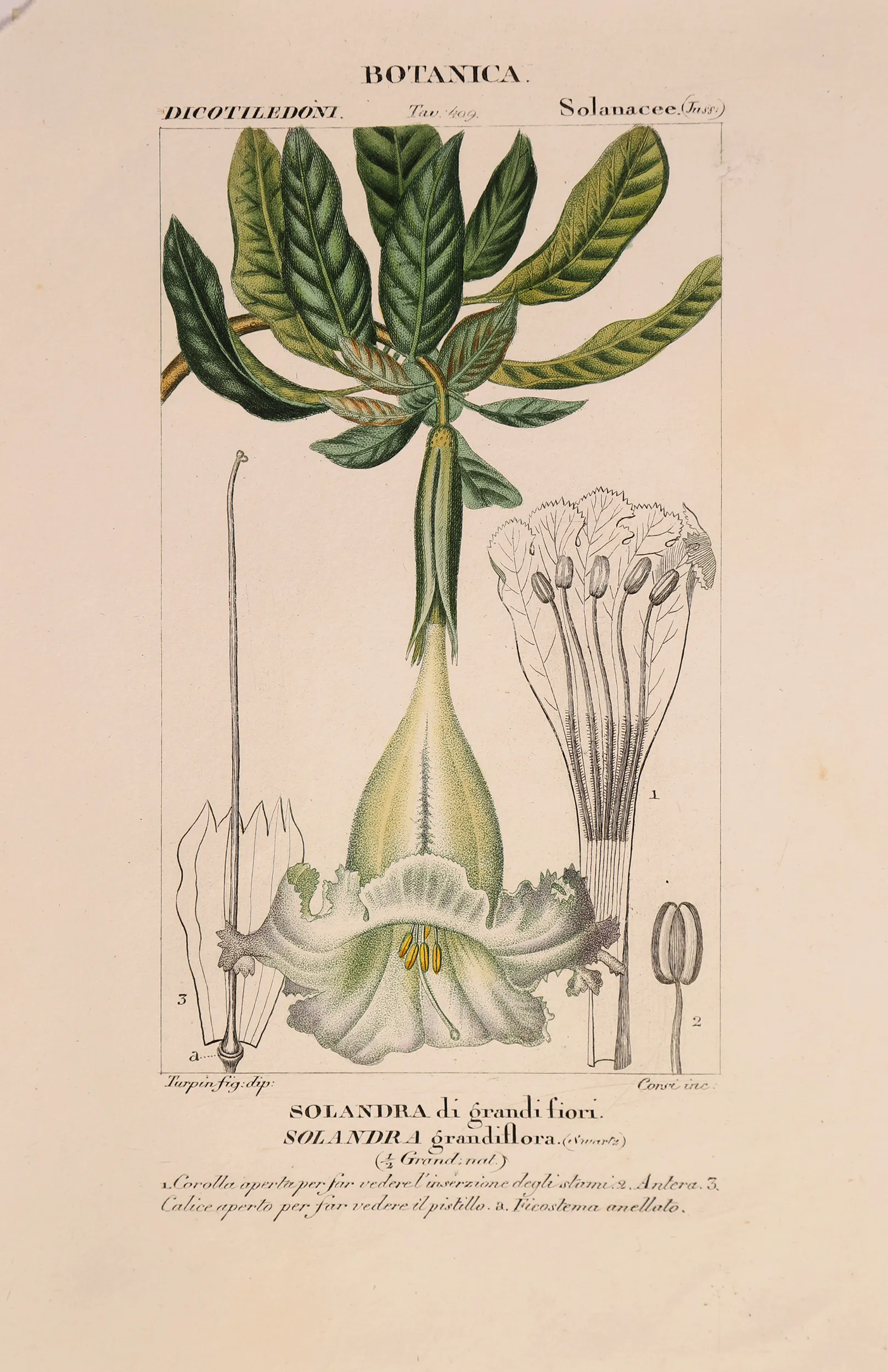

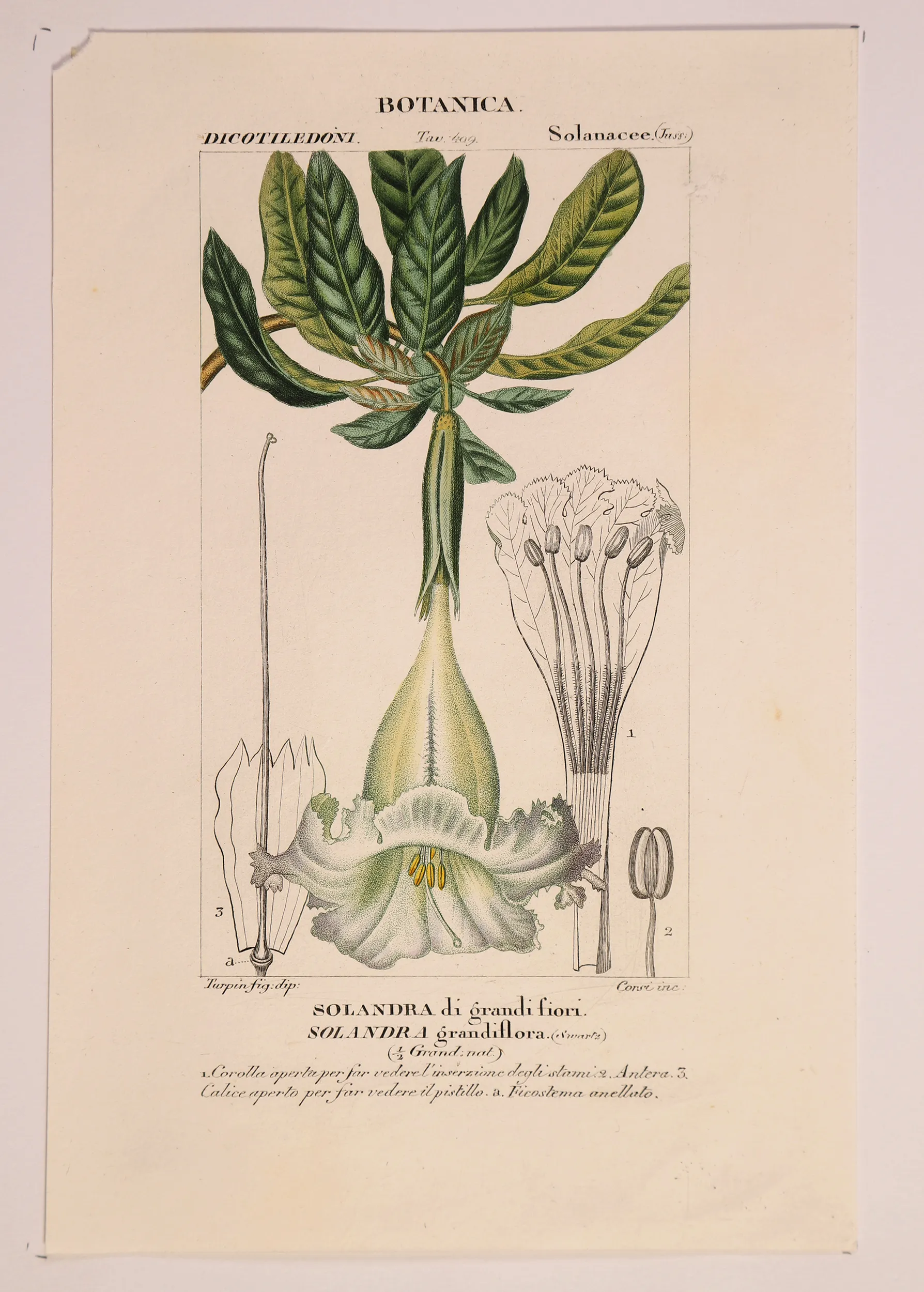
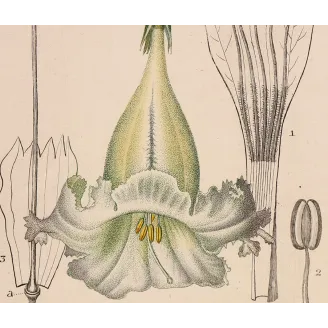
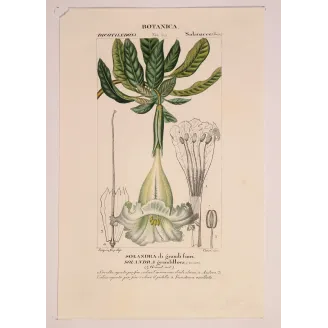
Beautiful antique flower print of Solandra, with large trumpet-shaped bloom.
 Delivery policy
Your print will be carefully prepared and shipped worldwide via trusted couriers (UPS or similar).
 Authentic antique prints
Original engravings from the 17th–19th century.
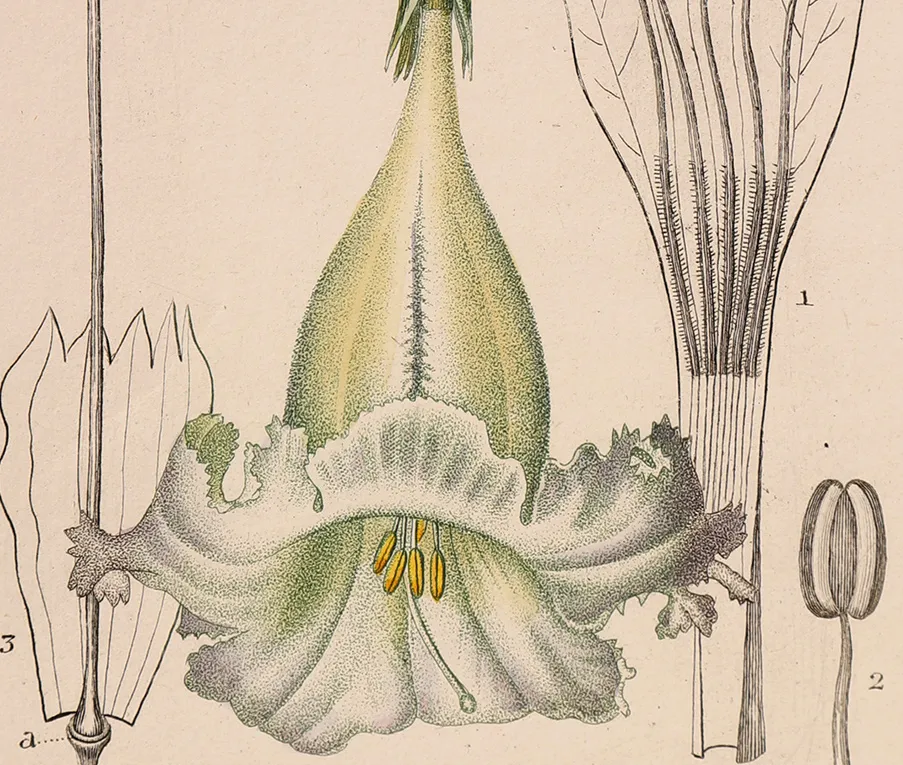
This original hand-colored engraving depicts Solandra grandiflora, a remarkable tropical species celebrated for its immense pendulous blossom. The composition centers on the elongated chalice-shaped corolla, rendered at near life-size proportion, accompanied by detailed dissections of stamens and floral structure.
The flower’s pale green-to-ivory gradient unfolds with sculptural clarity, its broad flared rim edged in soft shadow. Above, the dense arrangement of leathery leaves provides architectural weight, while the long suspended bloom introduces dramatic vertical movement — a refined study in botanical monumentality.
The plate originates from the Italian edition of the Dizionario di Scienze Naturali (Florence, Battelli press, early nineteenth century), an ambitious encyclopedic enterprise uniting scientific rigor with the finest standards of copperplate engraving and hand-applied color.
— • —
Unlike smaller ornamental blooms, Solandra grandiflora commands space. The fluted corolla resembles a suspended architectural form — almost a vegetal amphora — whose interior reveals the golden stamens. The tonal transition from pale green to cream creates depth and dimensionality rarely achieved in smaller botanical subjects.
Displayed individually, this engraving offers strong vertical emphasis and understated chromatic harmony. It pairs particularly well with interiors favoring restrained palettes, where its sculptural quality becomes the primary focal element.
Solandra grandiflora, often known as the Chalice Vine or Cup of Gold, is native to Central and South America. In nineteenth-century Europe, exotic species such as this symbolized expanding botanical knowledge and the fascination with tropical flora. Its immense, often nocturnally fragrant blossoms attracted particular attention among naturalists and horticulturists, challenging illustrators to reconcile grandeur of scale with scientific precision.
This engraving forms part of the historic Dizionario di Scienze Naturali, once preserved within a noble library and today included in the Sacchetti Collection. Each plate reflects a period when botanical science relied on visual authority — copperplate precision, hand coloring, and scholarly classification working in concert.
To discover more about the cultural and scientific context of these rare prints, we invite you to read our editorial feature “Not Just Another Print”.
The engraving is preserved in very good antique condition. The impression remains sharp and well-defined, with clean margins and stable early nineteenth-century smooth wove paper. No watermark has been observed. The hand-coloring retains clarity and subtle tonal transitions, particularly within the large corolla.
For further insight into Turpin’s contribution to botanical art, see:
Pierre Jean François Turpin – The Botanical Illustrator of Natural Harmony
Specific References
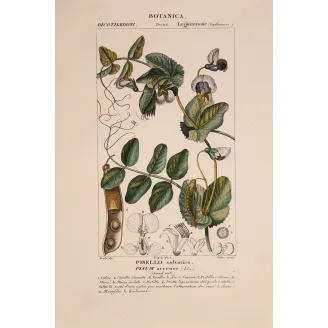
Colorful botanical illustration of Pisum arvense, wild pea, engraved by Turpin.
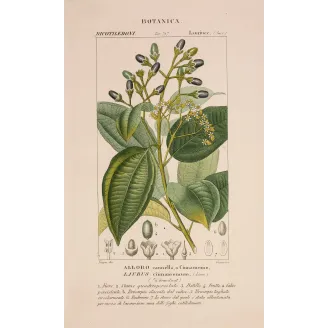
Finely detailed print of Laurus cinnamomum by Turpin, from the Dizionario di Scienze Naturali.
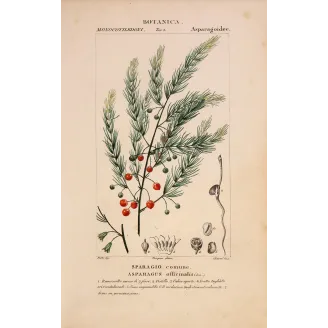
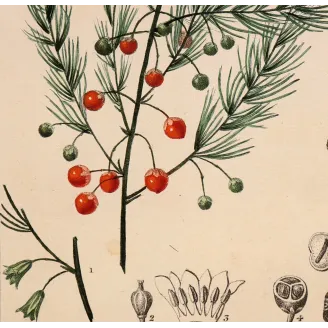
Botanical print of Asparagus officinalis by Turpin, featuring vivid orange berries.
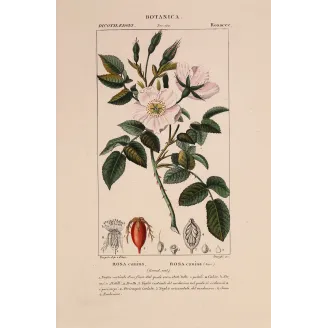
Delicate dog rose flower with soft pink petals and fine botanical details.
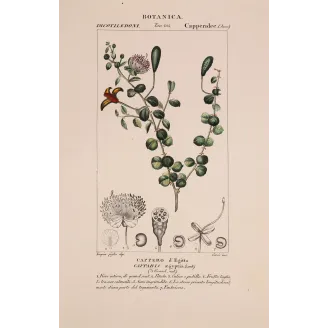
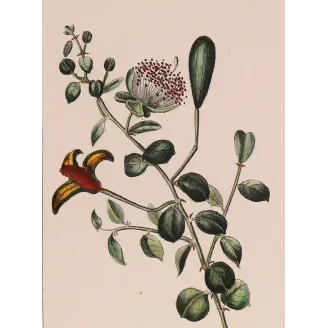
Vibrant caper plant illustration with both flowers and fruiting structures.
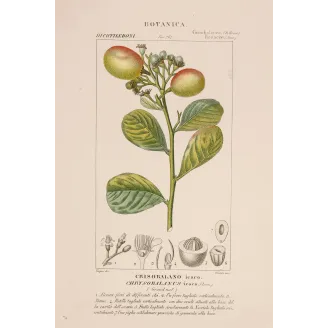
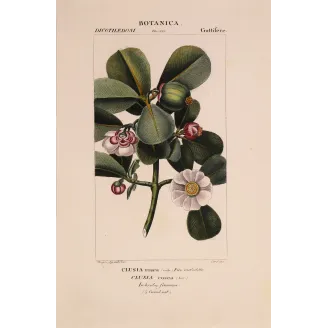
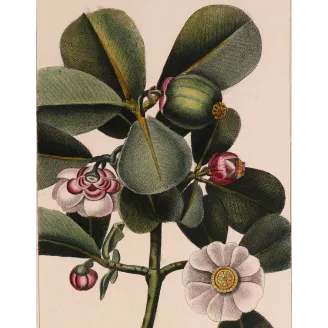
Elegant hand-colored botanical engraving of *Chrysobalanus icaco*, showing the round fruits and smooth glossy leaves in rich natural hues.
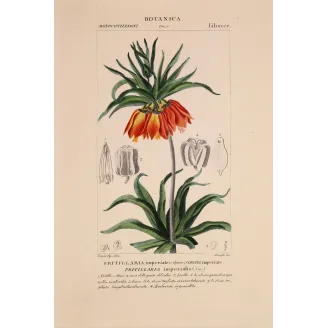
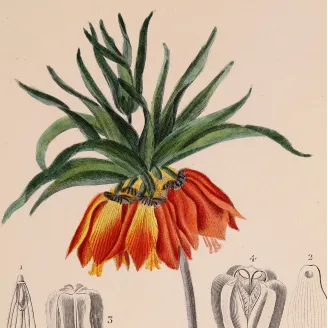
Striking antique print of Fritillaria imperialis with bright orange crown flowers.
A complete set of 22 original hand-colored lithographs of ferns by Turpin, from the Dizionario di Scienze Naturali (c. 1830).
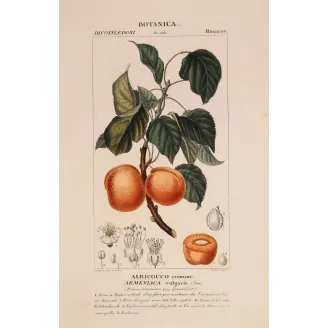
Original 19th-century botanical engraving of the common apricot, showing its velvety orange fruits and lush green leaves, rendered with great naturalistic balance.
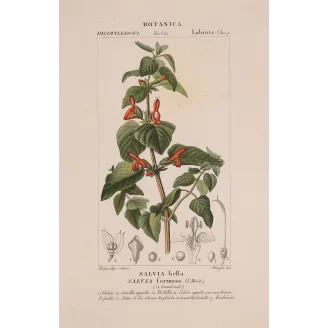
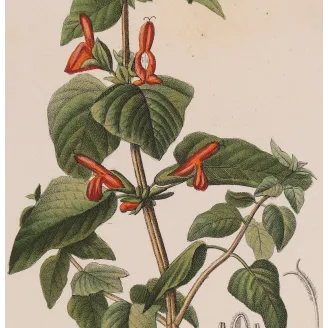
Vivid botanical plate of Salvia formosa, with striking red-orange tubular flowers.
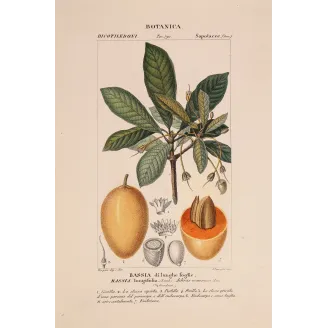
A rare depiction of *Bassia longifolia*, showing its elongated leaves and fruit sections in precise scientific detail and soft hand-colored tones.
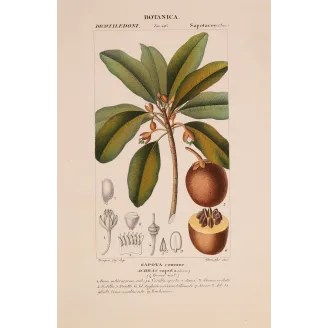
A warm-toned botanical engraving of *Achras sapota*, featuring its rounded fruit and large green leaves with exquisite texture
A striking hand-colored engraving of *Euphoria punicea*, displaying vivid red fruits and lush foliage in a refined 19th-century botanical composition.
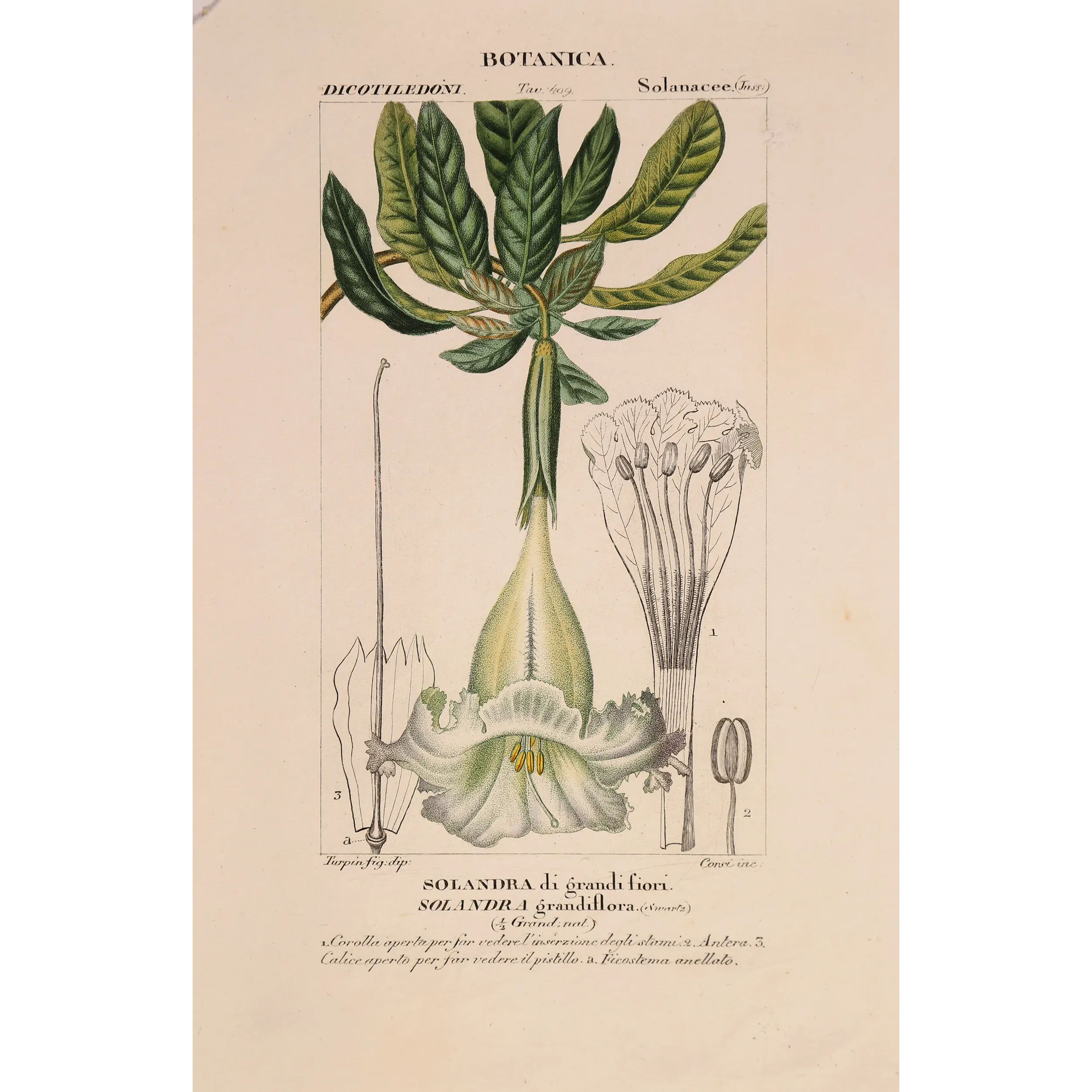
Beautiful antique flower print of Solandra, with large trumpet-shaped bloom.