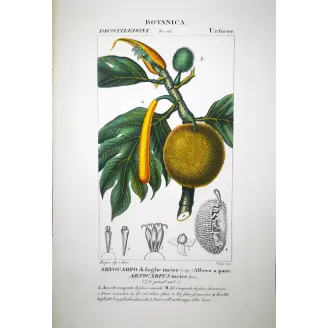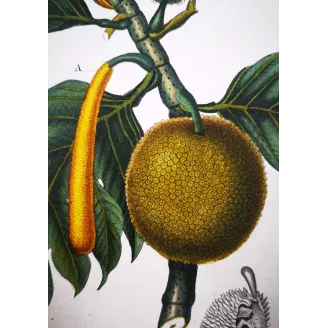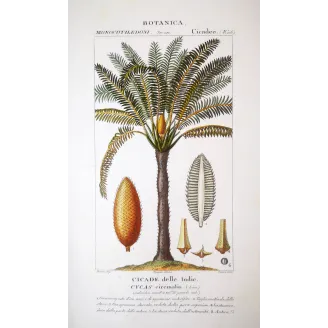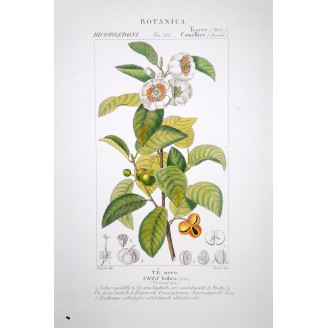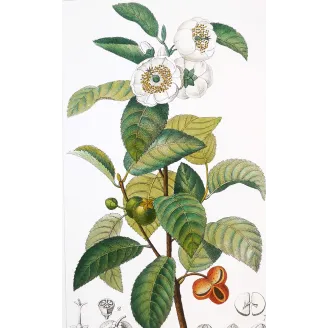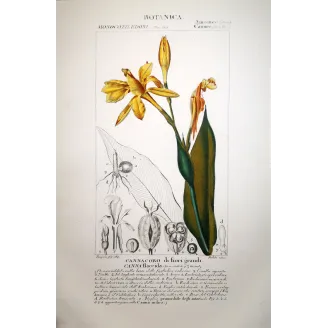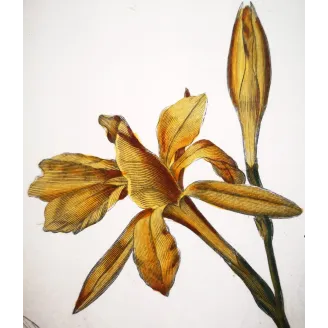
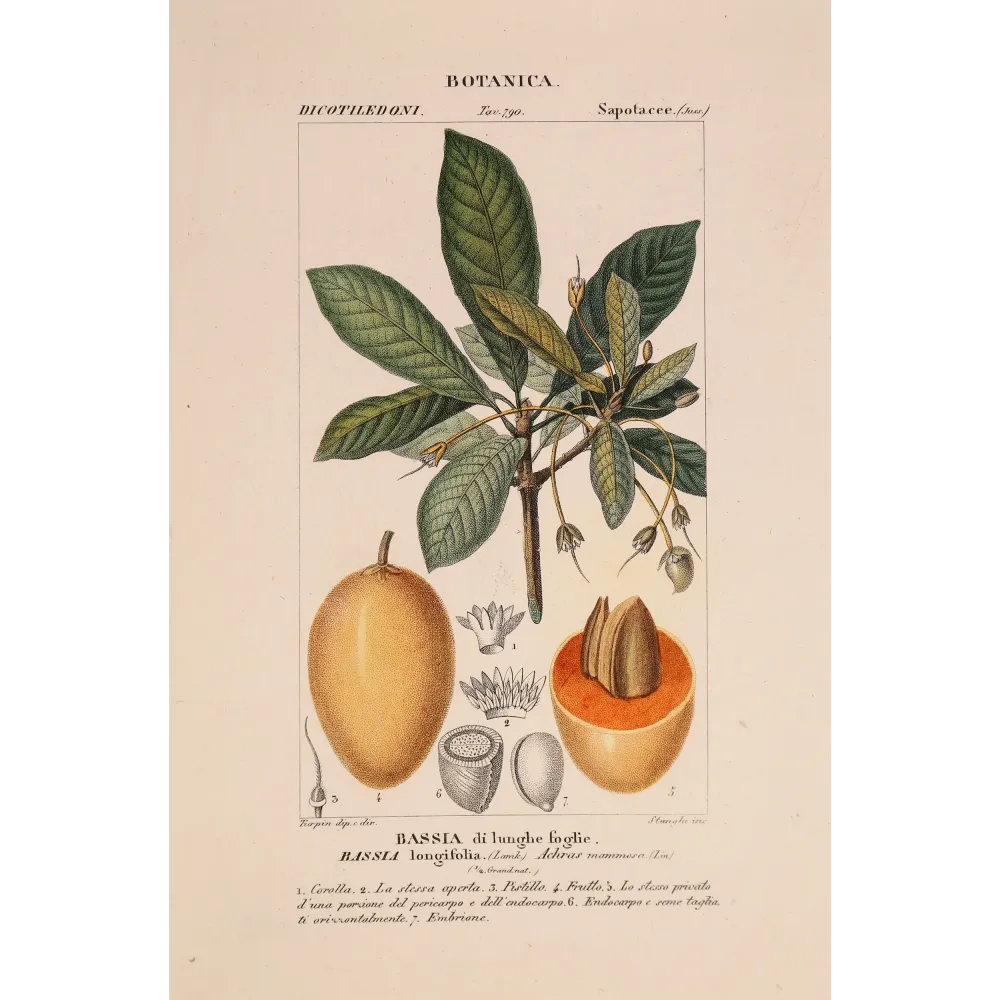
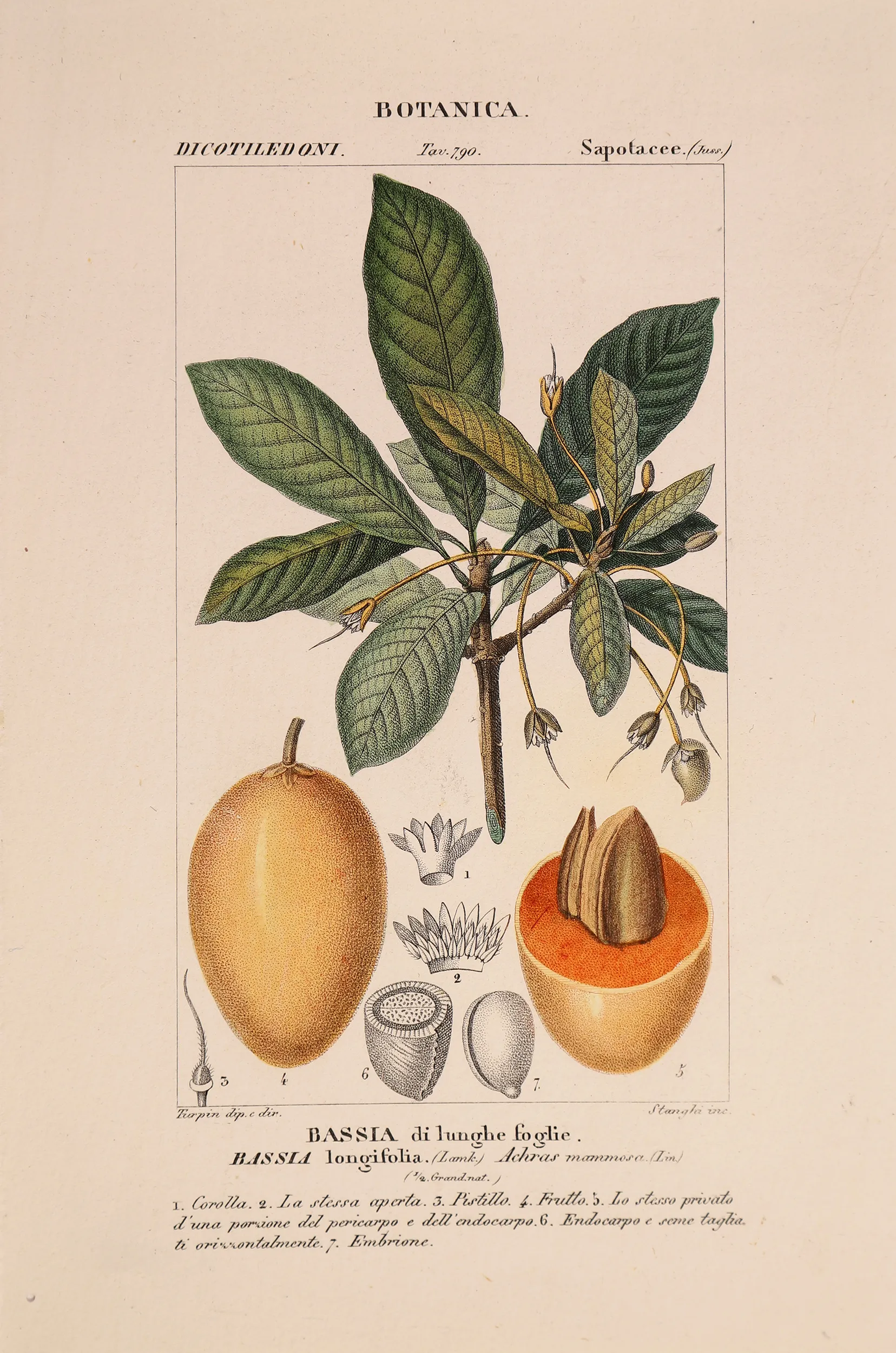
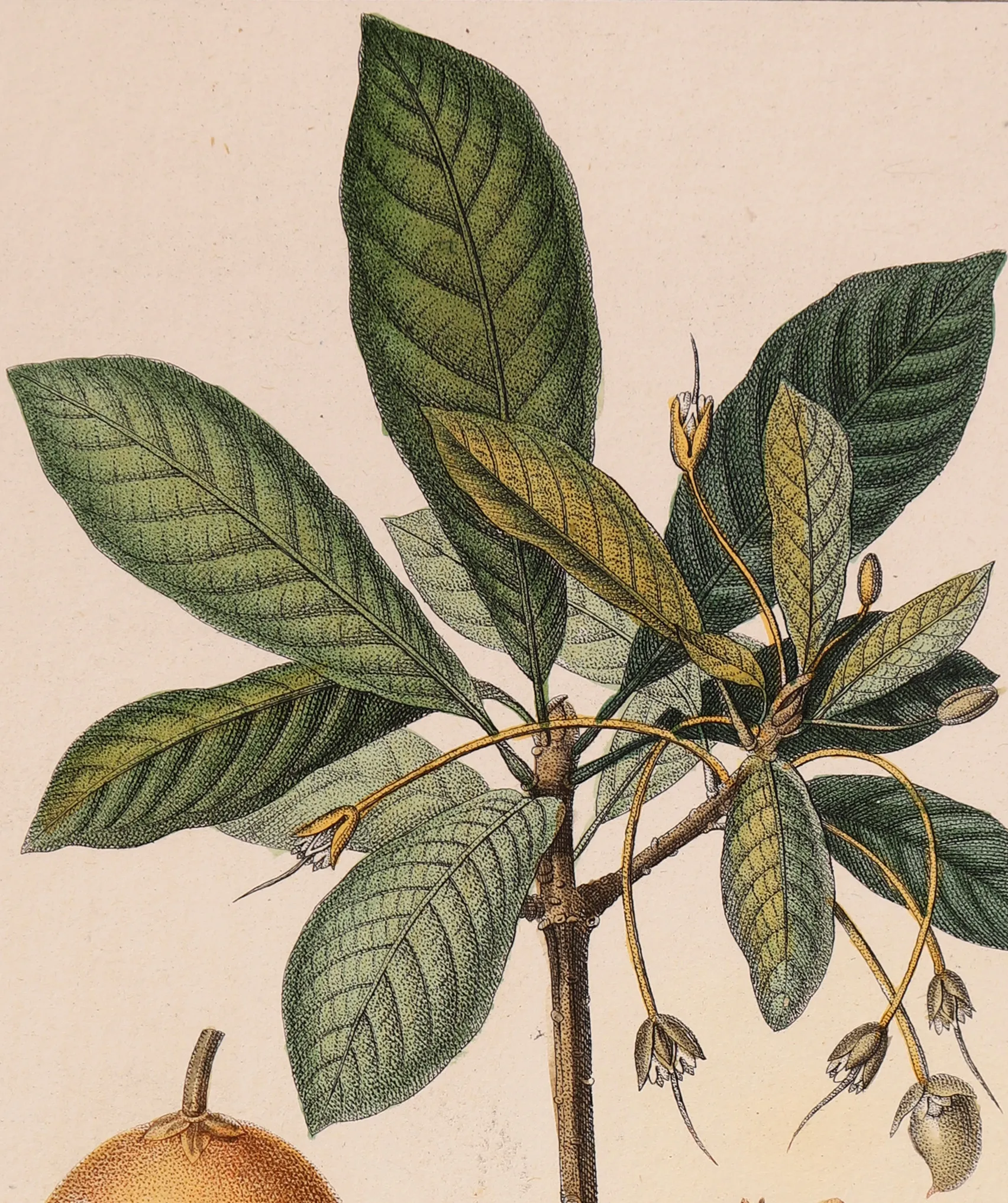

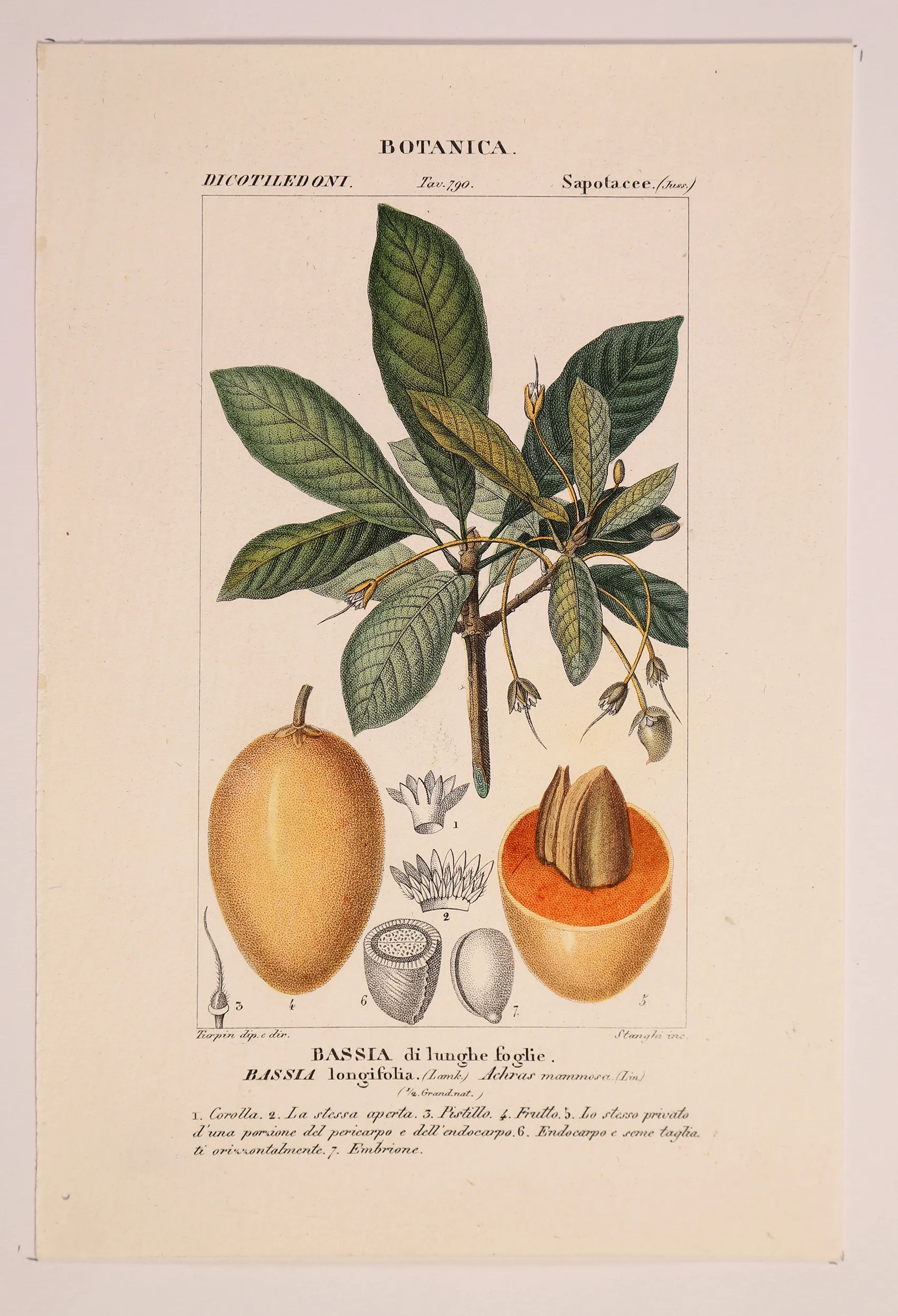
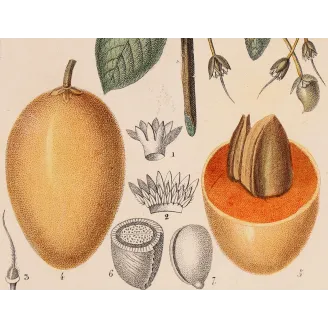
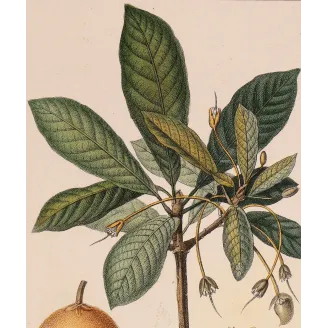
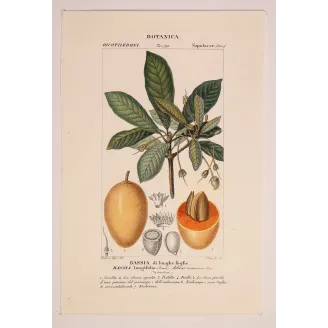
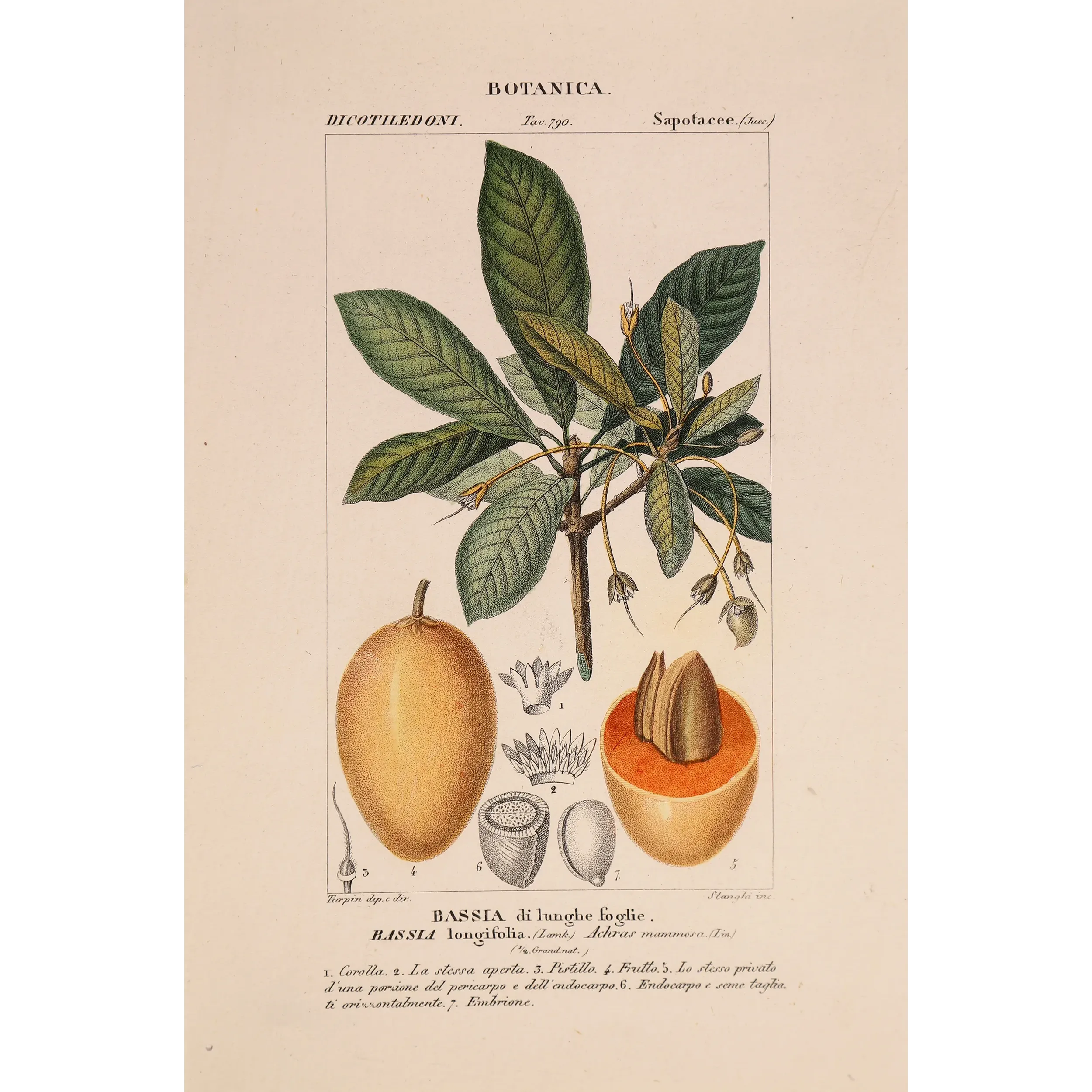
A rare depiction of *Bassia longifolia*, showing its elongated leaves and fruit sections in precise scientific detail and soft hand-colored tones.
 Delivery policy
Your print will be carefully prepared and shipped worldwide via trusted couriers (UPS or similar).
 Authentic antique prints
Original engravings from the 17th–19th century.
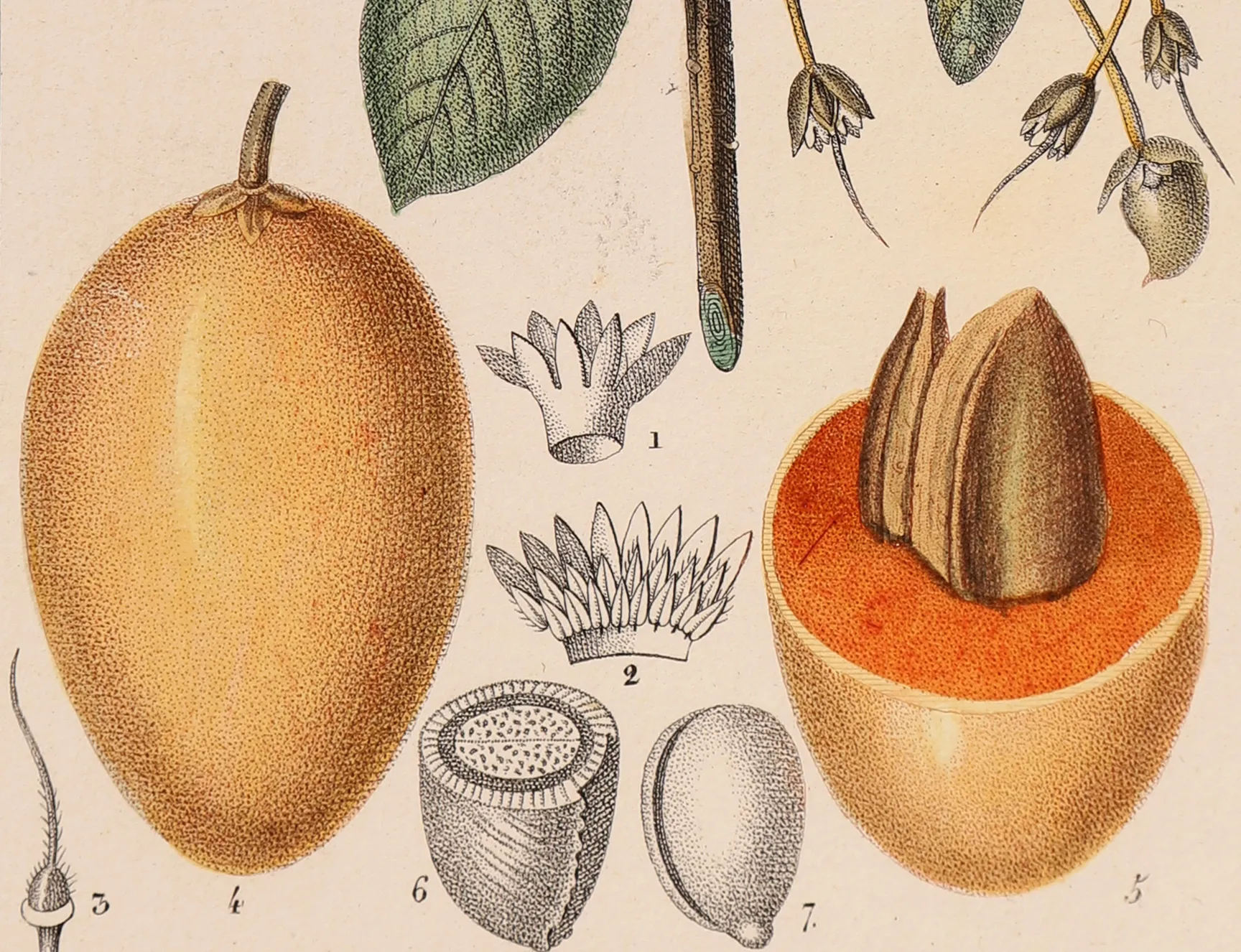
This original hand-colored engraving depicts the Mahua tree, Bassia longifolia, rendered with characteristic precision and compositional balance. The plate presents the fruiting branch alongside sectional studies of the flower and seed, uniting visual presence with analytical clarity.
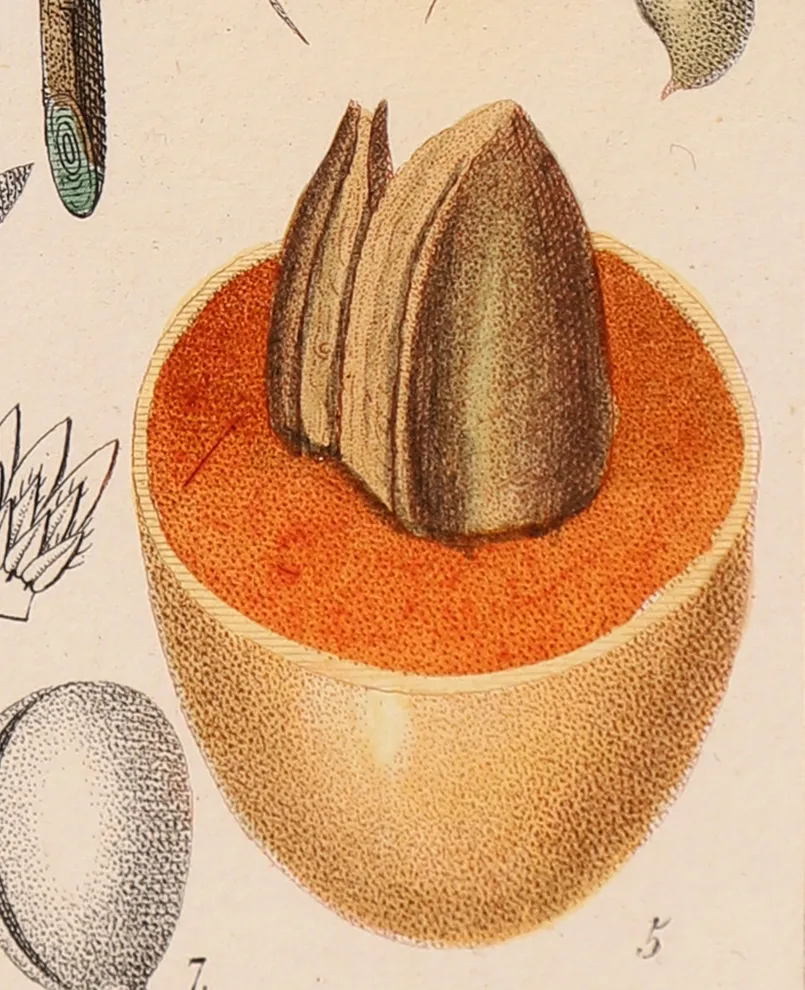
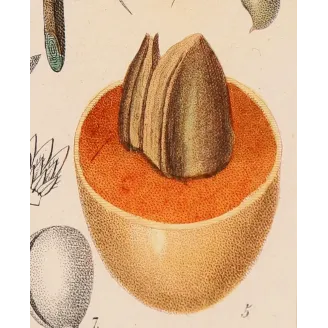
The elongated, golden fruit is shown both intact and in section, revealing the dense seed structure within its vivid orange pulp. Above, the broad leaves form a measured architectural canopy, their layered arrangement creating depth and equilibrium within the vertical format.
The engraving forms part of the Italian edition of the Dizionario di Scienze Naturali (Florence, Battelli press), one of the most ambitious encyclopedic natural history publications of the early nineteenth century.
— • —
The composition is structured around the contrast between foliage and fruit. The matte greens of the leaves create a restrained framework, while the warm tonal gradient of the fruit introduces visual intensity. The sectional rendering below enhances the scientific authority of the plate, yet remains discreet and balanced.
Unlike more overtly ornamental tropical subjects, this engraving carries a quieter dignity—measured, controlled, and reflective of Turpin’s disciplined botanical approach.
Bassia longifolia, commonly known as the Mahua tree, is native to the Indian subcontinent and has long played a significant role in rural economies. Its flowers are traditionally fermented to produce beverages, while its seeds yield oil used in cooking and craft. The tree occupies not only an agricultural function but also a cultural one, holding ritual and communal importance in various regions of India.
Within the broader context of early nineteenth-century natural history publishing, such species can be understood as part of Turpin’s “fruits of the global age” — plants documented as Europe expanded its botanical awareness through trade, colonial contact, and scientific exchange. The engraving thus records both a plant and the global networks that brought its image into European encyclopedic knowledge.
This plate forms part of the historic Dizionario di Scienze Naturali, once preserved within a noble library and today housed in the Sacchetti Collection. Each engraving reflects a period in which scientific documentation was inseparable from artisanal excellence — from the engraved copperplate line to the carefully applied hand-colouring.
To explore the refined provenance of these works, we invite you to read our editorial feature “Not Just Another Print”.
The engraving is preserved in excellent antique condition. The sheet presents clean margins and a sharp, well-defined impression. The original early nineteenth-century smooth wove paper remains stable and evenly toned. No watermark has been observed. The hand-colouring retains depth and balance, particularly in the tonal transitions of the fruit.
For further context on Pierre Jean François Turpin and his contribution to nineteenth-century botanical science, see our editorial feature:
Pierre Jean François Turpin – The Botanical Illustrator of Natural Harmony
Specific References
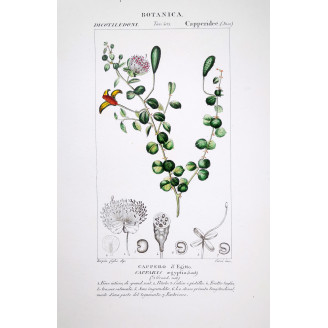
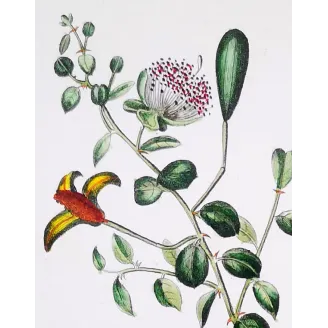
Vibrant caper plant illustration with both flowers and fruiting structures.
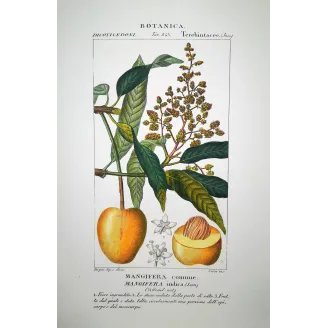
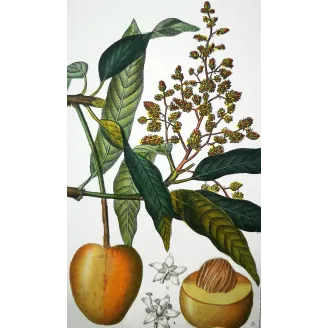
Vibrant hand-colored depiction of *Mangifera indica*, the mango tree, highlighting its lush leaves, golden fruit, and floral details.
An extraordinary 19th-century engraving of *Artocarpus incisa*, the breadfruit tree, showcasing its bold leaves and unique fruit texture.
Delicate and detailed illustration of the tea plant, with floral and seed elements beautifully depicted.
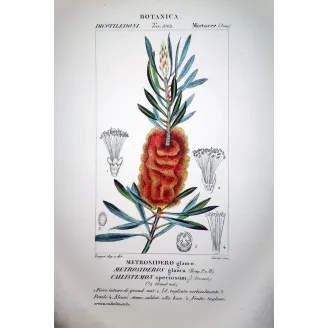
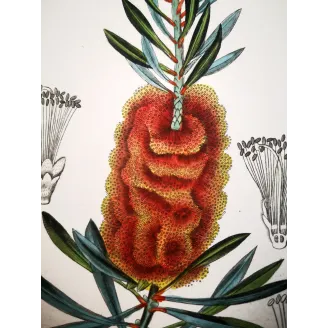
Stunning antique print of the red-flowering Callistemon, also known as bottlebrush.
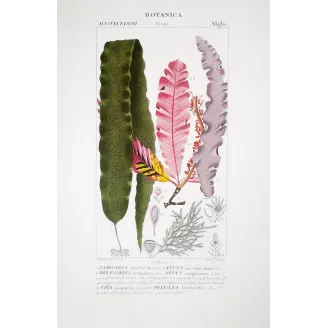
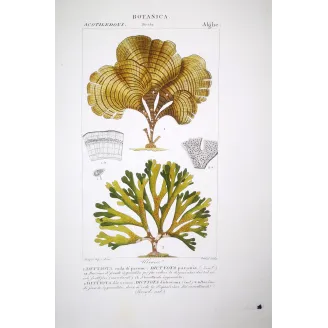
A unique lot of 7 hand-colored antique prints depicting various species of algae, illustrated by Turpin and Prêtre.
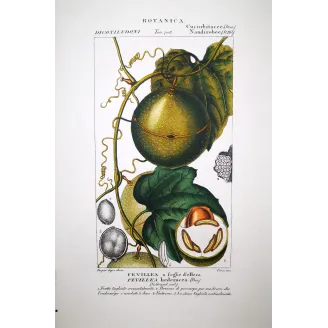
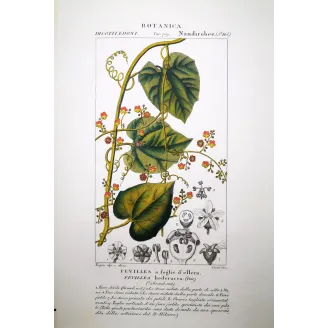
A coordinated pair of engravings depicting *Fevillea hederacea*, with intricate tendrils and elegant fruit structure, hand-colored with precision.
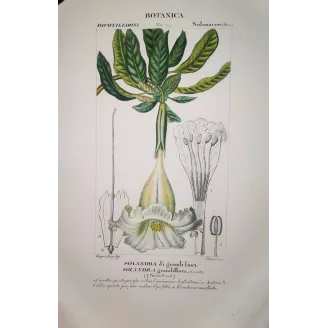
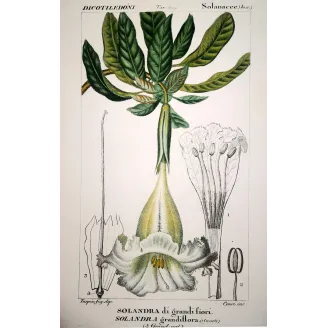
Beautiful antique flower print of Solandra, with large trumpet-shaped bloom.
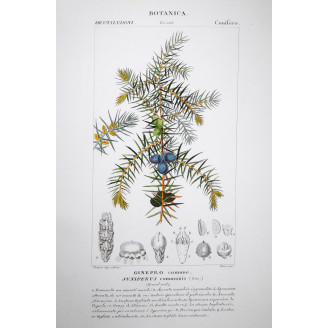
Elegant hand-colored plate of the juniper plant with berries and cone structure.
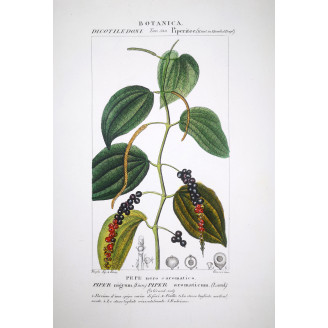
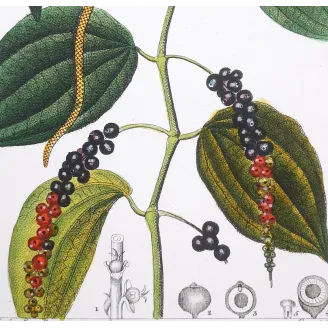
Detailed depiction of the black pepper vine with fruiting spikes and leaves.
A rare depiction of *Bassia longifolia*, showing its elongated leaves and fruit sections in precise scientific detail and soft hand-colored tones.