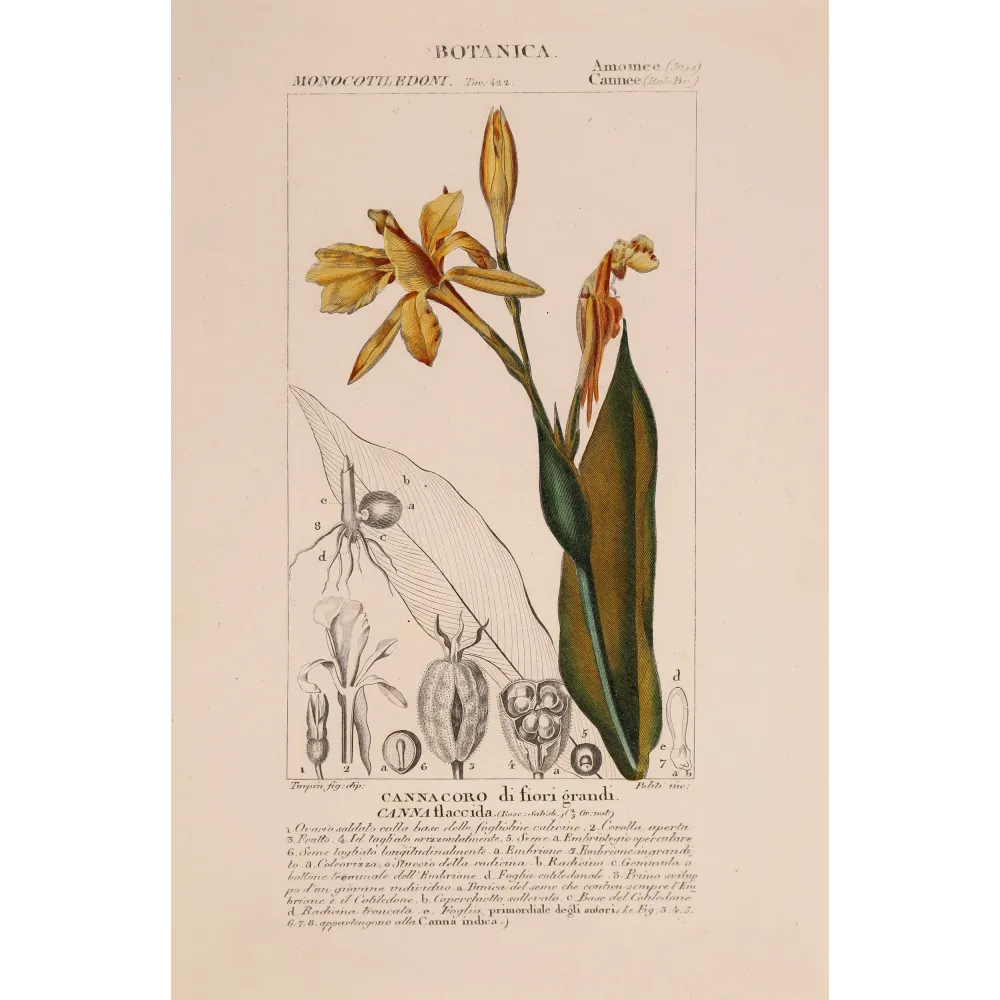
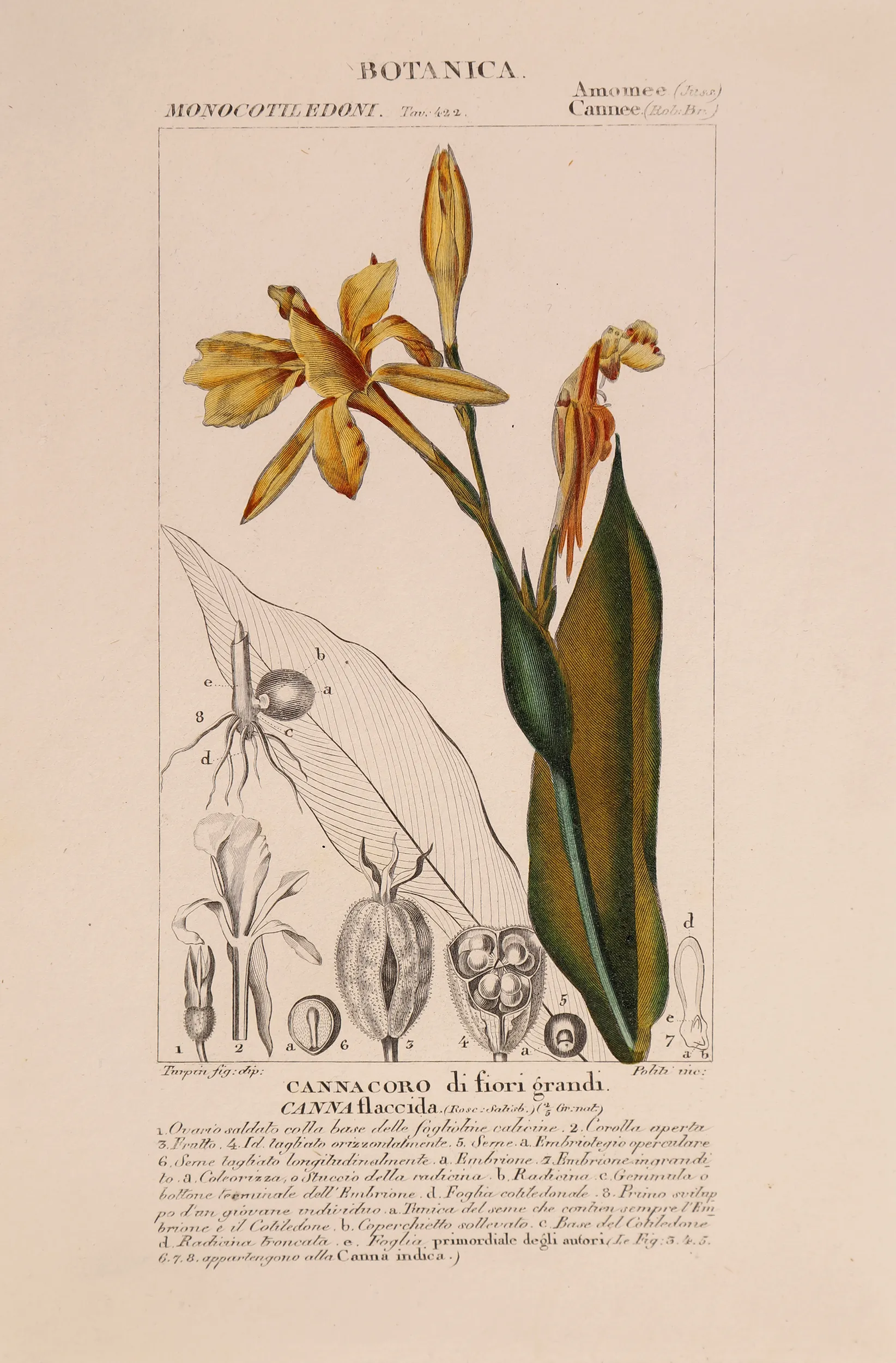
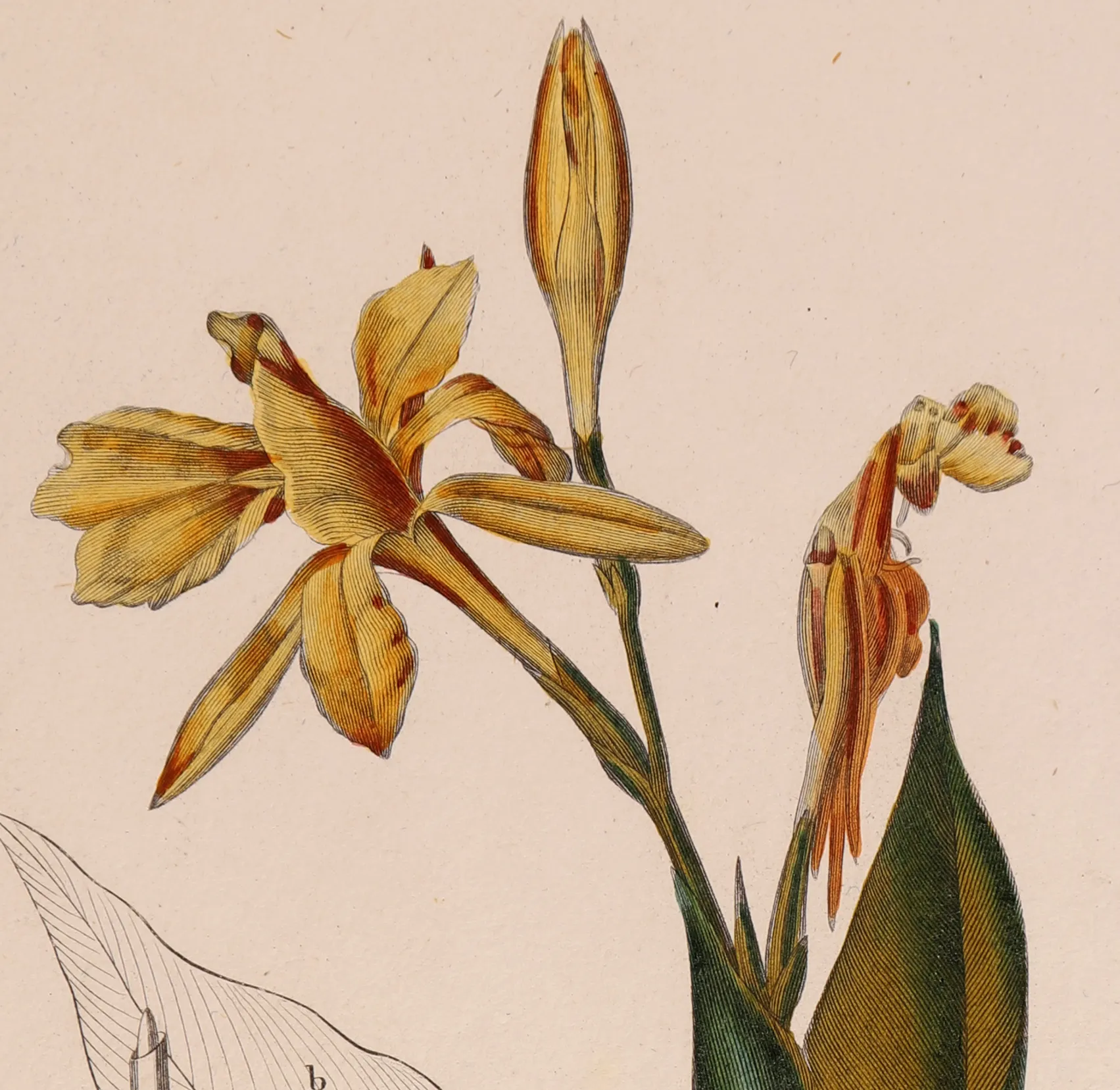

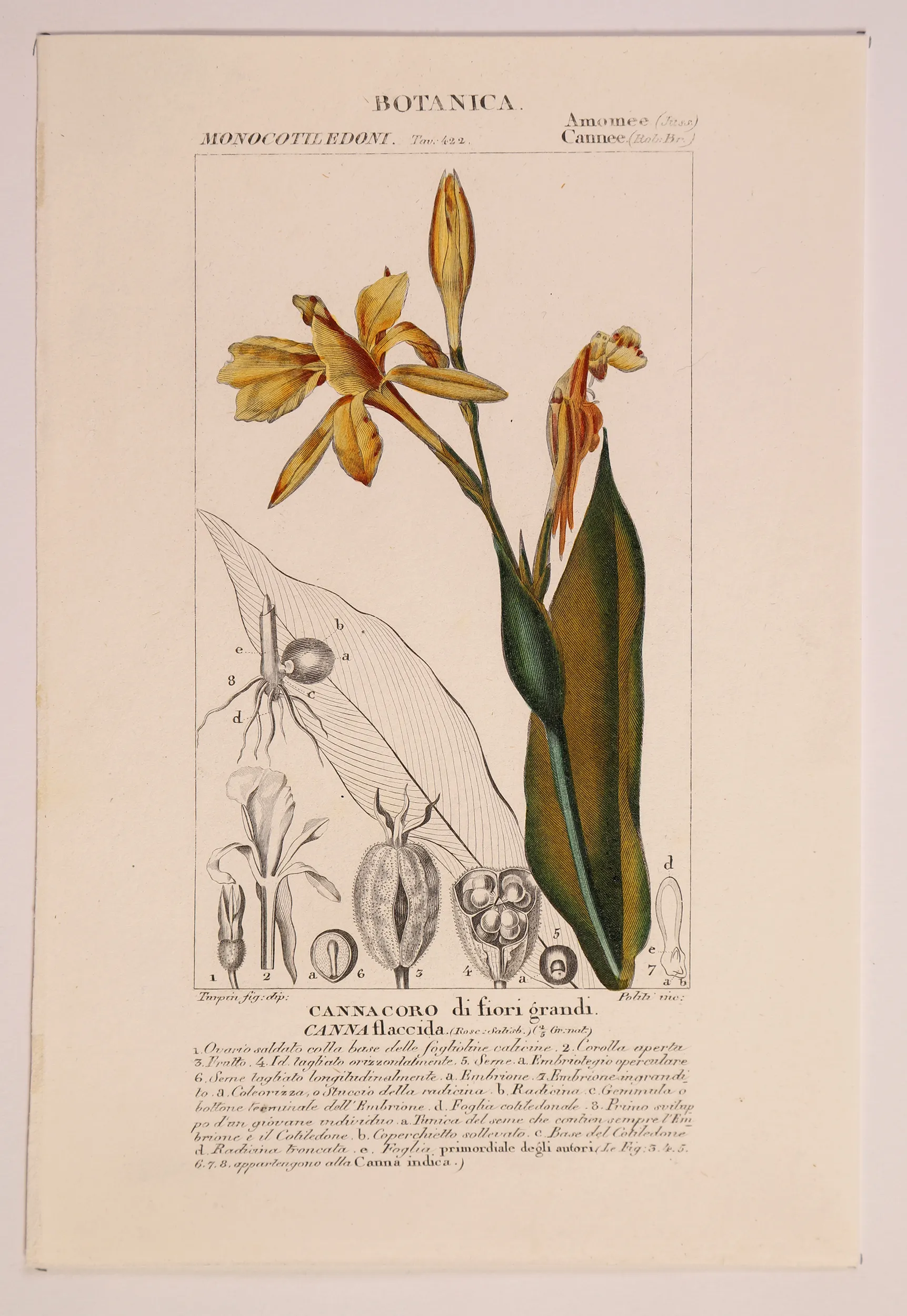
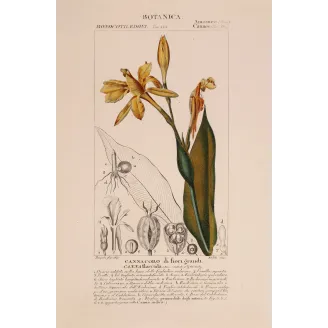
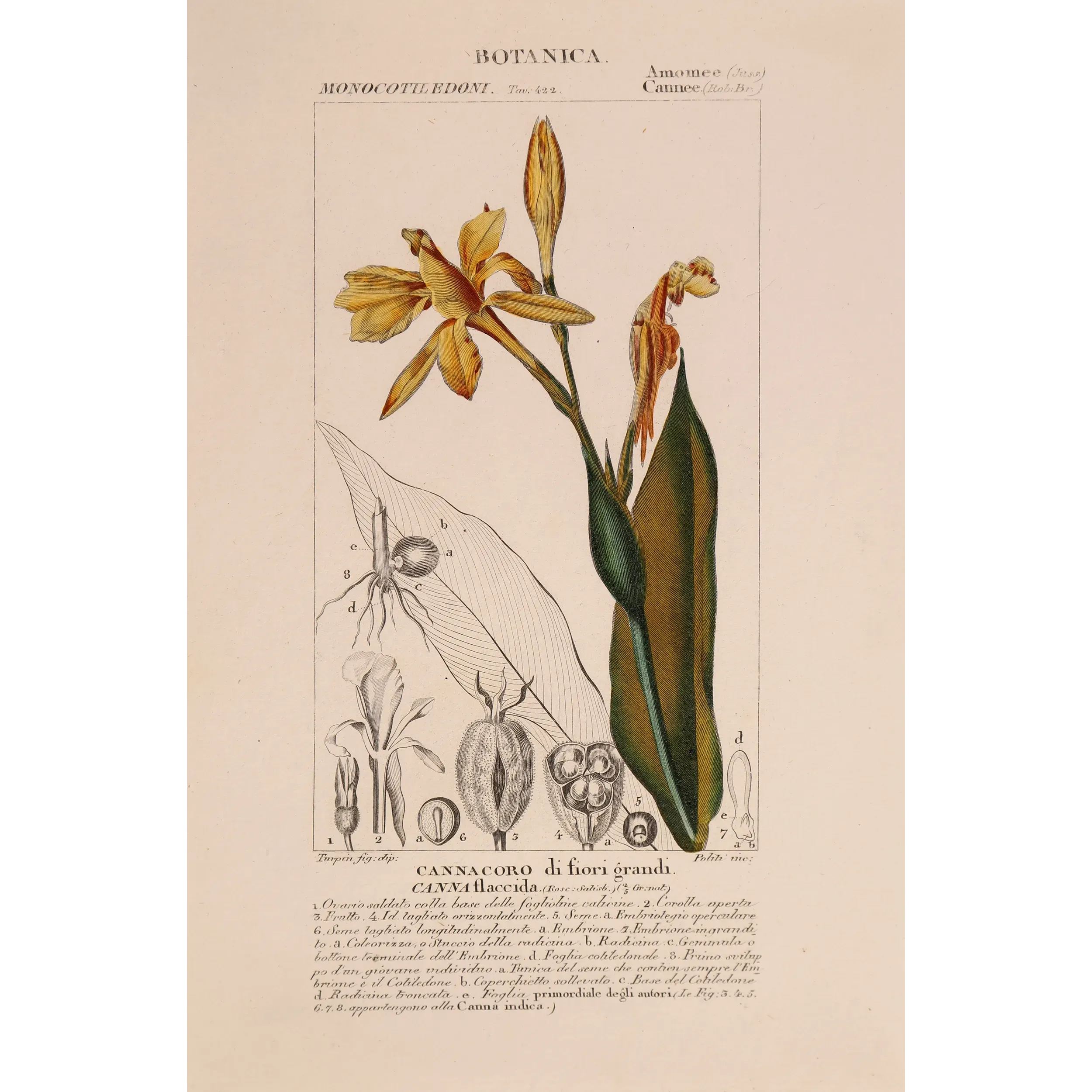
Tropical antique botanical featuring yellow Canna flaccida flowers.
 Delivery policy
Your print will be carefully prepared and shipped worldwide via trusted couriers (UPS or similar).
 Authentic antique prints
Original engravings from the 17th–19th century.
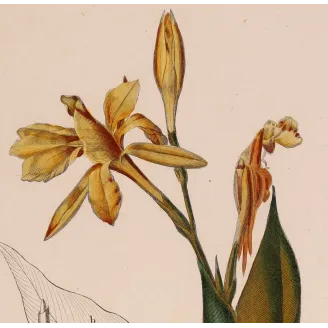
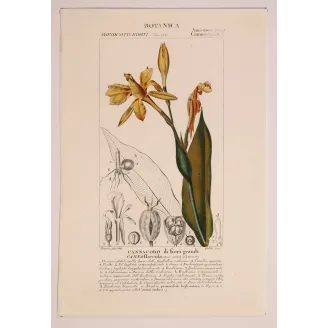
This original hand-colored engraving presents Canna coccinea, also referenced in early botanical literature as Canna indica or Canna flaccida, rendered with architectural clarity and tropical intensity. The plate combines the complete flowering stem with detailed anatomical studies, offering both ornamental presence and scientific precision.
The tall, upright composition emphasizes the plant’s vertical rhythm: elongated leaves rising in disciplined symmetry, crowned by luminous golden-orange blossoms. Turpin balances chromatic warmth with structural restraint, allowing the flower to dominate while preserving botanical accuracy in the surrounding analytical figures.
The engraving belongs to the Italian edition of the Dizionario di Scienze Naturali (Florence, Battelli press), an early nineteenth-century encyclopedic undertaking devoted to documenting the natural world through refined copperplate engraving and careful observation.
— • —
The composition is strongly vertical, creating a natural focal axis. The broad green leaves form a deep tonal base, against which the saturated yellow-orange petals appear radiant and sculptural. The anatomical dissections positioned below introduce measured contrast — fine line work, sectional views, and reproductive details that anchor the image in scientific method.
Displayed individually, the plate conveys both tropical vitality and nineteenth-century intellectual discipline. Its proportions make it particularly suited to narrow wall spaces or pairings with other monocot studies.
Canna species, native to the Americas, were introduced into European botanical collections and ornamental gardens during the early modern period. By the nineteenth century, they were admired for their bold foliage and vibrant flowers, representing the expanding geographic reach of botanical science. In illustrated encyclopedic works, such plants served as both decorative exemplars and subjects of structural analysis, reflecting a period in which tropical flora became integral to European classification systems and horticultural experimentation.
This plate forms part of the historic Dizionario di Scienze Naturali, once preserved within a noble library and today housed in the Sacchetti Collection. Each engraving embodies a period when scientific investigation was inseparable from artisanal mastery — from the precision of the engraved copperplate line to the carefully applied hand-colouring executed sheet by sheet.
Such works were conceived not as decorative ephemera, but as authoritative visual documents of knowledge. To explore the broader story of these rare prints and their refined provenance, we invite you to read our editorial feature “Not Just Another Print”.
The engraving is in excellent antique condition. The sheet presents clean, well-preserved margins and a crisp, well-defined impression. The original early nineteenth-century smooth wove paper remains stable. No watermark has been observed. The hand-colouring retains balanced saturation, with particularly well-preserved tonal depth in the foliage and floral highlights.
For further context on Pierre Jean François Turpin and his contribution to nineteenth-century botanical science, see our editorial feature:
Pierre Jean François Turpin – The Botanical Illustrator of Natural Harmony
Specific References
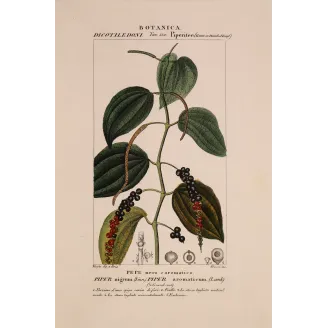
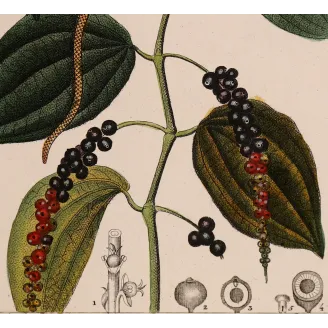
Detailed depiction of the black pepper vine with fruiting spikes and leaves.
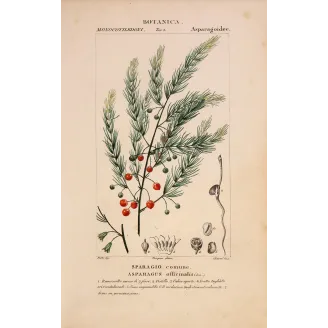
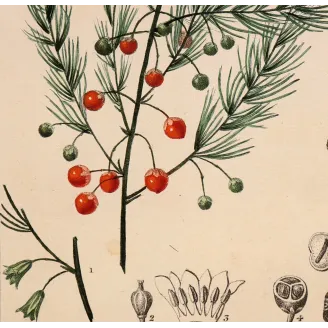
Botanical print of Asparagus officinalis by Turpin, featuring vivid orange berries.
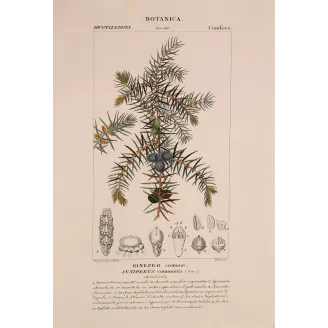
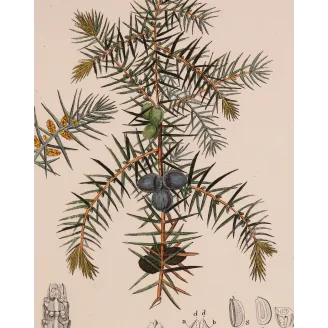
Elegant hand-colored plate of the juniper plant with berries and cone structure.
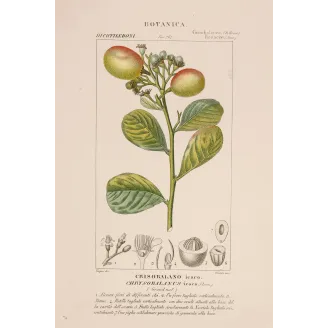
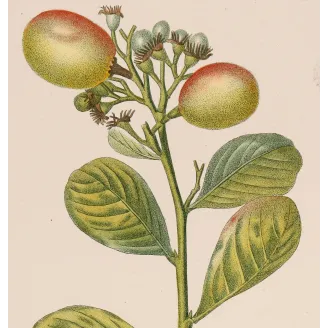
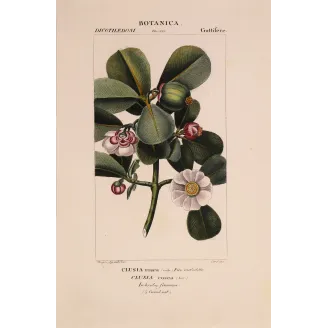
Elegant hand-colored botanical engraving of *Chrysobalanus icaco*, showing the round fruits and smooth glossy leaves in rich natural hues.
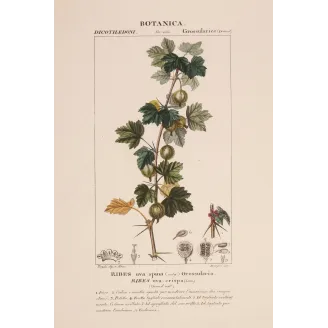
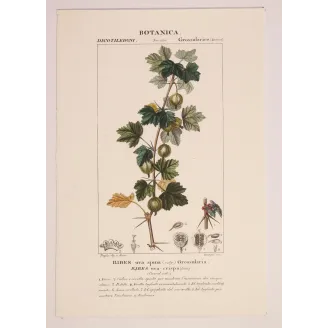
A charming depiction of *Ribes uva-crispa*, the gooseberry plant, detailed with its spiny stems and translucent green fruits.
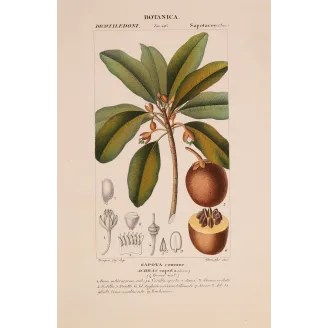
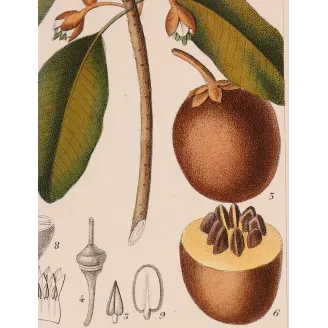
A warm-toned botanical engraving of *Achras sapota*, featuring its rounded fruit and large green leaves with exquisite texture
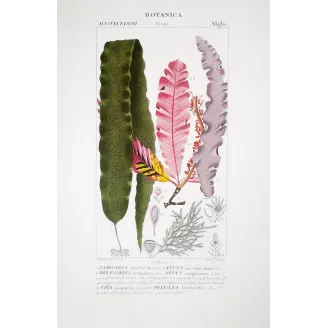
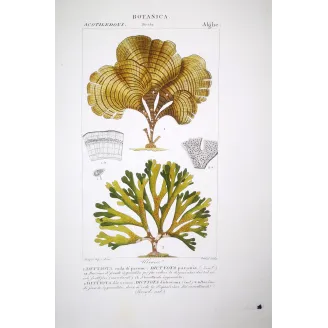
A unique lot of 7 hand-colored antique prints depicting various species of algae, illustrated by Turpin and Prêtre.
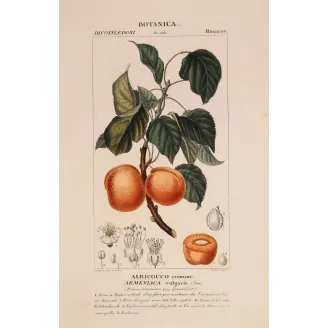
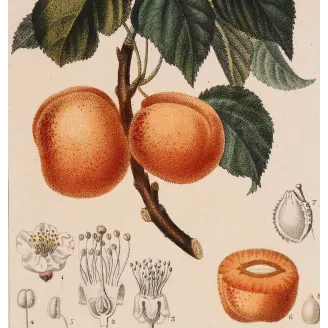
Original 19th-century botanical engraving of the common apricot, showing its velvety orange fruits and lush green leaves, rendered with great naturalistic balance.
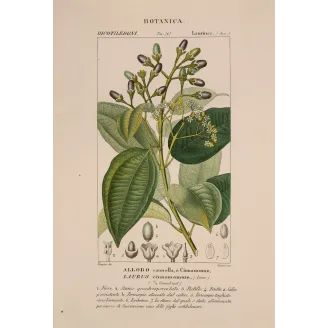
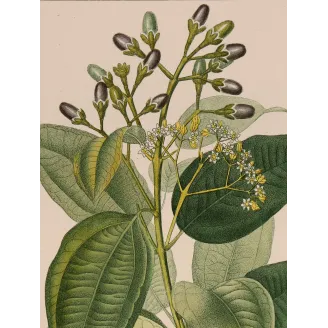
Elegant illustration of Laurus cinnamomum, showing leaves, flowers and seeds.
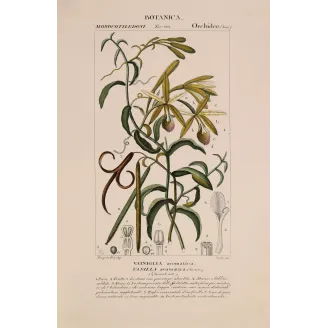
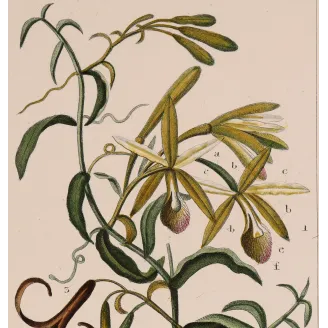
Delicate orchid illustration showing flower, pod and internal anatomy of vanilla.
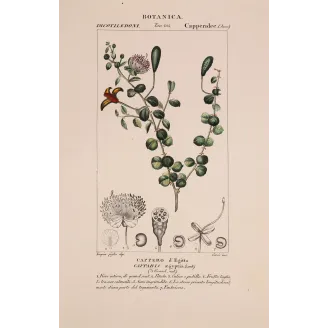
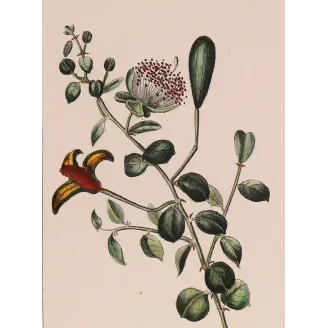
Vibrant caper plant illustration with both flowers and fruiting structures.
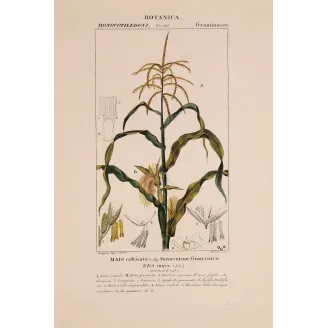
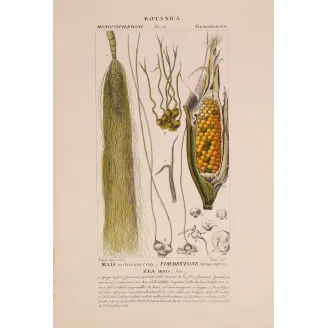
Double plate of cultivated maize (Zea mays) from Turpins botanical series.
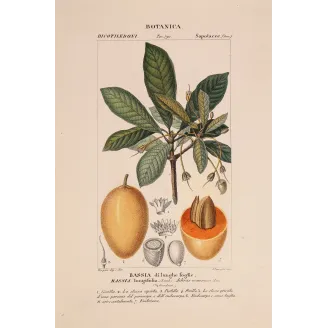
A rare depiction of *Bassia longifolia*, showing its elongated leaves and fruit sections in precise scientific detail and soft hand-colored tones.
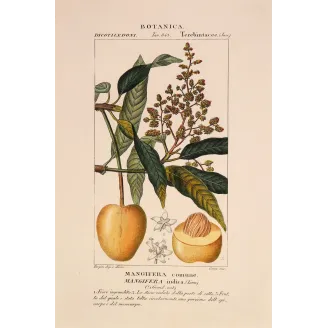
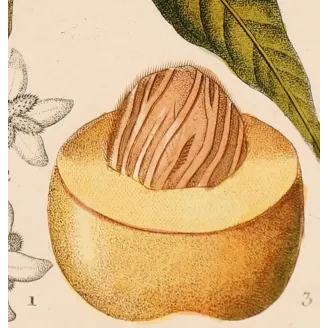
Vibrant hand-colored depiction of *Mangifera indica*, the mango tree, highlighting its lush leaves, golden fruit, and floral details.
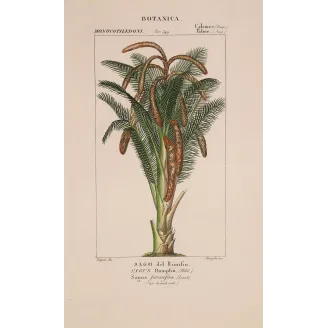
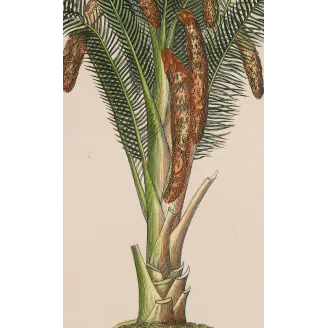
A pair of plates dedicated to the sago palm tree and its structural details.
Tropical antique botanical featuring yellow Canna flaccida flowers.