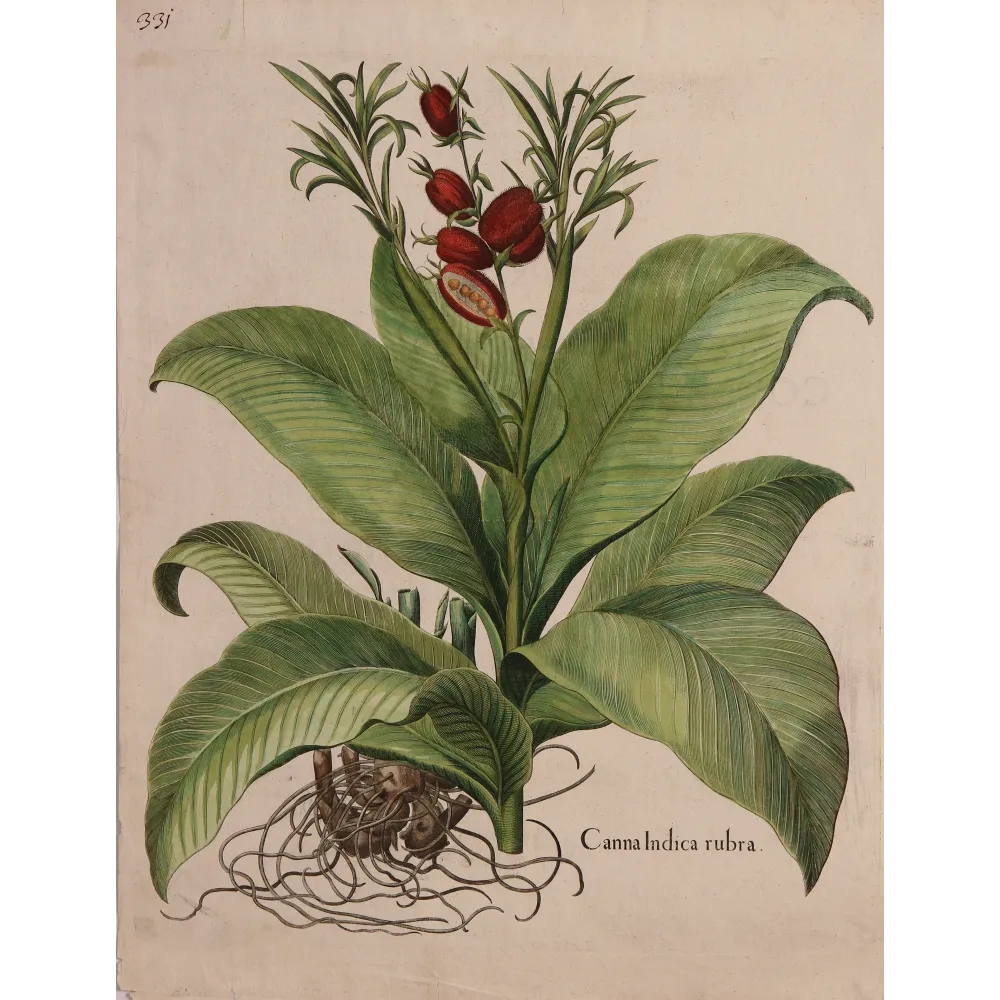
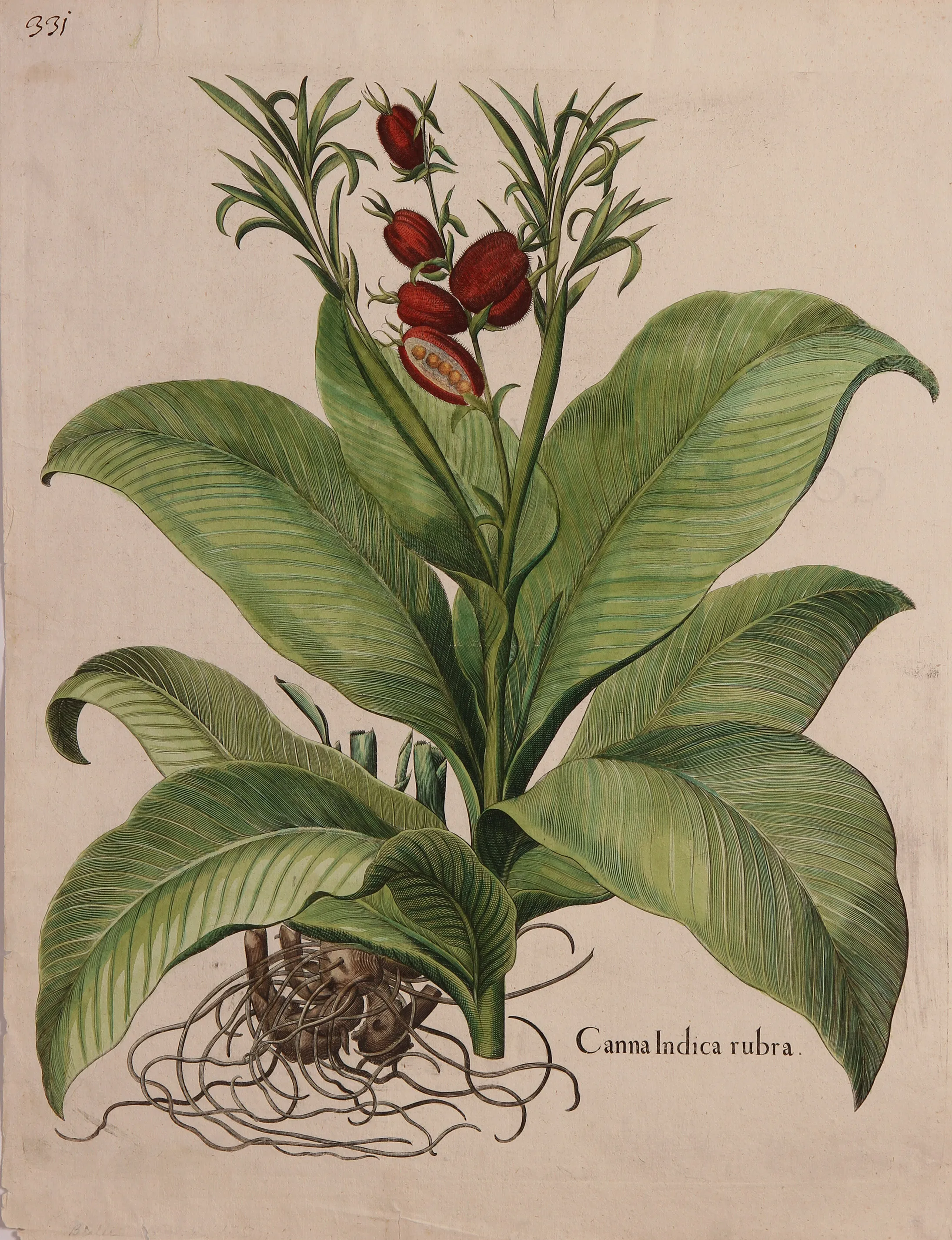
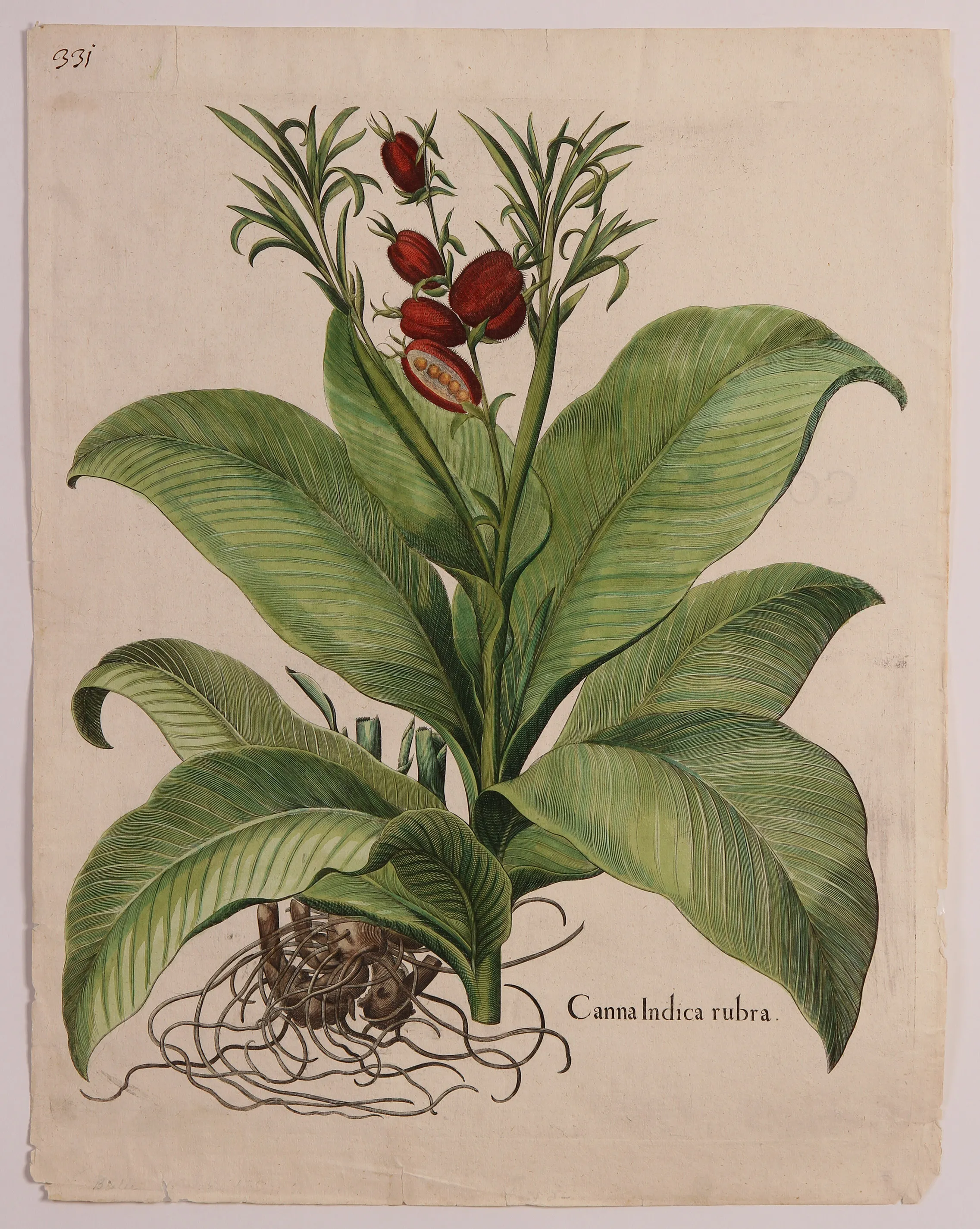
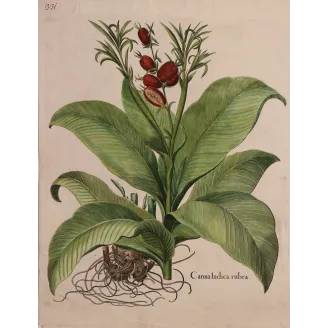
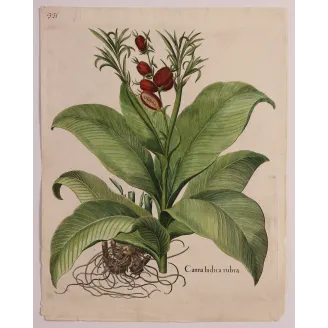
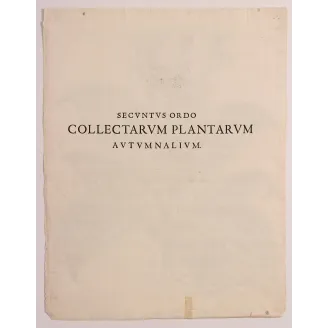
Original seventeenth-century hand-colored botanical engraving of Canna Indica rubra from Basilius Besler's monumental Hortus Eystettensis, first published in 1613. The imposing composition combines sweeping green foliage, exposed roots and vivid red botanical forms, while the laid-paper sheet preserves a watermark and the remarkable printed autumnal heading “SECVNDVS ORDO COLLECTARVM PLANTARVM AVTVMNALIVM” on its verso.
 Delivery policy
Your print will be carefully prepared and shipped worldwide via trusted couriers (UPS or similar).
 Authentic antique prints
Original engravings from the 17th–19th century.
This original hand-coloured botanical engraving from Basilius Besler’s Hortus Eystettensis, first published in 1613, depicts the plant historically inscribed Canna Indica rubra. The composition gives the specimen an extraordinary physical presence: broad leaves expand across the sheet, vigorous stems rise vertically through the centre, and the exposed underground structure anchors the plant to the lower edge of the image.
The great scale of the Hortus Eystettensis allows the plant to occupy the page almost architecturally. Nothing surrounds it. There is no landscape, garden setting or decorative frame. The botanical subject itself becomes the entire visual event.
The strength of the plate lies in this concentration: leaf, stem, root and vivid red botanical forms combine to transform a single plant into a monumental portrait.
The composition is organised around a strong central axis. Several upright stems rise from the underground structure while the surrounding leaves unfold laterally in broad sweeping curves, creating a balance between vertical growth and horizontal expansion.
The foliage dominates the image. Large overlapping leaves occupy most of the available surface and are articulated through dense engraved modelling combined with layered green colour. Their changing directions prevent the plant from appearing static: some leaves rise, others bend outward, while several curve back towards the centre of the composition.
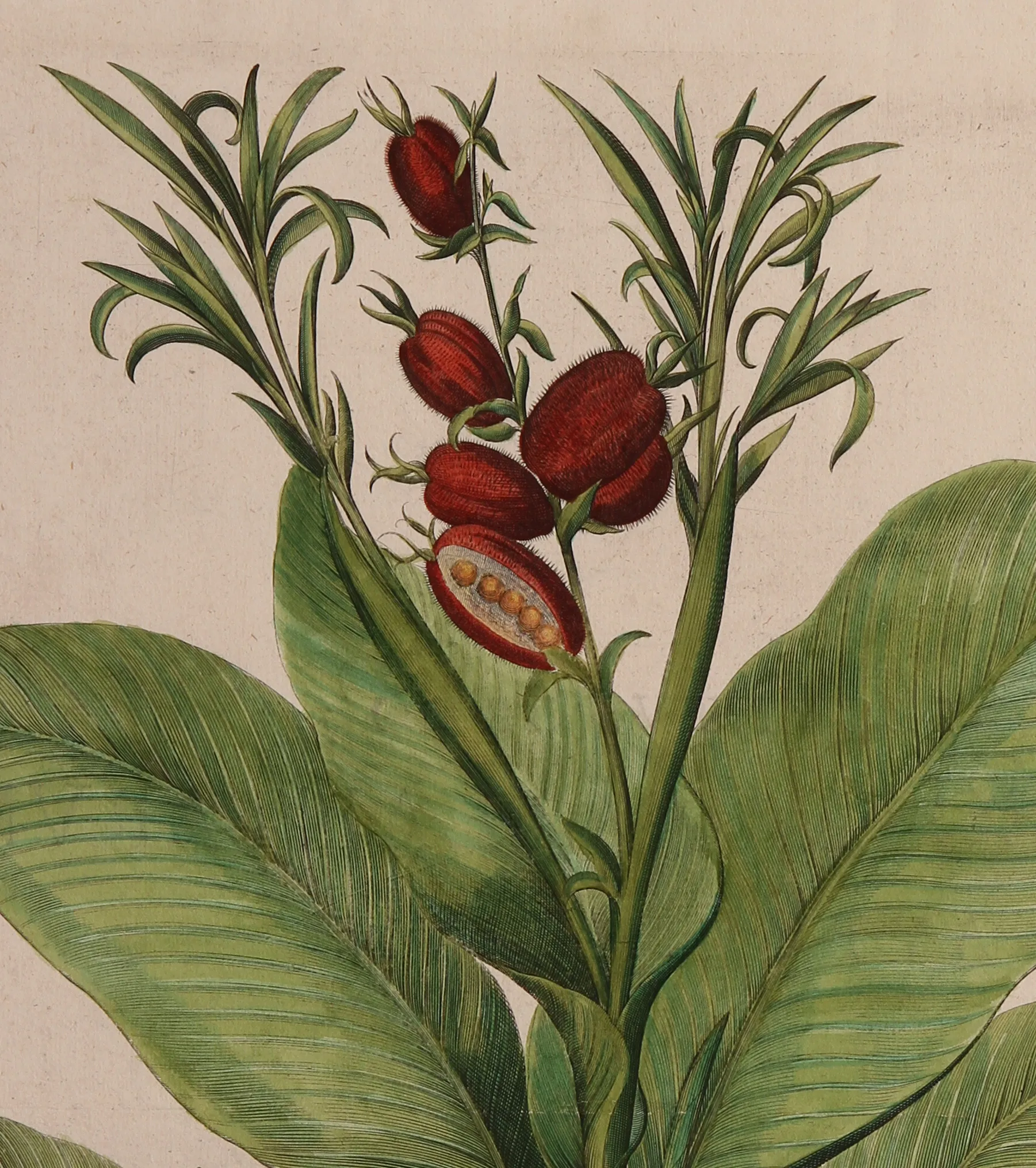
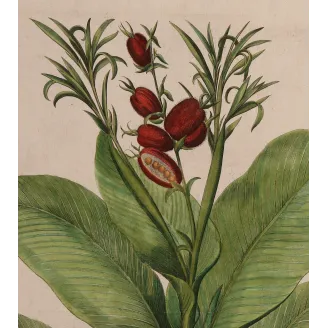
The principal chromatic contrast occurs in the upper section, where vivid red botanical forms emerge between the narrow green leaves. Their compact scale and saturated colour immediately attract the eye, creating a visual counterpoint to the much larger green masses below.
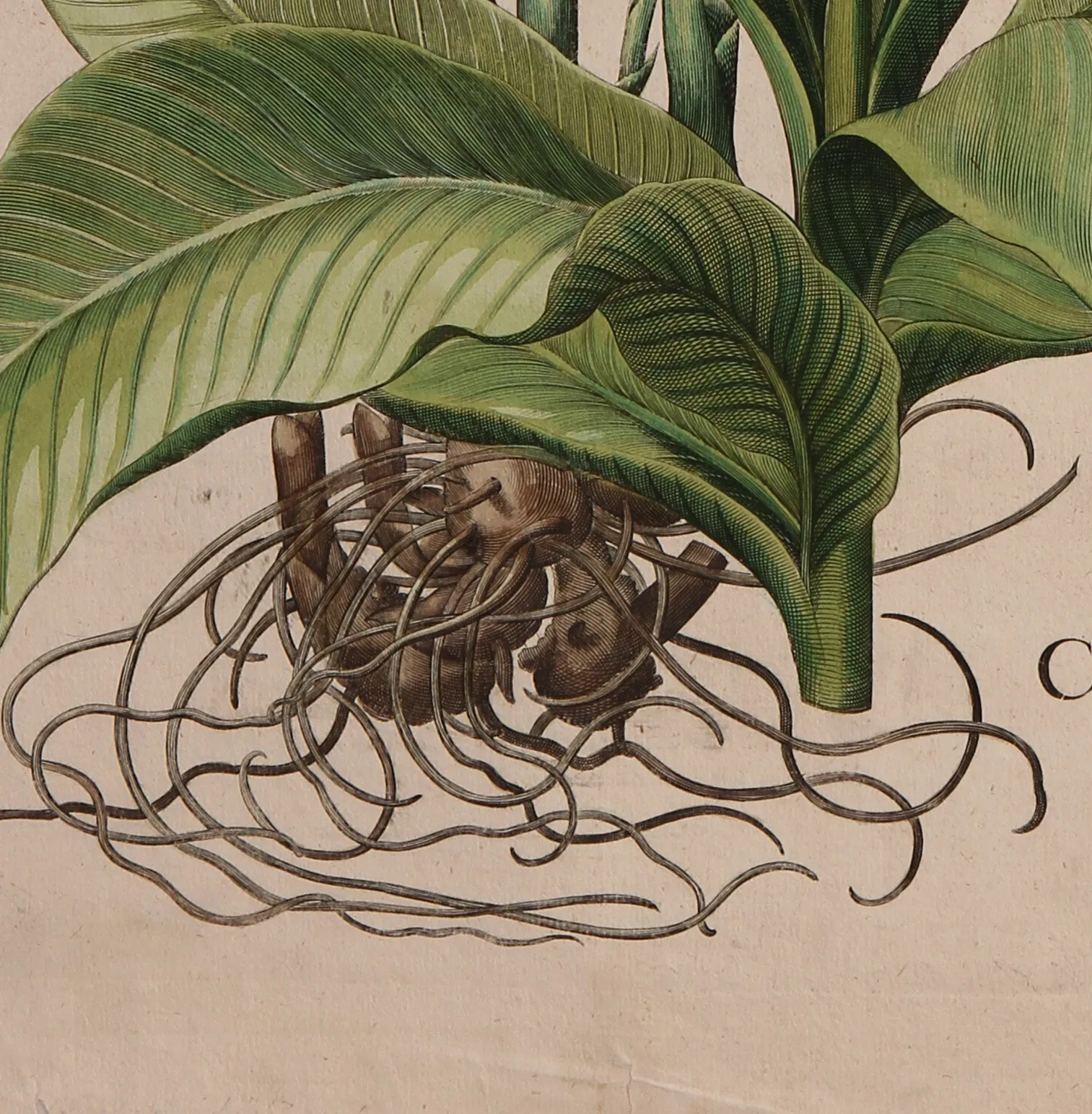
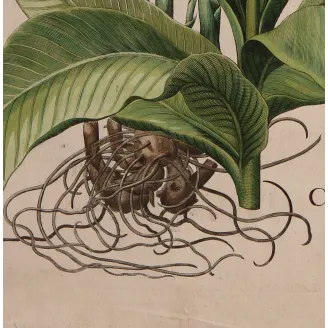
At the base of the plant, the underground structure is completely exposed. Roots extend freely across the open paper in an intricate network of thin lines, while the denser central mass provides both botanical information and visual weight.
This transition from root to leaf is essential to the composition. The lower section is intricate, linear and concentrated; the upper foliage becomes progressively broader and more expansive. The eye therefore moves naturally upward from the complexity of the roots towards the increasingly open architecture of the leaves.
The generous unprinted background is equally important. It isolates the specimen completely and allows even the outermost leaves and roots to remain clearly legible. Rather than functioning as empty space, the surrounding paper gives the plant scale, clarity and authority.
The historical inscription Canna Indica rubra identifies a red-flowered form of canna cultivated in early modern European gardens. Cannas are rhizomatous plants distinguished by their large leaves, vigorous upright growth and conspicuous flowers or fruiting structures.
Their luxuriant foliage and unfamiliar appearance made plants of this type particularly striking within the cultivated collections of seventeenth-century Europe. In Besler’s image, botanical recognition and visual spectacle are inseparable: the broad leaves, underground structure and reproductive forms are all displayed simultaneously.
Historical botanical names do not always correspond directly with modern taxonomic usage. The identification presented here therefore preserves the nomenclature engraved on the original plate rather than imposing a modern horticultural name upon a seventeenth-century representation.
The Hortus Eystettensis repeatedly demonstrates how botanical illustration can move beyond simple description. In this plate, Besler’s plant is not placed within a garden or shown as one element among many. It is isolated and enlarged until the plant itself becomes the architecture of the image.
The monumental foliage is fundamental to this effect. Each leaf forms a large visual surface, but the composition avoids heaviness through changing angles, overlapping contours and carefully controlled internal modelling. The eye does not encounter a single static mass of green, but a sequence of expanding forms.
The lower part of the plant provides the opposite visual language. Roots, fibres and underground structures create a dense linear network whose complexity anchors the broad foliage above. This contrast between intricate root structure and expansive leaf surfaces gives the plate much of its visual rhythm.
The red forms near the top of the composition perform another essential function. Their concentrated colour establishes a clear focal point without competing with the overall dominance of the foliage. The chromatic hierarchy is therefore extremely simple: green establishes scale and structure; red provides intensity.
The absence of environmental context is particularly significant. Nothing distracts from the specimen, yet the result is not clinical. The open sheet acts almost like a stage upon which the plant appears independently, allowing botanical observation to acquire an unexpectedly theatrical presence.
Seen at this scale, the plant ceases to function merely as an illustration of a species. It becomes something closer to a portrait — individual, self-contained and presented with the visual authority normally reserved for a human or emblematic subject.
This is one of the central achievements of the Hortus Eystettensis: the transformation of botanical specimens into images capable of preserving not only their identifying structures, but also something of the wonder inspired by encountering the living plant itself.
Direct examination of this impression reveals a substantial early laid sheet measuring approximately 54.5 × 42.5 cm. The handmade paper shows an approximate chain-line spacing of 30 mm, preserving the physical structure produced by the papermaking mould.
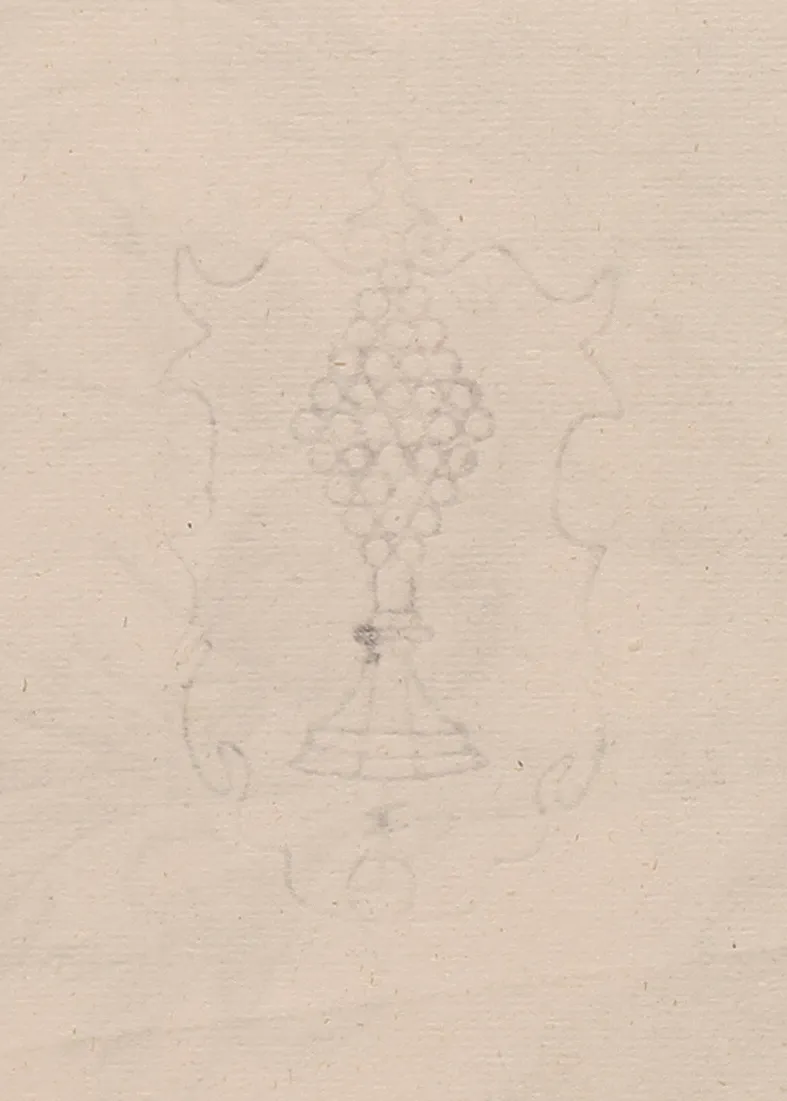
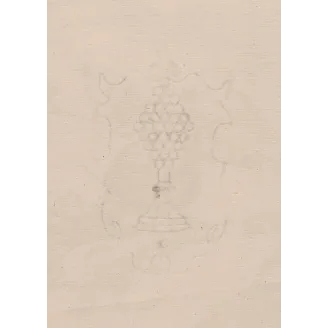
A watermark is visible within the sheet. Its surviving form corresponds to a pomme de pin or pine-cone device contained within a shield-like outline, a watermark type associated with paper used for the Hortus Eystettensis. The mark is recorded here as direct material evidence observed on this individual impression; it is not used in isolation to assign a specific issue or edition.
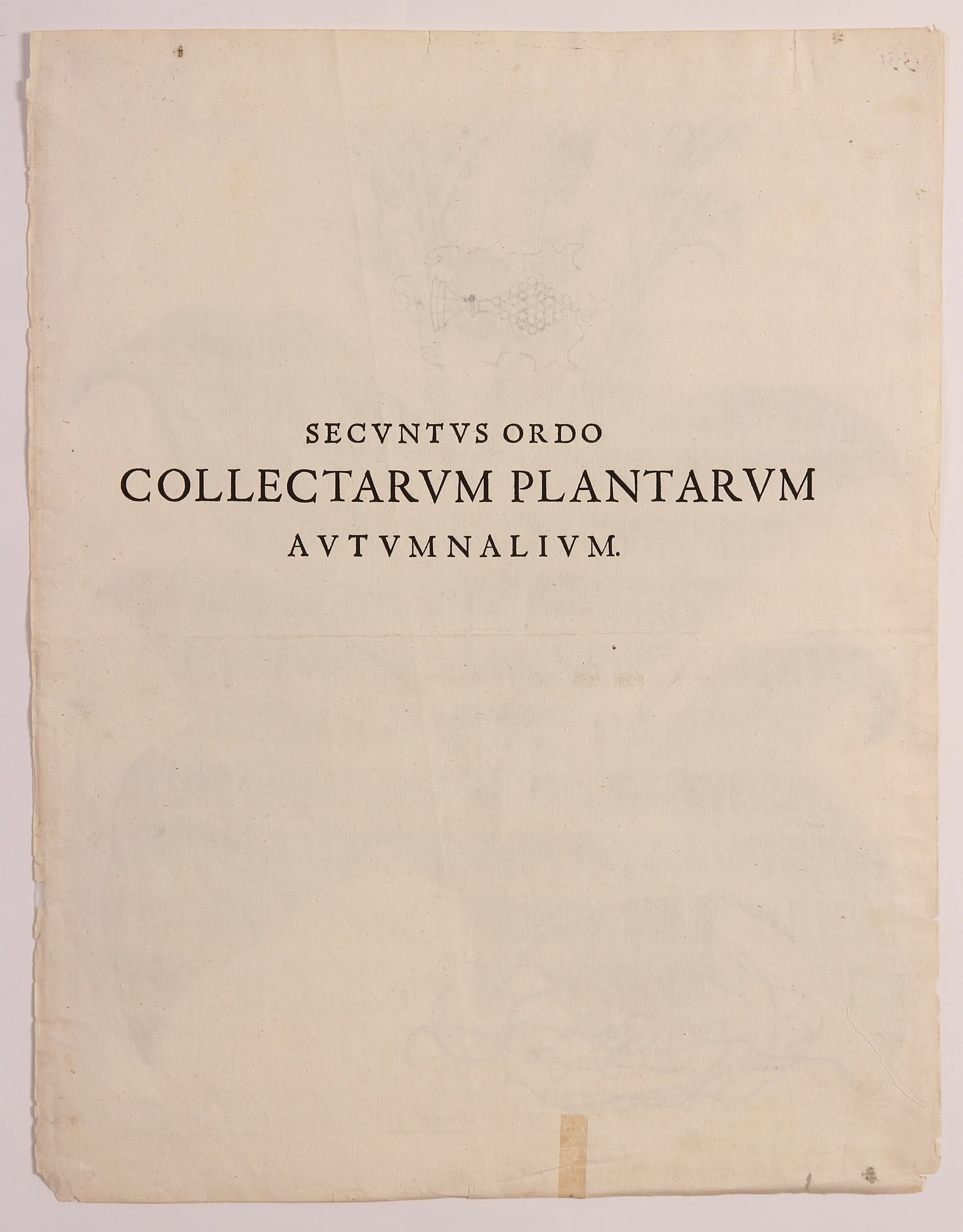
The verso preserves an especially important feature:
SECVNDVS ORDO
COLLECTARVM PLANTARVM
AVTVMNALIVM.
The large typographical heading may be understood as the “Second Order of the Collected Autumnal Plants.” It preserves direct evidence of the seasonal organisation through which the Hortus Eystettensis structured its botanical world.
The recto preserves the plant; the verso preserves something of the architecture of the book to which it belonged.
This relationship is particularly valuable for understanding the original function of the sheet. What appears today as an independent botanical image was conceived within a larger seasonal sequence in which individual plants formed part of an ordered representation of the garden across time.
Published in 1613, Basilius Besler’s Hortus Eystettensis transformed the celebrated garden at Eichstätt into one of the most ambitious botanical monuments of early modern Europe. Its monumental engravings recorded plants through an exceptional combination of botanical observation, large-scale composition and elaborate printmaking.
The work was organised according to the progression of the seasons. Spring, summer, autumn and winter became part of the architecture of the book, allowing plants that could never be seen flowering together in the living garden to coexist within its printed pages.
The original verso of this impression makes that structure tangible. Its large autumnal heading connects the individual image directly with the seasonal order of the original publication.
Our Historical Perspective explores this remarkable relationship between the living garden, the printed image and the passage of time through Besler’s own prefatory words, contemporary testimony and surviving pages of the work.
Basilius Besler and the Hortus Eystettensis: A Garden Against Time →
Explore the Basilius Besler – Hortus Eystettensis Collection →
Very good overall condition for an original early seventeenth-century botanical engraving. The laid paper remains structurally sound and the botanical image retains excellent visual presence and definition.
The hand colouring remains strong and well balanced, with extensive tonal variation across the foliage and vivid red accents in the upper botanical structures. The engraved modelling remains clearly legible beneath the colour throughout the composition.
The sheet preserves broad margins around the botanical image together with the original printed autumnal heading on the verso. Light age-related toning, minor marginal wear and small historical handling traces are present, consistent with the age and physical history of the sheet.
Small irregularities and minor edge losses are visible principally along the outer margins and do not materially affect the central botanical composition. The surviving watermark and laid-paper structure remain visible under appropriate transmitted light.
Please examine the professional high-resolution photographs of both recto and verso for a complete visual assessment. Additional photographs are available upon request.
Historical botanical inscription: Canna Indica rubra
Work: Hortus Eystettensis
Author / project director: Basilius Besler (1561–1629)
Place of publication: Nuremberg
Date: 1613
Technique: Original copper engraving with hand colouring
Artistic tradition: Early seventeenth-century botanical illustration
Paper: Early laid paper
Chain-line spacing: approx. 30 mm
Watermark: Present — pomme de pin / pine-cone device within a shield-like outline
Verso: Original printed heading “SECVNDVS ORDO COLLECTARVM PLANTARVM AVTVMNALIVM”
Manuscript notation: “353”, upper left recto
Sheet size: approx. 54.5 × 42.5 cm
Condition: Very good overall condition, with light age-related and marginal historical traces consistent with an early seventeenth-century sheet
Photography: Professional high-resolution photography of recto and verso
Additional photographs: Available upon request
Authenticity: Original seventeenth-century print — never a modern reproduction

Specific References
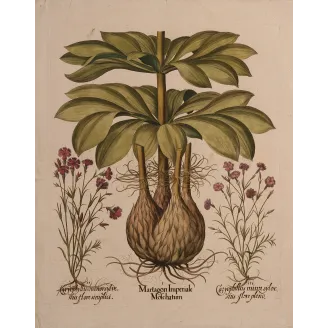
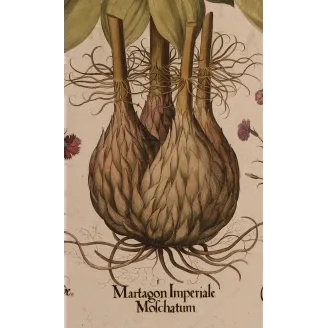
Original seventeenth-century hand-coloured botanical engraving from Basilius Besler’s monumental <em>Hortus Eystettensis</em>, published in 1613. This exceptionally large sheet preserves the lower part of an originally two-sheet composition, centred upon the imposing <em>Martagon Imperiale Molchatum</em> and accompanied by two flowering <em>Caryophyllus</em> forms. The verso retains the remarkable original typographical heading <em>Tertius Ordo Collectarum Plantarum Æstivalium</em>, material evidence of the seasonal organisation of Besler’s great botanical work.
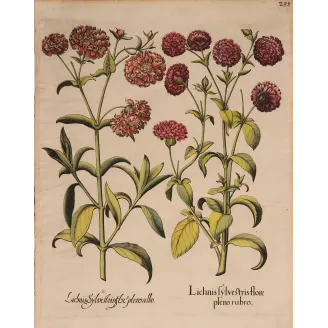
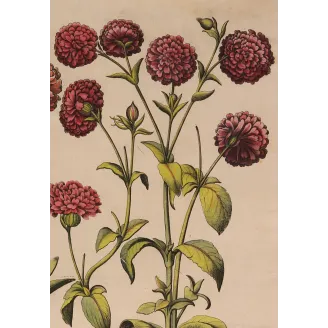
Original seventeenth-century hand-coloured botanical engraving depicting two forms historically inscribed <em>Lychnis Sylvestris</em>, from Basilius Besler’s monumental <em>Hortus Eystettensis</em>, published in 1613. The two flowering specimens create an exceptional comparative composition, with richly articulated red and crimson blossoms set against restrained green foliage. Printed on substantial laid paper with an approximately 30 mm chain-line spacing and a visible <em>pomme de pin</em> (pine-cone) watermark.
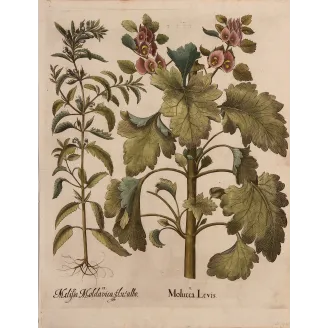
Original seventeenth-century hand-coloured botanical engraving depicting <em>Molucca Levis</em> and <em>Melissa Moldavica flor. albo</em>, from Basilius Besler’s monumental <em>Hortus Eystettensis</em>, published in 1613. The composition contrasts the slender architecture of the Melissa with the broad, sculptural foliage and distinctive pink-mauve flowers of the Molucca. Printed on substantial early laid paper with approximately 32 mm chain-line spacing and a visible, presently
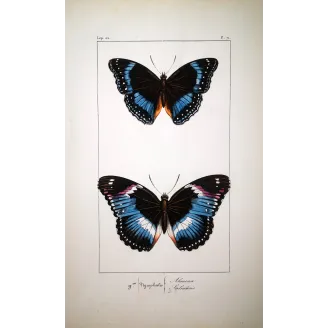
A vivid 19th-century hand-colored engraving depicting two striking tropical butterflies: the Blue-banded Eggfly (Hypolimnas alimena) and the Blue Diadem (Hypolimnas salmacis). Published in Hippolyte Lucas’s Exotic Butterflies (1835), the plate highlights their dramatic contrast of velvety black wings with electric blue bands and delicate white markings.
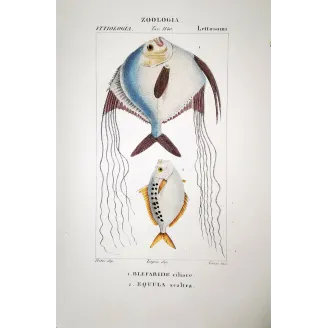
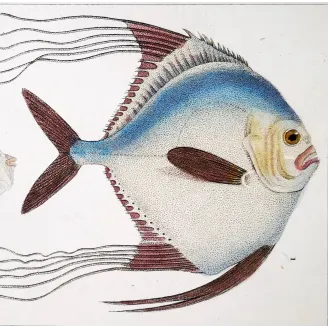
Delicate 19th-century hand-colored engraving of a ponyfish with companion species, ideal for marine-themed interiors and collectors.
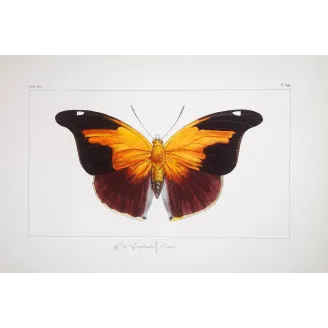
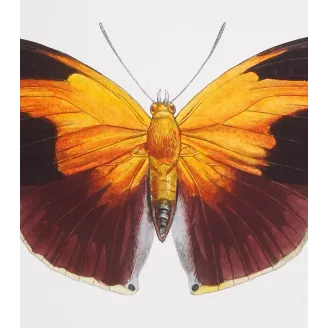
Original 1835 hand-colored engraving of Nymphalis orion, drawn and engraved by Pauquet under the scientific direction of Hippolyte Lucas for Exotic Butterflies.
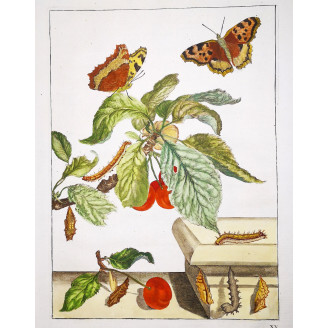
Original 1774 engraving by Jacob L'Admiral: Large Tortoiseshell on Sweet Cherry.
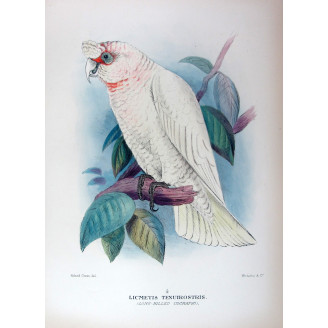
Glossy Cockatoo print by H. Goodchild, dark tones and rare presence on the plate
This second edition of the Water-Lily plate (No. 7) captures all the refined serenity of Plate 9, with slight variations in layout and ornamental balance.
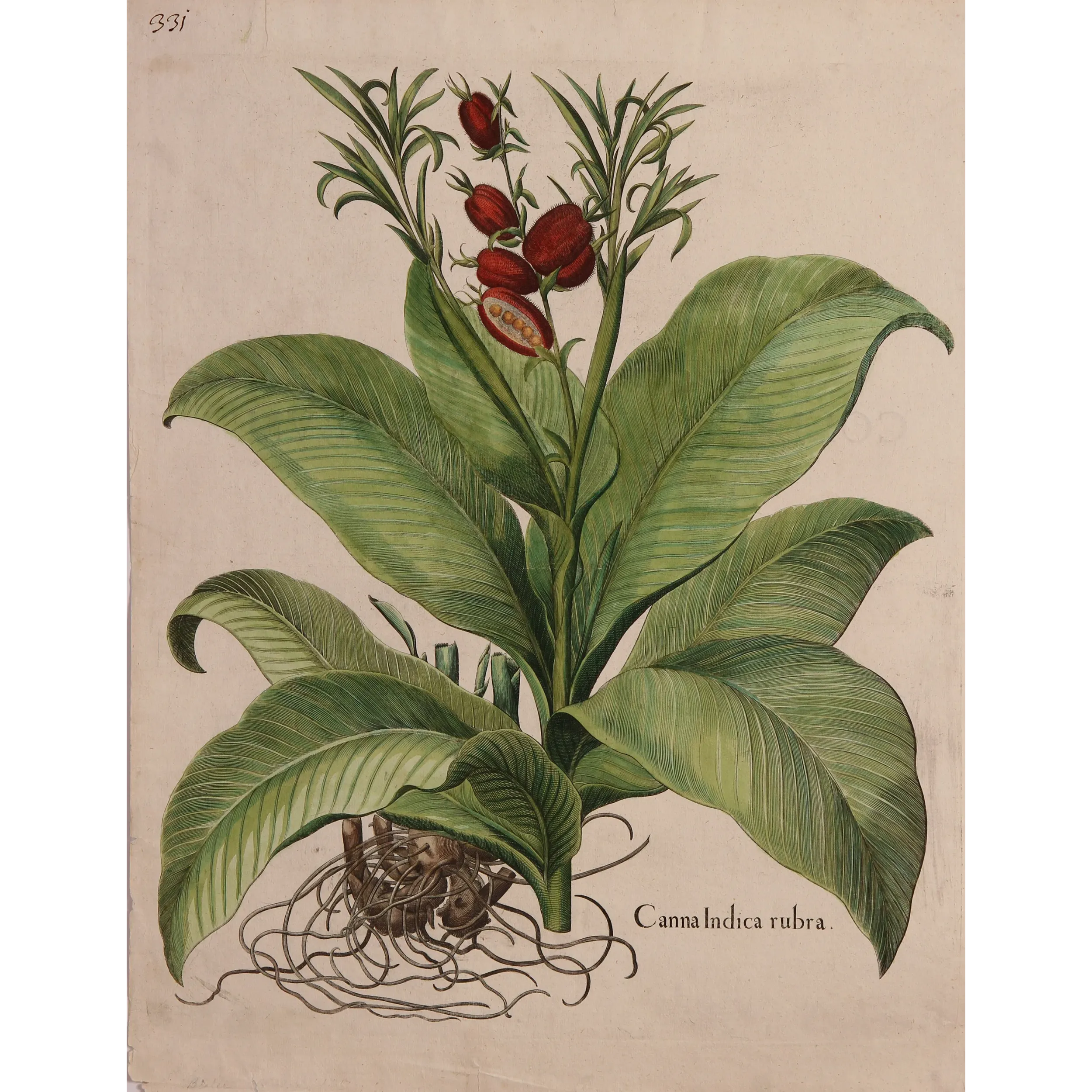
Original seventeenth-century hand-colored botanical engraving of Canna Indica rubra from Basilius Besler's monumental Hortus Eystettensis, first published in 1613. The imposing composition combines sweeping green foliage, exposed roots and vivid red botanical forms, while the laid-paper sheet preserves a watermark and the remarkable printed autumnal heading “SECVNDVS ORDO COLLECTARVM PLANTARVM AVTVMNALIVM” on its verso.