
Pierre-Joseph Redouté: Botanical Illustration Beyond Roses
Pierre-Joseph Redouté: Floral Art in the Service of Science
Pierre-Joseph Redouté (1759–1840) is celebrated for his roses, yet his botanical art reaches well beyond the flower garden. In the illustrated publishing enterprise known as the Nouveau Duhamel, and particularly its treatment of trees and shrubs, cultivated fruit trees became subjects of close observation and accomplished visual design.
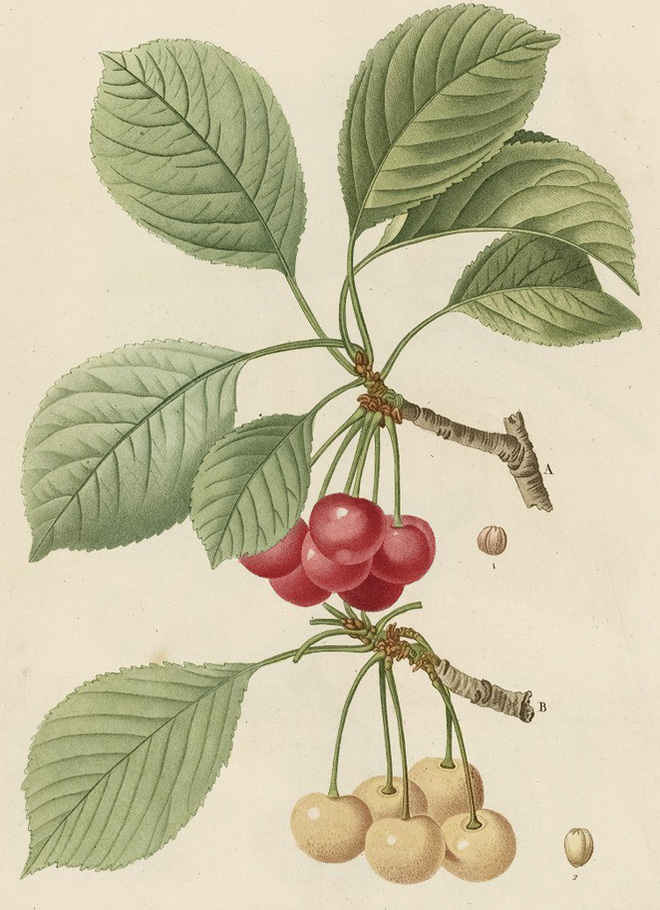
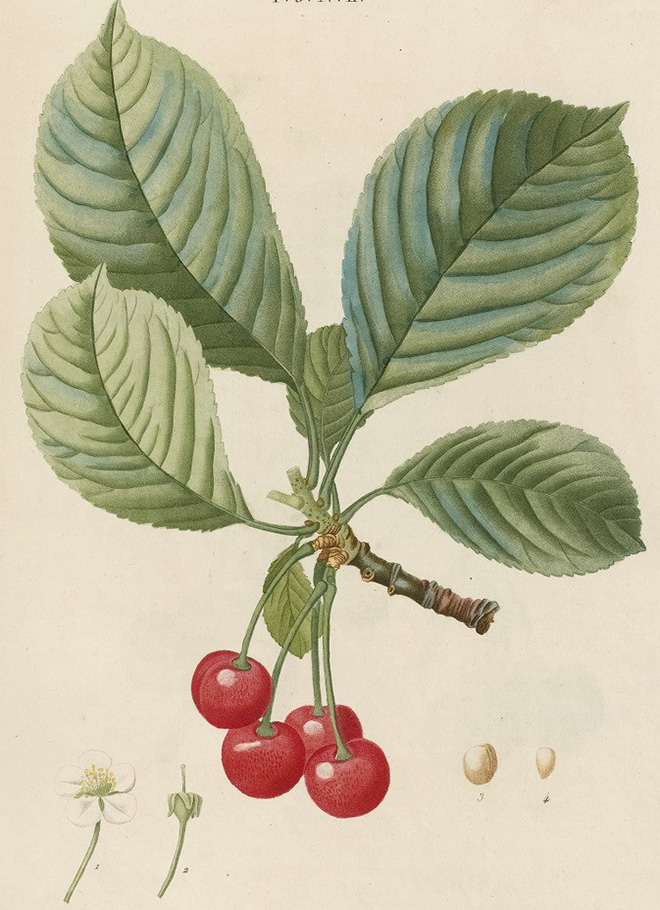
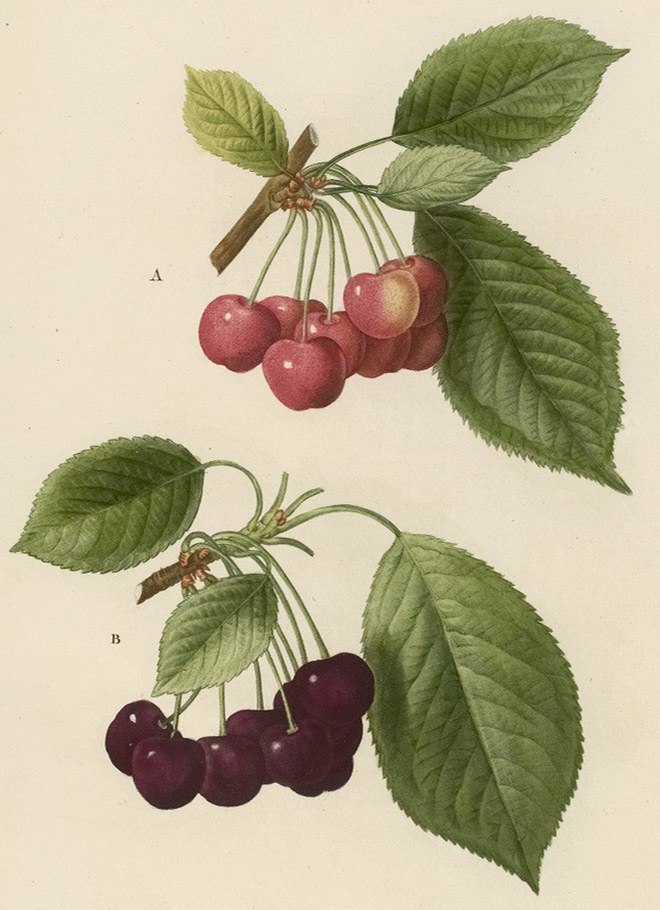
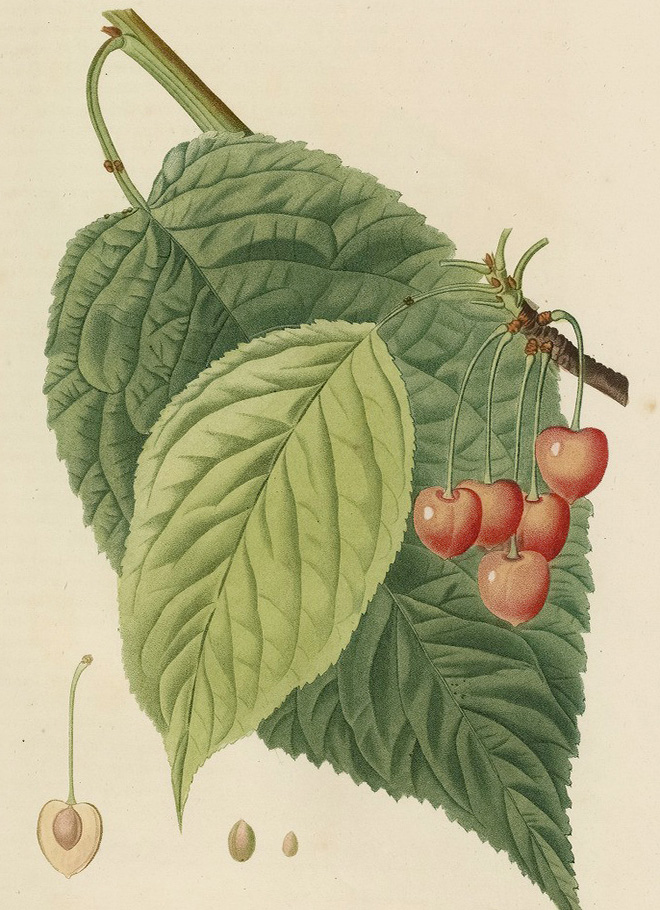
The cherry tree engravings offer a revealing way to encounter this broader achievement. Individually, they present botanical subjects with clarity and elegance. Viewed together, they invite comparison: between branching forms, leaves, flowers and fruit, and between the compositional decisions that make each plant legible.
This Curatorial Perspective follows the cherry trees as a coherent group within Redouté's wider botanical work. Its central question is simple: what becomes visible when related botanical images are considered together?
Beyond the Florilegia
The fame of Les Roses has shaped Redouté's modern reputation. But his attention to plants was never confined to ornamental flowers. Trees introduce a different set of visual problems: the character of a branch, the attachment and orientation of leaves, and the form and distribution of fruit all contribute to botanical recognition.
An illustration must communicate those features without becoming a crowded inventory. It must select, arrange and clarify. In the cherry engravings, botanical description and pictorial composition meet on the same sheet.
The cultivated tree is presented not as a distant landscape feature, but as a subject worthy of its own portrait.
The Visual Language of Botanical Knowledge
Botanical illustration makes plants available to readers who may never encounter the living specimen. It brings selected characteristics into view and allows them to be studied beyond the garden, orchard or collection where the plant was observed.
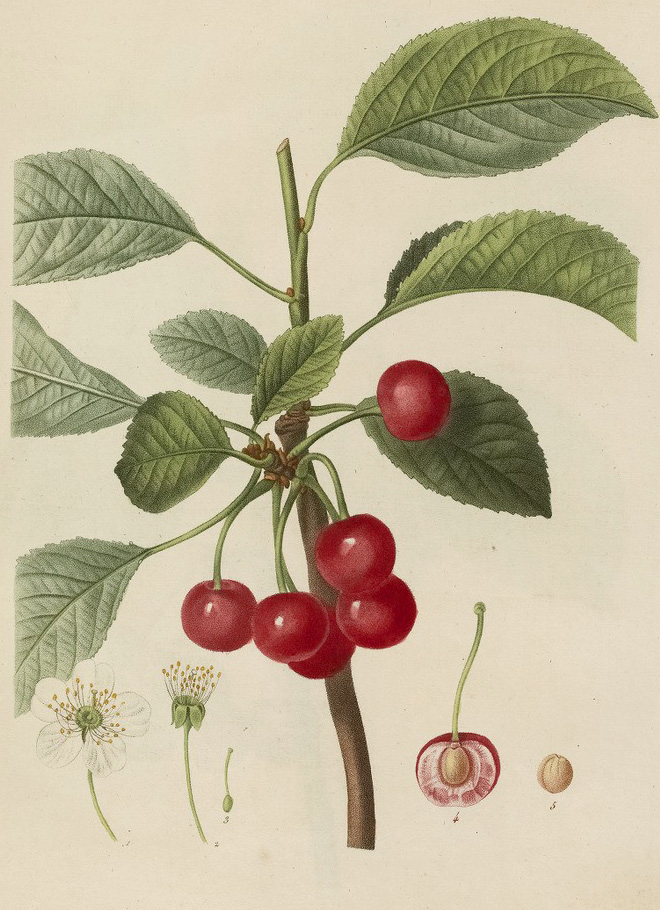
Redouté's designs are especially rewarding when examined for the choices behind their apparent naturalness. A branch establishes direction; leaves disclose their shapes without obscuring one another; fruit acquires volume through carefully organised light and shade. Open areas of paper give the eye space to move between these elements.
Such images do not simply reproduce everything that might be seen on a tree. They organise observation. Their elegance arises in part from the discipline with which botanical information is made visible.
From Redouté's Design to the Printed Sheet
The botanical engraving is a collaborative object. The artist establishes the design; an engraver translates it into a printing matrix; printing and, where present, colouring shape the appearance of the individual impression.
Stipple engraving, when used, permits subtle transitions of tone through the distribution of small engraved marks. Such effects can suggest the rounded surface of fruit and the delicate movement from light into shadow. They should not, however, be attributed automatically to Redouté's own hand as an engraver.
The inscription Redouté pinx. identifies his contribution as painter of the model. Other inscriptions on an individual plate may document the engraver's separate role. Reading these signatures is part of understanding how a botanical image was made.
The final sheet preserves an artistic conception through the material and technical work of printmaking.
Beyond Roses: Redouté's Cherry Trees
The cherry tree rewards a sustained botanical gaze. Its identity is communicated not by fruit alone but through relationships: how leaves emerge from a branch, how fruit is carried, and how the plant's characteristic forms are arranged.
One engraving offers an individual study. Several related engravings invite a different kind of looking. The viewer can move from sheet to sheet, recognising recurring structures and noticing differences in form, proportion and presentation.
The cherry plates thus support a comparative reading without losing their individuality as works of art. Each image has its own visual character; the group reveals the consistency and flexibility of the artist's approach.
A Coherent Visual Subset Within Arbres et Arbustes
Bringing the cherry engravings together is a curatorial choice, not a claim that they were issued as an independent publication. Within the wider illustrated work, their shared subject makes it possible to examine Redouté's visual method across related botanical images.
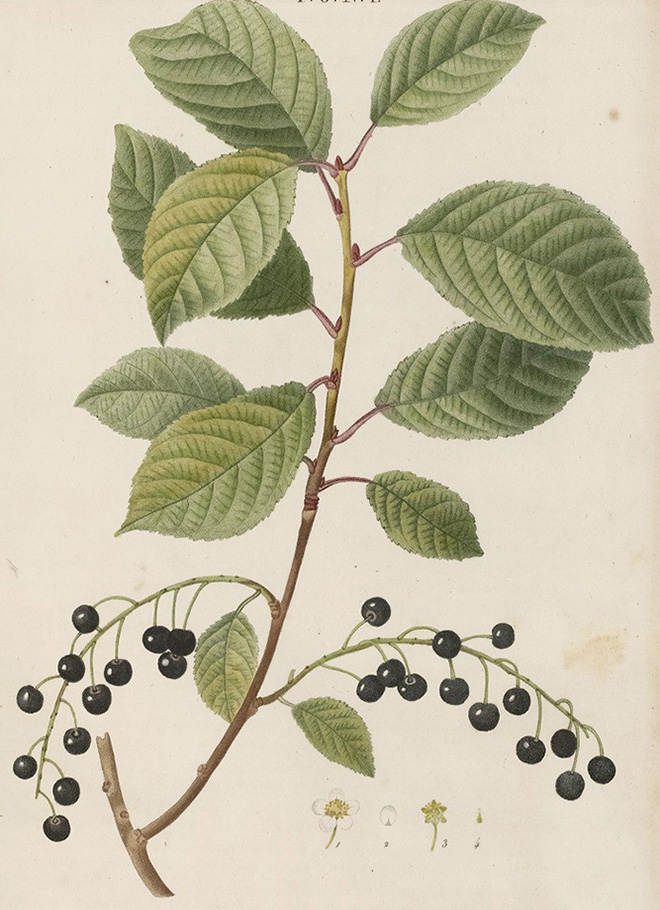
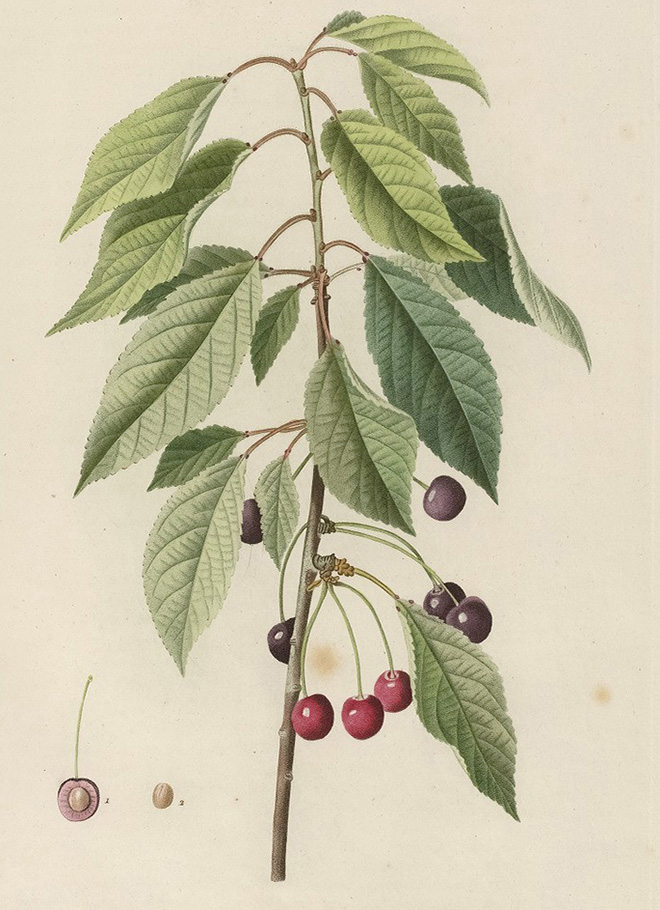
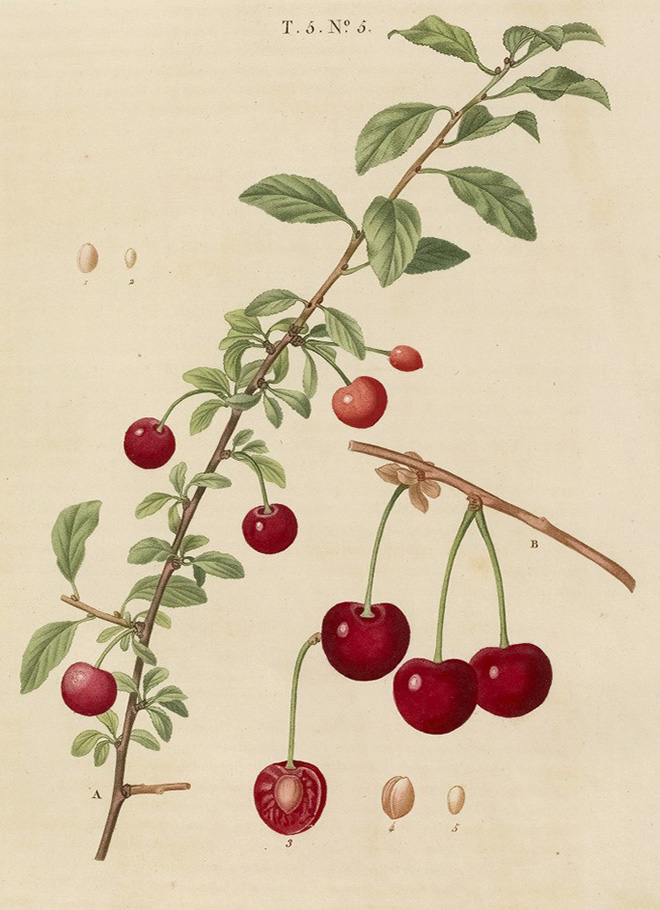
The viewer can compare the direction of the branches, the density of the foliage and the distribution of fruit. Equally revealing are the differences in pictorial balance: the way each specimen occupies the sheet, the intervals of open paper and the points at which the composition directs attention.
The repeated format makes these comparisons possible, while the changing botanical forms prevent the images from becoming repetitive. The group offers a richer experience than an isolated plate: a sequence of distinct images that can also be read in dialogue.
 |
 |
 |
|
 |
 |
 |
 |
The Art of Making Differences Visible
Comparison is not simply a matter of placing images side by side. The images must first make their botanical subjects sufficiently clear for the viewer to perceive meaningful distinctions.
In these cherry engravings, the absence of a landscape concentrates attention on the plant. Branches guide the eye; clusters of fruit establish points of emphasis; the intervals between leaves prevent complex structures from collapsing into visual confusion.
The botanical differences are not merely recorded. They are given a visual form through which they can be noticed and appreciated.
The Original Impression: Image and Evidence
An engraving can be admired for its composition, but an original impression also preserves evidence of its making and subsequent history. The printed marks, artist's inscription, paper, margins and any surviving colouring belong to the individual object, not simply to the botanical subject represented.
Such characteristics must be recorded through direct examination rather than assumed from another impression of the same plate. Differences in preservation, paper or colouring can matter to the understanding of an individual sheet.
For this reason, the individual Prantique catalogue entries bring together the botanical image, its bibliographic context and the material characteristics observable in the specific impression offered. The print is both an image to be seen and an object to be examined.
Seeing Redouté Differently
Redouté's association with roses is well deserved. It is nevertheless only one part of his botanical achievement.
The cherry tree engravings reveal the same attention to the visible character of plants applied to cultivated trees. Their branches, foliage and fruit are not secondary to the image: they are the means through which the plant is understood.
One sheet presents a particular botanical subject. The group reveals how a consistent artistic language responds to changing forms. Beyond the roses, Redouté's art offers another way of seeing cultivated nature.
A related group reveals the choices behind the images.
An original impression preserves the material evidence
of the artistic world that brought them into being.
A corpus teaches us to compare.
Curatorial Note
The cherry engravings considered here belong to the larger publishing enterprise commonly known as the Nouveau Duhamel. The preliminary Plan de l'Ouvrage identifies Redouté in connection with its drawings, while plates from the wider work also document the contributions of other artists. The present Perspective focuses on the images attributed to Redouté and on the interpretive possibilities of viewing the cherry trees together.
The historical and scientific ambitions of the Nouveau Duhamel deserve a separate Historical Perspective. This essay remains concerned with Redouté's visual language and the cherry tree group.
Selected References
- Nouveau Duhamel, vol. I (1800), preliminary Plan de l'Ouvrage.
- Wilfrid Blunt and William T. Stearn, The Art of Botanical Illustration.
- Gordon Dunthorne, Flower and Fruit Prints of the 18th and Early 19th Centuries.
- David Mabberley, The Botanical World of Pierre-Joseph Redouté.
Discover the Pierre-Joseph Redouté Collection
The story continues in the original engravings.
Explore original engravings attributed to Redouté, including the cherry tree studies discussed in this essay. The individual catalogue entries bring the story closer to each sheet, considering botanical subject and composition alongside bibliographic information and the physical evidence recorded through direct examination.
Discover the individual works and the details preserved by each original impression.
Related posts
-
 Émile-Allain Séguy and Prismes: Art Deco Geometry in Full Color
At the intersection of biology, modernism, and decorative arts, Émile-Allain Séguy occupies a singular place. Best...Read more
-
 La Plante et ses Applications Ornementales: Eugène Grasset and the Birth of Modern Botanical Design
In the golden age of Art Nouveau, few works embody the marriage between art and nature as perfectly as La Plante et...Read more
-
 Gregory M. Mathews and The Birds of Australia: A Monument of Ornithological Ambition
Gregory M. Mathews’ The Birds of Australia is a monumental blend of taxonomy and art. This article explores the...Read more
-
 Jacob L'Admiral and the Metamorphosis of Insects – A Dutch Enlightenment Marvel (1774)
In the vibrant scientific atmosphere of the 18th century, Jacob L’Admiral (1700–1775), a Dutch naturalist and...Read more
-
 The Hidden Nobility of Natural History Prints: From the Sacchetti Collection
The Hidden Nobility of Nature Prints In the vast and fascinating world of antique natural history prints, there are...Read more
Leave a comment