
Pierre-Joseph Redouté and the Making of a Botanical Image
Pierre-Joseph Redouté and the Making of a Botanical Image
Artistic authorship, scientific observation and the collaborative world of early nineteenth-century botanical publishing.
Pierre-Joseph Redouté occupies a distinctive place in the history of botanical illustration. His name evokes an exceptional union of scientific observation and artistic refinement: plants rendered with remarkable clarity, yet endowed with a visual presence that extends far beyond their original descriptive purpose.
Today, an antique botanical print associated with Redouté is often encountered as an individual work of art. Its subject, composition and colouring invite us to admire it independently of the book for which it was created. Yet the image we see is also the surviving result of a much larger process — one involving the observation of plants, the preparation of drawings, the translation of those drawings into engraved plates, and the complex practices of printing and colouring.
To understand a Redouté print fully, we must therefore look beyond the celebrated name.
We must consider not only the artist, but also the world that made his images possible.
The Artist and the Botanical World
Born in 1759 in Saint-Hubert, in what is now Belgium, Pierre-Joseph Redouté developed his career within the extraordinary botanical and artistic environment of late eighteenth- and early nineteenth-century France.
His association with the Jardin du Roi and the flower painter Gérard van Spaendonck helped shape an approach in which the close observation of plants was inseparable from the discipline of painting. Redouté's subsequent work brought him into contact with botanists, publishers and important collections of living plants.
His career extended across several major illustrated botanical publications, including Plantarum historia succulentarum, Les Liliacées, Jardin de la Malmaison and, later, Les Roses.
These works differed in their subjects, editorial ambitions and collaborators. Together, they reveal the range of Redouté's activity: not simply the production of beautiful flowers, but participation in an ambitious effort to represent botanical knowledge through images.
The botanical artist had to reconcile two demands.
The plant needed to remain recognisable and sufficiently precise for its scientific purpose. At the same time, its form had to be organised within the boundaries of a page.
In Redouté's work, this negotiation between observation and composition became a defining artistic language.
Before the Print: The Botanical Image
A botanical illustration begins with a subject that is neither static nor entirely predictable.
A living plant changes with its stage of growth. Flowers open and fade; fruit develops; leaves alter their position. A single specimen may not display every characteristic needed to communicate the identity of a species.
The finished illustration must therefore organise botanical information into a coherent visual form.
This is particularly evident in representations of trees and fruit-bearing plants, where a branch may be selected to convey the relationship between leaves, flowers and fruit without attempting to depict the entire tree.
Such an image is not merely a fragment of nature copied onto paper. It is a considered arrangement of observed features.
Redouté's compositions frequently achieve this through a controlled relationship between the principal botanical form and the surrounding space. A branch may occupy the page with apparent ease, while its direction, balance and distribution of leaves guide the viewer towards the elements of greatest visual interest.
The result can seem effortless.
Yet that apparent simplicity is itself an artistic achievement: botanical information has been made legible without surrendering the individuality of the plant.
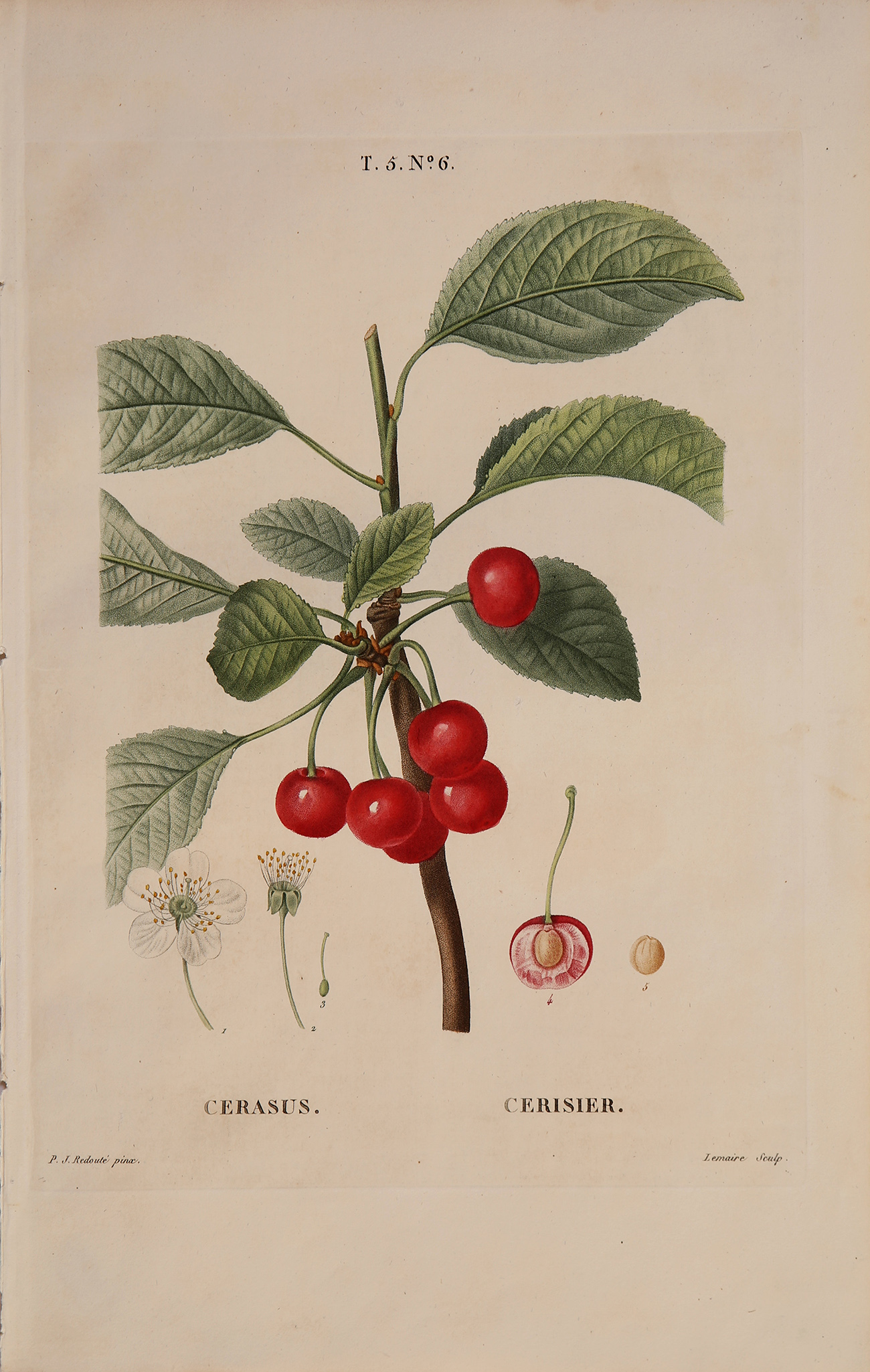
No single moment in the life of the plant would necessarily present all these elements so clearly. Their arrangement therefore transforms successive stages and internal structures into a coherent field of observation.
The branch remains graceful, yet its beauty is inseparable from its explanatory purpose. The surrounding paper keeps each element distinct, while the red fruit establishes the visual emphasis from which the eye moves towards the smaller analytical details.
What Does “Redouté pinx.” Tell Us?
Among the most revealing details on an original botanical print are the small inscriptions that appear beneath the image.
The abbreviation pinx., from the Latin pinxit, identifies the person who painted the original composition.
When a plate bears the inscription Redouté pinx., it records Redouté's artistic responsibility for the image. It does not, by itself, establish that he engraved the printing plate or personally printed the impression.
This distinction is fundamental.
A botanical illustration could pass through several hands before becoming a finished print. The original drawing or painting provided the visual model. An engraver translated that model into a printable matrix. The printer produced the impressions, and colouring might involve additional specialised work.
Each stage required a different kind of expertise.
The engraver faced the demanding task of translating the delicacy of a botanical painting into a reproducible image. Tonal transitions, the softness of petals and the subtle modelling of leaves all had to survive this transformation.
Stipple engraving, which builds tonal effects through carefully distributed dots, was particularly important in the reproduction of Redouté's botanical paintings.
Colour printing and subsequent finishing by hand could then bring the printed image closer to the appearance of the original artwork.
The completed plate was consequently both an expression of Redouté's vision and the product of skilled collaboration.
Recognising this process does not diminish the artist's contribution. It allows us to understand it more precisely.

They document collaboration rather than a single act of authorship. They do not identify the printer or the hands responsible for any final colouring, and they should not be made to say more than the impression itself records.
This distinction becomes still clearer across the publication. Other plates after Redouté were engraved by Gabriel, Bouquet, Bocquet, Duruisseau, Mlle Janninet and additional specialists. Conversely, Gabriel also engraved compositions signed P. Bessa pinx. The inscriptions allow the network behind the image to be reconstructed one plate at a time.
Redouté and the Nouveau Duhamel
The illustrated Traité des arbres et arbustes que l'on cultive en France en pleine terre, commonly known as the Nouveau Duhamel, offers a particularly revealing context in which to examine Redouté's work.
Published during the opening decades of the nineteenth century, it invoked the authority of Henri-Louis Duhamel du Monceau's earlier treatise while responding to a botanical world that had changed profoundly since its publication. New plants were entering European collections through expanding networks of exploration, exchange and cultivation, while questions of naturalisation and acclimatisation had acquired growing scientific and economic importance.
The work should therefore not be understood simply as a new edition written by Duhamel himself. Its preface presents a substantially revised and enlarged undertaking, intended to describe trees and shrubs through their classification, distinguishing characteristics, geographical origins, varieties, methods of cultivation and practical properties.
The plan brought the systems of Linnaeus and Jussieu into consideration and proposed an extensive treatment of genera and species, including etymology, synonymy, provenance and use. Indigenous and naturalised plants were considered alongside foreign species that might be introduced into France and potentially contribute to agriculture, industry or commerce.
The scale was correspondingly ambitious: the plan envisaged approximately two thousand species, issued in instalments that combined descriptive text with groups of six plates.
Within this programme, botanical illustration was not an ornamental supplement. It formed part of the work's method of description. The preface explicitly assigns the drawings to Redouté, while the surviving plates also document the participation of Pancrace Bessa and a wider network of engravers and specialists. An inscription such as Redouté pinx. identifies responsibility for the painted model; it does not collapse drawing, engraving, printing and colouring into a single act of authorship.
The Nouveau Duhamel thus provides an especially clear example of botanical publishing as a collaborative undertaking in which classification, cultivation and visual description were brought together.
For Redouté, this context presented a different artistic challenge from the representation of an isolated flower.
The character of a tree had to be conveyed through selected botanical elements: the structure of a branch, the disposition of leaves, the shape of fruit, or the relationship between several stages of development.
The composition needed to remain scientifically informative while retaining its integrity as an image.
A fruit-bearing branch could become a complete visual statement.
Its botanical purpose and decorative power were not competing qualities. They emerged from the same disciplined act of observation and arrangement.
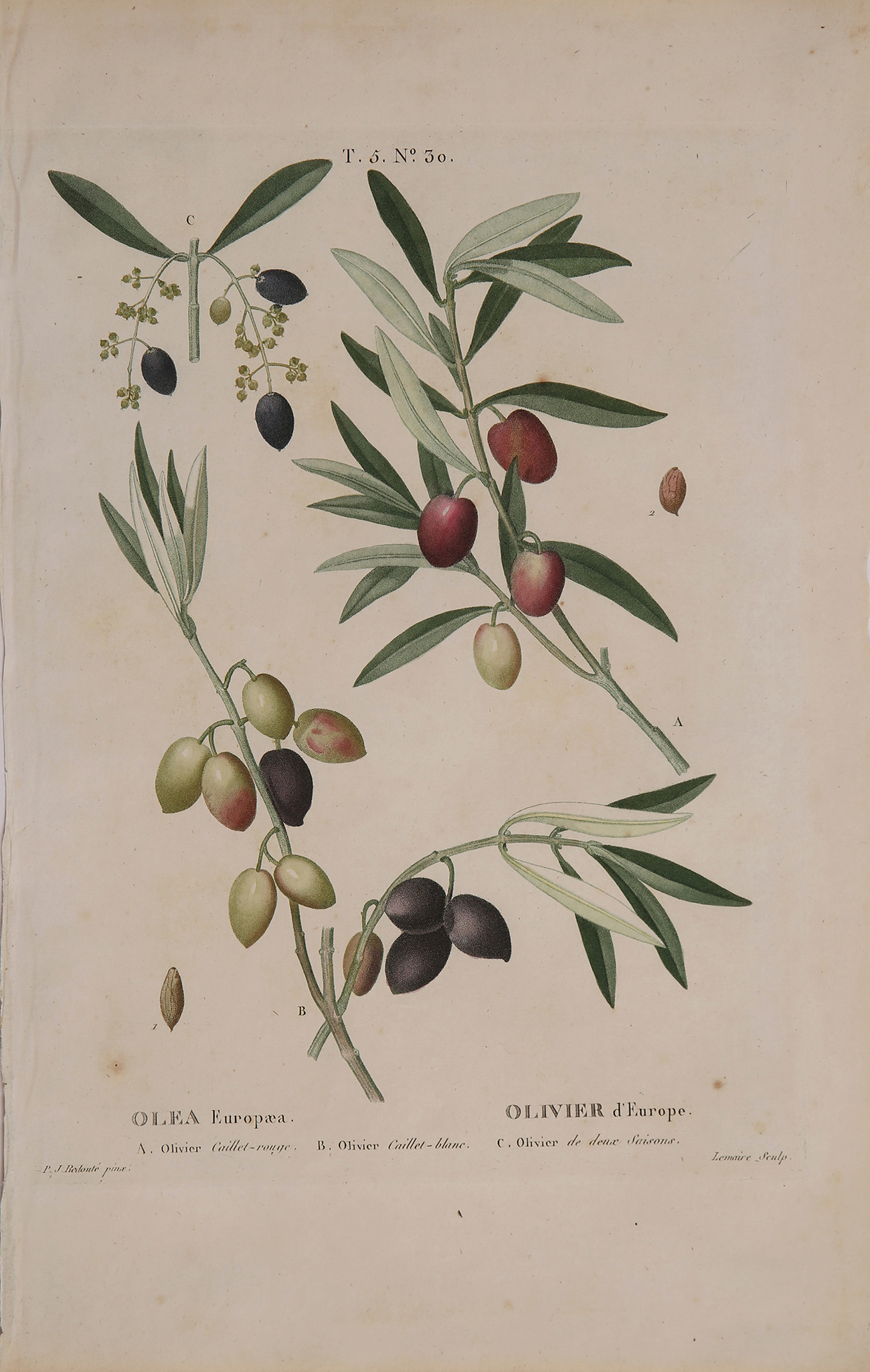
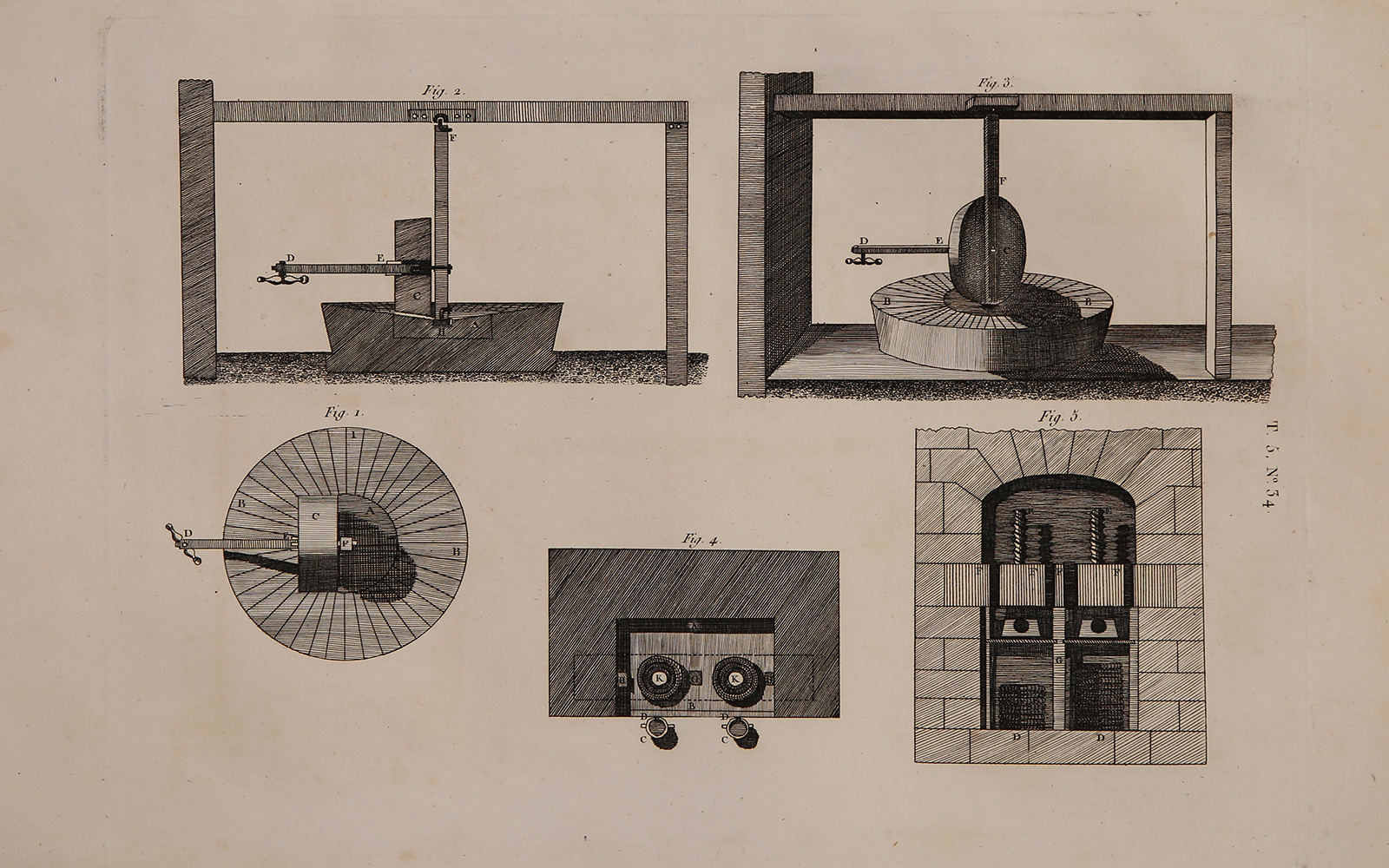
The surviving plates also reveal an editorial scope extending beyond botanical portraiture alone. A sequence devoted to the olive tree presents cultivated varieties and fruit at different stages, while the following fold-out plates illustrate mills and presses used in the production of olive oil.
The movement from plant to process is significant. It places botanical observation within a wider account of cultivation, agricultural value and practical knowledge.
 |
 |
Precision and Grace
Redouté's reputation is closely associated with the beauty of his botanical images. Beauty, however, is an insufficient explanation of their achievement.
Their visual refinement depends upon decisions that also serve the communication of botanical form.
A leaf must have volume without becoming visually heavy. A fruit must appear substantial while retaining the particularity of its surface and shape. A branch must convey its natural growth without losing coherence within the page.
These qualities can be examined through the composition itself.
The direction of a stem establishes movement. The spacing between leaves creates rhythm. The placement of a flower or fruit establishes emphasis. Areas of untouched paper give the botanical subject room to breathe.
Such observations belong to the interpretation of the image rather than to its bibliographic identification.
They help explain why a botanical print can remain compelling long after the scientific terminology or horticultural practices associated with its original publication have changed.
Its historical purpose remains important.
But its visual structure allows it to speak to viewers who encounter it in an entirely different setting.
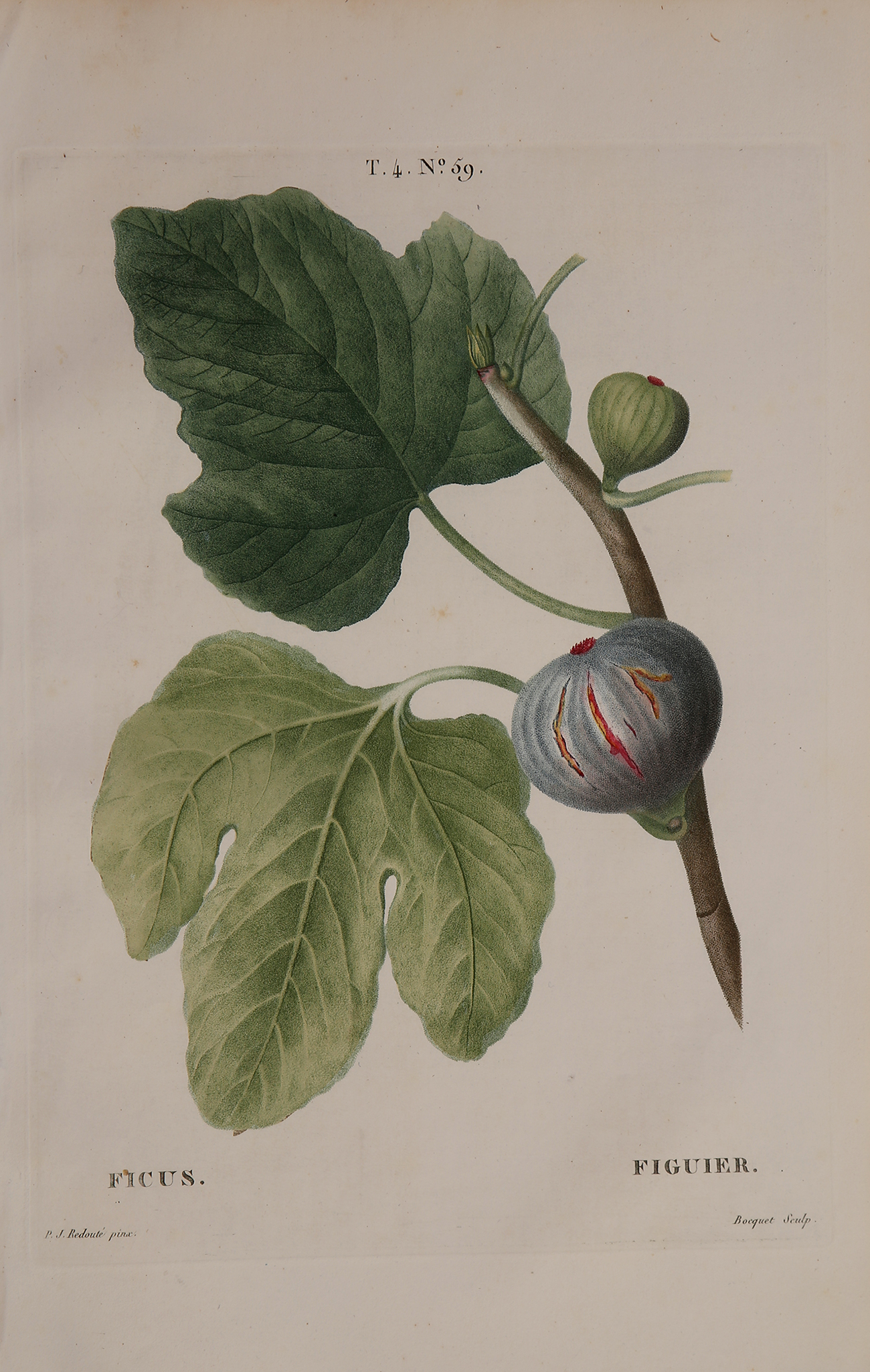
The effect cannot be assigned to Redouté alone. The plate is signed Bocquet sculp., recording the engraver responsible for translating the painted model. Printing and hand finishing contributed further to the appearance of this particular impression.
Its material history extends beyond the printed surface. Examination of the complete Ficus sequence T.4 N°53–59 has recorded A Courtalin watermarks on plates 54, 56, 57 and 58, and Odent & C marks on plates 53 and 59. The marks on plates 53 and 56 are incomplete at the lower sheet edges; no watermark was detected on plate 55. The historical relationship between Courtalin and the Odent family is explored below. These variations do not, by themselves, demonstrate separate editions or print runs.
Courtalin and the Odent Family
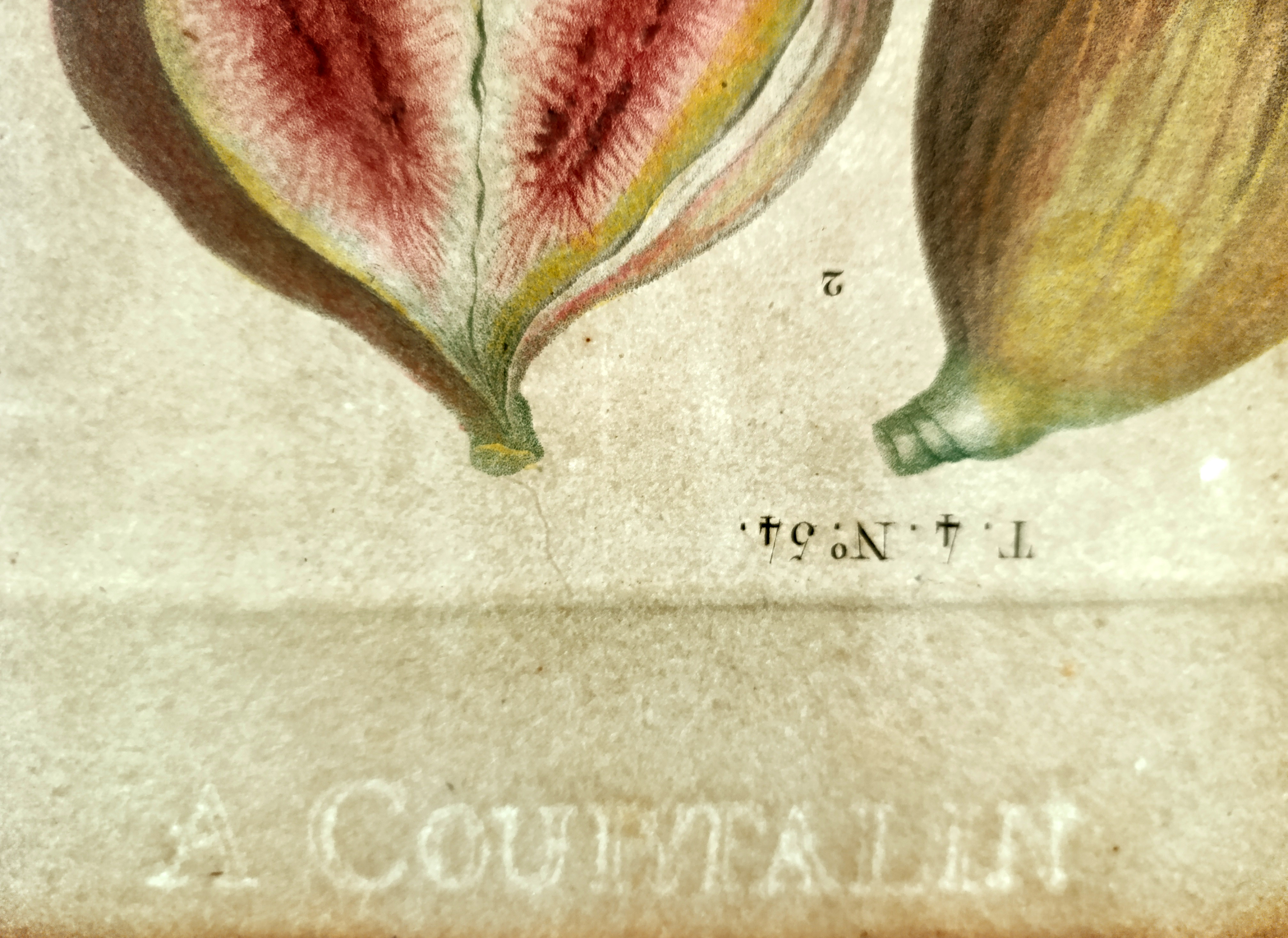
“A Courtalin” watermark photographed in transmitted light — detail from the Servantine fig plate after Pierre-Joseph Redouté, Nouveau Duhamel, Volume IV, Plate 54 (UAD54).
At Courtalin, in Pommeuse, Seine-et-Marne, the history of papermaking intersects with the material evidence preserved in these botanical prints. The departmental archives identify Jean Odent as owner of the paper mill and record its lease to his two sons, together with their partnership agreement, on 4 December 1810.
The names A Courtalin and Odent & C, recorded on sheets in the seven-plate fig Study Set examined by Prantique, can therefore be considered within a connected manufacturing history. The archival relationship supports associating the two names with the same establishment, rather than assuming two unrelated paper mills.
These marks extend our understanding beyond the painted model and engraved image to the manufacture of the sheet itself. They preserve a trace of the material supply behind botanical publishing, although they do not alone establish the production date of an impression or distinguish separate editions.
From Botanical Publication to Antique Print
A botanical plate was originally conceived as part of a publication.
Its meaning was shaped by its relationship to a botanical description, a sequence of subjects and the editorial structure of the work in which it appeared.
Today, surviving impressions may be encountered individually.
The change in context is significant.
A plate that once participated in a systematic presentation of botanical knowledge may now be appreciated for its individual composition, its historical character or its presence within an interior.
Yet its original identity does not disappear when it is separated from the book.
The title of the publication, the artist's inscription, the printing technique, the paper and the physical characteristics of the impression remain essential to understanding what the object is.
Nor should two impressions of the same image automatically be treated as materially identical.
Their condition, colouring, margins, paper and other surviving characteristics may differ. Such distinctions must be established through examination of the individual objects, not inferred from the reputation of the artist or the general description of the edition.
The impressions examined for this study make that variability tangible. Their sheets fall into three observable size groups, provisionally recorded as Formats A, B and C. The largest sheets have wider margins and a notably cleaner appearance, while watermark evidence in the group examined occurs only among the seven consecutive Ficus plates.
These observations describe the surviving objects. Without further bibliographic evidence, they should not be converted into claims about named large-paper or grand papier issues.
This is where the study of an antique print moves beyond the identification of its subject.
The image tells one part of its history.
The object tells another.
The Prantique Perspective: Beyond the Celebrated Name
At Prantique, the appreciation of an original botanical print begins with a distinction between three kinds of knowledge.
The first is bibliographic evidence: the publication to which the image belongs, its documented contributors, its date and the printing processes supported by historical sources.
The second is direct examination: the paper, inscriptions, plate mark where present, colouring, margins, condition and other characteristics of the surviving impression.
The third is curatorial interpretation: the visual qualities that make a particular image compelling — its movement, balance, botanical detail and relationship to the space around it.
These three perspectives complement one another, but they should not be confused.
The name Redouté establishes an important artistic association. It does not replace the need to identify the publication, read the inscriptions or examine the print itself.
Likewise, the beauty of a composition cannot establish its edition or prove the originality of its colouring.
A historically informed appreciation requires both sensitivity to the image and precision about the object.
Redouté's botanical prints reward precisely this kind of attention.
They invite us to admire the artist while recognising the engravers, printers, colourists, botanists and publishers whose contributions helped bring the images into existence.
And they remind us that an original antique print is more than a familiar image from the history of art.
It is a material witness to the history of knowledge, craftsmanship and visual culture.
but understood.
Continue Exploring the Original Works
Discover original botanical prints associated with Pierre-Joseph Redouté, examined as individual works on paper and understood within the collaborative history of the Nouveau Duhamel.
Related posts
-
 Émile-Allain Séguy and Prismes: Art Deco Geometry in Full Color
At the intersection of biology, modernism, and decorative arts, Émile-Allain Séguy occupies a singular place. Best...Read more
-
 La Plante et ses Applications Ornementales: Eugène Grasset and the Birth of Modern Botanical Design
In the golden age of Art Nouveau, few works embody the marriage between art and nature as perfectly as La Plante et...Read more
-
 Gregory M. Mathews and The Birds of Australia: A Monument of Ornithological Ambition
Gregory M. Mathews’ The Birds of Australia is a monumental blend of taxonomy and art. This article explores the...Read more
-
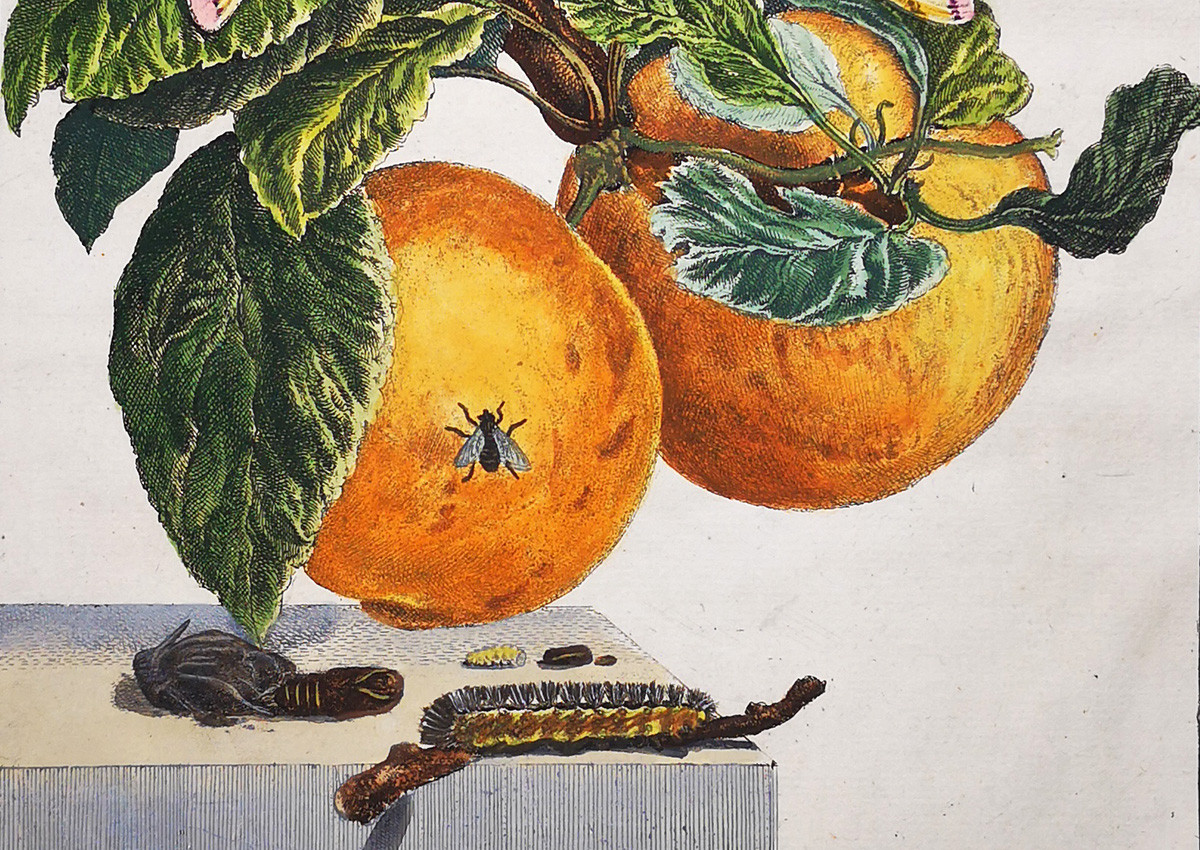 Jacob L'Admiral and the Metamorphosis of Insects – A Dutch Enlightenment Marvel (1774)
In the vibrant scientific atmosphere of the 18th century, Jacob L’Admiral (1700–1775), a Dutch naturalist and...Read more
-
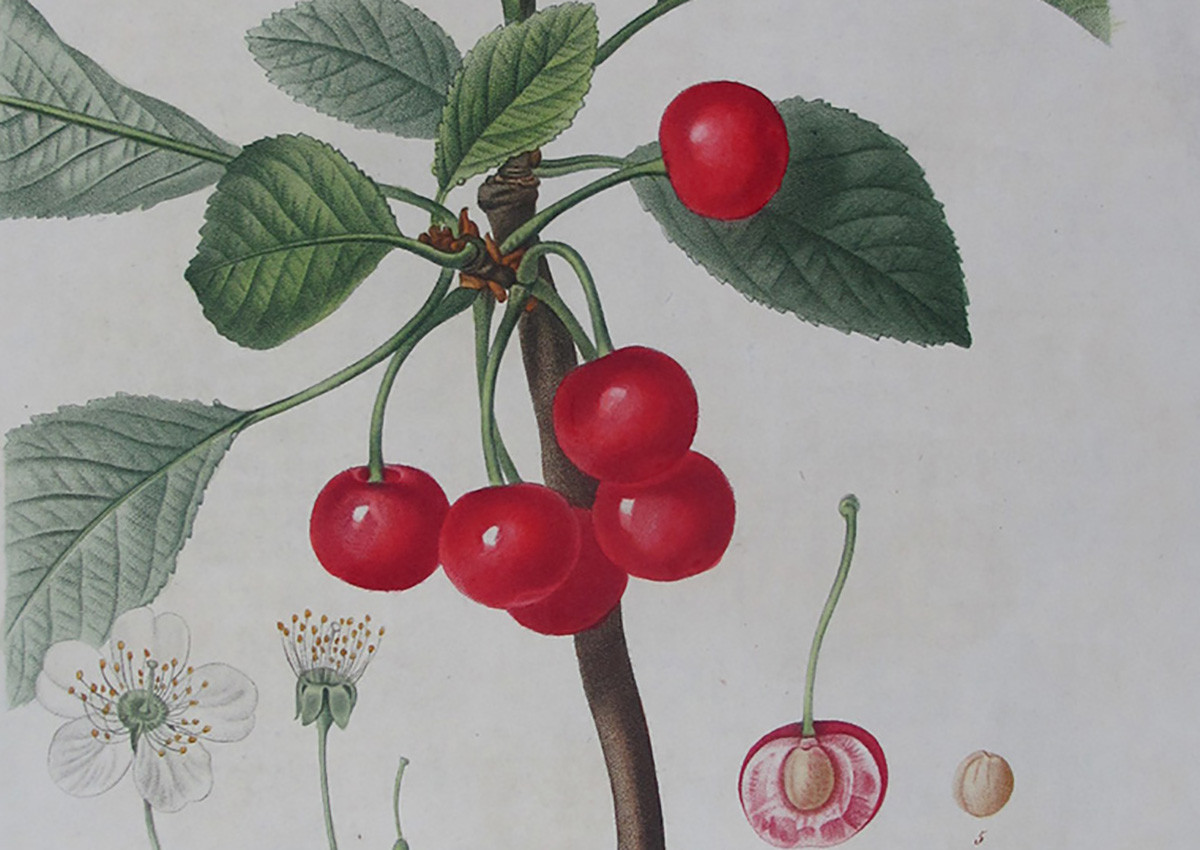 Pierre-Joseph Redouté: Botanical Illustration Beyond Roses
Pierre-Joseph Redouté (1759–1840) is universally regarded as the most influential botanical illustrator of the late...Read more
Leave a comment