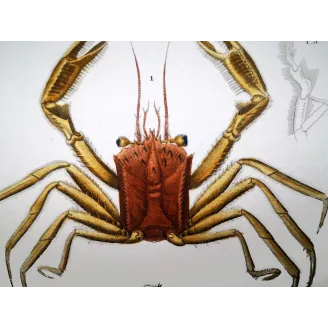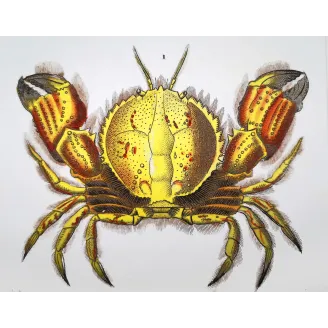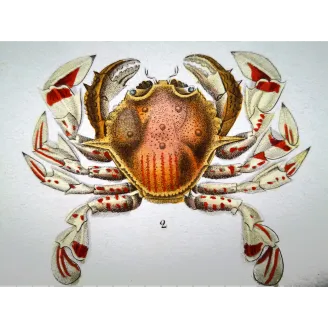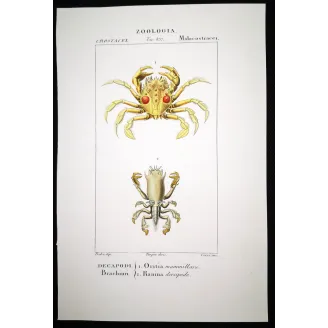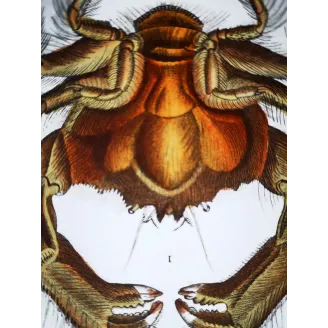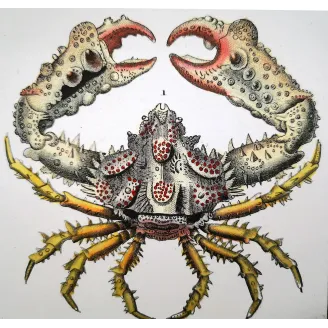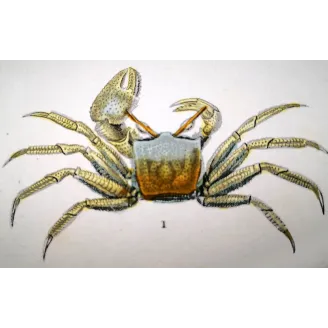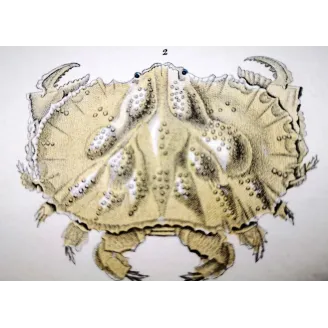

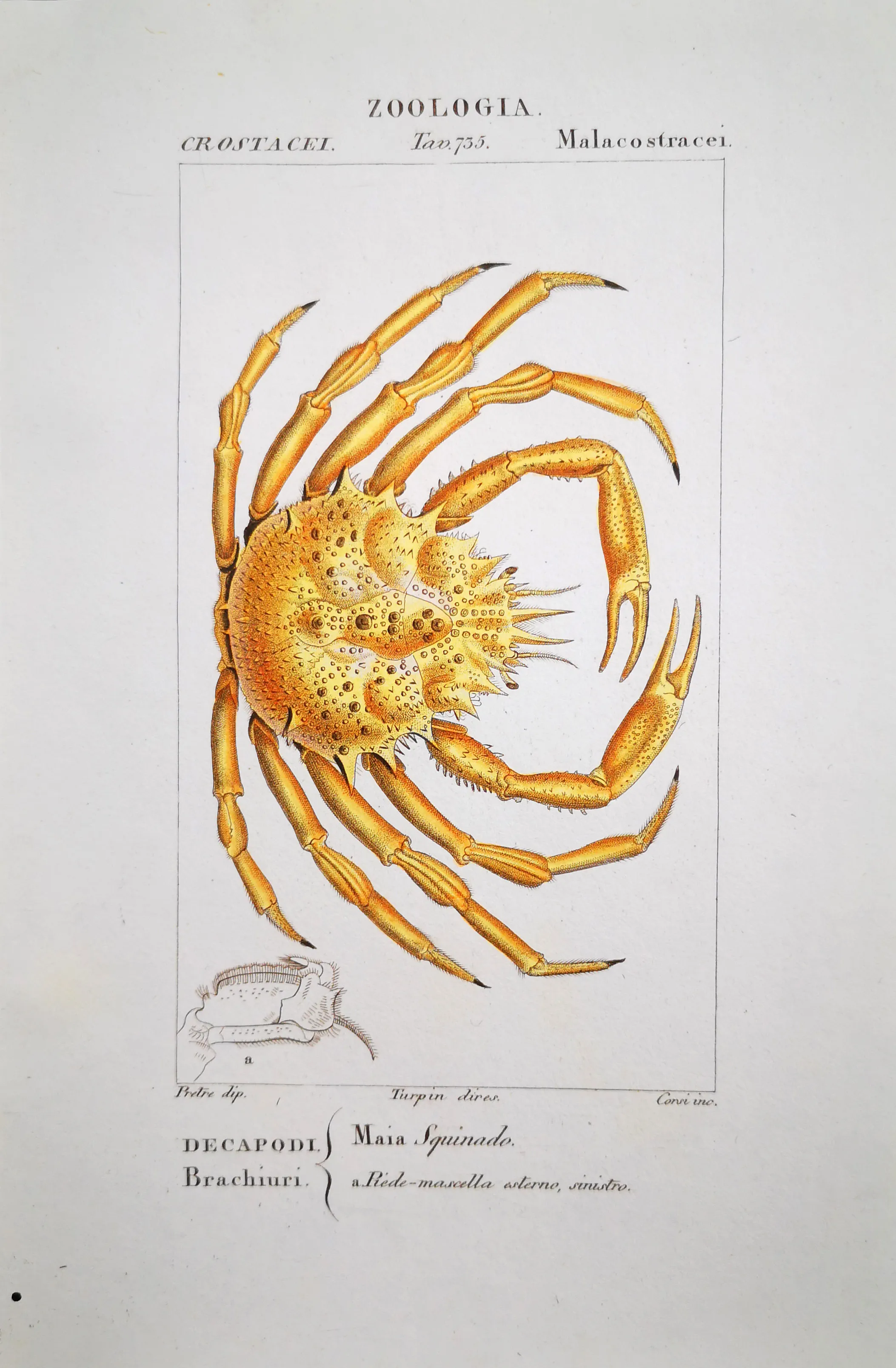
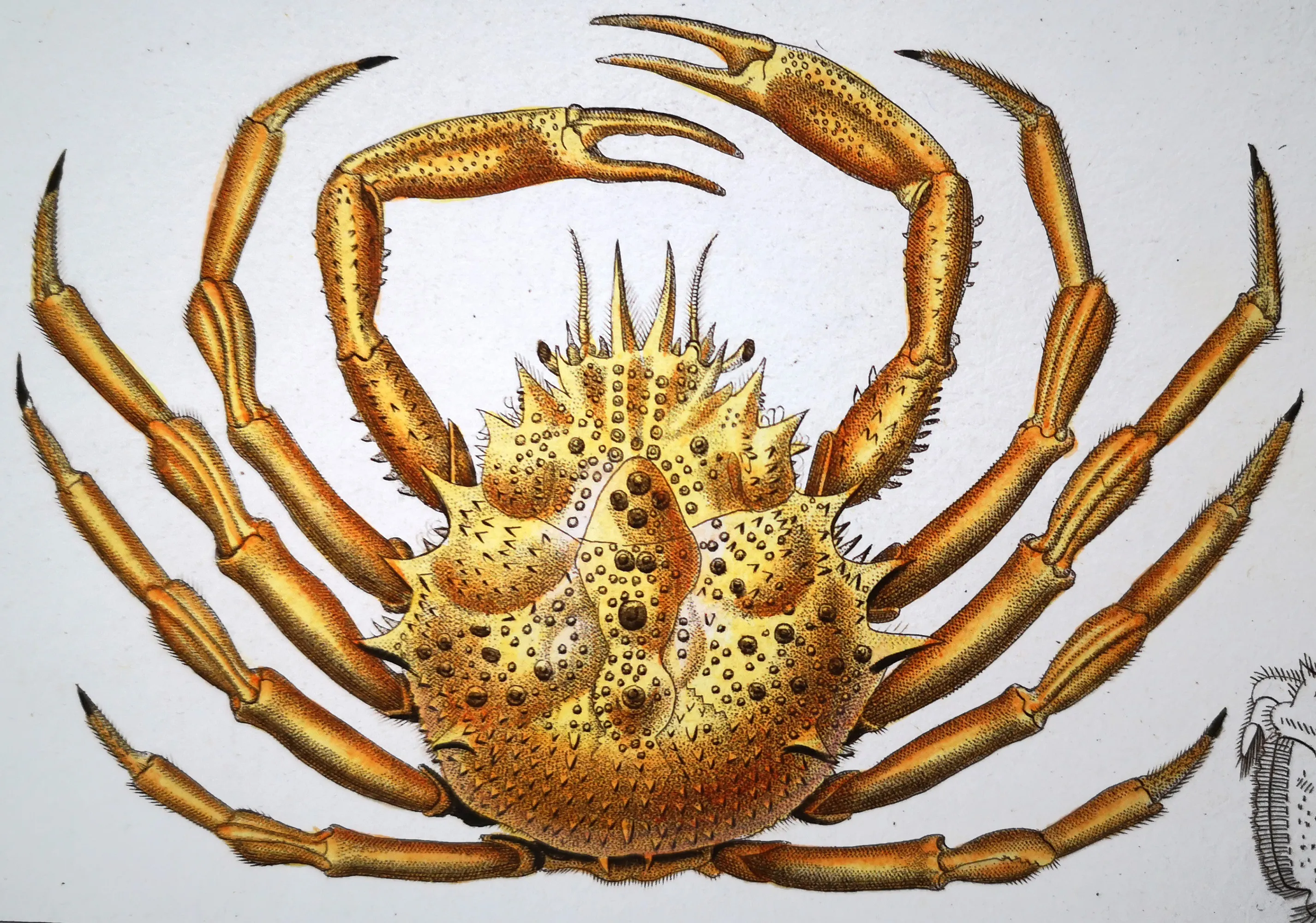
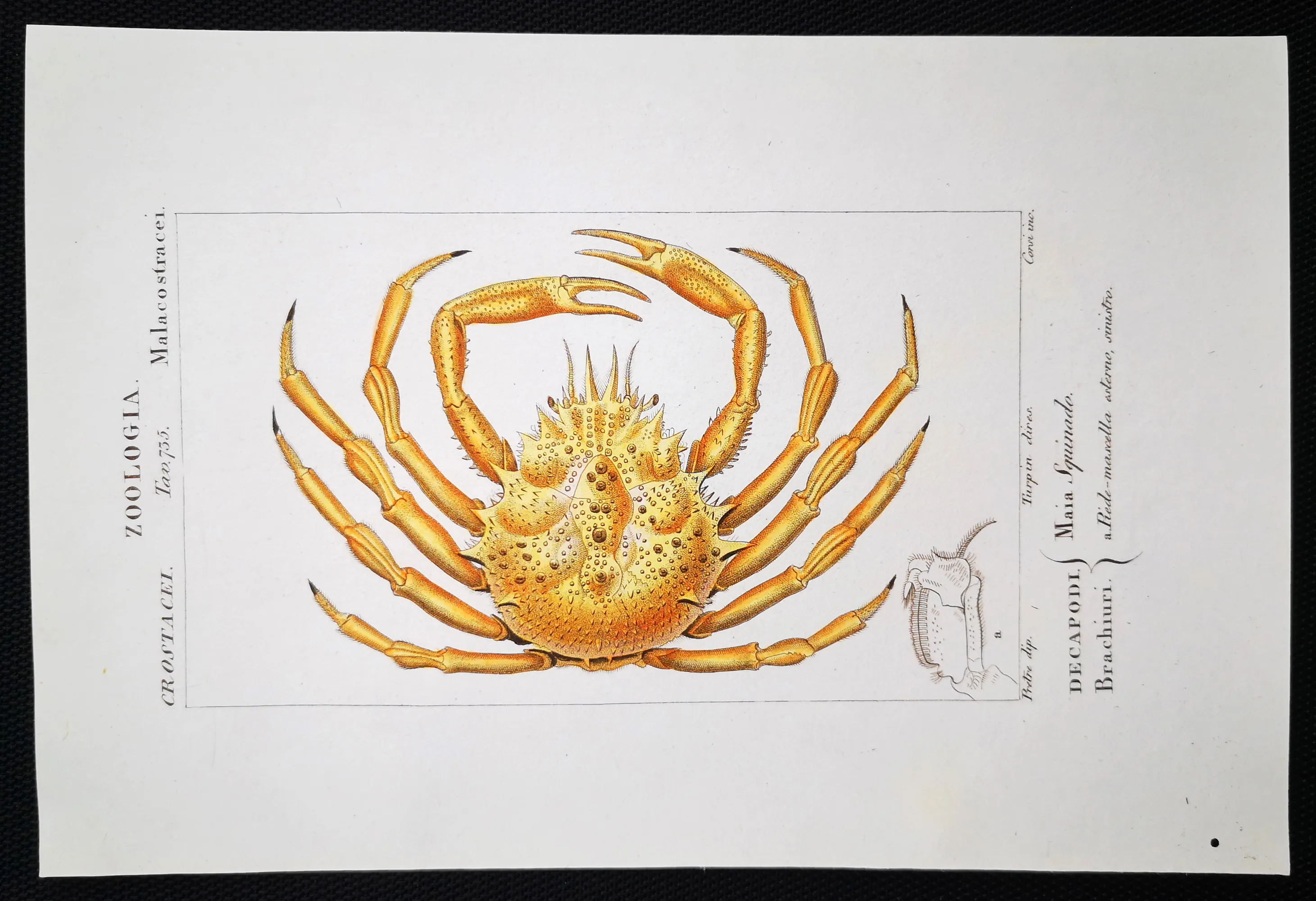


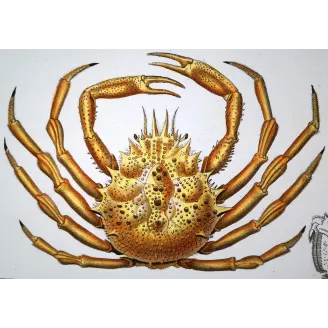
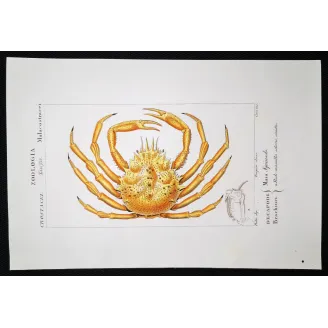
Fine 19th-century hand-colored engraving of *Maia squinado*, a striking spiny crab rendered with vivid tones, ideal for refined marine-themed interiors.
 Delivery policy
Your print will be carefully prepared and shipped worldwide via trusted couriers (UPS or similar).
 Authentic antique prints
Original engravings from the 17th–19th century.
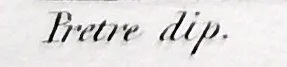
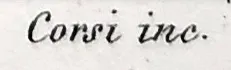
This original early nineteenth-century hand-colored engraving depicts Maia squinado, the spiny spider crab, rendered with striking sculptural presence. The plate belongs to the crustacean section of the Dizionario di Scienze Naturali, illustrated by Pierre Antoine Prêtre and engraved under the direction of Turpin.
The composition isolates the crab against a luminous ground, allowing its articulated limbs and armored carapace to unfold with almost architectural clarity. The warm ochre tonalities, punctuated by subtle shading, lend depth and tactile realism to the exoskeleton.
— • —
The radial symmetry of the spider crab creates a commanding visual geometry. Its elongated legs form a dynamic perimeter, while the textured dorsal surface introduces intricate detail and rhythm. Prêtre’s disciplined linework captures both scientific precision and ornamental elegance.
The restrained palette enhances its decorative strength: golden-brown hues over creamy paper create a refined contrast ideal for classic interiors, maritime libraries, or contemporary spaces seeking structured natural forms.
Maia squinado, known as the Mediterranean spider crab, has long held culinary, ecological, and cultural relevance across southern Europe. In nineteenth-century natural history, such species embodied the fascination for marine biodiversity that accompanied expanding scientific exploration.
Crustaceans like the spider crab were especially valued in encyclopedic publications because their armored anatomy, articulated limbs, and symmetrical structure demonstrated nature’s mechanical sophistication. Plates of this kind were collected not merely as scientific references, but as intellectual objects — symbols of Enlightenment taxonomy and the desire to classify the living world.
For today’s collector, this engraving speaks to both marine heritage and cabinet-of-curiosities aesthetics: a subject that is at once biologically exact and visually monumental.
This engraving originates from the Dizionario di Scienze Naturali, published in Florence in the early nineteenth century. The Sacchetti Collection preserves these plates as testimony to a monumental publishing enterprise in which art and science converged.
Nearly two centuries later, these works continue to embody an era when natural history was celebrated through ambitious, encyclopedic projects that are now practically unrepeatable.
Learn more about the collection:
Nobility of Natural History Prints – The Sacchetti Collection
Excellent antique condition. Clean margins and well-preserved hand coloring on original smooth early nineteenth-century wove paper. No watermark observed.
Discover more about the artist:
Pierre Antoine Prêtre – Illustrator of Natural Science and Marine Life
Looking for: Maia squinado engraving, antique crab print, hand-colored crustacean illustration, 19th-century marine natural history art.
Specific References
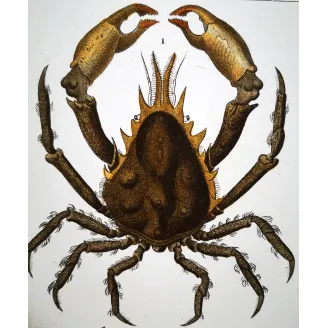
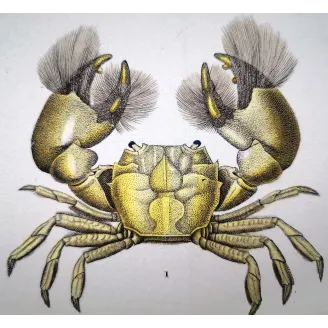
Refined 19th-century engraving of *Omola frontespinosa*, a rare crab with slender claws and delicate yellow-orange tones.
Elegant 19th-century engraving of the rare *Ateleciclo*, a vividly colored marine crab illustrated with sharp detail and refined shading.
Fine 19th-century hand-colored engraving of *Polybia henslowii*, a vivid marine crab illustrated with contrasting tones.
Elegant 19th-century engraving of *Oritia mammillare*, a beautifully textured marine species with red highlights.
19th-century hand-colored engraving of *Dromia invadissima*, a rare crab with rich orange tones, illustrated by Prêtre with refined marine detail.
Exceptional 19th-century hand-colored engraving of *Partenope orrida*, a spectacular crab with dramatic claws and vibrant marine coloration.
Dynamic 19th-century engraving of *Ocypode ceratophthalma*, a crab with expressive claws and bold coloration.
Fine 19th-century engraving of *Calappa tuberculata*, a beautifully armored crab with ornate textures and yellow tones.
Vivid 19th-century hand-colored engraving of *Pisa tetraodonte*, a distinctive crab with elaborate ornamentation and warm marine tones.
19th-century hand-colored engraving of *Grapsus penicillatus*, a vivid marine crab with expressive claws and warm tones.
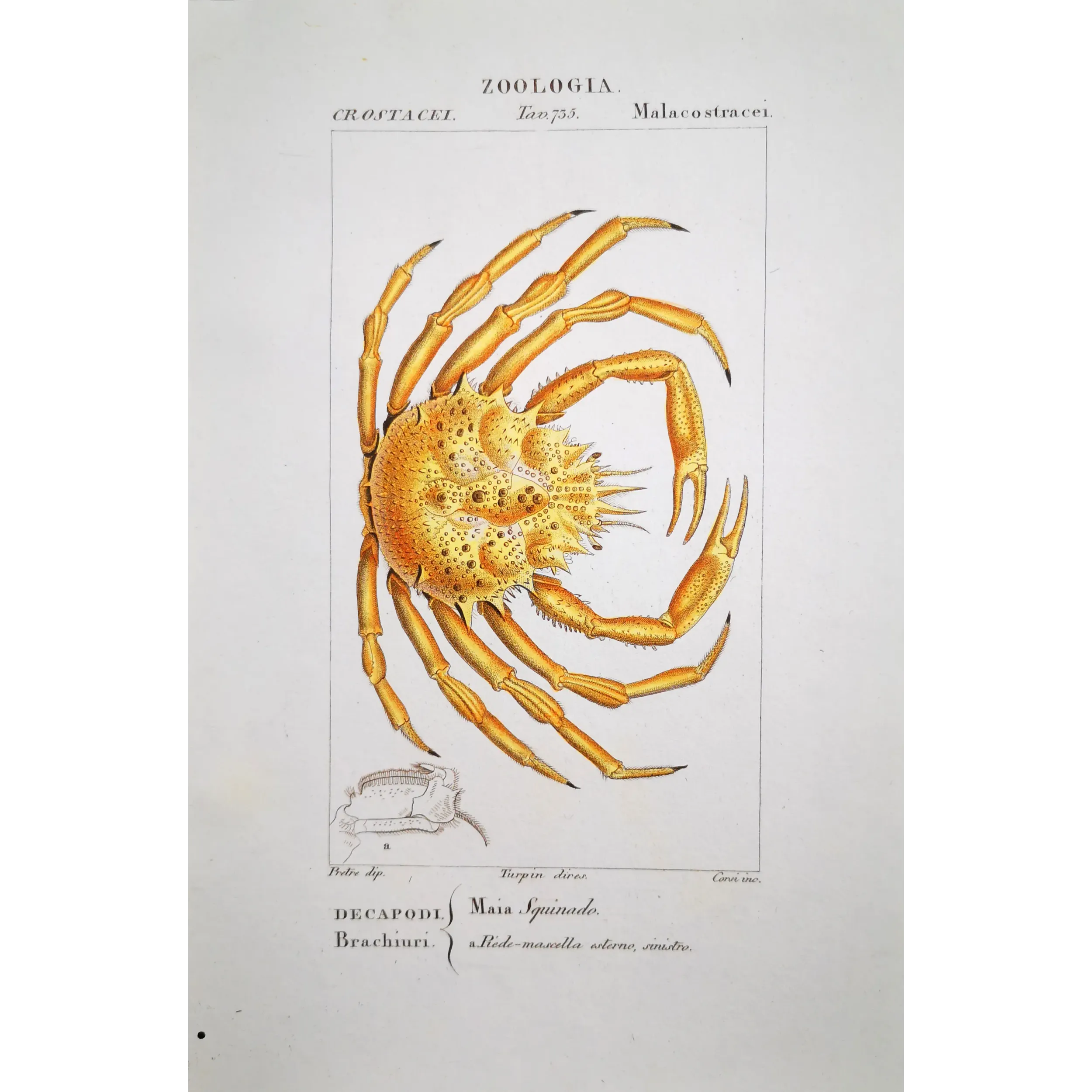
Fine 19th-century hand-colored engraving of *Maia squinado*, a striking spiny crab rendered with vivid tones, ideal for refined marine-themed interiors.