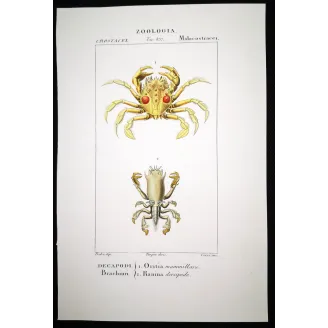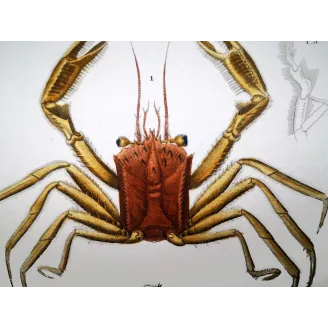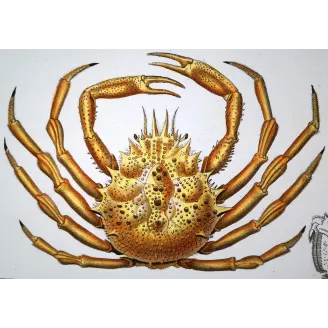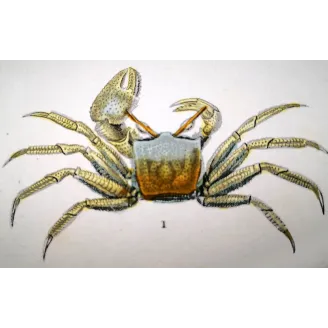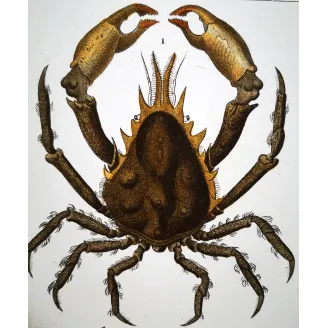

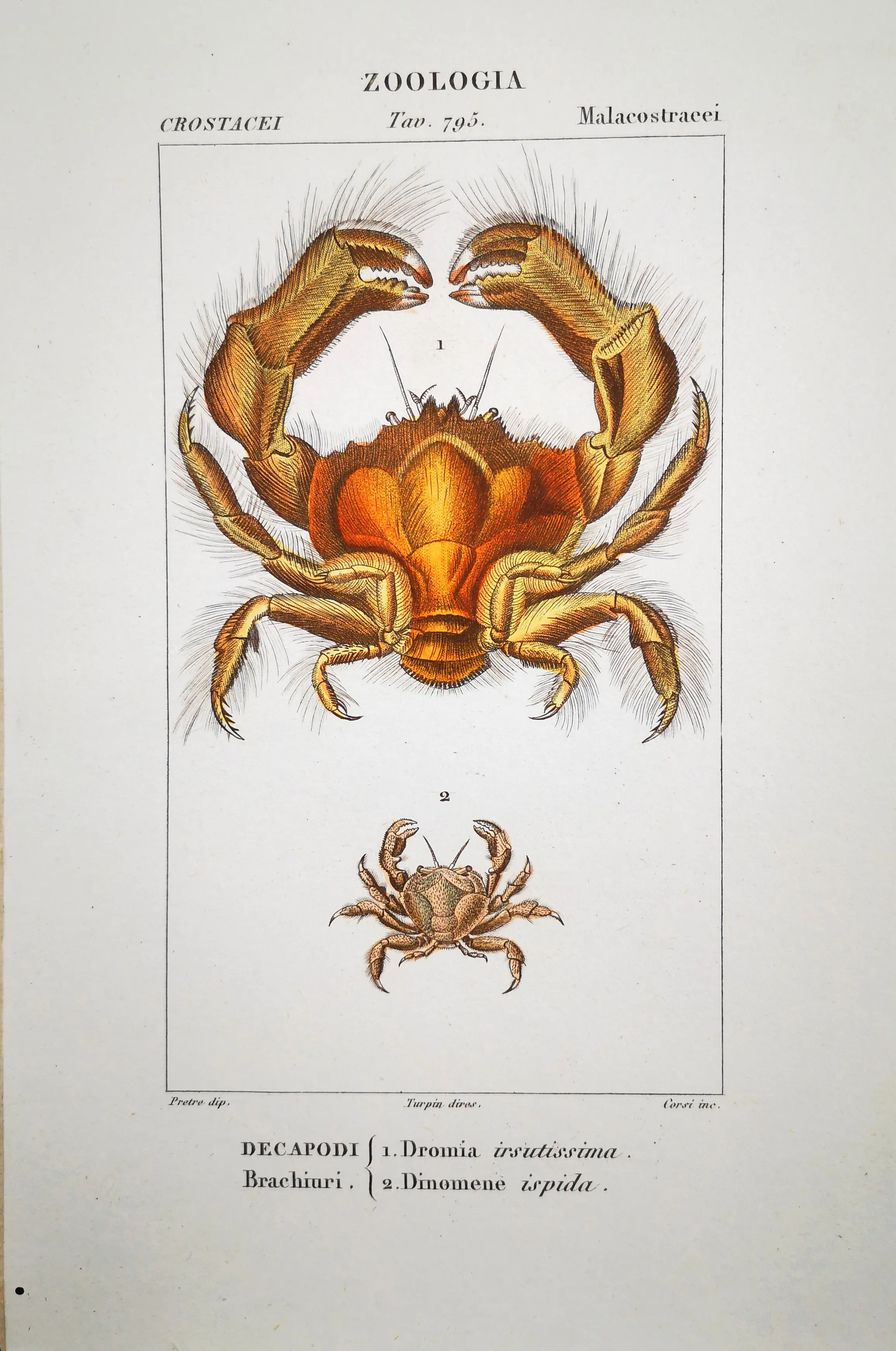
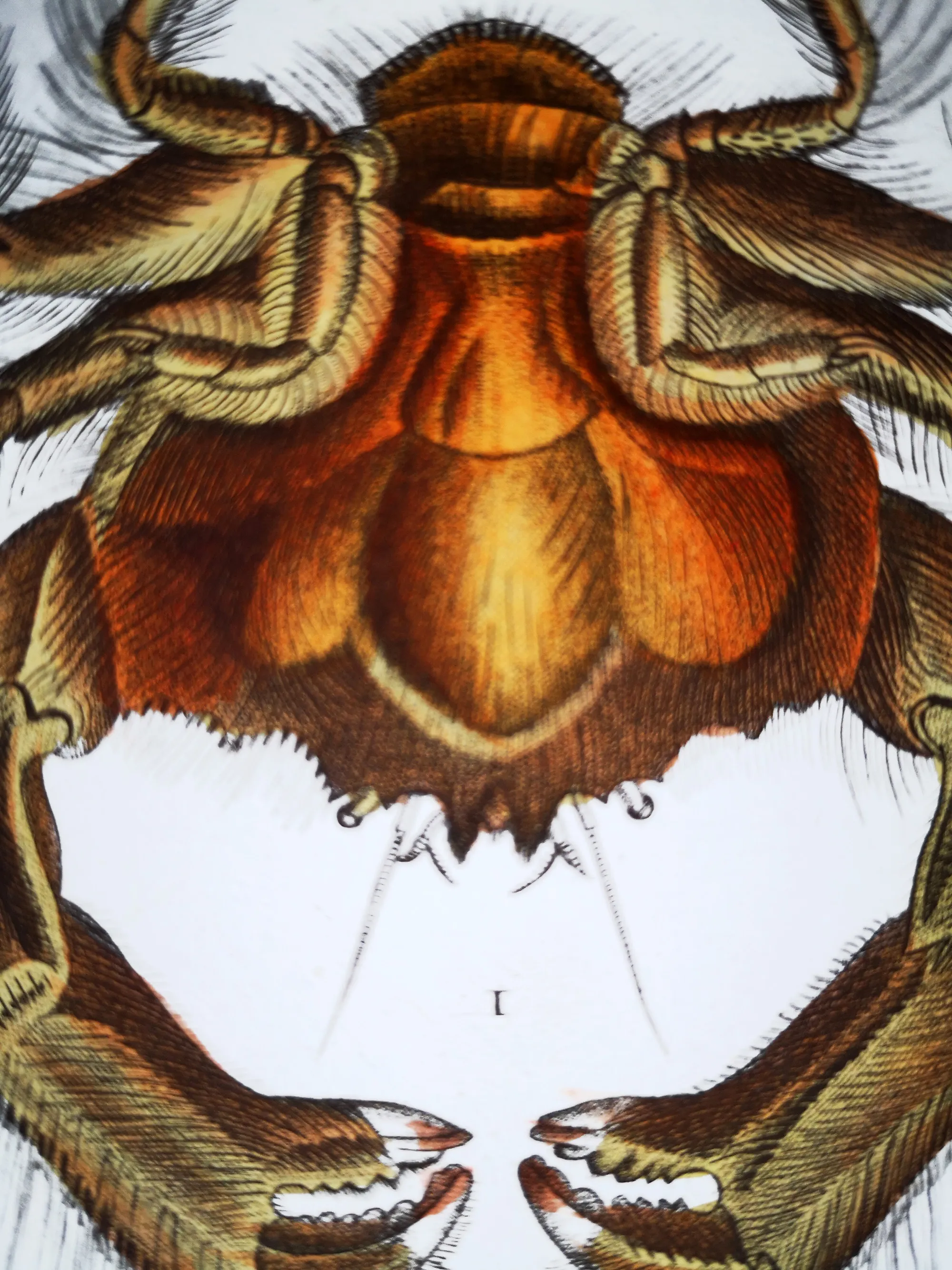
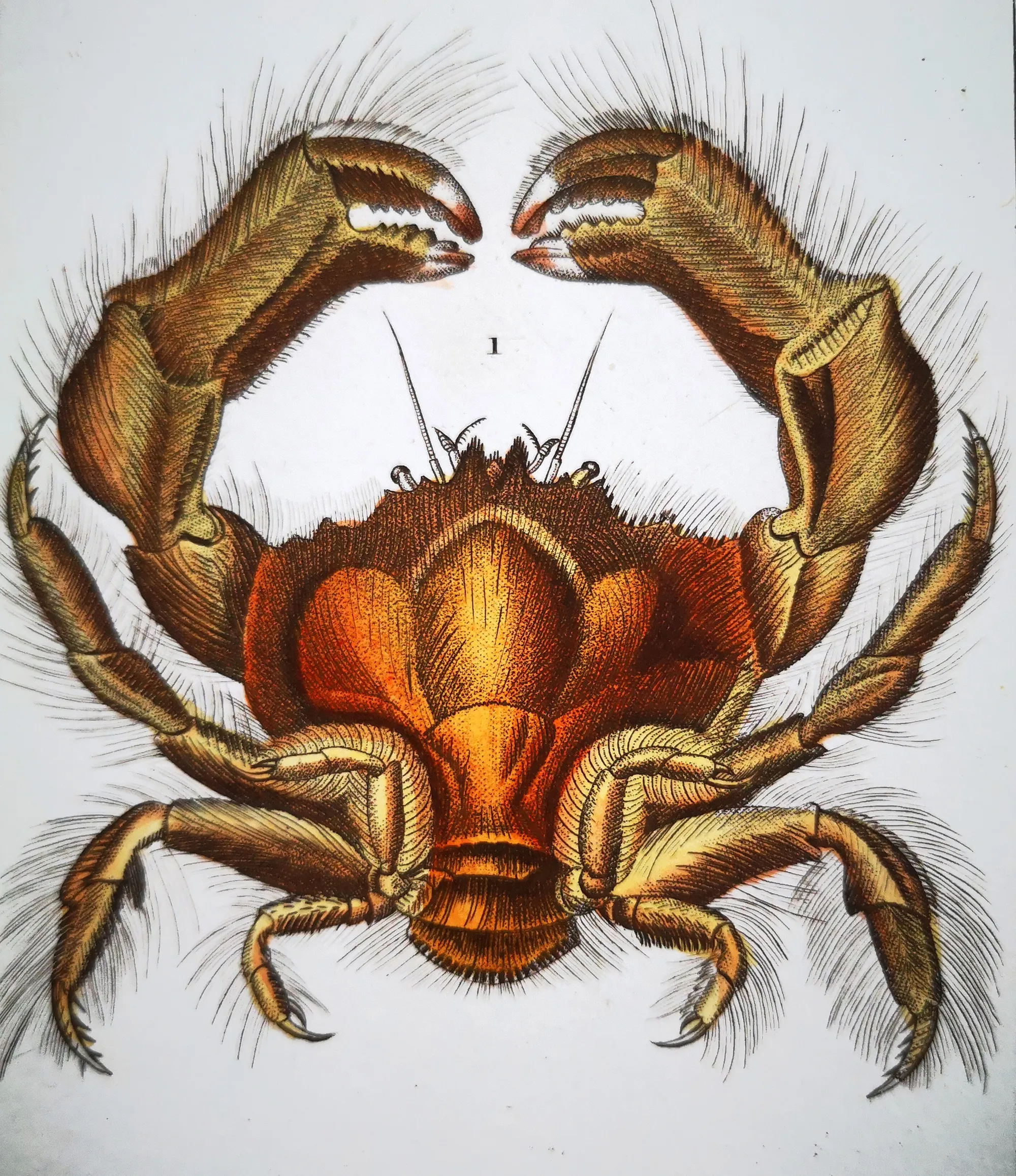
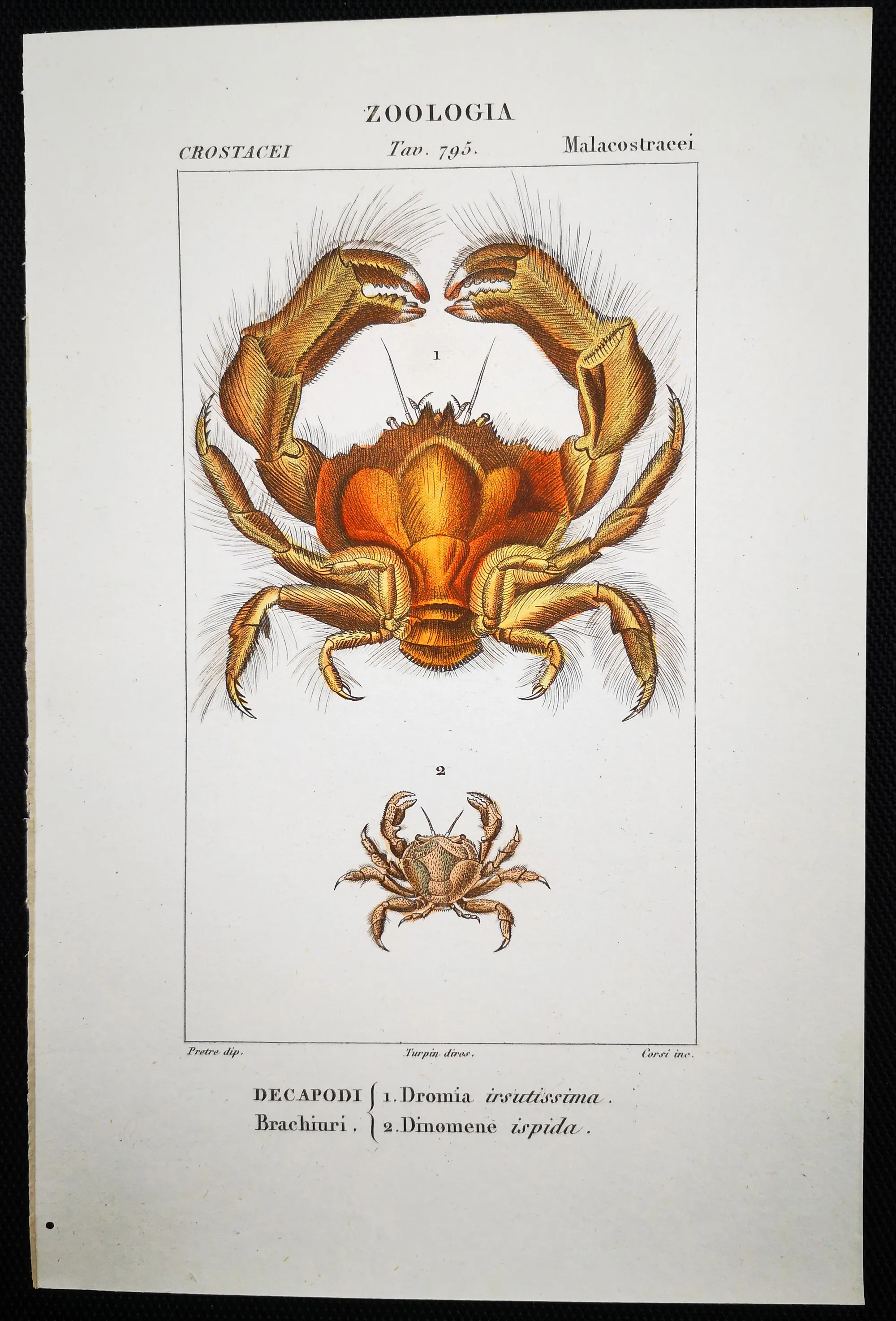


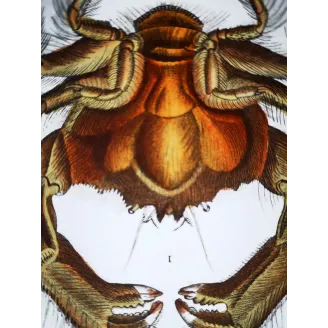
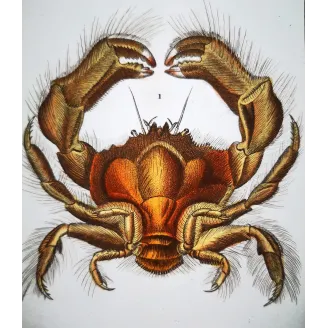
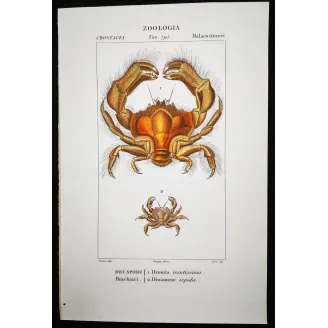
19th-century hand-colored engraving of *Dromia invadissima*, a rare crab with rich orange tones, illustrated by Prêtre with refined marine detail.
 Delivery policy
Your print will be carefully prepared and shipped worldwide via trusted couriers (UPS or similar).
 Authentic antique prints
Original engravings from the 17th–19th century.
This refined early nineteenth-century engraving represents Dromia invidissima, a species belonging to the sponge crabs, rendered with scientific clarity and subtle chromatic restraint. The plate forms part of the crustacean section of the Dizionario di Scienze Naturali, illustrated by Pierre Antoine Prêtre.
The composition balances monumentality and delicacy: the upper specimen displays robust claws and a dense, velvety carapace, while the smaller figure beneath offers comparative scale and morphological insight.
— • —
The warm amber and sienna tones lend the crab a luminous presence against the pale ground. Fine engraved lines articulate texture with remarkable sensitivity, transforming what could be a purely zoological study into an object of ornamental refinement.
Its compact structure and pronounced claws create a stable visual axis, ideal for interiors that value symmetry, order, and natural geometry.
Species of the genus Dromia were historically admired for their peculiar behavior of carrying sponges on their carapace — a natural adaptation that fascinated early zoologists. Such traits exemplified nature’s ingenuity and were frequently highlighted in nineteenth-century encyclopedic works.
Crustaceans like Dromia invidissima embodied the scientific spirit of classification that defined the Enlightenment and post-Linnaean era. Their armored bodies, articulated limbs, and structural precision made them compelling subjects for collectors interested in both marine life and the intellectual history of taxonomy.
Today, this engraving preserves that dual legacy: a document of biological study and a sculptural image of enduring decorative strength.
Published in Florence in the early nineteenth century, the Dizionario di Scienze Naturali stands among the great encyclopedic enterprises of its time. The Sacchetti Collection preserves these plates as witnesses to an era when art and science were inseparable.
Nearly two centuries later, these engravings continue to reflect the ambition of monumental natural history publishing.
Nobility of Natural History Prints – The Sacchetti Collection
Excellent antique condition. Clean margins and well-preserved hand coloring on original smooth early nineteenth-century wove paper. No watermark observed.
Looking for: Dromia engraving, antique crab print, 19th-century crustacean illustration, natural history marine art.
Specific References
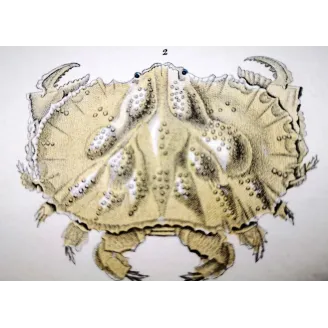
Fine 19th-century engraving of *Calappa tuberculata*, a beautifully armored crab with ornate textures and yellow tones.
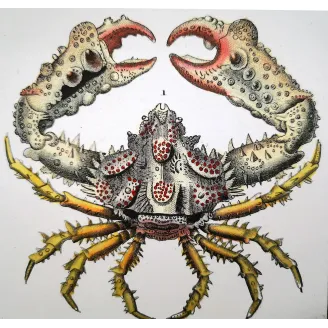
Exceptional 19th-century hand-colored engraving of *Partenope orrida*, a spectacular crab with dramatic claws and vibrant marine coloration.
Elegant 19th-century engraving of the rare *Ateleciclo*, a vividly colored marine crab illustrated with sharp detail and refined shading.
Elegant 19th-century engraving of *Oritia mammillare*, a beautifully textured marine species with red highlights.
Refined 19th-century engraving of *Omola frontespinosa*, a rare crab with slender claws and delicate yellow-orange tones.
Fine 19th-century hand-colored engraving of *Maia squinado*, a striking spiny crab rendered with vivid tones, ideal for refined marine-themed interiors.
Dynamic 19th-century engraving of *Ocypode ceratophthalma*, a crab with expressive claws and bold coloration.
Vivid 19th-century hand-colored engraving of *Pisa tetraodonte*, a distinctive crab with elaborate ornamentation and warm marine tones.
Fine 19th-century hand-colored engraving of *Polybia henslowii*, a vivid marine crab illustrated with contrasting tones.
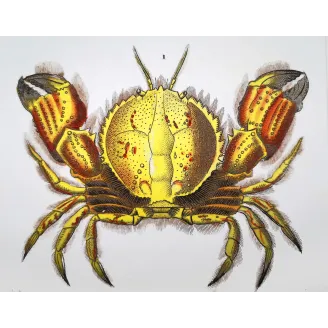
19th-century hand-colored engraving of *Grapsus penicillatus*, a vivid marine crab with expressive claws and warm tones.
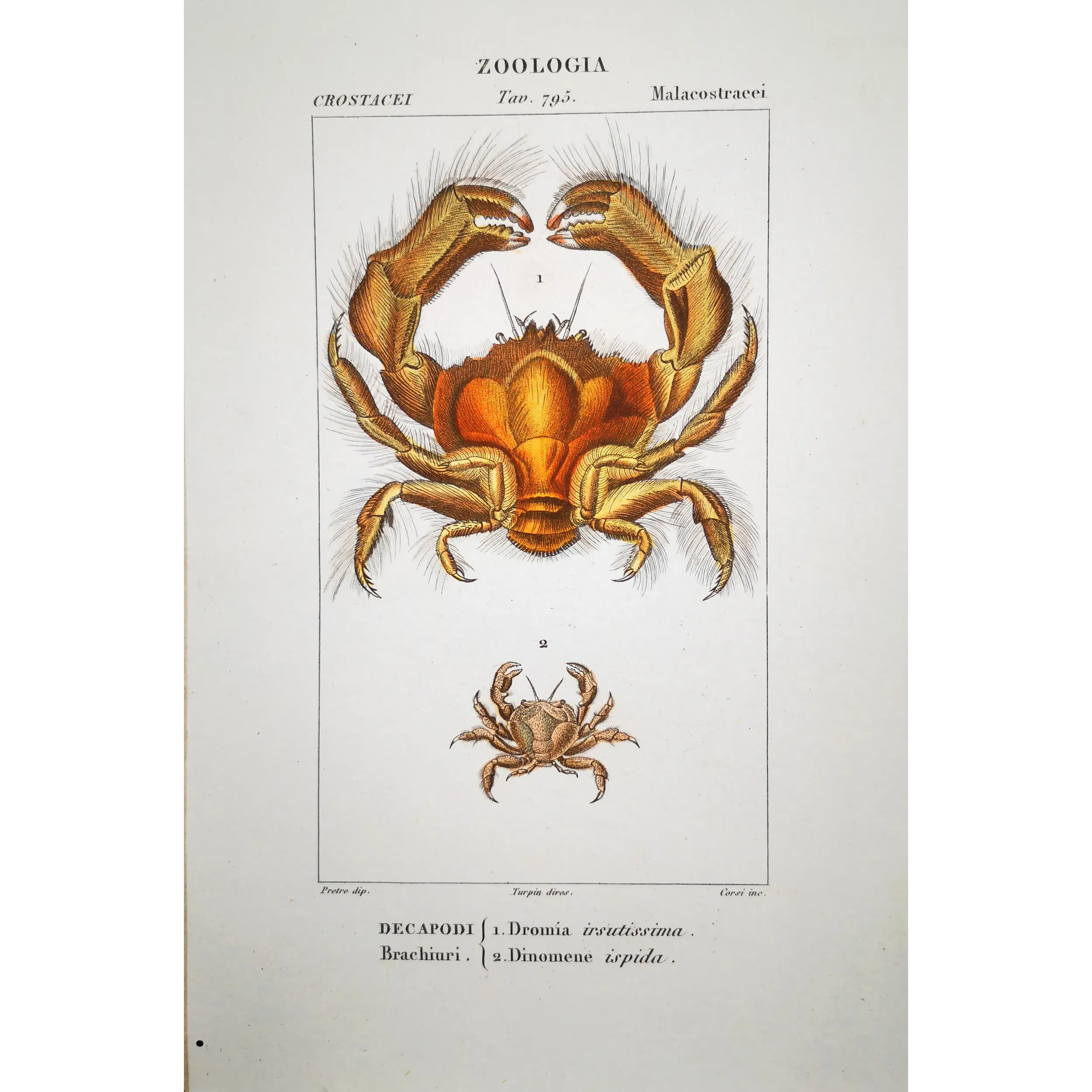
19th-century hand-colored engraving of *Dromia invadissima*, a rare crab with rich orange tones, illustrated by Prêtre with refined marine detail.