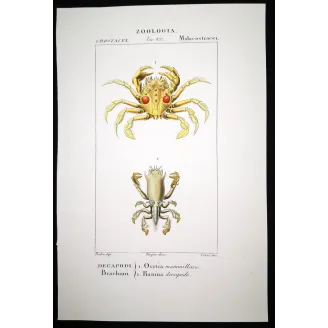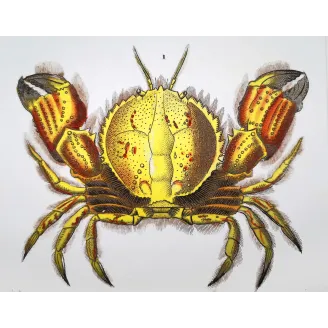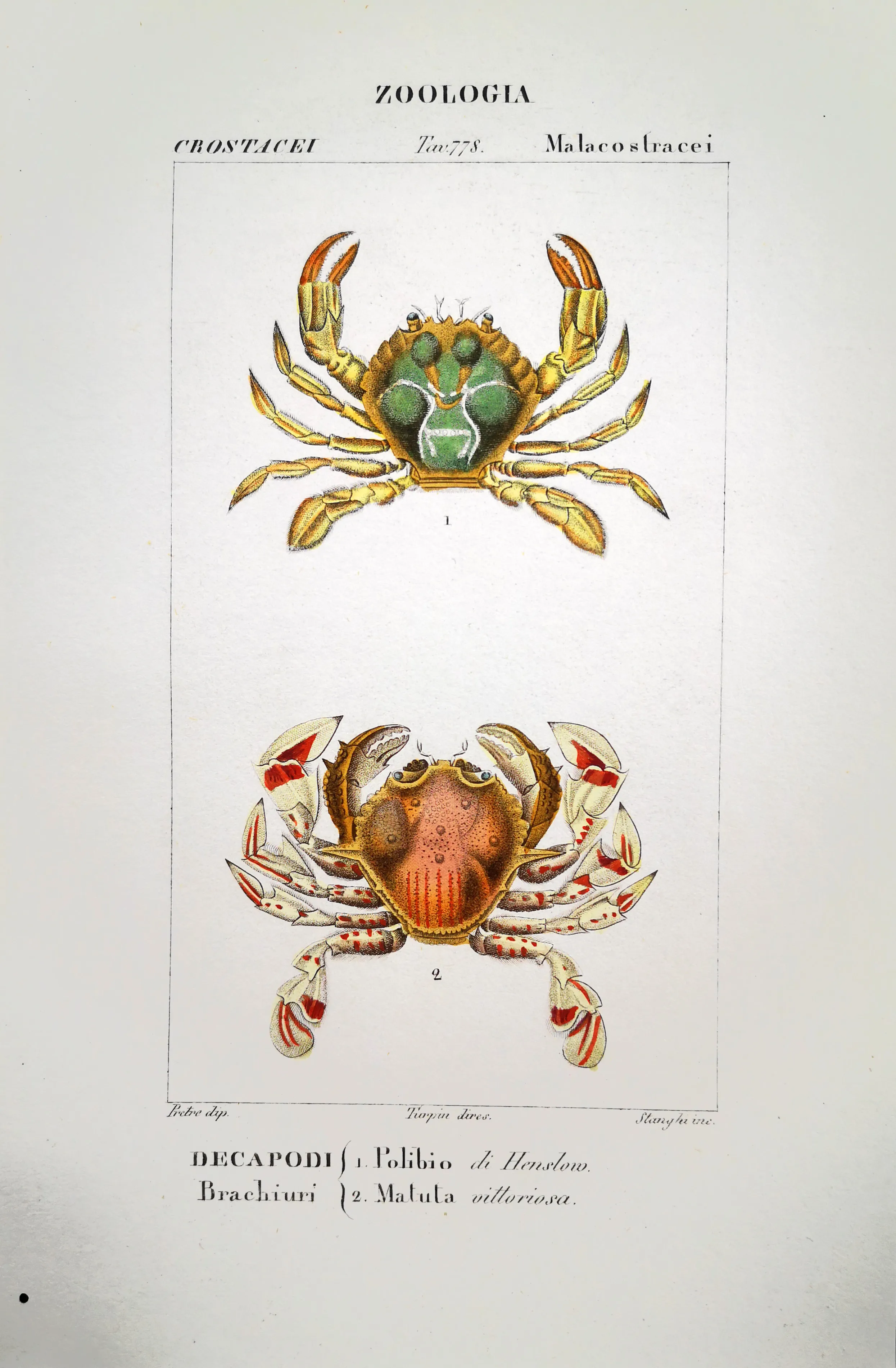
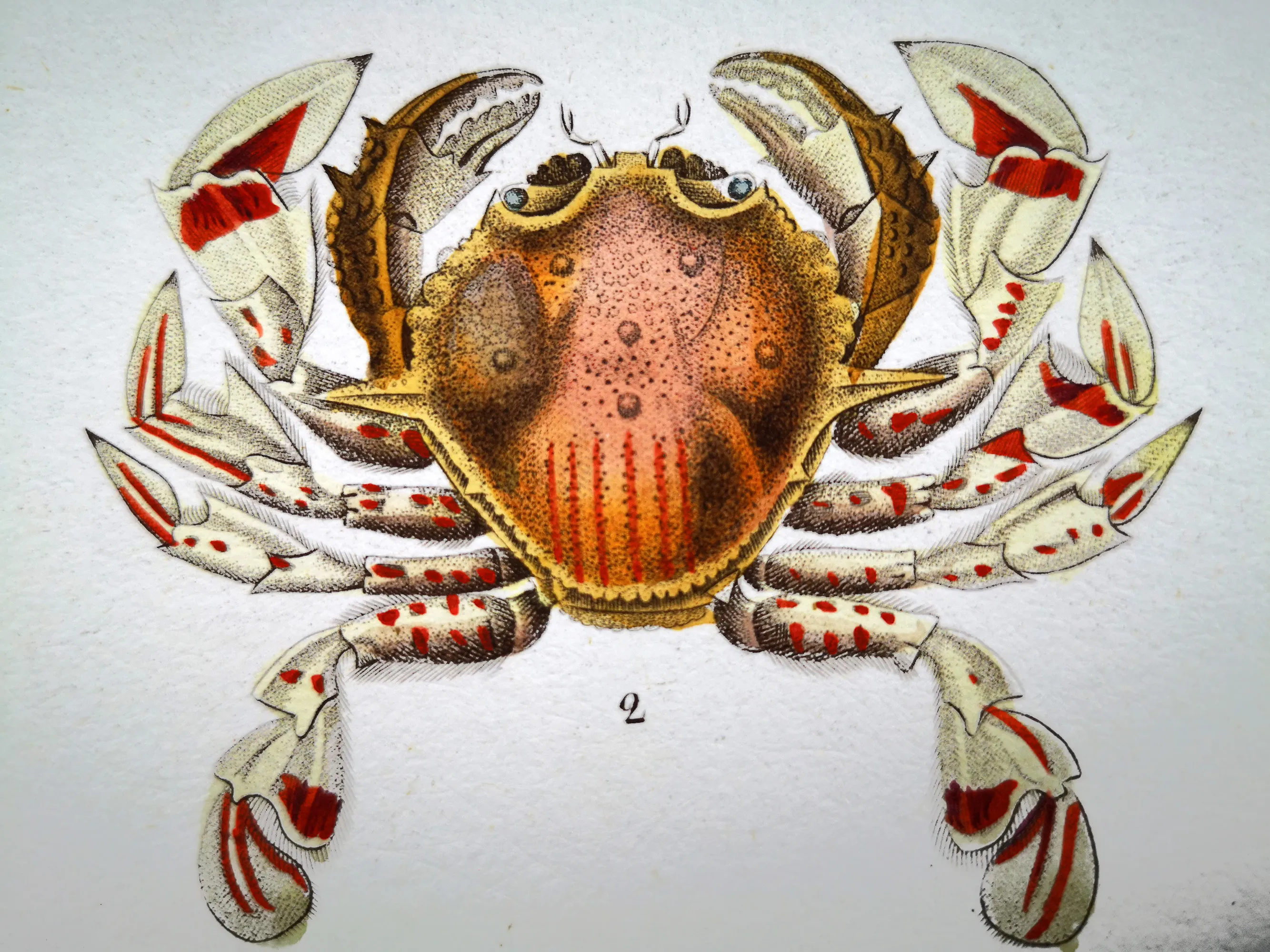
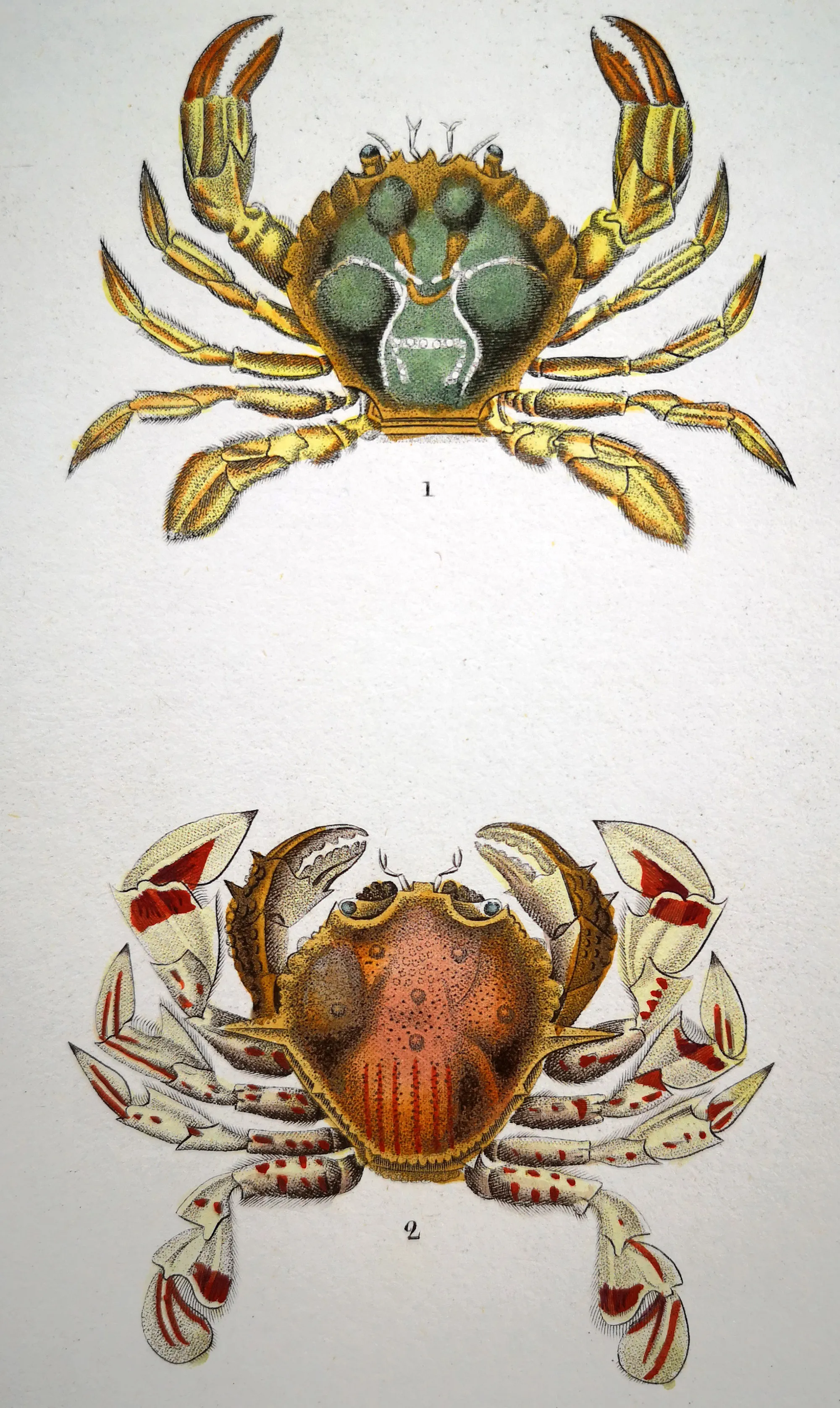
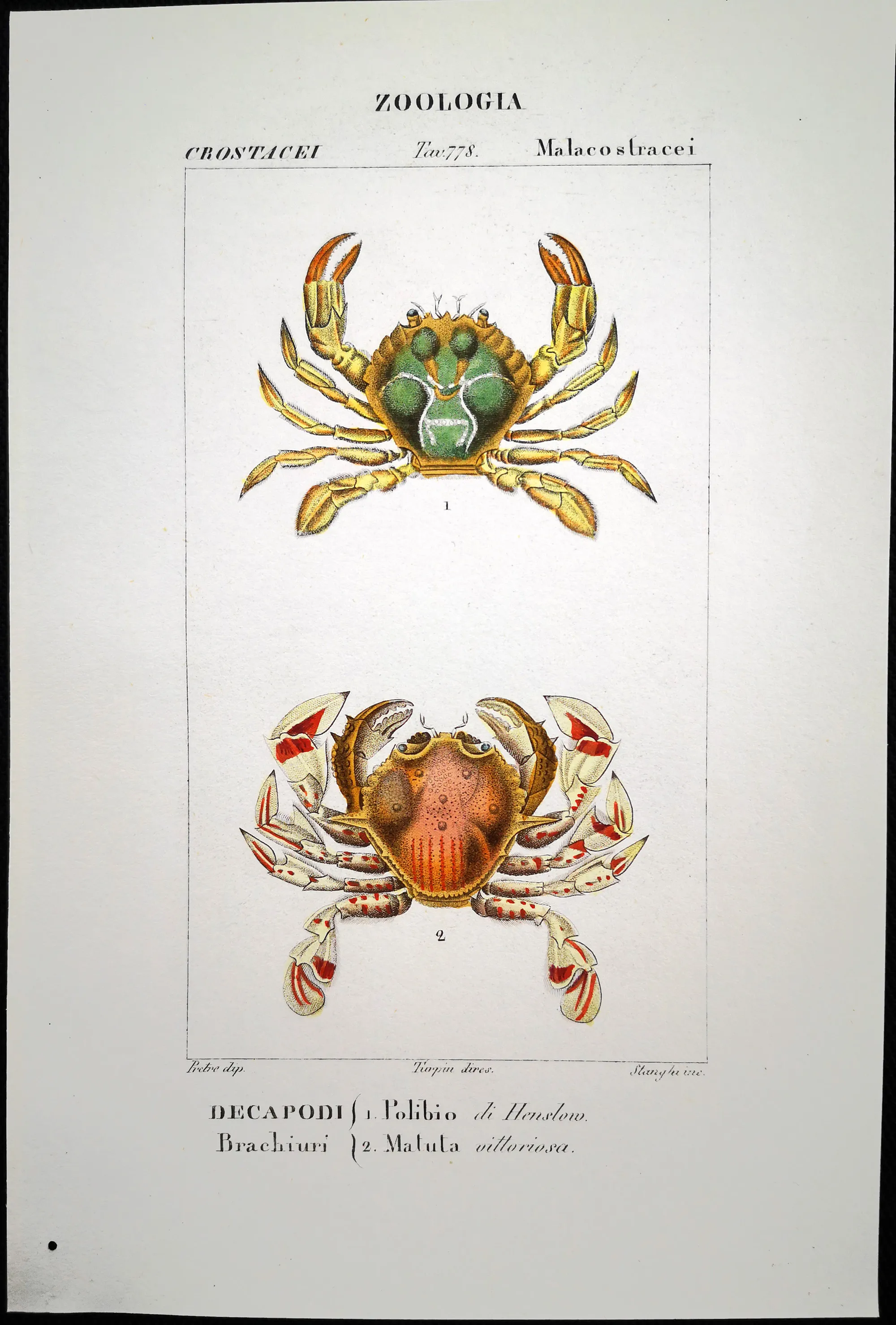



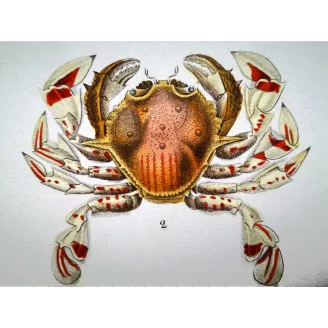
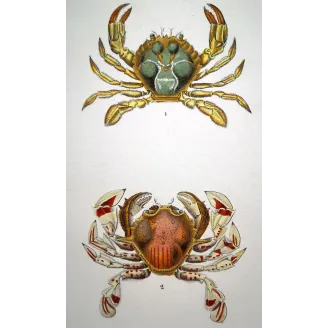
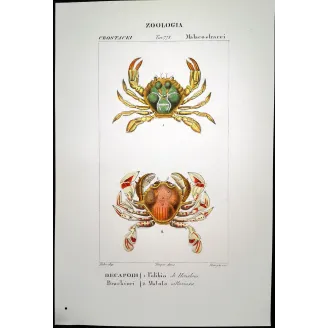
Fine 19th-century hand-colored engraving of *Polybia henslowii*, a vivid marine crab illustrated with contrasting tones.
 Delivery policy
Your print will be carefully prepared and shipped worldwide via trusted couriers (UPS or similar).
 Authentic antique prints
Original engravings from the 17th–19th century.
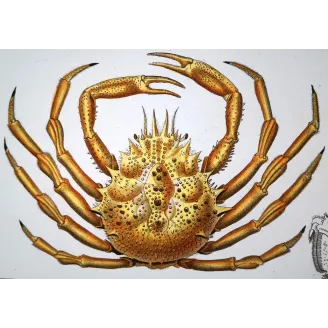
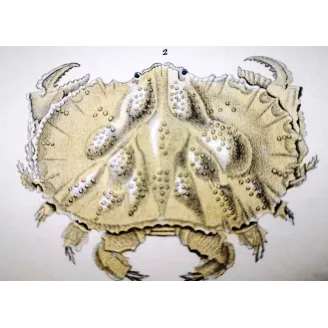
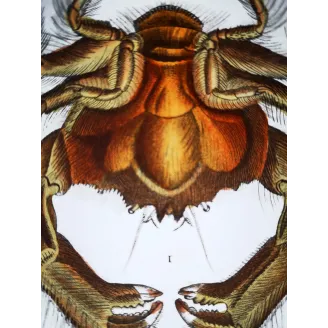
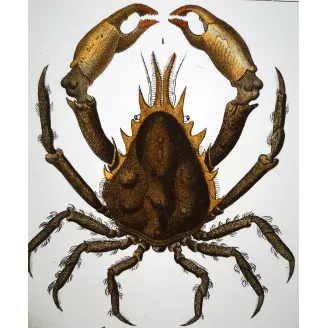
This striking engraving depicts Polibio di Henslow and Matuta vittoriosa, rendered with bold coloration and anatomical precision for the crustacean section of the Dizionario di Scienze Naturali, illustrated by Pierre Antoine Prêtre.
The upper specimen features a vivid green carapace framed by golden limbs, while the lower crab introduces red articulations and mottled ornamentation, intensifying visual contrast.
— • —
The emerald dorsal shield commands attention against the pale ground. Fine engraved lines articulate structure, while red accents animate the limbs with rhythmic vitality.
The composition combines scientific rigor with decorative authority, ideal for contemporary interiors seeking bold yet scholarly natural imagery.
Members of these genera were admired for their morphological distinctiveness and regional distribution. Their pigmentation and armored forms fascinated early marine naturalists.
Such engravings reflect the expanding global horizons of nineteenth-century zoological research.
Today, the plate stands as both a taxonomic document and an object of chromatic refinement.
The Sacchetti edition of the Dizionario di Scienze Naturali represents one of Italy’s most ambitious scientific publications.
These crustacean plates demonstrate how taxonomy and artistry converged in early nineteenth-century print culture.
Nobility of Natural History Prints – The Sacchetti Collection
Excellent antique condition. Clean margins and luminous original hand coloring. No watermark observed.
Discover more about Pierre Antoine Prêtre and his contribution to natural history illustration
Looking for: Matuta engraving, antique crab illustration, green carapace crustacean print, marine zoology art.
Specific References
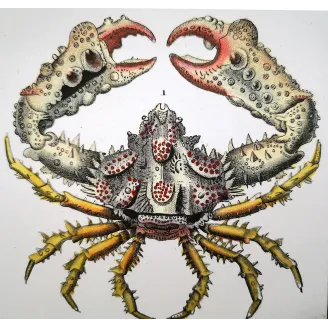
Exceptional 19th-century hand-colored engraving of *Partenope orrida*, a spectacular crab with dramatic claws and vibrant marine coloration.
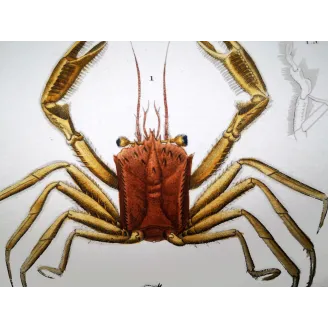
Refined 19th-century engraving of *Omola frontespinosa*, a rare crab with slender claws and delicate yellow-orange tones.
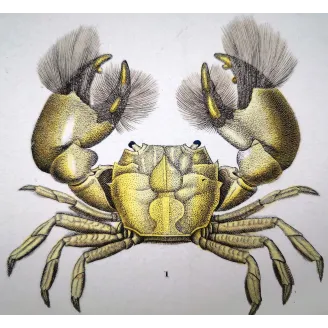
19th-century hand-colored engraving of *Grapsus penicillatus*, a vivid marine crab with expressive claws and warm tones.
Elegant 19th-century engraving of *Oritia mammillare*, a beautifully textured marine species with red highlights.
Fine 19th-century hand-colored engraving of *Maia squinado*, a striking spiny crab rendered with vivid tones, ideal for refined marine-themed interiors.
Fine 19th-century engraving of *Calappa tuberculata*, a beautifully armored crab with ornate textures and yellow tones.
19th-century hand-colored engraving of *Dromia invadissima*, a rare crab with rich orange tones, illustrated by Prêtre with refined marine detail.
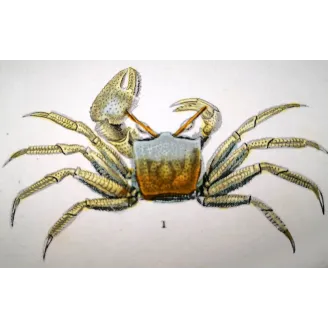
Dynamic 19th-century engraving of *Ocypode ceratophthalma*, a crab with expressive claws and bold coloration.
Elegant 19th-century engraving of the rare *Ateleciclo*, a vividly colored marine crab illustrated with sharp detail and refined shading.
Vivid 19th-century hand-colored engraving of *Pisa tetraodonte*, a distinctive crab with elaborate ornamentation and warm marine tones.
Vivid 19th-century hand-colored engraving of *Pisa tetraodonte*, a distinctive crab with elaborate ornamentation and warm marine tones.
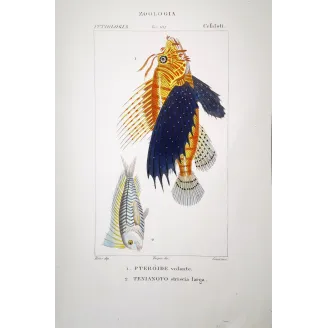
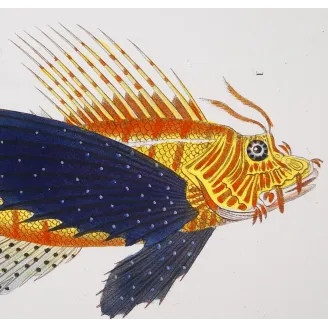
Vivid dual composition featuring the Flying Gurnard and Striped Wrasse, blending blue and golden hues.
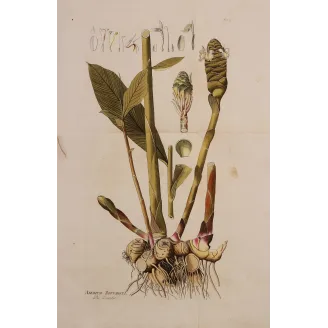
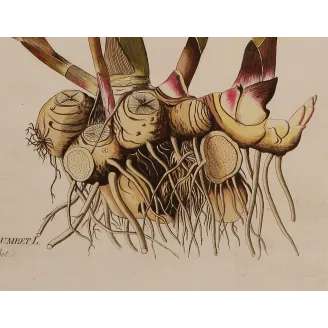
Exceptional large-format eighteenth-century botanical engraving depicting <em>Amomum Zerumbet</em> L., published as Plate II of Joseph Jacob von Plenck’s <em>Icones Plantarum Medicinalium</em>. Printed on a large folded sheet of Honig laid paper with complete watermark and contemporary hand colouring, the composition combines monumental rhizomatous structures, tall architectural stems and precisely observed analytical details. A rare large-scale Plenck Statement Piece with remarkable historical and visual presence.
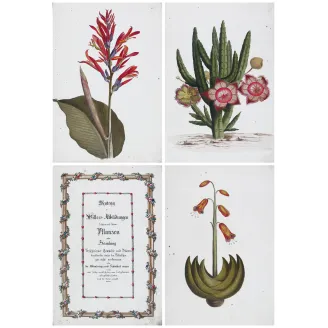
A rare set of four original 18th-century botanical watercolors, entirely hand-painted and rich in color and detail. A curated ensemble combining scientific observation with decorative elegance — perfect for refined interiors and collectors.
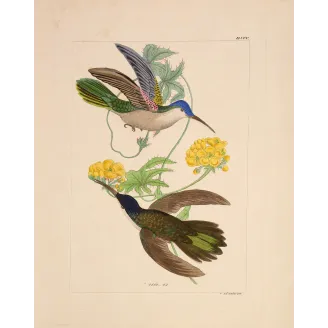
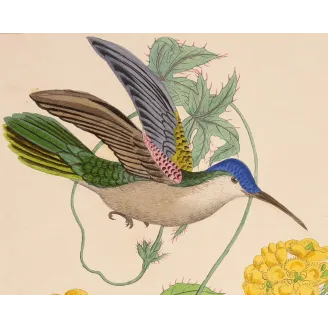
Original nineteenth-century hand-colored engraving depicting the Blue-headed Sabrewing (Saepiopterus lazulus), a tropical hummingbird illustrated by Ludwig Reichenbach in his celebrated Trochilinarum Enumeratio.
Charming pear study by Redouté, showing delicate blossom and ripening fruit. Balanced and refined.
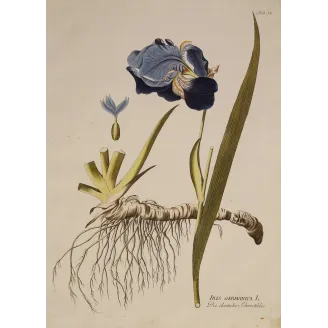
An original eighteenth-century botanical engraving depicting Iris germanica, published in Joseph Jacob von Plenck's celebrated Icones Plantarum Medicinalium. Printed on fine laid paper bearing the Honig watermark, the sheet combines scientific precision with the refined artistic craftsmanship of the Viennese botanical school.
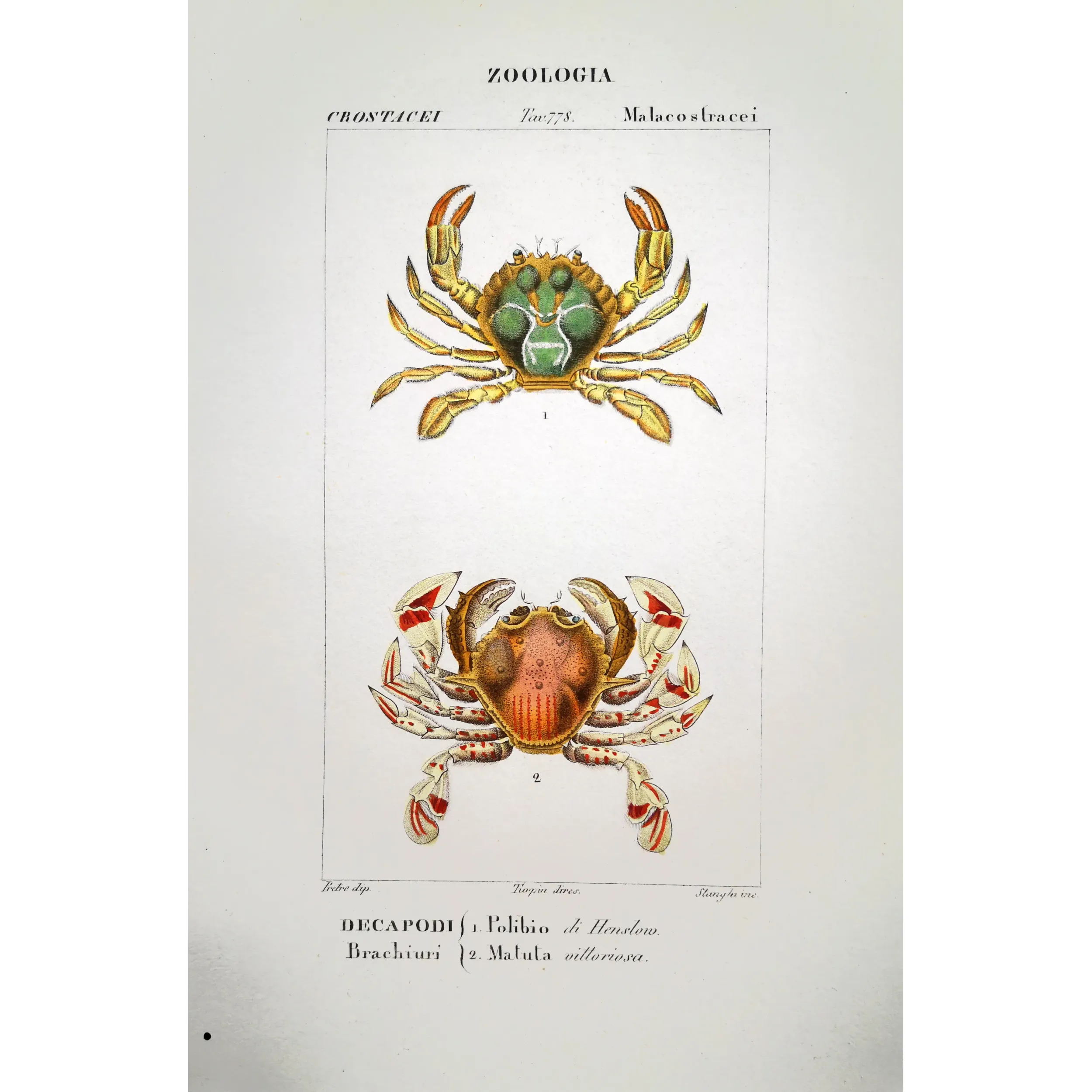
Fine 19th-century hand-colored engraving of *Polybia henslowii*, a vivid marine crab illustrated with contrasting tones.