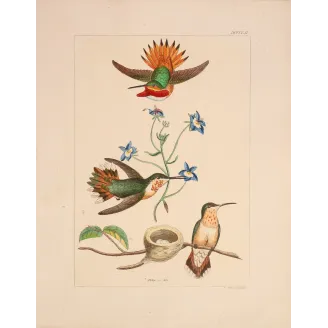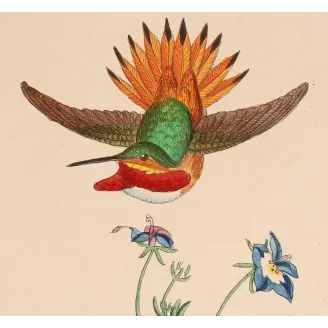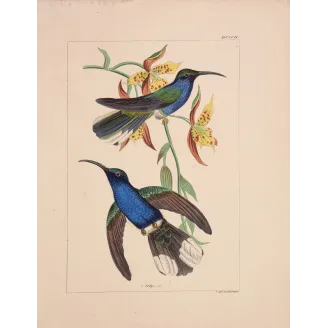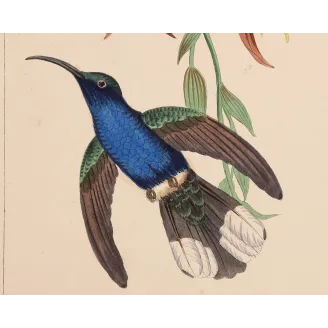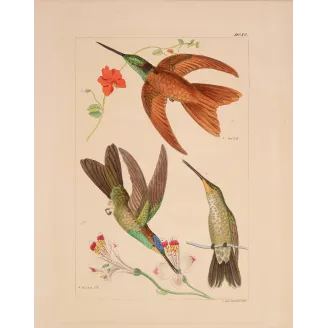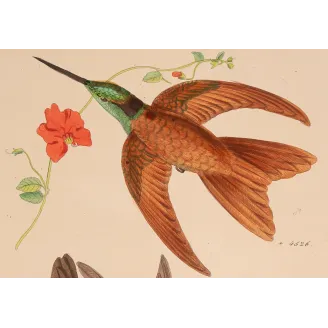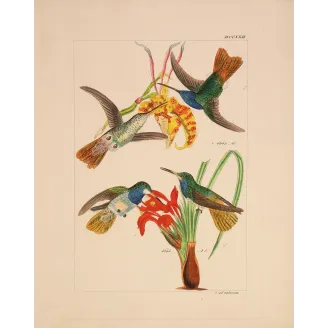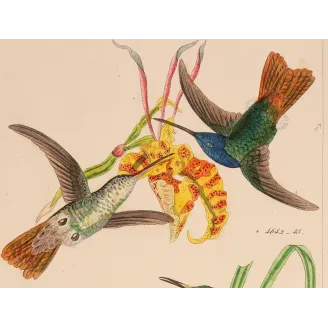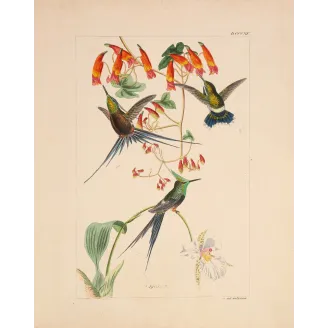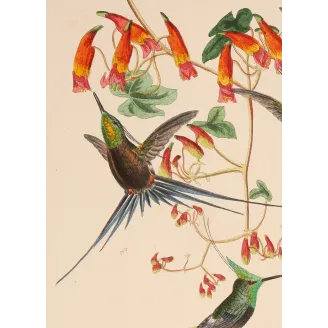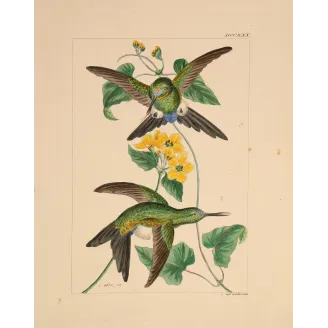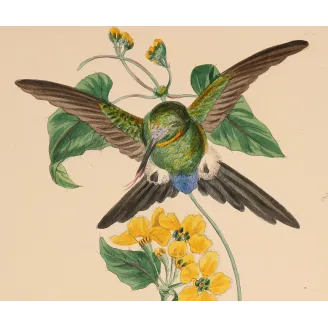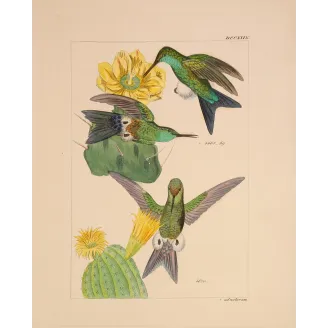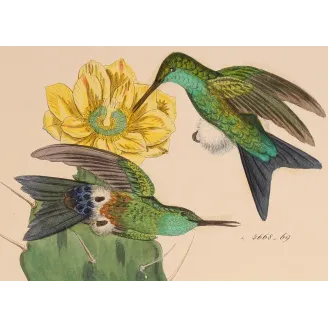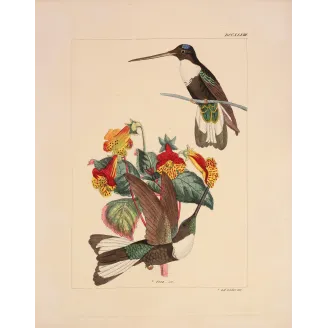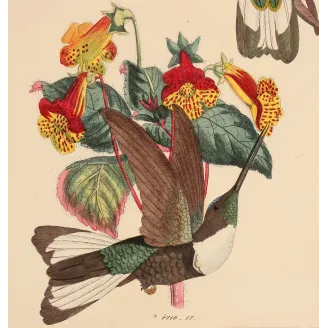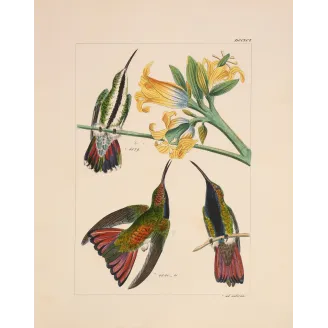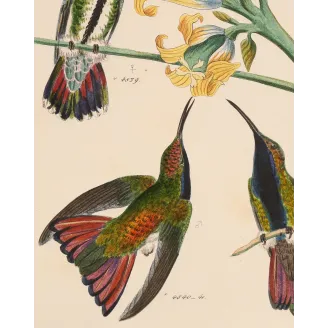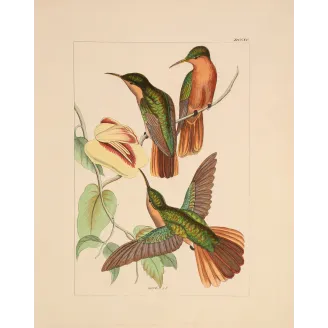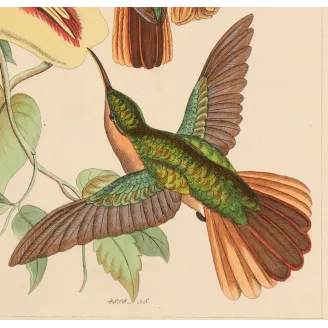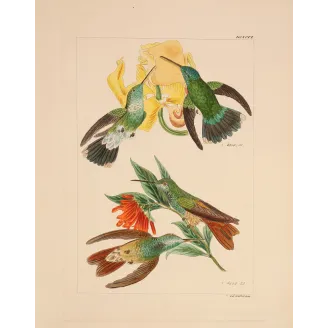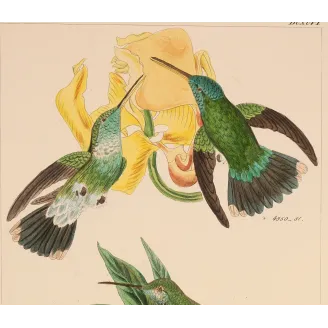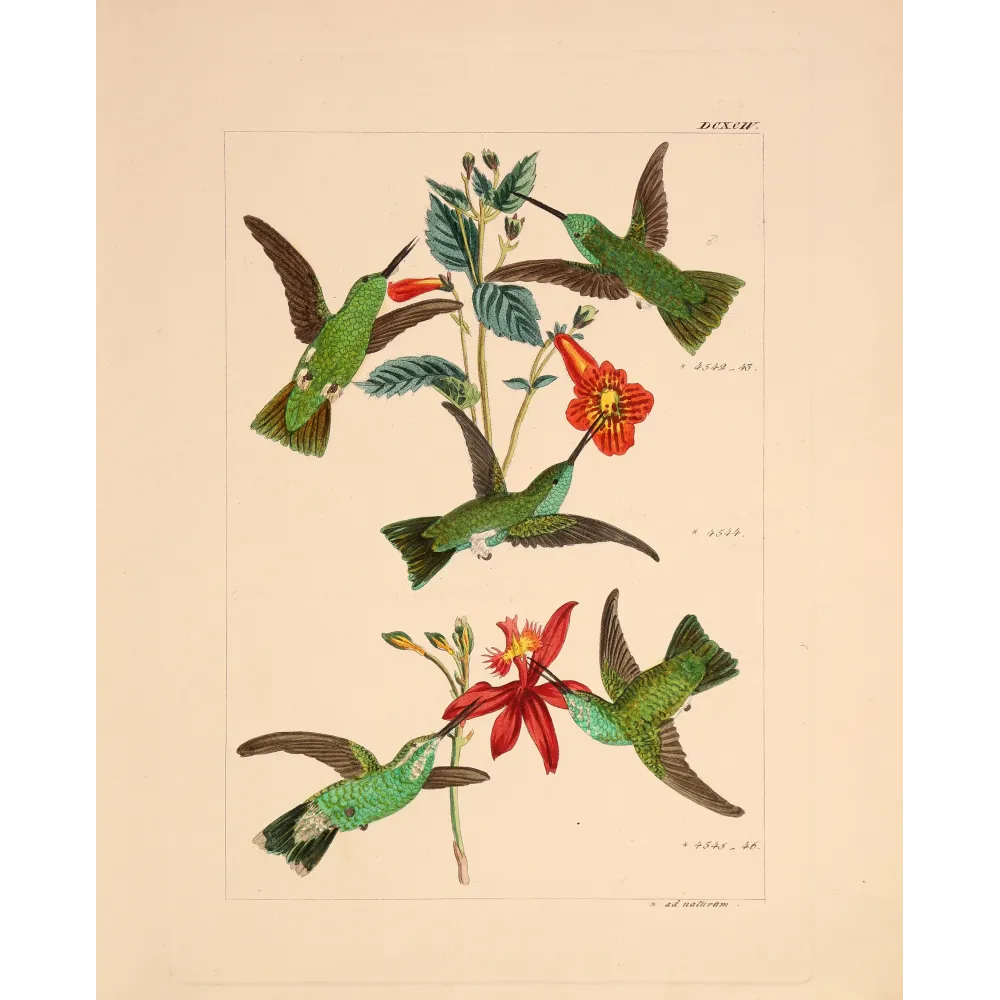
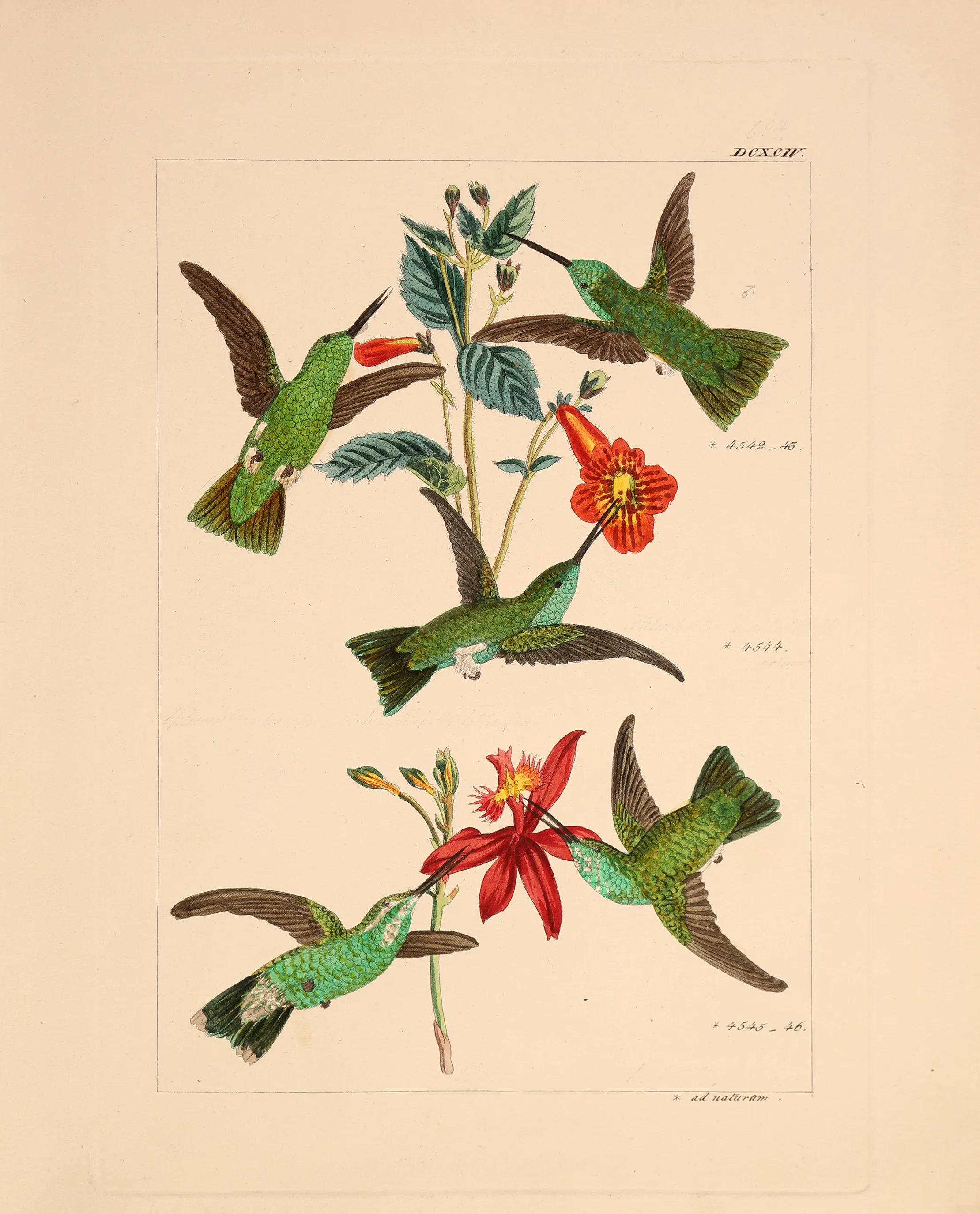
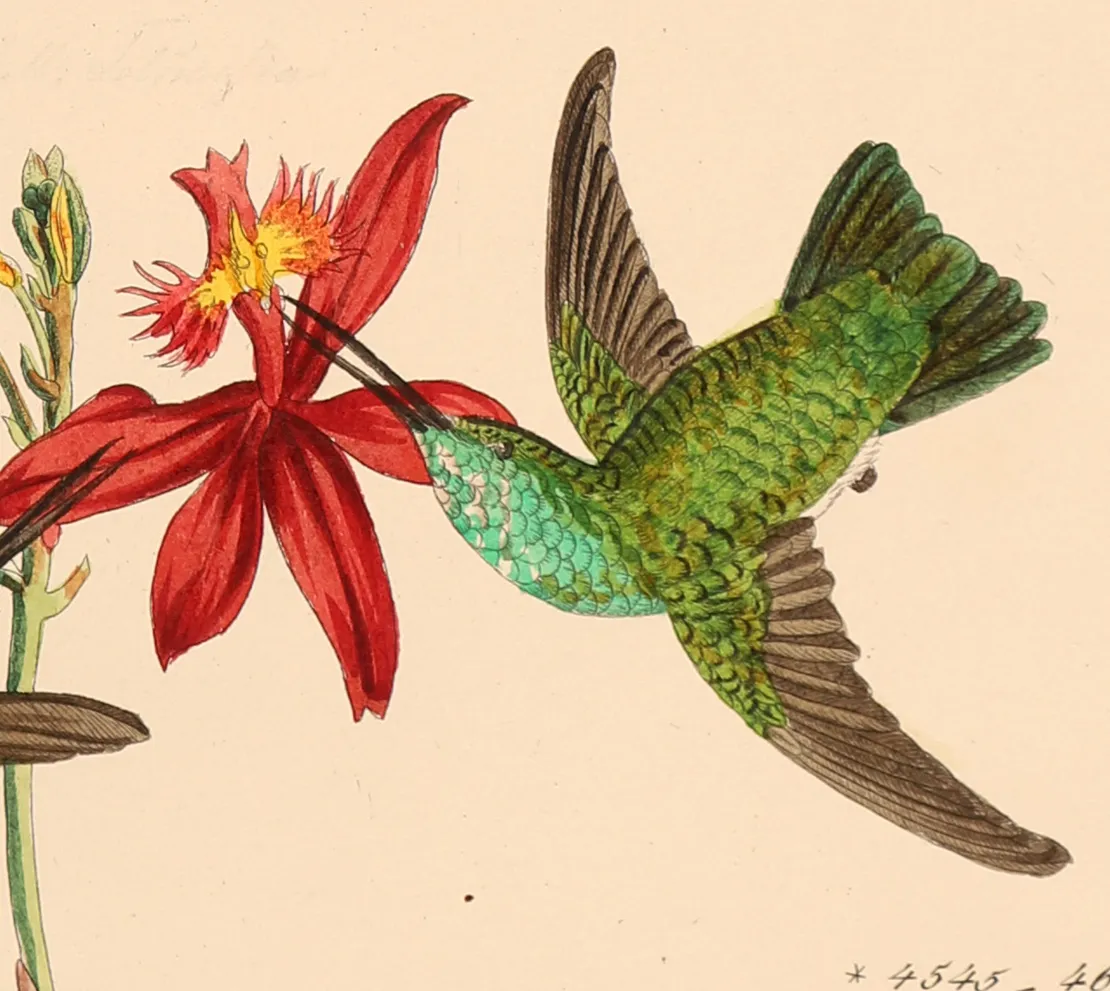
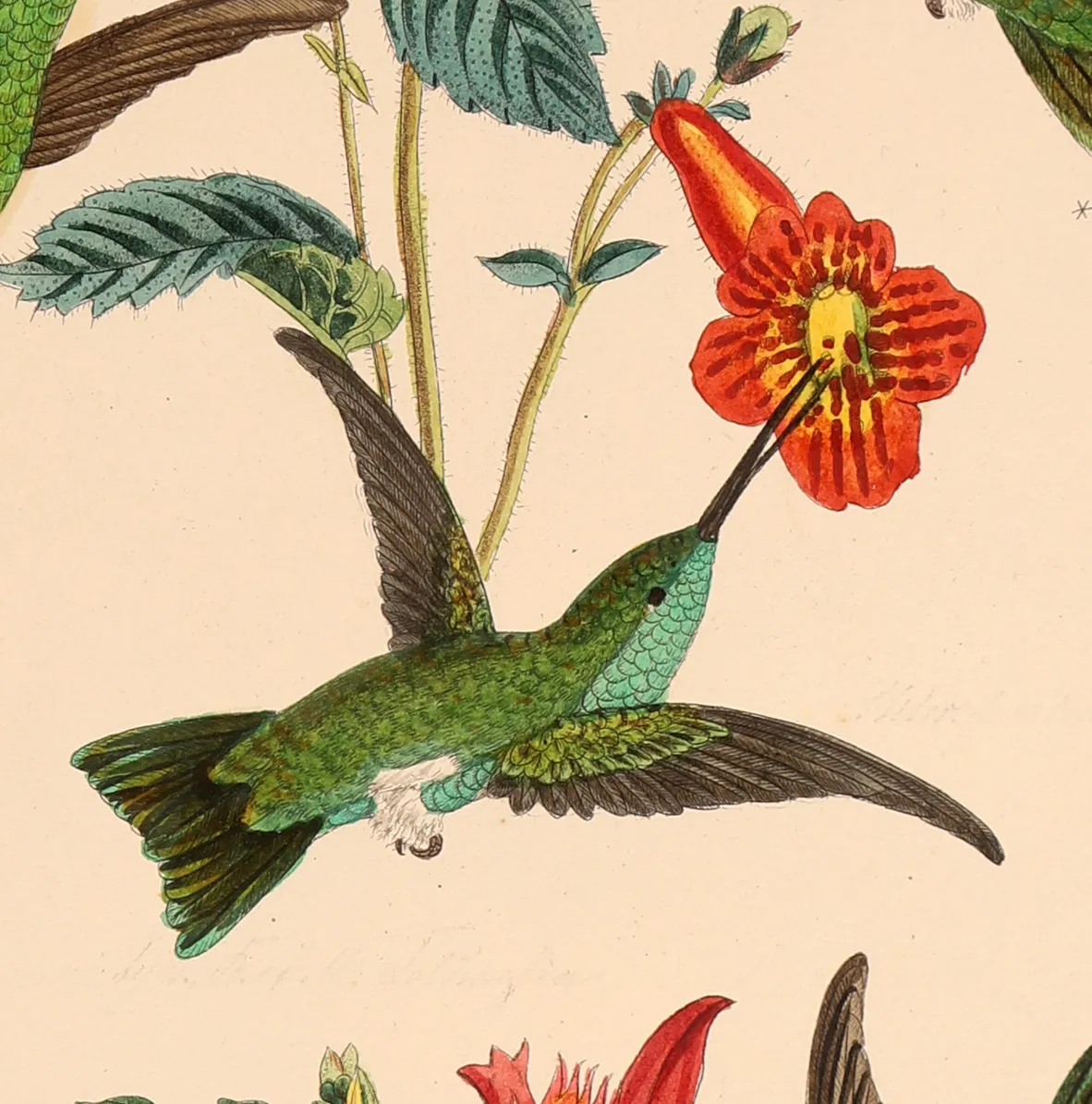
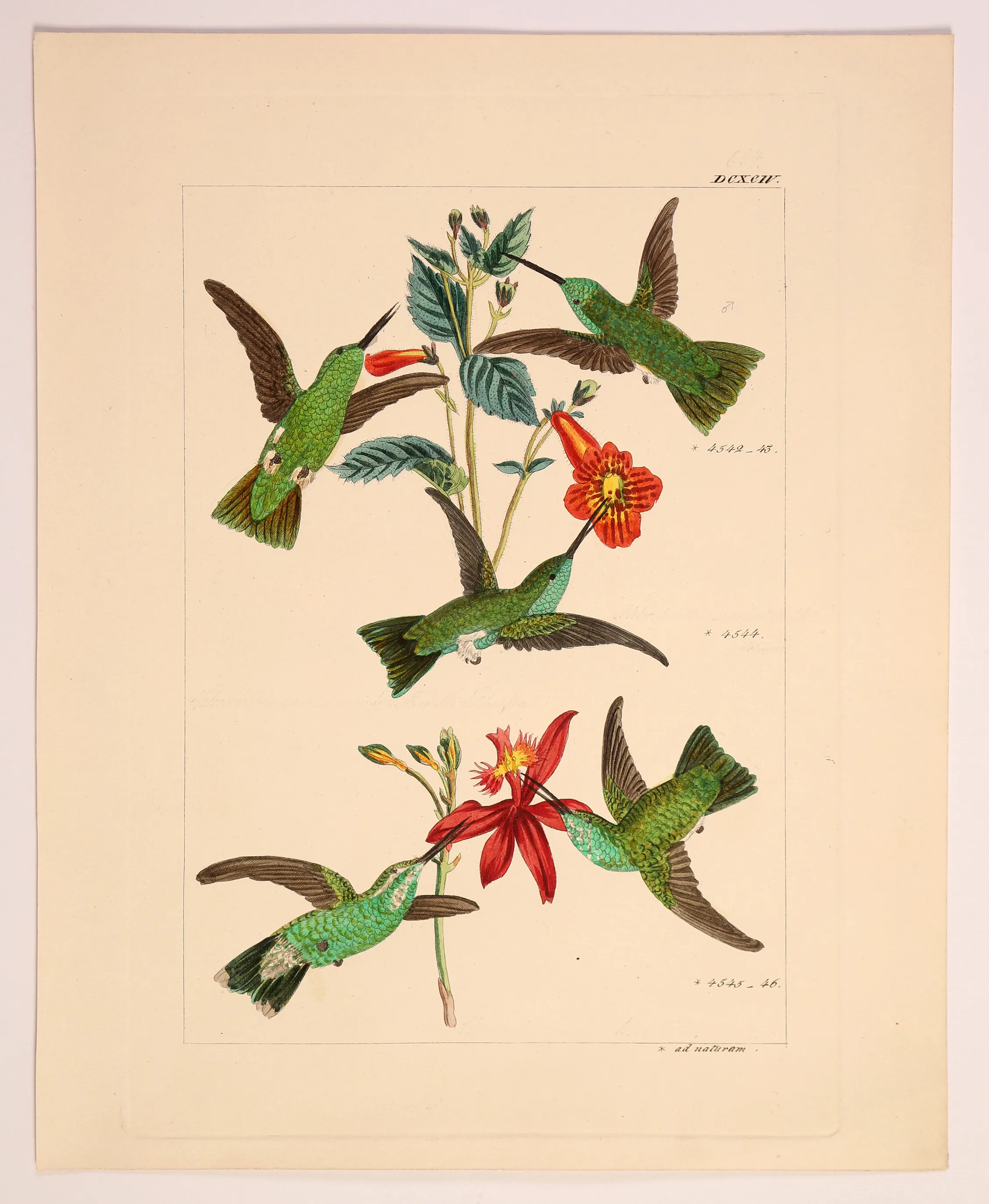
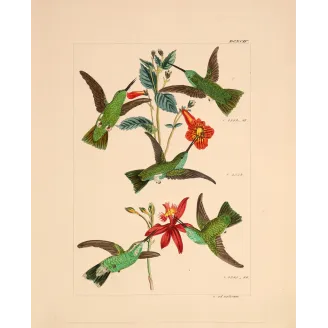
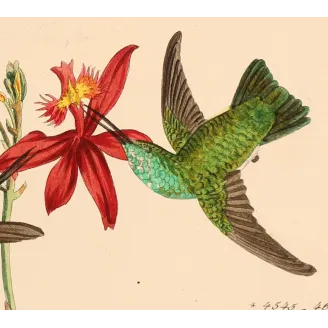
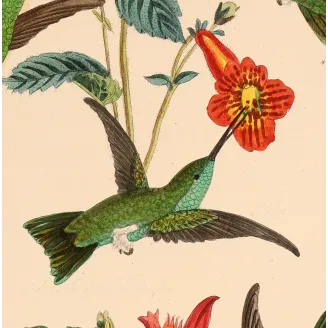
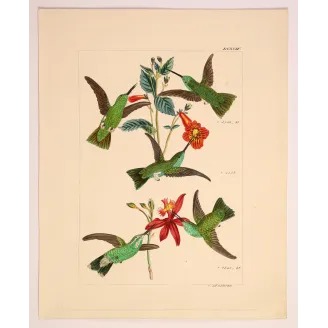
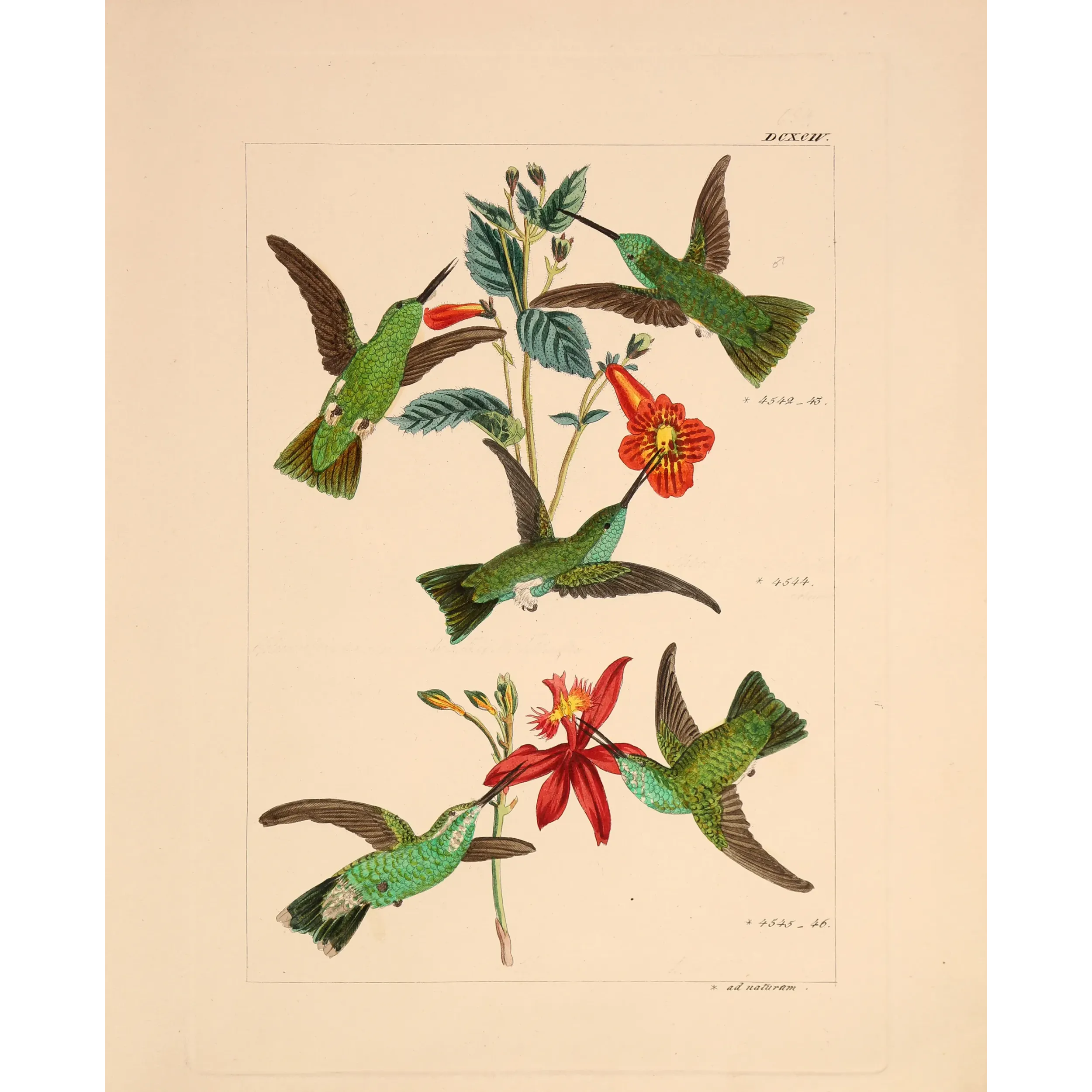
An exceptional original hand-colored engraving from Ludwig Reichenbach's Trochilinarum Enumeratio, depicting five brilliant hummingbirds feeding among scarlet tropical flowers. Featuring Esmeralda, Euchloris and Maculicollis, this dynamic nineteenth-century composition beautifully combines botanical richness with the elegance of Victorian ornithological illustration.
 Delivery policy
Your print will be carefully prepared and shipped worldwide via trusted couriers (UPS or similar).
 Authentic antique prints
Original engravings from the 17th–19th century.
This spectacular original nineteenth-century hand-colored engraving from Ludwig Reichenbach's Trochilinarum Enumeratio presents five hummingbirds in continuous flight among brilliant tropical blossoms. Bringing together the species Esmeralda, Euchloris and Maculicollis, the composition captures the extraordinary vitality and elegance that made hummingbirds one of the greatest fascinations of Victorian natural history.
The engraving combines scientific precision with remarkable artistic refinement. Brilliant emerald plumage contrasts with vivid scarlet flowers, while the birds appear suspended in perpetual motion, each adopting a different posture as they approach the nectar-rich blossoms. The result is one of the most energetic and visually captivating plates of Reichenbach's celebrated work.
Unlike plates devoted to a single specimen, this composition creates an authentic aerial choreography. Five hummingbirds occupy different levels of the image, their wings frozen in rapid motion while converging on flowering plants that structure the entire scene. The careful arrangement produces remarkable visual balance despite the constant suggestion of movement.
The luminous emerald feathers are beautifully enhanced by the intense reds and oranges of the blossoms, producing a sophisticated chromatic dialogue that immediately attracts the eye. Both scientifically significant and highly decorative, the engraving possesses the timeless elegance that characterises the finest nineteenth-century natural history illustration.
Reichenbach assembled three closely related hummingbirds on this remarkable plate: Esmeralda, Euchloris and Maculicollis. Rather than isolating each bird, he chose to represent them together within a shared botanical environment, illustrating both their diversity and their specialised feeding behaviour.
The original index associates the plate with two tropical flowering plants: Achimenes pedunculata Benth. and Epidendrum cinnabarinum Salzm. Their tubular blossoms provide an ideal source of nectar for long-billed hummingbirds and reinforce the ecological relationship between these extraordinary birds and the flowering plants of New Granada and Peru documented throughout Trochilinarum Enumeratio.
This engraving belongs to Ludwig Reichenbach's remarkable world of hummingbirds, where Victorian scientific curiosity meets extraordinary visual elegance. Explore the story behind Trochilinarum Enumeratio and discover why these original hummingbird engravings remain so compelling today.
Very Good condition. Original nineteenth-century paper with strong hand colouring and a clear plate mark. Minor age-related signs may be present, entirely consistent with authenticity and the historical character of the work.
Species: Esmeralda, Euchloris and Maculicollis
Work: Trochilinarum Enumeratio
Author: Ludwig Reichenbach
Date: c. 1855–1860
Technique: Original hand-colored engraving
Plate: DCXCIV (694)
Reference numbers: 4542–46
Inscription: ad naturam (“drawn from life”)
Associated plants: Achimenes pedunculata Benth. and Epidendrum cinnabarinum Salzm.
Origin noted by Reichenbach: New Granada and Peru
Sheet size: approx. 28.5 × 22.5 cm
Specific References
An exceptional original hand-colored engraving from Ludwig Reichenbach's Trochilinarum Enumeratio, portraying hummingbirds during the nesting season. Featuring a beautifully woven nest, delicate blue flowers and vibrant emerald plumage, this rare nineteenth-century composition combines ornithological observation with remarkable decorative elegance.
Original 19th-century hummingbird engraving depicting Cuvier’s Sabrewing (*Campylopterus cuvierii*), published by Ludwig Reichenbach for *Trochilinarum Enumeratio*. A refined composition marked *ad naturam* — drawn from life — combining scientific observation with remarkable decorative elegance.
Original nineteenth-century hand-colored engraving depicting Coeligena sagittata and the hummingbird identified by Reichenbach as Warszewiczii (later associated with Helianthea iris Gould). A visually striking composition featuring emerald plumage, warm copper tones and two botanical species from Northern Peru.
An original nineteenth-century hand-colored engraving from Ludwig Reichenbach's Trochilinarum Enumeratio, depicting Chrysuronia eliciae among the tropical blossoms of Pitcairnia exscapa. A richly composed Victorian natural history plate celebrating hummingbirds, botanical diversity and the living complexity of tropical ecosystems.
An original nineteenth-century hand-colored engraving from Ludwig Reichenbach's Trochilinarum Enumeratio, portraying elegant long-tailed hummingbirds suspended among cascading tropical blossoms. This exceptionally decorative composition combines graceful movement, botanical beauty and the refined artistry of Victorian natural history illustration.
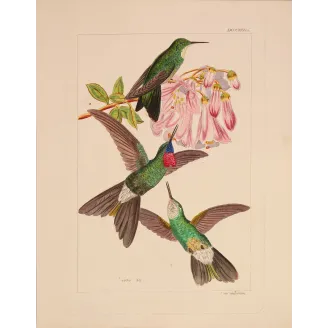
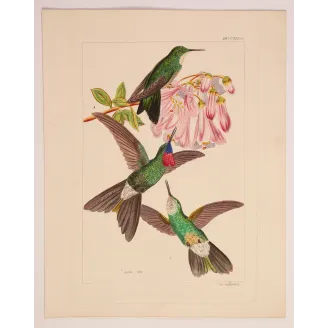
An original nineteenth-century hand-colored engraving from Ludwig Reichenbach's Trochilinarum Enumeratio, depicting three hummingbirds gathered around elegant pendulous blossoms. One of the most harmonious compositions of the series, celebrating movement, colour and the timeless relationship between hummingbirds and flowering plants.
An original hand-colored engraving depicting Lucian's Puffleg (Eriocnemis luciani), one of the most distinctive high-Andean hummingbirds illustrated by Ludwig Reichenbach in Trochilinarum Enumeratio (c. 1855–1860). Drawn ad naturam ("from life"), the composition captures the remarkable white feather tufts that give pufflegs their name, together with brilliant emerald plumage and delicate yellow blossoms. Combining Victorian scientific precision with refined decorative elegance, this authentic nineteenth-century engraving remains both an important ornithological document and a striking work of natural history art.
An original nineteenth-century hand-colored engraving from Ludwig Reichenbach's Trochilinarum Enumeratio, depicting Eriocnemis simplex among flowering passionflowers and cactus blossoms. A remarkable natural history engraving celebrating the extraordinary botanical diversity of hummingbird habitats.
An original nineteenth-century hand-colored engraving from Ludwig Reichenbach's Trochilinarum Enumeratio, depicting Bourcieria prunellii among the vibrant blossoms of Achimenes picta. A refined composition balancing quiet observation and graceful flight in one of the most elegant plates of the series.
An original nineteenth-century hand-colored engraving from Ludwig Reichenbach's Trochilinarum Enumeratio, depicting Mango Hummingbirds feeding among elegant tropical blossoms. This refined composition celebrates the remarkable evolutionary relationship between hummingbirds and the flowers they pollinate.
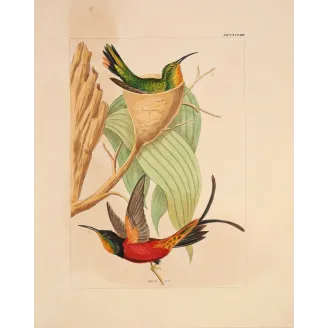
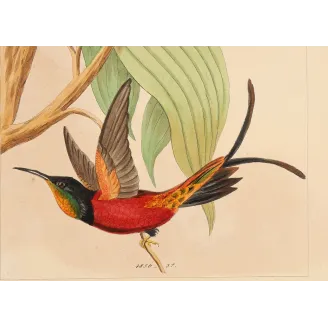
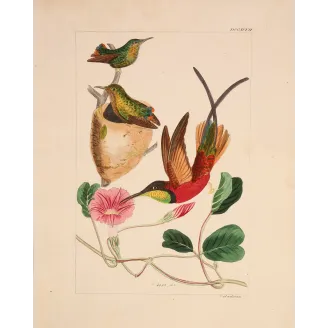
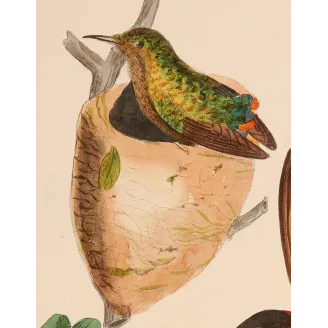
An exceptional original hand-colored engraving from Ludwig Reichenbach's Trochilinarum Enumeratio, depicting the magnificent Crimson Topaz (Topaza pyra) beside its beautifully woven nest. One of the rarest behavioural studies in nineteenth-century ornithological illustration, combining scientific observation with remarkable decorative elegance.
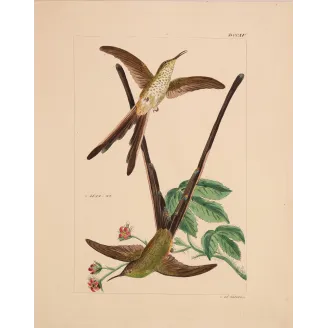
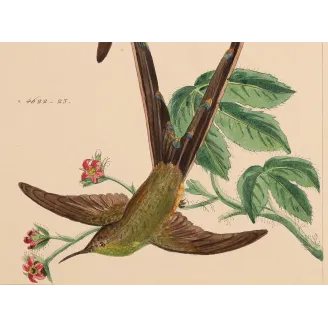
Original nineteenth-century hand-colored engraving depicting Victoria's Trainbearer (Lesbia victoriae), a rare Andean hummingbird illustrated by Ludwig Reichenbach in Trochilinarum Enumeratio.
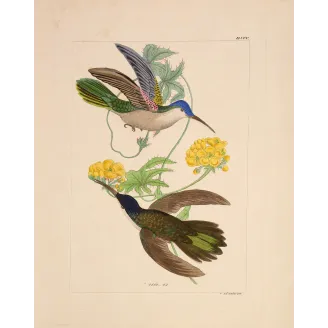
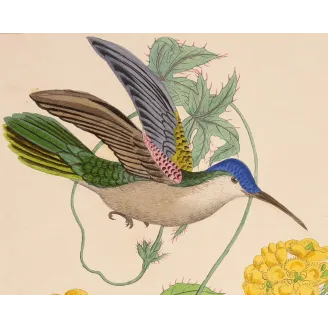
Original nineteenth-century hand-colored engraving depicting the Blue-headed Sabrewing (Saepiopterus lazulus), a tropical hummingbird illustrated by Ludwig Reichenbach in his celebrated Trochilinarum Enumeratio.
Original nineteenth-century hand-colored engraving depicting the Jamaican Mango (Anthracothorax mango), a striking tropical hummingbird illustrated by Ludwig Reichenbach in his celebrated Trochilinarum Enumeratio.
An original nineteenth-century hand-colored engraving from Ludwig Reichenbach's Trochilinarum Enumeratio, depicting Lesbia victoriae among spectacular tropical blossoms. A refined natural history composition celebrating the remarkable partnership between hummingbirds and flowering plants.
An exceptionally decorative nineteenth-century hand-colored engraving depicting the Crimson Topaz (Topaza pyra), one of the most spectacular hummingbirds of the Amazon Basin. Published by Ludwig Reichenbach in Trochilinarum Enumeratio, the composition combines vibrant colour, remarkable movement and a rarely encountered nesting scene.
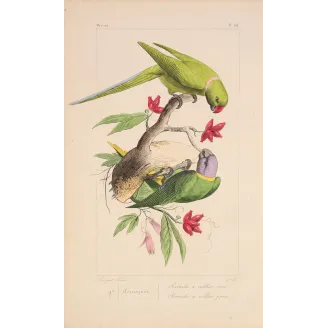
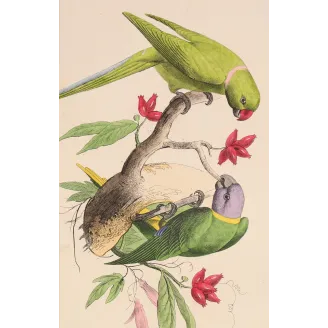
Vivid 19th-century hand-colored engraving depicting two parakeets in dynamic interaction, with striking green plumage and contrasting red and violet accents. A highly decorative exotic bird composition.
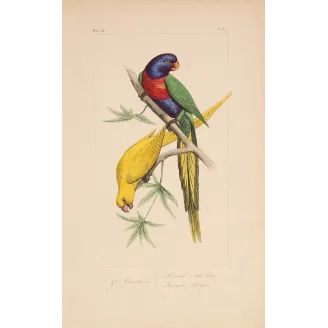
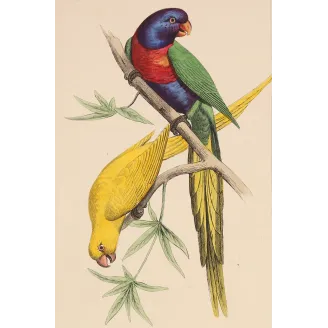
A striking 19th-century engraving depicting two vividly colored parakeets in a dynamic composition. The intense contrast of blue, red, green and yellow creates a highly decorative work, ideal as a focal piece in refined interiors.
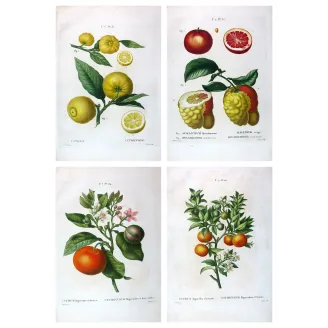
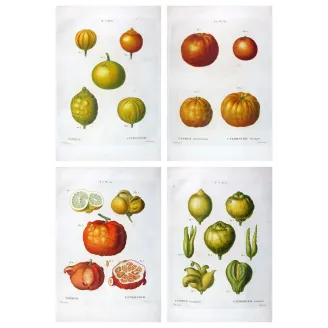
A coherent ensemble of eight original orange and bigarade engravings by Pancrace Bessa, reflecting the cultivated discipline of French orangeries in the Napoleonic era. Botanical precision and architectural composure unite in a refined citrus portfolio preserved as a complete series.
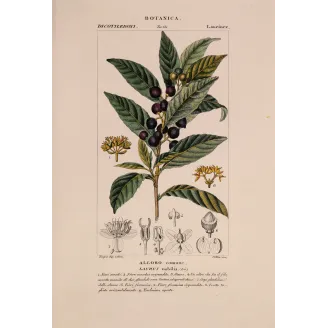
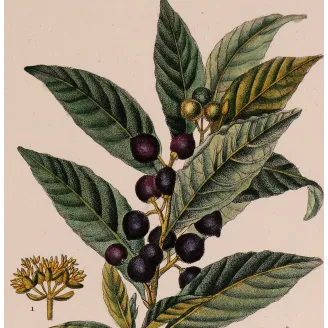
Graceful composition of bay laurel with fruits, blossoms, and internal flower structure.
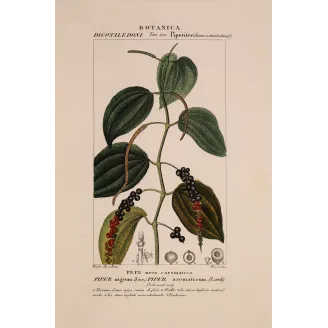
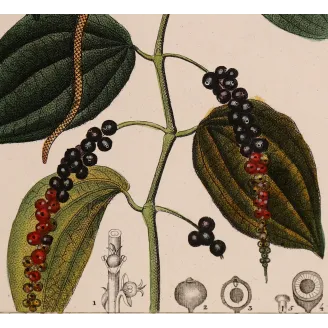
Detailed depiction of the black pepper vine with fruiting spikes and leaves.
An exceptional original hand-colored engraving from Ludwig Reichenbach's Trochilinarum Enumeratio, depicting five brilliant hummingbirds feeding among scarlet tropical flowers. Featuring Esmeralda, Euchloris and Maculicollis, this dynamic nineteenth-century composition beautifully combines botanical richness with the elegance of Victorian ornithological illustration.