
A Guide to Collecting and Decorating with Antique Bird Prints
A Guide to Collecting and Decorating with Antique Bird Prints
Knowledge. Emotion. Beauty.
Long before photography transformed the way we observe nature, the world’s greatest bird artists combined careful observation, scientific curiosity and artistic vision to create works that continue to inspire collectors, bird lovers and interior enthusiasts today.
This page is part of an evolving Prantique guide dedicated to the passions, knowledge and visual experiences that lead people to original antique bird prints. Technical subjects such as paper, plate marks, historical printing processes and hand-colouring are examined separately in our Antique Prints Guide.
Who Is This Guide For?
This guide is designed for anyone looking for authentic antique bird prints to decorate a living room, create a gallery wall, begin a collection, or simply learn more before making a purchase.
It answers some of the most common questions asked by first-time buyers and collectors alike. Where should you buy original antique bird prints? How can you tell an original print from a reproduction? Which artists, books and subjects are worth considering? And how do you choose prints that suit both your personal taste and your home?
Rather than offering quick recommendations, this guide explains the history, collecting appeal and decorative qualities of antique bird prints, helping you make informed decisions based on knowledge rather than marketing.
Prantique's Curatorial Perspective
This guide reflects the perspective of an independent online gallery specialising in original antique prints.
Every work entering the Prantique collection is individually researched, documented through professional documentary photography and presented not simply as an historical document, but as an artwork that may eventually become part of someone's everyday life.
Every original print tells more than one story.
It tells the story of the artist who created it, the natural world that inspired it and the people who continue to find meaning in it today.
Over many years, conversations with collectors, birdwatchers, researchers, interior designers and first-time buyers have revealed something surprisingly consistent.
People rarely begin with antique bird prints.
They begin with birds.
About this Guide
This guide explores why original antique bird prints continue to inspire collectors, bird lovers and interior enthusiasts today.
Rather than focusing on how antique prints were made, it examines the artistic language, historical context and enduring emotional appeal that continue to make these works meaningful in contemporary homes.
Technical subjects such as historic paper, plate marks, printing methods, hand-colouring and authenticity are explored separately in our Antique Prints Guide, allowing this guide to focus on the experience of collecting, understanding and living with original antique bird prints.
People Often Love Birds Before They Discover Antique Bird Prints
Over many years of handling original antique prints, we have had the privilege of meeting people from remarkably different backgrounds who shared a deep affection for birds.
Some were experienced collectors. Others were birdwatchers, wildlife photographers, biologists, veterinarians, conservation professionals or people who had simply spent much of their lives observing birds in the natural world.
Others arrived by a completely different route. They were looking for meaningful artwork, refining a room or searching for an authentic object capable of bringing nature, colour and character into their home.
One pattern appeared again and again.
People rarely began with a passion for antique bird prints.
They began with birds.
The original print came later — as a natural extension of an existing fascination, a memory of something once observed, a way of living with nature every day or the beginning of a collection that gradually acquired personal meaning.
Observation, Knowledge and Artistic Vision
Long before photography, knowledge of the world’s birds depended on direct observation, travel, preserved specimens, field notes and the extraordinary ability of artists to transform what naturalists had seen into images that others could study.
Yet the finest bird illustrations were never merely visual records.
The great illustrators of natural history were also artists. They understood composition, movement, colour, visual rhythm and the emotional force of a living creature represented on paper.
Their work had to be scientifically credible, but accuracy alone was not enough. Monumental natural-history publications were expensive undertakings, frequently issued in parts and supported by subscribers whose continued interest helped make the projects possible.
The images therefore also needed to astonish, persuade and inspire.
Scientific observation and artistic beauty were not opposing ambitions. In the finest works, each strengthened the other. These artists made nature understandable through precision — and unforgettable through beauty.
Hummingbirds — Movement, Colour and Wonder
Few birds seem to exist so completely between observation and imagination.
Hummingbirds are tiny, intensely alive and almost impossible for the eye to hold still. Their rapidly moving wings, iridescent plumage and ability to remain suspended beside a flower make them appear momentarily free from the ordinary rules of nature.
To nineteenth-century European audiences, they also belonged to a world of distant landscapes, tropical vegetation and continuing discovery. Expeditions through Central and South America revealed species whose colours and forms often seemed more imaginative than real.
Artists faced an unusual challenge.
They had to translate speed into stillness, iridescence into pigment and an intensely living presence into a fixed composition on paper.
The finest hummingbird prints do not merely identify their subjects. They preserve the impression of movement.
Perhaps this is why they still evoke such immediate responses today: lightness, vitality, colour, optimism and wonder.
Living with Antique Hummingbird Prints
Hummingbird prints possess an unusual visual lightness.
Their presence can be vivid without feeling heavy, decorative without becoming merely ornamental and historically significant without making a contemporary room feel formal or old-fashioned.
A single original engraving can become a quiet point of attention in a reading room, bedroom or study. A carefully assembled group can introduce colour, movement and natural rhythm into a larger living space.
Yet their appeal is not determined only by where they are placed.
For the bird lover, they may preserve a lifelong fascination with a remarkable creature. For the collector, they can open the door to the history of ornithology, exploration and nineteenth-century publishing. For someone refining a home, they offer an authentic work whose beauty is inseparable from its history.
Different people may arrive for different reasons. The same print can satisfy them all.
One Print, Many Stories
A catalogue description can identify a species, publication, artist and historical context.
Looking closely at the work reveals something different.
In this engraving of the Crimson Topaz, the most important element may not be the spectacular colour of the male bird, although that is what first attracts the eye.
The composition is organised around something quieter.
The nest.
One hummingbird hovers above it. Another remains close to it. Below, the brilliantly coloured male moves toward the open blossom.
The eye travels naturally from bird to nest, from nest to flower and back again. What initially appears to be a formal natural-history illustration gradually becomes a scene.
Reichenbach is not simply presenting an isolated specimen for identification.
He is inviting us to observe behaviour, relationship and habitat.
The sheet documents a remarkable species, but it also tells a small visual story about life in the natural world.
That is the point at which scientific illustration becomes something more: an image capable of preserving knowledge while continuing to communicate movement, intimacy and wonder across generations.
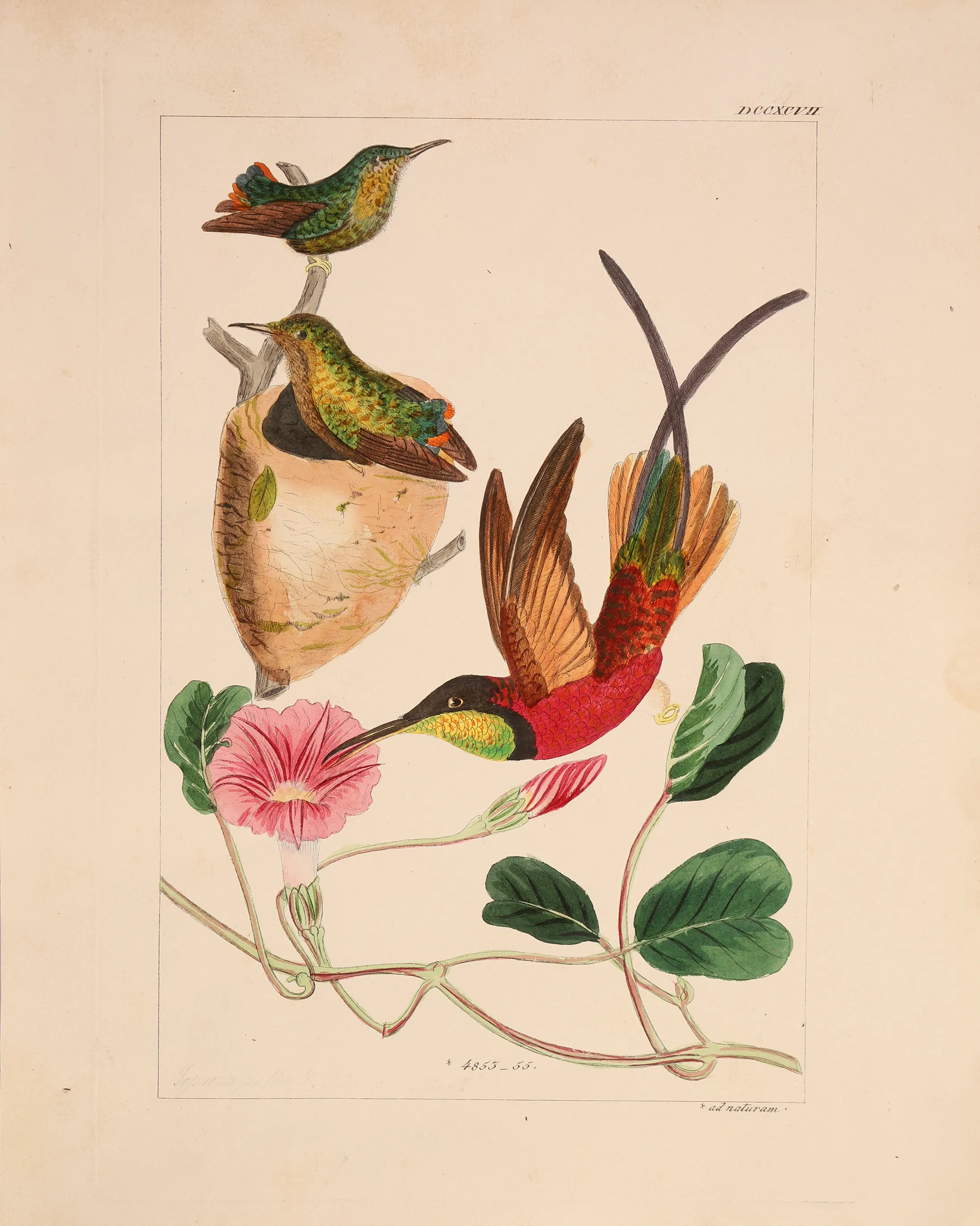
Crimson Topaz (Topaza pyra) with Nest — Ludwig Reichenbach, c.1855
Original nineteenth-century hand-coloured engraving from Trochilinarum Enumeratio.
A Guide Designed to Grow
Hummingbirds represent only one of the many visual and emotional worlds found within antique bird illustration.
Raptors communicate strength, freedom and concentrated presence. Owls invite silence and contemplation. Birds of paradise embody ornament, astonishment and the historic fascination with distant worlds. Waterbirds bring equilibrium and landscape. Songbirds evoke gardens, seasons and memory. Parrots combine intelligence, colour and theatrical personality.
Each deserves to be understood through its own visual language, emotional resonance and historical context.
This guide will therefore grow together with the Prantique collection. New chapters will be added when original works allow us not only to discuss these different bird worlds, but to place the reader directly in front of them.
Knowledge. Emotion. Beauty.
Antique bird prints occupy an unusual space between natural history, art and contemporary life. They preserve the work of the first great observers of birds, the artistic vision of their illustrators and the emotions of those who continue to live with these images today.
Collecting may begin with knowledge. Decorating may begin with beauty. Very often, both begin with emotion.
Continue the Journey
This guide focuses on the visual, cultural and emotional worlds surrounding antique bird prints. Readers wishing to understand their material and technical foundations — including historic paper, plate marks, printing methods, hand-colouring and authenticity — may continue through our Antique Prints Guide.
Questions about an antique bird print? Whether you are a collector, bird lover, researcher, interior professional or simply curious, we are always happy to discuss original antique prints, artists, historical publications and the works currently presented by Prantique. You may contact us at [email protected].
Related posts
-
 Pochoir or Lithograph? Understanding the True Technique Behind Grasset’s La Plante
In the world of antique print collecting, the difference between pochoir and color lithography is more than a...Read more
Pochoir or Lithograph? Understanding the True Technique Behind Grasset’s La Plante
In the world of antique print collecting, the difference between pochoir and color lithography is more than a...Read more -
 The Hidden Nobility of Natural History Prints: From the Sacchetti Collection
The Hidden Nobility of Nature Prints In the vast and fascinating world of antique natural history prints, there are...Read more
The Hidden Nobility of Natural History Prints: From the Sacchetti Collection
The Hidden Nobility of Nature Prints In the vast and fascinating world of antique natural history prints, there are...Read more -
 Paper in Antique Prints: Laid, Wove & Watermarks
An overview of laid and wove paper in antique prints, with a focus on watermarks as material evidence for dating,...Read more
Paper in Antique Prints: Laid, Wove & Watermarks
An overview of laid and wove paper in antique prints, with a focus on watermarks as material evidence for dating,...Read more -
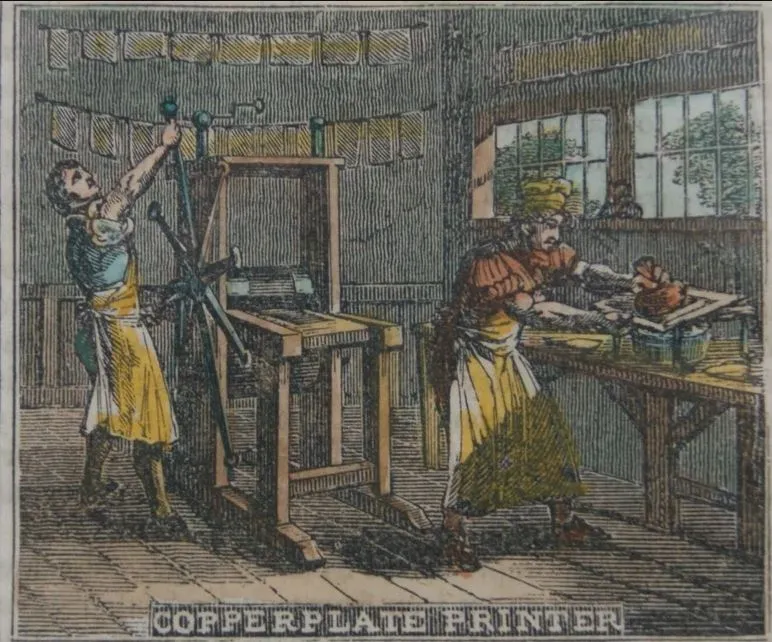 Plate Marks in Antique Prints: Reading the Printed Impression
Plate marks are subtle physical traces left by the printing process itself. This article explores how plate...Read more
Plate Marks in Antique Prints: Reading the Printed Impression
Plate marks are subtle physical traces left by the printing process itself. This article explores how plate...Read more -
 Why Antique Prints Feel Different — And Why They Quietly Transform a Room
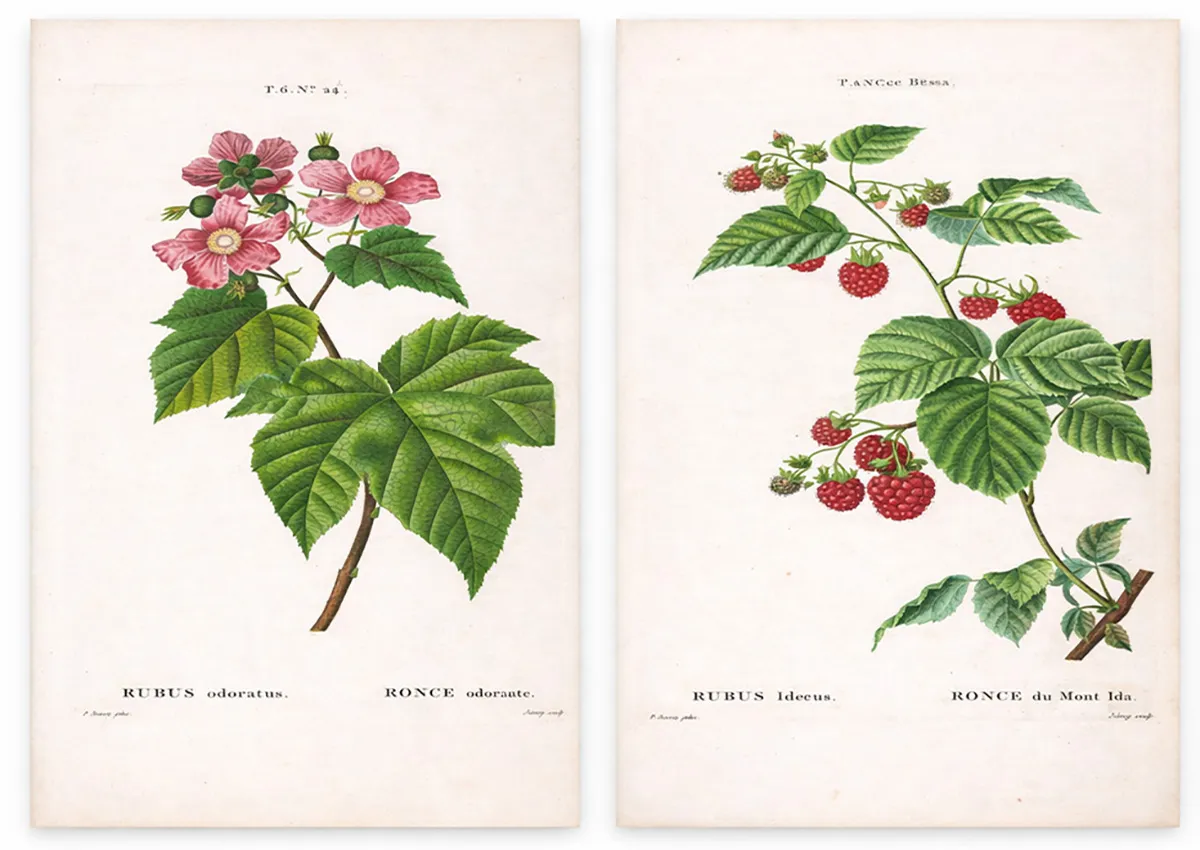
A reflective essay on why antique botanical and natural history prints transform interiors not only through their...Read more
Why Antique Prints Feel Different — And Why They Quietly Transform a Room
A reflective essay on why antique botanical and natural history prints transform interiors not only through their...Read more
Leave a comment