
Novitates Zoologicae: Keulemans, Rothschild and the Birth of a Modern Zoological Journal
Novitates Zoologicae: Scientific Discovery and Ornithological Art at the Tring Museum
Every original print survives through a succession of human decisions. Artists, printers, colourists, publishers, collectors, librarians and institutions may each contribute a small part to its journey, often without knowing who will encounter the work many generations later.
The ornithological plates published in Novitates Zoologicae are remarkable survivors of this kind. Created during one of the great periods of zoological discovery, they remain original witnesses to an age in which the natural world was still being revealed, compared and described species by species.
Founded in 1894 in connection with the Zoological Museum at Tring, Novitates Zoologicae became one of the principal journals through which this rapidly expanding knowledge was organised and communicated. Edited by Walter Rothschild, Ernst Hartert and Karl Jordan, it brought together taxonomy, geographical research and scientific illustration for an international community of specialists.
Among its most memorable contributions were the ornithological plates created by John Gerrard Keulemans. Combining lithographic precision, sensitive colouring and exceptional clarity of observation, these illustrations allow us to encounter that extraordinary scientific world through the very impressions that once carried its discoveries beyond Tring.
A Journal for Zoological Novelties
Unlike a conventional natural history book organised around a predetermined sequence of familiar animals, Novitates Zoologicae functioned as a working scientific journal. Its pages recorded new species, revised classifications, geographical observations and comparative studies as specimens entered European collections and were examined by specialists.
The title itself, derived from the Latin expression for “zoological novelties”, expressed the publication’s purpose. These were not retrospective summaries of animals already well known to European naturalists, but reports from the advancing edge of zoological knowledge.
Recently collected forms could be named, compared and placed within a developing scientific system. The introductory pages established a clear editorial method centred upon taxonomy, geographical distribution, species, subspecies and nomenclature.
Each issue therefore recorded knowledge while it was still being formed. The journal was not simply describing the natural world: it was participating directly in the process through which that world became scientifically legible.
Walter Rothschild and the Zoological Museum at Tring
The journal emerged from the remarkable zoological enterprise established by Walter Rothschild at Tring. His museum was not conceived merely as a private display of rare animals. It developed into an active centre of collection, comparison and taxonomic research, connected with naturalists, dealers, explorers and scientific institutions throughout the world.
Rather than thinking of Tring only as a building, it is perhaps more revealing to understand it as a meeting place. Specimens arrived from distant regions. Naturalists examined and compared them. Artists translated observation into images. Printers and colourists gave those images material form, while editors prepared them to travel through the international scientific community.
Rothschild’s resources made it possible to assemble specimens on an exceptional scale, but the scientific significance of the museum depended equally upon the specialists who studied them. Ernst Hartert became central to its ornithological work, while Karl Jordan contributed particularly to entomology and systematic zoology.
Through Novitates Zoologicae, research undertaken at Tring could circulate beyond the museum itself. A private collection was transformed into a productive scientific resource whose discoveries entered the international literature of natural history.
The institution survives today as the Natural History Museum at Tring. Its historic galleries and collections preserve the atmosphere and scientific legacy of Walter Rothschild’s project, like an old place whose continued existence allows a vanished intellectual world to remain partly present.
John Gerrard Keulemans and the Ornithological Plates
Many of the journal’s most memorable ornithological plates were created by John Gerrard Keulemans, one of the defining bird illustrators of the late nineteenth century. His contribution was especially appropriate to a publication concerned with newly described or insufficiently documented species.
Keulemans combined close anatomical observation with an exceptional ability to give each subject visual presence. His compositions are scientifically controlled but never static. Carefully selected poses reveal the form of the bill, wings, tail and plumage while retaining a convincing suggestion of living character.
The botanical settings remain deliberately restrained. Branches, leaves and softly developed backgrounds establish scale and atmosphere without competing with the zoological subject. This balance between clarity and natural presence is one of the qualities that makes Keulemans’ work immediately recognisable.
Yet Keulemans did not work in isolation. His original conception passed through a collaborative sequence involving lithographic preparation, printing and the application of colour. Each finished plate is therefore not the achievement of one name alone, but the meeting point of several specialised forms of knowledge and craftsmanship.
For a broader account of his life, artistic language and principal publications, readers may consult our dedicated article: J.G. Keulemans: Precision and Passion in Ornithological Illustration .
Scientific Illustration Before Modern Photography
Before modern colour photography became a practical scientific instrument, illustration played a fundamental role in zoological description. A successful plate had to communicate the distinguishing features of a species clearly enough to support recognition, comparison and classification.
Shape, proportion, posture and colour were therefore not secondary decorative elements. They formed part of the scientific argument. The visual representation allowed geographically distant specimens to be studied and compared by readers who might never encounter the original bird.
The plate occupied a position between specimen and written description. It made the diagnostic features of the bird visible, portable and reproducible, allowing knowledge created in one museum to travel into libraries, universities and private scientific collections elsewhere.
The aesthetic refinement of Keulemans’ illustrations did not diminish this scientific purpose. On the contrary, the precision of the lithographic drawing and the sensitivity of the colouring allowed complex anatomical information to be presented with unusual clarity and grace.
The Visual Character of the Plates
Keulemans’ plates for Novitates Zoologicae possess a quiet intensity. The birds are commonly presented against softly suggested foliage or restrained fields of colour, allowing the viewer’s attention to move immediately towards the plumage and defining anatomical features.
The lithographic drawing remains active beneath the colour, describing individual feathers, facial markings and subtle changes in texture. Transparent passages permit the printed structure to remain visible, while more concentrated colour establishes the deep blues, greens, reds and metallic effects characteristic of many tropical birds.
Scientific precision establishes the structure; colour restores the presence of the living bird.
This combination gives the illustrations their distinctive quality. They are exact enough for scientific study, yet sufficiently balanced and luminous to retain a powerful independent presence as original works on paper. The longer they are observed, the more clearly scientific discipline and artistic sensitivity appear not as competing qualities, but as parts of the same visual language.
A Curatorial Question: Hand-Coloured or Colour Printed?
While cataloguing the original Novitates Zoologicae plates in the Prantique collection, one technical question repeatedly emerged. Their tonal softness, subtle variations and surface character created the immediate visual impression of hand colouring. Yet visual perception alone is never sufficient to establish a printing technique.
The question is especially relevant because hand colouring and sophisticated methods of colour printing coexisted during the final decades of the nineteenth century. Chronology alone cannot distinguish between them, and high-quality chromolithography was already capable of producing remarkably subtle results.
Contrary to what can sometimes be found in illustrated natural history publications, the introductory pages of Novitates Zoologicae provide virtually no information about the printing or colouring methods employed for the plates. The editors concentrate instead upon taxonomy, nomenclature and geographical distribution.
Rather than relying solely upon established catalogue descriptions, we therefore returned to the original impressions themselves. Looking closely is often the most reliable beginning of historical understanding: when the documentary record remains incomplete, the physical object may still preserve evidence of its own making.
Our objective was not to prove a theory, but to ask whether the perceived character of hand colouring was supported by observable material evidence.
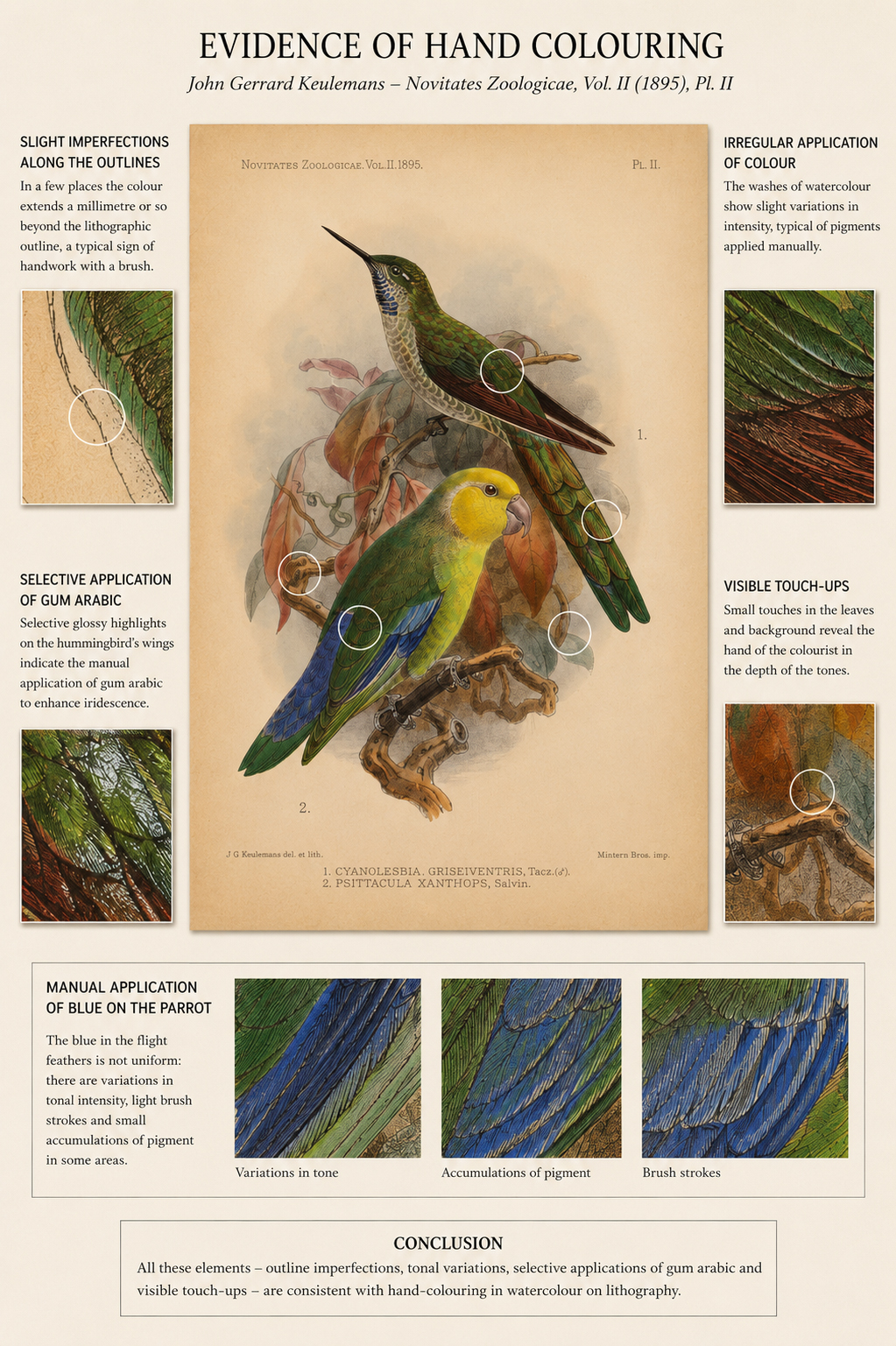
Material observations made during the examination of an original Keulemans plate from Novitates Zoologicae, Volume II, 1895.
Reading the Material Evidence
Close examination reveals several passages in which colour extends slightly beyond the printed lithographic boundary. These are small, localised irregularities rather than the consistent displacement that might result from the misregistration of a mechanically printed colour layer. Their character is compatible with pigment applied individually by brush.
The blue flight feathers of the parrot provide a particularly revealing example. Their application is not perfectly uniform. Neighbouring areas show slight differences in saturation, occasional accumulations of pigment and fine linear marks following the structure of the feathers.
Under changing light, selected areas of the hummingbird’s plumage also reveal localised surface reflections compatible with the selective use of gum arabic. Such finishing would intensify darker pigments and suggest the shifting brilliance of iridescent feathers without concealing the lithographic structure beneath.
These details do not reduce the quality of the impression. They preserve the rhythm of its execution. What may initially appear to be a slight irregularity becomes, under closer observation, evidence of the physical sequence through which the finished plate was created.
Comparison and Bibliographic Evidence
The observations are reinforced by comparison with unmistakably chromolithographic illustrations, including lepidopterological plates published within the wider journal. Their mechanically constructed colour fields possess a visibly different regularity, registration and surface character.
Institutional records, bibliographic descriptions and specialist antiquarian catalogues also regularly identify Keulemans’ ornithological plates from the early volumes of Novitates Zoologicae as hand-coloured lithographs.
Material observation alone rarely provides complete certainty. Bibliographic terminology alone may be equally insufficient. Considered together, however, they form a coherent and persuasive picture.
The convergence of lithographic underdrawing, locally irregular pigment application, tonal variation, selective surface enhancement and consistent bibliographic descriptions supports the classification of these ornithological plates as original lithographs coloured by hand with watercolour and, in selected areas, heightened with gum arabic.
Why These Small Traces Matter
A slight extension of blue pigment beyond a printed outline may initially appear insignificant. Yet details of this kind belong to the material history of the object. They preserve the individual actions through which the finished plate was created.
Keulemans prepared the image and translated it into lithographic form. The printer transferred that image to paper. A skilled colourist then followed its intricate structure, applying transparent pigments feather by feather and introducing selected highlights where additional depth or brilliance was required.
The slight overlap of blue pigment is not simply an imperfection. It is a quiet trace of the colourist’s hand, still visible more than a century later.
Understanding these apparently minor traces changes the way we look at the plate. What first appears to be simply an illustration gradually reveals itself as the surviving result of many individual hands—artist, lithographer, printer and colourist—working together within a precise historical and scientific context.
The object becomes not only an image of a bird, but material evidence of the people, techniques and decisions that brought that image into existence. Its meaning lies not in one isolated name or gesture, but in the complete constellation of contributions preserved upon the sheet.
From Scientific Document to Cultural Witness
For the zoologists of the 1890s, these plates served an immediate and practical purpose. They recorded newly described or insufficiently known species with the accuracy required for scientific comparison.
More than a century later, their role has naturally evolved. They continue to preserve scientific information, but they also bear witness to an extraordinary period in the history of exploration, museum culture, printing and natural history illustration.
The museum, the artist’s studio, the lithographic workshop, the colourist’s table and the international networks through which specimens and ideas travelled all meet upon the same sheet of paper. No single element tells the entire story; each belongs to the larger process that allowed the finished impression to exist.
To live with one of these original impressions today is therefore not simply to display a bird upon a wall. It is to keep within everyday view a genuine fragment of the intellectual and artistic world that produced it.
Why the Novitates Plates Still Matter
Today, Keulemans’ illustrations from Novitates Zoologicae are appreciated far beyond their original taxonomic purpose. Collectors admire their balance between scientific discipline and visual elegance, while historians recognise them as documents of a period in which museums, exploration and print culture were reshaping knowledge of the natural world.
Their compositions retain a striking contemporary clarity. Generous areas of unprinted paper isolate the birds, while subtle vegetation and carefully controlled colour allow them to remain both visually refined and immediately legible.
Individual plates possess sufficient presence to be displayed independently, while related subjects can form coherent ornithological groupings. Their decorative versatility does not diminish their historical importance: every impression remains an original artefact from one of the defining periods of Victorian zoological publishing.
Seen each day within a contemporary interior, an original plate can remain quietly present without surrendering its history. Its beauty may be immediate, while its deeper meanings continue to emerge through observation, knowledge and the stories shared around it.
Far from being modern reproductions, these original lithographs preserve the scientific ambition, artistic refinement and individual craftsmanship of the Tring Museum’s remarkable publishing enterprise.
Prantique’s Curatorial Perspective
Every original print carries multiple histories: the species represented, the artist who observed it, the craftsmen who produced it, the scientific community that first studied it and the collectors who preserved it.
Curatorial work does not invent these stories. Its responsibility is to recognise them, document them carefully and allow them to become visible once again.
The observations presented in this article arose directly from the cataloguing of original examples in the Prantique collection. Our purpose is not to replace specialist laboratory analysis, but to explain transparently how material examination, historical bibliography and comparative observation inform our descriptions.
To collect an original Keulemans plate from Novitates Zoologicae is therefore not simply to acquire an image of a bird. It is to preserve a fragment of the scientific, artistic and material culture that developed around the Tring Museum at the close of the nineteenth century.
Curatorial work does not exist simply to describe objects. Its deeper purpose is to preserve and make visible the way of seeing that first brought those objects into existence.
It preserves centuries of wonder for the natural world,
careful observation and patient craftsmanship,
thanks to the care of those who chose to preserve the values it embodies.
Continue Exploring the Original Works
The plates discussed in this article were originally created to communicate new zoological discoveries. Today, the surviving impressions continue a different journey. Each original work in the Prantique collection has been individually examined, professionally photographed and documented so that its historical, artistic and material character can be appreciated in detail.
Explore the Keulemans Novitates Zoologicae collection and continue the story through the original works themselves.
Related posts
-
 Émile-Allain Séguy and Prismes: Art Deco Geometry in Full Color
At the intersection of biology, modernism, and decorative arts, Émile-Allain Séguy occupies a singular place. Best...Read more
-
 La Plante et ses Applications Ornementales: Eugène Grasset and the Birth of Modern Botanical Design
In the golden age of Art Nouveau, few works embody the marriage between art and nature as perfectly as La Plante et...Read more
-
 Gregory M. Mathews and The Birds of Australia: A Monument of Ornithological Ambition
Gregory M. Mathews’ The Birds of Australia is a monumental blend of taxonomy and art. This article explores the...Read more
-
 Jacob L'Admiral and the Metamorphosis of Insects – A Dutch Enlightenment Marvel (1774)
In the vibrant scientific atmosphere of the 18th century, Jacob L’Admiral (1700–1775), a Dutch naturalist and...Read more
-
 Pierre-Joseph Redouté: Botanical Illustration Beyond Roses
Pierre-Joseph Redouté (1759–1840) is universally regarded as the most influential botanical illustrator of the late...Read more
Leave a comment