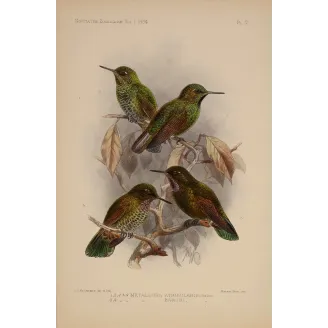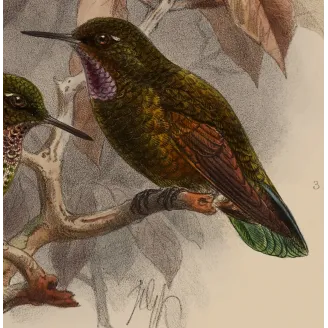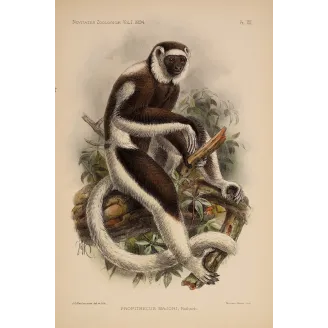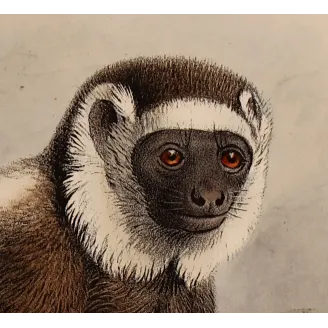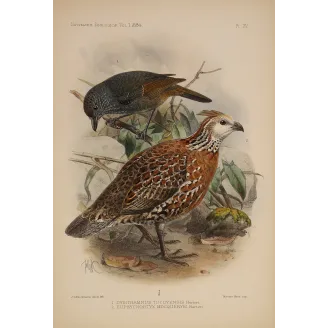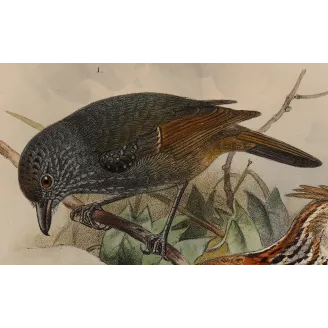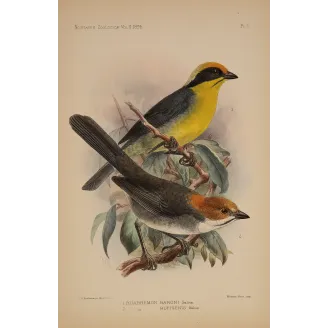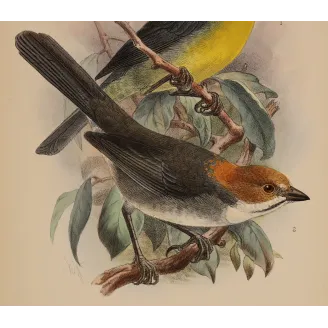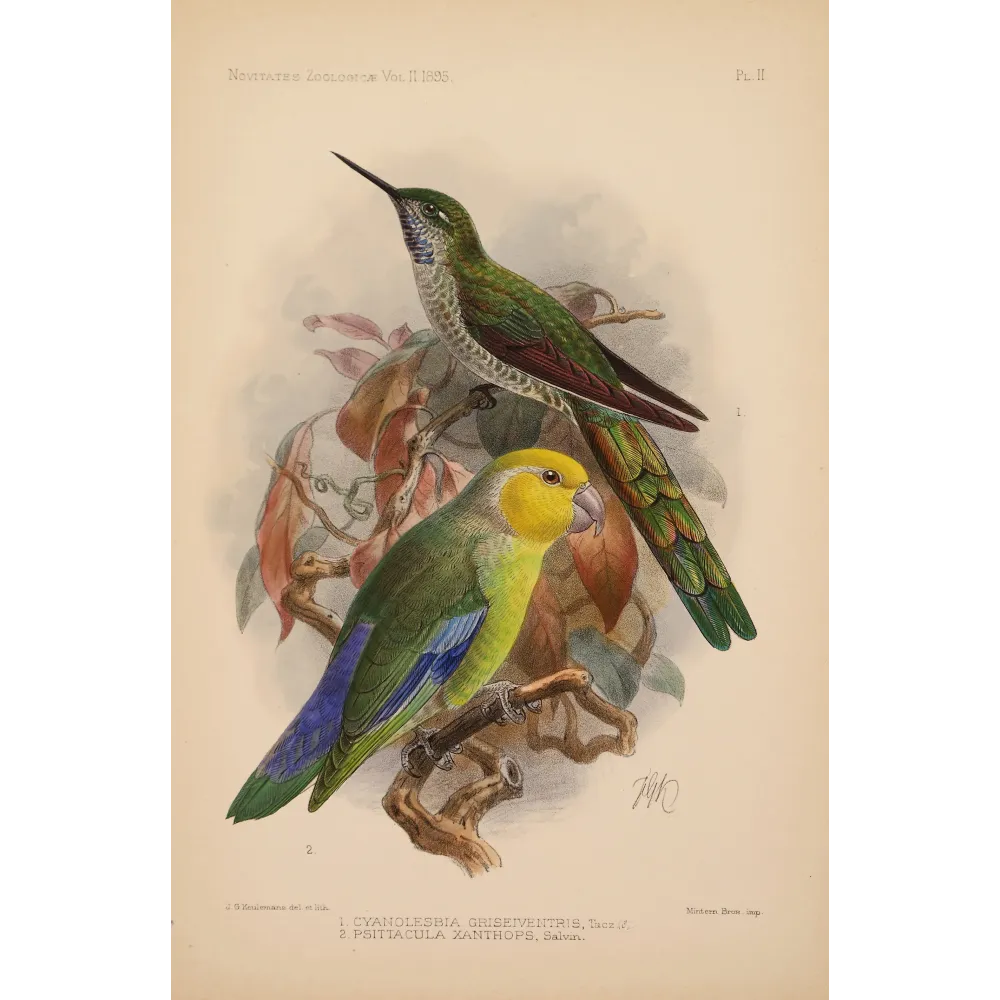
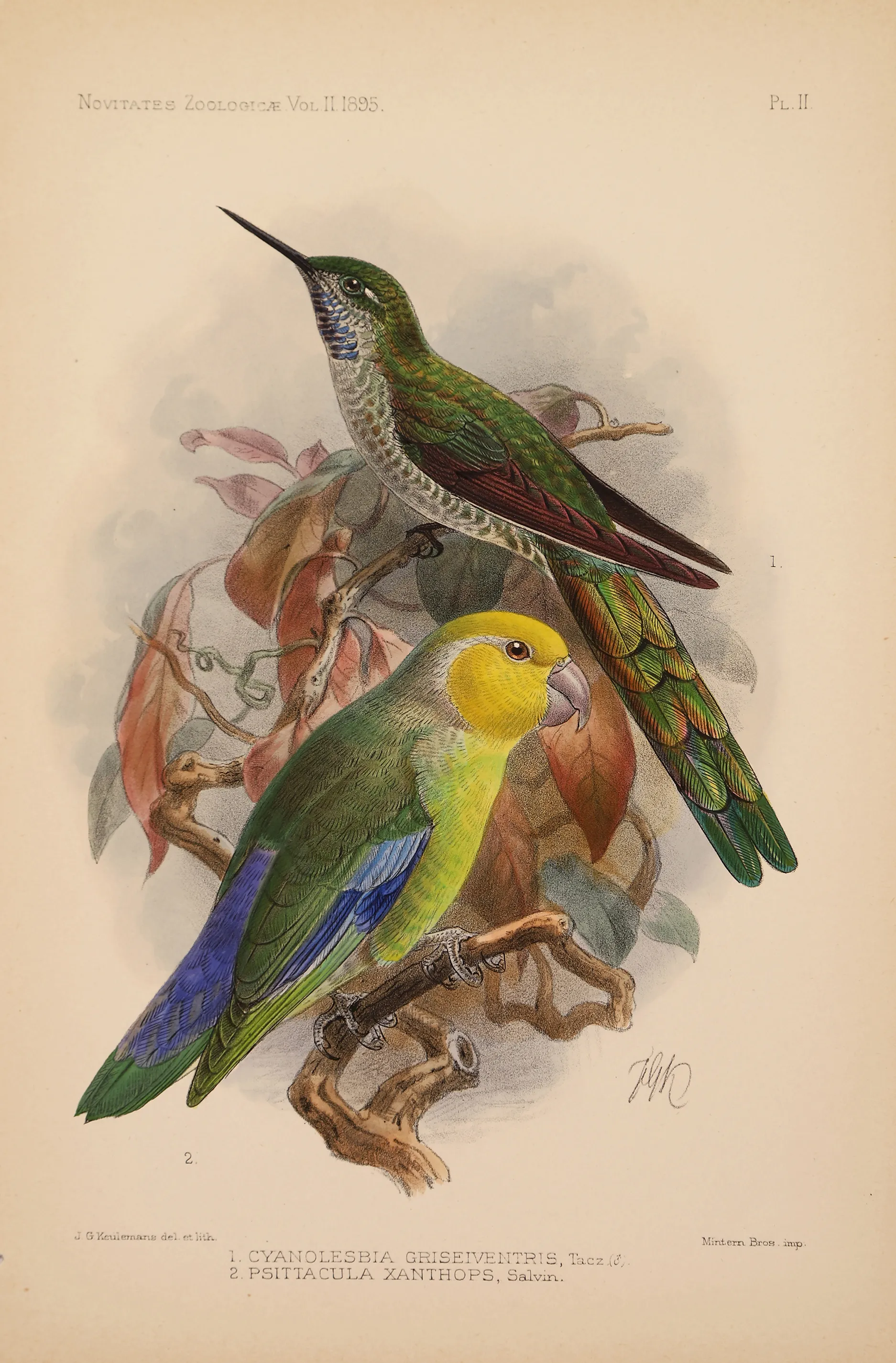
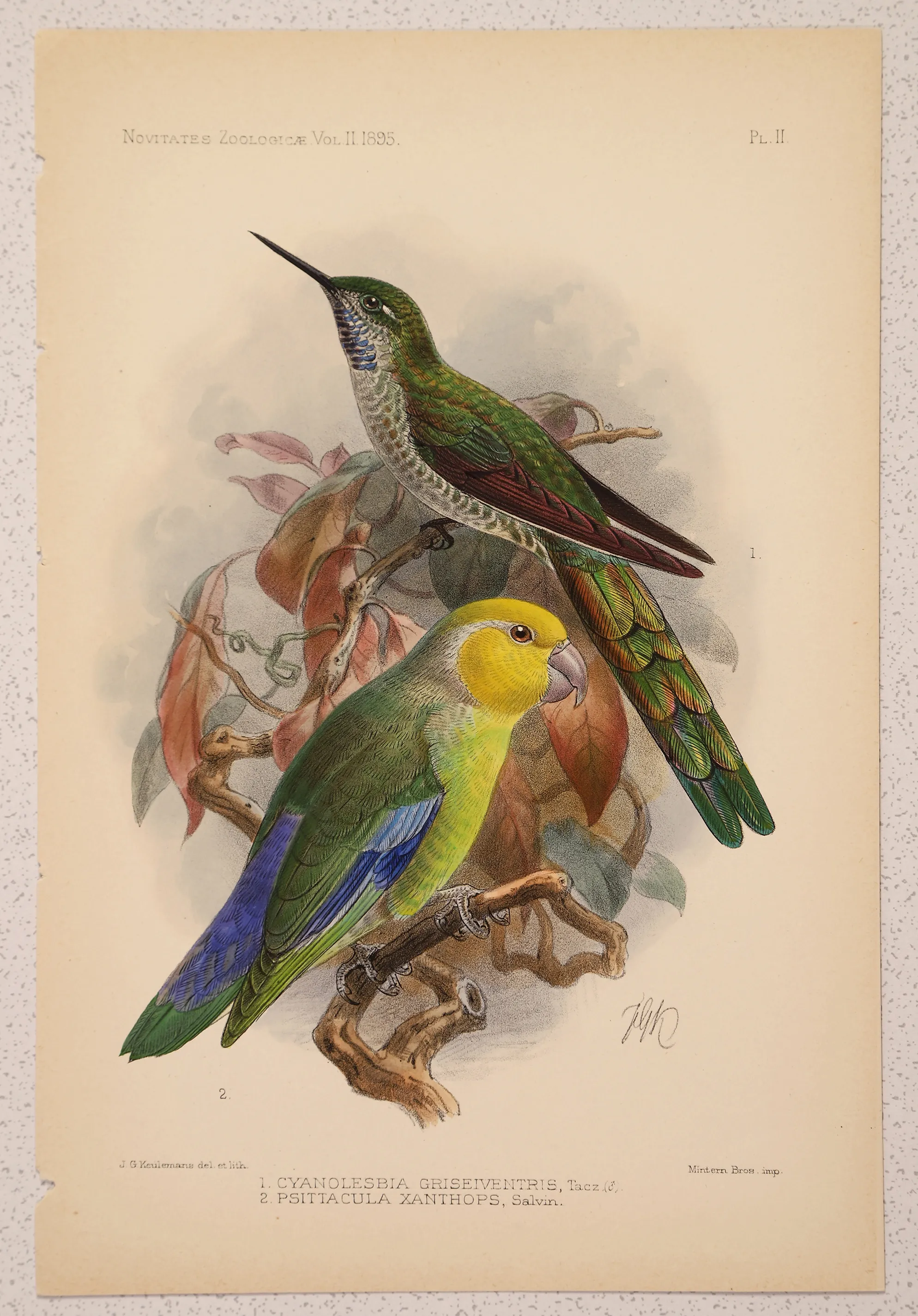
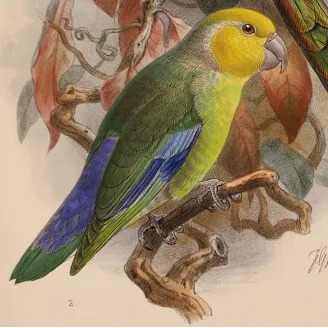
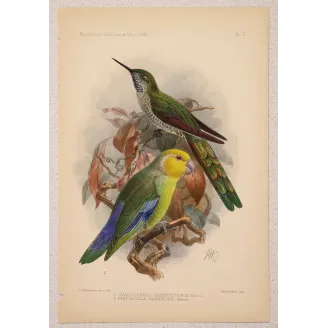
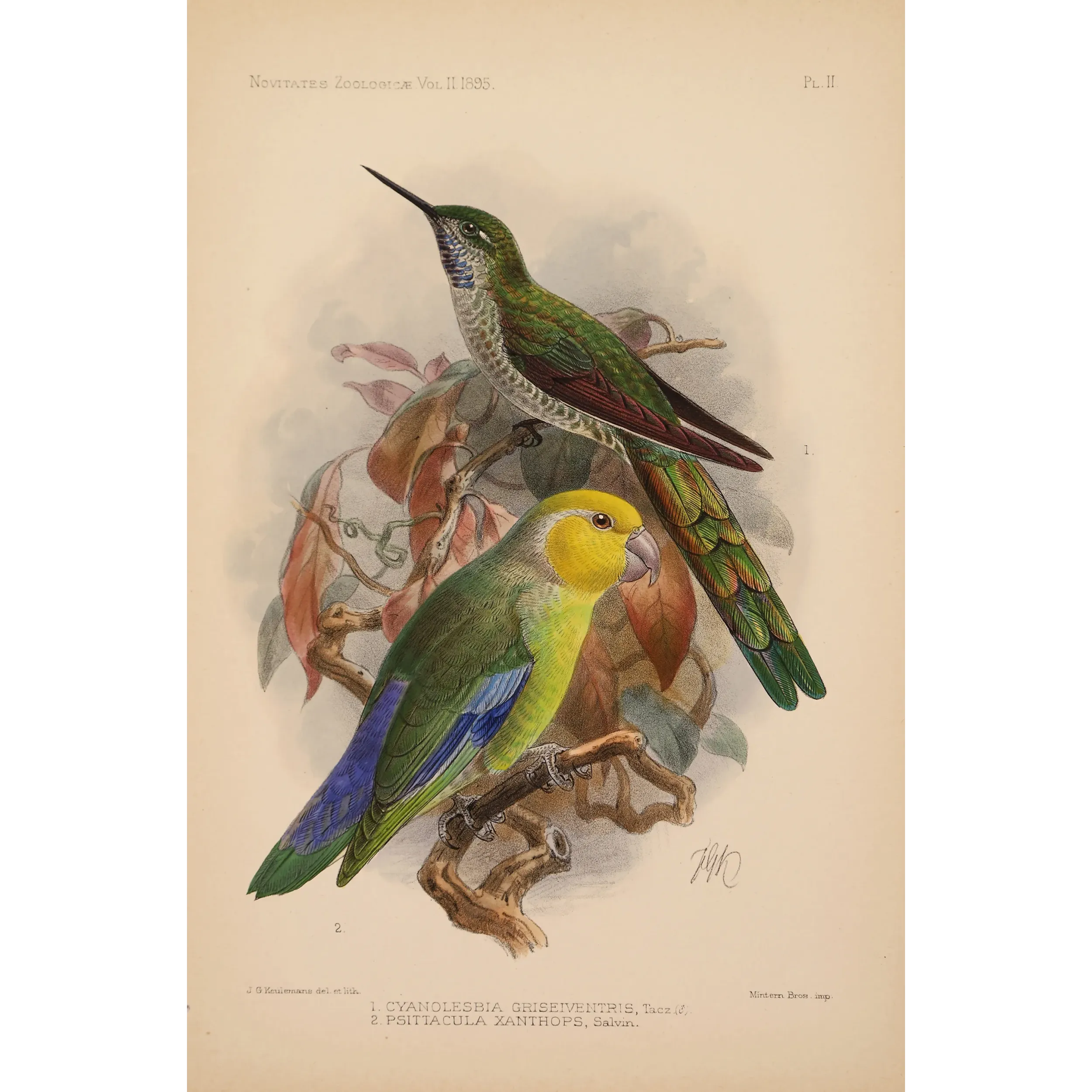
Original hand-coloured lithograph by John Gerrard Keulemans from Novitates Zoologicae, Volume II, Plate II, published in 1895. The composition depicts the Grey-bellied Comet and Yellow-faced Parrotlet against a restrained botanical background, with selective gum arabic highlights visible across parts of the hummingbird’s plumage. Printed on substantial wove paper by Mintern Bros. and preserved in very good condition.
 Delivery policy
Your print will be carefully prepared and shipped worldwide via trusted couriers (UPS or similar).
 Authentic antique prints
Original engravings from the 17th–19th century.
Published in 1895 for Novitates Zoologicae, this original hand-coloured lithograph preserves a moment when zoologists, artists, lithographic printers and colourists worked together to transform scientific observation into lasting visual form. Within this wider enterprise, John Gerrard Keulemans united ornithological precision with artistic restraint in a composition of remarkable balance and clarity.
Published as Plate II in Volume II of the journal, the image presents two South American birds of strikingly different form and character: the Grey-bellied Comet hummingbird, originally captioned Cyanolesbia griseiventris, and the Yellow-faced Parrotlet, published under the historical name Psittacula xanthops.
The hummingbird occupies the upper part of the composition, its slender bill, elongated tail and finely articulated plumage extending across softly developed vegetation. Below, the compact parrotlet introduces a stronger concentration of yellow, green and blue, establishing an immediate contrast between delicacy and substance.
The plate is memorable not only for the beauty of its two subjects, but for the way Keulemans allows them to inhabit the same visual world: one light, elongated and iridescent; the other rounded, vividly coloured and quietly self-contained.
Keulemans organises the plate around two opposing but complementary diagonals. The hummingbird rises towards the upper left, following the direction of its long bill, while its extended tail descends towards the right. The parrotlet occupies the lower foreground and turns in the opposite direction, creating a balanced circulation across the sheet.
The Grey-bellied Comet is represented with exceptional delicacy. Its compact green body is extended by a long, dark bill and a particularly developed tail, whose overlapping feathers move through green, yellow, olive and darker marginal tones. Small blue markings along the throat provide concentrated flashes of colour against the cooler grey-white modelling of the breast.
The wings introduce a deeper chromatic register. Dark red-brown passages lie beneath the green upper plumage, while fine lithographic lines remain visible through the transparent colour. Under changing light, selected areas of the wing and adjacent plumage reveal restrained glossy reflections that intensify the bird’s iridescent character without concealing the underlying drawing.
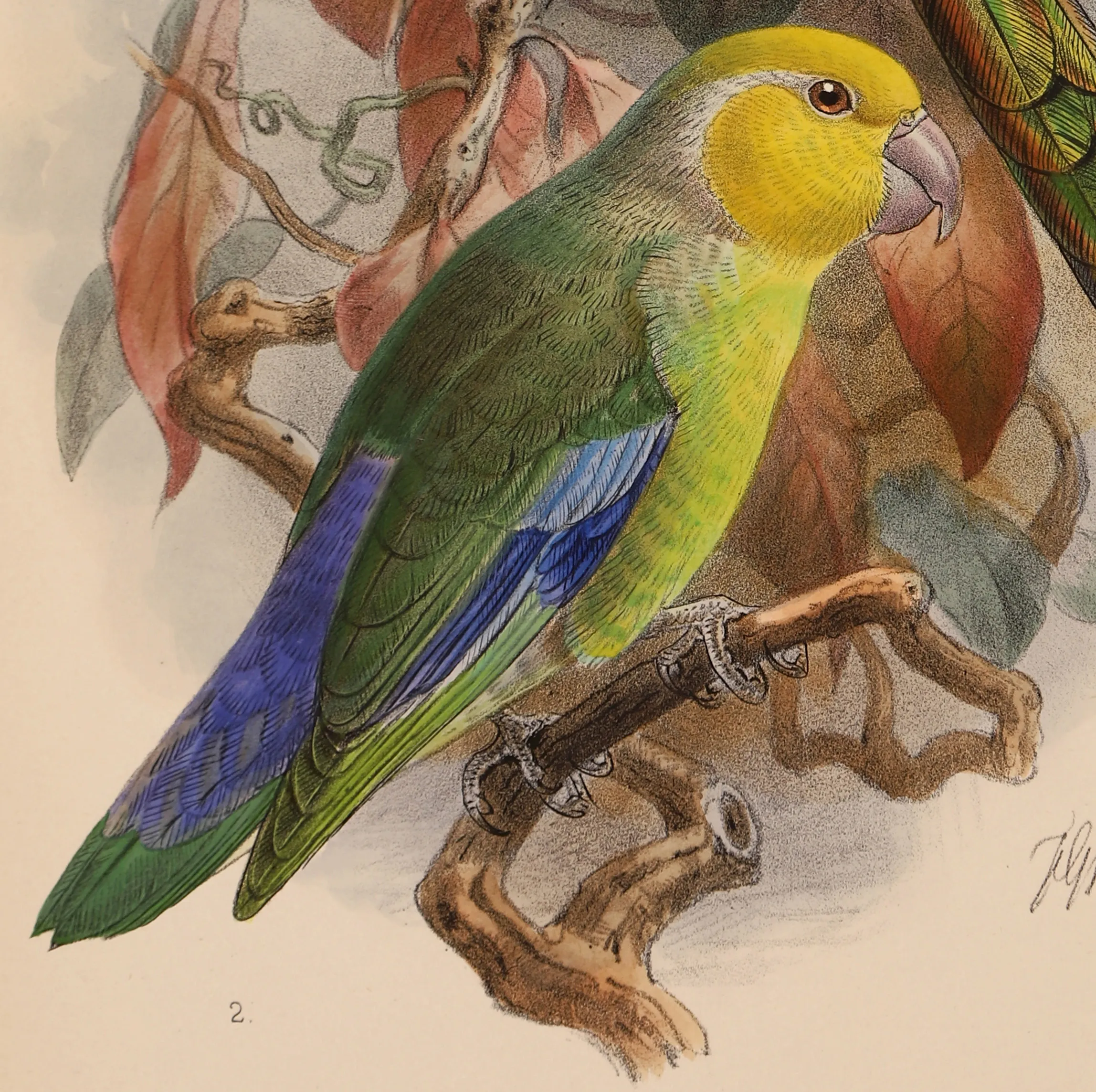
The Yellow-faced Parrotlet is more compact and visually substantial. Its rounded yellow head and breast form the brightest chromatic area of the plate. The yellow gradually gives way to pale green across the lower breast and deeper green over the body and wings.
The blue flight feathers are especially expressive. Their colouring is not mechanically uniform: variations of tone, local concentrations of pigment and slight linear striations remain visible within the lithographic structure. These subtle differences animate the plumage and give the colour a distinctly individual character.
The parrotlet’s lilac-grey bill and carefully defined eye soften the strength of the yellow face. Beneath the body, the feet and claws are rendered with notable precision, gripping the branch through closely controlled lines and restrained brown-grey washes.
The surrounding vegetation remains deliberately discreet. Leaves in pale green, dusty rose, brown and blue-grey create an atmospheric setting rather than a fully described habitat. Their translucent treatment allows the birds to remain dominant while introducing sufficient depth and environmental coherence.
The background therefore enriches rather than limits the observation of the subjects. It completes the impression of living birds encountered among foliage without obscuring the distinguishing forms of their bills, wings, tails, plumage and feet.
Keulemans’ lithographic drawing remains active throughout. Individual feathers are described through changes in line direction and density, while the transparent colour preserves the printed structure beneath. The result combines scientific clarity with an unusually vivid sense of presence.
The upper bird is identified in the original caption as Cyanolesbia griseiventris Taczanowski. It is now generally classified as Taphrolesbia griseiventris and known in English as the Grey-bellied Comet, a distinctive hummingbird native to the Andean regions of Peru.
Its appearance is characterised by predominantly green plumage, a pale greyish underside, a straight elongated bill and a particularly long, graduated tail. These proportions give the bird the elegant, almost weightless profile that Keulemans captures so effectively in the upper half of the composition.
The lower subject was published under the name Psittacula xanthops Salvin and is now classified as Forpus xanthops, the Yellow-faced Parrotlet. It is a small Peruvian parrot distinguished by its bright yellow face and breast, green body, blue wing feathers and compact rounded form.
The scientific names printed beneath the image preserve the taxonomic language used when the species were presented to the zoological community in 1895. Subsequent reclassification does not diminish their historical importance; rather, it demonstrates how scientific understanding continues to evolve after an original description has entered the literature.
The plate may therefore be read on two levels. It remains a precise ornithological representation of two species while also recording a particular moment in the continuing history of zoological classification.
This plate occupies a central position within the Prantique collection of Keulemans illustrations from Novitates Zoologicae. The encounter between two markedly different species, the refined botanical setting and the particularly legible traces of the production process make it an exemplary work through which to understand the artistic and material character of the series.
Keulemans presents the birds not as isolated taxonomic specimens, but as distinct living presences held within a coherent visual environment. The hummingbird is defined by extension and movement; the parrotlet by concentration and stability. Their contrasting structures remain scientifically legible, yet the composition avoids the rigidity of a comparative diagram.
The restrained vegetation plays an important role in this transformation. It suggests an inhabited natural world while allowing the diagnostic features of both species to remain fully accessible. Scientific observation and artistic presentation are not treated as competing requirements, but as complementary parts of the same image.
Close examination of the original impression reveals several features consistent with individual hand colouring. Along selected contours, pigment occasionally extends slightly beyond the lithographic boundary. Within the blue feathers of the parrotlet, neighbouring passages vary subtly in saturation and density, with small accumulations and linear applications following the direction of the plumage.
These minute irregularities are not visually disruptive. They preserve the actions of the colourist who completed the printed framework by hand, interpreting the structure of the feathers through transparent watercolour rather than applying a mechanically uniform field of colour.
The selected glossy passages visible across parts of the hummingbird’s wing and plumage are consistent with a restrained application of gum arabic. Used locally rather than across the complete subject, this finishing introduces subtle changes in reflected light that suggest the shifting brilliance of iridescent feathers.
This assessment is based upon close visual examination of the original impression, comparative observation and supporting bibliographic descriptions rather than laboratory analysis. Considered together, the lithographic underdrawing, local variations in pigment application and selective surface enhancement form a coherent body of material evidence.
The image is printed on substantial late nineteenth-century wove paper. Unlike laid paper, the sheet displays no regular pattern of laid and chain lines. Its dense, even surface was particularly suited to receiving fine lithographic drawing and subsequent layers of transparent colour.
The paper possesses sufficient body to support the colouring while limiting visible penetration to the reverse. Its warm historical tone forms part of the material presence of the sheet and remains harmonious with the muted vegetation surrounding the birds.
As a lithograph, the work does not display the recessed plate mark associated with copper engraving or etching. The drawing was transferred from a flat lithographic surface, a process well suited to the flexible lines, tonal transitions and finely differentiated feather structures characteristic of Keulemans’ work.
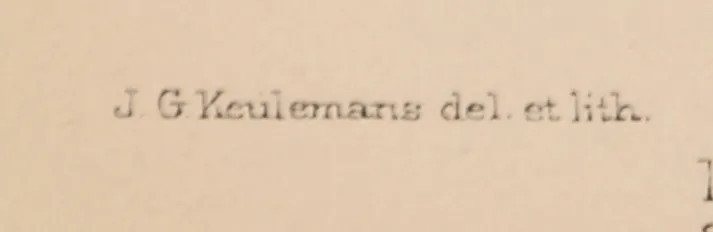
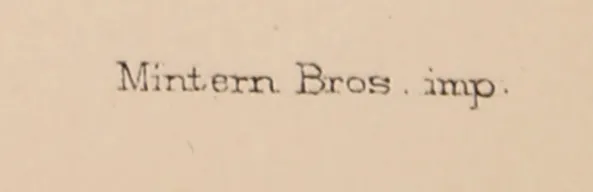
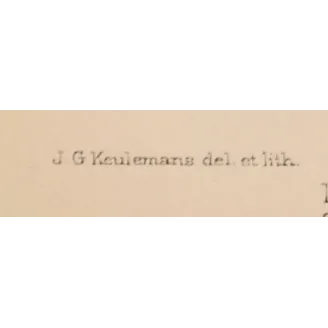
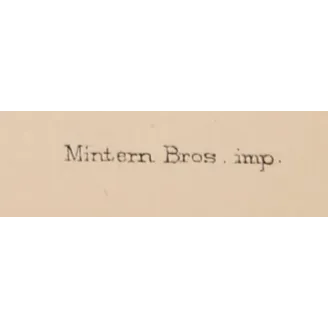
The inscriptions preserve the complete chain of artistic and editorial production. At lower left, “J. G. Keulemans del. et lith.” records Keulemans’ responsibility for both the original drawing and its lithographic translation. At lower right, “Mintern Bros. imp.” identifies the London printing establishment responsible for producing the impression.
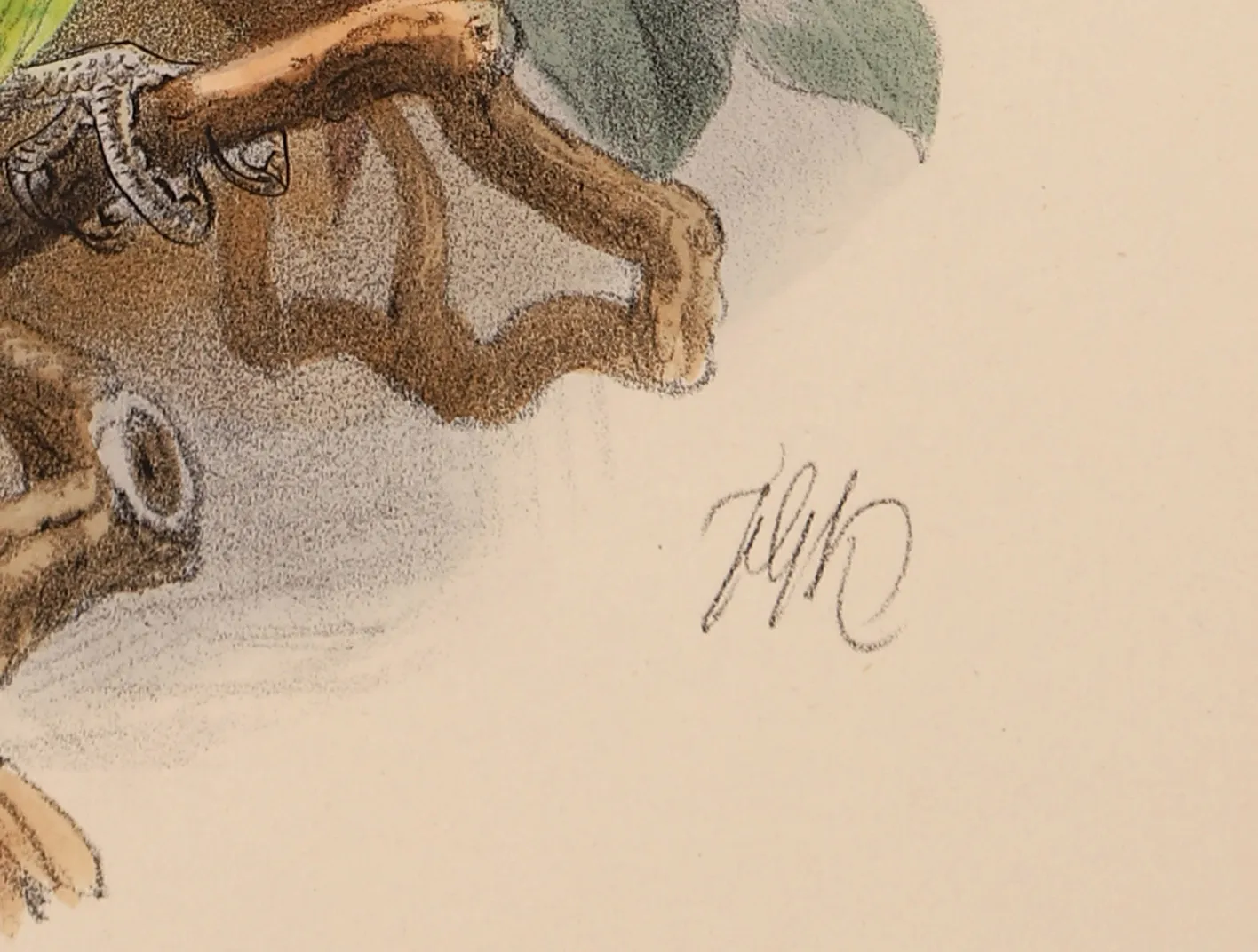
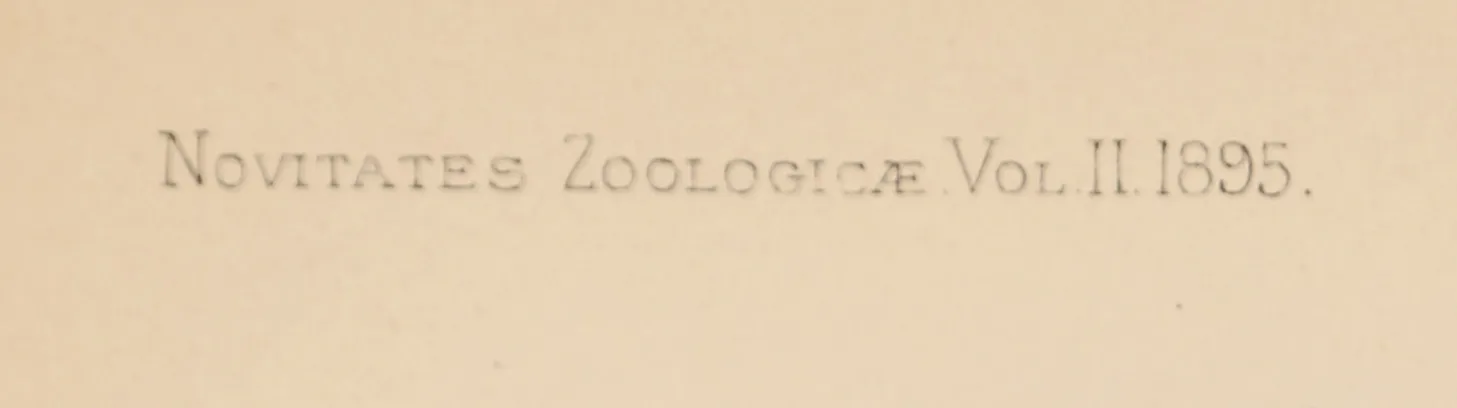
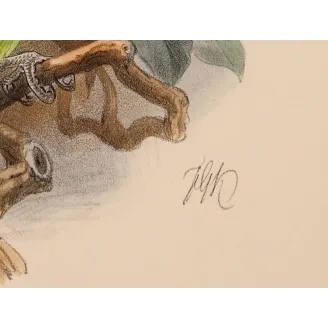
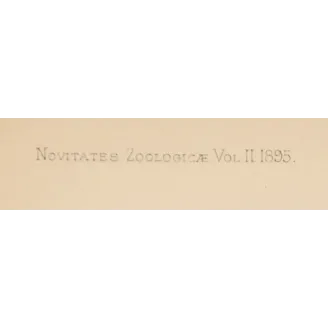
Keulemans’ lithographic monogram is also incorporated within the image. It belongs to the printed composition and should not be understood as an individually hand-applied signature. At the upper edge, the title, volume, year and plate number retain the original relationship between the image and Volume II of Novitates Zoologicae.
The monogram, printed credits, editorial inscriptions and material traces of colour application transform the sheet from an isolated image of two birds into evidence of a larger collaborative enterprise. Naturalists studied and classified the specimens; Keulemans translated their distinguishing features into visual form; lithographic printers transferred the design to paper; and skilled colourists completed each impression individually.
This particular plate also became the starting point for Prantique’s examination of the colouring methods used for the ornithological illustrations in Novitates Zoologicae. Its value within the collection lies therefore not only in the beauty of its subjects, but in the unusual clarity with which it allows the complete creative and scientific process to be observed.
This original lithograph represents one page of a much larger story. Behind it lies the remarkable world of Walter Rothschild’s Zoological Museum at Tring, where specimens arriving from distant regions became the subject of scientific research, classification and visual documentation.
Novitates Zoologicae provided the editorial framework through which this developing knowledge could circulate internationally. Zoologists examined and named species, artists translated their observations into images, lithographic printers gave those images repeatable form and colourists completed each impression individually.
The material evidence preserved in this plate—lithographic drawing, variations in the application of blue pigment and selective glossy passages—became the starting point for our investigation into how the ornithological illustrations were produced and coloured.
The complete Heritage Essay follows this wider constellation of people, techniques and ideas, from Walter Rothschild’s museum and Keulemans’ studio to the surviving original impressions that continue to make this chapter of Victorian zoology visible today.
Novitates Zoologicae: Keulemans, Rothschild and the Birth of a Modern Zoological Journal →
Very good condition. The substantial late nineteenth-century wove paper remains structurally sound and stable.
The lithographic impression remains clearly defined throughout. The original hand-applied watercolour is stable and fully legible, with no significant losses affecting the birds or surrounding vegetation.
The selective gum arabic visible across portions of the hummingbird’s wing and plumage remains present and well integrated with the underlying colour.
The sheet displays natural age-related toning, becoming somewhat deeper towards the outer borders. Minor handling traces and small marks are principally confined to the margins and former binding edge.
The central illustrated field is free from major creases, tears, losses or visually disruptive staining. The title, date, plate number, species captions, artist’s credit and printer’s inscription remain fully legible.
The professional high-resolution photographs document the complete sheet, illustrated field, inscriptions, paper tone and visible condition details for direct assessment.
Editorial title: Emerald Wings and Golden Plumage
Original species caption: Cyanolesbia griseiventris Tacz.; Psittacula xanthops Salvin
Current scientific names: Taphrolesbia griseiventris; Forpus xanthops
Common names: Grey-bellied Comet; Yellow-faced Parrotlet
Work: Novitates Zoologicae
Volume: Vol. II
Plate: II
Artist and lithographer: John Gerrard Keulemans (1842–1912)
Printed artist’s credit: J. G. Keulemans del. et lith.
Printer: Mintern Bros., London
Printed printer’s credit: Mintern Bros. imp.
Place of publication: Tring, England
Date: 1895
Technique: Original lithograph with contemporary hand-applied watercolour
Finishing: Selective gum arabic visible principally on parts of the hummingbird’s wing and plumage
Paper: Substantial late nineteenth-century wove paper
Plate mark: Not applicable to the lithographic process
Signature: Keulemans lithographic monogram within the printed image; printed attribution below; not individually hand-signed
Sheet size: approx. 28 × 19 cm
Condition: Very good condition, with natural historical toning becoming somewhat deeper towards the outer borders
Collector positioning: Principal plate within the Prantique Keulemans Novitates collection and the central case study for our examination of the hand-colouring technique
Collection: Keulemans Novitates
Authenticity: Original nineteenth-century print — never a modern reproduction
Specific References
Original hand-coloured lithograph by John Gerrard Keulemans from Novitates Zoologicae, Volume I, Plate IV, published in 1894. Four closely related metaltail hummingbirds are arranged as a comparative study of shared structure and subtle variation, with selective gum arabic visible across the bodies of all four subjects. Printed by Mintern Bros. on substantial wove paper and preserved in very good condition.
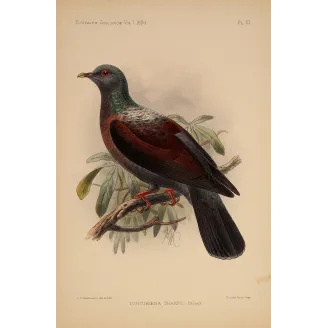
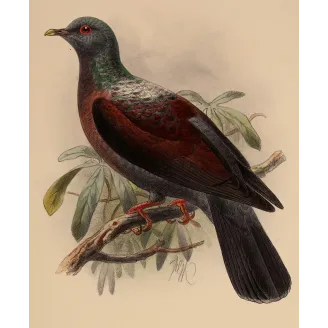
Original hand-coloured lithograph by John Gerrard Keulemans from Novitates Zoologicae, Volume I, Plate III, published in 1894. The plate depicts Turturoena sharpei, now classified as Columba delegorguei sharpei, with selective gum arabic highlights on the wings, tail, eye, neck and throat. Printed by Mintern Bros. on substantial wove paper and preserved in very good condition.
Original hand-coloured lithograph by John Gerrard Keulemans from Novitates Zoologicae, Volume I, Plate XII, published in 1894. Depicting Propithecus majori (Major's Sifaka), the composition combines precise anatomical observation with an unusually expressive portrayal of a living primate. Selective gum arabic remains visible on the pupils and across the darker fur of the forelimb, thigh and body. Printed by Mintern Bros. on substantial wove paper and preserved in very good condition.
Original hand-coloured lithograph by John Gerrard Keulemans from Novitates Zoologicae, Volume I, Plate XV, published in 1894. The composition presents a Venezuelan White-streaked Antvireo above a richly patterned Crested Bobwhite, using vertical placement to suggest two distinct ecological levels within the same natural environment. Selective gum arabic remains visible on the pupils of both subjects and more extensively across the plumage of the lower bird. Printed by Mintern Bros. on substantial wove paper and preserved in very good condition.
Original hand-coloured lithograph by John Gerrard Keulemans from Novitates Zoologicae, Volume II, Plate I, published in 1895. The composition depicts two Peruvian Andean brushfinches against a restrained botanical setting, with selective gum arabic highlights around the eyes and across parts of the upper bird’s wings. Printed by Mintern Bros. on substantial wove paper and preserved in very good condition.
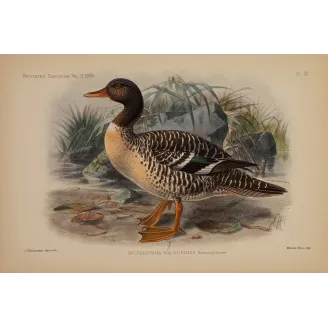
Original hand-coloured lithograph by John Gerrard Keulemans from Novitates Zoologicae, Volume II, Plate III, published in 1895. Depicting the remarkable Waigeu Duck (Salvadorina waigiuensis), the composition combines precise zoological observation with a carefully constructed wetland landscape. Selective gum arabic remains visible across the wing feathers, tail, pupil and neck. Printed by Mintern Bros. on substantial wove paper and preserved in very good condition.
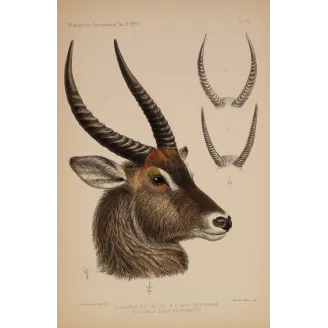
Original hand-coloured lithograph by John Gerrard Keulemans from Novitates Zoologicae, Volume II, Plate IV, published in 1895. The sheet combines a finely observed portrait of an African waterbuck with comparative studies of three horn forms used for zoological identification. Selective gum arabic remains visible on the forehead, pupil, nose and darker portions of the principal horns. Printed by Mintern Bros. on substantial wove paper and preserved in very good condition.
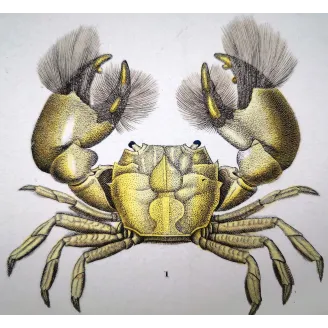
19th-century hand-colored engraving of *Grapsus penicillatus*, a vivid marine crab with expressive claws and warm tones.
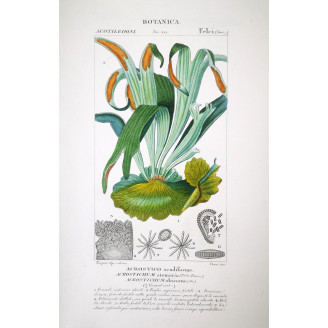
A complete set of 22 original hand-colored Engravings of ferns by Turpin, from the Dizionario di Scienze Naturali (c. 1830).
Original 1774 engraving by Jacob L'Admiral: Early Moth Stage among Willow Leaves.
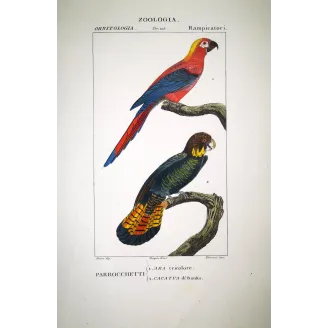
Vibrant parakeets perched on branches: a scarlet macaw and a black cockatoo with yellow and red highlights.
This vivid 19th-century engraving depicts two exotic aracaris, showcasing striking contrasts of green, red and yellow plumage. A highly decorative composition combining scientific observation with strong visual appeal, ideal for collectors of tropical ornithology and refined interior spaces.
Fine 18th-century engraving of the Medlar Tree by Elisabeth Blackwell, featuring fruit, blossom, and botanical detail.
With its compound leaves and clusters of red berries, the sorb tree is rich in folk symbolism.
Original nineteenth-century hand-colored engraving by Ludwig Reichenbach, depicting three hummingbirds among pink blossoms. A rare later plate from the Trochilinarum Enumeratio corpus, not fully documented in the principal published index.
Original hand-coloured lithograph by John Gerrard Keulemans from Novitates Zoologicae, Volume II, Plate II, published in 1895. The composition depicts the Grey-bellied Comet and Yellow-faced Parrotlet against a restrained botanical background, with selective gum arabic highlights visible across parts of the hummingbird’s plumage. Printed on substantial wove paper by Mintern Bros. and preserved in very good condition.