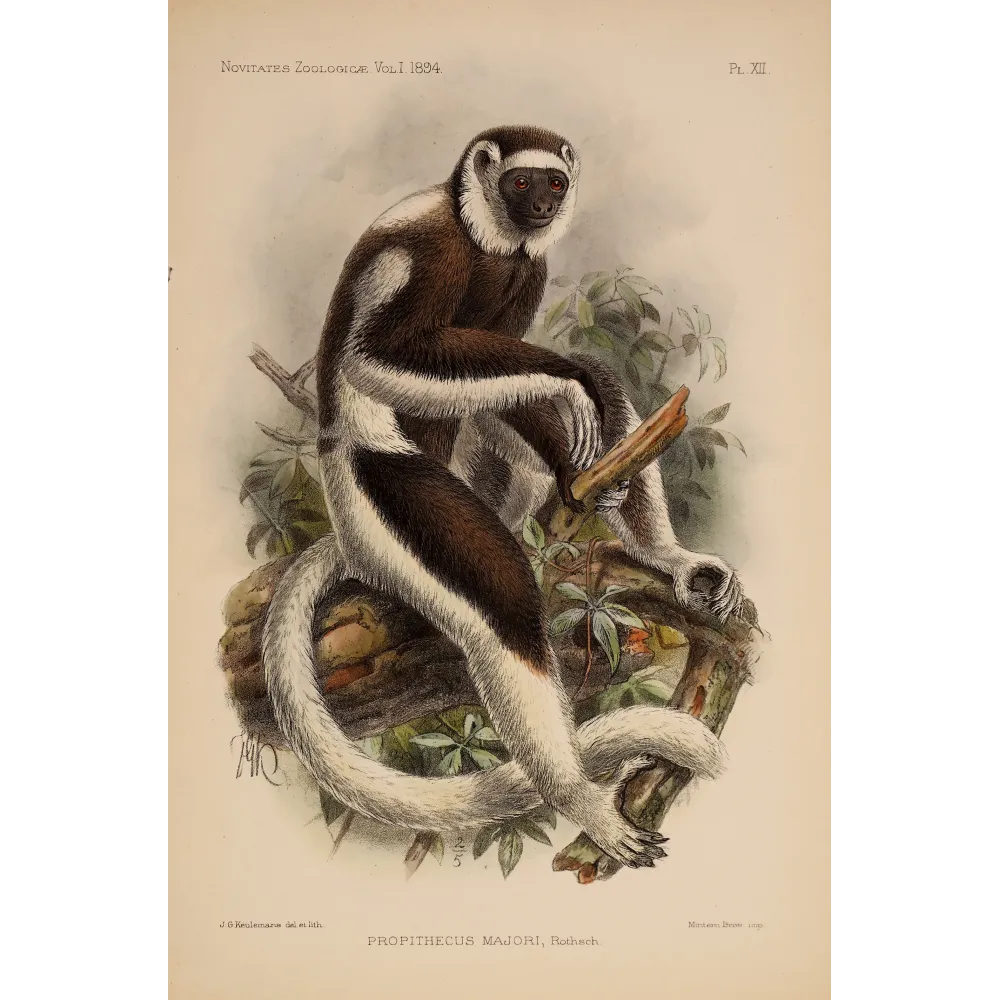
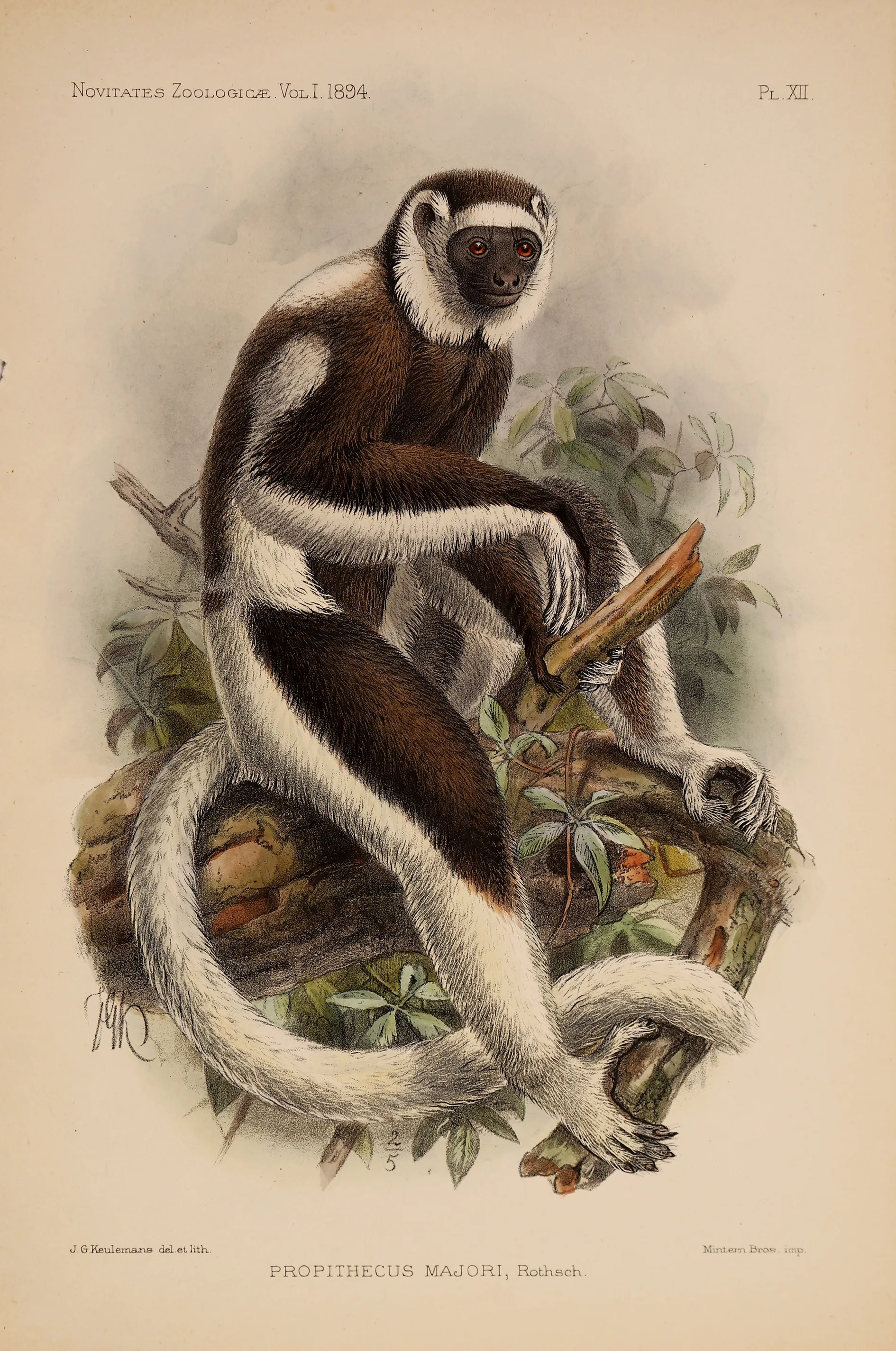

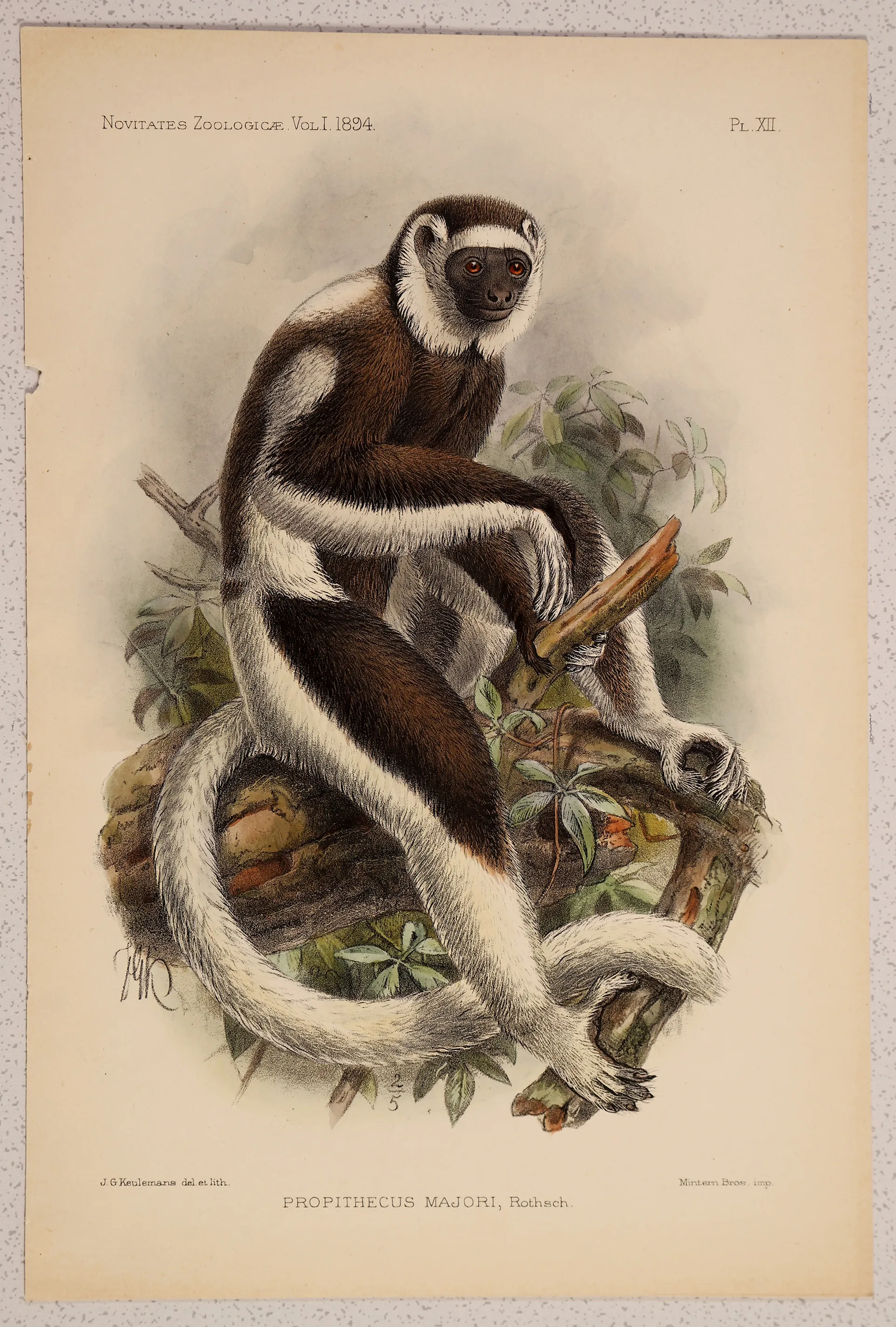
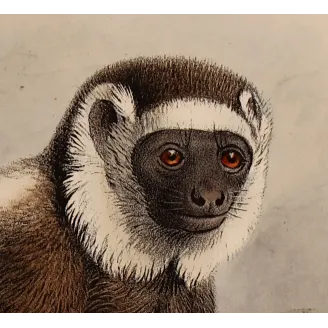
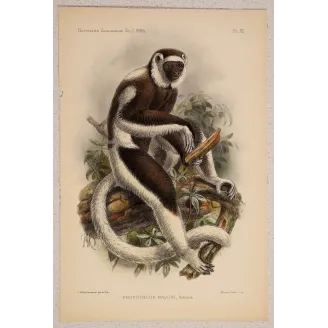
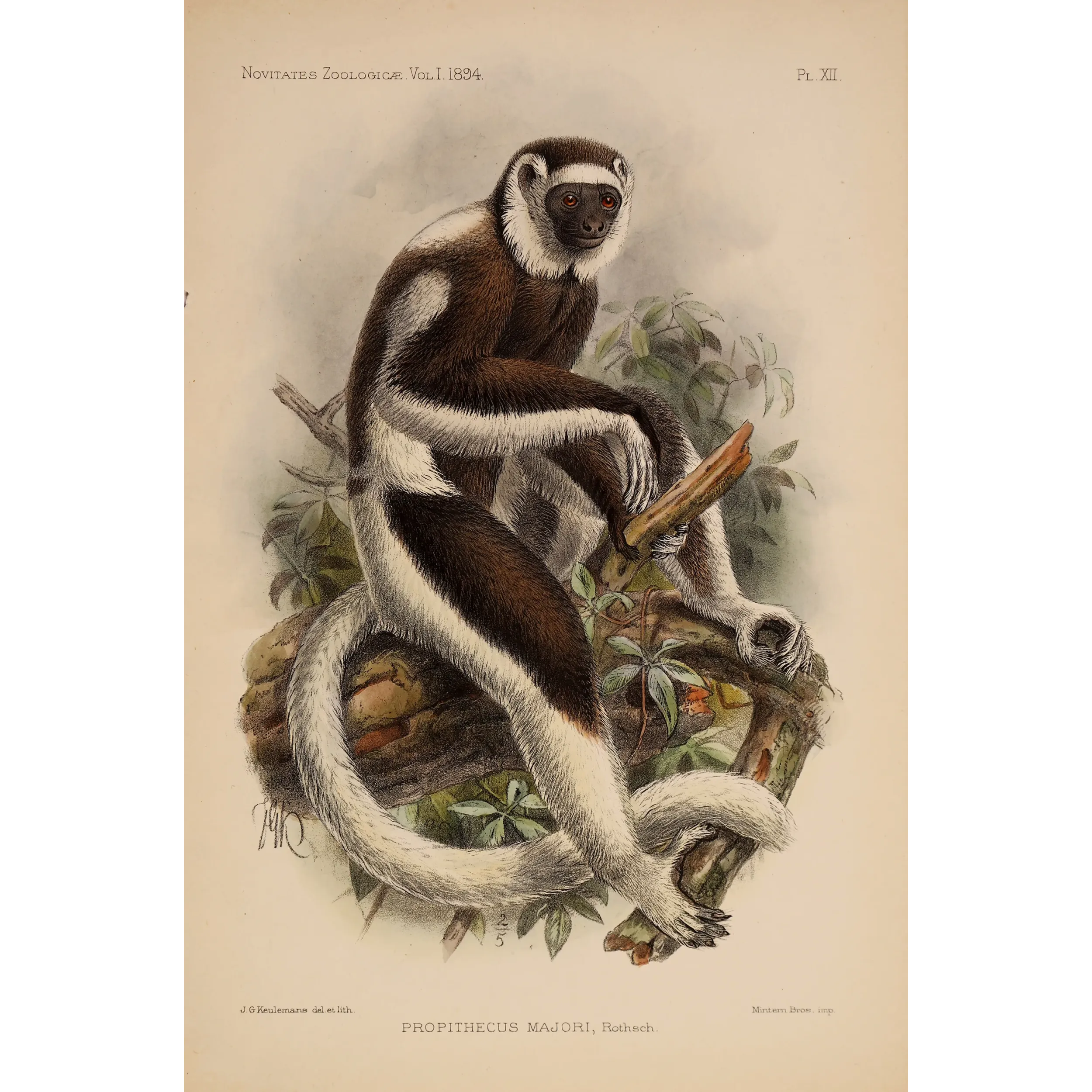
Original hand-coloured lithograph by John Gerrard Keulemans from Novitates Zoologicae, Volume I, Plate XII, published in 1894. Depicting Propithecus majori (Major's Sifaka), the composition combines precise anatomical observation with an unusually expressive portrayal of a living primate. Selective gum arabic remains visible on the pupils and across the darker fur of the forelimb, thigh and body. Printed by Mintern Bros. on substantial wove paper and preserved in very good condition.
 Delivery policy
Your print will be carefully prepared and shipped worldwide via trusted couriers (UPS or similar).
 Authentic antique prints
Original engravings from the 17th–19th century.
Published in 1894 for Novitates Zoologicae, this original hand-coloured lithograph by John Gerrard Keulemans depicts the primate originally described as Propithecus majori. Seated among branches and softly developed vegetation, the animal is presented with the anatomical clarity expected of a scientific illustration, yet with an expressive immediacy rarely encountered in a purely taxonomic image.
Published as Plate XII in Volume I of the journal, the composition follows the extended structure of the animal’s body. Long limbs, grasping hands and feet, contrasting areas of dark and pale fur and the sweeping tail remain fully available for zoological observation.
At the same time, the nearly frontal face establishes an unusually direct relationship with the viewer. The bright eyes, relaxed posture and carefully balanced limbs create the impression of a living animal momentarily at rest rather than an immobile specimen arranged for description.
The scientific specimen quietly becomes an individual presence. Every limb contributes to anatomical accuracy, yet the expression belongs unmistakably to a living animal.
Keulemans builds the composition around the interlocking curves of the body, limbs and tail. The torso rises vertically through the upper half of the image, while the arms and legs cross the central field in a sequence of diagonals that gives the seated figure both stability and movement.
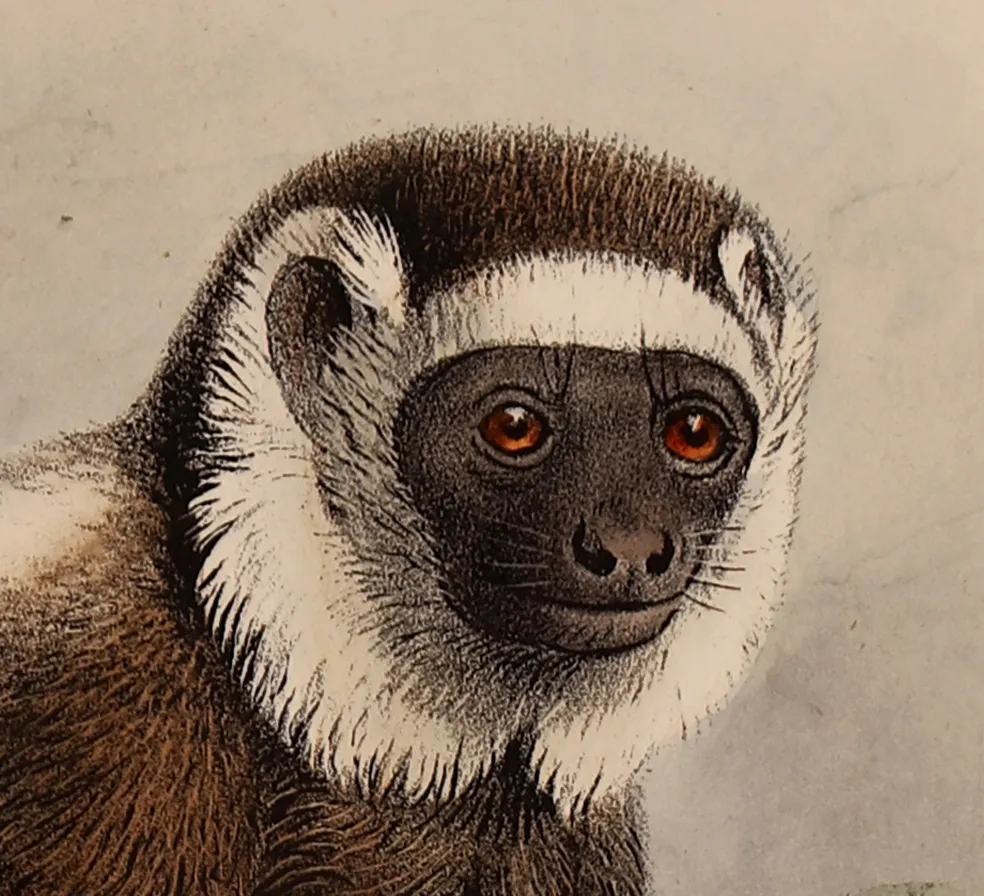
The face forms the immediate centre of attention. It is turned almost directly towards the viewer, framed by pale fur across the forehead, cheeks and sides of the neck. The darker central mask concentrates attention upon the eyes, nose and closed mouth.
The eyes are particularly effective. Their warm reddish-brown colour and small points of reflected light give the expression alertness without exaggeration. Keulemans avoids imposing a human emotion upon the animal, yet preserves a convincing sense of awareness.
The upper body is constructed through broad contrasts between dark brown-black fur and sharply defined pale areas. A light patch appears across the shoulder, while a long white band follows the side of the torso and continues through the inner limbs.
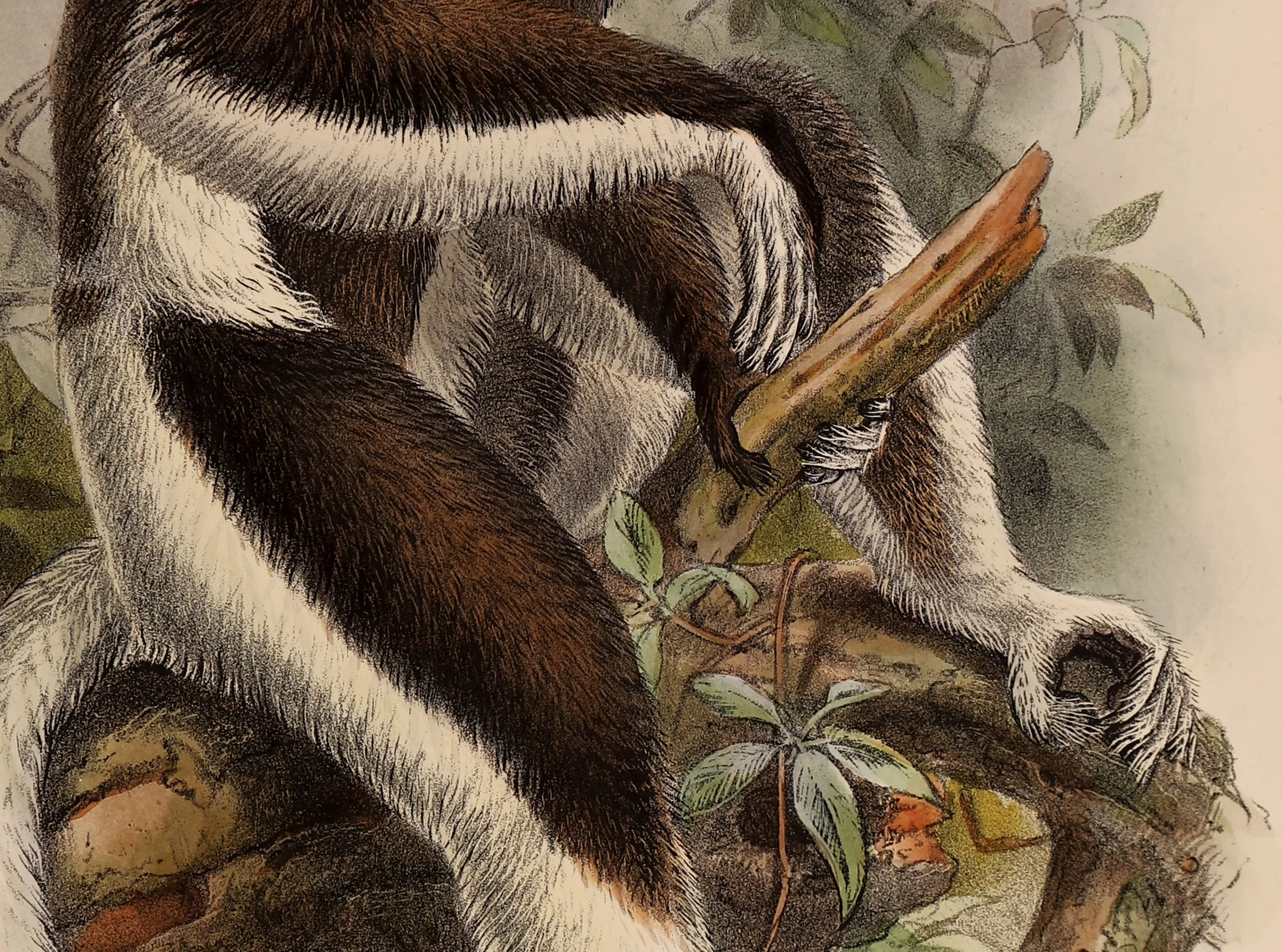
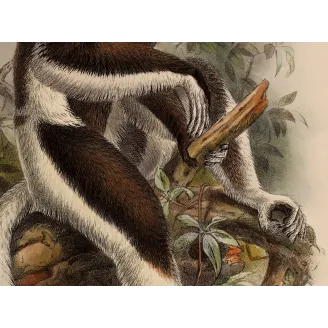
The right forelimb extends across the body and rests upon a broken branch. Its position reveals the length of the arm, the transition from dark upper fur to the paler hand and the independent structure of the fingers.
The opposite arm descends towards the lower right, ending in a relaxed but clearly articulated hand. Each finger is separated through fine lithographic lines, allowing the grasping anatomy of the primate to remain fully legible.
The thighs and lower limbs create a second system of diagonals. One leg crosses the centre of the composition, while the other extends downwards and ends in a long foot wrapped around the supporting branch. The separated toes and dark nails are rendered with particular precision.
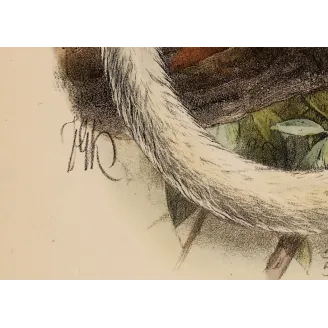
The long tail forms the principal rhythmic element of the image. Beginning behind the body, it curves broadly across the lower field before turning back towards the right. Its sweeping movement encloses the vegetation and visually anchors the seated figure.
The fur is described through closely directed lithographic strokes rather than broad blocks of colour. Along the arms, thighs and torso, changes in line density follow the direction of growth and create subtle variations of depth and texture.
The surrounding vegetation is softly developed in muted green, brown and ochre. Branches, leaves and areas of shaded ground establish a natural setting without competing with the strong black-and-white pattern of the animal.
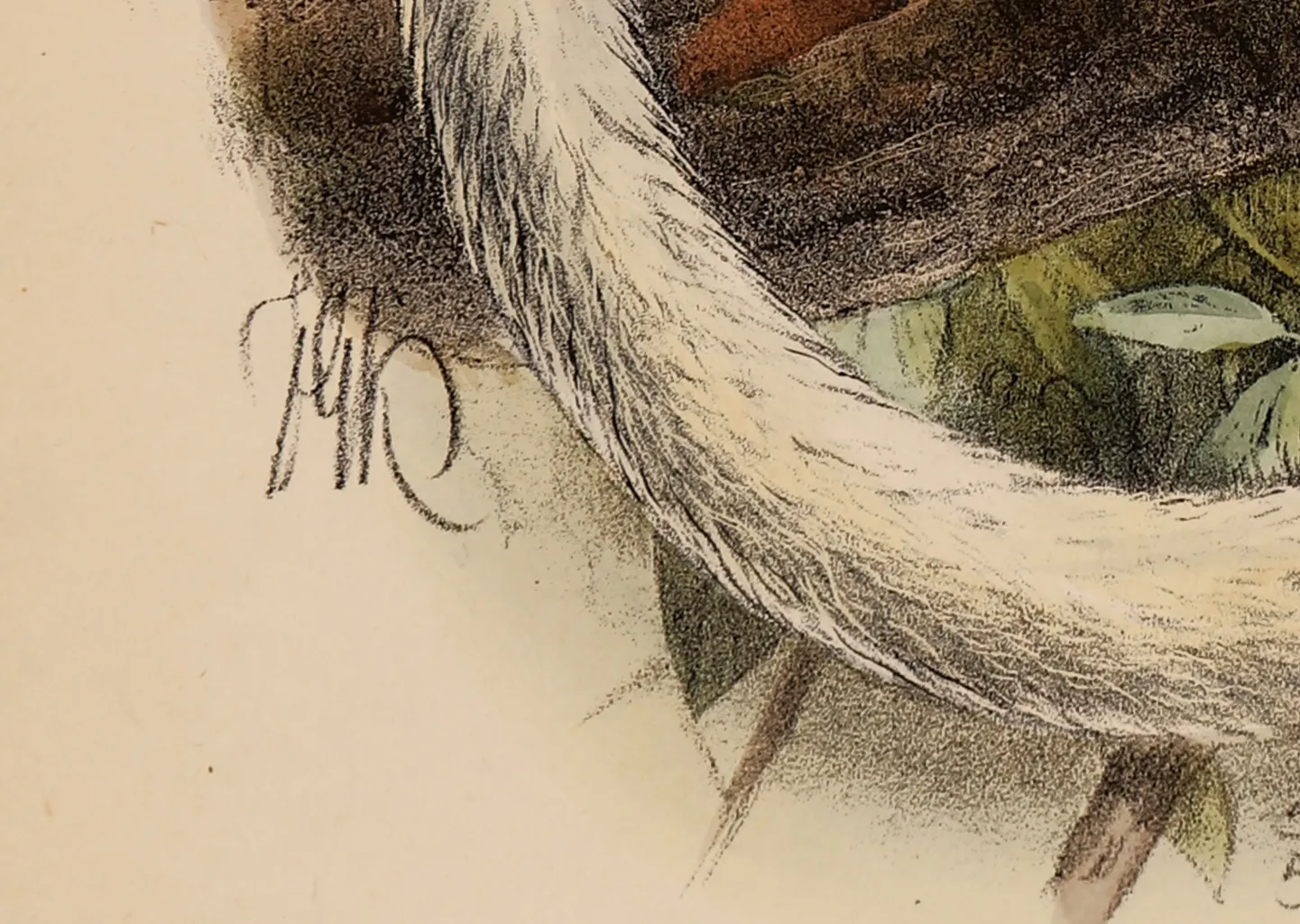
Keulemans’ monogram appears within the lower left of the illustrated field. Like the surrounding vegetation, it remains visually subordinate to the animal while preserving the complete identity of the printed composition.
The result is a carefully controlled balance between anatomical description and living presence. The viewer may examine the limbs, hands, feet, tail and distribution of the fur, yet the image continues to be experienced first as an encounter with an individual animal.
The animal is identified in the original caption as Propithecus majori Rothschild. The name records the taxonomic interpretation under which the specimen was introduced to the zoological community through Novitates Zoologicae in 1894.
It belongs to the sifakas, a group of lemurs native to Madagascar and distinguished by their long limbs, powerful hind legs, extended tails and highly specialised arboreal locomotion.
Sifakas move through trees by climbing and making long controlled leaps between vertical supports. Their elongated limbs, grasping hands and feet and upright resting postures reflect this strongly arboreal way of life.
The present illustration records these characteristics clearly. The long arms and legs, independently articulated fingers and toes, strong grasp around the branch and sweeping tail all contribute to the scientific identification of the animal.
The sharply contrasting dark and pale coat is equally important. Keulemans carefully distinguishes the white facial frame, shoulders, sides, inner limbs and tail from the deeper brown-black passages covering much of the torso, arms and thighs.
The precise modern taxonomic treatment of the historical name Propithecus majori has varied within later classifications of the sifaka group. The original caption is therefore retained here as an essential part of the scientific and editorial history of this particular sheet.
The scientific specimen quietly becomes an individual presence. Every limb contributes to anatomical accuracy, yet the expression belongs unmistakably to a living animal.
This transformation begins with the face. By turning the animal almost directly towards the viewer, Keulemans establishes an immediate visual encounter while retaining the proportions and identifying features required by zoological illustration.
The expression is not created through theatrical gesture. The mouth remains closed, the head upright and the body relaxed. Life enters the composition through much smaller decisions: the direction of the eyes, the position of the hands and the balanced suspension of the limbs around the branches.
The posture is anatomically informative. Each arm, leg, hand and foot occupies a different position, allowing the viewer to examine the elongated proportions and grasping structures of the animal without reducing the figure to a rigid anatomical diagram.
The long tail contributes equally to scientific clarity and compositional unity. It records an essential physical characteristic of the animal while creating the broad curve that gathers the lower half of the image into a coherent visual whole.
Keulemans also distinguishes the textures of pale and dark fur through changes in line density and direction. The white passages remain soft and open, while the deeper areas of the arms, body and thighs are built through closely layered strokes.
Close examination of the original impression reveals selective glossy finishing over the pupils and across portions of the darker fur, particularly on the forelimb and thigh. These local reflections are consistent with restrained applications of gum arabic over the hand-coloured surface.
Here gum arabic performs a different function from the finishing observed on iridescent bird plumage. Rather than suggesting metallic feathers, it introduces the subtle natural sheen of short dark fur and gives additional vitality to the animal’s eyes.
The finish is not distributed uniformly across the body. It follows selected dark passages, creating optical changes that become visible under shifting light while leaving the pale fur and surrounding vegetation comparatively matt.
This contrast between matt and gently reflective surfaces reinforces the underlying structure of the coat. The darker arm and thigh acquire additional depth, while the small glossy points within the pupils intensify the sense of alert presence.
The contemporary hand-applied colour remains transparent enough for the lithographic drawing to stay active throughout. Individual strokes continue to define the fur, facial features, hands, feet, branches and surrounding vegetation beneath the colour.
Minute differences in pigment density and local application remain compatible with individual manual finishing. The colour follows the direction of the printed fur rather than forming a mechanically uniform surface.
This assessment is based upon close visual examination of the original impression, comparative observation and supporting bibliographic descriptions rather than laboratory analysis. Considered together, the lithographic underdrawing, transparent colour and selective gum arabic form a coherent material sequence.
The image is printed on substantial late nineteenth-century wove paper. The sheet displays no regular pattern of laid and chain lines. Its dense, even surface was well suited to fine lithographic drawing, contemporary hand colouring and local surface finishing.
As a lithograph, the work does not display the recessed plate mark associated with copper engraving or etching. The flat printing process allowed Keulemans to preserve the flexible drawn line required for fur, facial modelling, fingers, toes and softly developed foliage.
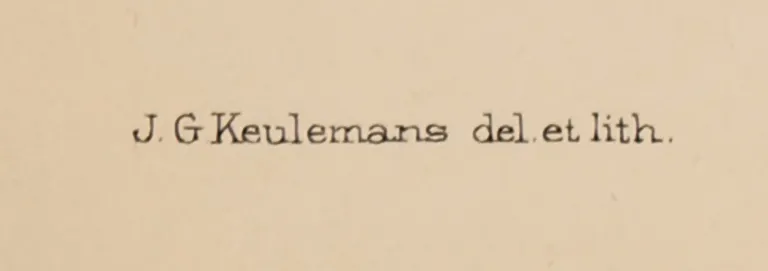
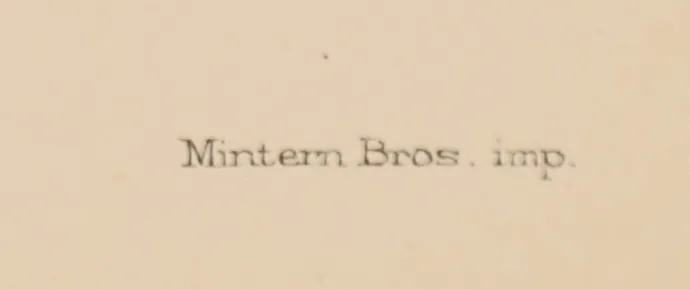
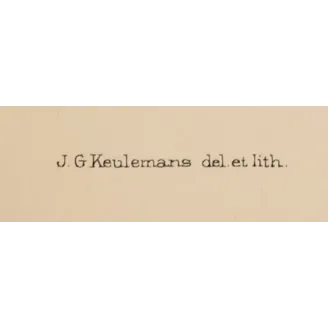
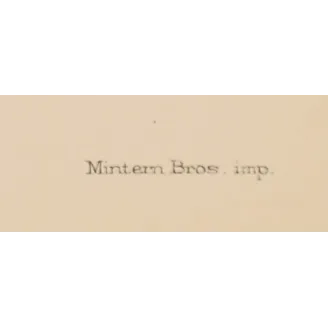
The printed inscriptions preserve the artistic and editorial chain of production. At lower left, “J. G. Keulemans del. et lith.” records Keulemans’ responsibility for both the original drawing and its lithographic preparation. At lower right, “Mintern Bros. imp.” identifies the London printing establishment responsible for producing the impression.
Keulemans’ lithographic monogram is incorporated within the lower left of the illustrated field. It belongs to the printed composition and should not be interpreted as an individually hand-applied signature.
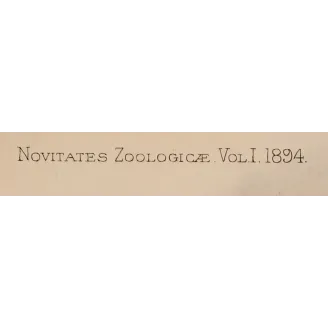
At the upper edge, the journal title, volume, year and plate number connect the sheet securely to Volume I of Novitates Zoologicae. The caption beneath the image preserves Rothschild’s original taxonomic attribution.
Together, the printed line, hand-applied colour, local gum arabic and surviving inscriptions reveal the collaborative structure behind the image. Scientific observation establishes the animal’s form, but Keulemans’ composition allows that form to retain posture, balance and individuality.
This original lithograph belongs to the wider history of zoological research centred upon Walter Rothschild’s museum at Tring. Specimens arriving from distant regions were examined, classified and transformed into images capable of communicating new scientific knowledge internationally.
The presentation of Propithecus majori demonstrates how Keulemans extended his observational method beyond birds. The animal’s limbs, hands, feet, tail and contrasting coat remain scientifically precise, while its nearly frontal expression preserves the impression of an individual living presence.
Rothschild established the taxonomic identity recorded beneath the image; Keulemans translated the primate into visual form; Mintern Brothers produced the lithographic impression; and skilled colourists completed the sheet through transparent watercolour and selective gum arabic.
The complete Heritage Essay explores this wider network of museum research, field collection, illustration, printing and hand colouring, from Walter Rothschild’s collections and Keulemans’ studio to the surviving original impressions that continue to make Victorian zoological knowledge visible today.
Novitates Zoologicae: Keulemans, Rothschild and the Birth of a Modern Zoological Journal →
Very good condition. The substantial late nineteenth-century wove paper remains structurally sound and stable.
The lithographic impression remains clearly defined throughout. The original hand-applied watercolour is stable and fully legible across the animal and surrounding vegetation.
Selective gum arabic remains visible over the pupils and across portions of the darker fur, particularly on the forelimb and thigh. The finishing remains integrated with the underlying colour.
The sheet displays natural age-related toning, becoming somewhat deeper towards the outer borders. Minor handling and former binding traces are principally confined to the margins.
A small irregularity is visible along the left outer edge, outside the principal illustrated field. It does not affect the animal, inscriptions or central composition.
The central illustrated field is free from major creases, losses or visually disruptive staining. The title, date, plate number, species caption, artist’s credit and printer’s inscription remain fully legible.
The professional high-resolution photographs document the complete sheet, illustrated field, inscriptions, paper tone and visible condition details for direct assessment.
Editorial title: The Quiet Presence of a Living Primate
Original species caption: Propithecus majori Rothschild
Current taxonomic context: Historical taxon within the sifaka group; later treatments have associated it with the western sifaka complex
Common name: Major’s Sifaka
Geographical association: Madagascar
Work: Novitates Zoologicae
Volume: Vol. I
Plate: XII
Artist and lithographer: John Gerrard Keulemans (1842–1912)
Printed artist’s credit: J. G. Keulemans del. et lith.
Printer: Mintern Bros., London
Printed printer’s credit: Mintern Bros. imp.
Place of publication: Tring, England
Date: 1894
Technique: Original lithograph with contemporary hand-applied watercolour
Finishing: Selective gum arabic visible on the pupils and across darker portions of the forelimb, thigh and body fur
Paper: Substantial late nineteenth-century wove paper
Plate mark: Not applicable to the lithographic process
Signature: Keulemans lithographic monogram within the printed image; printed attribution below; not individually hand-signed
Sheet size: approx. 28 × 19 cm
Condition: Very good condition, with natural historical toning becoming somewhat deeper towards the outer borders and a small irregularity along the left outer edge
Collector positioning: An unusually expressive mammal plate in which precise anatomical observation is united with posture, balance and individual living presence
Collection: Keulemans Novitates
Authenticity: Original nineteenth-century print — never a modern reproduction
Specific References
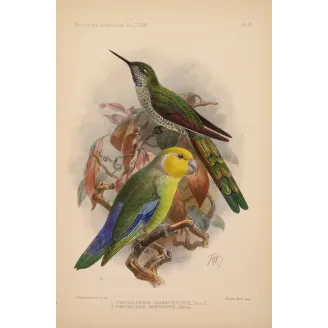
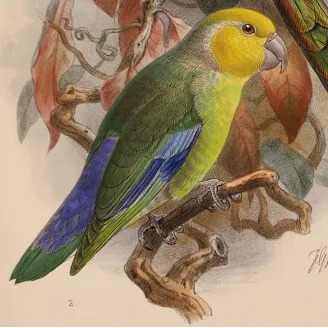
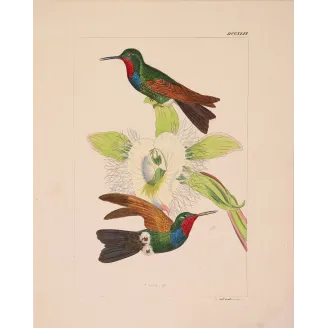
Original hand-coloured lithograph by John Gerrard Keulemans from Novitates Zoologicae, Volume II, Plate II, published in 1895. The composition depicts the Grey-bellied Comet and Yellow-faced Parrotlet against a restrained botanical background, with selective gum arabic highlights visible across parts of the hummingbird’s plumage. Printed on substantial wove paper by Mintern Bros. and preserved in very good condition.
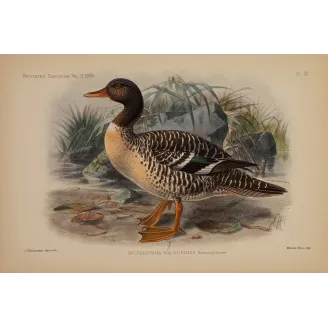
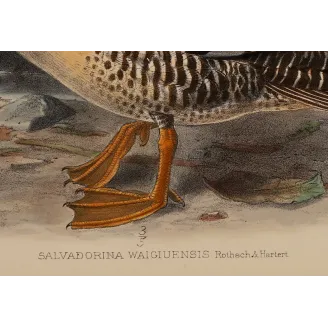
Original hand-coloured lithograph by John Gerrard Keulemans from Novitates Zoologicae, Volume II, Plate III, published in 1895. Depicting the remarkable Waigeu Duck (Salvadorina waigiuensis), the composition combines precise zoological observation with a carefully constructed wetland landscape. Selective gum arabic remains visible across the wing feathers, tail, pupil and neck. Printed by Mintern Bros. on substantial wove paper and preserved in very good condition.
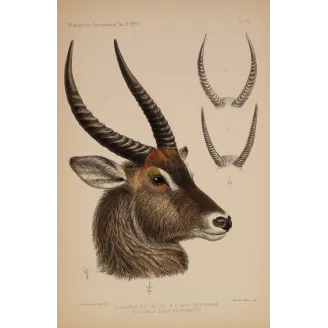
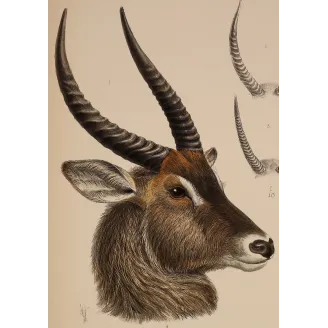
Original hand-coloured lithograph by John Gerrard Keulemans from Novitates Zoologicae, Volume II, Plate IV, published in 1895. The sheet combines a finely observed portrait of an African waterbuck with comparative studies of three horn forms used for zoological identification. Selective gum arabic remains visible on the forehead, pupil, nose and darker portions of the principal horns. Printed by Mintern Bros. on substantial wove paper and preserved in very good condition.
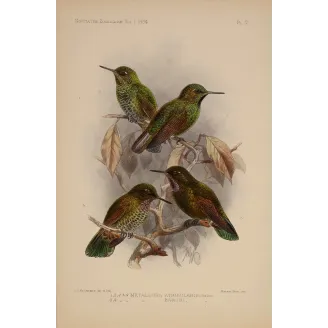
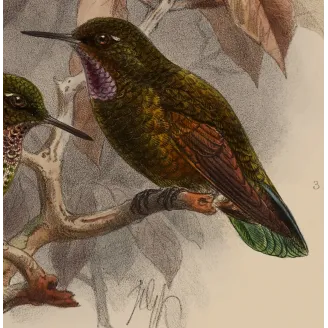
Original hand-coloured lithograph by John Gerrard Keulemans from Novitates Zoologicae, Volume I, Plate IV, published in 1894. Four closely related metaltail hummingbirds are arranged as a comparative study of shared structure and subtle variation, with selective gum arabic visible across the bodies of all four subjects. Printed by Mintern Bros. on substantial wove paper and preserved in very good condition.
Original hand-coloured lithograph by John Gerrard Keulemans from Novitates Zoologicae, Volume I, Plate III, published in 1894. The plate depicts Turturoena sharpei, now classified as Columba delegorguei sharpei, with selective gum arabic highlights on the wings, tail, eye, neck and throat. Printed by Mintern Bros. on substantial wove paper and preserved in very good condition.
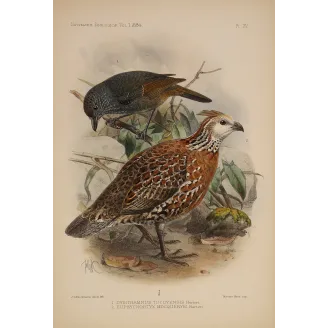
Original hand-coloured lithograph by John Gerrard Keulemans from Novitates Zoologicae, Volume I, Plate XV, published in 1894. The composition presents a Venezuelan White-streaked Antvireo above a richly patterned Crested Bobwhite, using vertical placement to suggest two distinct ecological levels within the same natural environment. Selective gum arabic remains visible on the pupils of both subjects and more extensively across the plumage of the lower bird. Printed by Mintern Bros. on substantial wove paper and preserved in very good condition.
Original hand-coloured lithograph by John Gerrard Keulemans from Novitates Zoologicae, Volume II, Plate I, published in 1895. The composition depicts two Peruvian Andean brushfinches against a restrained botanical setting, with selective gum arabic highlights around the eyes and across parts of the upper bird’s wings. Printed by Mintern Bros. on substantial wove paper and preserved in very good condition.
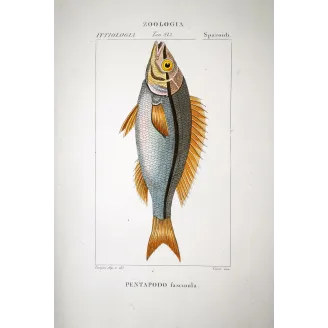
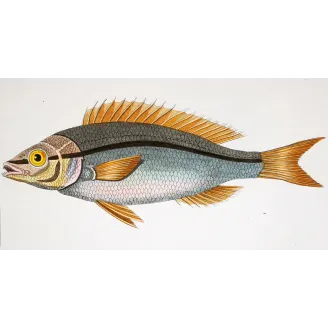
Elegant Pentapodus fish with shimmering orange-silver tones and refined aquatic poise.
Original hand-coloured lithograph by John Gerrard Keulemans from Novitates Zoologicae, Volume I, Plate XV, published in 1894. The composition presents a Venezuelan White-streaked Antvireo above a richly patterned Crested Bobwhite, using vertical placement to suggest two distinct ecological levels within the same natural environment. Selective gum arabic remains visible on the pupils of both subjects and more extensively across the plumage of the lower bird. Printed by Mintern Bros. on substantial wove paper and preserved in very good condition.
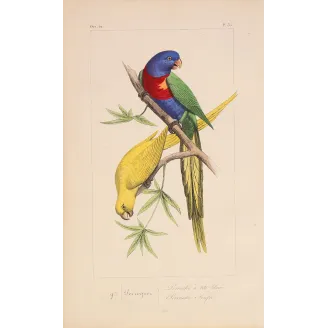
Highly decorative 19th-century engraving of exotic parakeets with vivid blue, red and yellow plumage. A striking and colorful antique bird print.
Original nineteenth-century hand-colored engraving depicting the Purple-throated Carib (Eulampis jugularis), one of the most spectacular Caribbean hummingbirds illustrated in Ludwig Reichenbach’s Trochilinarum Enumeratio.
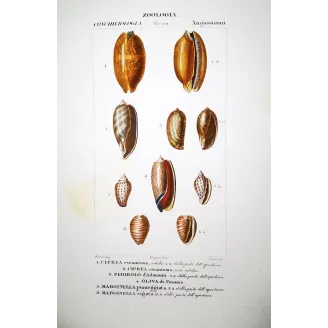
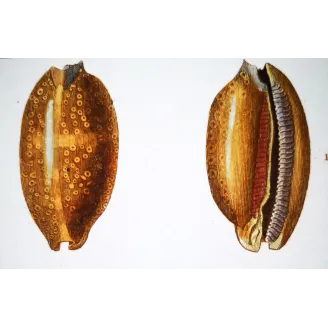
Fine antique print of Ciprea, Peribolo, Marginella highly decorative sea shells by Prêtre.
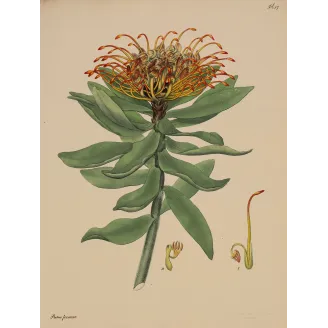
An original hand-coloured copper engraving of Protea formosa, published by Henry Charles Andrews in The Botanist's Repository (1799). Distinguished by its spectacular upward flowering styles, exceptionally delicate watercolour and refined botanical execution, this plate represents one of the most elegant Protea engravings of the series.
Colored illustration depicting two South American toucans: the Toco and the Red-belted Aracari.
Original hand-coloured lithograph by John Gerrard Keulemans from Novitates Zoologicae, Volume I, Plate XII, published in 1894. Depicting Propithecus majori (Major's Sifaka), the composition combines precise anatomical observation with an unusually expressive portrayal of a living primate. Selective gum arabic remains visible on the pupils and across the darker fur of the forelimb, thigh and body. Printed by Mintern Bros. on substantial wove paper and preserved in very good condition.