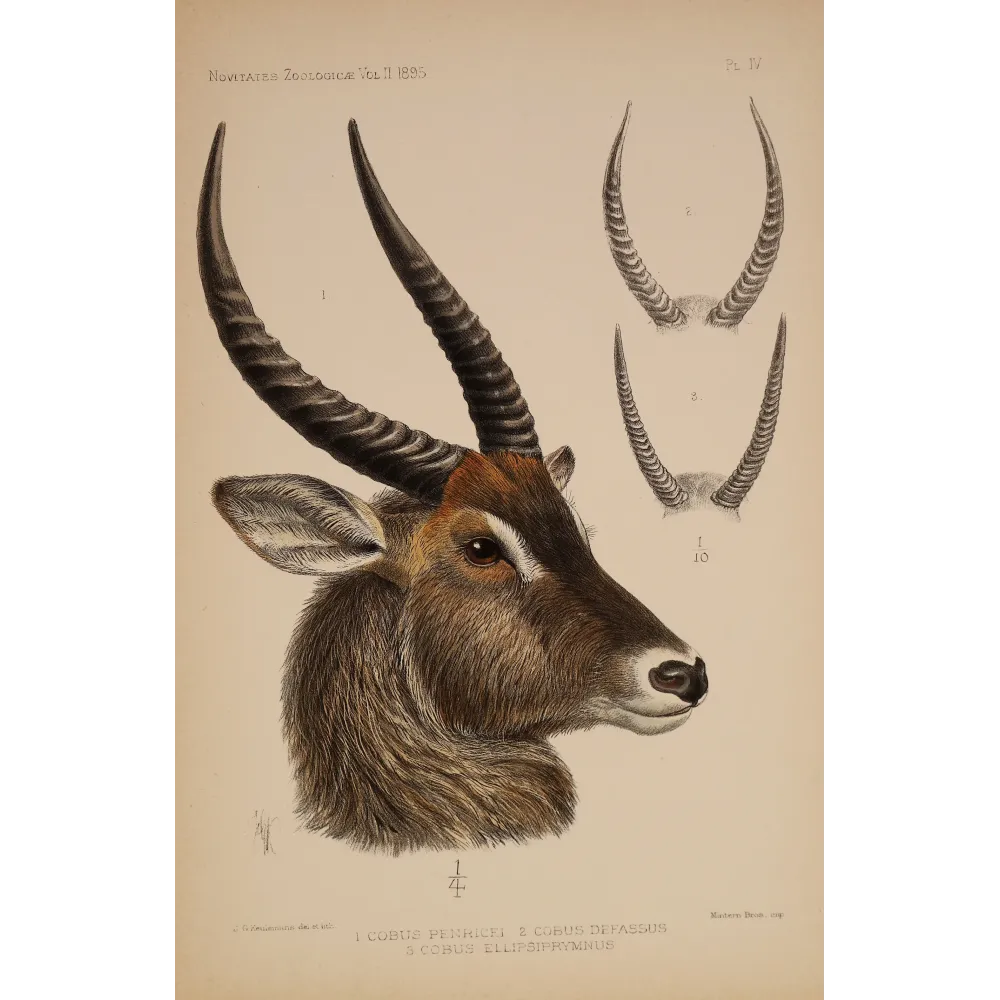
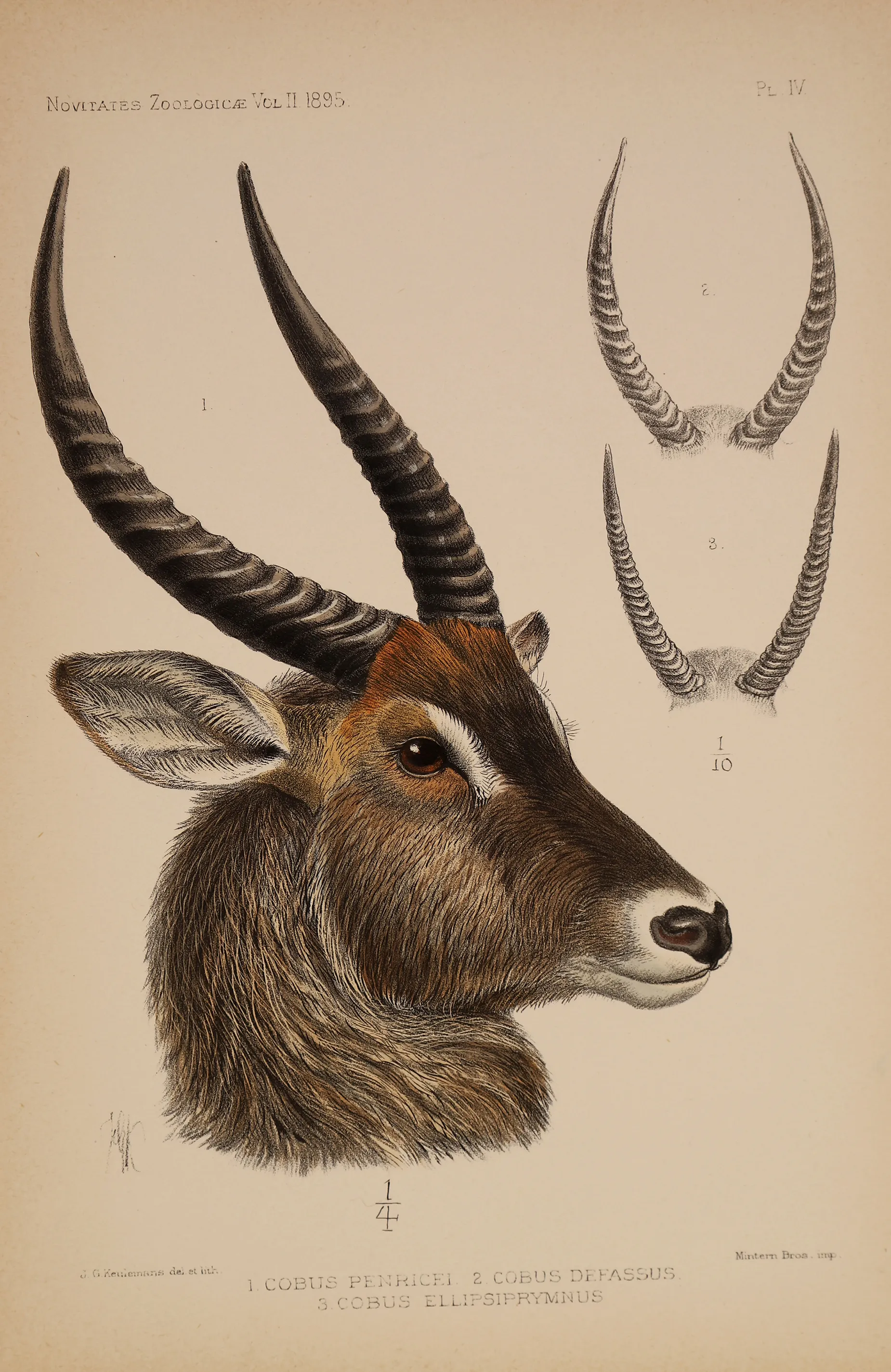
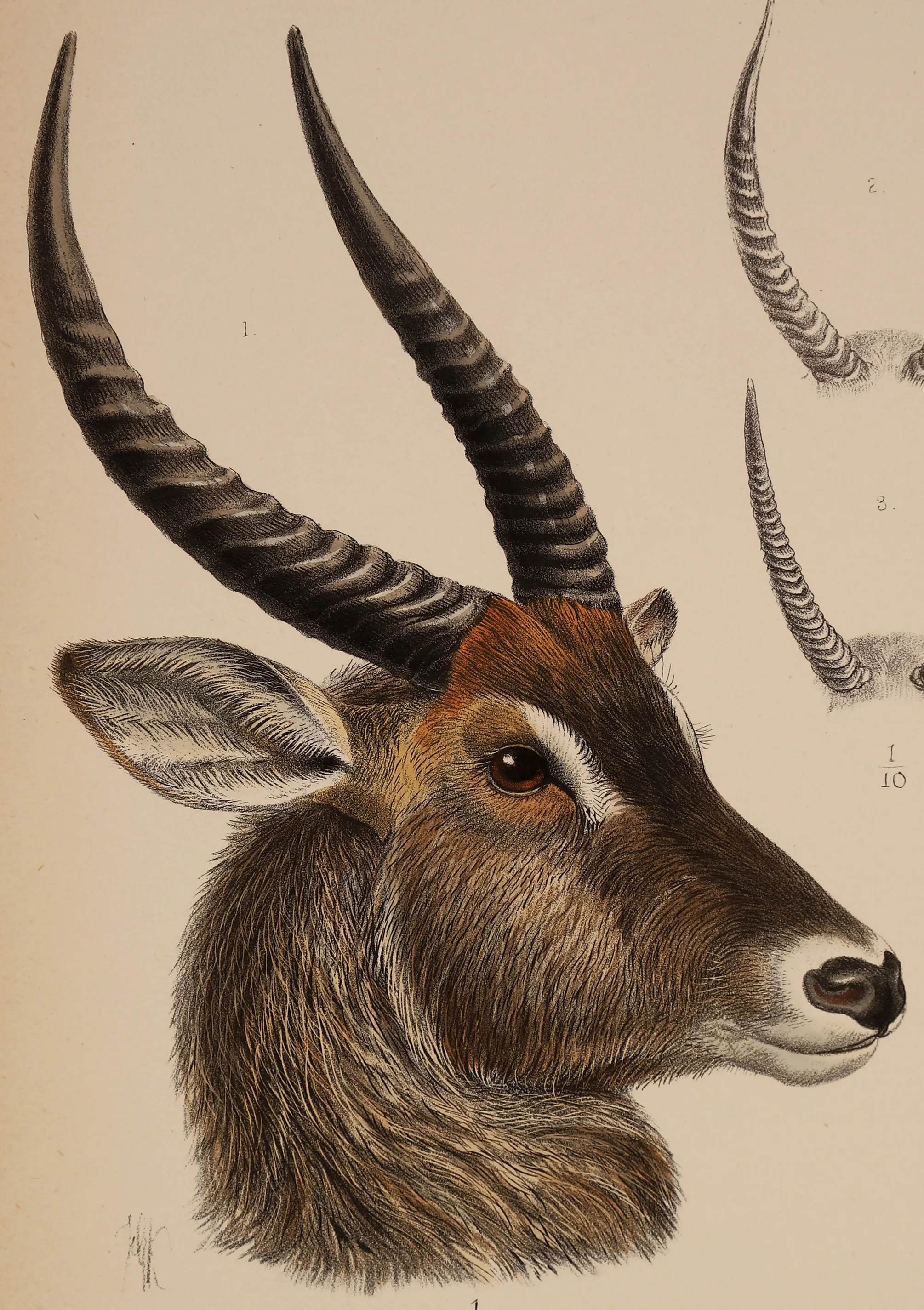
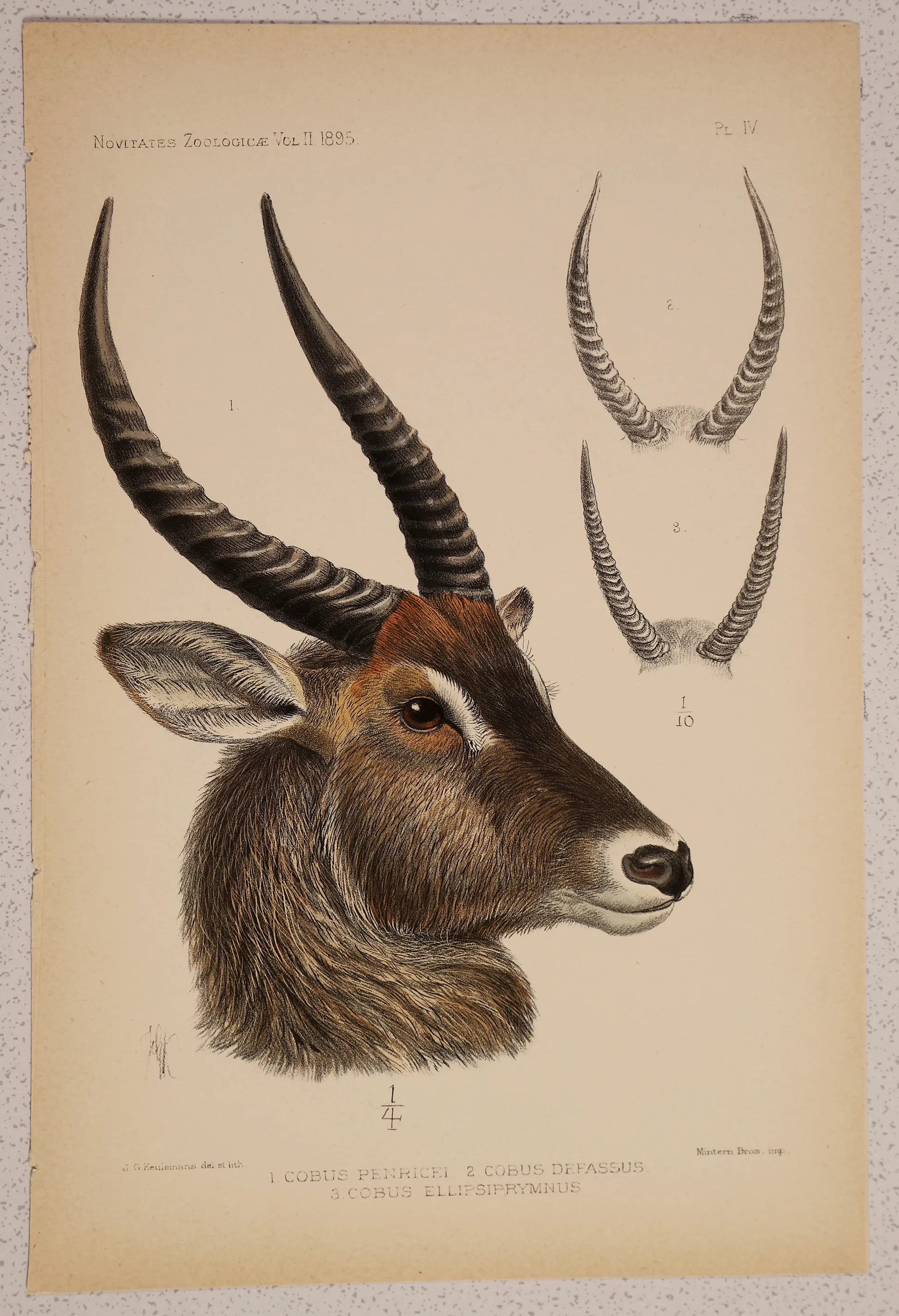
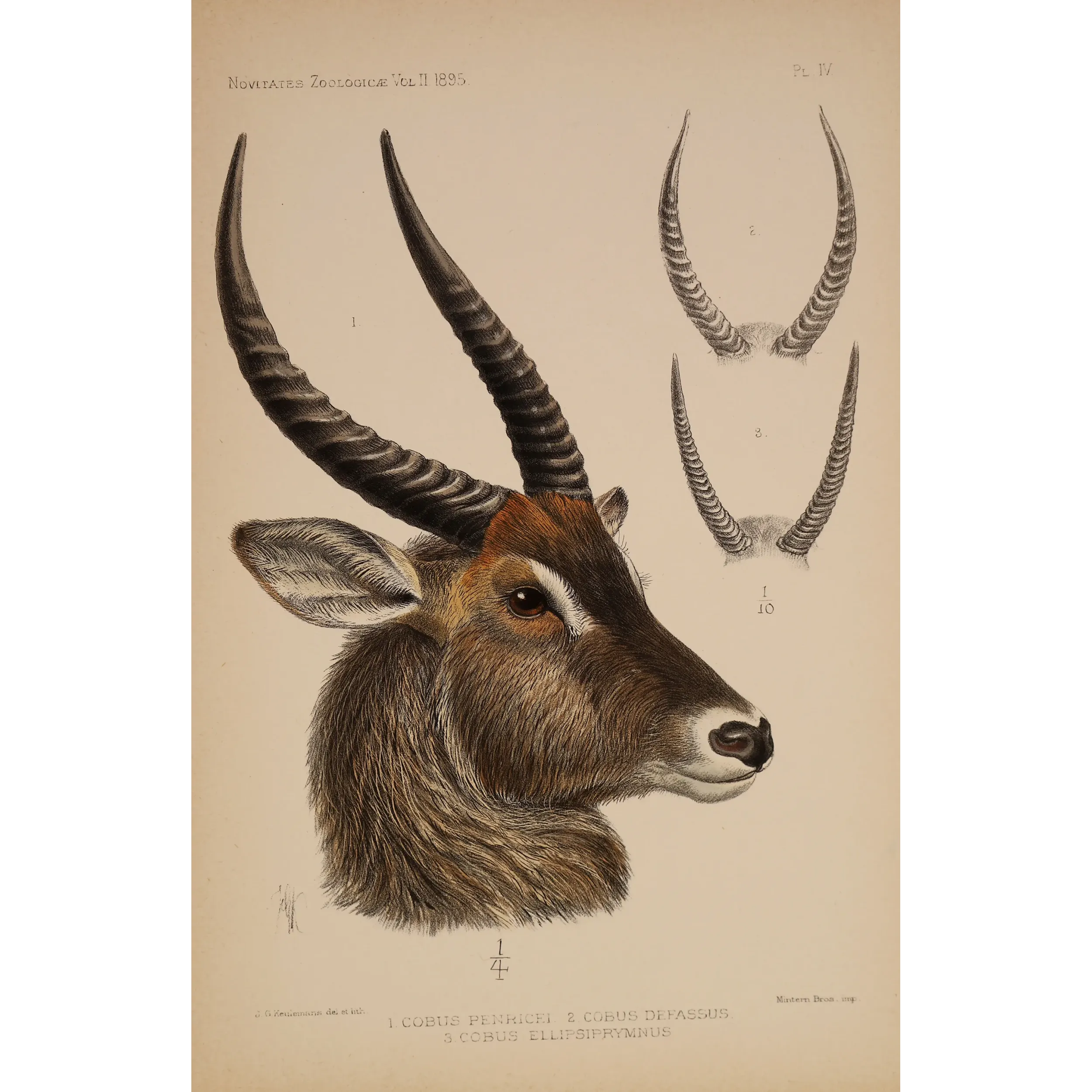
Original hand-coloured lithograph by John Gerrard Keulemans from Novitates Zoologicae, Volume II, Plate IV, published in 1895. The sheet combines a finely observed portrait of an African waterbuck with comparative studies of three horn forms used for zoological identification. Selective gum arabic remains visible on the forehead, pupil, nose and darker portions of the principal horns. Printed by Mintern Bros. on substantial wove paper and preserved in very good condition.
 Delivery policy
Your print will be carefully prepared and shipped worldwide via trusted couriers (UPS or similar).
 Authentic antique prints
Original engravings from the 17th–19th century.
Published in 1895 for Novitates Zoologicae, this original hand-coloured lithograph by John Gerrard Keulemans combines two different modes of zoological representation within a single sheet. A large and carefully modelled portrait of an African waterbuck occupies the principal field, while three smaller comparative studies isolate the horns as structures to be examined, distinguished and measured.
Published as Plate IV in Volume II of the journal, the original caption identifies three historical taxa: Cobus penricei, Cobus defassus and Cobus ellipsiprymnus. These names belong to the nineteenth-century study of the African waterbuck group and preserve the classifications through which differences in horn form were understood at the time of publication.
The principal head is presented with imposing clarity. Long ringed horns rise through the upper half of the sheet, while the carefully observed eye, muzzle, ear and densely worked coat give the animal an expressive and unmistakably living presence.
Keulemans moves from portrait to comparison, allowing the expressive presence of the animal and the analytical precision of zoological study to occupy the same sheet.
The composition is organised around the monumental head and horns of the principal animal. The neck and lower head occupy the central and lower portions of the sheet, while the two horns rise in broad, symmetrical curves towards the upper edge.
The horns create the dominant visual movement. Their outward expansion gives the portrait scale and authority, while the inward turn of the pointed tips restores balance and draws the eye back towards the animal’s head.
Each horn is described through repeated transverse ridges that gradually change in width and spacing as they ascend. Darker outer passages alternate with paler raised bands, allowing the cylindrical form and changing curvature to remain fully legible.
The forehead introduces a warm concentration of ochre-brown colour between the dark horn bases. Short, closely directed lines follow the growth of the coat and create a transition from the crown towards the lighter face.
The eye forms the principal focal point within the portrait. Its rounded dark surface is framed by a pale marking that extends towards the muzzle, giving the animal an alert expression without compromising anatomical precision.
The muzzle projects towards the right and is modelled through increasingly pale brown, grey and cream passages. The dark nose provides a compact visual endpoint, while the mouth is indicated through a restrained line rather than exaggerated modelling.
The large ear extends towards the left and offers a contrasting surface. Fine pale strokes describe the inner hair, while the darker outer edge preserves its shape against the open background.
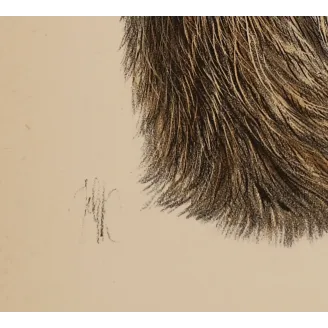
The neck and lower coat are rendered through dense, directional lithographic marks. Longer strokes along the throat and lower neck suggest the changing length and direction of the hair, producing a textured surface that remains distinct from the compact modelling of the face.
At upper right, two smaller pairs of horns are presented independently from the animal. Their reduced scale and near-monochrome treatment immediately distinguish them from the coloured portrait.
These comparative studies draw attention to structural differences: the distance between the horn bases, the width and rhythm of the ridges, the outward spread of the shafts and the degree to which the points turn inwards.
Numerical references and scale indications reinforce the scientific purpose of the sheet. The viewer is encouraged to move repeatedly between the living portrait and the isolated anatomical forms, comparing appearance with measurable structure.
The background remains almost entirely open. Without foliage or landscape, attention is concentrated upon the animal’s identifying features and upon the relationship between the principal portrait and the comparative horn studies.
The names printed beneath the image—Cobus penricei, Cobus defassus and Cobus ellipsiprymnus—record the historical taxonomy applied to African waterbucks at the end of the nineteenth century.
Waterbucks are large African antelopes associated principally with grasslands, floodplains and areas close to permanent water. Their substantial bodies, shaggy coats and strongly developed ringed horns make them among the most visually distinctive members of the antelope family.
The horns are carried by males and provide important evidence for zoological comparison. Their length, curvature, spacing, transverse ridges and terminal orientation could all contribute to the distinction of regional forms and historically proposed taxa.
Keulemans records these structures at two levels. The large portrait preserves the relationship between horns, skull, ear, eye and muzzle, while the smaller studies allow selected horn forms to be compared without the visual complexity of the complete head.
The historical genus Cobus is now written Kobus, and later zoological classifications have reconsidered the precise status and relationships of several names represented on the sheet. The original caption remains essential, however, because it preserves the scientific interpretation for which the plate was created in 1895.
The image therefore documents not only the anatomy of the animals, but a particular stage in the development of mammalian taxonomy, when careful visual comparison formed a central instrument of zoological research.
Keulemans moves from portrait to comparison, allowing the expressive presence of the animal and the analytical precision of zoological study to occupy the same sheet.
The large head functions first as a portrait. Scale, modelling and the concentration of detail around the eye and muzzle encourage the viewer to recognise an individual living animal rather than an abstract anatomical type.
The smaller horn studies change the mode of observation. Detached from the head and reduced to their essential structure, the horns become evidence to be compared through curvature, proportion, ridging and orientation.
This transition from presence to analysis is central to the plate. The portrait establishes the coherence of the living form; the comparative details reveal how zoological knowledge is constructed by isolating particular features and examining their variation.
Keulemans keeps the two registers visually distinct. Contemporary hand colouring is concentrated principally upon the animal’s head, while the smaller studies remain almost monochromatic. The contrast allows the viewer to move immediately between descriptive portraiture and analytical diagram.
The absence of a developed landscape is equally deliberate. Nothing distracts from the structures under examination. The animal occupies an open field in which the horns, eye, ear, muzzle and coat can be read with exceptional clarity.
Close examination of the original impression reveals selective glossy finishing across the forehead, pupil and nose, together with local applications on the darker portions of the principal horns. These reflections are consistent with restrained use of gum arabic over the hand-coloured surface.
The material serves several different optical purposes. Over the pupil, it introduces a concentrated point of reflected light that reinforces the alert presence of the animal. On the nose, it suggests the smoother and naturally more reflective surface of the muzzle.
Across the forehead, the finish gives additional depth to the warm brown coat without covering the direction of the printed hair. On the darker horn passages, it subtly strengthens the contrast between raised ridges and recessed areas.
The gum arabic is not applied as a continuous varnish. Its distribution responds to the different surfaces represented—eye, nose, fur and horn—demonstrating how a single finishing material could be adapted to several zoological textures.
The contemporary hand-applied colour remains transparent enough for the lithographic drawing to stay active throughout. Fine lines define the coat, facial modelling, ear, muzzle and repeated horn ridges beneath the colour.
Minute variations in colour density and local application remain compatible with individual hand finishing. Pigment follows the forms established by the printed design rather than producing mechanically uniform fields.
This assessment is based upon close visual examination of the original impression, comparative observation and supporting bibliographic descriptions rather than laboratory analysis. Considered together, the lithographic underdrawing, transparent colour and selective gum arabic form a coherent material sequence.
The image is printed on substantial late nineteenth-century wove paper. The sheet displays no regular pattern of laid and chain lines. Its dense, even surface was well suited to finely articulated lithographic drawing, contemporary hand colouring and local glossy finishing.
As a lithograph, the work does not display the recessed plate mark associated with copper engraving or etching. The flat printing process allowed Keulemans to preserve the flexible line required for hair, facial modelling and the repeated rings of the horns.
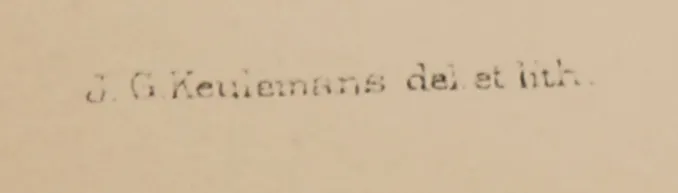
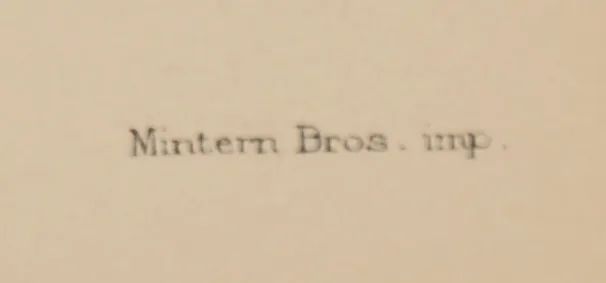
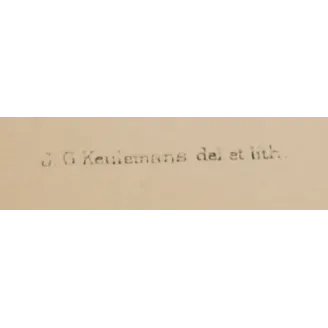
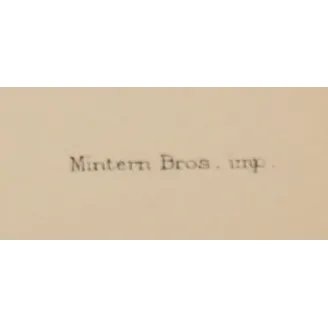
The printed inscriptions preserve the artistic and editorial chain of production. At lower left, “J. G. Keulemans del. et lith.” records Keulemans’ responsibility for both the original drawing and its lithographic preparation. At lower right, “Mintern Bros. imp.” identifies the London printing establishment responsible for producing the impression.
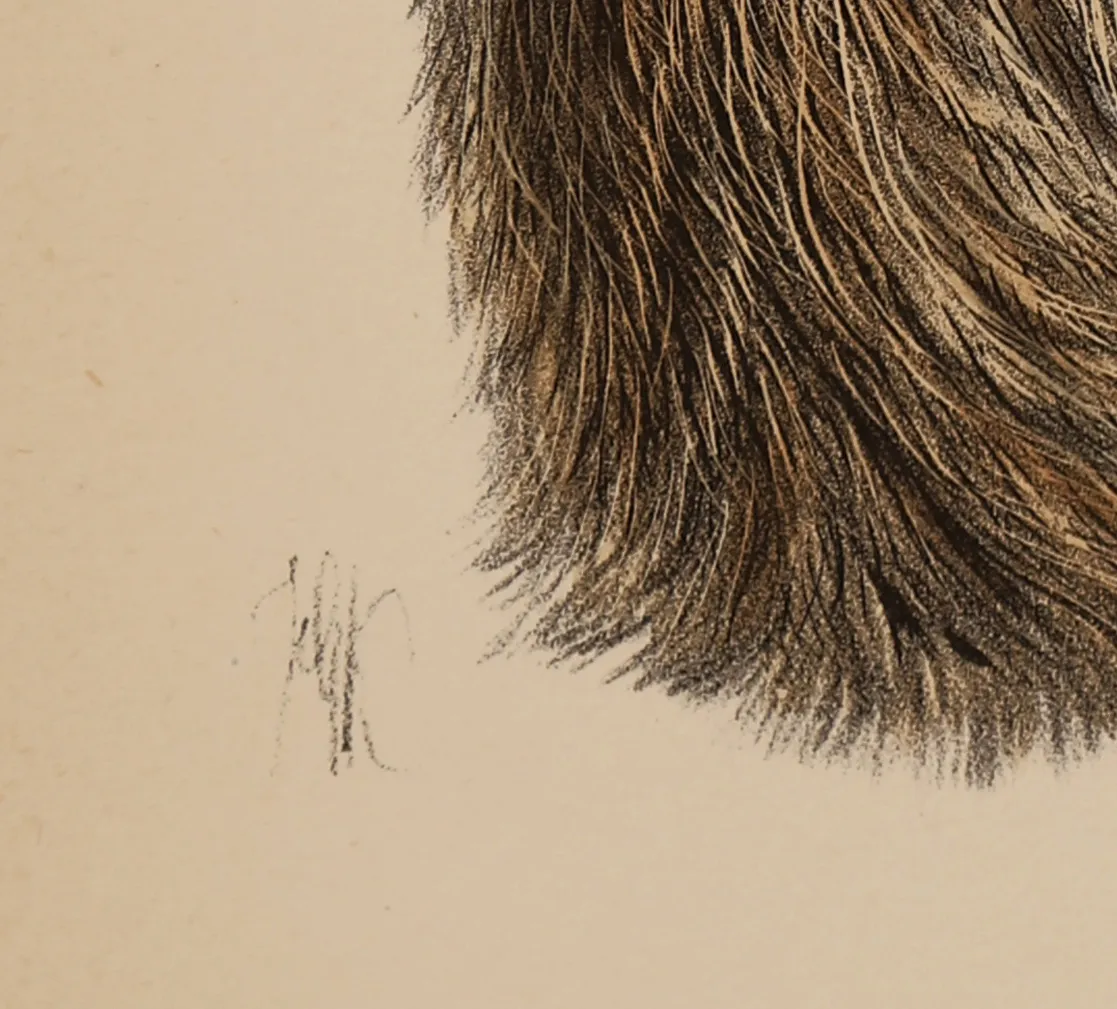
Keulemans’ lithographic monogram is incorporated within the lower left of the illustrated field. It belongs to the printed composition and should not be interpreted as an individually hand-applied signature.
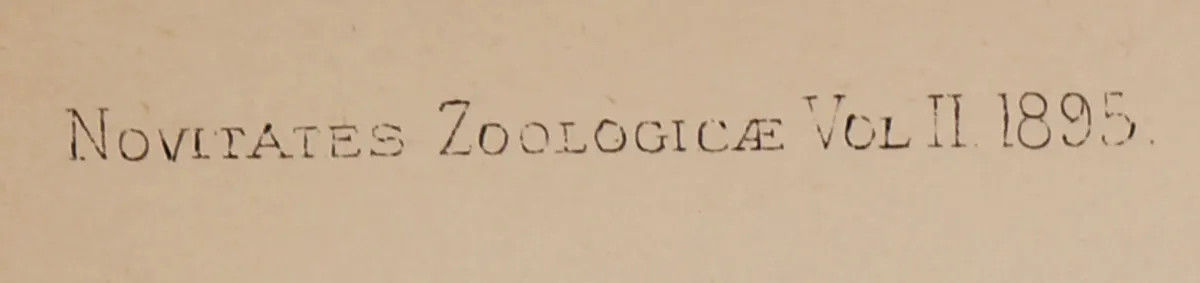
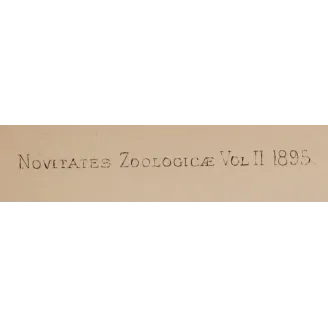
At the upper edge, the journal title, volume, year and plate number connect the sheet securely to Volume II of Novitates Zoologicae. The numbered captions and scale indications preserve its intended function as a comparative zoological document.
Together, the expressive portrait, isolated anatomical studies, printed line, hand-applied colour and selective surface finishing reveal how observation becomes classification. The living animal remains present, but particular structures are separated so that variation can be compared and understood.
This original lithograph belongs to the wider history of zoological research centred upon Walter Rothschild’s museum at Tring. Specimens arriving from distant regions were examined, classified and transformed into images capable of communicating new scientific knowledge internationally.
The African waterbuck study demonstrates two complementary functions of zoological illustration. The large portrait preserves the presence and complete structure of the animal, while the smaller horn studies isolate particular features for direct comparison.
Keulemans translated these descriptive and analytical requirements into visual form; Mintern Brothers produced the lithographic impression; and skilled colourists completed the principal portrait through transparent watercolour and selective gum arabic.
The complete Heritage Essay explores this wider network of museum research, field collection, illustration, printing and hand colouring, from Walter Rothschild’s collections and Keulemans’ studio to the surviving original impressions that continue to make Victorian zoological knowledge visible today.
Novitates Zoologicae: Keulemans, Rothschild and the Birth of a Modern Zoological Journal →
Very good condition. The substantial late nineteenth-century wove paper remains structurally sound and stable.
The lithographic impression remains clearly defined throughout. The original hand-applied watercolour is stable and fully legible across the principal animal portrait.
Selective gum arabic remains visible on the forehead, pupil and nose and across darker portions of the principal horns. The finishing remains integrated with the underlying colour.
The sheet displays natural age-related toning, becoming somewhat deeper towards the outer borders. Minor handling and former binding traces are principally confined to the left margin.
Small edge irregularities and binding-related marks remain outside the principal illustrated field and do not affect the animal portrait, comparative horn studies or printed captions.
The central illustrated field is free from major creases, losses or visually disruptive staining. The title, date, plate number, species captions, scale indications, artist’s credit and printer’s inscription remain fully legible.
The professional high-resolution photographs document the complete sheet, illustrated field, inscriptions, paper tone and visible condition details for direct assessment.
Editorial title: Portrait and Measure
Original species caption: 1. Cobus penricei; 2. Cobus defassus; 3. Cobus ellipsiprymnus
Current taxonomic context: Historical taxa associated with the African waterbuck group, now placed within the genus Kobus
Common group: African Waterbucks
Work: Novitates Zoologicae
Volume: Vol. II
Plate: IV
Artist and lithographer: John Gerrard Keulemans (1842–1912)
Printed artist’s credit: J. G. Keulemans del. et lith.
Printer: Mintern Bros., London
Printed printer’s credit: Mintern Bros. imp.
Place of publication: Tring, England
Date: 1895
Technique: Original lithograph with contemporary hand-applied watercolour
Finishing: Selective gum arabic visible on the forehead, pupil, nose and darker portions of the principal horns
Paper: Substantial late nineteenth-century wove paper
Plate mark: Not applicable to the lithographic process
Signature: Keulemans lithographic monogram within the printed image; printed attribution below; not individually hand-signed
Sheet size: approx. 28 × 19 cm
Condition: Very good condition, with natural historical toning becoming somewhat deeper towards the outer borders and minor former binding traces along the left edge
Collector positioning: An intellectually engaging zoological plate uniting an expressive animal portrait with comparative studies of horn structure and proportion
Collection: Keulemans Novitates
Authenticity: Original nineteenth-century print — never a modern reproduction
Specific References
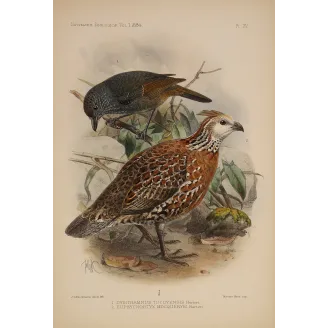
Original hand-coloured lithograph by John Gerrard Keulemans from Novitates Zoologicae, Volume I, Plate XV, published in 1894. The composition presents a Venezuelan White-streaked Antvireo above a richly patterned Crested Bobwhite, using vertical placement to suggest two distinct ecological levels within the same natural environment. Selective gum arabic remains visible on the pupils of both subjects and more extensively across the plumage of the lower bird. Printed by Mintern Bros. on substantial wove paper and preserved in very good condition.
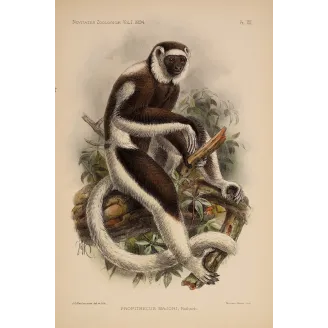
Original hand-coloured lithograph by John Gerrard Keulemans from Novitates Zoologicae, Volume I, Plate XII, published in 1894. Depicting Propithecus majori (Major's Sifaka), the composition combines precise anatomical observation with an unusually expressive portrayal of a living primate. Selective gum arabic remains visible on the pupils and across the darker fur of the forelimb, thigh and body. Printed by Mintern Bros. on substantial wove paper and preserved in very good condition.
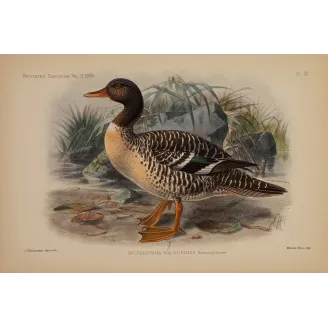
Original hand-coloured lithograph by John Gerrard Keulemans from Novitates Zoologicae, Volume II, Plate III, published in 1895. Depicting the remarkable Waigeu Duck (Salvadorina waigiuensis), the composition combines precise zoological observation with a carefully constructed wetland landscape. Selective gum arabic remains visible across the wing feathers, tail, pupil and neck. Printed by Mintern Bros. on substantial wove paper and preserved in very good condition.
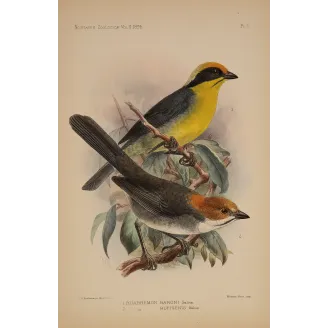
Original hand-coloured lithograph by John Gerrard Keulemans from Novitates Zoologicae, Volume II, Plate I, published in 1895. The composition depicts two Peruvian Andean brushfinches against a restrained botanical setting, with selective gum arabic highlights around the eyes and across parts of the upper bird’s wings. Printed by Mintern Bros. on substantial wove paper and preserved in very good condition.
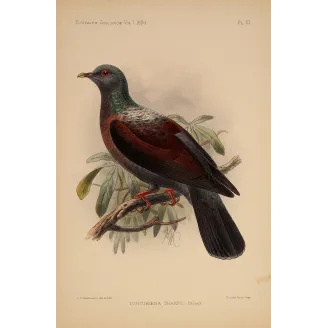
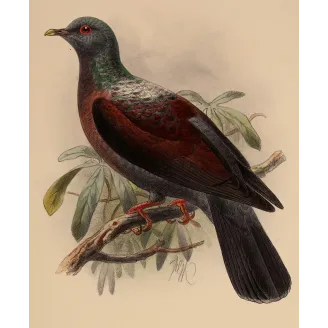
Original hand-coloured lithograph by John Gerrard Keulemans from Novitates Zoologicae, Volume I, Plate III, published in 1894. The plate depicts Turturoena sharpei, now classified as Columba delegorguei sharpei, with selective gum arabic highlights on the wings, tail, eye, neck and throat. Printed by Mintern Bros. on substantial wove paper and preserved in very good condition.
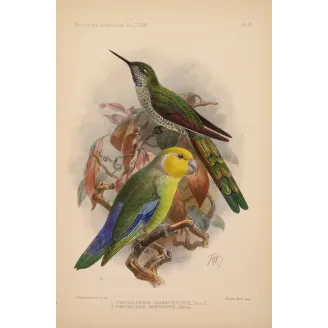
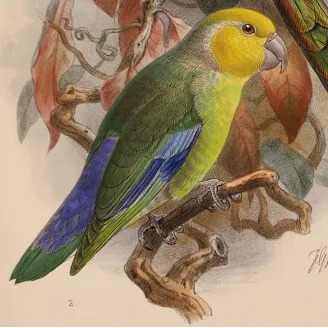
Original hand-coloured lithograph by John Gerrard Keulemans from Novitates Zoologicae, Volume II, Plate II, published in 1895. The composition depicts the Grey-bellied Comet and Yellow-faced Parrotlet against a restrained botanical background, with selective gum arabic highlights visible across parts of the hummingbird’s plumage. Printed on substantial wove paper by Mintern Bros. and preserved in very good condition.
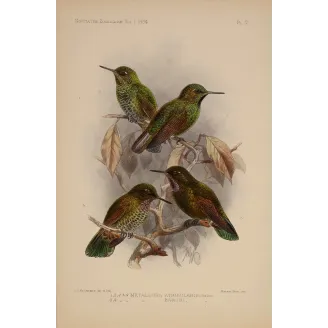
Original hand-coloured lithograph by John Gerrard Keulemans from Novitates Zoologicae, Volume I, Plate IV, published in 1894. Four closely related metaltail hummingbirds are arranged as a comparative study of shared structure and subtle variation, with selective gum arabic visible across the bodies of all four subjects. Printed by Mintern Bros. on substantial wove paper and preserved in very good condition.
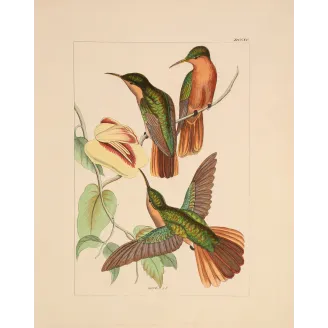
Original nineteenth-century hand-colored engraving depicting the Jamaican Mango (Anthracothorax mango), a striking tropical hummingbird illustrated by Ludwig Reichenbach in his celebrated Trochilinarum Enumeratio.
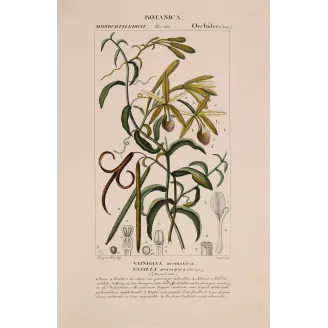
Delicate orchid illustration showing flower, pod and internal anatomy of vanilla.
Original hand-coloured lithograph by John Gerrard Keulemans from Novitates Zoologicae, Volume II, Plate I, published in 1895. The composition depicts two Peruvian Andean brushfinches against a restrained botanical setting, with selective gum arabic highlights around the eyes and across parts of the upper bird’s wings. Printed by Mintern Bros. on substantial wove paper and preserved in very good condition.
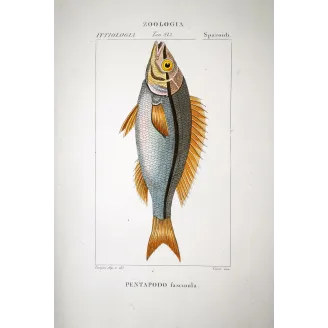
Elegant Pentapodus fish with shimmering orange-silver tones and refined aquatic poise.
Original hand-coloured lithograph by John Gerrard Keulemans from Novitates Zoologicae, Volume I, Plate XV, published in 1894. The composition presents a Venezuelan White-streaked Antvireo above a richly patterned Crested Bobwhite, using vertical placement to suggest two distinct ecological levels within the same natural environment. Selective gum arabic remains visible on the pupils of both subjects and more extensively across the plumage of the lower bird. Printed by Mintern Bros. on substantial wove paper and preserved in very good condition.
Highly decorative 19th-century engraving of exotic parakeets with vivid blue, red and yellow plumage. A striking and colorful antique bird print.
Original nineteenth-century hand-colored engraving depicting the Purple-throated Carib (Eulampis jugularis), one of the most spectacular Caribbean hummingbirds illustrated in Ludwig Reichenbach’s Trochilinarum Enumeratio.
Fine antique print of Ciprea, Peribolo, Marginella highly decorative sea shells by Prêtre.
Original hand-coloured lithograph by John Gerrard Keulemans from Novitates Zoologicae, Volume II, Plate IV, published in 1895. The sheet combines a finely observed portrait of an African waterbuck with comparative studies of three horn forms used for zoological identification. Selective gum arabic remains visible on the forehead, pupil, nose and darker portions of the principal horns. Printed by Mintern Bros. on substantial wove paper and preserved in very good condition.