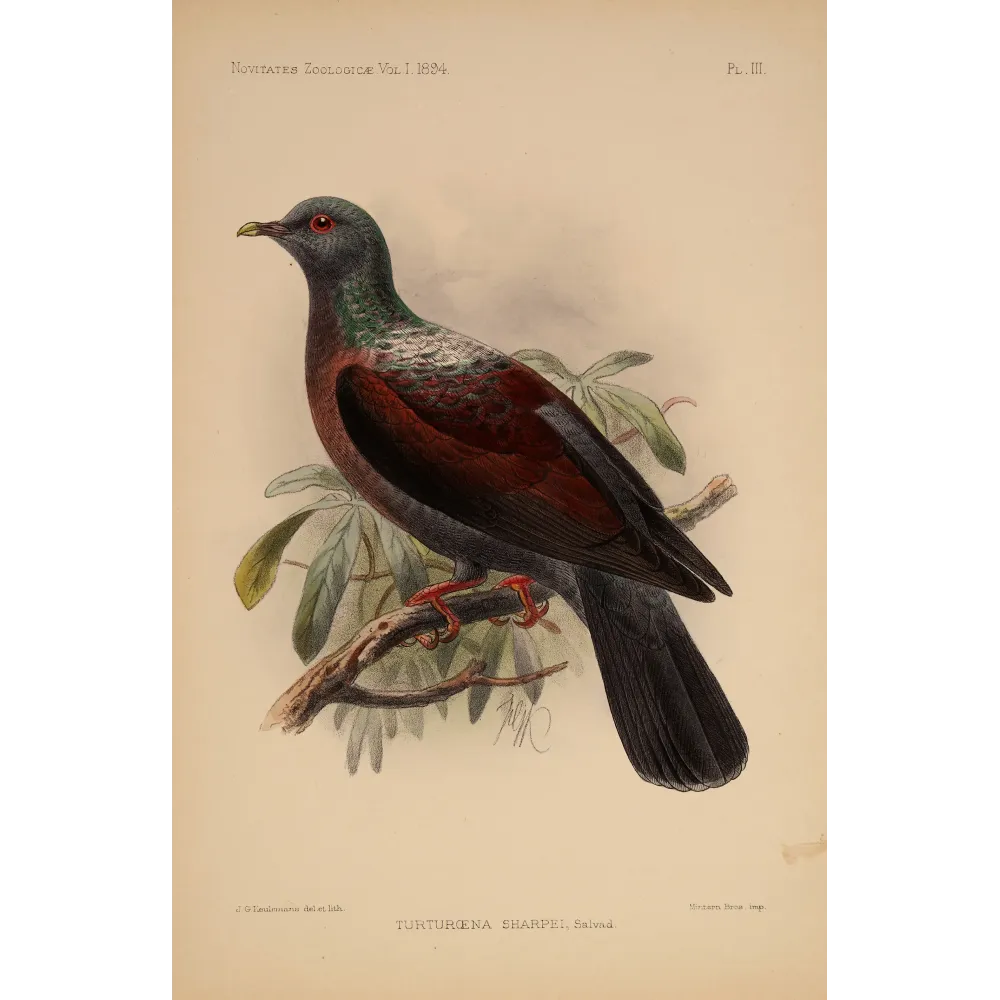
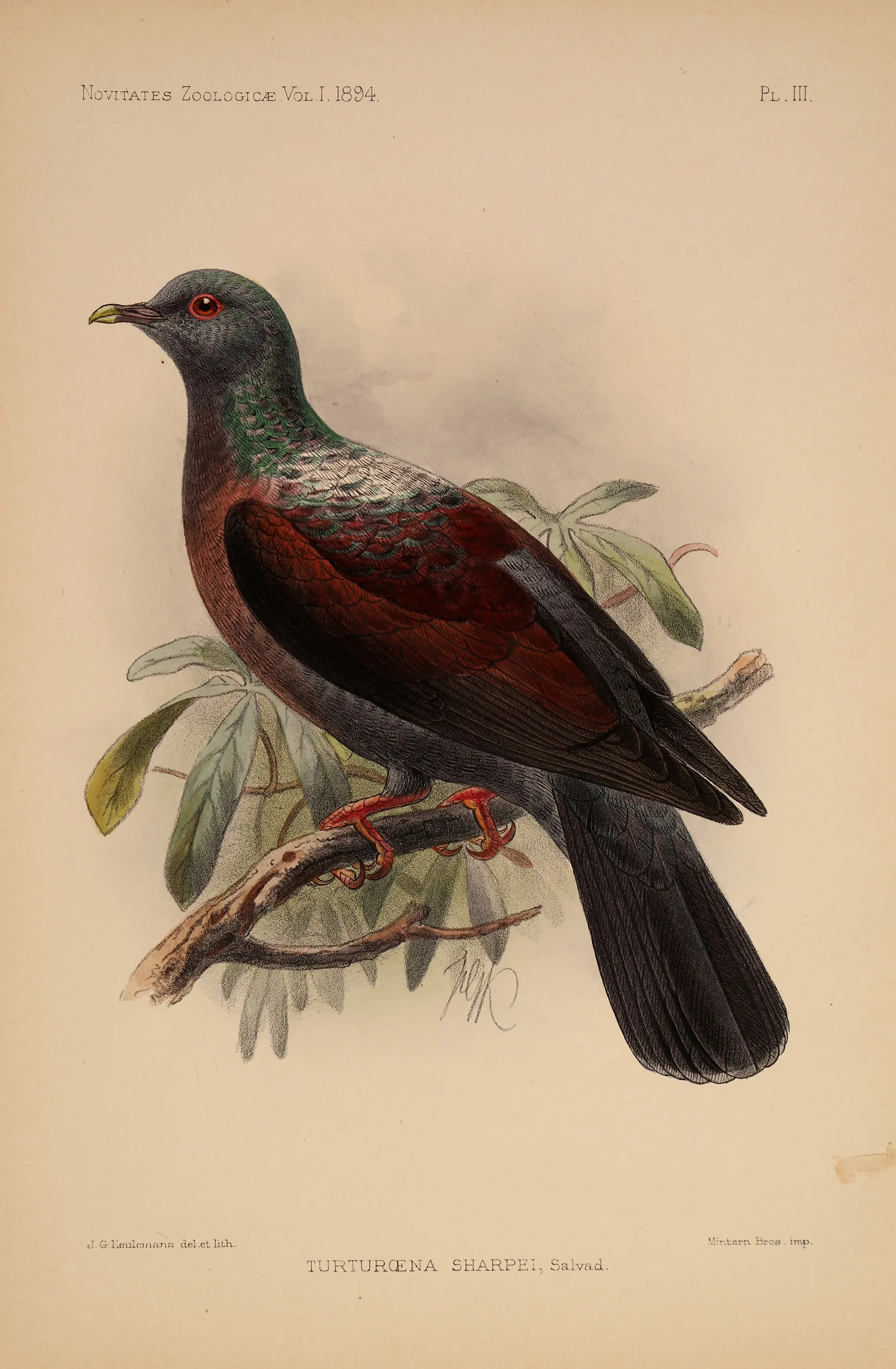
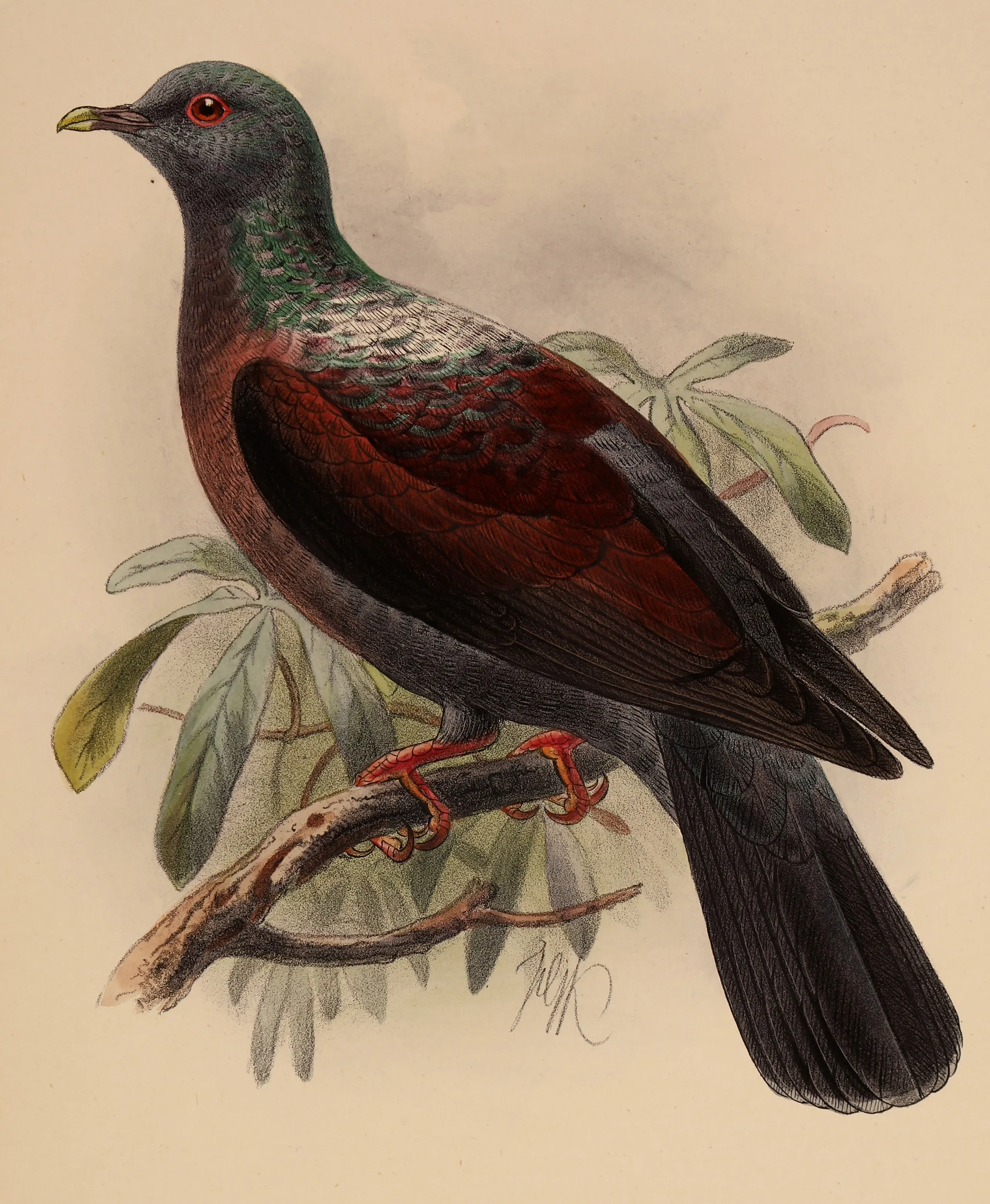
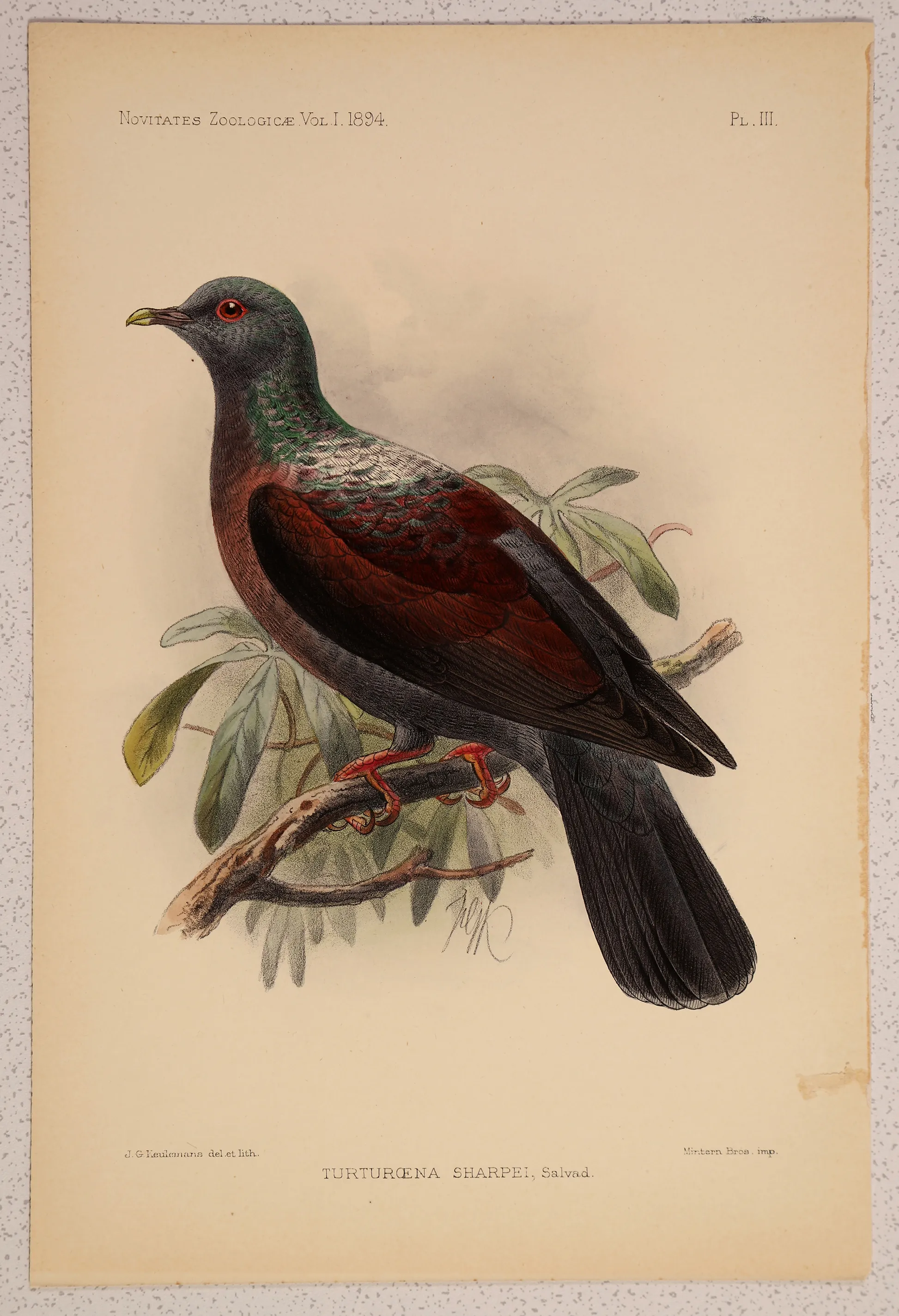
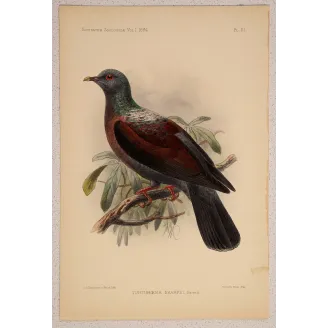
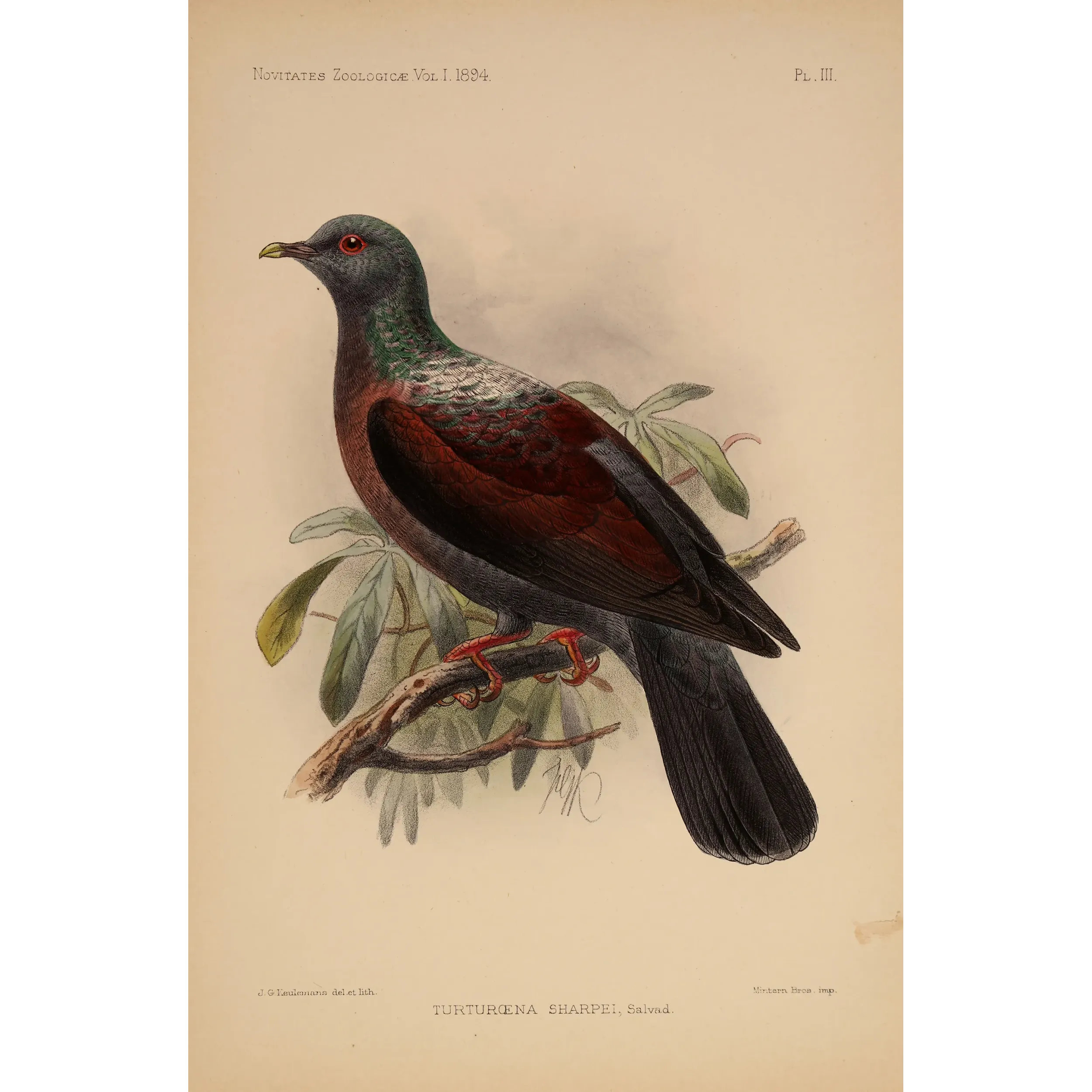
Original hand-coloured lithograph by John Gerrard Keulemans from Novitates Zoologicae, Volume I, Plate III, published in 1894. The plate depicts Turturoena sharpei, now classified as Columba delegorguei sharpei, with selective gum arabic highlights on the wings, tail, eye, neck and throat. Printed by Mintern Bros. on substantial wove paper and preserved in very good condition.
 Delivery policy
Your print will be carefully prepared and shipped worldwide via trusted couriers (UPS or similar).
 Authentic antique prints
Original engravings from the 17th–19th century.
Published in 1894 for Novitates Zoologicae, this original hand-coloured lithograph presents a single bird with an authority that extends far beyond the conventions of a taxonomic plate. John Gerrard Keulemans preserves every feature required for scientific recognition while giving the subject weight, composure and an unmistakable sense of living presence.
Published as Plate III in Volume I of the journal, the bird is identified beneath the image under the historical name Turturoena sharpei Salvadori. It is now generally classified as Columba delegorguei sharpei, a form of the Eastern Bronze-naped Pigeon.
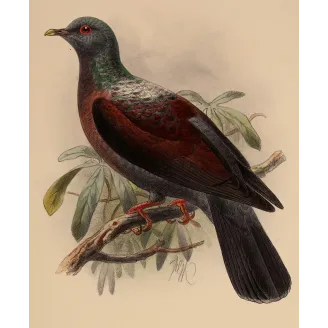
The pigeon occupies almost the entire illustrated field. Its upright body, slightly raised head and long descending tail form a stable silhouette, while the red eye, bronze-red wings and changing green, grey and violet tones introduce concentrated areas of chromatic intensity.
Keulemans transforms a single taxonomic specimen into a living presence without sacrificing scientific legibility: the bird remains precisely observable, yet never appears reduced to a diagram or detached study.
The composition is built around a broad descending diagonal. The head rises towards the upper left, while the folded wings, body and long tail move progressively downwards towards the lower right. This direction gives the bird both stability and a quiet sense of forward presence.
The head is held slightly above the body, creating an alert but unforced posture. The short bill points towards the open space at left, while the circular red eye forms the most immediate focal point of the composition.
Around the head and neck, the plumage passes through slate grey, muted green and darker violet-grey tones. Small green feather markings become more visible across the side and rear of the neck, forming a gradual transition towards the pale, finely articulated band over the upper back.
The wings provide the strongest field of colour. Deep bronze-red and chestnut passages extend across the coverts, while darker feather margins preserve the internal structure of each overlapping form. The transparent colour allows the lithographic drawing to remain clearly visible beneath.
A cooler grey-black band follows the lower edge of the body and continues into the tail. The long tail feathers are rendered with controlled parallel lines, each one retaining its individual contour while contributing to a single dark and visually weighty form.
The breast is treated more softly. Brown, mauve-grey and muted rose tones pass gradually into the darker underside, creating volume without relying on hard outlines. This tonal modelling gives the body a convincing sense of mass.
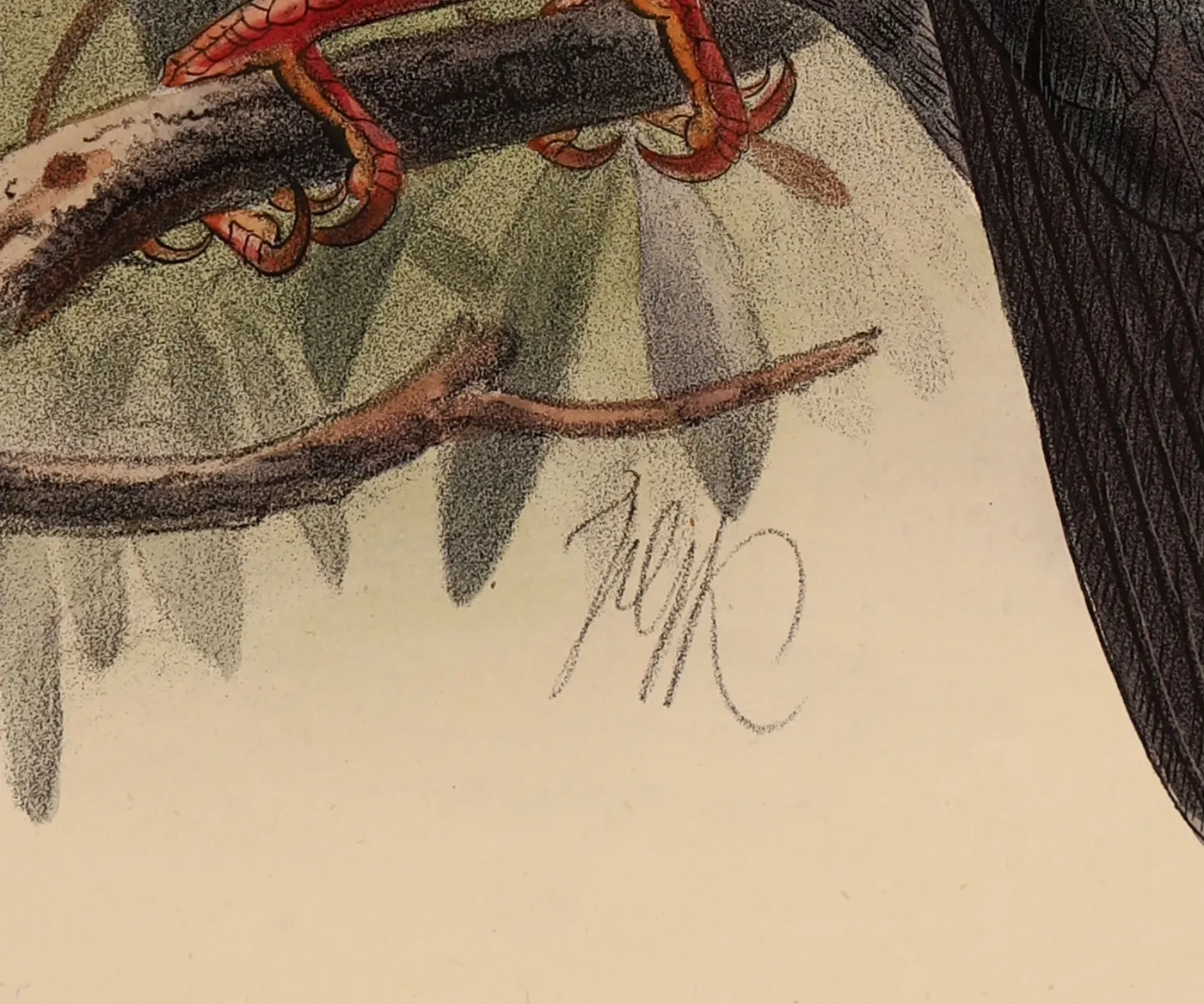
The bright red feet introduce a small but decisive chromatic accent beneath the body. Their position on the branch is anatomically clear: the toes close around the support, while the claws follow its curvature through finely controlled lithographic lines.
The surrounding vegetation remains deliberately restrained. Pale green and grey leaves form a loose botanical setting behind the bird, while the branch extends diagonally beneath its body. These elements provide spatial depth without competing with the subject.
Keulemans keeps the silhouette exceptionally clear. The head, breast, folded wings, feet and tail may all be examined without obstruction, yet the bird never appears isolated from the suggestion of a natural environment.
The resulting image is both monumental and quiet. Its strength does not depend on movement or dramatic colour, but on the careful distribution of weight, the controlled modelling of the body and the sustained presence of a single living subject.
The bird is identified in the original caption as Turturoena sharpei Salvadori. The name preserves the taxonomic treatment in use when the plate was published in 1894.
The taxon is now generally classified as Columba delegorguei sharpei, a form of the Eastern Bronze-naped Pigeon. The group is characterised by dark plumage, bronze or reddish wings, subtle green and violet reflections around the neck and a long dark tail.
Keulemans records these identifying features with particular clarity. The bronze-red wing coverts, darker flight feathers, coloured neck, red orbital area and contrasting feet remain individually legible within the broader tonal unity of the bird.
The historical name printed beneath the image is part of the scientific identity of the original sheet. Its later reassignment to the genus Columba demonstrates how zoological classification continues to evolve after an illustrated description has entered the literature.
The plate may therefore be read both as a precise representation of the bird and as a record of the taxonomic framework through which it was understood at the end of the nineteenth century.
This plate demonstrates Keulemans’ ability to transform a single taxonomic specimen into a living presence without sacrificing scientific legibility. Every major diagnostic feature remains accessible, yet the bird possesses weight, posture and a quiet psychological immediacy.
The effect begins with scale. Rather than placing the subject at a distance, Keulemans allows the pigeon to occupy most of the illustrated field. Its body becomes almost architectural: the head rises above the breast, the wings form a broad central mass and the tail descends as a stable visual counterweight.
The pose is carefully judged. The bird neither flies nor performs a dramatic gesture. It simply stands upon the branch, alert and self-contained. This restraint allows attention to settle on the structure of the plumage, the changing colours of the neck and wings and the physical relationship between body, feet and support.
Scientific clarity is preserved through the clean silhouette. The bill, orbital area, neck, breast, folded wings, feet and tail remain separately readable, while the botanical background is kept sufficiently pale to avoid interrupting the bird’s outline.
The colour is similarly controlled. Bronze-red wings provide warmth, but do not overwhelm the darker body. Green and violet passages around the neck are introduced in small, carefully placed areas, suggesting changes in reflected light rather than creating a uniform decorative surface.
Close examination of the original impression reveals selective glossy finishing across the feathers of the wings and tail, around the eye and over portions of the neck and throat. These local reflections are consistent with a restrained application of gum arabic over the hand-coloured surface.
The gum arabic does not form a continuous coating. It is concentrated where reflected light can reinforce the vitality of the eye, the layered structure of the wing feathers and the subtle lustre associated with the neck and throat plumage.
Under changing light, these passages become alternately visible and subdued. Their purpose is not to produce an overall glossy finish, but to introduce slight variations across the surface corresponding to the changing character of living feathers.
The original hand-applied watercolour remains transparent enough for the lithographic structure to stay active throughout. Feather divisions, tonal transitions and the modelling of the head, breast and tail continue to be defined primarily through the printed line.
Minute differences in pigment density and local application are compatible with manual colouring. The bronze-red wing feathers, green neck markings and darker passages do not form mechanically uniform fields, but follow the direction and division of the printed plumage.
This assessment is based upon close visual examination of the original impression, comparative observation and supporting bibliographic descriptions rather than laboratory analysis. Considered together, the lithographic underdrawing, transparent colour and selective surface enhancement form a coherent material sequence.
The image is printed on substantial late nineteenth-century wove paper. The sheet displays no regular pattern of laid and chain lines. Its dense, even surface was well suited to receiving finely differentiated lithographic drawing, transparent watercolour and local gum arabic finishing.
As a lithograph, the work does not display the recessed plate mark associated with copper engraving or etching. The flat printing process allowed Keulemans to preserve the direct and flexible line required for feather structure, tonal modelling, claws and softly developed foliage.
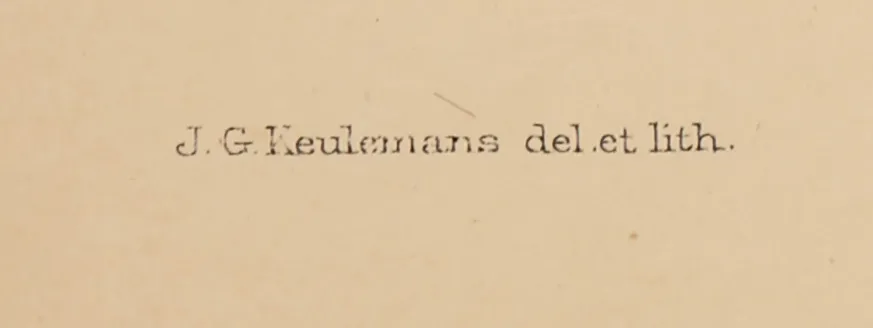
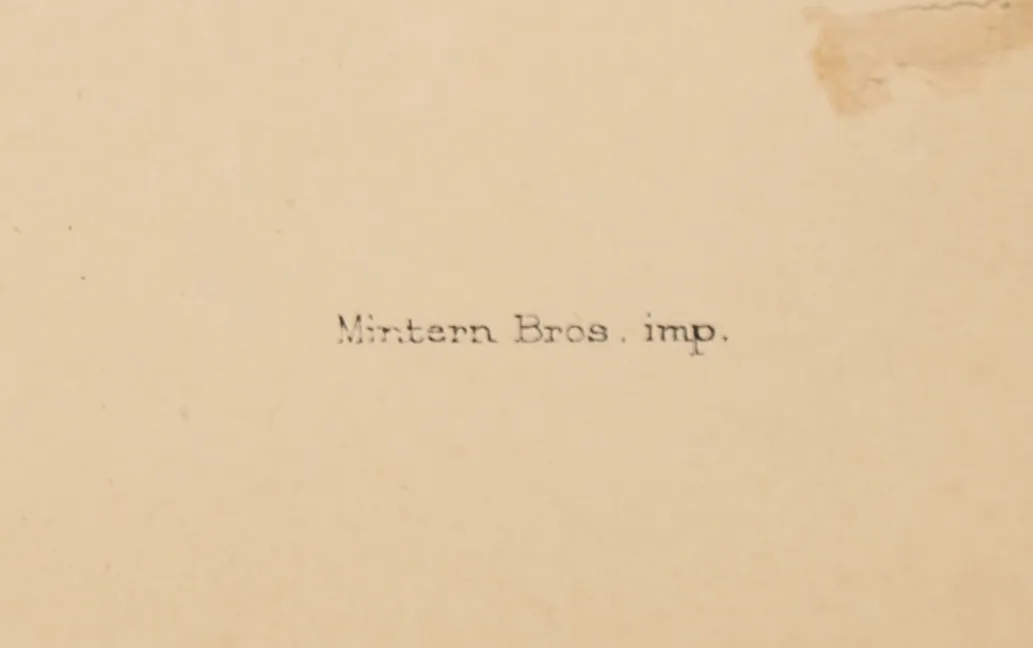
The printed inscriptions preserve the artistic and editorial chain of production. At lower left, “J. G. Keulemans del. et lith.” records Keulemans’ responsibility for both the original drawing and its lithographic preparation. At lower right, “Mintern Bros. imp.” identifies the London printing establishment responsible for the impression.
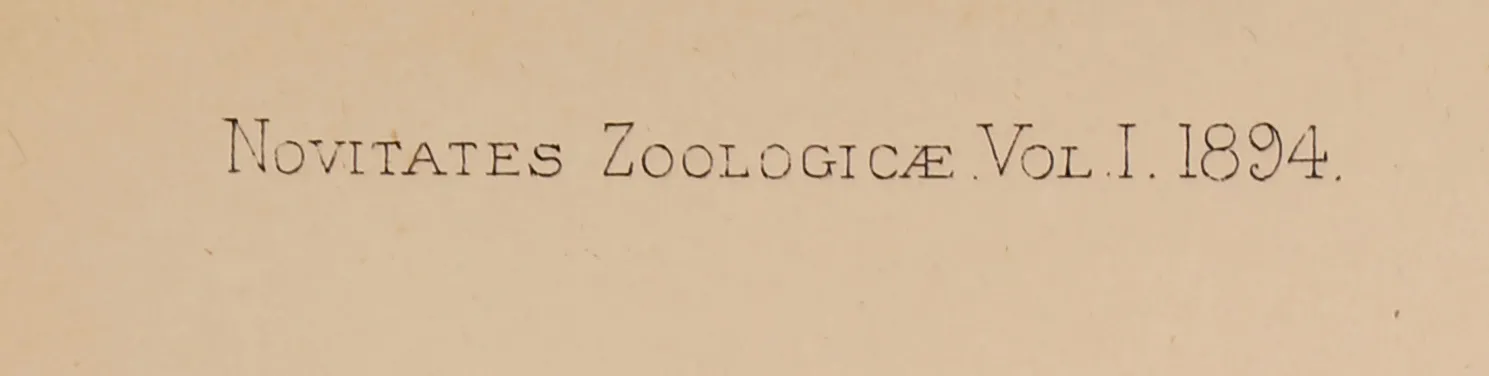
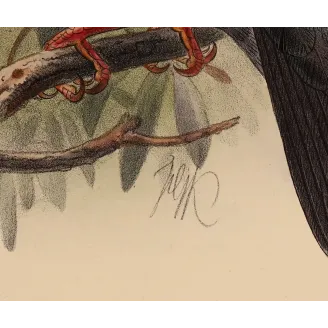
Keulemans’ lithographic monogram is incorporated within the image beneath the bird. It belongs to the printed composition and should not be interpreted as an individually hand-applied signature. At the upper edge, the title, volume, year and plate number connect the sheet securely to Volume I of Novitates Zoologicae.
Together, the printed line, contemporary hand colouring, selective gum arabic and surviving editorial inscriptions reveal the complete structure of the work. A scientific subject was observed, drawn, transferred to stone, printed, coloured and finished through a succession of specialised hands.
The distinction of this plate lies in the restraint with which that complex process is brought together. Nothing distracts from the bird, yet the result is more than an identification image: it is a convincing encounter with a singular living form.
This original lithograph belongs to the wider history of zoological research centred upon Walter Rothschild’s museum at Tring. Specimens entering the collection were examined, classified and transformed into images capable of communicating new scientific knowledge internationally.
The presentation of a single subject allowed Keulemans to unite close scientific observation with a more concentrated visual presence. The bird’s identifying features remain fully accessible, while its posture, scale and botanical setting preserve the impression of a living creature rather than a detached specimen.
Novitates Zoologicae provided the editorial framework for this collaboration. Naturalists established the taxonomic identity, Keulemans translated the bird into visual form, Mintern Brothers produced the lithographic impression and skilled colourists completed each sheet individually.
The complete Heritage Essay follows this wider network of museum research, illustration, printing and hand colouring, from Walter Rothschild’s collections and Keulemans’ studio to the original impressions that continue to make Victorian zoological knowledge visible today.
Novitates Zoologicae: Keulemans, Rothschild and the Birth of a Modern Zoological Journal →
Very good condition. The substantial late nineteenth-century wove paper remains structurally sound and stable.
The lithographic impression remains clearly defined throughout. The original hand-applied watercolour is stable and fully legible across the bird and surrounding vegetation.
Selective gum arabic remains visible across portions of the wing feathers and tail, around the eye and over areas of the neck and throat. The finishing remains integrated with the underlying colour.
The sheet displays natural age-related toning, becoming somewhat deeper towards the outer borders. Minor handling and former binding traces are principally confined to the margins.
A small localised historical surface mark is visible in the lower right margin, outside the principal illustrated field. It does not affect the bird or the main composition.
The central illustrated field is free from major creases, tears, losses or visually disruptive staining. The title, date, plate number, species caption, artist’s credit and printer’s inscription remain fully legible.
The professional high-resolution photographs document the complete sheet, illustrated field, inscriptions, paper tone and visible condition details for direct assessment.
Editorial title: Bronze Plumage and Quiet Presence
Original species caption: Turturoena sharpei Salvadori
Current scientific name: Columba delegorguei sharpei
Common name: Eastern Bronze-naped Pigeon
Work: Novitates Zoologicae
Volume: Vol. I
Plate: III
Artist and lithographer: John Gerrard Keulemans (1842–1912)
Printed artist’s credit: J. G. Keulemans del. et lith.
Printer: Mintern Bros., London
Printed printer’s credit: Mintern Bros. imp.
Place of publication: Tring, England
Date: 1894
Technique: Original lithograph with contemporary hand-applied watercolour
Finishing: Selective gum arabic visible on the wings, tail, eye, neck and throat
Paper: Substantial late nineteenth-century wove paper
Plate mark: Not applicable to the lithographic process
Signature: Keulemans lithographic monogram within the printed image; printed attribution below; not individually hand-signed
Sheet size: approx. 28 × 19 cm
Condition: Very good condition, with natural historical toning becoming somewhat deeper towards the outer borders and a small localised mark in the lower right margin
Collector positioning: A composed single-subject plate in which scientific legibility is united with scale, poise and quiet living presence
Collection: Keulemans Novitates
Authenticity: Original nineteenth-century print — never a modern reproduction
Specific References
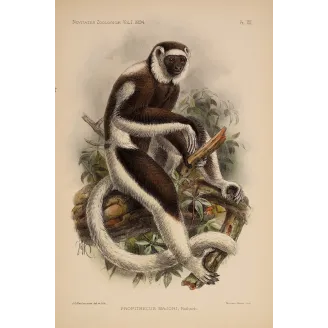
Original hand-coloured lithograph by John Gerrard Keulemans from Novitates Zoologicae, Volume I, Plate XII, published in 1894. Depicting Propithecus majori (Major's Sifaka), the composition combines precise anatomical observation with an unusually expressive portrayal of a living primate. Selective gum arabic remains visible on the pupils and across the darker fur of the forelimb, thigh and body. Printed by Mintern Bros. on substantial wove paper and preserved in very good condition.
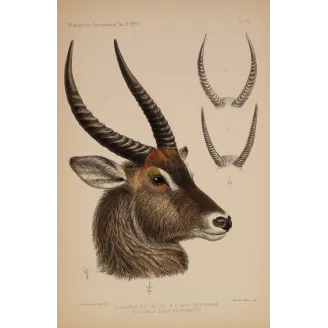
Original hand-coloured lithograph by John Gerrard Keulemans from Novitates Zoologicae, Volume II, Plate IV, published in 1895. The sheet combines a finely observed portrait of an African waterbuck with comparative studies of three horn forms used for zoological identification. Selective gum arabic remains visible on the forehead, pupil, nose and darker portions of the principal horns. Printed by Mintern Bros. on substantial wove paper and preserved in very good condition.
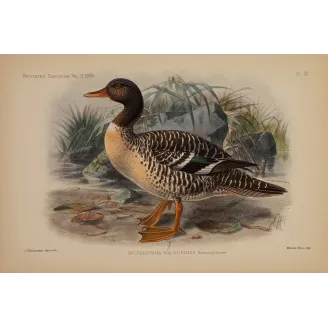
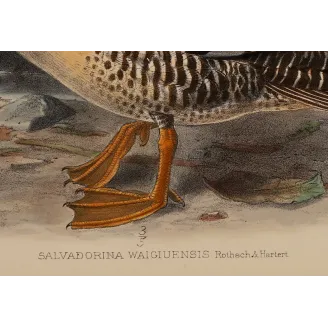
Original hand-coloured lithograph by John Gerrard Keulemans from Novitates Zoologicae, Volume II, Plate III, published in 1895. Depicting the remarkable Waigeu Duck (Salvadorina waigiuensis), the composition combines precise zoological observation with a carefully constructed wetland landscape. Selective gum arabic remains visible across the wing feathers, tail, pupil and neck. Printed by Mintern Bros. on substantial wove paper and preserved in very good condition.
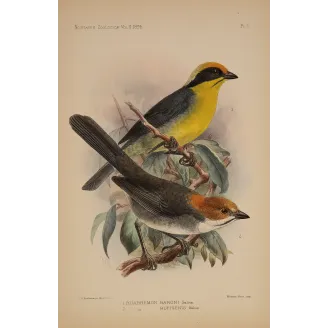
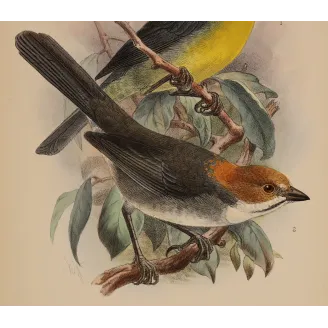
Original hand-coloured lithograph by John Gerrard Keulemans from Novitates Zoologicae, Volume II, Plate I, published in 1895. The composition depicts two Peruvian Andean brushfinches against a restrained botanical setting, with selective gum arabic highlights around the eyes and across parts of the upper bird’s wings. Printed by Mintern Bros. on substantial wove paper and preserved in very good condition.
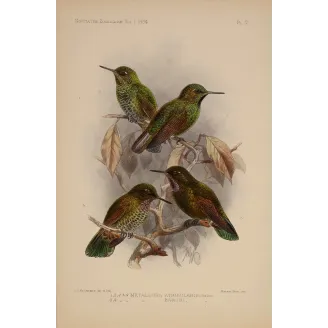
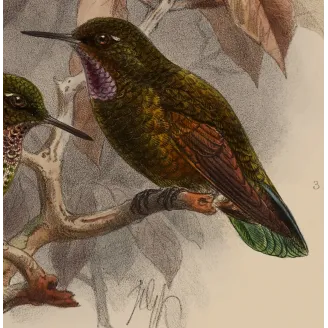
Original hand-coloured lithograph by John Gerrard Keulemans from Novitates Zoologicae, Volume I, Plate IV, published in 1894. Four closely related metaltail hummingbirds are arranged as a comparative study of shared structure and subtle variation, with selective gum arabic visible across the bodies of all four subjects. Printed by Mintern Bros. on substantial wove paper and preserved in very good condition.
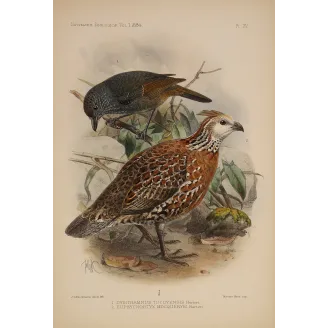
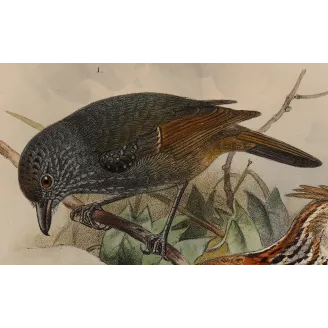
Original hand-coloured lithograph by John Gerrard Keulemans from Novitates Zoologicae, Volume I, Plate XV, published in 1894. The composition presents a Venezuelan White-streaked Antvireo above a richly patterned Crested Bobwhite, using vertical placement to suggest two distinct ecological levels within the same natural environment. Selective gum arabic remains visible on the pupils of both subjects and more extensively across the plumage of the lower bird. Printed by Mintern Bros. on substantial wove paper and preserved in very good condition.
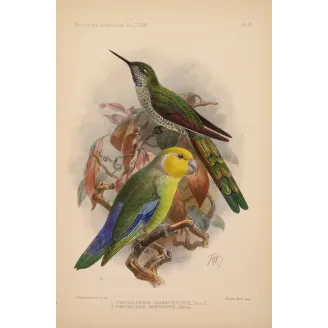
Original hand-coloured lithograph by John Gerrard Keulemans from Novitates Zoologicae, Volume II, Plate II, published in 1895. The composition depicts the Grey-bellied Comet and Yellow-faced Parrotlet against a restrained botanical background, with selective gum arabic highlights visible across parts of the hummingbird’s plumage. Printed on substantial wove paper by Mintern Bros. and preserved in very good condition.
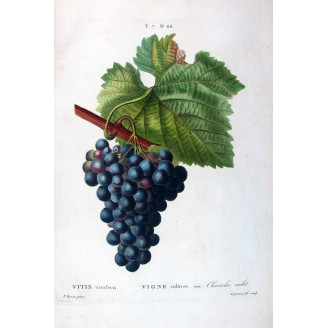
Original antique print of the cultivated Chasselas grape vine, Vitis vinifera, by Pancrace Bessa.
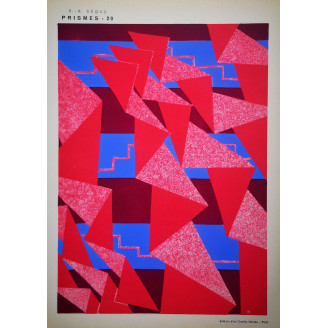
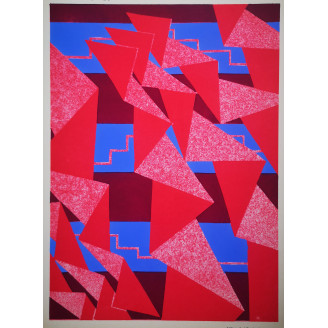
Original 1931 pochoir print by Émile-Allain Séguy. Plate No. 20, from the rare portfolio *Prismes*.
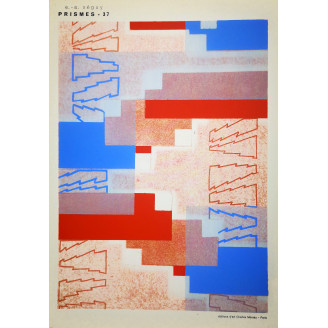
Original 1931 pochoir print by Émile-Allain Séguy. Plate No. 37, from the rare portfolio *Prismes*.
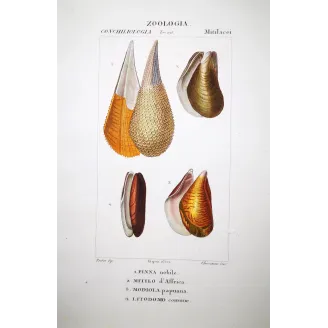
Antique conchology print: Pinna nobilis, Mitilo, Modiola, and Litodomo drawn by Prêtre.
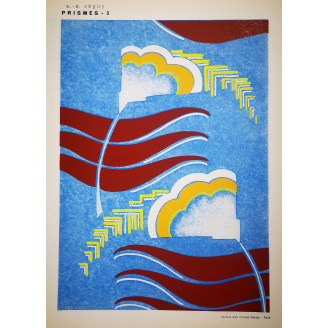
Original 1931 pochoir print by Émile-Allain Séguy. Plate No. 3, from the rare portfolio *Prismes*
Original 1931 pochoir print by Émile-Allain Séguy. From the rare portfolio *Prismes*.
Original 1931 pochoir print by Émile-Allain Séguy. From the rare portfolio *Prismes*.
Original hand-coloured lithograph by John Gerrard Keulemans from Novitates Zoologicae, Volume I, Plate III, published in 1894. The plate depicts Turturoena sharpei, now classified as Columba delegorguei sharpei, with selective gum arabic highlights on the wings, tail, eye, neck and throat. Printed by Mintern Bros. on substantial wove paper and preserved in very good condition.