
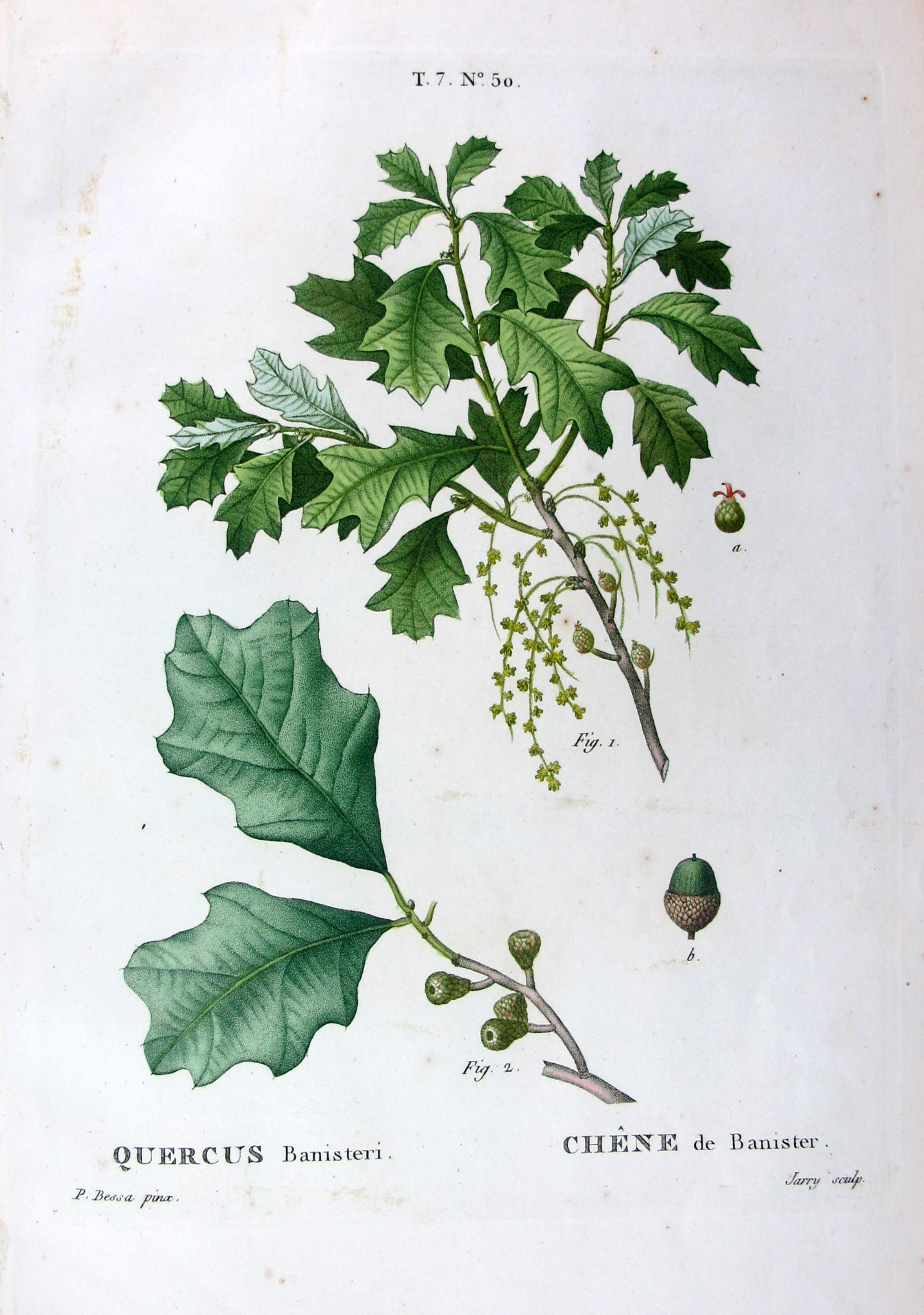
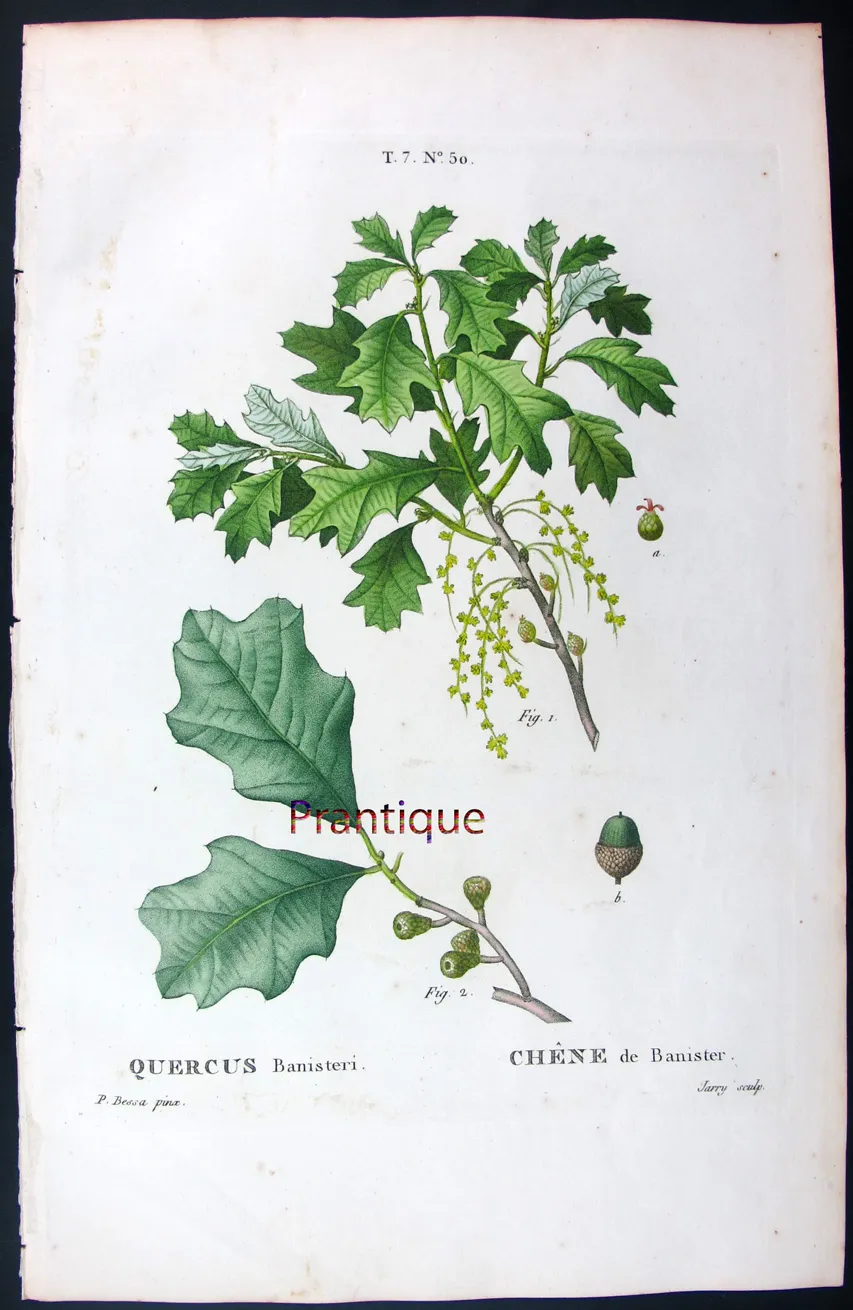

Engraving of Banisters oak with botanical accuracy.
 Delivery policy
Your print will be carefully prepared and shipped worldwide via trusted couriers (UPS or similar).
 Authentic antique prints
Original engravings from the 17th–19th century.
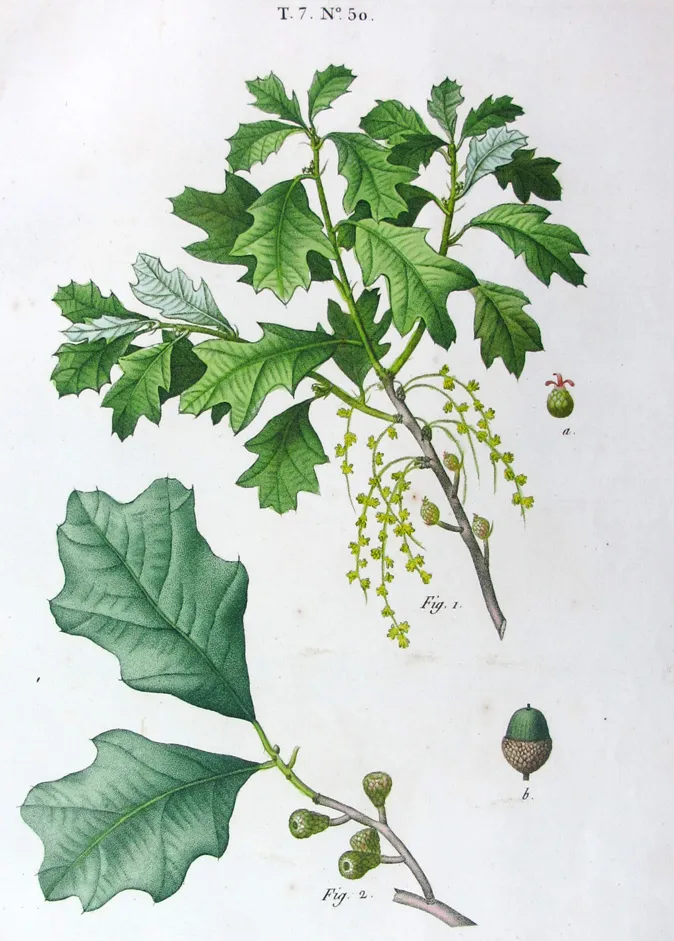
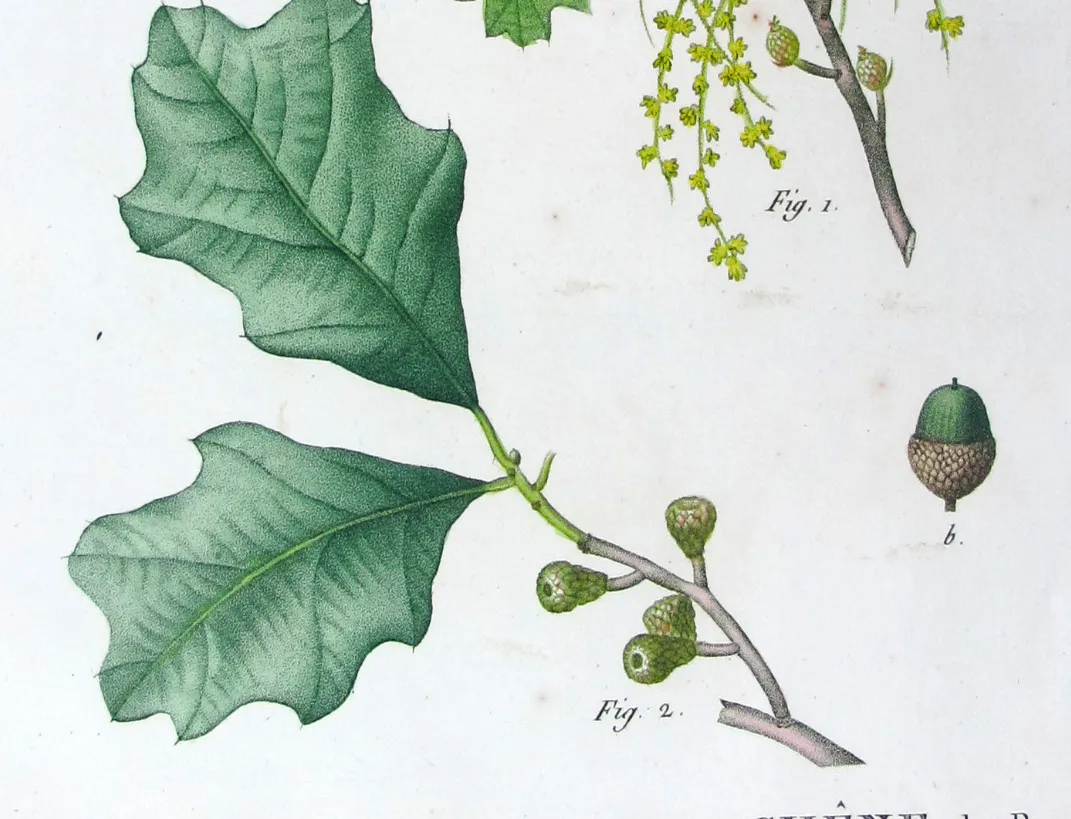
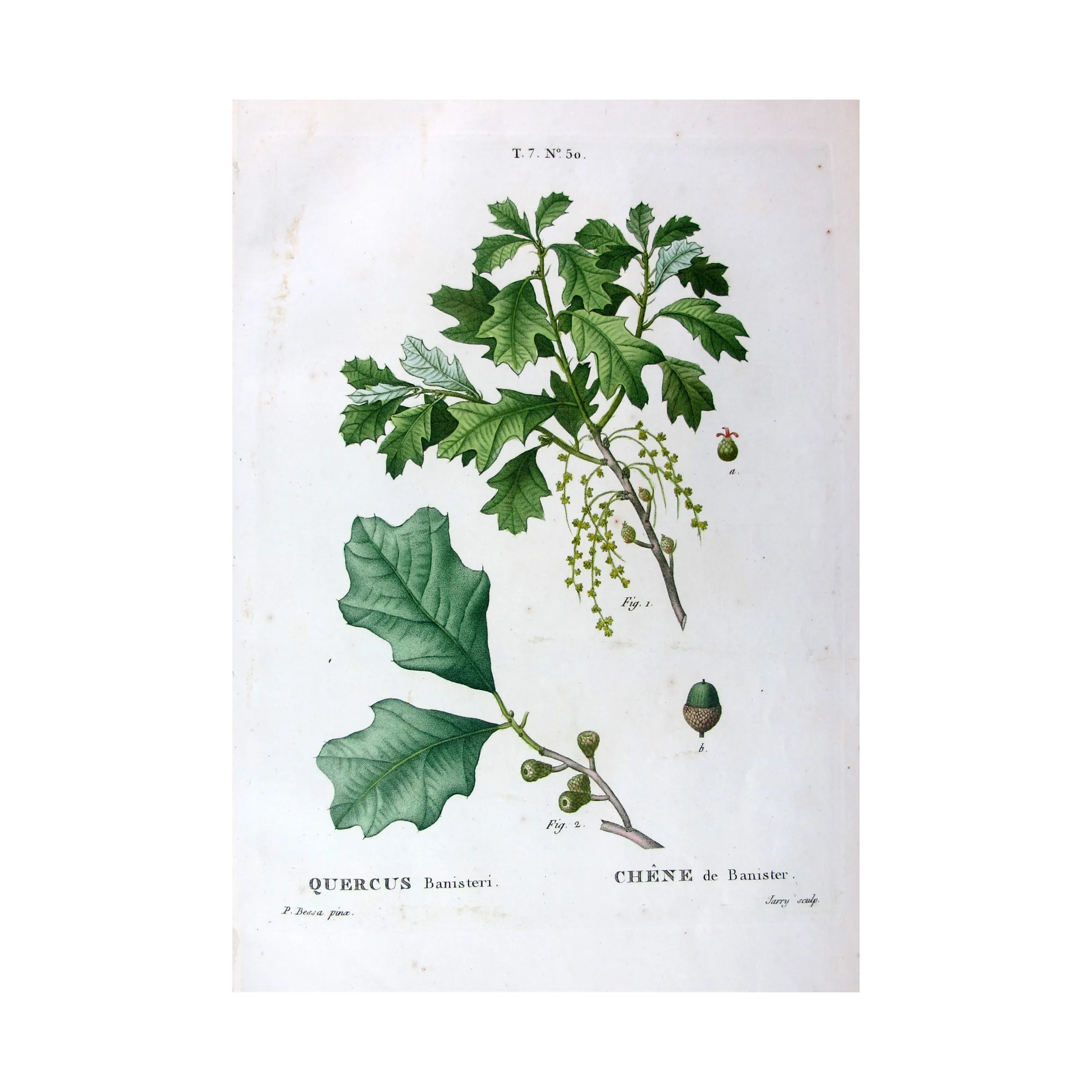
This original engraving depicts Quercus banisteri, a North American oak presented through a carefully balanced composition combining a flowering branch, a mature acorn, and a separate analytical study of foliage. The arrangement allows both botanical clarity and visual rhythm, typical of Bessa’s disciplined approach.
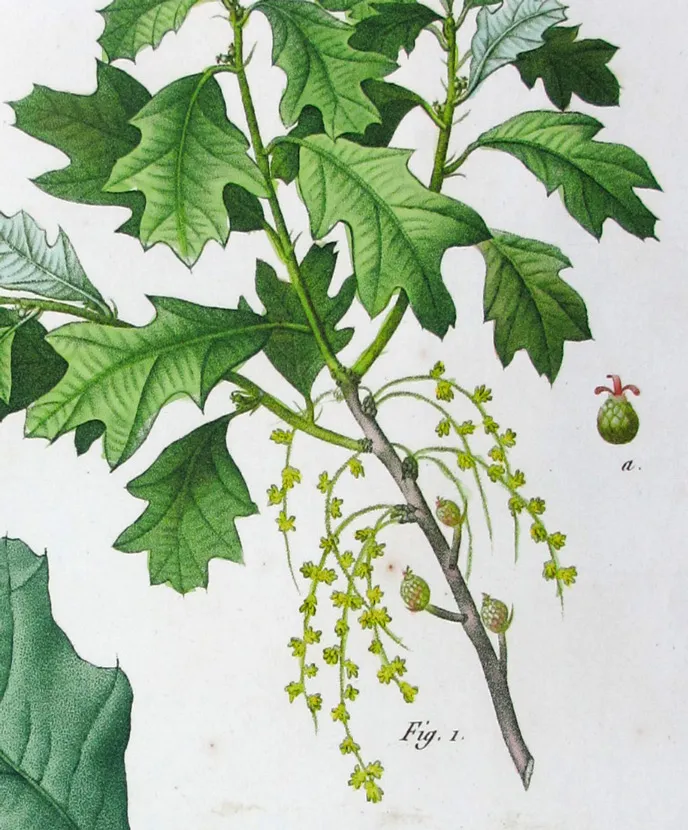
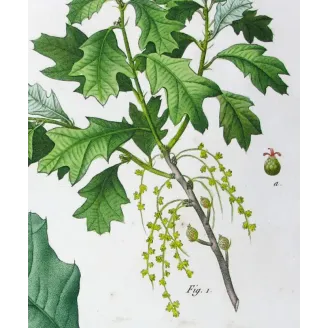
The upper branch carries pendant male catkins and developing fruit, while the broader lower leaves introduce a structural counterbalance. The tonal modelling of the greens is soft yet controlled, creating depth without heaviness and preserving the clean, architectural quality of the oak form.
An intriguing historical nuance lies in the name itself. Quercus banisteri is today generally regarded as a synonym or early classification of what is now known as Quercus laurifolia, the Laurel Oak. This plate therefore captures a moment in botanical history when the taxonomy of American oaks was still evolving, reflecting the dynamic nature of scientific understanding in the early nineteenth century.
— • —
The composition is spacious and vertically oriented. The elongated leaves of the principal branch convey a laurel-like elegance, differentiating this species from the more heavily lobed oaks previously examined. The pendant catkins introduce movement, softening the otherwise firm oak structure.
The acorn, presented separately for clarity, is engraved with precise stipple work, its textured cup contrasting with the smooth curvature of the nut. This controlled detailing demonstrates Jarry’s technical finesse and his ability to translate botanical observation into refined decorative presentation.
Quercus banisteri, now commonly associated with Quercus laurifolia, is native to the southeastern United States and is known for its evergreen or semi-evergreen foliage. Its laurel-like leaves distinguish it visually from more deeply lobed oak species. The shifting nomenclature surrounding this species illustrates the complexities faced by early botanists in classifying the diverse and often hybridizing Quercus genus.
The engraving is in Like Brand New condition. The sheet remains clean and well preserved, with fresh original hand-colouring and an even natural paper tone. No watermark has been observed. The engraved credits confirm the original drawing by Pancrace Bessa and the engraving executed by Jarry, verifying its authenticity as an original early nineteenth-century plate.
For further context on Pancrace Bessa and his distinctive contribution to French botanical illustration, see our editorial feature:
Specific References
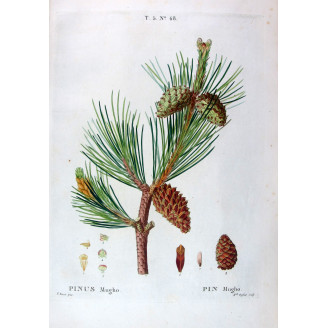
Antique engraving of Pinus Mugho by Bessa, rich in botanical detail.
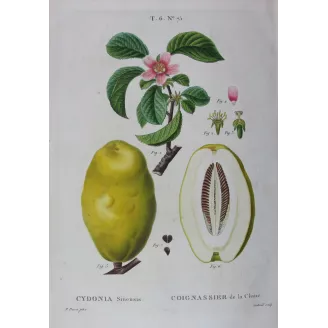
Chinese Quince Coignassier de la Chine Original hand-colored botanical engraving by Pancrace Bessa.
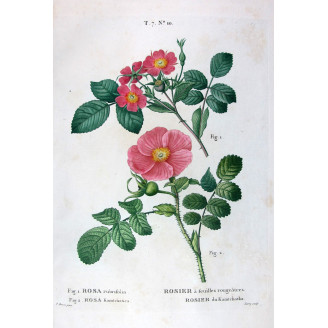
Kamchatka Rose Rosier du Kamchatka Original hand-colored botanical engraving by Pancrace Bessa.
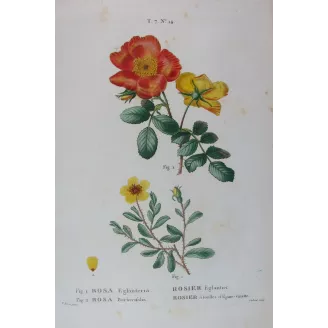
Eglantine & Berberis-leaved Rose Rosier à feuilles d'Épine-vinette Original hand-colored botanical engraving by Pancrace Bessa.
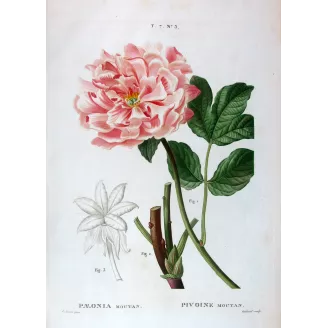
Tree Peony Pivoine moutan Original hand-colored botanical engraving by Pancrace Bessa.
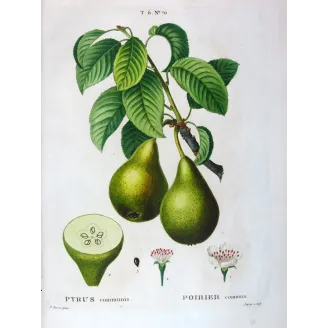
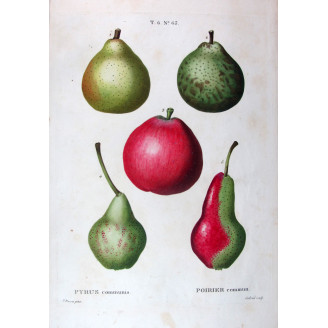
A refined early 19th-century botanical engraving depicting cultivated pear varieties (Pyrus communis), drawn by Pancrace Bessa and engraved for Arbres et Arbustes. Executed with restraint and clarity, the plate exemplifies the elegance of French pomological illustration, uniting scientific precision with a calm, decorative sensibility. The harmonious composition and subtle hand-colouring make it a timeless and highly collectible work.
A refined study of French cultivated pear varieties, distinguished by subtle chromatic contrasts and carefully modelled forms. This hand-colored engraving reflects Pancrace Bessa’s ability to elevate orchard subjects through balance, restraint, and quiet visual authority.
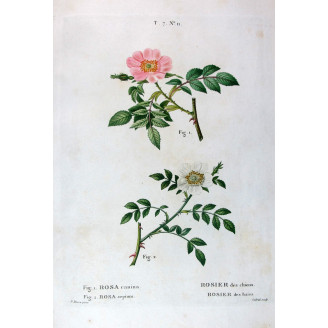
Dog Rose & Hedge Rose Rosier des chiens & Rosier des haies Original hand-colored botanical engraving by Pancrace Bessa.
Engraving of Banisters oak with botanical accuracy.