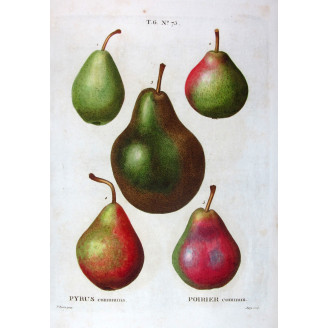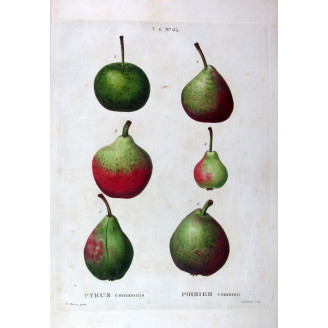
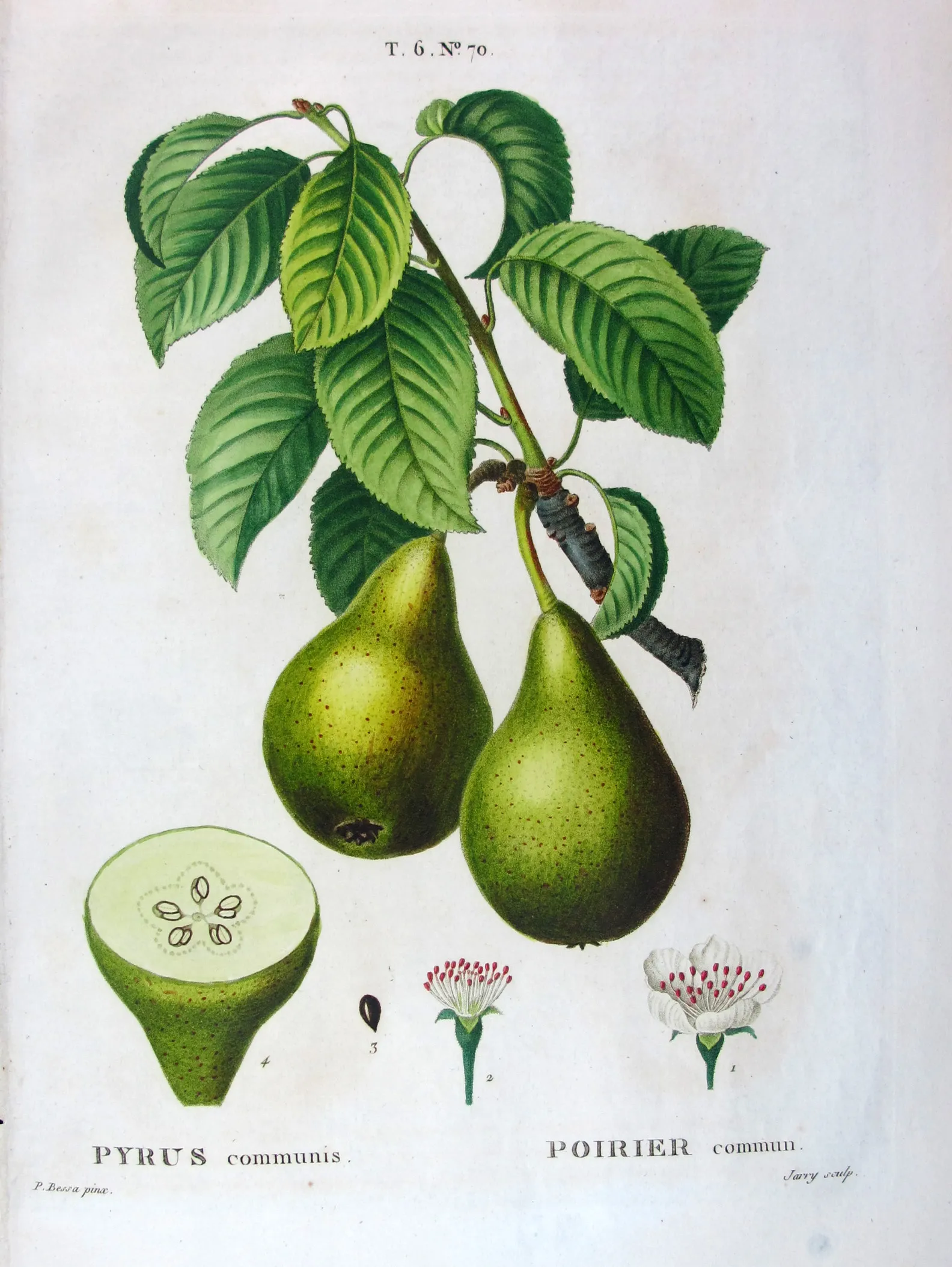
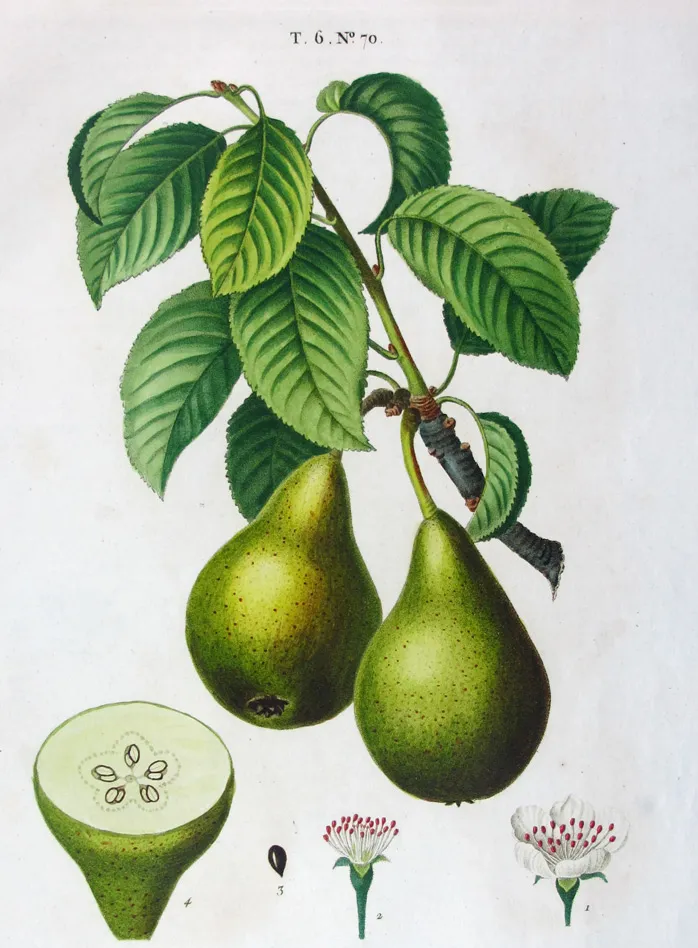
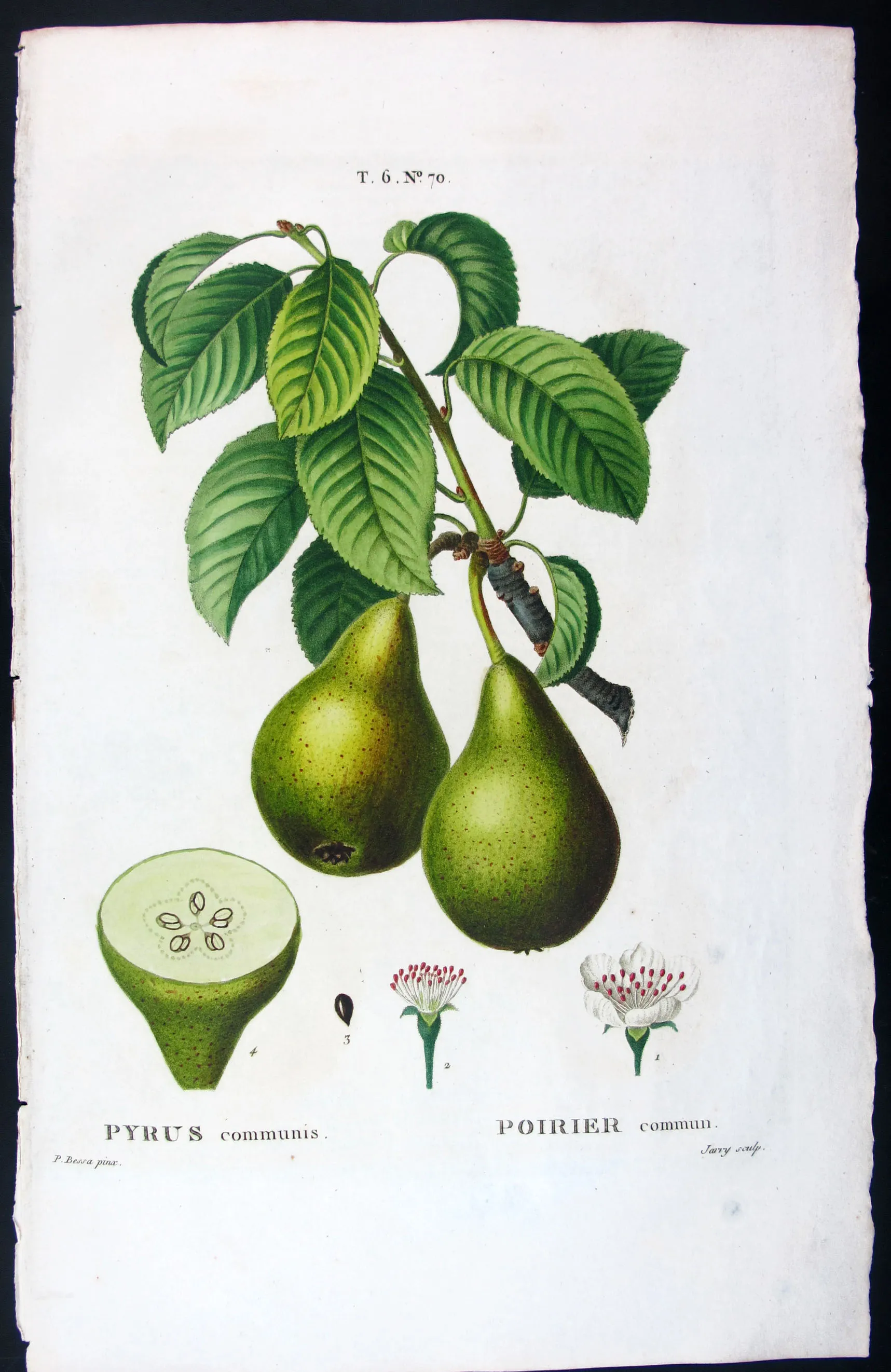
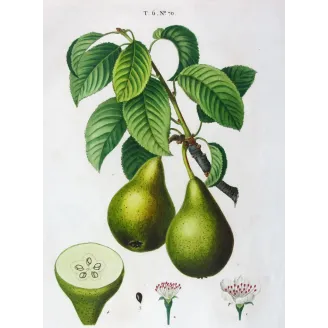
A refined early 19th-century botanical engraving depicting cultivated pear varieties (Pyrus communis), drawn by Pancrace Bessa and engraved for Arbres et Arbustes. Executed with restraint and clarity, the plate exemplifies the elegance of French pomological illustration, uniting scientific precision with a calm, decorative sensibility. The harmonious composition and subtle hand-colouring make it a timeless and highly collectible work.
 Delivery policy
Your print will be carefully prepared and shipped worldwide via trusted couriers (UPS or similar).
 Authentic antique prints
Original engravings from the 17th–19th century.
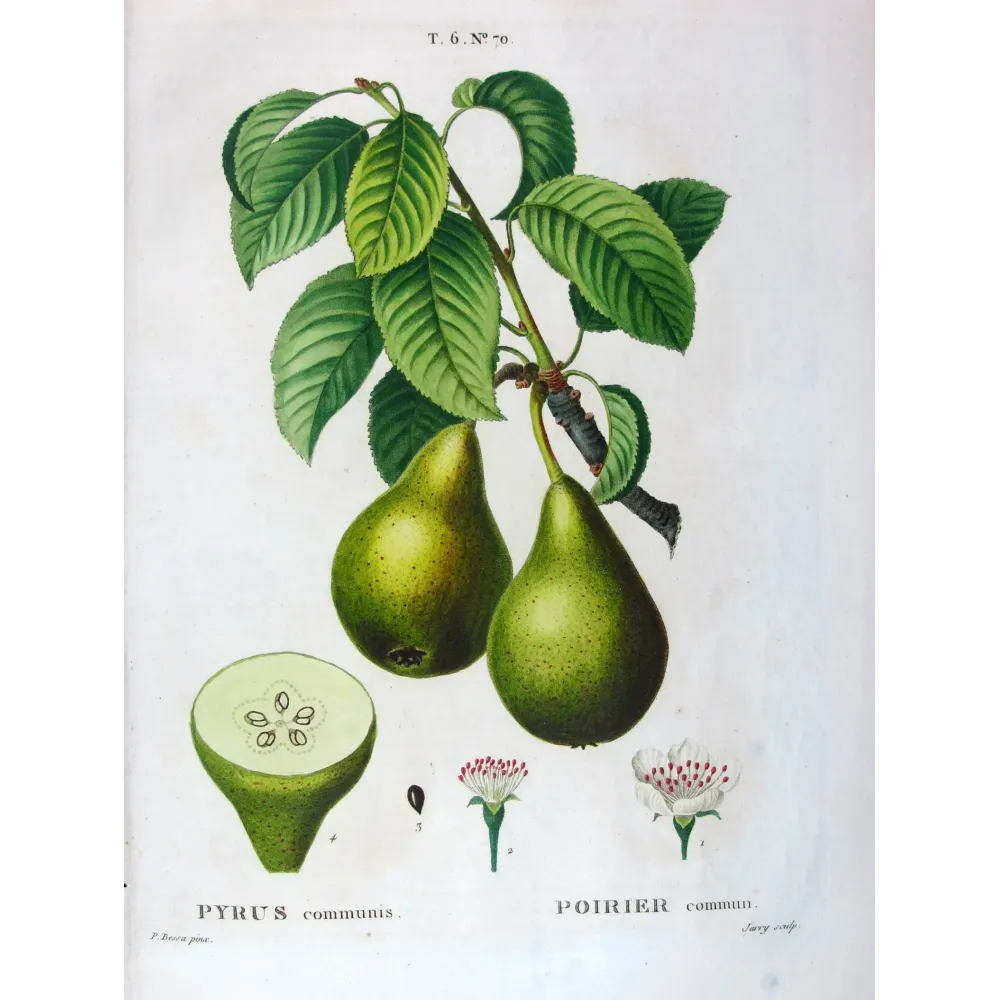
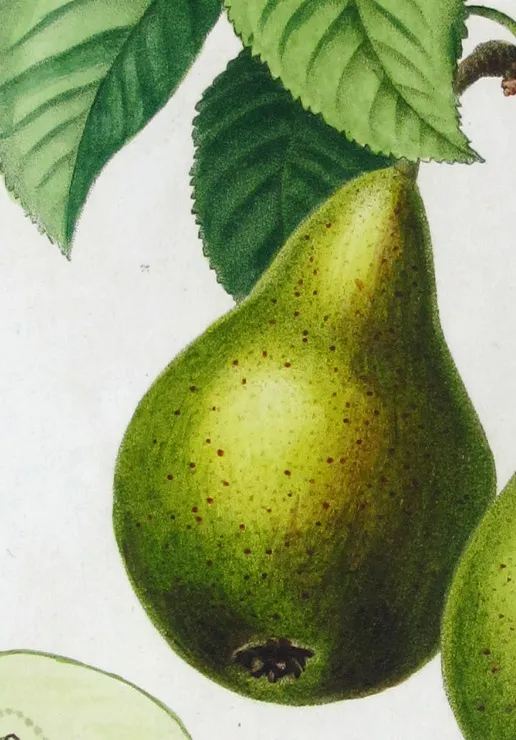
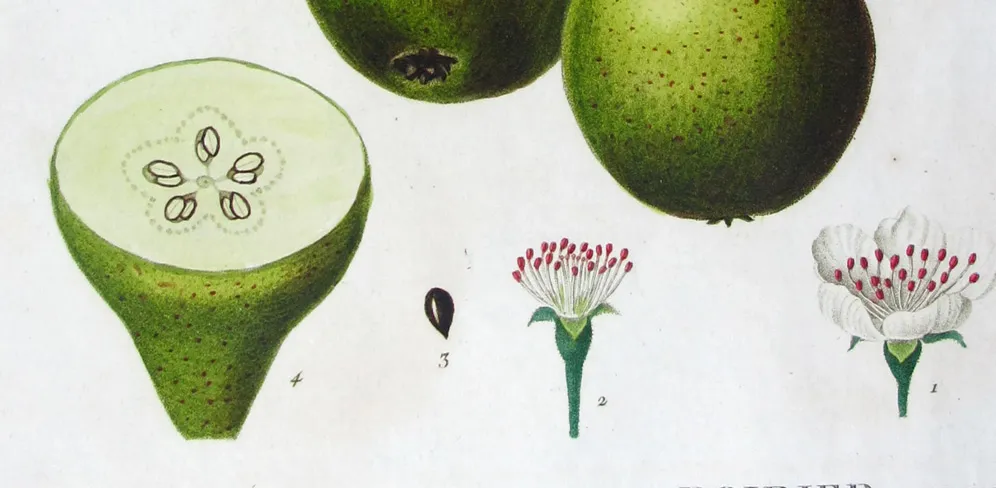
This original botanical engraving depicts a fruiting branch of a pear tree, shown bearing two mature fruits, accompanied by detailed studies of the flower, internal structure, and seed. The composition is restrained and harmonious, balancing visual elegance with botanical completeness.
Bessa presents the pears with soft, sculptural clarity. Their elongated forms are modelled through subtle tonal transitions, suggesting ripeness and weight without excess. The surrounding foliage, rendered in layered greens with crisp veining, frames the fruit and reinforces the vertical rhythm of the composition.
The engraving forms part of Arbres et Arbustes, one of the most accomplished French botanical publications of the early nineteenth century, in which Pancrace Bessa consistently elevated cultivated orchard subjects through refined observation and compositional balance.
— • —
The composition is organized around a gently curving branch that supports two pears suspended in visual equilibrium. This dual-fruit arrangement creates a sense of calm abundance, while the generous negative space of the sheet enhances clarity and elegance.
Below, the horizontal section of the pear reveals the internal chambers and seeds with precision, reinforcing the plate’s analytical dimension. The accompanying floral and seed studies complete the botanical narrative, allowing the engraving to function simultaneously as a decorative work and a document of cultivated variety.
Although broadly classified under Pyrus communis, this plate is more precisely identified in the original publication as representing the Poirier d’Angleterre. This historic cultivated pear variety was valued in early nineteenth-century orchards for its refined form, balanced proportions, and association with English horticultural traditions admired in France at the time.
The careful inclusion of fruit, flower, and a horizontal section illustrates the pomological approach of the period, in which cultivated varieties were documented through both outward appearance and internal organization. Such engravings were intended not only for scientific reference, but also for refined domestic and scholarly audiences.
In this plate, the pear is presented as both an object of study and an expression of cultivated elegance, exemplifying Bessa’s ability to unite botanical precision with visual grace.
The engraving is in very good antique condition. Light, even browning is present, consistent with the natural ageing of early nineteenth-century paper. A very faint toning is visible along the upper margin, close to the plate mark, and remains discreet and largely unobtrusive. No watermark has been observed. The original hand-colouring is well preserved across foliage, fruit, and analytical details, with no significant defects affecting the image. The engraved credits “P. Bessa pinx.” and “Jarry sculp.” are present, attesting to the original drawing by Pancrace Bessa and the engraving executed by Jarry.
For further context on Pancrace Bessa and his distinctive contribution to French botanical illustration, see our editorial feature:
Specific References
Elegant depiction of a rich purple Muscat grape variety by Pancrace Bessa.
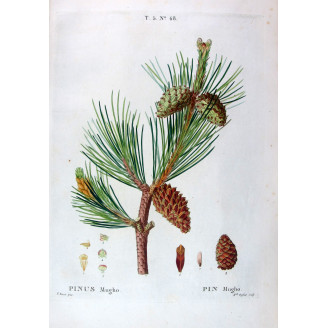
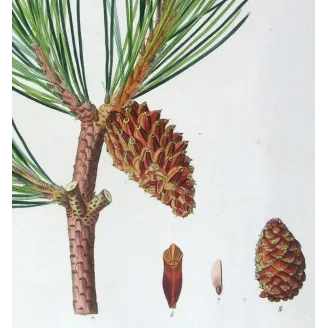
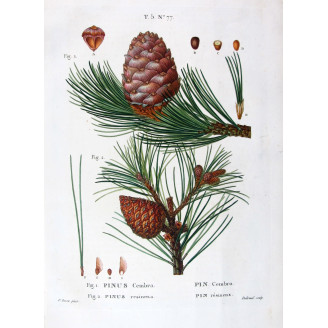
Antique engraving of Pinus Mugho by Bessa, rich in botanical detail.
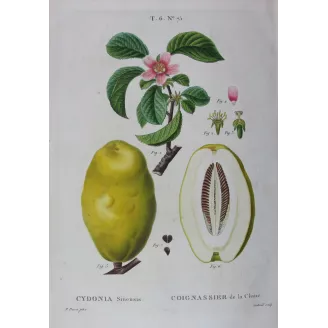
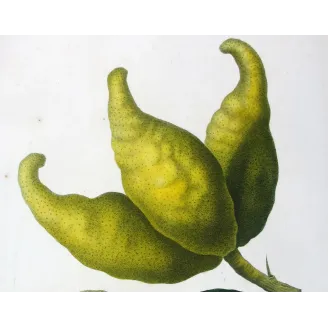
Chinese Quince Coignassier de la Chine Original hand-colored botanical engraving by Pancrace Bessa.
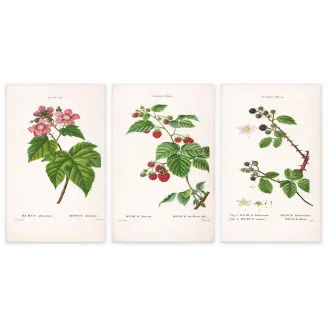
Illustration of the sweet-scented flowering bramble, Rubus odoratus, in full bloom.
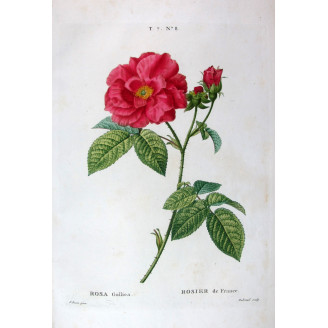
French Rose Rosier de France Original hand-colored botanical engraving by Pancrace Bessa.
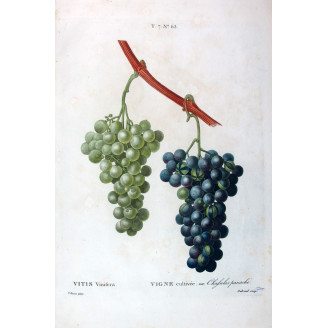
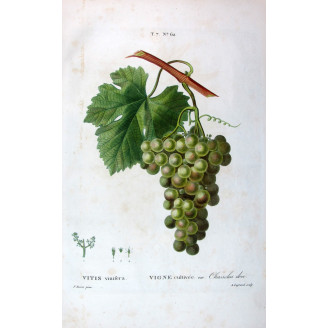
Rare depiction of striped Chasselas grape clusters, unique in its pattern and color.
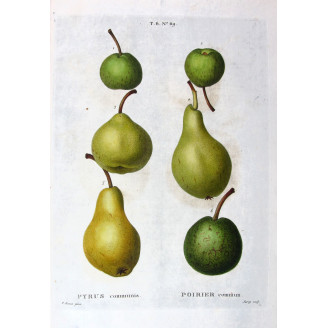
A refined study of cultivated pears, presenting five distinct fruit forms arranged in a balanced and harmonious composition. Subtle variations in shape, colour, and surface texture create a quiet visual rhythm, reflecting Pancrace Bessa’s ability to transform orchard subjects into works of enduring elegance.
Depiction of golden grapes with vivid green leaves in fine detail.
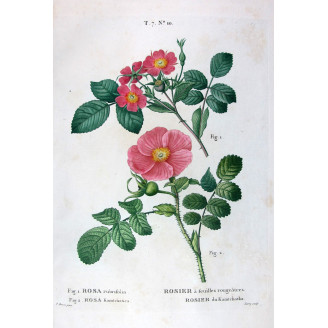
Kamchatka Rose Rosier du Kamchatka Original hand-colored botanical engraving by Pancrace Bessa.
Chinese Quince Coignassier de la Chine Original hand-colored botanical engraving by Pancrace Bessa.
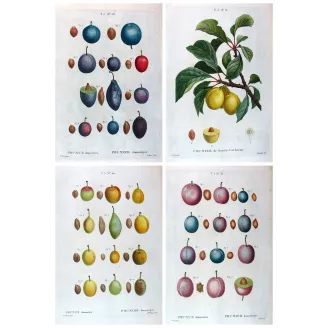
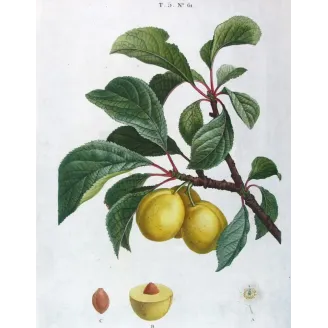
Botanical illustration of the Saint Catherine plum, a delicate fruit-bearing tree, by Pancrace Bessa.
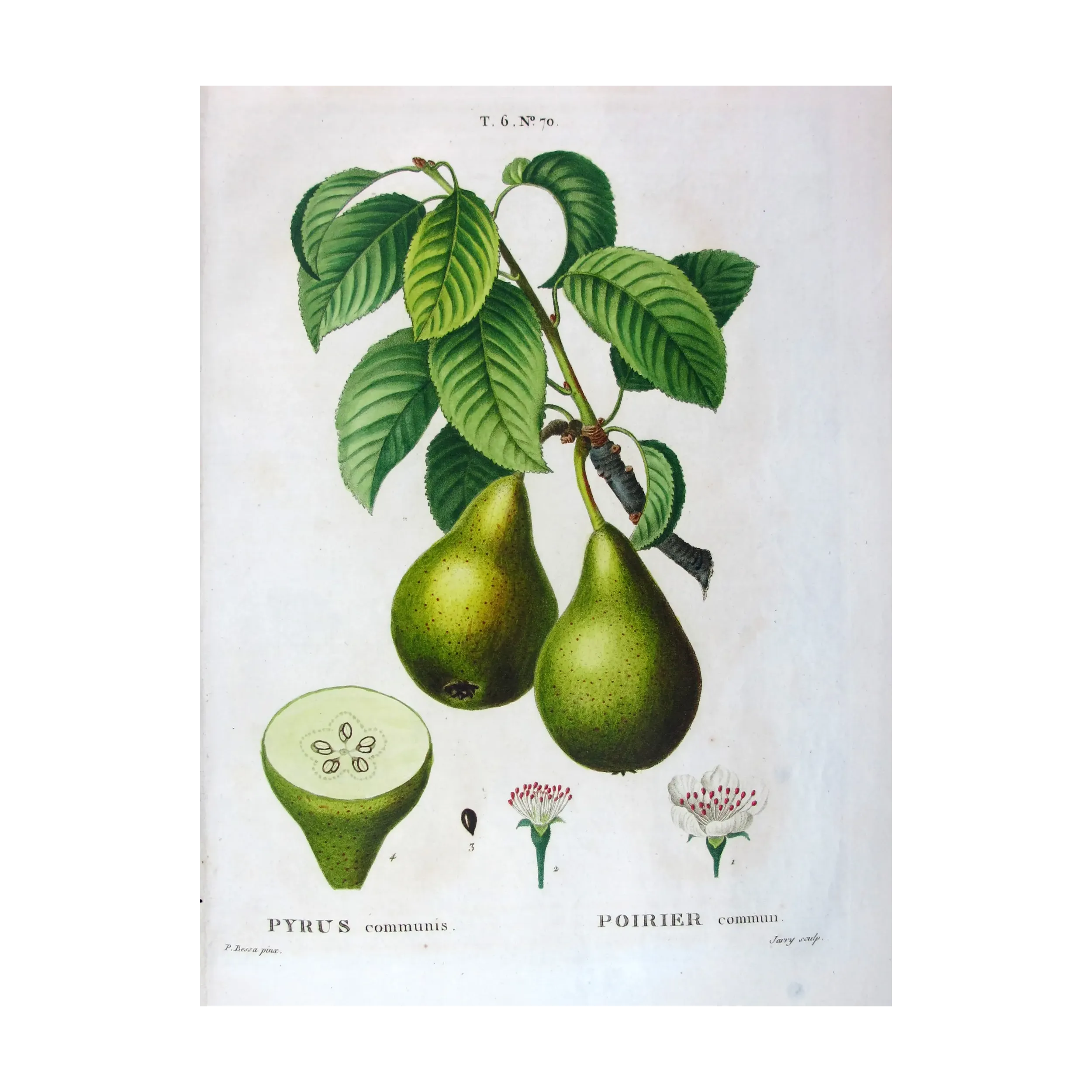
A refined early 19th-century botanical engraving depicting cultivated pear varieties (Pyrus communis), drawn by Pancrace Bessa and engraved for Arbres et Arbustes. Executed with restraint and clarity, the plate exemplifies the elegance of French pomological illustration, uniting scientific precision with a calm, decorative sensibility. The harmonious composition and subtle hand-colouring make it a timeless and highly collectible work.