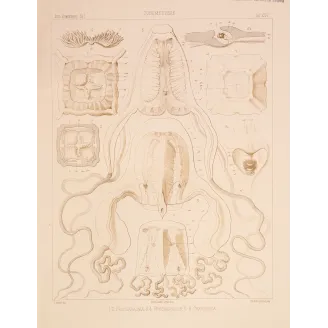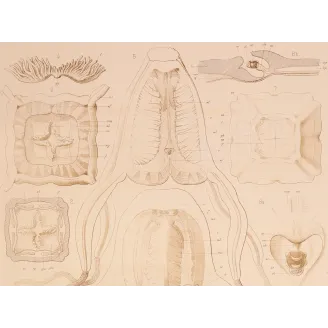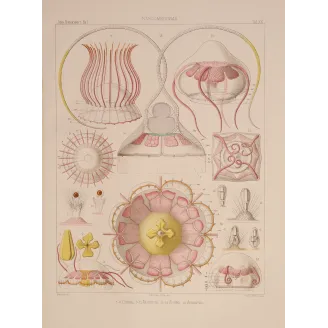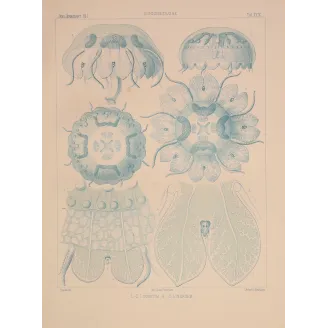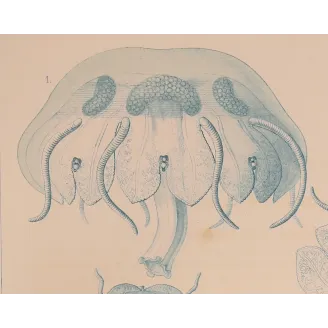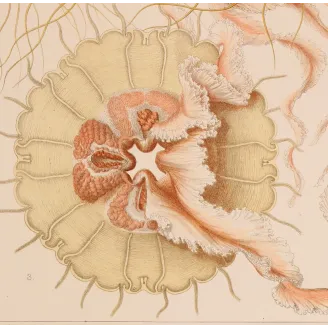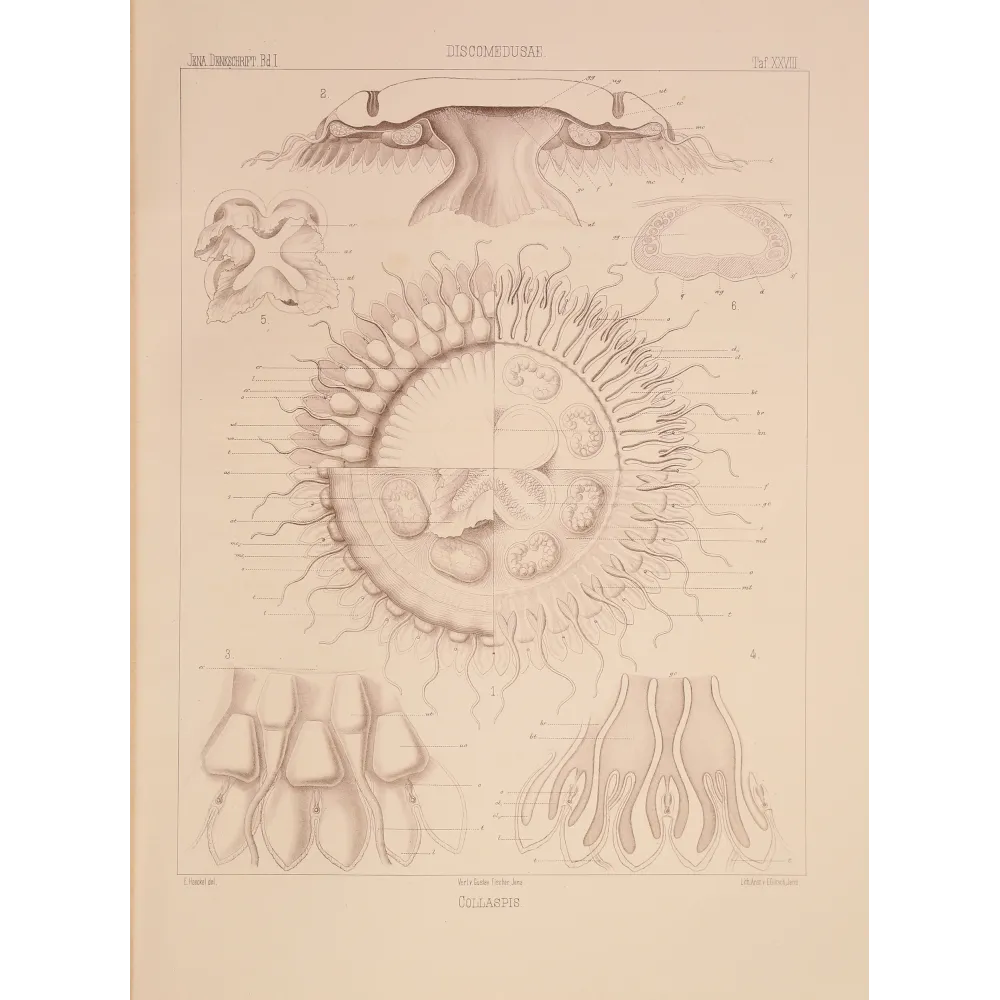
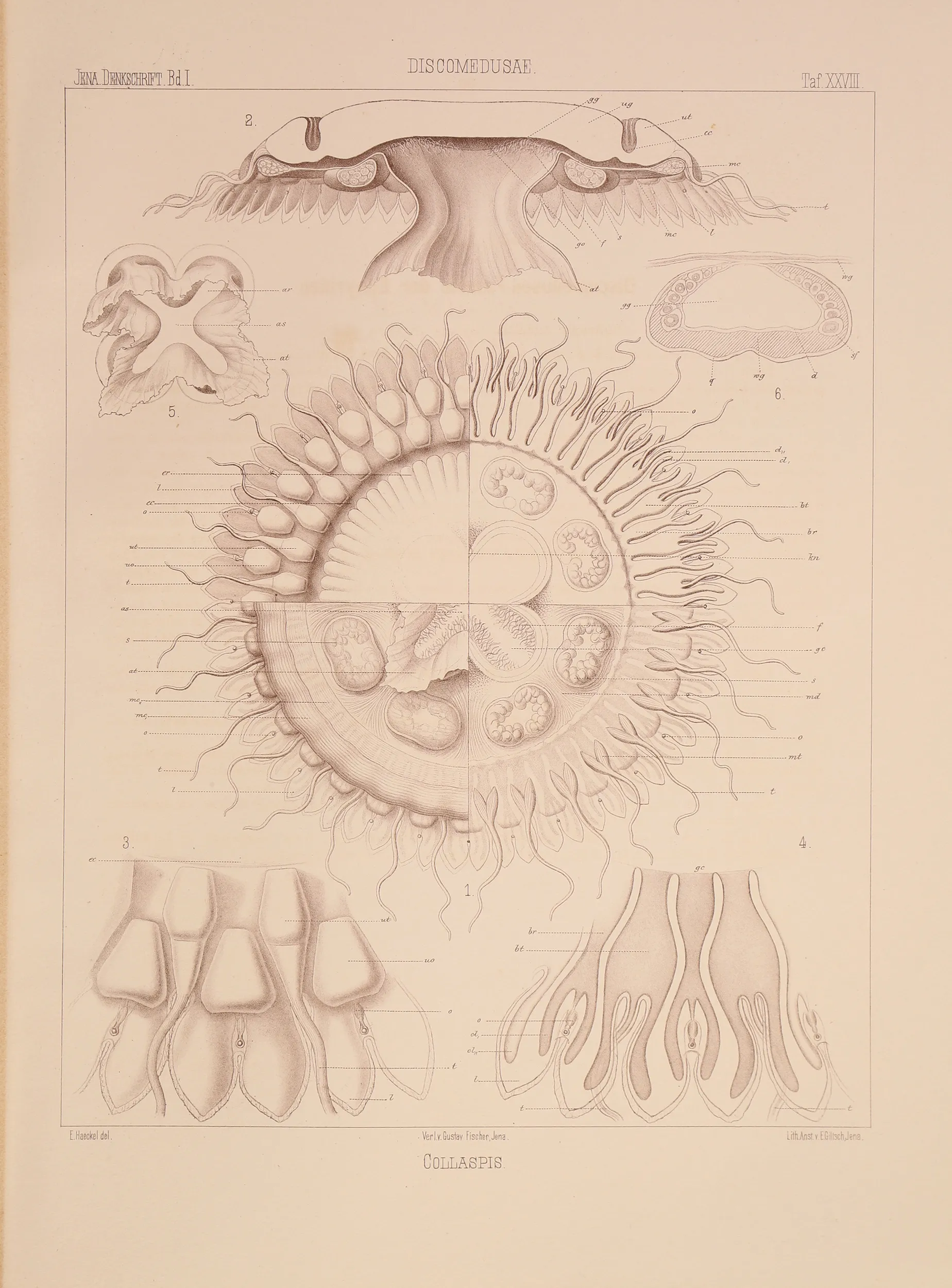
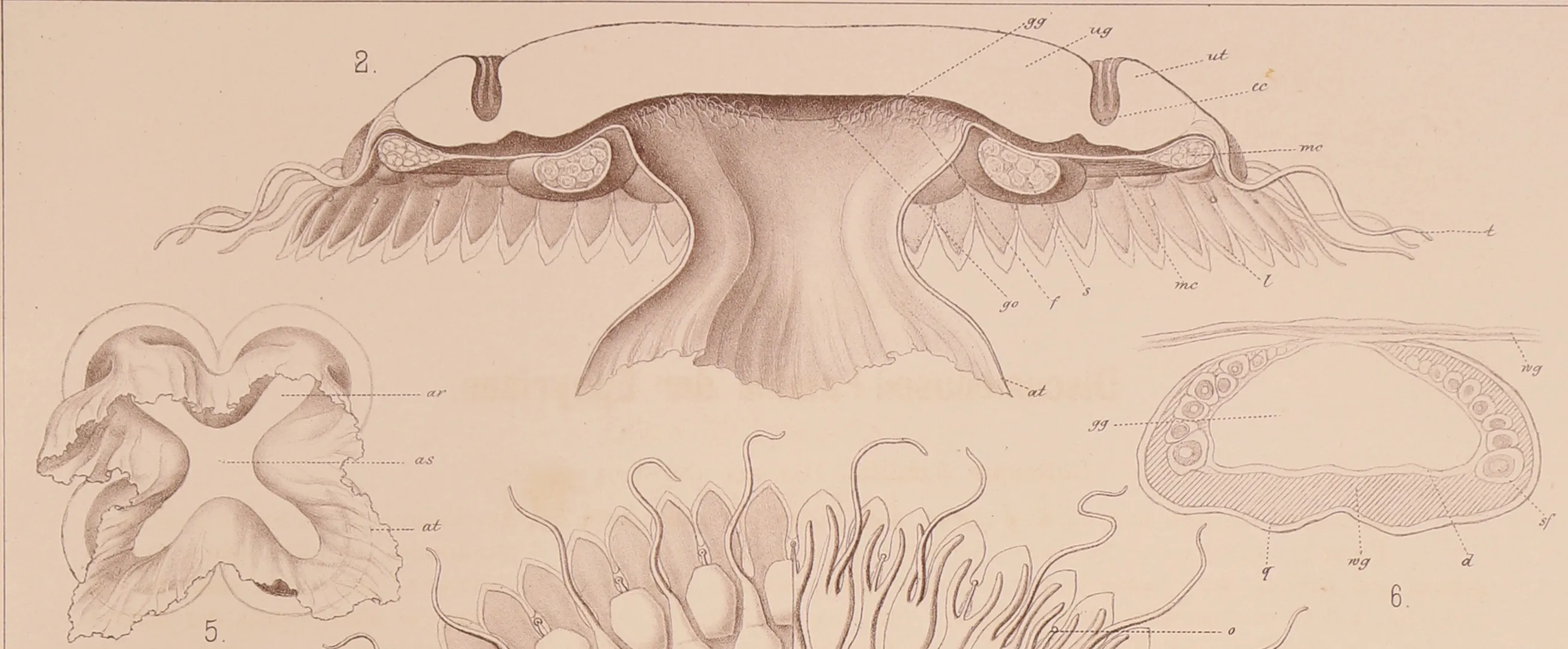
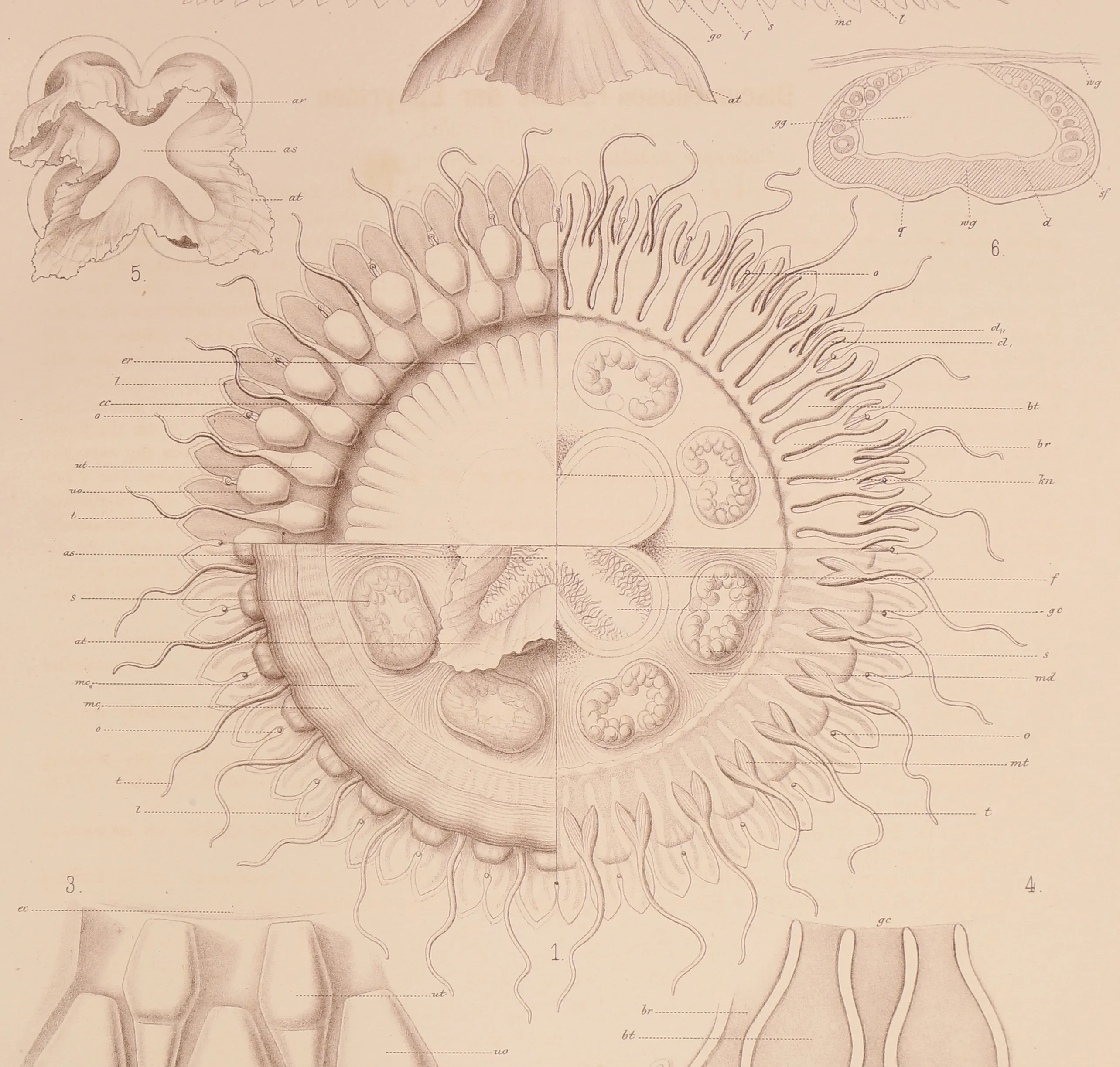
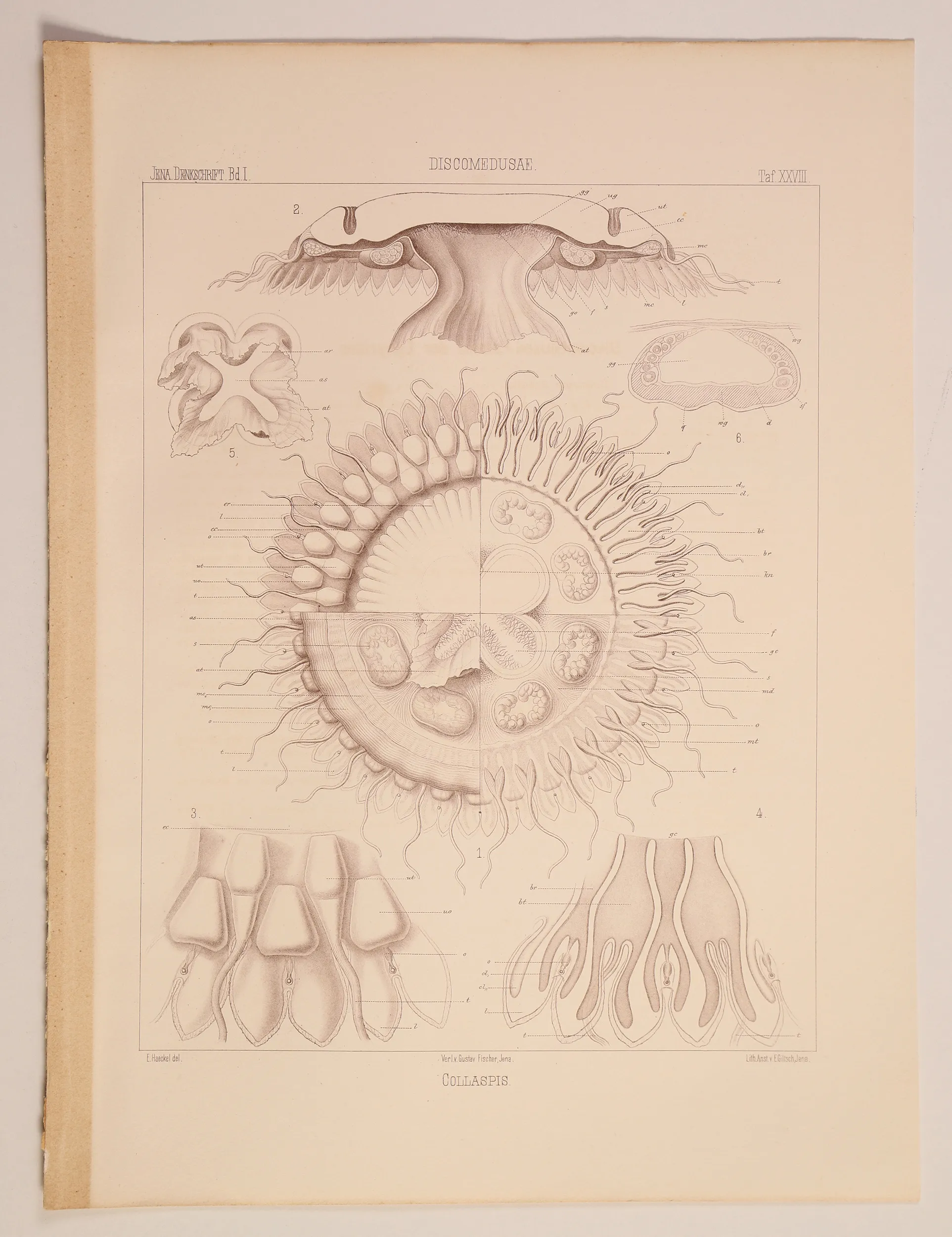
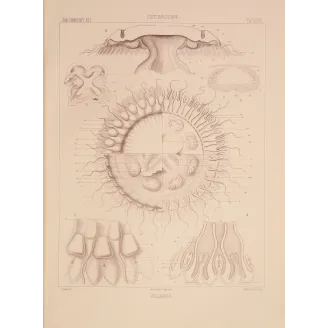
Original 1879 lithograph from Ernst Haeckel's Das System der Medusen, depicting Collaspis jellyfish with extraordinary anatomical precision. A refined scientific composition centered on radial symmetry and marine morphology.
 Delivery policy
Your print will be carefully prepared and shipped worldwide via trusted couriers (UPS or similar).
 Authentic antique prints
Original engravings from the 17th–19th century.
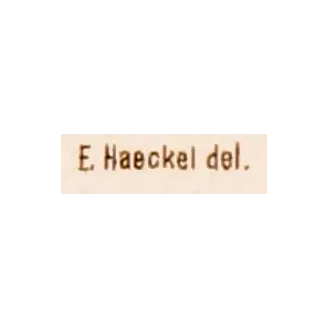
This original lithograph from Ernst Haeckel’s monumental scientific work Das System der Medusen (1879) presents Collaspis, a refined jellyfish form belonging to the Discomedusae. Bearing the important plate credit “E. Haeckel del.”, the work reflects Haeckel’s extraordinary ability to make marine anatomy visually intelligible, balanced and elegant.
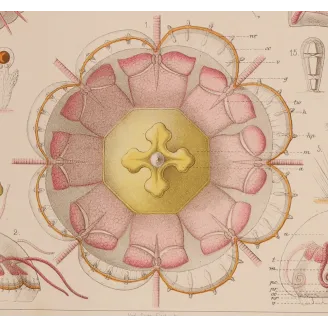
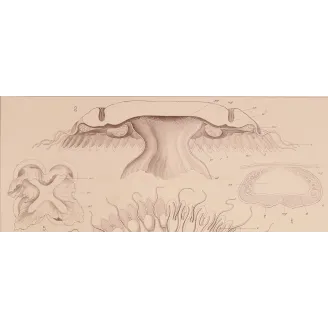
At the centre of the composition, a large radial anatomical study reveals the hidden geometry of the organism. Around it, secondary figures and sectional details clarify its structure, transforming scientific observation into a quiet and sophisticated visual language.
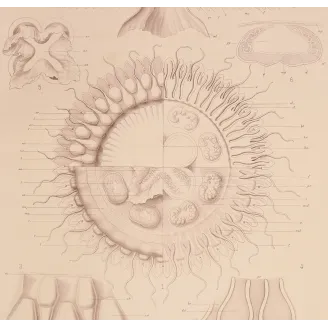
The plate is dominated by a circular anatomical form whose delicate internal structures radiate from the centre with remarkable precision. This radial arrangement gives the image a contemplative, almost meditative quality, while preserving the clarity expected from nineteenth-century scientific illustration.
Haeckel’s visual method allows the viewer to move between scientific analysis and aesthetic appreciation. The organism is not simply recorded; it is organised into a composition where biology, geometry and visual order become inseparable.
With its restrained sepia tonality and precise anatomical structure, this lithograph has a quiet intellectual presence. It is particularly suited to studies, libraries, natural history collections, contemporary interiors and spaces where scientific imagery is appreciated as refined visual art.
Displayed individually, the plate offers a subtle and sophisticated focal point; placed within a curated Haeckel wall arrangement, it contributes a calm scientific counterpoint to more colourful or decorative medusae plates.
Discover more about Ernst Haeckel, his marine studies and the visual world behind his extraordinary jellyfish plates in our editorial feature:
Ernst Haeckel and the Beauty of Jellyfish
Printed on original nineteenth-century paper and preserved in very good antique condition. Minor age-related toning, occasional spotting and gentle signs of handling may be present, consistent with authentic scientific lithographs of this period. Please examine the photographs carefully, as each impression retains its own individual antique character.
Specific References
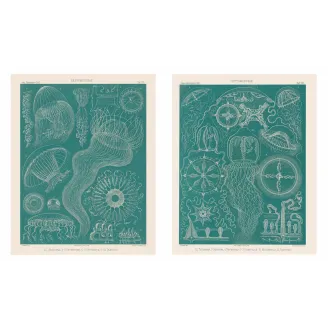
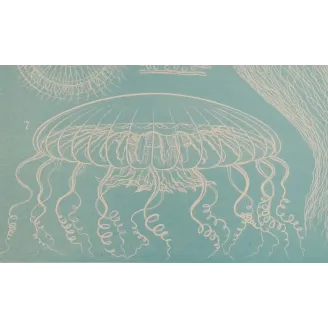
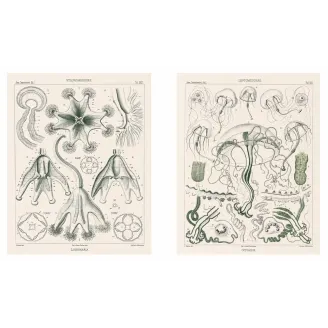
A refined pair of original 19th-century jellyfish lithographs by Ernst Haeckel, selected from Das System der Medusen (1879). Rendered in delicate monochrome cyan tones, these scientific plates reveal the hidden geometry of marine life with remarkable decorative elegance. A striking museum-quality ensemble for interiors inspired by science, design and natural history.
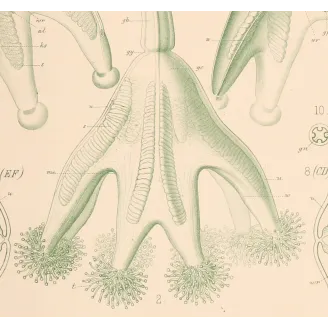
An original 1879 lithograph by Ernst Haeckel from Das System der Medusen, depicting the remarkable anatomy of Cubomedusae (box jellyfish). Combining scientific precision with striking architectural symmetry, this authentic nineteenth-century plate reveals the hidden biological structures behind one of the ocean’s most fascinating marine organisms.
A refined curated diptych of two original 1879 lithographs by Ernst Haeckel from Das System der Medusen, printed in delicate monochromatic green and bearing the plate credit “E. Haeckel del.” Combining marine geometry with scientific precision, these authentic nineteenth-century jellyfish studies create an unusually elegant visual ensemble for collectors, interiors and natural history enthusiasts.
An original 1879 lithograph by Ernst Haeckel from Das System der Medusen, depicting the remarkable forms of the Narcomedusae. Combining delicate pink, coral and golden tones with extraordinary scientific precision, this authentic nineteenth-century marine study reveals why Haeckel's jellyfish imagery later became one of the defining visual inspirations of Art Nouveau.
Original 1879 lithograph from Ernst Haeckel's Das System der Medusen, depicting Linantha and Linerges jellyfish in a refined pale-blue palette. A striking combination of scientific precision, marine symmetry and decorative elegance.
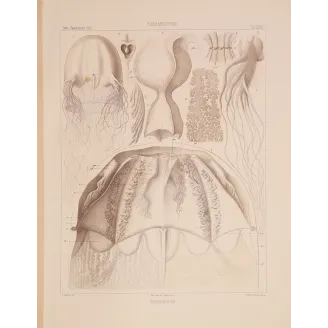
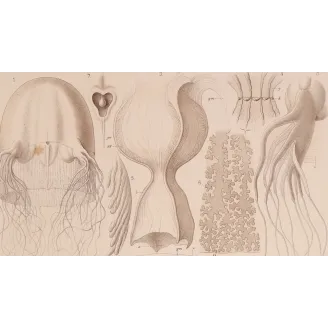
An original 1879 lithograph by Ernst Haeckel from Das System der Medusen, depicting the extraordinary anatomy of Chirodropus, one of the most remarkable Cubomedusae. Combining scientific precision, monumental scale and elegant nineteenth-century lithographic craftsmanship, this authentic marine study reveals the hidden architecture of one of nature’s most complex jellyfish forms.
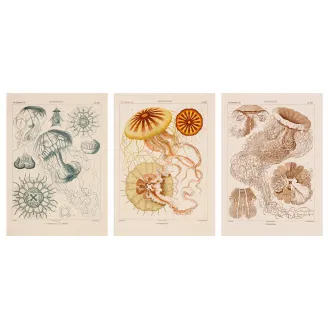
A rare curated suite of three original 1879 lithographs by Ernst Haeckel, bringing together medusae later visually echoed in his iconic Kunstformen der Natur. A museum-grade grouping combining scientific beauty, early marine illustration and exceptional decorative presence.
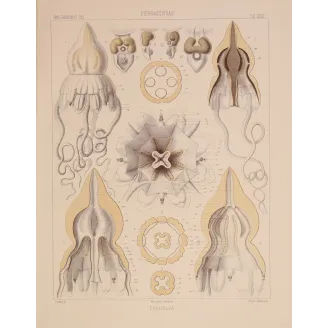
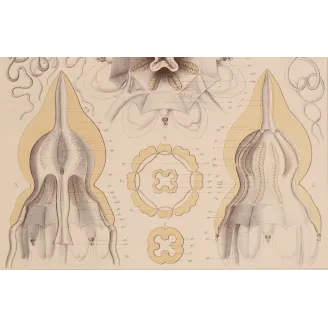
Original 1879 lithograph from Ernst Haeckel's Das System der Medusen, depicting Pericolpa and related Peromedusae forms. A refined marine study combining biological symmetry, architectural structure and delicate golden tones.
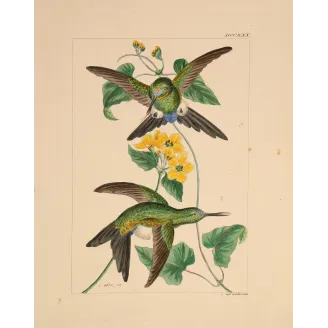
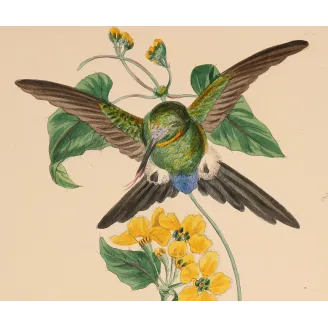
An original hand-colored engraving depicting Lucian's Puffleg (Eriocnemis luciani), one of the most distinctive high-Andean hummingbirds illustrated by Ludwig Reichenbach in Trochilinarum Enumeratio (c. 1855–1860). Drawn ad naturam ("from life"), the composition captures the remarkable white feather tufts that give pufflegs their name, together with brilliant emerald plumage and delicate yellow blossoms. Combining Victorian scientific precision with refined decorative elegance, this authentic nineteenth-century engraving remains both an important ornithological document and a striking work of natural history art.
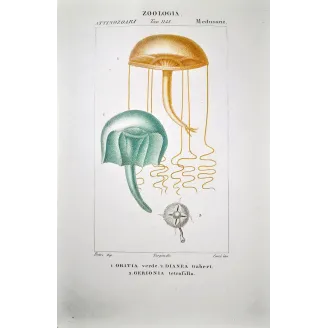
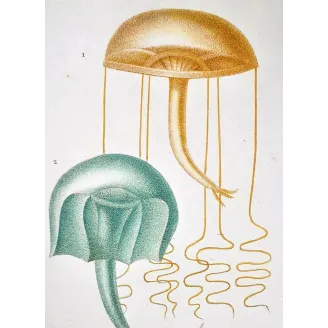
Trio of rare jellyfish types in soft tones, hand-colored lithograph by Prêtre.
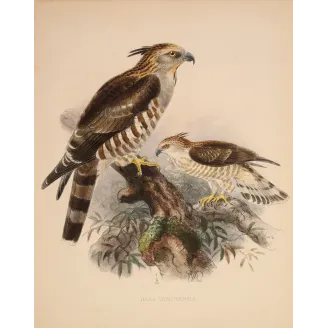
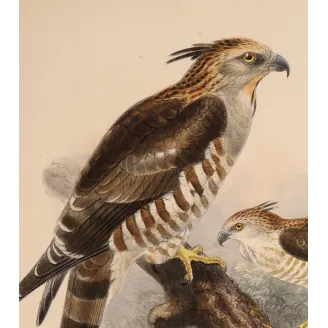
Original antique bird print depicting Baza ceylonensis (Ceylon Hawk-Eagle), illustrated by J.G. Keulemans for A History of the Birds of Ceylon. A striking Victorian ornithological lithograph featuring a refined pair of raptors with strong decorative presence.
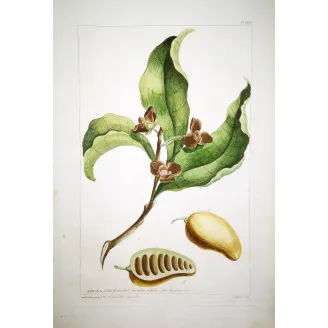
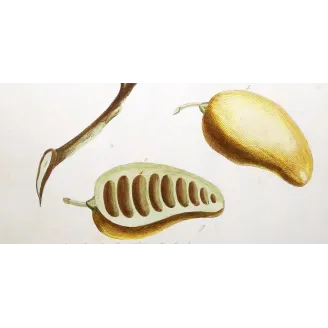
An original 18th-century hand-colored engraving depicting a Custard Apple (Annona sp.), from Philip Miller’s Figures of the Most Beautiful, Useful, and Uncommon Plants. Combining botanical precision with decorative clarity, the composition features both the plant and its distinctive fruit in sectional detail.
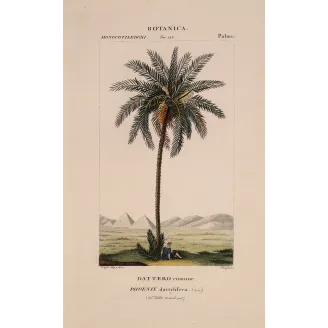
Detailed antique illustrations of the date palm tree and its floral and fruit anatomy.
Fine botanical engraving showing delicate redcurrant clusters and bright green leaves.
An exceptional original hand-colored engraving from Ludwig Reichenbach's Trochilinarum Enumeratio, depicting five brilliant hummingbirds feeding among scarlet tropical flowers. Featuring Esmeralda, Euchloris and Maculicollis, this dynamic nineteenth-century composition beautifully combines botanical richness with the elegance of Victorian ornithological illustration.
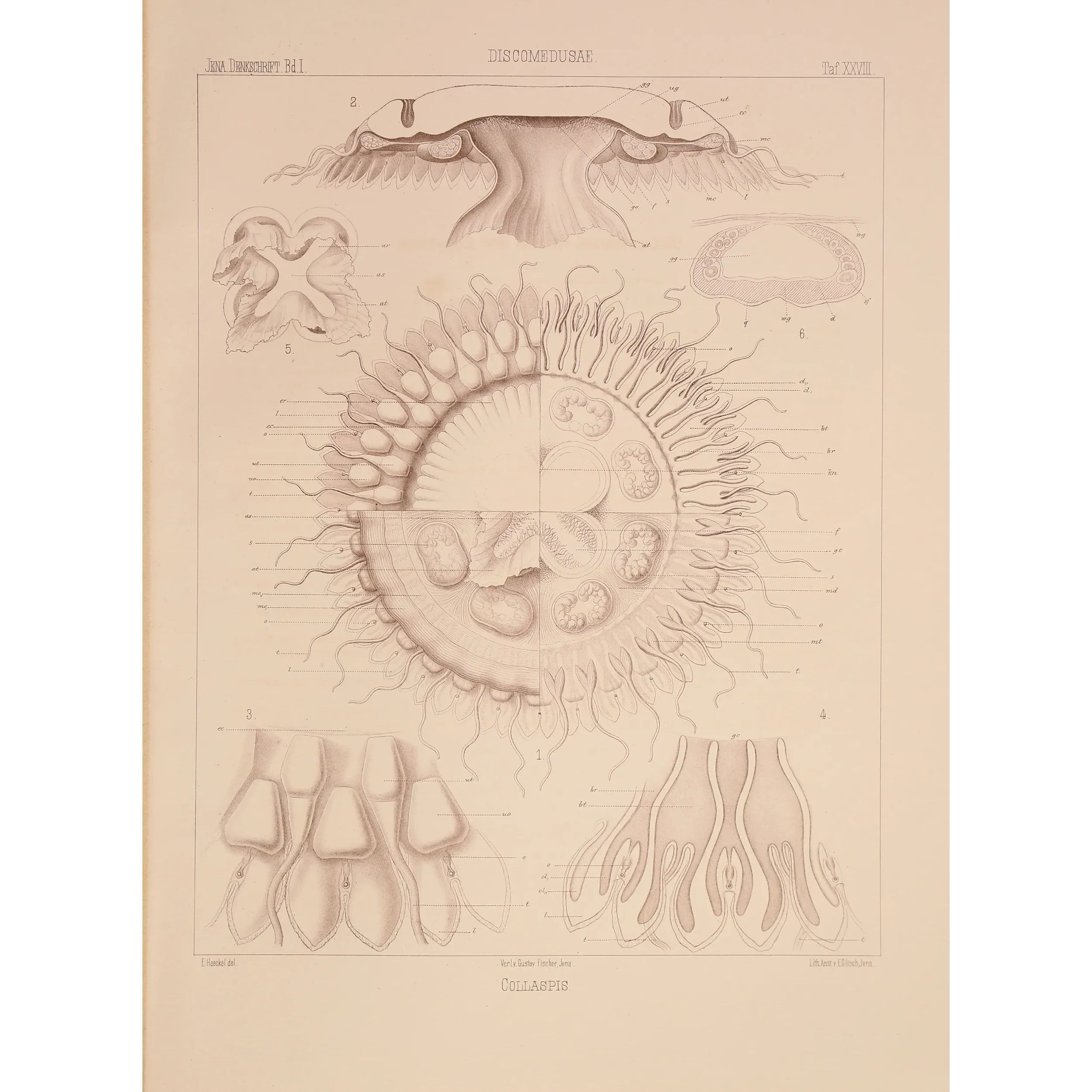
Original 1879 lithograph from Ernst Haeckel's Das System der Medusen, depicting Collaspis jellyfish with extraordinary anatomical precision. A refined scientific composition centered on radial symmetry and marine morphology.