
Birds of Ceylon: An Island Apart in Victorian Ornithology
Birds of Ceylon: An Island Apart in Victorian Ornithology
William Vincent Legge, J.G. Keulemans and the Scientific Discovery of Sri Lanka’s Avifauna
Visitors approaching nineteenth-century Ceylon in search of the spectacular forms associated with the Malay Archipelago or the brilliant plumage of tropical America might initially have been surprised. William Vincent Legge himself observed that the island’s ornithological importance lay elsewhere. Its birds were not defined principally by visual extravagance, but by the richness, variety and regional distinctiveness of an avifauna shaped by monsoon climate, luxuriant vegetation, abundant insect life and a complex geography.
Ceylon lay close to the southern coast of India and shared many of the larger region’s familiar bird families. Yet hornbills, barbets, drongos, woodpeckers, cuckoos and birds of prey repeatedly appeared in forms that seemed unmistakably their own. This combination of proximity and difference made the island a naturally bounded field of comparison: a place where zoologists could ask how geography, climate and long periods of relative isolation shaped the living world.
William Vincent Legge’s A History of the Birds of Ceylon, published in three parts between 1878 and 1880, gave monumental form to that enquiry. Its extensive text brought together more than eight years of observation on the island, earlier literature, private collections, museum specimens and geographic comparison, while thirty-four coloured plates by John Gerrard Keulemans transformed selected birds into precise and memorable visual documents.
The work belongs to a decisive period in the history of ornithology. Species were no longer studied only as isolated curiosities. Increasingly, naturalists sought to understand how entire regional faunas were related, why neighbouring territories contained similar but distinct birds, and where the uncertain boundary between local variation and independent species should be drawn.
An Island Experienced Through Birds
Legge began his introduction not with a taxonomic table, but with the experience of arriving on the island. He described common birds inhabiting cultivated country near the western towns, species moving through the vegetation beside roads and railways, and a remarkable variety of calls encountered during an early morning walk.
The laughter-like voices of larger kingfishers, the resonant call of the coucals and the energetic sounds of barbets formed part of Ceylon’s natural identity. This acoustic landscape mattered because the island’s avifauna was not understood only through specimens arranged in cabinets. It was first encountered as movement, sound, habitat and daily presence.
Legge also resisted presenting tropical beauty as a simple contest of colour. He considered much of Ceylon’s plumage comparatively restrained, while recognising exceptional grace and elegance of form among sunbirds, pittas, kingfishers and other characteristic groups. His emphasis was therefore not upon exotic spectacle for its own sake, but upon the individuality of the island’s birds and the ecological conditions that sustained them.
This distinction provides an important key to the entire work. A History of the Birds of Ceylon was conceived not as an album of the most decorative species, but as an attempt to understand an island through the total character of its avifauna.
An Island That Changed the Way Scientists Looked at Nature
Ceylon—today Sri Lanka—is separated from India by a comparatively narrow stretch of sea. This physical closeness encouraged early naturalists to interpret much of its fauna as an extension of the neighbouring subcontinent. Careful observation, however, revealed a more complex picture.
Some birds occurred on both sides of the water. Others belonged to recognisable Asian families but differed consistently in plumage, proportions, voice, habitat or distribution. Still others were confined to the island’s forests and hills. Ceylon therefore appeared both connected and separate: biologically related to India, yet sufficiently isolated to possess a distinctive natural identity.
The island’s internal geography deepened that distinction. Wet-zone forests, drier lowlands, central highlands and changing elevations created a mosaic of habitats within a relatively compact area. For ornithologists, this meant that regional difference could be studied at several scales at once: between Ceylon and India, between lowland and upland environments, and between widespread species and forms restricted to particular parts of the island. Legge’s own table of birds considered “peculiar to Ceylon”—using the nineteenth-century term for forms regarded as particular to the island—also recorded their distribution across hill districts, low country and the Nuwara Eliya plateau.
Such observations contributed to a larger transformation in natural history. Geography was becoming more than the background against which species were found. It was increasingly understood as one of the forces that could help explain why living forms differed.
The birds of Ceylon offered especially persuasive evidence because so many appeared familiar at the level of family or general structure, yet distinct when examined closely. The essential question was no longer merely, “What bird is this?” It became, “How is this bird related to those beyond the island, and what degree of difference is scientifically meaningful?”
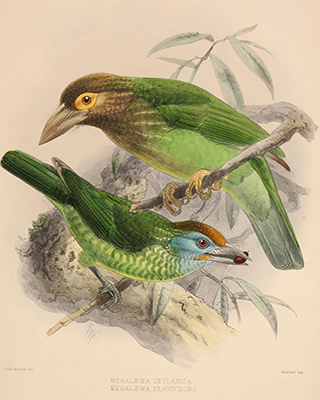
The Ceylon Barbets plate places two closely related birds within the same composition. Their shared structure identifies them as members of one group, while their heads, facial colour and plumage patterns invite immediate comparison. One belongs to a wider South Asian distribution; the other is an island endemic. The plate turns classification into an act of looking.
A Century of Observation Before Legge
Legge did not present his work as an isolated discovery. In the introduction, he carefully reconstructed more than a century of earlier attempts to record the birds of Ceylon, beginning with eighteenth-century naturalists whose knowledge depended upon drawings, collected specimens and correspondence across Europe and Asia.
George Edwards had illustrated birds associated with India and Ceylon as early as the 1740s. Governor Gideon Loten assembled specimens and commissioned drawings later used by Pieter Boddaert and other naturalists. Johann Reinhold Forster applied Linnaean names to several Ceylonese forms, while later observers gradually extended the list of known species.
During the nineteenth century, Edgar Leopold Layard, Edward Frederick Kelaart and other collectors transformed scattered knowledge into increasingly systematic records. Their work depended upon travel across the island, exchanges of specimens, identification by specialists such as Edward Blyth in Calcutta, and publication through scientific journals and learned societies.
Legge’s monument was therefore built upon a network rather than upon solitary genius. He inherited observations, specimens, disputed names and incomplete catalogues accumulated by generations of predecessors. His achievement was to examine, compare and organise that dispersed inheritance into the first comprehensive treatment of the island’s birds.
The Age of Scientific Comparison
By the time Legge’s work appeared, ornithology had entered an increasingly comparative age. Earlier natural histories had often concentrated on describing individual specimens, assigning names and recording visible characteristics. Nineteenth-century researchers inherited that descriptive tradition but placed growing emphasis on distribution, affinity and relationship.
Legge’s own working method makes this transformation especially clear. After returning to England in 1877, he combined his field knowledge of the birds’ life histories with the large collection he had assembled on the island. He then compared those specimens with skins held by the British Museum and by fellow ornithologists in London, particularly material from adjacent countries.
Museum collections made such comparison possible on a scale previously unimaginable. Bills, tails, wing proportions, feather patterns and colour markings could be placed side by side across populations collected hundreds or thousands of miles apart. Similarity and difference became observable within the same room.
Regional monographs such as A History of the Birds of Ceylon were essential to this process. Their value did not lie only in assembling a list of birds inhabiting one territory. They created a structured body of evidence through which the fauna of that territory could be compared with neighbouring regions.
The closing pages of Legge’s introductory survey turn explicitly to the “affinities” of the Ceylonese avifauna. This was the central scientific problem: not simply what lived on the island, but how its birds were connected to the fauna of India and other surrounding regions. In this setting, illustration was not an ornament added after the science had been completed. It was part of the comparative method itself.
William Vincent Legge and the Making of a Regional Monograph
William Vincent Legge approached Ceylon’s birds with the combined experience of a military officer, field observer and systematic ornithologist. During eight and a half years of residence on the island, he devoted his available time to studying its birds and assembling a substantial collection of specimens.
In his preface, Legge explained that no complete treatise on the birds of Ceylon had yet been written. The need for such a work appeared to him increasingly urgent, but his ambition extended beyond filling a bibliographic gap. He wished to encourage an interest in natural history among the island’s educated community and even hoped that an ornithological school might take root in Ceylon.
This intention gives the publication an unusually human dimension. Legge did not claim that the work would introduce new knowledge to every European specialist. He described it primarily as a text for the local student and collector, hoping that even a small number of readers might develop a lasting interest in the study of birds.
A History of the Birds of Ceylon was published by the author in London between 1878 and 1880 after three further years of intense work. Its more than twelve hundred pages combined classification, distribution, habits, local occurrence, historical bibliography and comparison with birds beyond the island.
The historical scientific names visible on the plates should therefore not be treated as errors to be removed from the object. They preserve the classificatory language of their own period. Some names remain close to current usage; others have been revised, divided or transferred to different genera. Together they document the continuing nature of scientific knowledge.
John Gerrard Keulemans and the Visual Language of Ornithology
A work built upon comparison required an illustrator capable of preserving both anatomical precision and the character of a living bird. John Gerrard Keulemans was exceptionally well suited to that role.
Keulemans understood that a scientific bird plate had to do several things simultaneously. It needed to communicate the form of the bill, the relative length of wing and tail, the distribution of colour and the posture characteristic of the species. It also had to recover vitality from preserved skins, whose natural volume, movement and expression had often been diminished by preparation and storage.
In the Birds of Ceylon plates, he avoided unnecessary theatricality. Branches and foliage establish scale and habitat without overwhelming the subjects. Birds are arranged to expose diagnostic features while retaining balance, movement and convincing weight. On plates containing more than one species, their relationship is often clarified through position, direction and colour contrast.
The result is a visual language in which scientific information and artistic coherence reinforce each other. Keulemans did not merely make Legge’s descriptions attractive. He made comparison immediate.
Explore the artist’s wider career, working method and place within Victorian ornithological publishing.
J.G. Keulemans: Precision and Passion in Ornithological Illustration →
The Making of the Plates
The coloured plates in A History of the Birds of Ceylon were produced as lithographs and finished with contemporary hand colouring. The inscriptions visible on impressions in the Prantique collection identify Keulemans as lithographer and Hanhart as printer, linking the sheets directly to the specialist London world of Victorian natural history publishing.
Lithography was particularly effective for ornithological illustration. Drawn marks could move from firm structural contours to soft tonal passages, allowing feather masses, shadows and fine anatomical divisions to be articulated without the harder uniformity associated with some earlier reproductive processes.
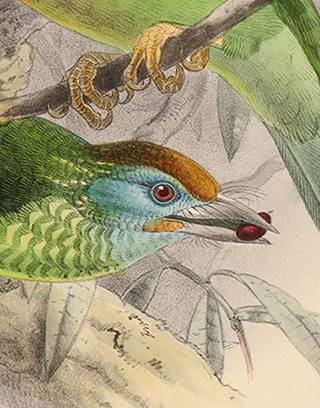
Printing alone, however, could not fully communicate the distinctions upon which bird identification often depended. A crimson crown, a yellow forehead, an iridescent blue-black body or a small patch of contrasting plumage might separate one species from another. Colour therefore remained part of the scientific content.
Each printed sheet subsequently passed through a colouring process carried out by hand. Working from an established model, colourists applied pigments in successive areas and tonal layers. The general appearance of the edition remained consistent, yet the hand process inevitably introduced slight variations in density, edge, transparency and emphasis from one impression to another.
The physical sheet consequently preserves several forms of labour at once: Keulemans’ observation and draughtsmanship, the transfer and printing of the lithographic image, and the patient application of colour. Fine nineteenth-century paper provided the surface upon which these stages were united. Close inspection can reveal details easily flattened by digital reproduction: the distinction between printed tone and transparent pigment, small changes in saturation and areas where colour stops just inside or moves fractionally beyond the lithographic boundary.
The plate combining the Crimson-fronted Barbet and Ceylon Hanging Parrot demonstrates why colour could not be treated as a merely decorative addition. Green plumage, crimson and yellow markings, blue passages and small tonal changes clarify the anatomy and separate the two species. Removing colour would not simply reduce the plate’s beauty; it would remove part of its scientific language.
Reading Birds of Ceylon Today
The twelve original plates brought together in the Prantique collection offer a concentrated view of the wider work. Hornbills, barbets, flamebacks, malkohas, parrots, mynas, drongos and raptors represent markedly different ecological roles, structures and visual identities.
Viewed individually, each sheet is a carefully resolved portrait. Viewed together, they reveal the comparative logic that made a regional ornithology possible. The hornbill is recognised by its extraordinary bill and elongated profile. Barbets compress vivid colour into compact, fruit-eating forms. Drongos are defined by dark plumage and decisive tail structures. Malkohas and coucals extend across the page through long bodies and tails, while the birds of prey introduce a different language of mass, talons and controlled alertness.
Several plates unite two related subjects, allowing comparison to occur within a single sheet. Others isolate one distinctive species so that its regional character becomes unmistakable. The alternating formats create a visual rhythm between classification and portraiture.
The collection also preserves the changing history of names. Terms such as Tockus gingalensis, Megalaema flavifrons or Dissemurus lophorhinus belong to the taxonomic framework used by Legge and his contemporaries. Modern ornithology may classify some of these birds differently, but the historical inscriptions remain essential evidence of how the island’s fauna was interpreted when the work was made.
This is why the plates should be read on more than one level. They are images of Sri Lankan birds, examples of Keulemans’ art, products of nineteenth-century lithography and surviving documents from a formative stage in the study of geographic variation and endemism.
Preserving a Scientific Vision
Original natural history prints are often first encountered through their visual beauty. In the Birds of Ceylon plates, that beauty is undeniable: sculptural profiles, controlled compositions and preserved hand colour give the birds an immediacy that remains compelling nearly a century and a half after publication.
Their deeper value, however, lies in the scientific vision they preserve. Legge’s work belongs to a period when the study of species was expanding into the study of relationships, distributions and regional faunas. Ceylon provided an especially revealing setting because its birds combined obvious connections with continental Asia and equally obvious signs of independent development.
Keulemans gave this scientific problem visible form. Through lithographic line, tonal modelling and hand-applied colour, distinctions that might remain abstract in written taxonomy became available to direct observation.
At Prantique, we consider these sheets not simply as decorative bird prints, but as material fragments of a larger intellectual enterprise. Their paper, printed inscriptions, lithographic structure, hand colouring and historical nomenclature preserve the collaboration between field observation, scientific publishing and specialist craftsmanship.
To understand them fully is to see not only the birds represented upon the page, but the questions that made their representation necessary.
It preserves centuries of wonder for the natural world,
careful observation and patient craftsmanship,
thanks to the care of those who chose
William Vincent Legge’s A History of the Birds of Ceylon continues to preserve one of the defining encounters between island natural history and Victorian scientific publishing. Its plates allow us to see Sri Lanka’s birds through the questions, methods and craftsmanship of the period in which their regional distinctiveness first received monumental visual form.
Explore Original Birds of Ceylon Prints
Discover Prantique’s selection of original hand-coloured lithographs from William Vincent Legge’s A History of the Birds of Ceylon, illustrated by J.G. Keulemans and featuring hornbills, barbets, malkohas, drongos, parrots and birds of prey from Sri Lanka’s distinctive avifauna.
Related posts
-
 Émile-Allain Séguy and Prismes: Art Deco Geometry in Full Color
At the intersection of biology, modernism, and decorative arts, Émile-Allain Séguy occupies a singular place. Best...Read more
-
 La Plante et ses Applications Ornementales: Eugène Grasset and the Birth of Modern Botanical Design
In the golden age of Art Nouveau, few works embody the marriage between art and nature as perfectly as La Plante et...Read more
-
 Gregory M. Mathews and The Birds of Australia: A Monument of Ornithological Ambition
Gregory M. Mathews’ The Birds of Australia is a monumental blend of taxonomy and art. This article explores the...Read more
-
 Jacob L'Admiral and the Metamorphosis of Insects – A Dutch Enlightenment Marvel (1774)
In the vibrant scientific atmosphere of the 18th century, Jacob L’Admiral (1700–1775), a Dutch naturalist and...Read more
-
 Pierre-Joseph Redouté: Botanical Illustration Beyond Roses
Pierre-Joseph Redouté (1759–1840) is universally regarded as the most influential botanical illustrator of the late...Read more
Leave a comment