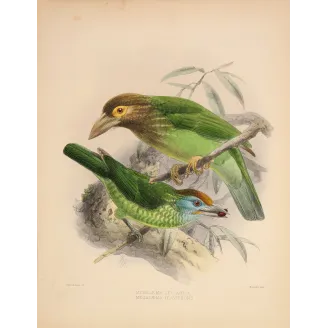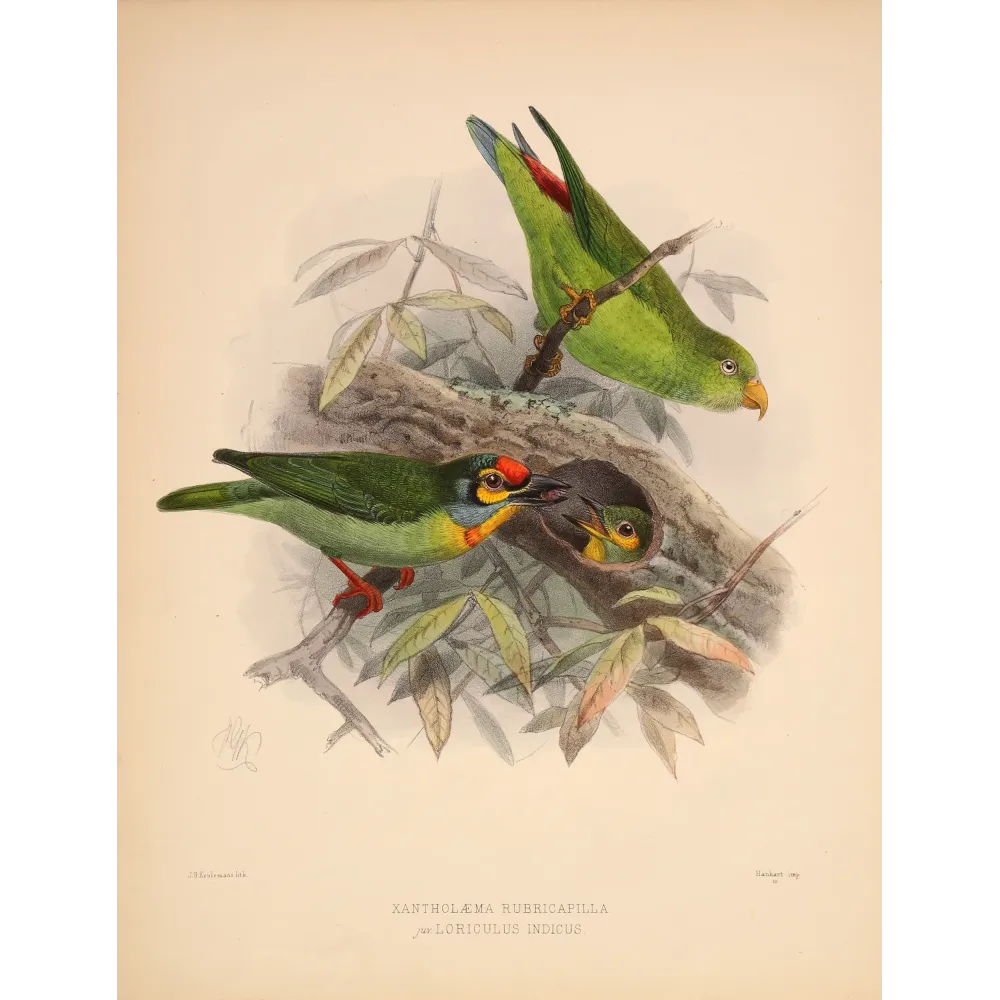
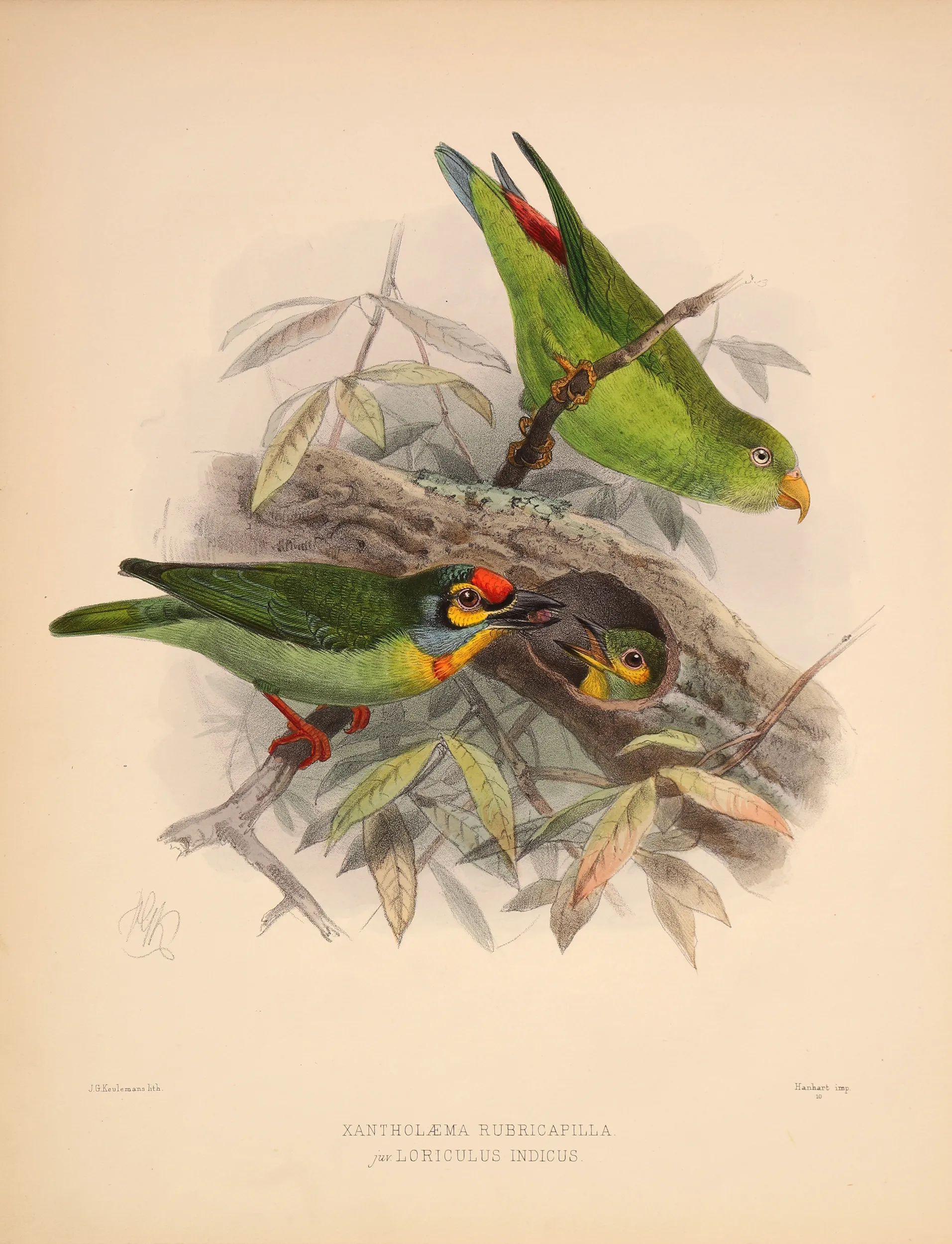
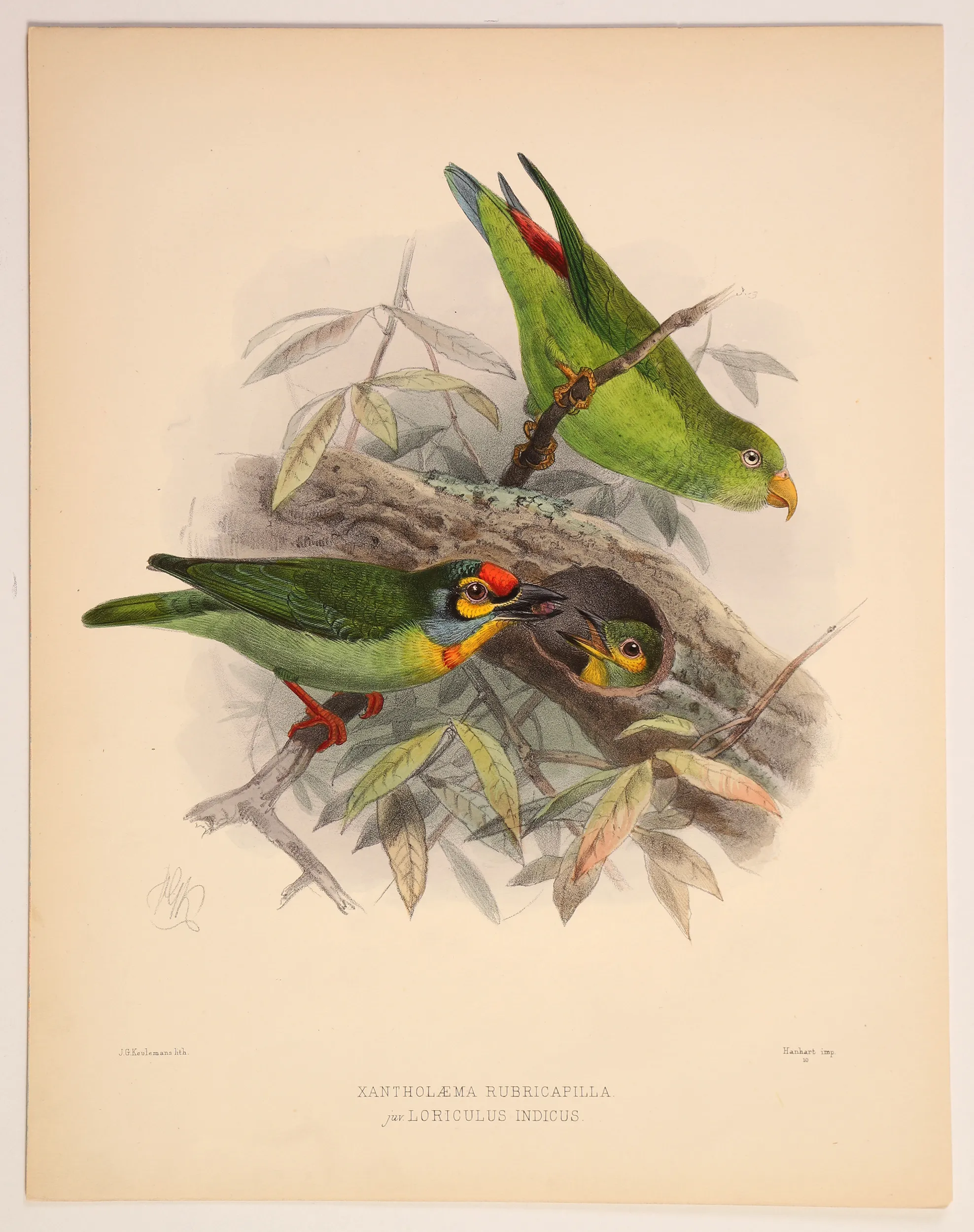
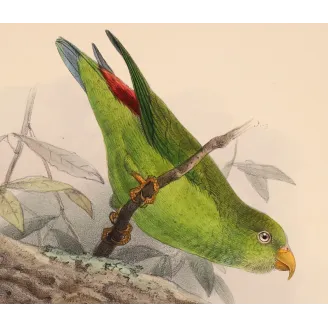
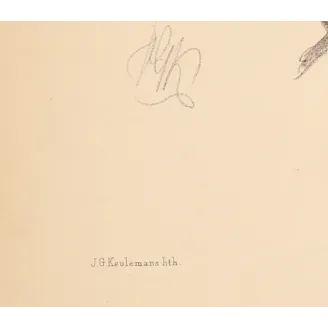
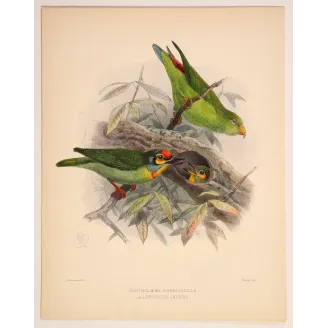
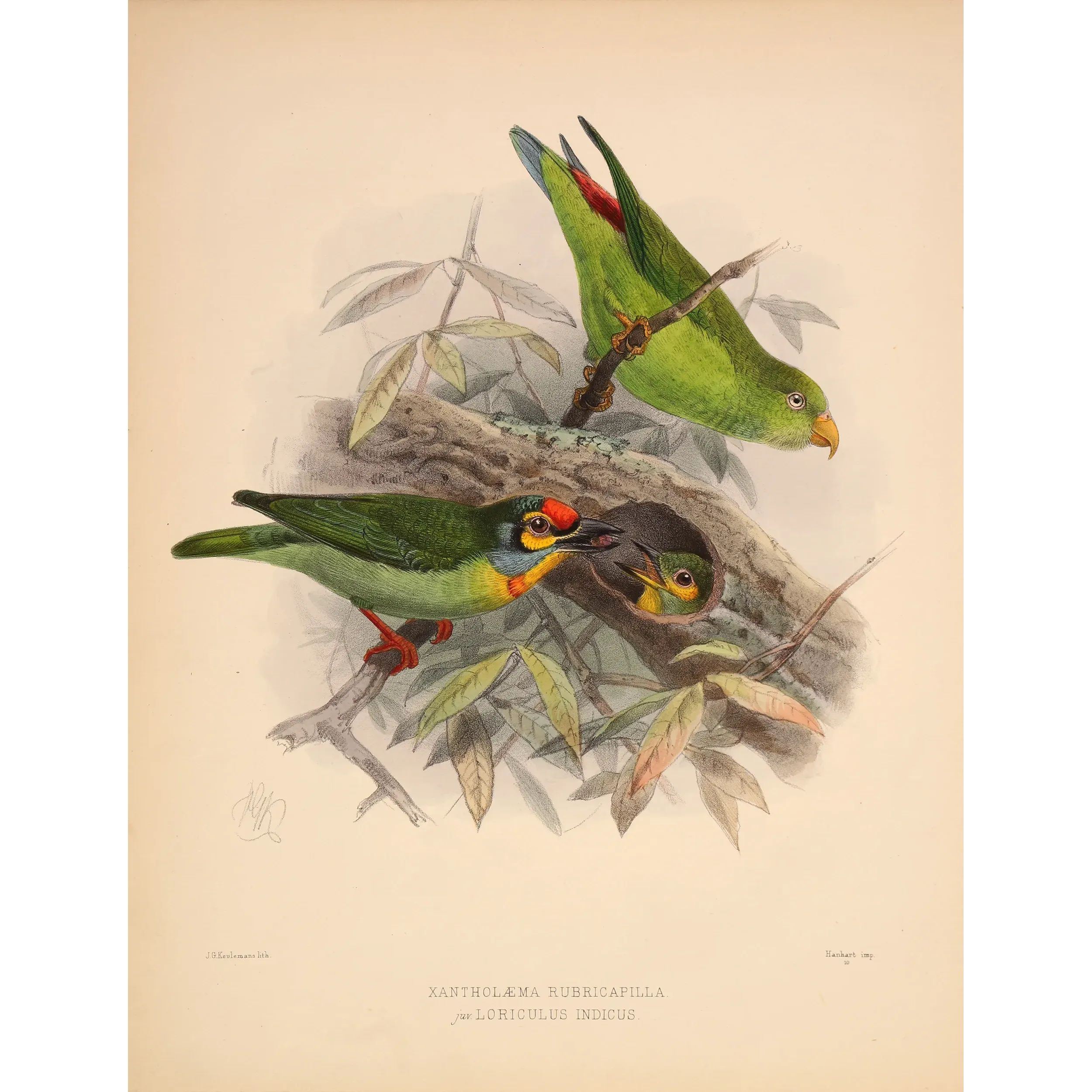
Original hand-colored bird engraving depicting the Crimson-fronted Barbet (Xantholaema rubricapilla) and the Ceylon Hanging Parrot (Loriculus indicus), illustrated by Johannes Gerardus Keulemans for Birds of Ceylon. A vivid tropical composition rich in colour and narrative charm.
 Delivery policy
Your print will be carefully prepared and shipped worldwide via trusted couriers (UPS or similar).
 Authentic antique prints
Original engravings from the 17th–19th century.
This original nineteenth-century plate brings together the Crimson-fronted Barbet (Xantholaema rubricapilla) and the Ceylon Hanging Parrot (Loriculus indicus) in one of Johannes Gerardus Keulemans’ most animated compositions for William Vincent Legge’s A History of the Birds of Ceylon.
Brilliant greens, concentrated accents of crimson and yellow, and a carefully constructed nesting scene give the plate exceptional vitality. Yet its strongest narrative element is not colour alone: the image is organised around parental care, with the adult approaching the nest cavity and the young bird emerging from within the trunk to receive food.
— • —
The composition develops on two distinct visual levels. The first is chromatic: vivid greens dominate the plumage of the principal birds, articulated through a sophisticated range of lighter and darker tonalities and punctuated by intense crimson, yellow and blue details. The second is narrative: the entire lower section of the image converges upon the nest cavity and the young bird within it.
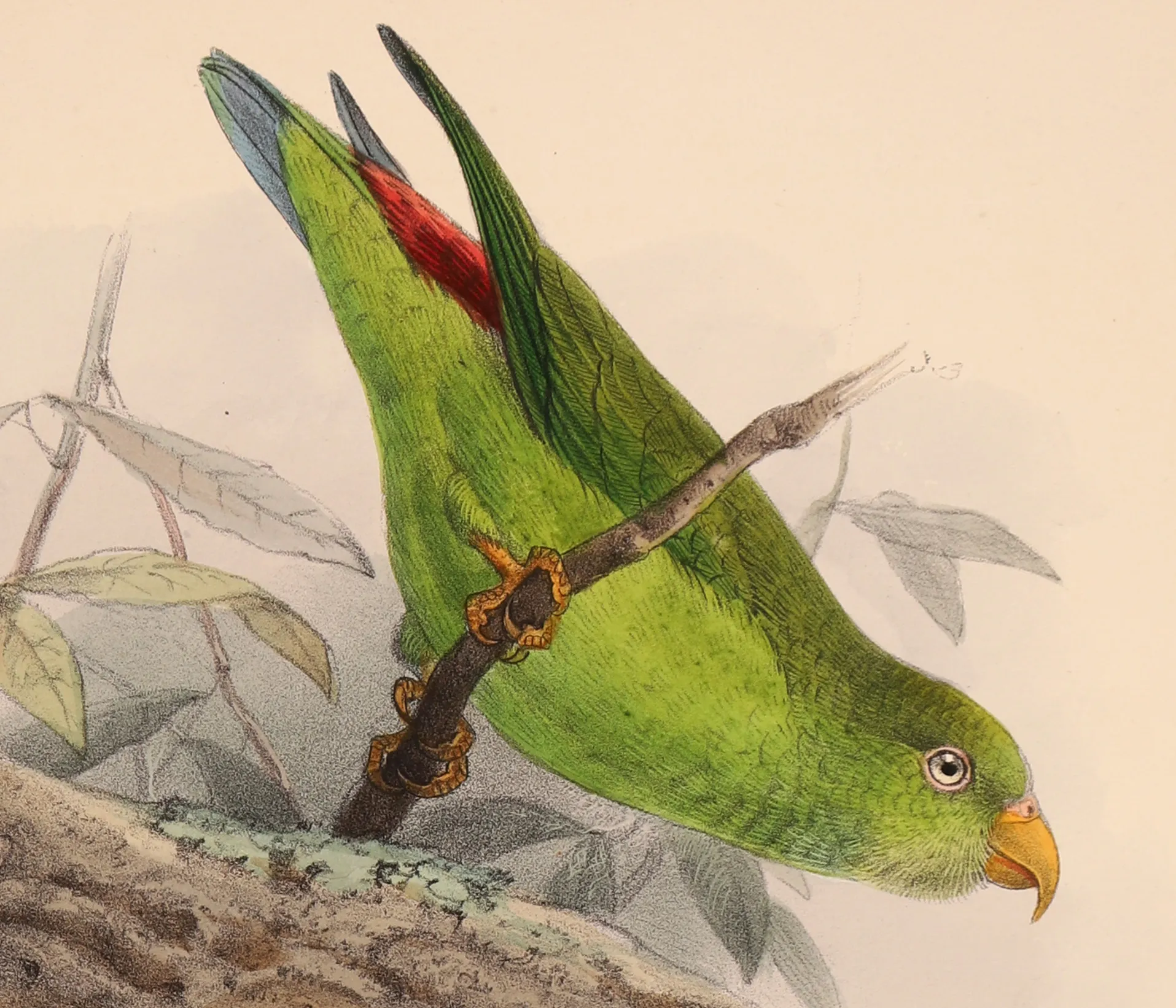
The upper Hanging Parrot introduces a strong diagonal movement, its suspended posture giving the plate immediate dynamism. Below, the Crimson-fronted Barbet advances horizontally towards the nest, creating a counter-direction that stabilises the composition while drawing the viewer’s attention directly to the feeding scene.
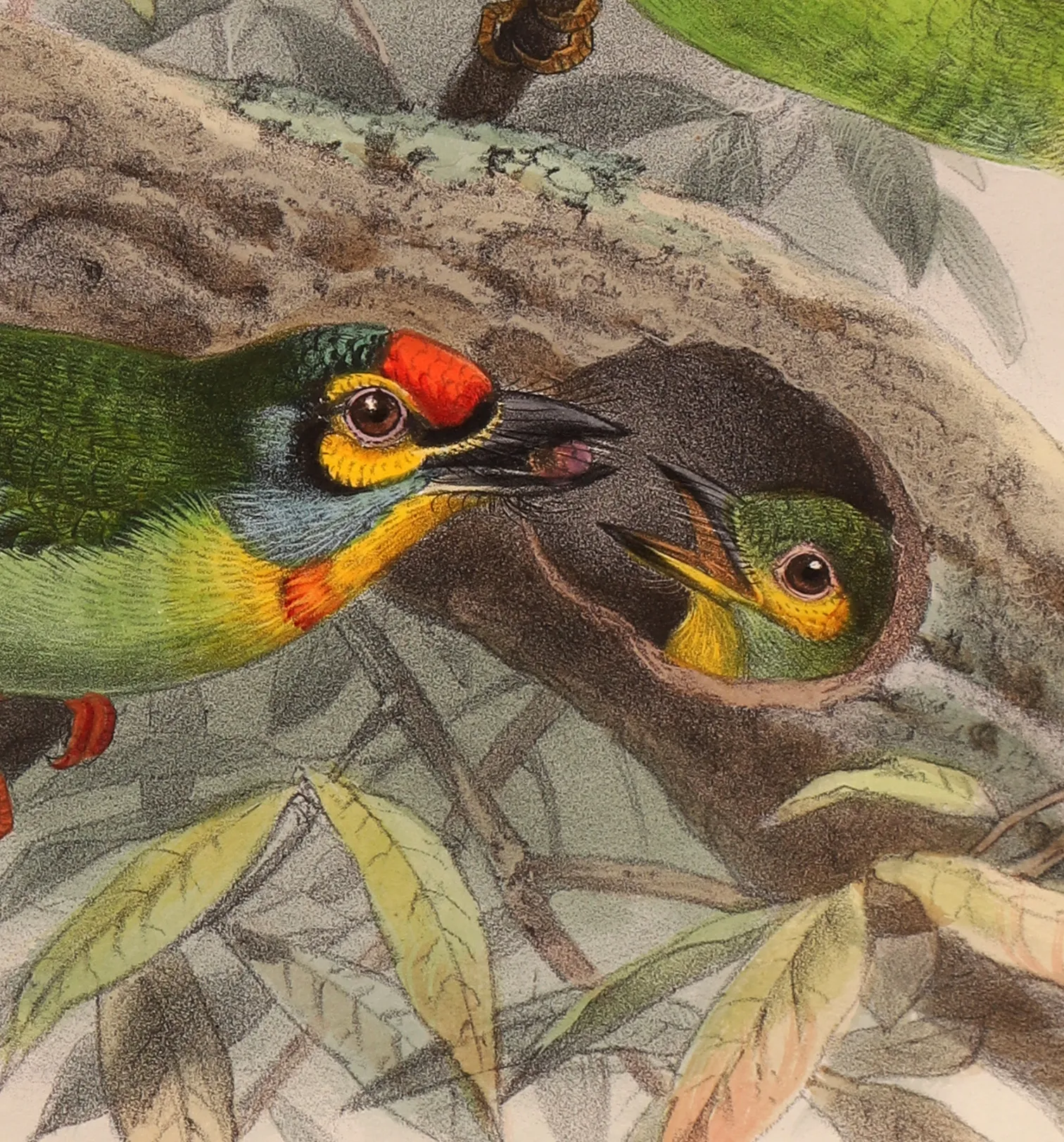
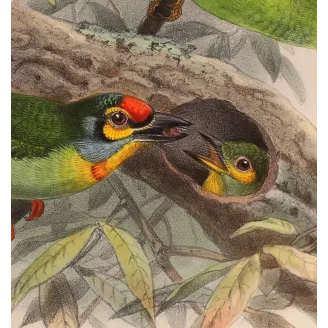
The young bird inside the trunk becomes the true living centre of the plate. Its emerging head interrupts the darker hollow of the nesting cavity, while the adult’s open bill and forward posture establish a precise moment of anticipation. Keulemans transforms a taxonomic plate into an observed episode of family behaviour.
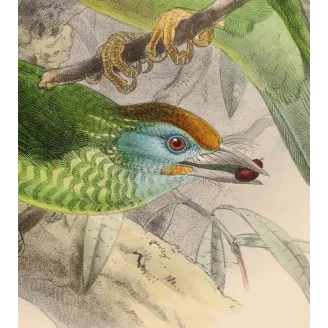
Direct examination of the original impression reveals selective applications of gum arabic across the wing plumage of both principal birds. The transparent finish is concentrated in the darker feather passages, where reflected light increases the definition of overlapping structures and enriches the depth of the green colouring.
A further application of gum arabic is visible on the head of the juvenile within the trunk. Here the gloss has a distinctly narrative function: the small reflective surface gives the young bird greater visual presence and helps separate it from the surrounding hollow, reinforcing its role as the focal point of the scene.
The botanical and arboreal background remains predominantly soft and pastel, but in this composition it assumes a more active role than in many other plates from the series. The trunk does not simply provide habitat; it encloses and protects the juvenile, becoming part of the visual narrative of shelter, dependence and feeding.
Keulemans therefore allows the setting to participate without overwhelming the birds. Pale foliage, muted bark and soft lithographic greys remain subordinate in colour, yet they provide the structural framework that makes the nesting episode intelligible.
The result is a remarkably luminous composition. Saturated greens retain freshness and brilliance, while the restrained background preserves clarity and depth. Scientific description, colour harmony and observed behaviour converge in a scene that feels unusually immediate and alive.
More than a simple pairing of two tropical species, the plate becomes a study of movement, habitat and parental care — one of those rare moments in Victorian natural history illustration where the scientific record acquires genuine narrative intimacy.
The Crimson-fronted Barbet (Xantholaema rubricapilla) and the Ceylon Hanging Parrot (Loriculus indicus) are among the most colourful birds associated with Sri Lanka’s tropical forests. Both possess strongly distinctive plumage, yet differ markedly in body structure, posture and behaviour.
Their combination within a single plate allows Keulemans to present not only contrasting species, but contrasting modes of life. The perched barbet, suspended parrot and nest-bound juvenile create a compact visual study of adult form, movement and reproductive behaviour.
Within Legge’s wider ornithological project, scenes of this kind expanded the role of illustration beyond identification alone, documenting how birds occupied habitat, interacted with nesting sites and participated in the cycle of care and development.
This original lithograph belongs to William Vincent Legge’s A History of the Birds of Ceylon, published between 1878 and 1880 after more than eight years of observation and collecting on the island. The work became the first comprehensive ornithological treatment of Ceylon, bringing together field experience, historical literature, museum comparison and the illustrations of Johannes Gerardus Keulemans.
This plate is especially revealing because it moves beyond the isolated species portrait. The interaction between adult birds, nest cavity and juvenile introduces a behavioural dimension, showing how ornithological illustration could also preserve moments of nesting life, parental care and ecological context.
Understand the Historical Context of this Print →
Discover more about the artist: Johannes Gerardus Keulemans — Precision and Passion in Ornithological Illustration.
Browse the complete collection: Keulemans – Birds of Ceylon Collection.
For readers wishing to better understand antique prints—from technique and paper to collecting criteria—explore our Antique Prints Guide.
Excellent antique condition. Fresh, crisp and well-defined impression with original contemporary hand colouring and hand-finished surface intact. Printed and coloured areas remain clean and stable, with no significant fading, abrasion or pigment loss affecting the principal subjects. Paper sound and stable with generous original margins. Minor age-related handling traces and tonal variation may be present, consistent with the period. No watermark observed.
Specific References
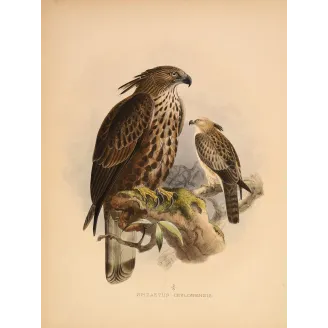
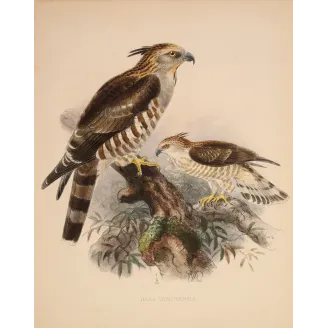
Original antique bird print depicting Spizaëtus ceylonensis (Ceylon Hawk-Eagle), illustrated by J.G. Keulemans for A History of the Birds of Ceylon. A refined Victorian ornithological lithograph featuring an elegant pair of raptors with remarkable decorative presence.
Original nineteenth-century bird print depicting two remarkable Sri Lankan barbets — Megalaema zeylanica and Megalaema flavifrons — illustrated by Johannes Gerardus Keulemans for William Vincent Legge’s celebrated Birds of Ceylon. Rich in tropical colour and compositional balance, this striking ornithological lithograph combines scientific observation with refined decorative appeal.
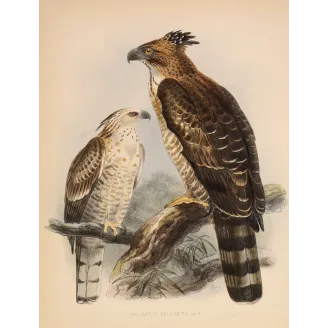
Original antique bird print depicting Spizaëtus kelaarti (Crested Hawk-Eagle), illustrated by J.G. Keulemans for A History of the Birds of Ceylon. A striking Victorian ornithological lithograph featuring an imposing pair of raptors with exceptional decorative presence.
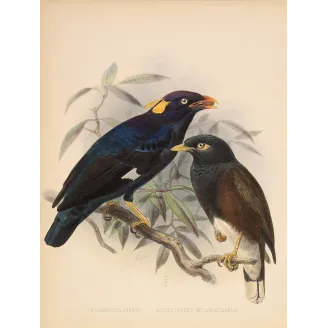
Original nineteenth-century bird print depicting two remarkable Sri Lankan mynas — Eulabes ptilogenys and Acridotheres melanosternus — illustrated by Johannes Gerardus Keulemans for William Vincent Legge’s celebrated Birds of Ceylon. Distinguished by rich iridescent plumage and refined compositional balance, this elegant ornithological lithograph combines scientific precision with exceptional decorative sophistication.
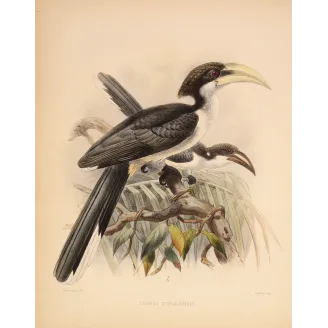
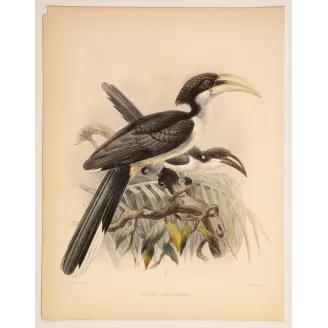
Original nineteenth-century bird print depicting the elegant Ceylon Hornbill (Tockus gingalensis), illustrated by Johannes Gerardus Keulemans for William Vincent Legge’s celebrated Birds of Ceylon. This refined ornithological lithograph combines scientific precision with sculptural decorative appeal, featuring the species’ remarkable ivory-coloured bill and poised tropical composition.
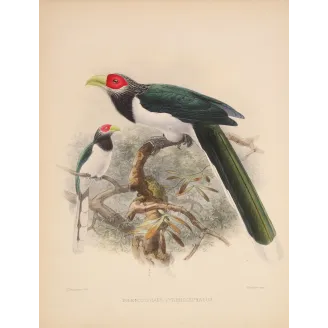
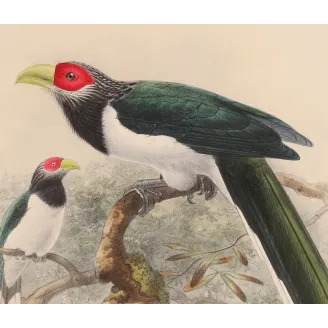
Original nineteenth-century bird print depicting the remarkable Red-faced Malkoha (Phaenicophaeus pyrrhocephalus), illustrated by Johannes Gerardus Keulemans for William Vincent Legge’s celebrated Birds of Ceylon. With its vivid scarlet face, elegant elongated tail and refined tropical palette, this striking ornithological lithograph combines scientific precision with exceptional decorative presence.
Original antique bird print depicting Baza ceylonensis (Ceylon Hawk-Eagle), illustrated by J.G. Keulemans for A History of the Birds of Ceylon. A striking Victorian ornithological lithograph featuring a refined pair of raptors with strong decorative presence.
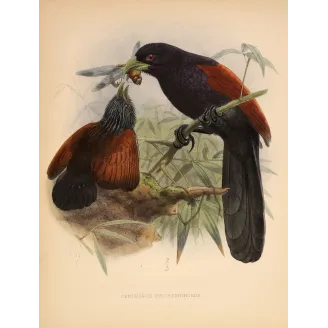
Original hand-colored bird engraving depicting the Green-Billed Coucal (Centropus chlororhynchus), illustrated by Johannes Gerardus Keulemans for The Birds of Ceylon. A striking tropical composition with rich chestnut and deep blue plumage.
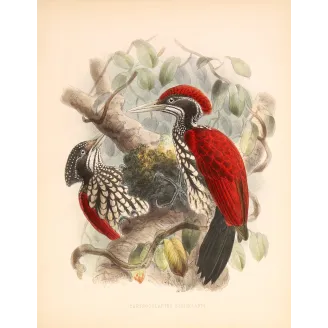
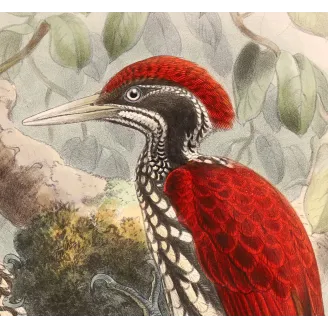
Original nineteenth-century bird print depicting the striking Crimson-backed Flameback (Chrysocolaptes stricklandi), illustrated by Johannes Gerardus Keulemans for William Vincent Legge’s celebrated Birds of Ceylon. This rare ornithological lithograph combines scientific precision with exceptional decorative appeal, featuring vivid crimson plumage and refined naturalistic composition.
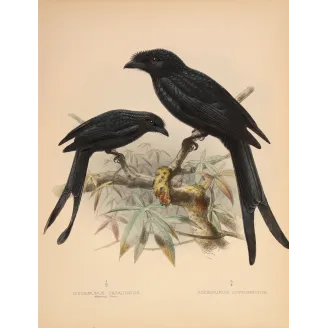
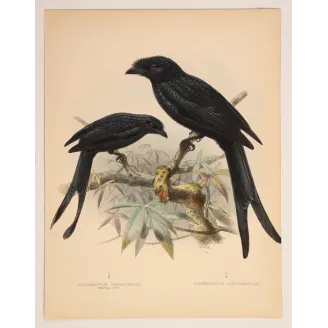
Original nineteenth-century bird print depicting two remarkable Sri Lankan drongos — Dissemurus paradiseus and Dissemurus lophorhinus — illustrated by Johannes Gerardus Keulemans for William Vincent Legge’s celebrated Birds of Ceylon. Distinguished by deep iridescent plumage and elegant elongated forms, this refined ornithological lithograph combines scientific precision with understated decorative sophistication.
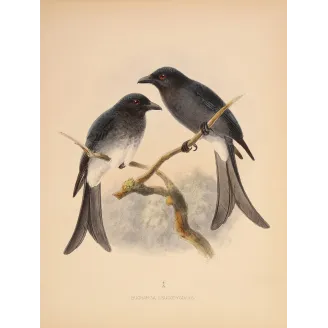
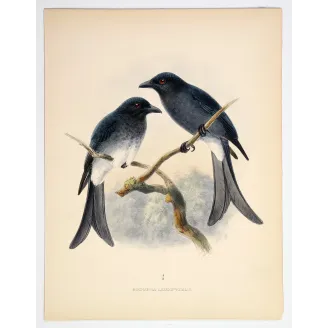
Original antique bird print by J.G. Keulemans depicting Buchanga leucopygialis (White-rumped Drongo), from A History of the Birds of Ceylon. A refined Victorian ornithological lithograph with elegant tonal balance and exceptional decorative presence.
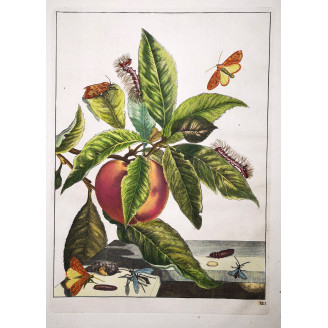
Original 1774 engraving by Jacob L'Admiral: Moths and Larvae on Fruit Tree Branch.
Original 1774 engraving by Jacob L'Admiral: Red Twin-spot Carpet on Mallow.
18th-century hand-colored engraving of the Wilding or Crab Tree by Elisabeth Blackwell, with blossom and fruit details.
Original seventeenth-century hand-colored botanical engraving of Canna Indica rubra from Basilius Besler's monumental Hortus Eystettensis, first published in 1613. The imposing composition combines sweeping green foliage, exposed roots and vivid red botanical forms, while the laid-paper sheet preserves a watermark and the remarkable printed autumnal heading “SECVNDVS ORDO COLLECTARVM PLANTARVM AVTVMNALIVM” on its verso.
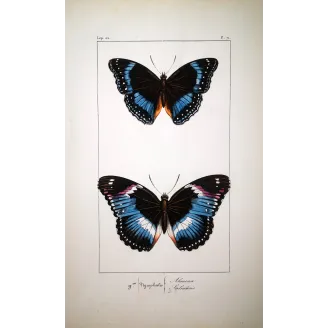
A vivid 19th-century hand-colored engraving depicting two striking tropical butterflies: the Blue-banded Eggfly (Hypolimnas alimena) and the Blue Diadem (Hypolimnas salmacis). Published in Hippolyte Lucas’s Exotic Butterflies (1835), the plate highlights their dramatic contrast of velvety black wings with electric blue bands and delicate white markings.
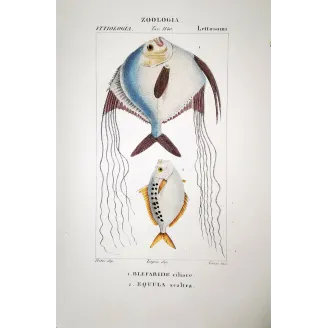
Delicate 19th-century hand-colored engraving of a ponyfish with companion species, ideal for marine-themed interiors and collectors.
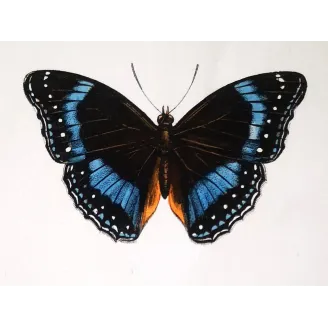
Original 1835 hand-colored engraving of Nymphalis orion, drawn and engraved by Pauquet under the scientific direction of Hippolyte Lucas for Exotic Butterflies.
Original 1774 engraving by Jacob L'Admiral: Large Tortoiseshell on Sweet Cherry.
Original hand-colored bird engraving depicting the Crimson-fronted Barbet (Xantholaema rubricapilla) and the Ceylon Hanging Parrot (Loriculus indicus), illustrated by Johannes Gerardus Keulemans for Birds of Ceylon. A vivid tropical composition rich in colour and narrative charm.