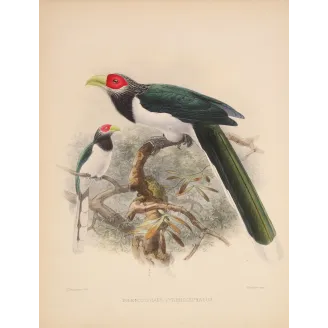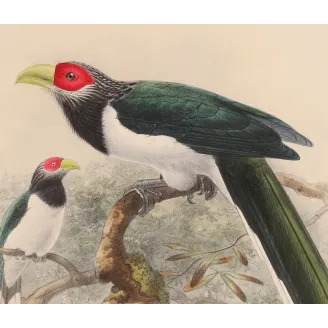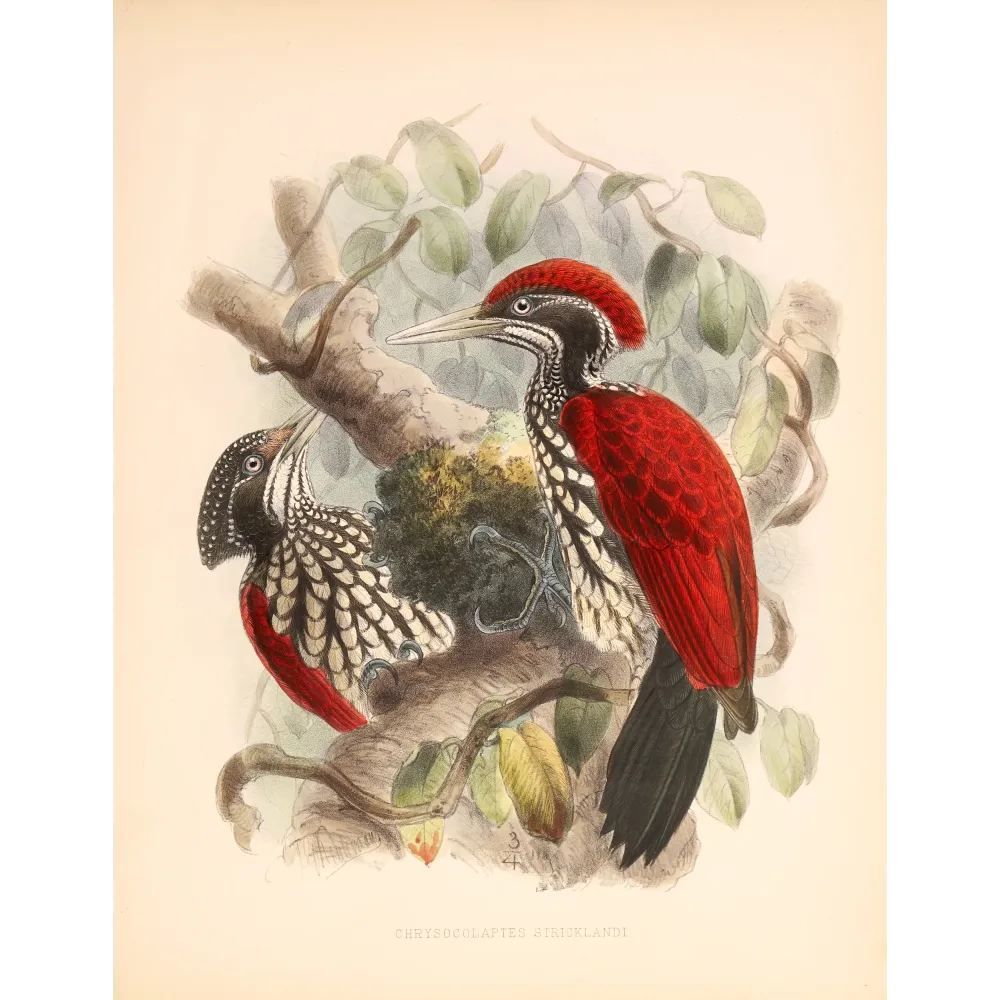
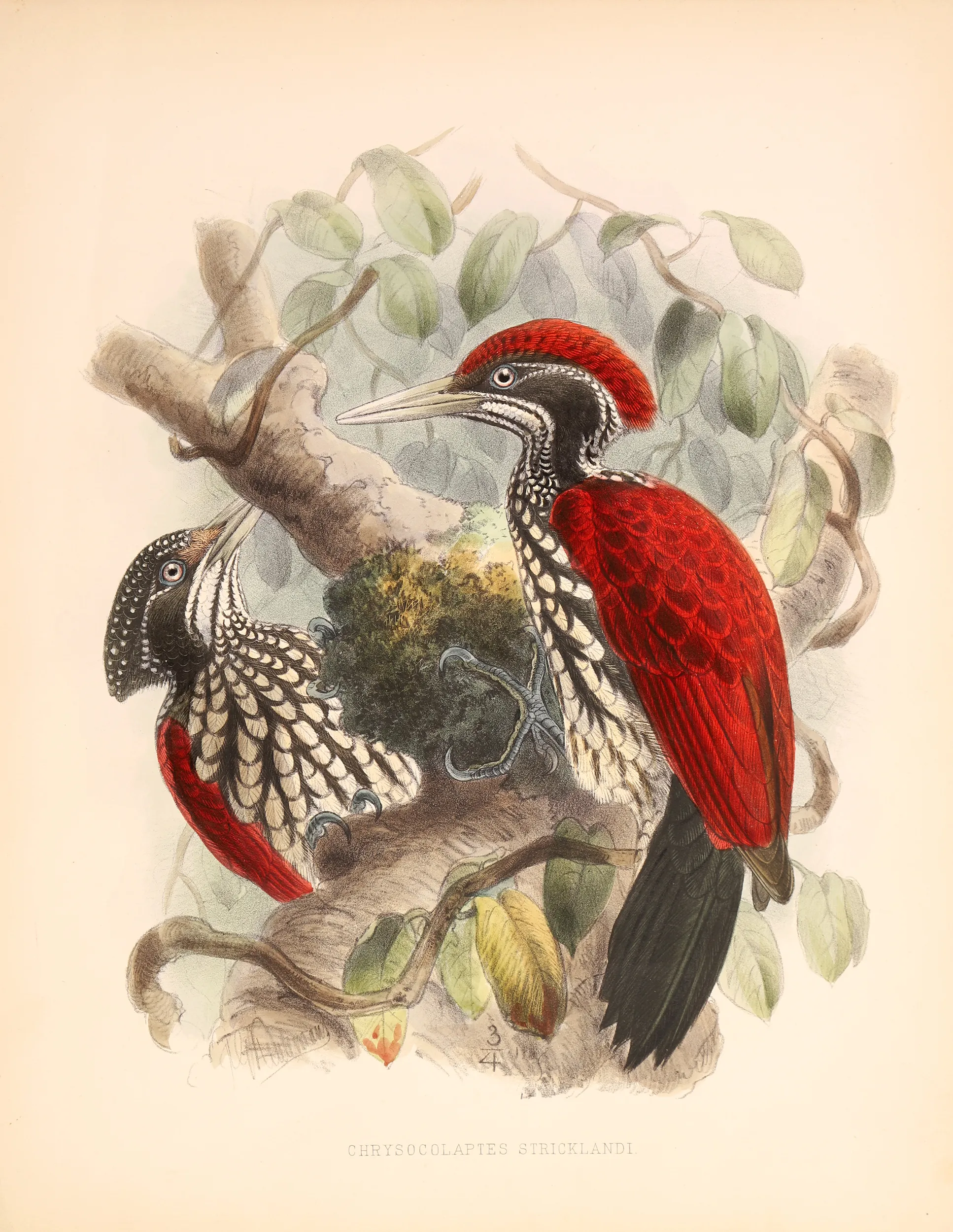
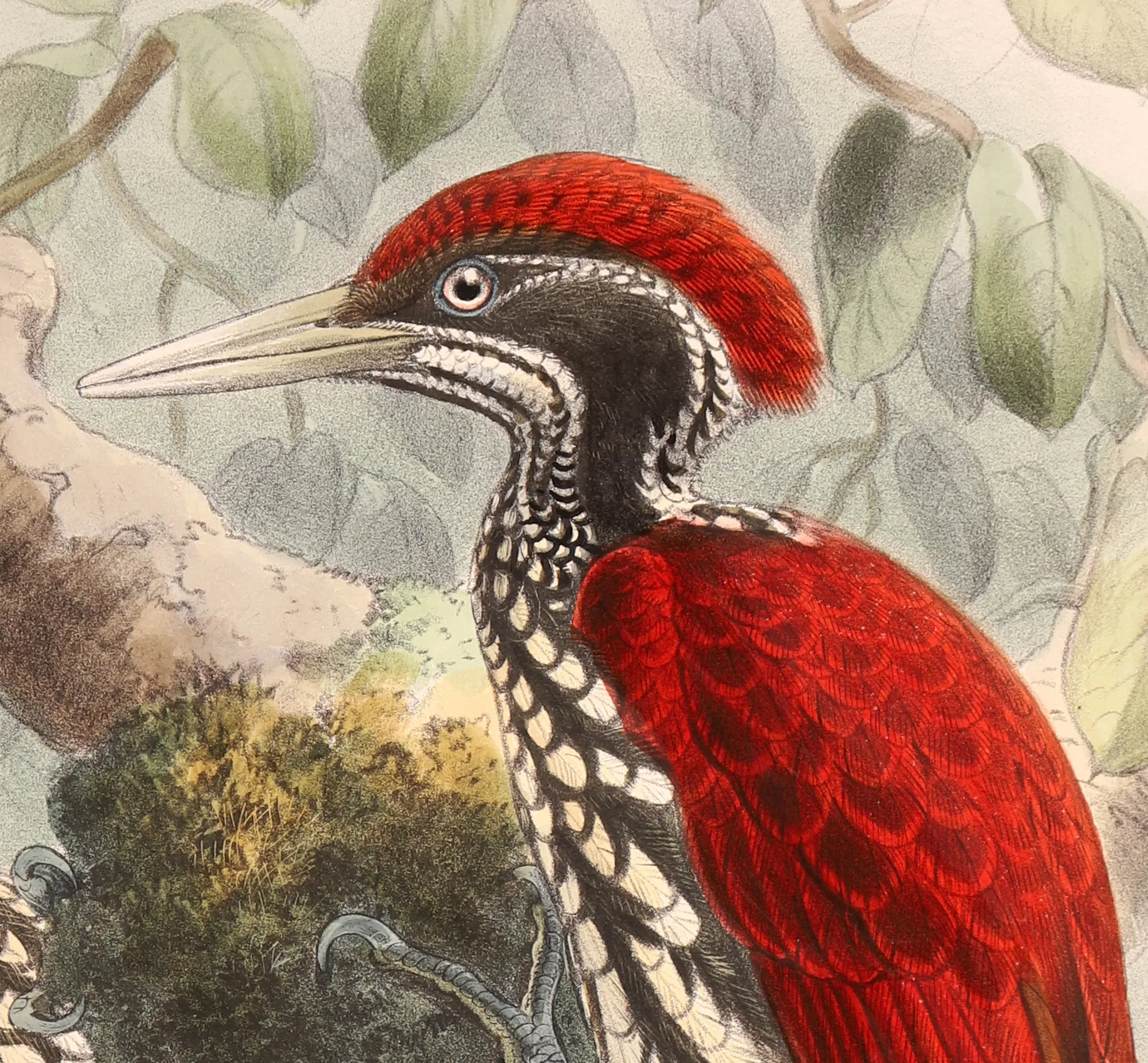
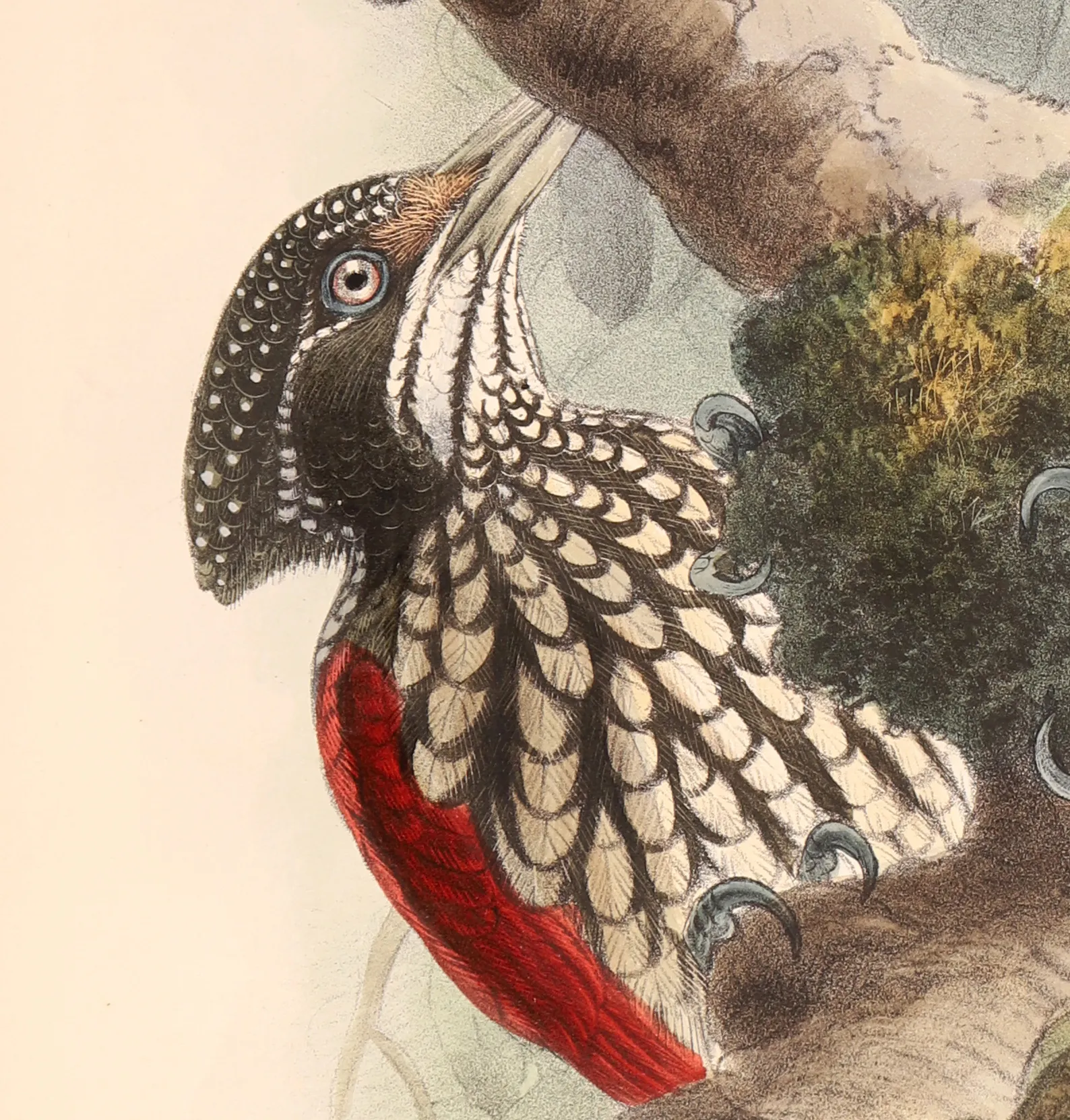
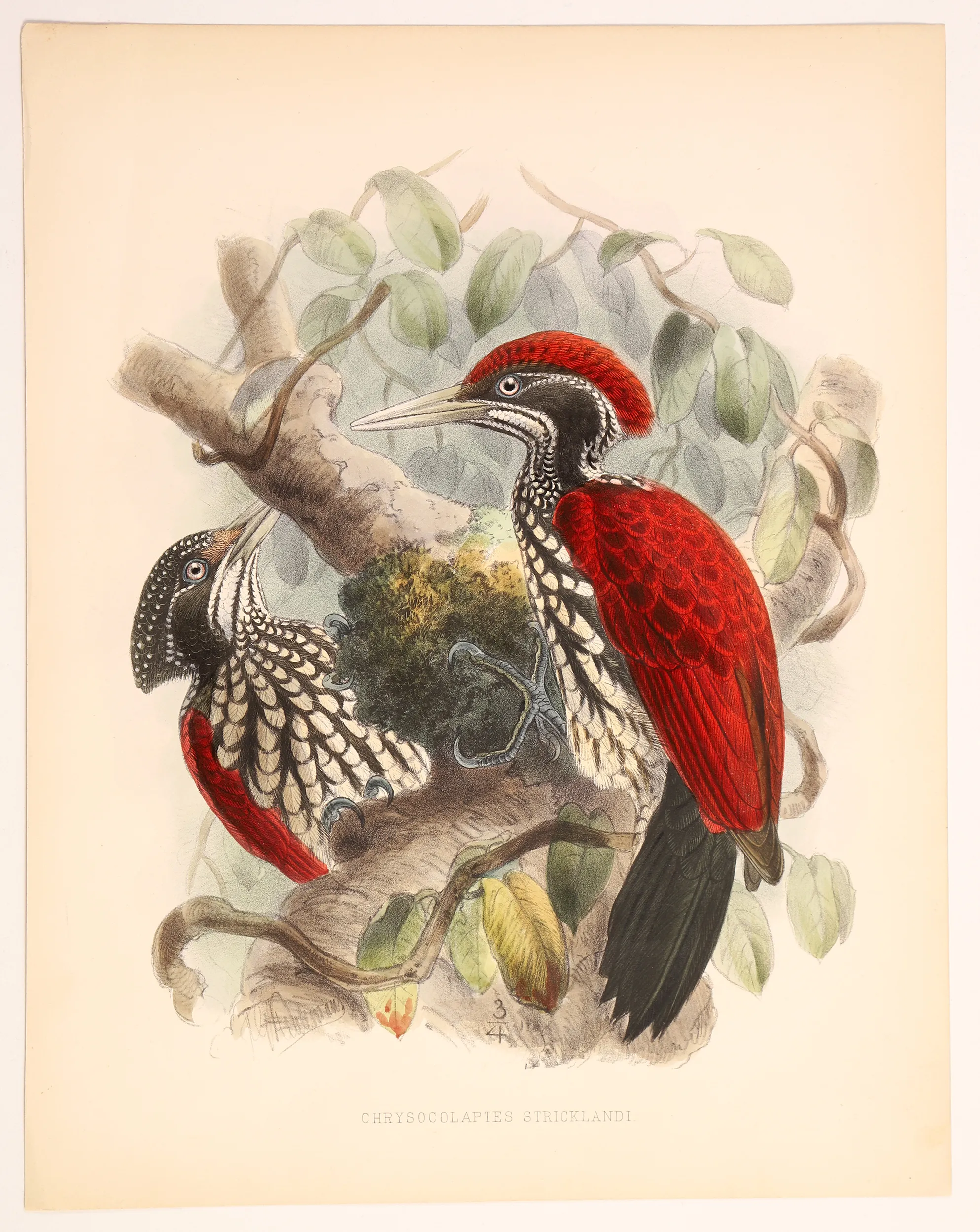
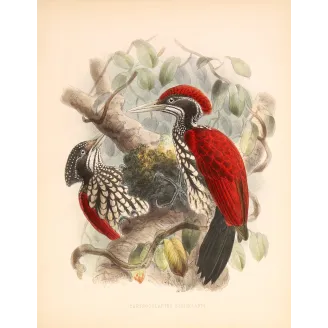
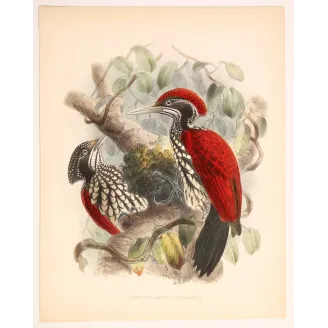
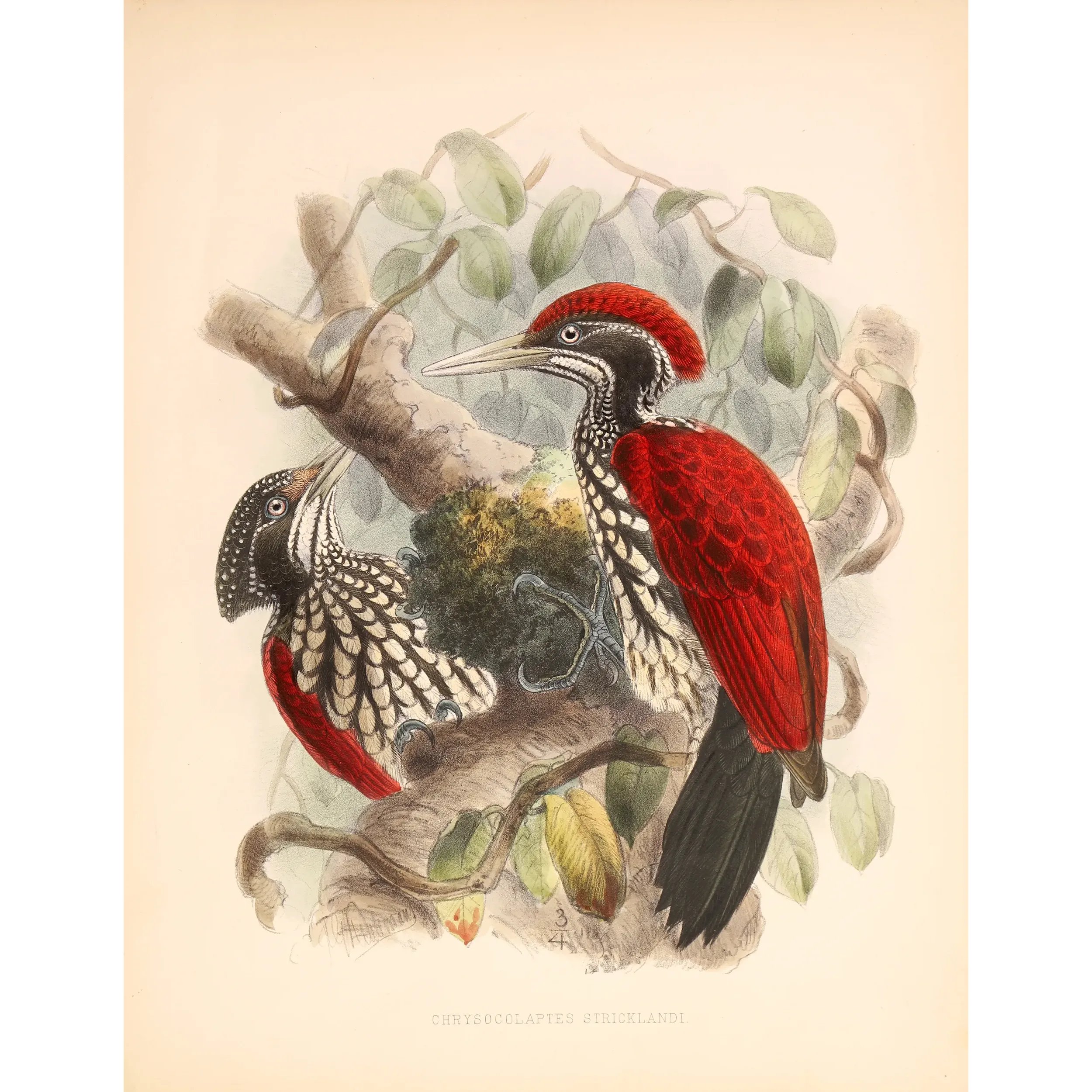
Original nineteenth-century bird print depicting the striking Crimson-backed Flameback (Chrysocolaptes stricklandi), illustrated by Johannes Gerardus Keulemans for William Vincent Legge’s celebrated Birds of Ceylon. This rare ornithological lithograph combines scientific precision with exceptional decorative appeal, featuring vivid crimson plumage and refined naturalistic composition.
 Delivery policy
Your print will be carefully prepared and shipped worldwide via trusted couriers (UPS or similar).
 Authentic antique prints
Original engravings from the 17th–19th century.
Few nineteenth-century ornithological illustrations combine scientific precision with decorative impact as convincingly as this remarkable Crimson-backed Flameback (Chrysocolaptes stricklandi). Dominated by deep crimson plumage set against restrained grey-green foliage, Johannes Gerardus Keulemans transforms careful zoological observation into an image of exceptional visual presence.
Published in William Vincent Legge’s A History of the Birds of Ceylon, the plate reflects a moment when natural history illustration reached one of its most sophisticated expressions, balancing diagnostic accuracy with an accomplished sense of colour, movement and composition.
— • —
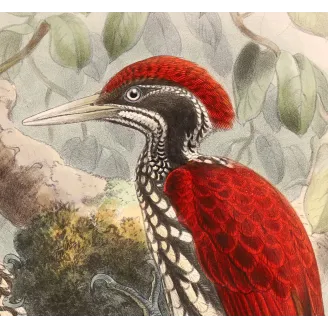
The composition is immediately defined by the dark, warm crimson mantle of the principal bird. This extensive field of colour establishes a powerful focal point against the quieter foliage, while the finely articulated black-and-white markings across the neck and breast introduce a contrasting rhythm of repeated lines and spots.
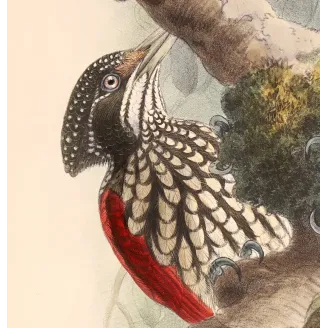
Keulemans builds the image through elegant asymmetry. The dominant bird rises almost vertically from the branch with poised, sculptural authority, while the second figure turns downward and away, introducing movement and directing the eye through the lower part of the composition. Their opposing postures create a subtle visual dialogue between stillness and action.
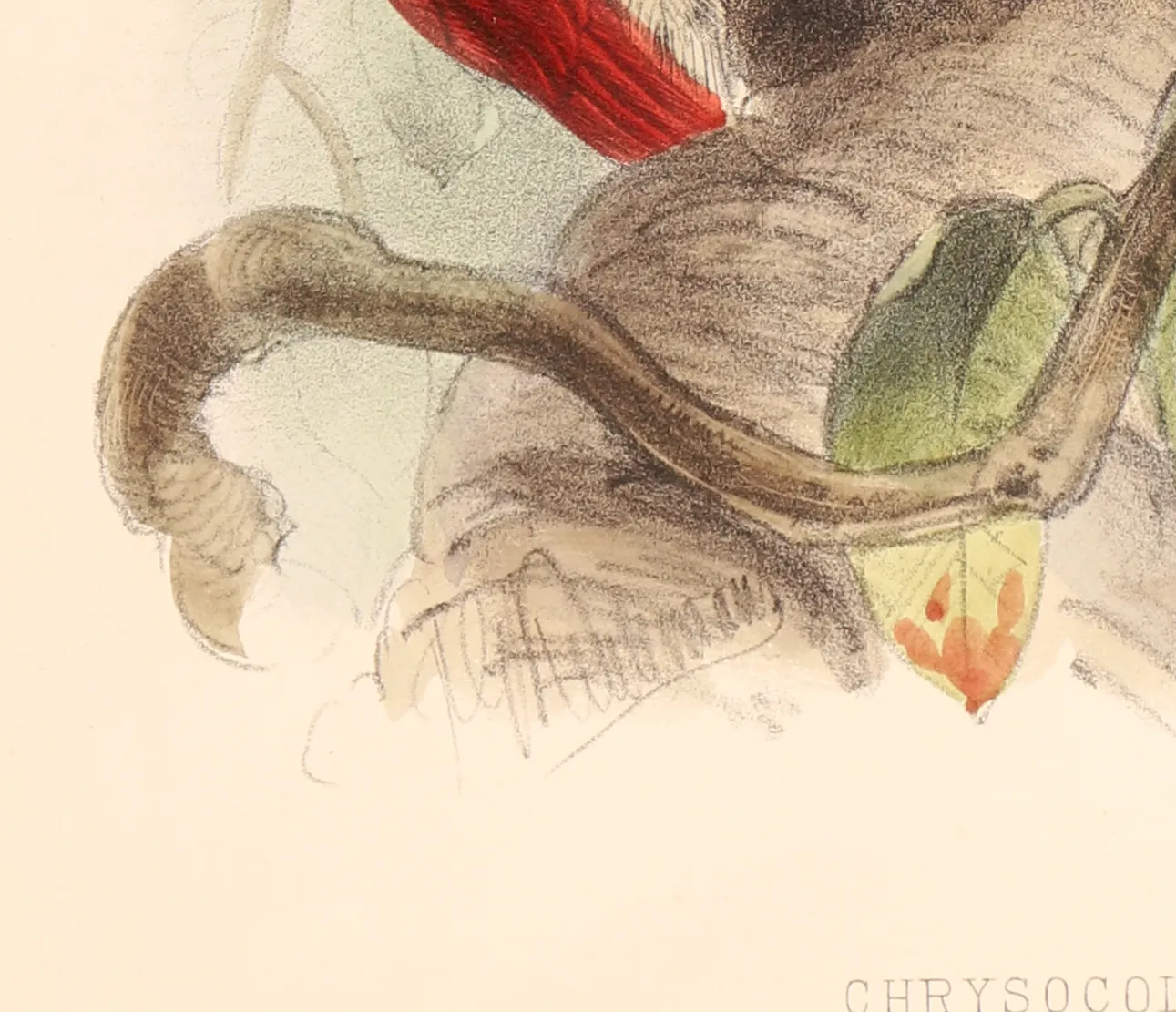
The surrounding branches are restrained but structurally important. Their curves echo the contours of the birds and connect the two figures without enclosing them. Soft botanical elements establish the natural setting while remaining sufficiently subdued to preserve the clarity of the ornithological subjects.
Generous areas of open paper are equally significant. Rather than filling the sheet with dense habitat detail, Keulemans allows the birds to occupy the image with unusual confidence. This controlled use of negative space strengthens their silhouettes and gives the plate a spacious, almost painterly character.
Direct examination of the original impression reveals an extensive application of gum arabic across the crimson plumage of the principal bird, together with more selective gloss upon portions of its black tail. These transparent surface finishes catch changing light, intensifying the depth of the warm oxblood-red colouring and subtly differentiating the texture and structure of the feathers.
Here the gum arabic serves both an artistic and an observational purpose. It increases the brilliance and physical presence of the dominant plumage while helping the coloured areas retain the optical richness associated with the living bird. The same finish gives selected dark tail feathers a restrained sheen, preventing the black passages from appearing visually flat.
This is the only plate presently observed within the Prantique Birds of Ceylon collection in which such an extensive glossy surface significantly affects photographic reproduction. Under direct viewing, the crimson appears warmer, darker and more oxblood in tone than it may appear in the principal photographs. A single photograph must inevitably balance colour accuracy against reflective highlights and cannot fully reproduce the changing interaction between pigment, gum arabic and light.
The result is an image in which scientific observation becomes inseparable from visual design and material craftsmanship. The plate records the species with precision, yet its enduring power lies in the way colour, balance, surface and movement transform that record into a memorable work of natural history art.
The Crimson-backed Flameback (Chrysocolaptes stricklandi) is a distinctive Sri Lankan woodpecker recognised by its rich crimson upper plumage, contrasting black-and-white markings and powerful climbing form. Its long bill and strong feet reflect the anatomical adaptations associated with life upon trunks and branches.
The species belongs to a wider Asian group of flamebacks whose shared structures invited careful comparison among nineteenth-century ornithologists. In Ceylon, such birds contributed to the larger scientific discussion surrounding the relationship between island populations and their continental relatives.
Legge’s regional study sought to understand these birds not merely as isolated species, but as part of an avifauna shaped by habitat, geography and the island’s close yet complex relationship with India.
This original lithograph belongs to William Vincent Legge’s A History of the Birds of Ceylon, published between 1878 and 1880 after more than eight years of observation and collecting on the island. The work became the first comprehensive ornithological treatment of Ceylon and brought together field experience, museum comparison, historical literature and the illustrations of Johannes Gerardus Keulemans.
The Crimson-backed Flameback exemplifies the wider purpose of the publication. Its distinctive visual identity made it an ideal subject for Keulemans, while its relationship to other Asian woodpeckers reflects the scientific questions that made Ceylon such an important field of comparative study.
Understand the Historical Context of this Print →
Discover more about the artist: Johannes Gerardus Keulemans — Precision and Passion in Ornithological Illustration.
Browse the complete collection: Keulemans – Birds of Ceylon Collection.
For readers wishing to better understand antique prints—from technique and paper to collecting criteria—explore our Antique Prints Guide.
Excellent antique condition. An exceptionally fresh and virtually immaculate impression, preserving its original contemporary hand colouring with remarkable depth and brilliance. The sheet remains bright, crisp and exceptionally clean, with only negligible evidence of age.
Extensive and beautifully preserved applications of gum arabic remain visible across the crimson mantle of the principal bird, with additional selective gloss upon portions of the black tail. These original surface finishes create delicate variations of sheen and colour under changing light and contribute significantly to the extraordinary visual richness of the impression.
The original crimson is appreciably warmer, darker and more oxblood in character when viewed directly than it may appear in photography. This difference results from the unusually broad glossy surface, whose changing reflections cannot be completely conveyed in a single fixed image.
Printed on fine nineteenth-century paper with generous original margins. No watermark observed. Overall, this is an outstanding and unusually well-preserved example of Keulemans’ hand-coloured ornithological lithography.
Specific References
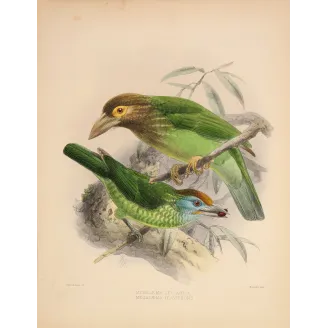
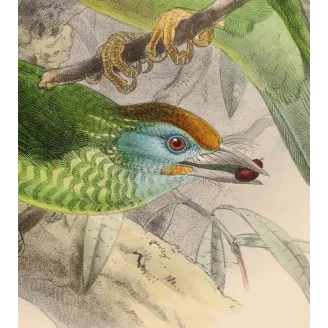
Original nineteenth-century bird print depicting two remarkable Sri Lankan barbets — Megalaema zeylanica and Megalaema flavifrons — illustrated by Johannes Gerardus Keulemans for William Vincent Legge’s celebrated Birds of Ceylon. Rich in tropical colour and compositional balance, this striking ornithological lithograph combines scientific observation with refined decorative appeal.
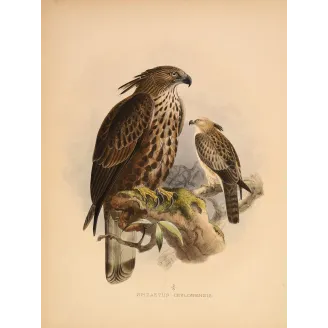
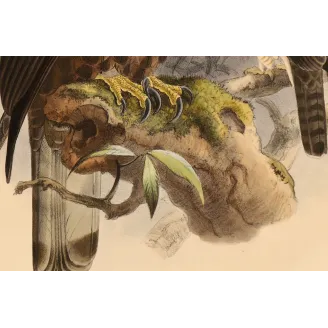
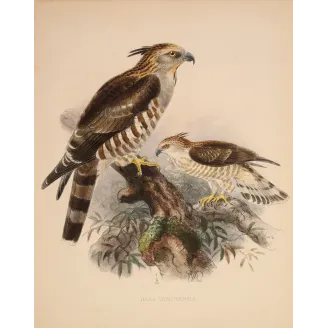
Original antique bird print depicting Spizaëtus ceylonensis (Ceylon Hawk-Eagle), illustrated by J.G. Keulemans for A History of the Birds of Ceylon. A refined Victorian ornithological lithograph featuring an elegant pair of raptors with remarkable decorative presence.
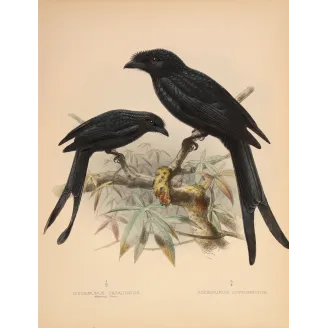
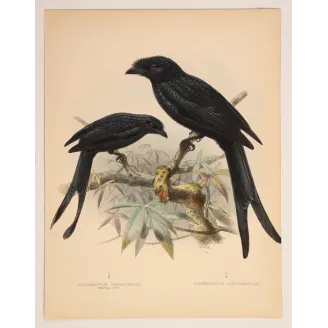
Original nineteenth-century bird print depicting two remarkable Sri Lankan drongos — Dissemurus paradiseus and Dissemurus lophorhinus — illustrated by Johannes Gerardus Keulemans for William Vincent Legge’s celebrated Birds of Ceylon. Distinguished by deep iridescent plumage and elegant elongated forms, this refined ornithological lithograph combines scientific precision with understated decorative sophistication.
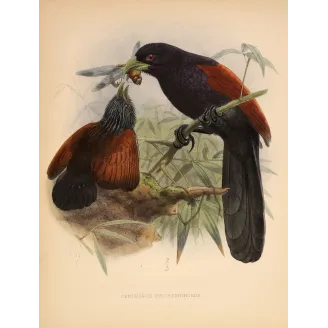
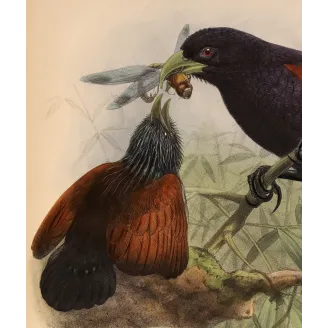
Original hand-colored bird engraving depicting the Green-Billed Coucal (Centropus chlororhynchus), illustrated by Johannes Gerardus Keulemans for The Birds of Ceylon. A striking tropical composition with rich chestnut and deep blue plumage.
Original antique bird print depicting Baza ceylonensis (Ceylon Hawk-Eagle), illustrated by J.G. Keulemans for A History of the Birds of Ceylon. A striking Victorian ornithological lithograph featuring a refined pair of raptors with strong decorative presence.
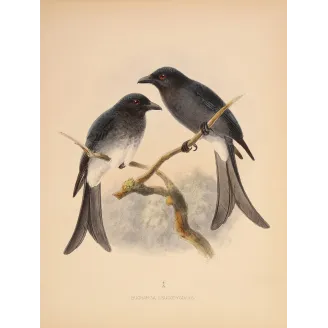
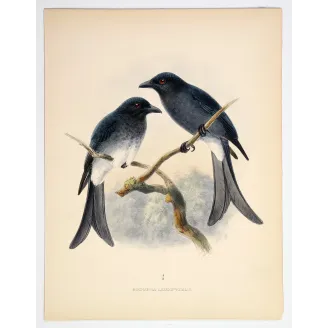
Original antique bird print by J.G. Keulemans depicting Buchanga leucopygialis (White-rumped Drongo), from A History of the Birds of Ceylon. A refined Victorian ornithological lithograph with elegant tonal balance and exceptional decorative presence.
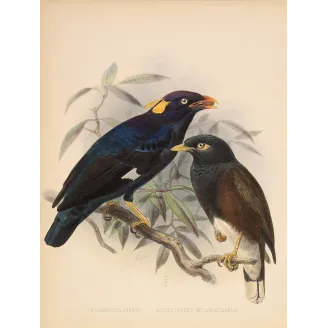
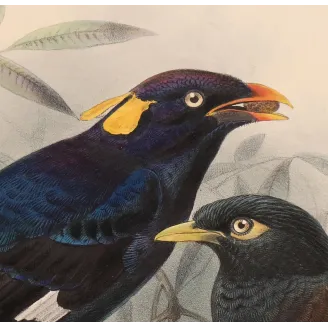
Original nineteenth-century bird print depicting two remarkable Sri Lankan mynas — Eulabes ptilogenys and Acridotheres melanosternus — illustrated by Johannes Gerardus Keulemans for William Vincent Legge’s celebrated Birds of Ceylon. Distinguished by rich iridescent plumage and refined compositional balance, this elegant ornithological lithograph combines scientific precision with exceptional decorative sophistication.
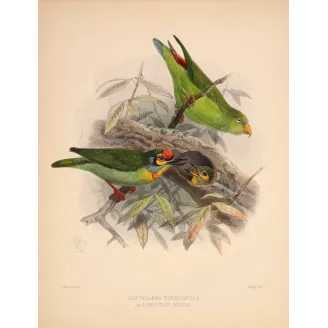
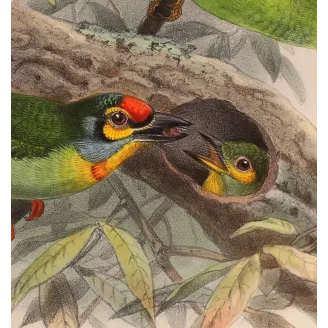
Original hand-colored bird engraving depicting the Crimson-fronted Barbet (Xantholaema rubricapilla) and the Ceylon Hanging Parrot (Loriculus indicus), illustrated by Johannes Gerardus Keulemans for Birds of Ceylon. A vivid tropical composition rich in colour and narrative charm.
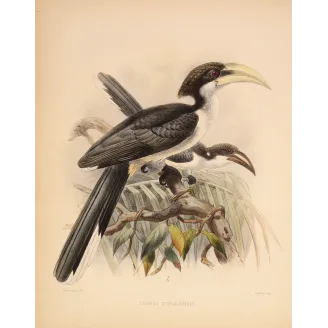
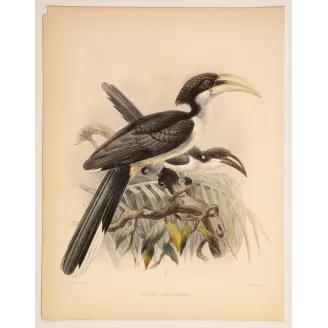
Original nineteenth-century bird print depicting the elegant Ceylon Hornbill (Tockus gingalensis), illustrated by Johannes Gerardus Keulemans for William Vincent Legge’s celebrated Birds of Ceylon. This refined ornithological lithograph combines scientific precision with sculptural decorative appeal, featuring the species’ remarkable ivory-coloured bill and poised tropical composition.
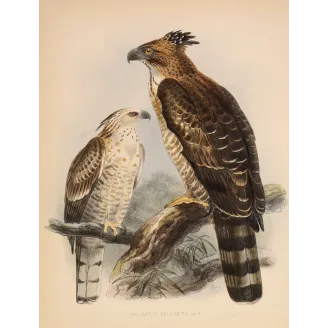
Original antique bird print depicting Spizaëtus kelaarti (Crested Hawk-Eagle), illustrated by J.G. Keulemans for A History of the Birds of Ceylon. A striking Victorian ornithological lithograph featuring an imposing pair of raptors with exceptional decorative presence.
Original nineteenth-century bird print depicting the remarkable Red-faced Malkoha (Phaenicophaeus pyrrhocephalus), illustrated by Johannes Gerardus Keulemans for William Vincent Legge’s celebrated Birds of Ceylon. With its vivid scarlet face, elegant elongated tail and refined tropical palette, this striking ornithological lithograph combines scientific precision with exceptional decorative presence.
Original nineteenth-century bird print depicting the elegant Ceylon Hornbill (Tockus gingalensis), illustrated by Johannes Gerardus Keulemans for William Vincent Legge’s celebrated Birds of Ceylon. This refined ornithological lithograph combines scientific precision with sculptural decorative appeal, featuring the species’ remarkable ivory-coloured bill and poised tropical composition.
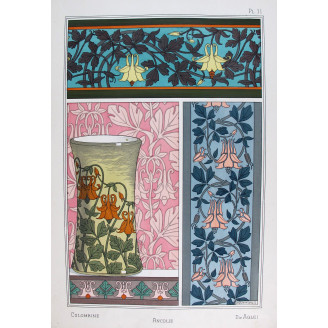
Graceful and enigmatic, the columbine (ancolie) is rendered here in flowing lines and soft complexity.
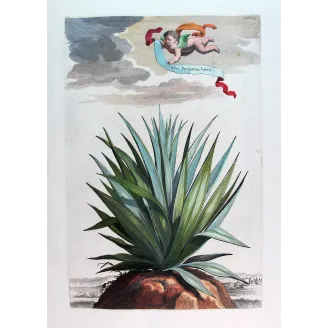
A striking 17th-century botanical engraving from Abraham Munting’s Nauwkeurige Beschryving der Aardgewassen - Phytographia Curiosa, depicting a monumental aloe with architectural structure and a decorative cartouche. A powerful example of early botanical art combining scientific observation with theatrical composition.
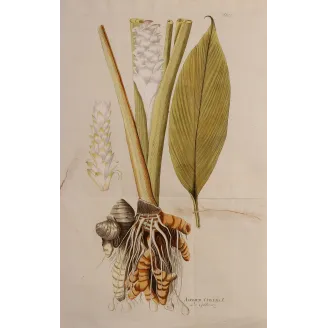
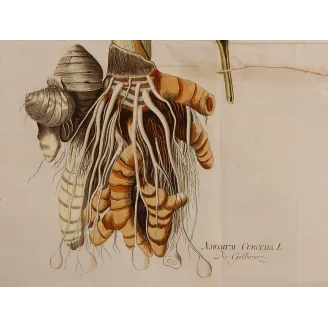
Exceptional large-format eighteenth-century botanical engraving depicting <em>Amomum Curcuma</em> L., published as Plate IV of Joseph Jacob von Plenck’s <em>Icones Plantarum Medicinalium</em>. Printed on a large folded sheet of Honig laid paper with complete watermark and contemporary hand colouring, the composition combines a remarkably refined pale inflorescence, monumental foliage and an exceptionally detailed rhizomatous structure. A powerful Plenck Statement Piece preserving both extraordinary botanical clarity and the visible material history of an eighteenth-century folded plate.
In this vibrant composition, Grasset elevates the humble gourd (courge) to an elegant decorative form.
Vibrant parakeets perched on branches: a scarlet macaw and a black cockatoo with yellow and red highlights.
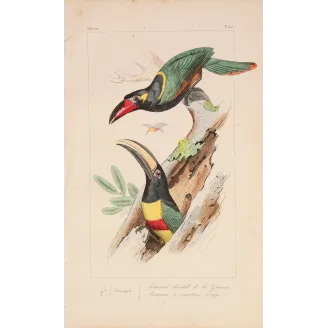
This vivid 19th-century engraving depicts two exotic aracaris, showcasing striking contrasts of green, red and yellow plumage. A highly decorative composition combining scientific observation with strong visual appeal, ideal for collectors of tropical ornithology and refined interior spaces.
Fine 18th-century engraving of the Medlar Tree by Elisabeth Blackwell, featuring fruit, blossom, and botanical detail.
Original nineteenth-century bird print depicting the striking Crimson-backed Flameback (Chrysocolaptes stricklandi), illustrated by Johannes Gerardus Keulemans for William Vincent Legge’s celebrated Birds of Ceylon. This rare ornithological lithograph combines scientific precision with exceptional decorative appeal, featuring vivid crimson plumage and refined naturalistic composition.