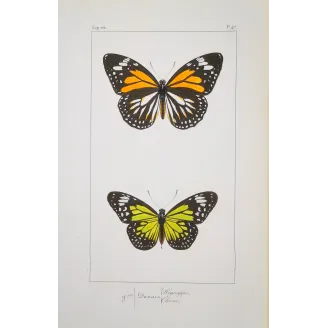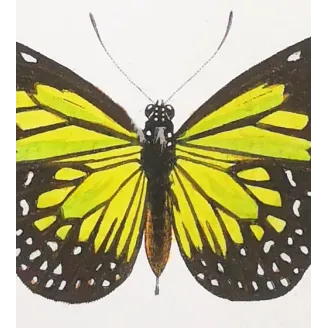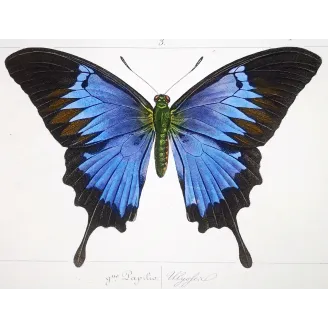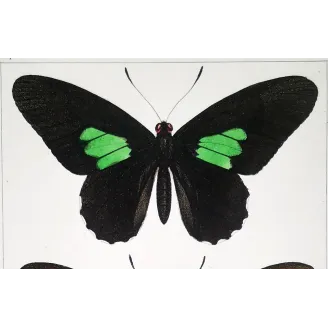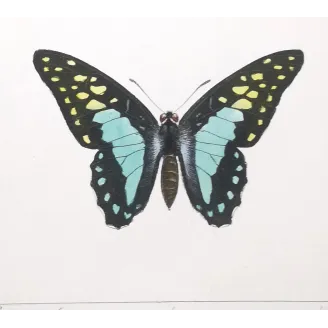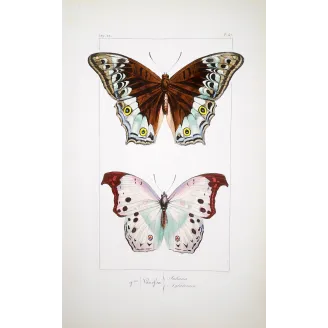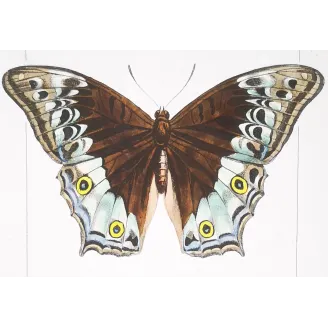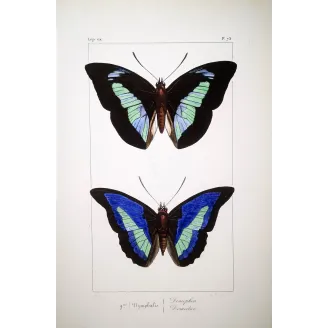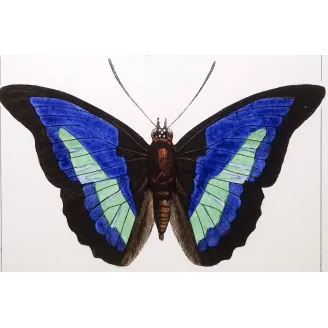
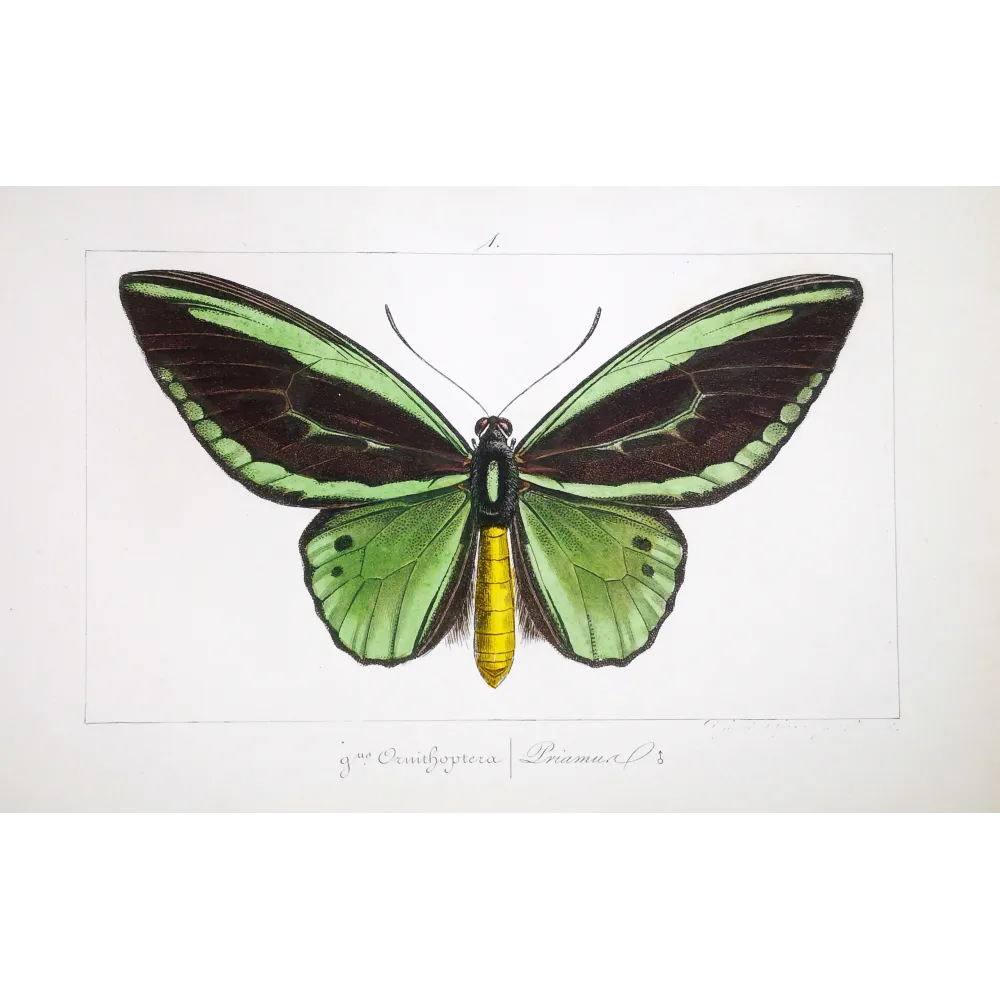
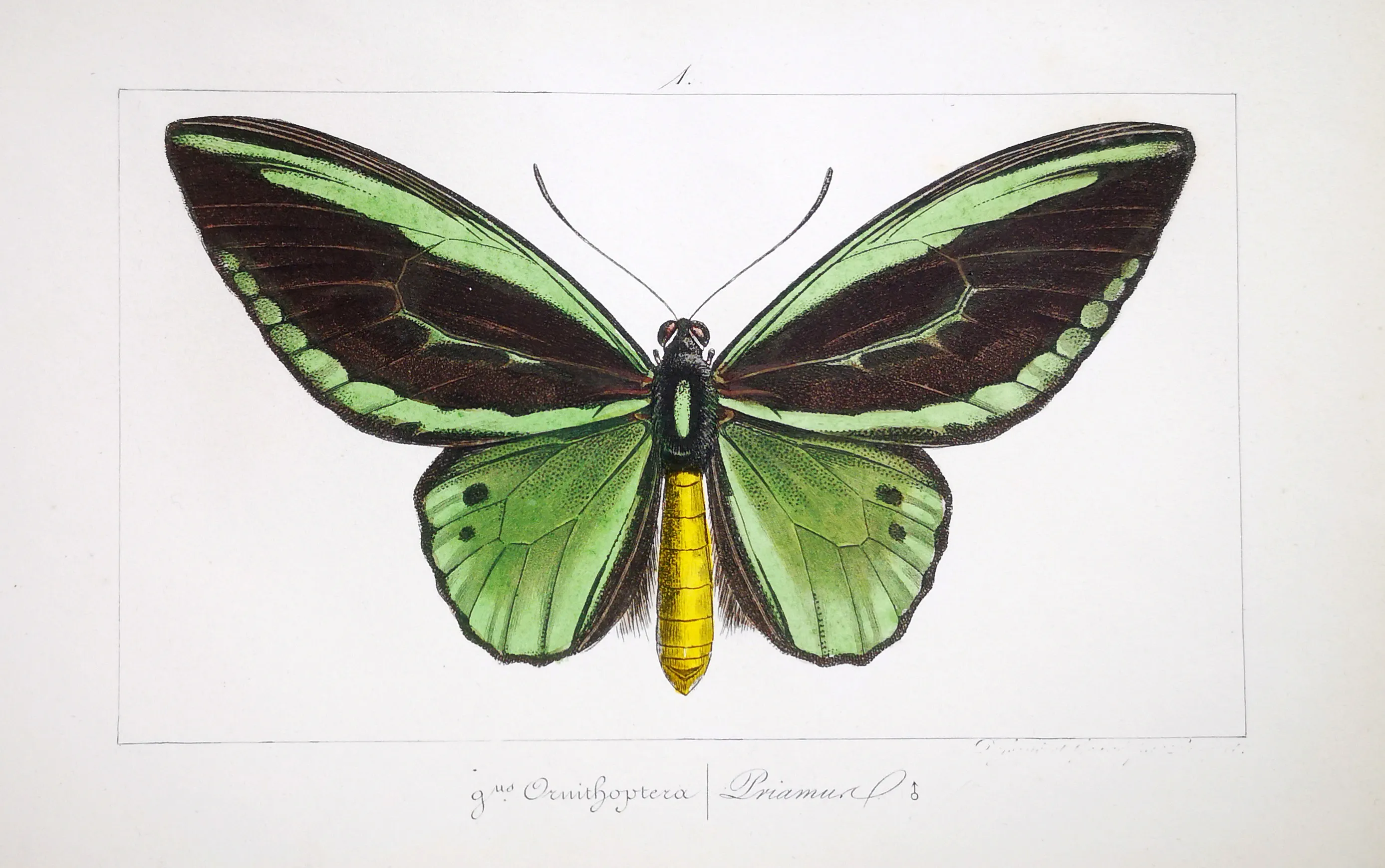
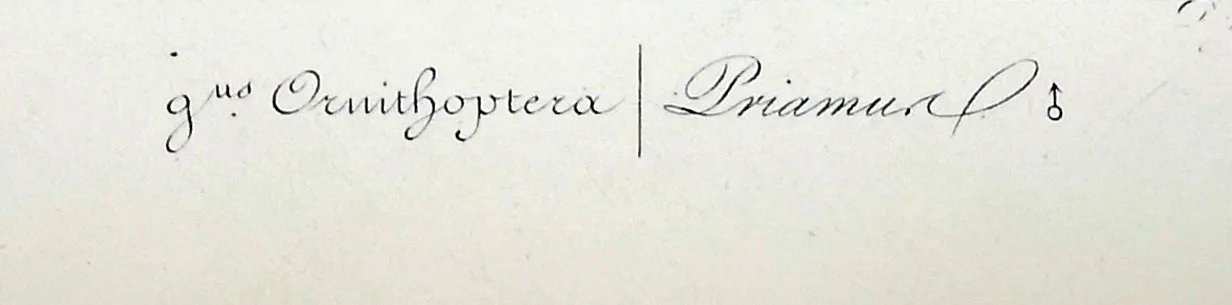
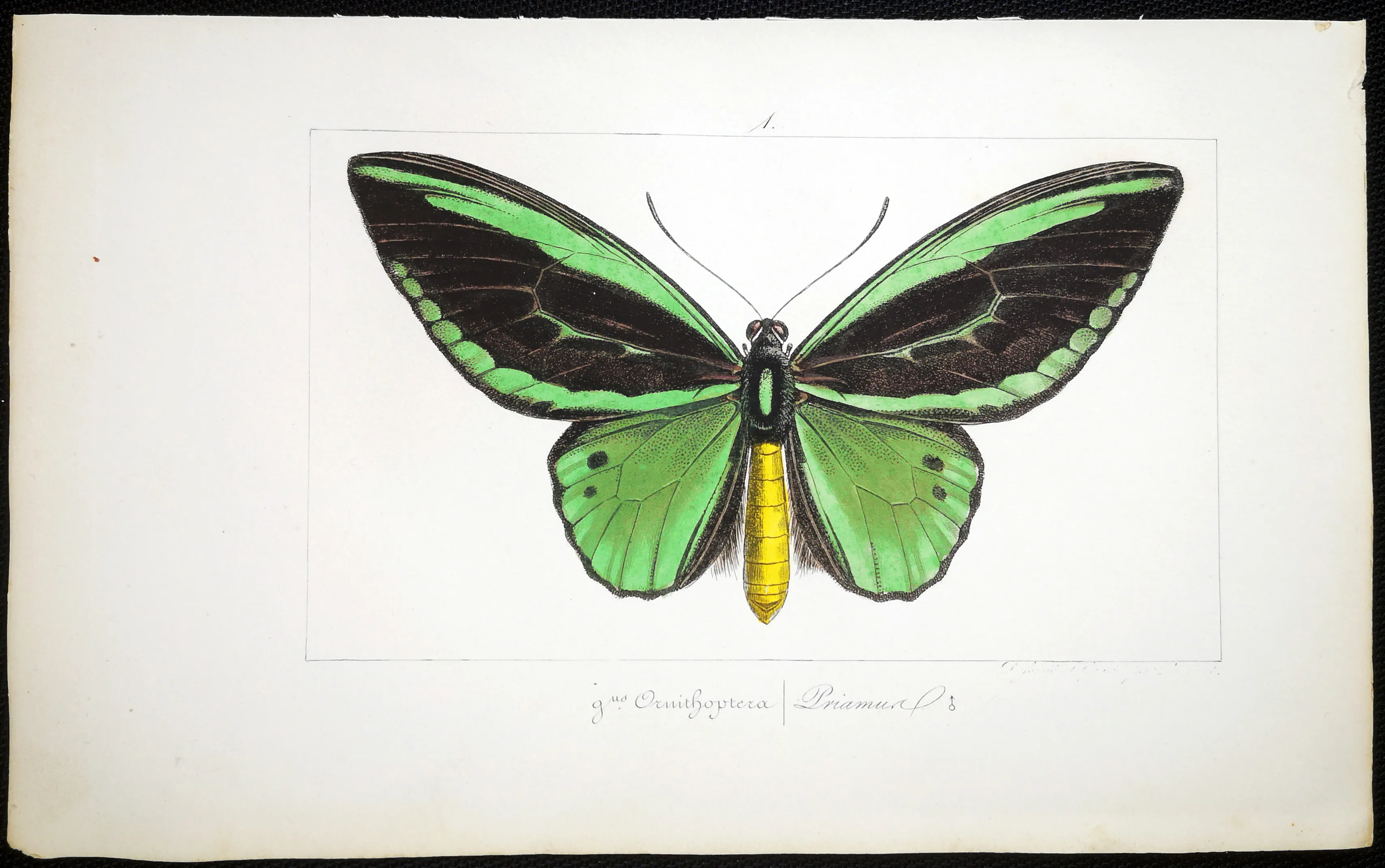
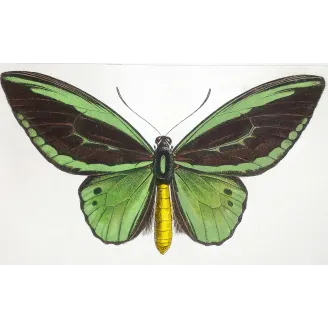
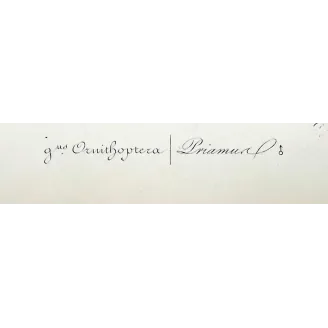
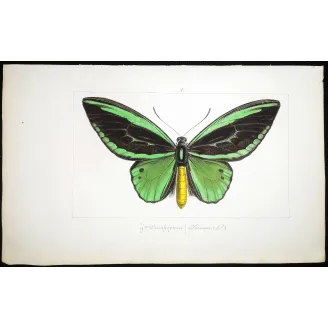
Original 1835 hand-colored engraving of Ornithoptera priamus (Common Green Birdwing), drawn and engraved by Pauquet under the scientific direction of Hippolyte Lucas.
 Delivery policy
Your print will be carefully prepared and shipped worldwide via trusted couriers (UPS or similar).
 Authentic antique prints
Original engravings from the 17th–19th century.
This original 1835 hand-colored copper engraving depicts Ornithoptera priamus, the Common Green Birdwing, one of the most celebrated tropical butterflies of the nineteenth century. The plate forms part of Exotic Butterflies, produced under the scientific direction of Hippolyte Lucas and drawn and engraved by Pauquet.
Isolated against a clean ground and presented with striking symmetry, the specimen is rendered with museum-like precision — a disciplined image that unites scientific clarity with bold decorative presence.
— • —
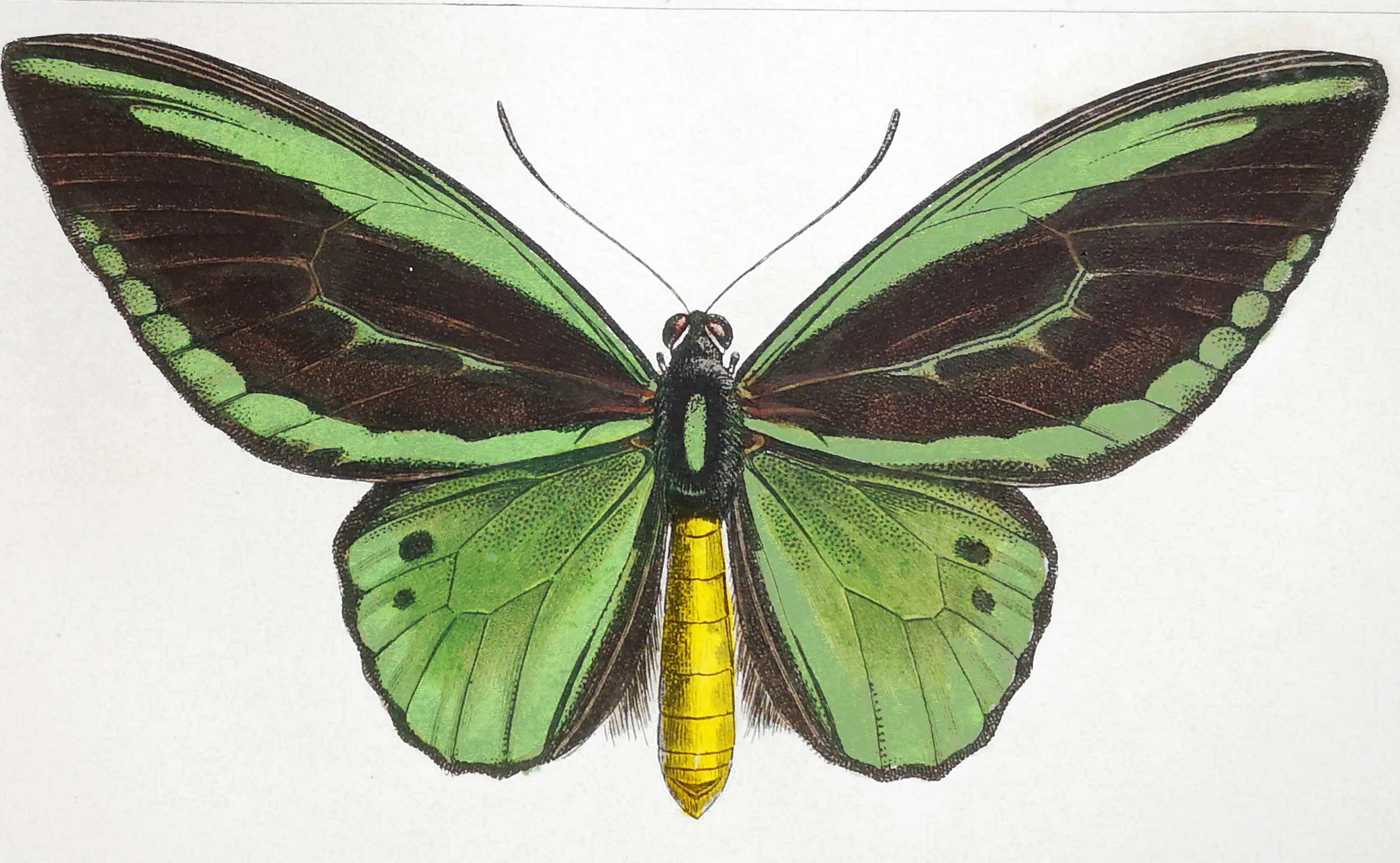
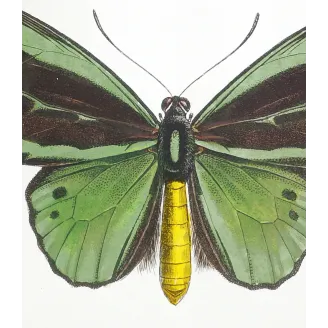
The wings unfold in monumental balance: deep velvety blacks frame radiant emerald-green panels that appear almost luminous against the white field. The upper wings display elongated green bands that guide the eye outward, while the lower wings soften into rounded forms with delicate tonal transitions.
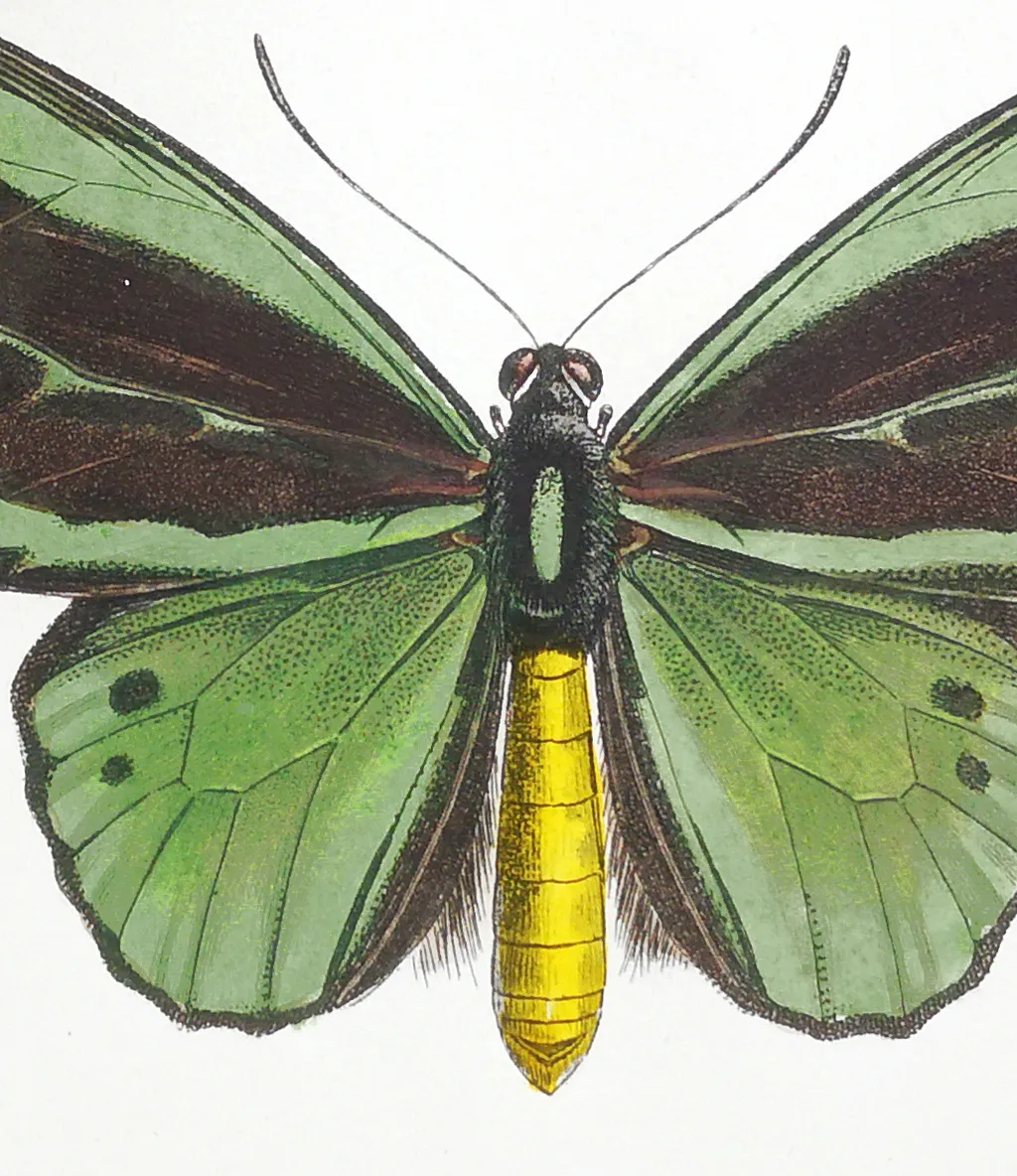
At the centre, the golden-yellow abdomen introduces a vertical axis of chromatic intensity, anchoring the composition and heightening contrast. The engraving preserves venation and structure with measured precision, while the hand-coloring adds depth and vitality — transforming a preserved specimen into a striking work of natural history art.
Ornithoptera butterflies, commonly known as birdwings, are among the largest and most spectacular Lepidoptera of the Indo-Australian region. The male of Ornithoptera priamus is especially admired for its intense emerald coloration and dramatic wing span.
In the early nineteenth century, such species symbolised the allure of distant territories and expanding natural history collections. Their scale, colour, and rarity made them ideal subjects for engraved publication — embodiments of both scientific discovery and aesthetic fascination.
This engraving belongs to the remarkable series Exotic Butterflies, published in 1835 under the scientific direction of Hippolyte Lucas — a period when nature was celebrated through monumental illustrated works, now practically unachievable.
Discover the historical context in our editorial feature: Hippolyte Lucas: Scientific Vision and the Golden Age of Exotic Butterflies.
The plate was drawn and engraved by Pauquet, whose refined copperplate technique translated real specimens into enduring images of exceptional clarity: Pauquet: The Engraver Behind the Exotic Butterflies.
Very good antique condition. Fresh and vibrant original hand-coloring with strong engraved impression. Printed on fine original nineteenth-century paper. Minor age toning consistent with 1835 publication.Well-preserved examples of this quality are becoming increasingly scarce, particularly with such fresh color and clarity.
Specific References
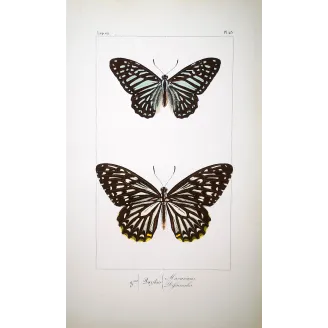
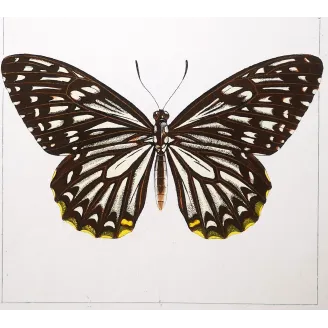
A finely detailed 19th-century hand-colored engraving depicting two forms of the Clipper Butterfly (Parthenos sylvia). Published in Hippolyte Lucas’s Exotic Butterflies (1835), the plate highlights the species’ elegant network of white markings across dark wings, creating a striking geometric pattern characteristic of tropical Asian butterflies.
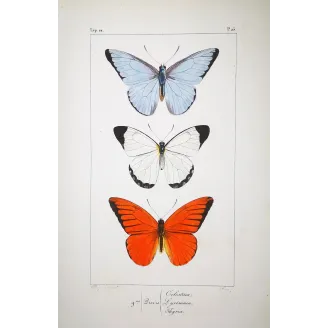
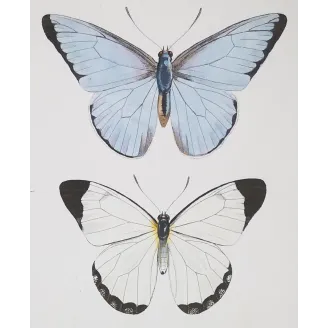
Delicate blue, white, and vivid red butterflies arranged in a refined vertical composition. An elegant 1835 engraving with balanced decorative appeal.
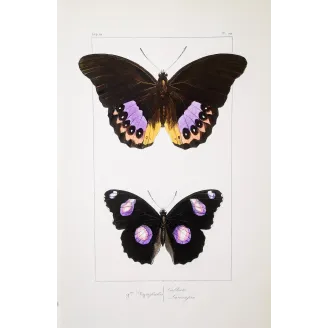
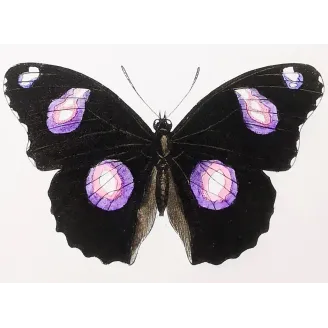
A striking 19th-century hand-colored engraving depicting two tropical pansy butterflies: the Golden Pansy (Junonia callista) and the Purple Pansy (Junonia laomedia). Published in Hippolyte Lucas’s Exotic Butterflies (1835), the plate highlights their dramatic wing contrasts and luminous violet eye-spots.
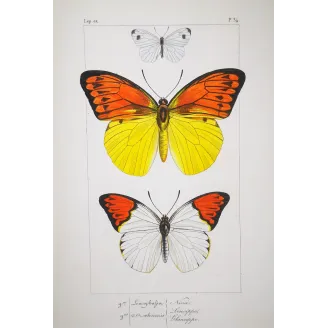
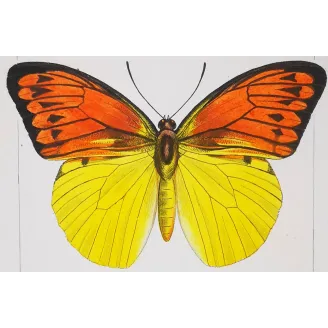
Bright orange and yellow butterflies with striking contrast against white wings. A vivid 1835 engraving with strong decorative and visual impact.
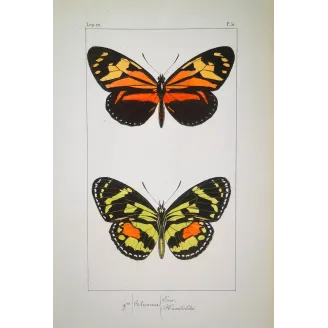
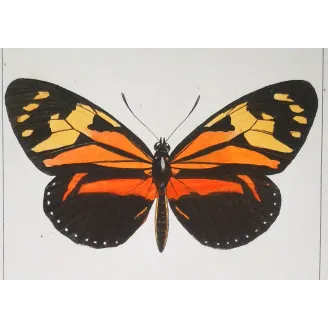
Striking black butterflies with vivid orange and yellow bands. A bold 1835 engraving with strong contrast and exceptional decorative impact.
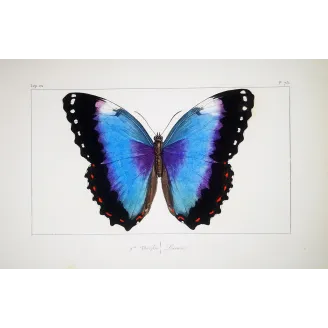
An original 19th-century hand-colored engraving of Morpho leonte, the striking Blue Morpho butterfly, drawn and engraved by Pauquet under the scientific direction of Hippolyte Lucas.
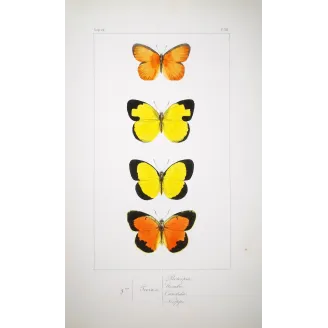
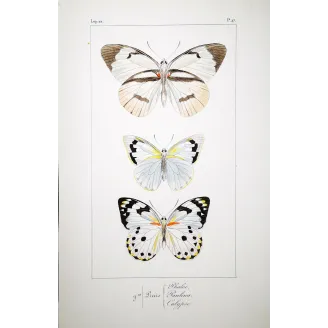
Sulphur Butterflies (Terias hecabe, candida, nicippe) – Antique Hand-Colored Engraving (1835)
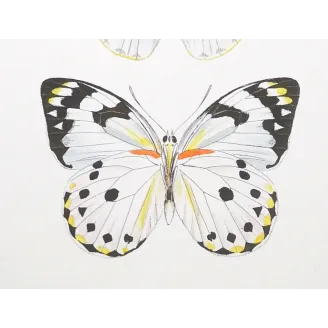
Delicate white butterflies with subtle yellow, orange, and black accents. A refined 1835 engraving with light and elegant decorative appeal.
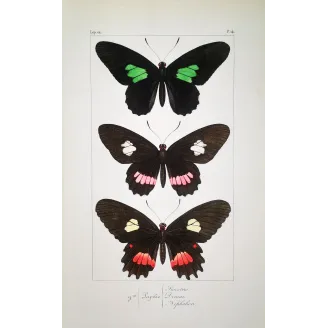
Striking black butterflies with vivid green, pink, and red accents. A dramatic 1835 engraving with strong contrast and bold decorative appeal.
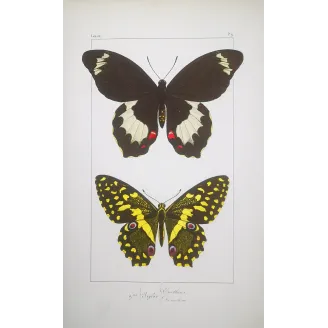
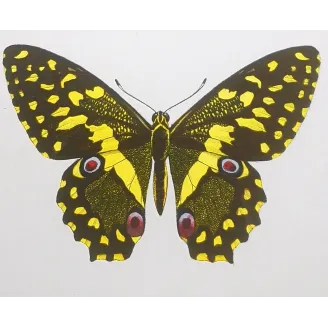
Yellow and black butterflies with striking eye spots and bold contrast patterns. A vivid 1835 engraving, perfect as antique butterfly wall art.
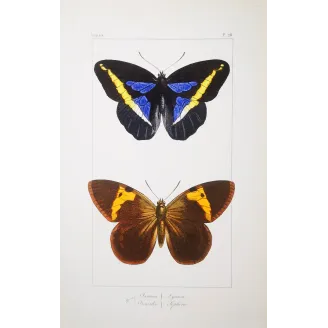
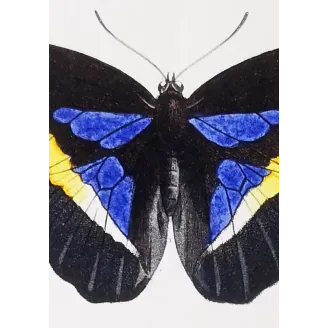
A bold pairing of Demophon Prepona (Archaeoprepona demophon) and Brassolis sophorae, featuring electric blue and golden bands on deep black wings. A striking example of antique butterfly wall art with strong visual contrast.
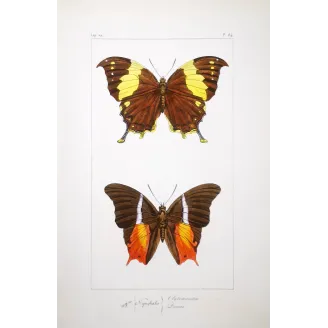
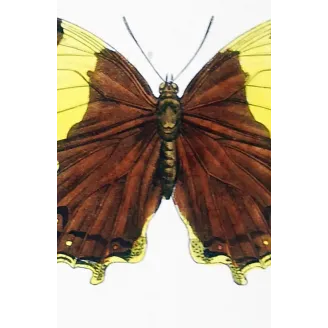
Tropical butterflies with warm amber, yellow and red tones on deep brown wings. A refined 1835 engraving, ideal as antique butterfly wall art.
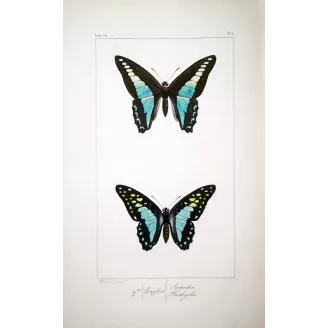
A vivid 19th-century hand-colored engraving depicting two striking Asian swallowtail butterflies: the Common Bluebottle (Papilio sarpedon) and the Spotted Bluebottle (Papilio bathycles). Published in Hippolyte Lucas’s Exotic Butterflies (1835), the plate highlights their elegant turquoise wing bands set against deep black wings.
Peacock Pansy (Junonia almana) and Grey Pansy (Junonia atlites) with distinctive eye-spots and soft tonal contrasts. A refined 1835 engraving, ideal as antique butterfly wall art.
Demophon & Demodice Butterflies (Archaeoprepona demophon, Prepona laertes demodice) – Antique Hand-Colored Engraving, Exotic Butterflies (1835).
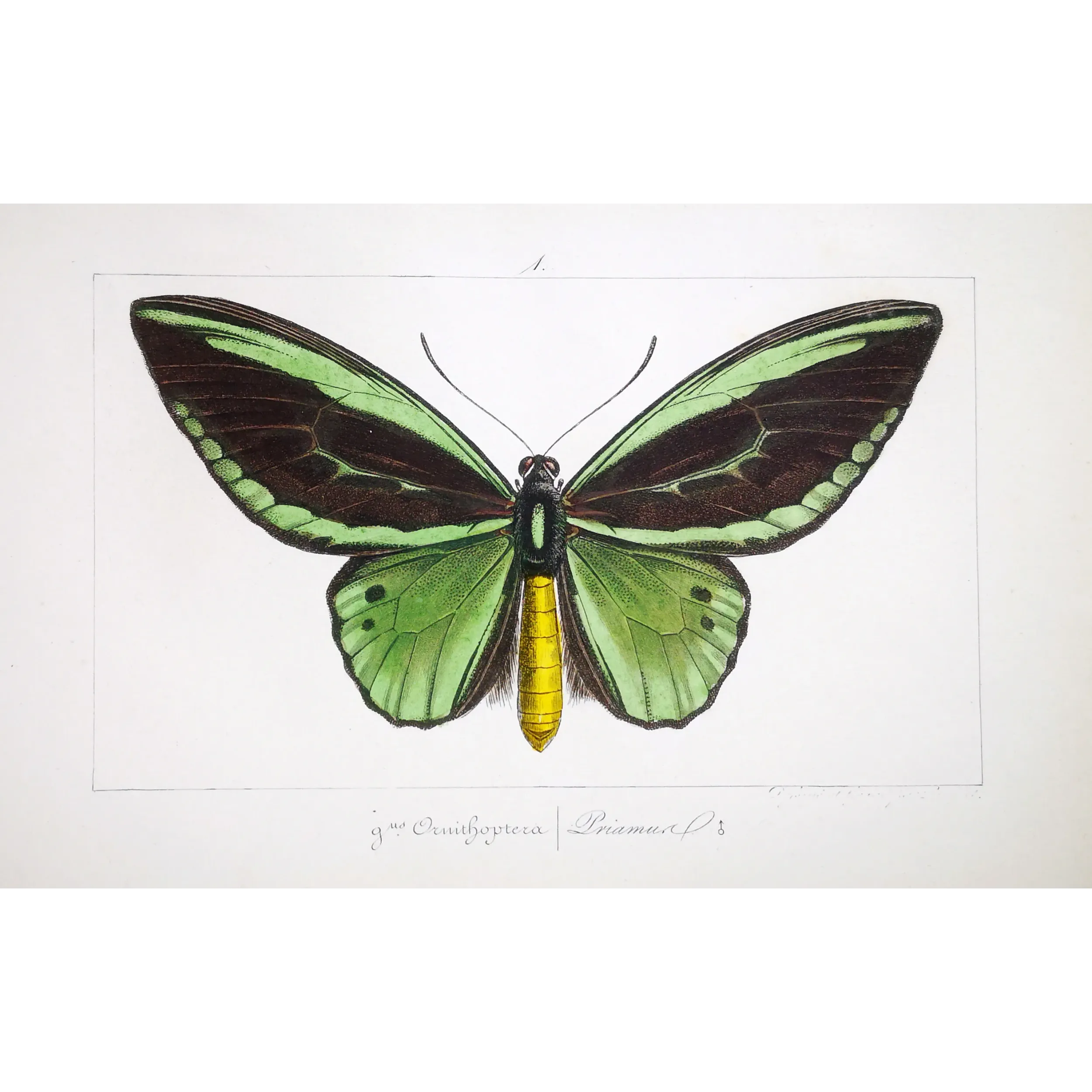
Original 1835 hand-colored engraving of Ornithoptera priamus (Common Green Birdwing), drawn and engraved by Pauquet under the scientific direction of Hippolyte Lucas.