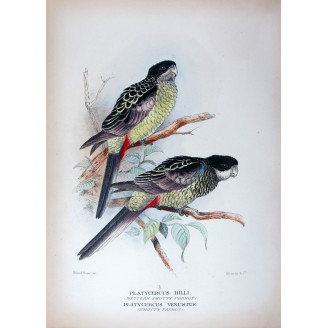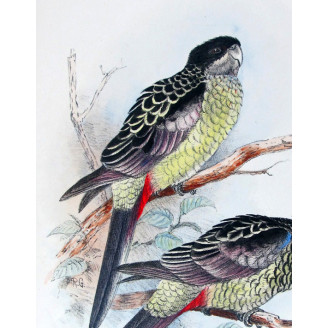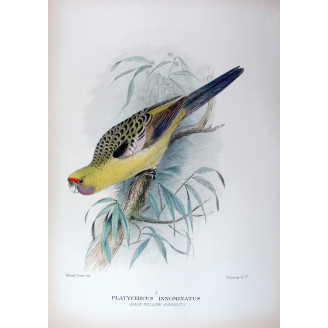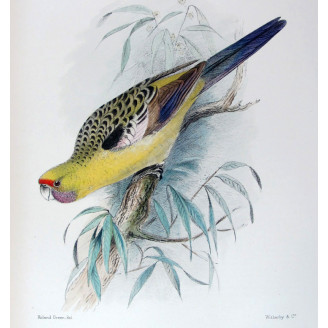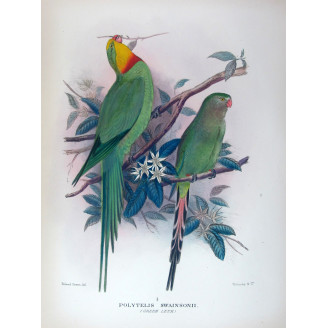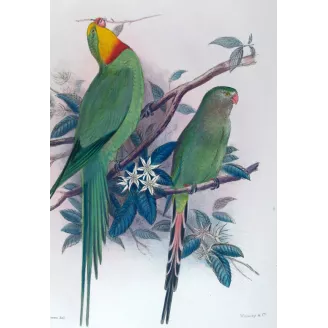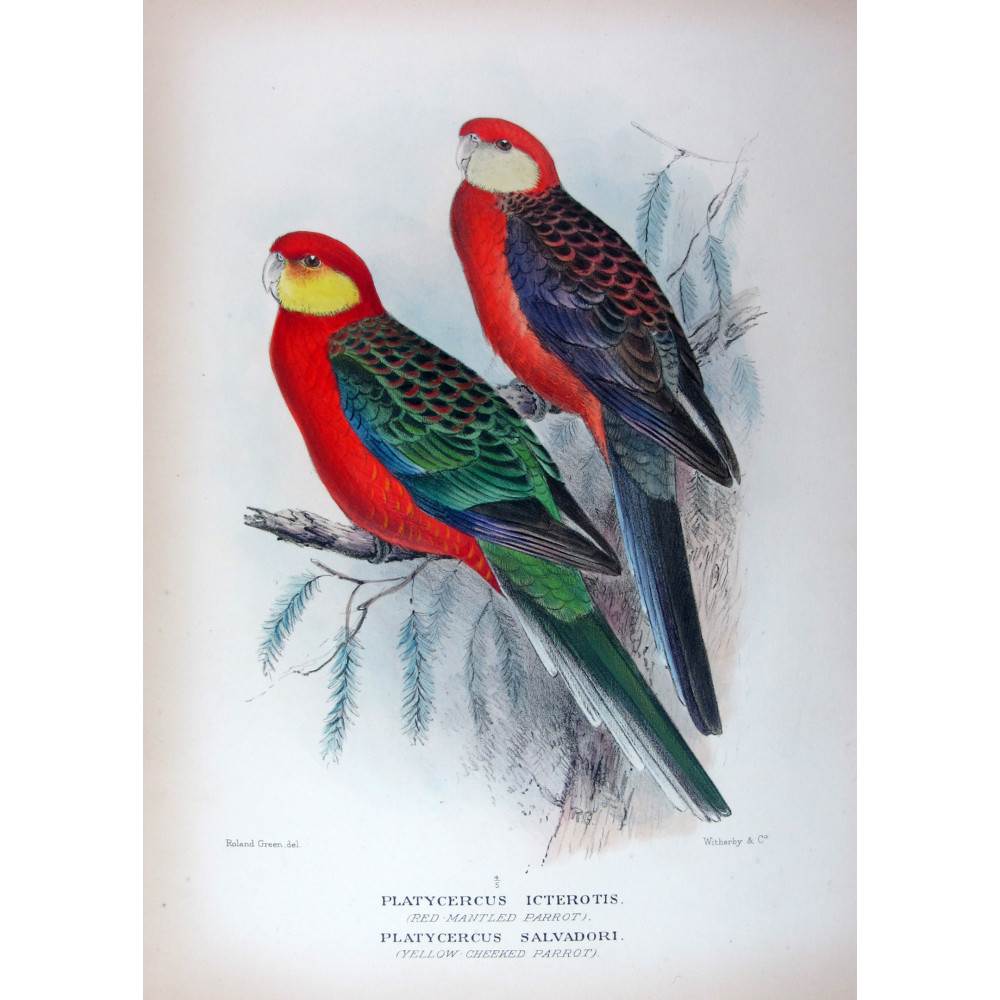
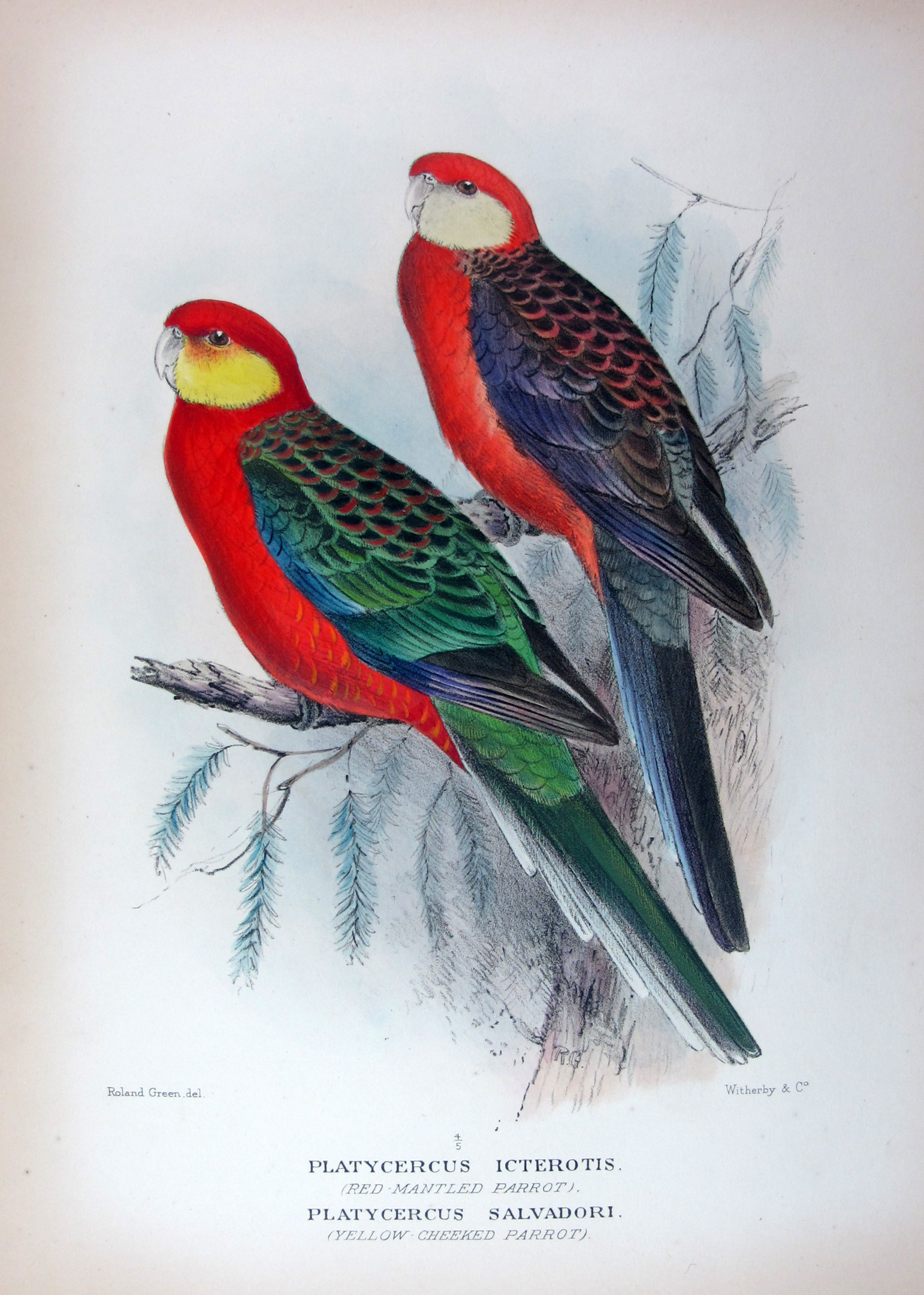
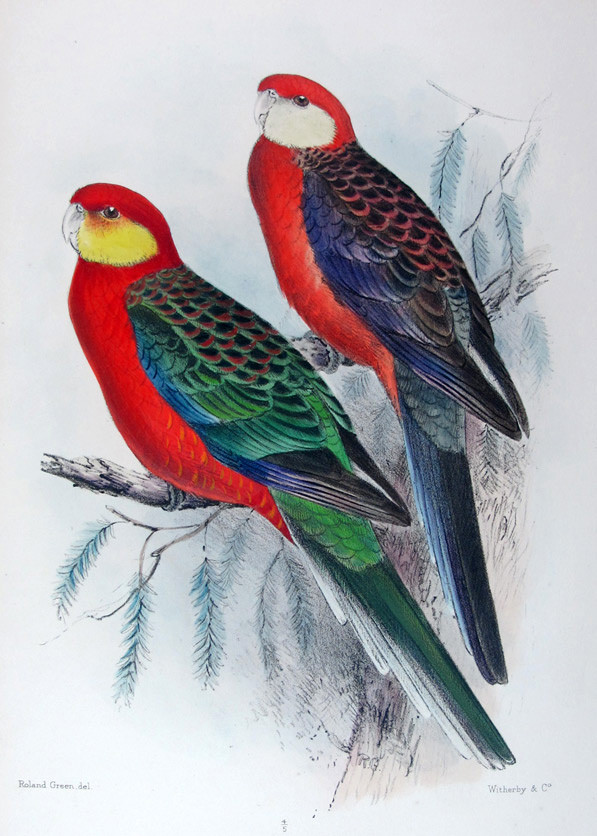
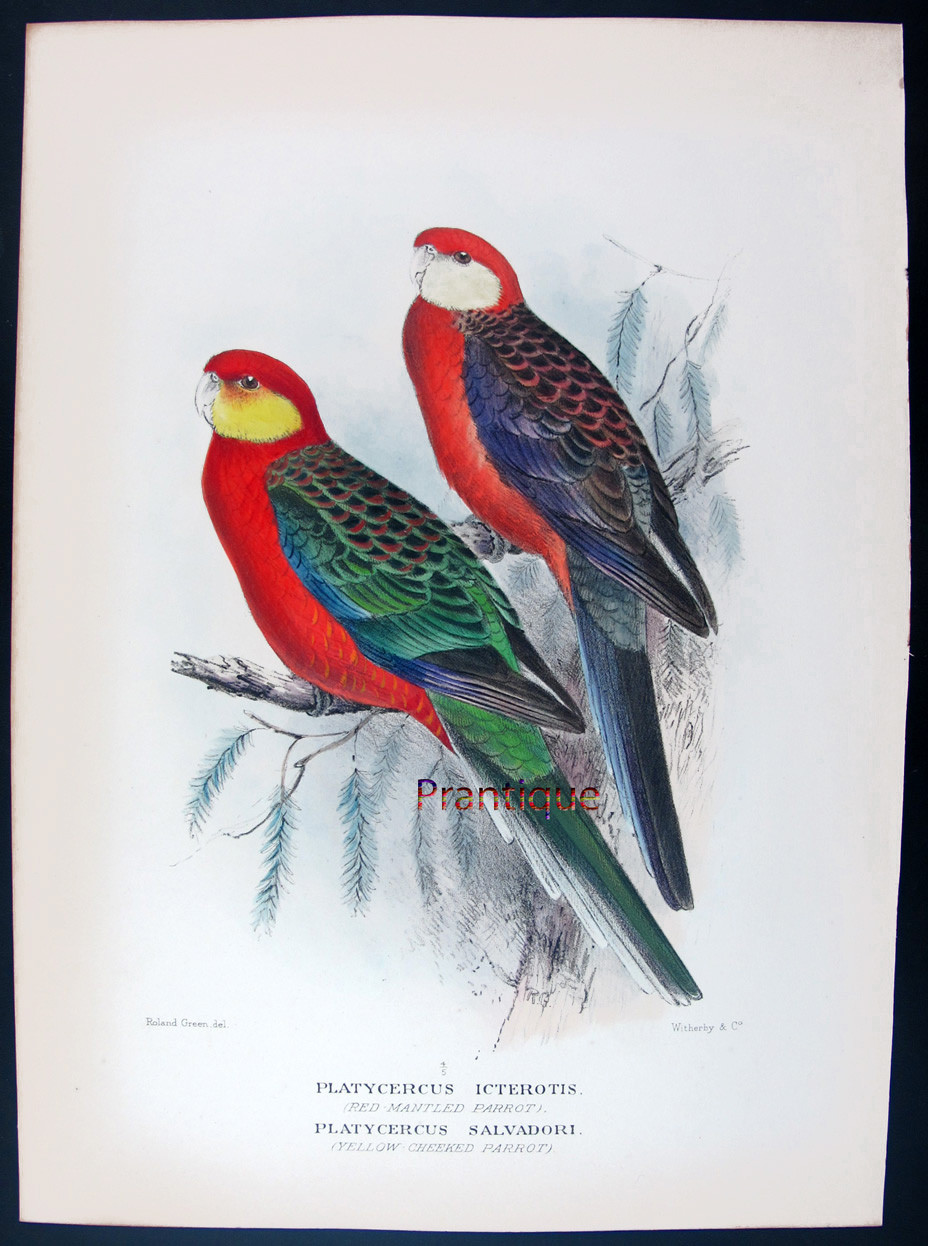
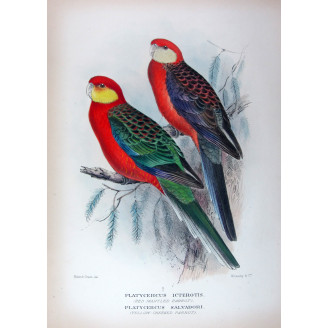
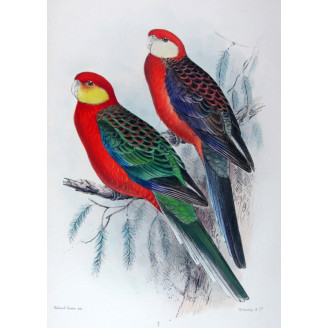
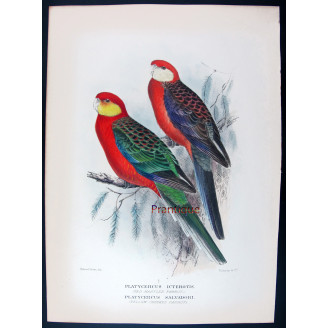
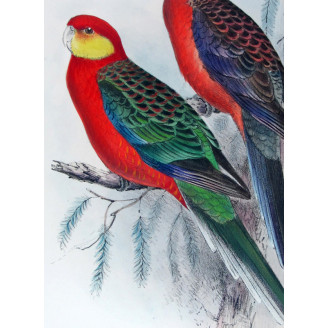
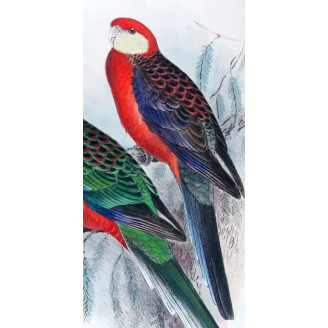
Antique lithograph of the Red-mantled Parrot & Yellow-cheeked Parrot by Roland Green.
 Delivery policy
Your print will be carefully prepared and shipped worldwide via trusted couriers (UPS or similar).
 Authentic antique prints
Original engravings from the 17th–19th century.
This original early twentieth-century hand-colored lithograph depicts two brilliantly colored parrots identified on the plate as Platycercus icterotis (Red-mantled Parrot) and Platycercus salvadori (Yellow-cheeked Parrot). The sheet belongs to Gregory M. Mathews’ landmark publication The Birds of Australia, illustrated by Roland Green and issued by Witherby & Co.
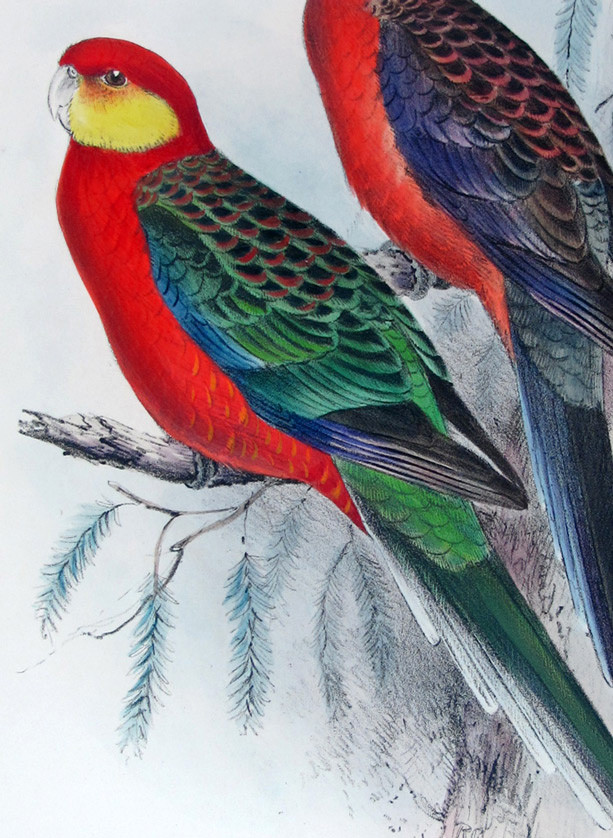
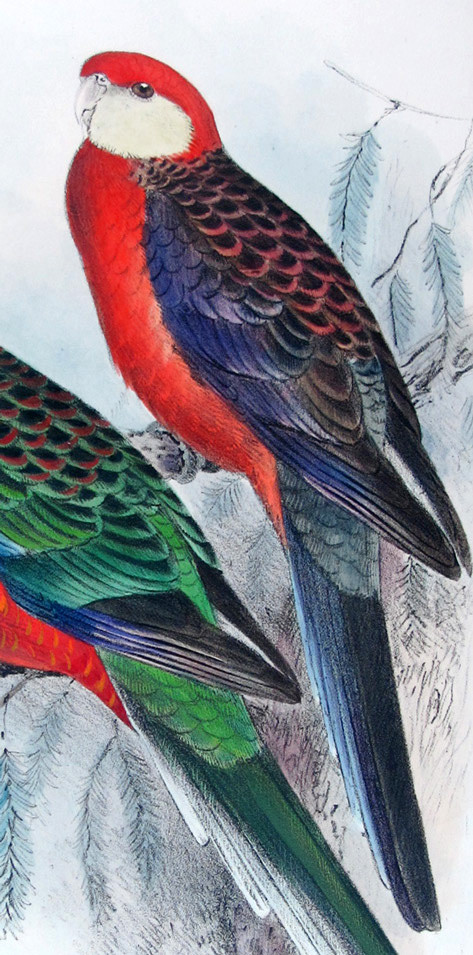
Presented in a tall, elegant pairing against a minimal background, the two birds form a vivid chromatic dialogue: saturated scarlet bodies balanced by emerald greens and deep blues, punctuated by a single warm accent of yellow at the cheek.
— • —
Roland Green designs this plate around powerful colour architecture. The dominant reds are applied with confident saturation, creating immediate visual presence, while the wing plumage is built from layered greens, teal, and ultramarine—each feather articulated with disciplined line and tonal modelling.
The composition is strikingly vertical: one bird forward, one set slightly behind, producing depth and balance without additional scenery. The understated branchwork and pale atmosphere keep the focus entirely on plumage, allowing the scarlet-and-emerald contrast to function almost like a decorative emblem.
Parrots of the Platycercus group are celebrated for their vivid coloration and regional diversity across Australia. The presence of distinct facial markings—such as the warm yellow cheek—served as key identifiers for early ornithologists as taxonomy evolved during the late nineteenth and early twentieth centuries.
In Mathews’ comprehensive survey, such paired plates offered both scientific comparison and visual impact, demonstrating how natural history illustration could unite taxonomy with unmistakable decorative power.
This lithograph originates from The Birds of Australia, Gregory M. Mathews’ ambitious early twentieth-century ornithological enterprise. Conceived as a definitive scientific record, the work united rigorous taxonomy with the refined artistry of leading wildlife illustrators, producing one of the most authoritative visual catalogues of Australian birdlife. Explore the broader historical scope in our editorial feature: Gregory M. Mathews and The Birds of Australia .
Plates such as this exemplify the series at its most decorative: scientific comparison presented with the colour authority and compositional clarity of fine art.
Very good antique condition. Fresh original hand-coloring with strong lithographic impression. Printed on fine early twentieth-century wove paper. Minor age toning slightly more visible along the outer margins, consistent with age.
For further insight into Roland Green’s contribution to ornithological illustration: Roland Green – Dynamic Vision and Field-Born Precision in Bird Art
Specific References
Antique lithograph of the Western Smutty Parrot & Smutty Parrot by Roland Green.
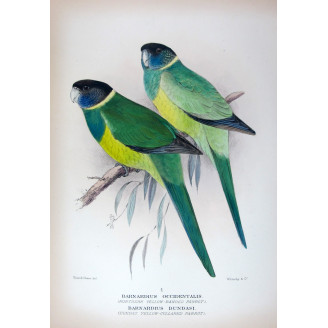
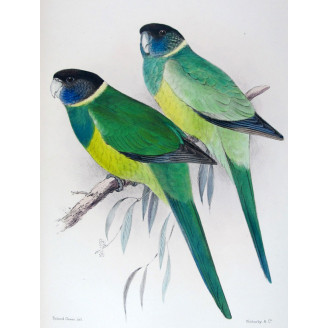
Antique lithograph of the Northern Yellow-banded Parrot & Dundas Yellow-collared Parrot by Roland Green.
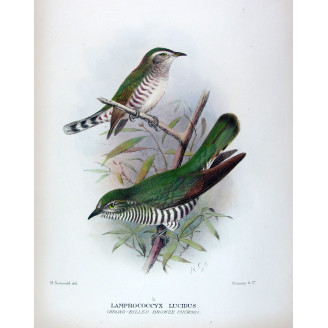
Broad-billed Bronze Cuckoo (Lamprococcyx lucidus) – Original lithograph by Henrik Grønvold.
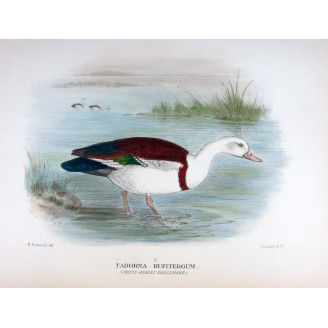
Original lithograph of the White-headed Sheldrake by Henrik Grønvold (Tadorna rufitergum).
Australian Shoveler (Spatula rhynchotis) – Original antique bird print by H. Grønvold.
Western Pink-eared Duck (Malacorhynchus assimilis) – Original antique bird print by H. Grønvold.
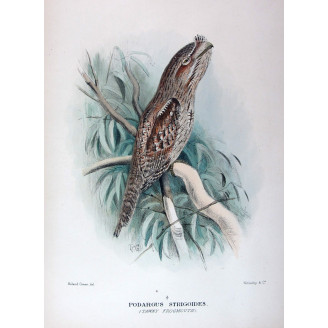
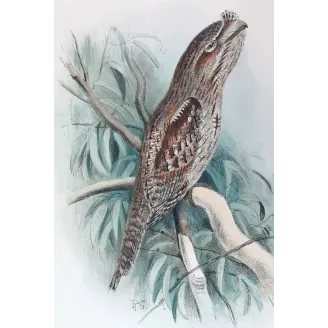
Original lithograph of the Tawny Frogmouth by Roland Green from Mathews' Birds of Australia.
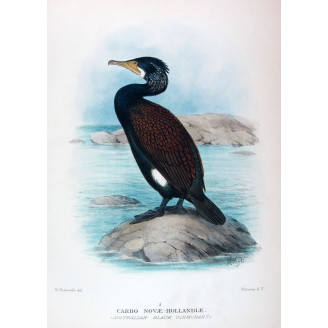
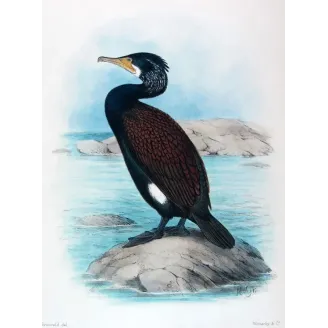
Australian Black Cormorant (Carbo novæ-hollandiæ) – Original antique bird print by H. Grønvold.
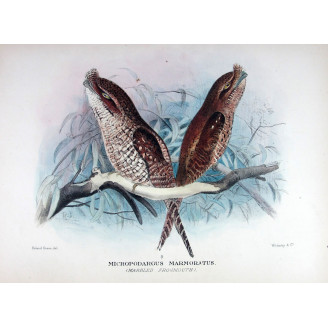
Original lithograph of the Marbled Frogmouth by Roland Green from Mathews' Birds of Australia.
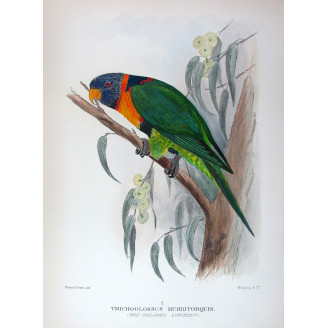
Colorful print of the Red-collared Lorikeet by Roland Green, original hand-color.
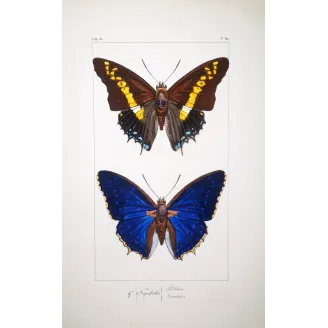
Original 1835 hand-colored copper engraving depicting the butterflies Pollux and Eurilochus. A visually striking double-specimen plate from Hippolyte Lucas’ celebrated Exotic Butterflies, engraved by Pauquet, with strong appeal as natural history art and antique butterfly wall art.
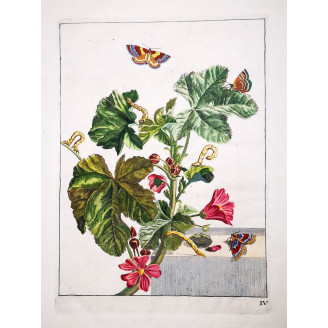
Original 1774 engraving by Jacob L'Admiral: Red Twin-spot Carpet on Mallow.
18th-century hand-colored engraving of the Wilding or Crab Tree by Elisabeth Blackwell, with blossom and fruit details.
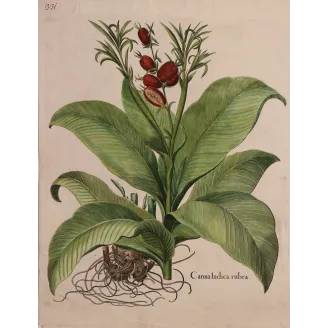
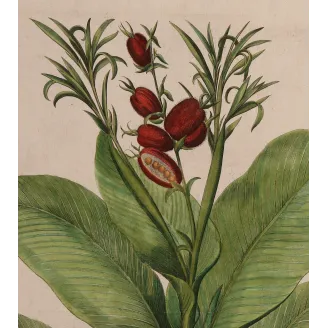
Original seventeenth-century hand-colored botanical engraving of Canna Indica rubra from Basilius Besler's monumental Hortus Eystettensis, first published in 1613. The imposing composition combines sweeping green foliage, exposed roots and vivid red botanical forms, while the laid-paper sheet preserves a watermark and the remarkable printed autumnal heading “SECVNDVS ORDO COLLECTARVM PLANTARVM AVTVMNALIVM” on its verso.
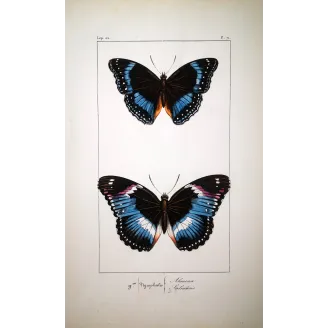
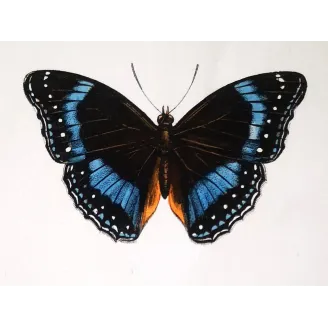
A vivid 19th-century hand-colored engraving depicting two striking tropical butterflies: the Blue-banded Eggfly (Hypolimnas alimena) and the Blue Diadem (Hypolimnas salmacis). Published in Hippolyte Lucas’s Exotic Butterflies (1835), the plate highlights their dramatic contrast of velvety black wings with electric blue bands and delicate white markings.
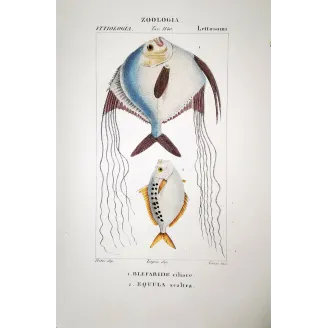
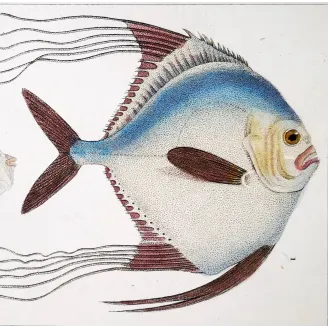
Delicate 19th-century hand-colored engraving of a ponyfish with companion species, ideal for marine-themed interiors and collectors.
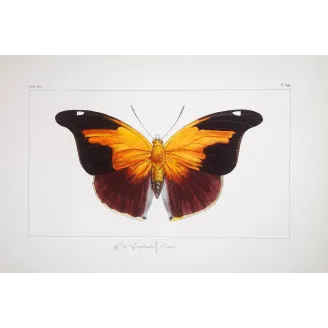
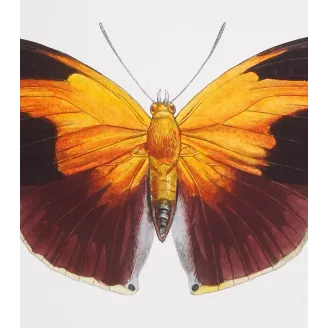
Original 1835 hand-colored engraving of Nymphalis orion, drawn and engraved by Pauquet under the scientific direction of Hippolyte Lucas for Exotic Butterflies.
Original 1774 engraving by Jacob L'Admiral: Large Tortoiseshell on Sweet Cherry.
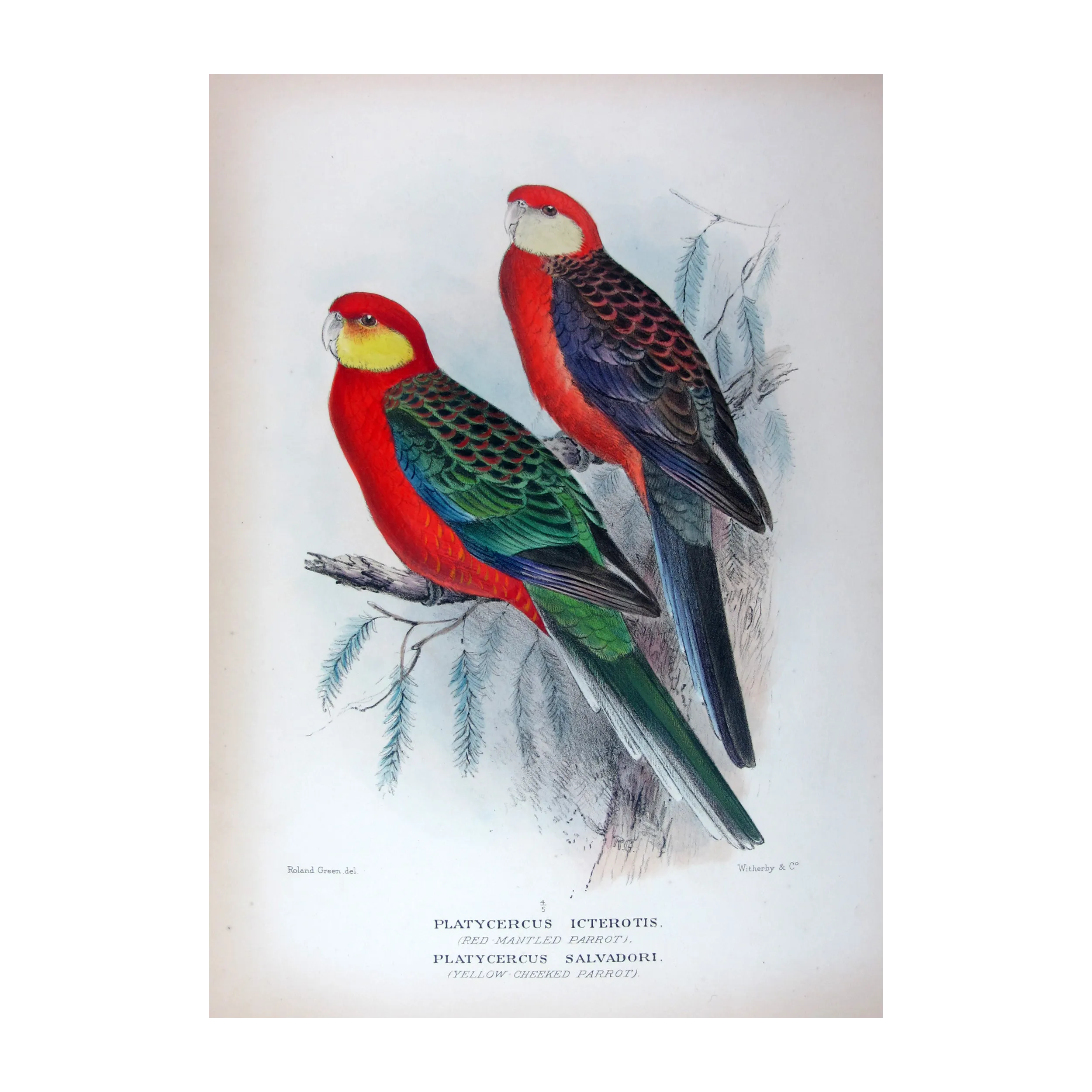
Antique lithograph of the Red-mantled Parrot & Yellow-cheeked Parrot by Roland Green.