- New
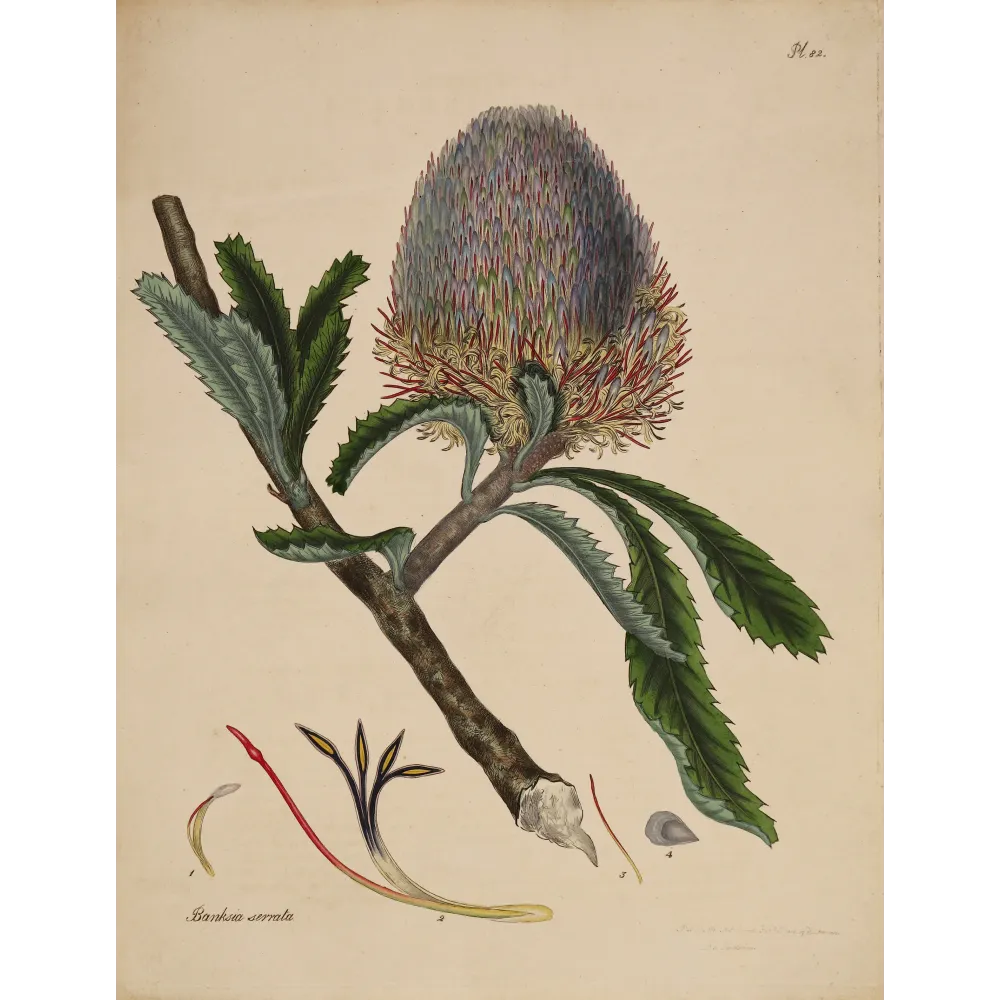
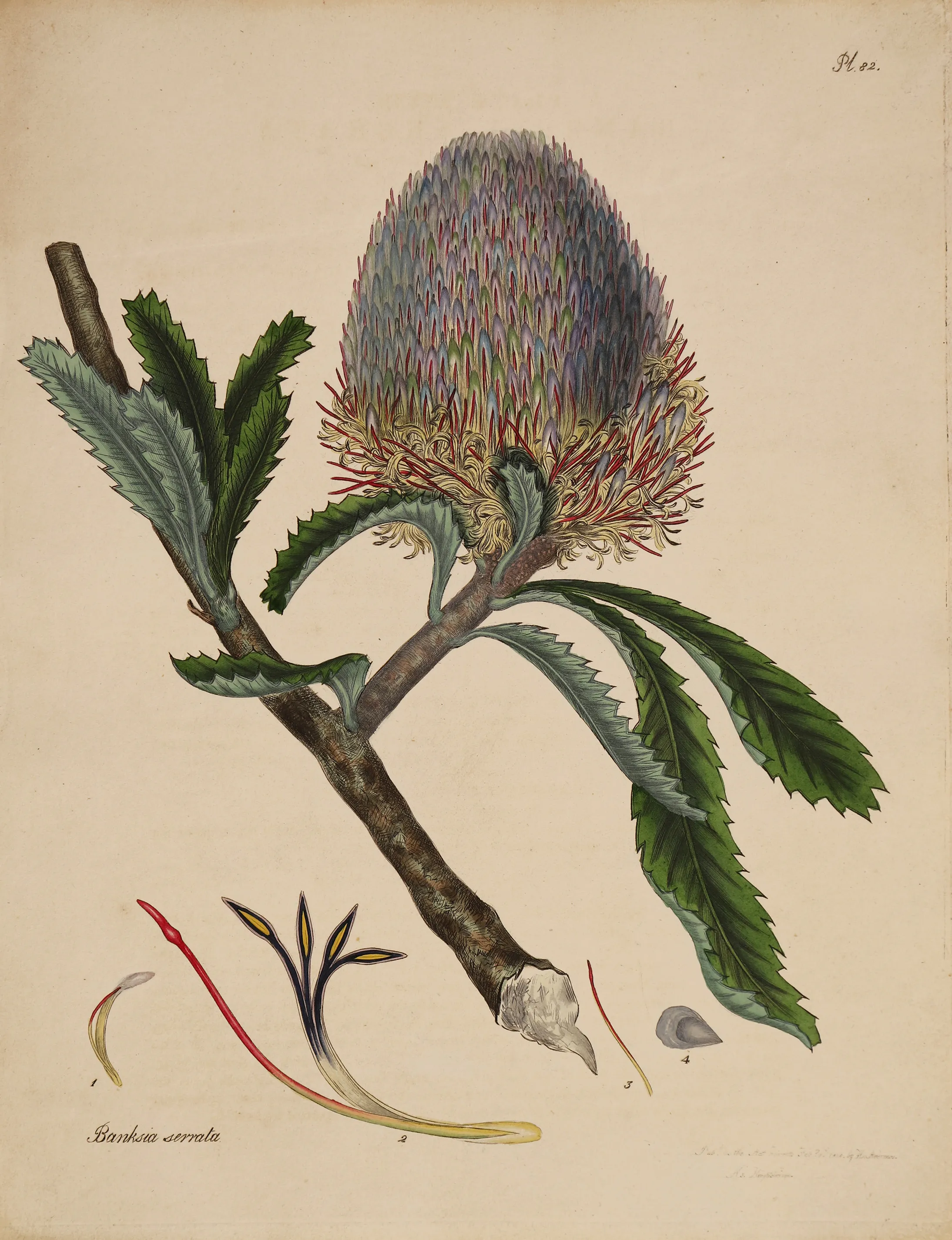
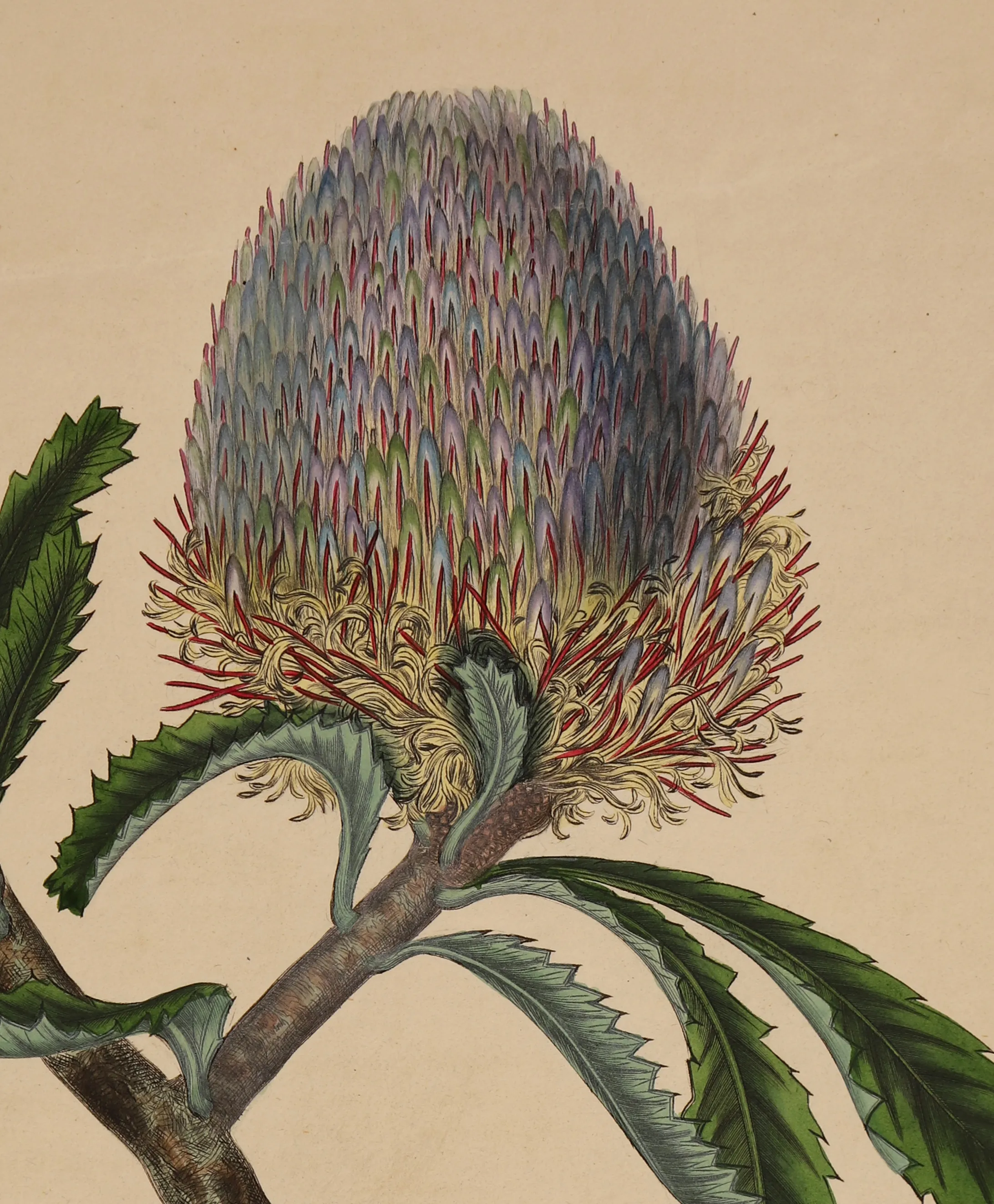
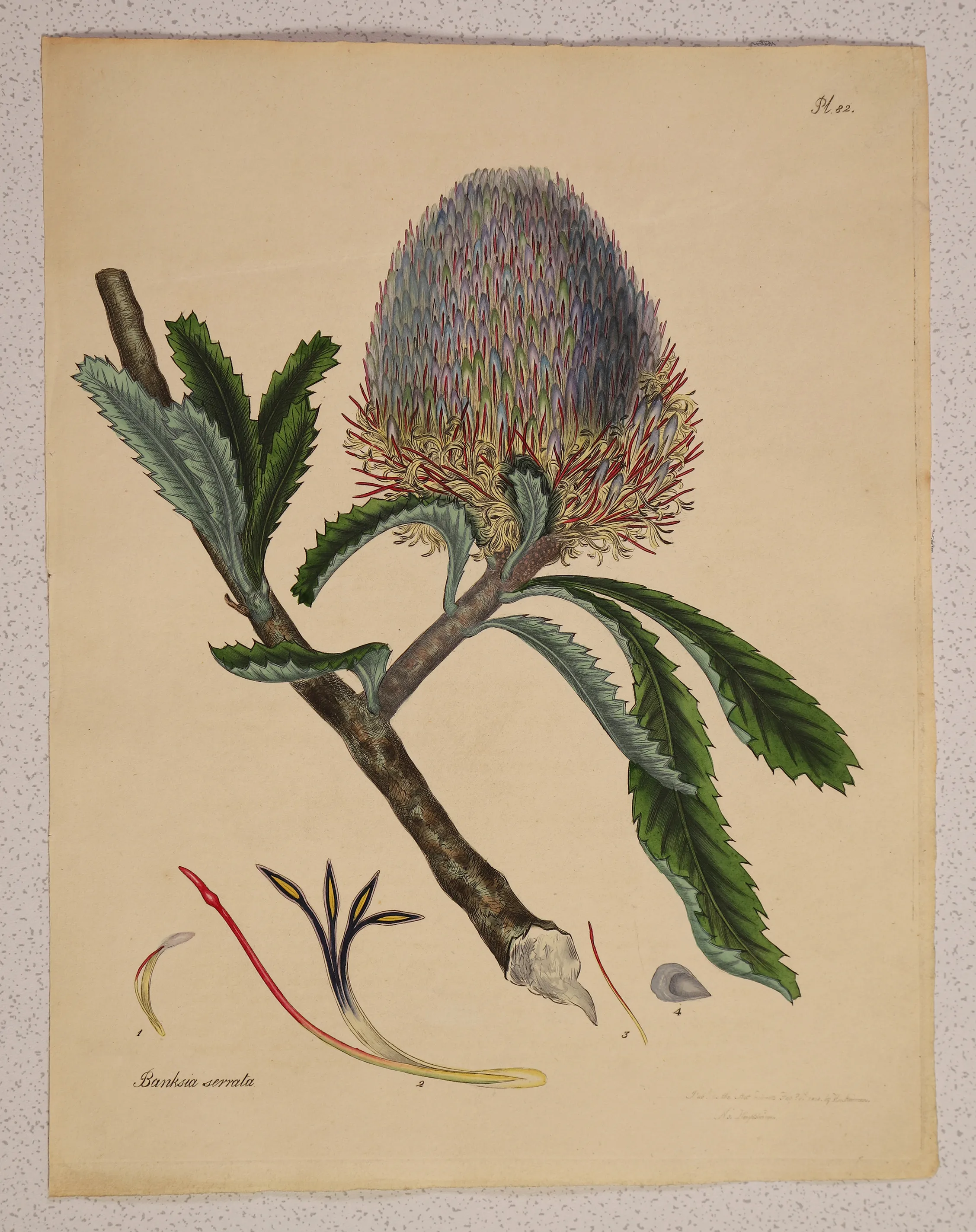
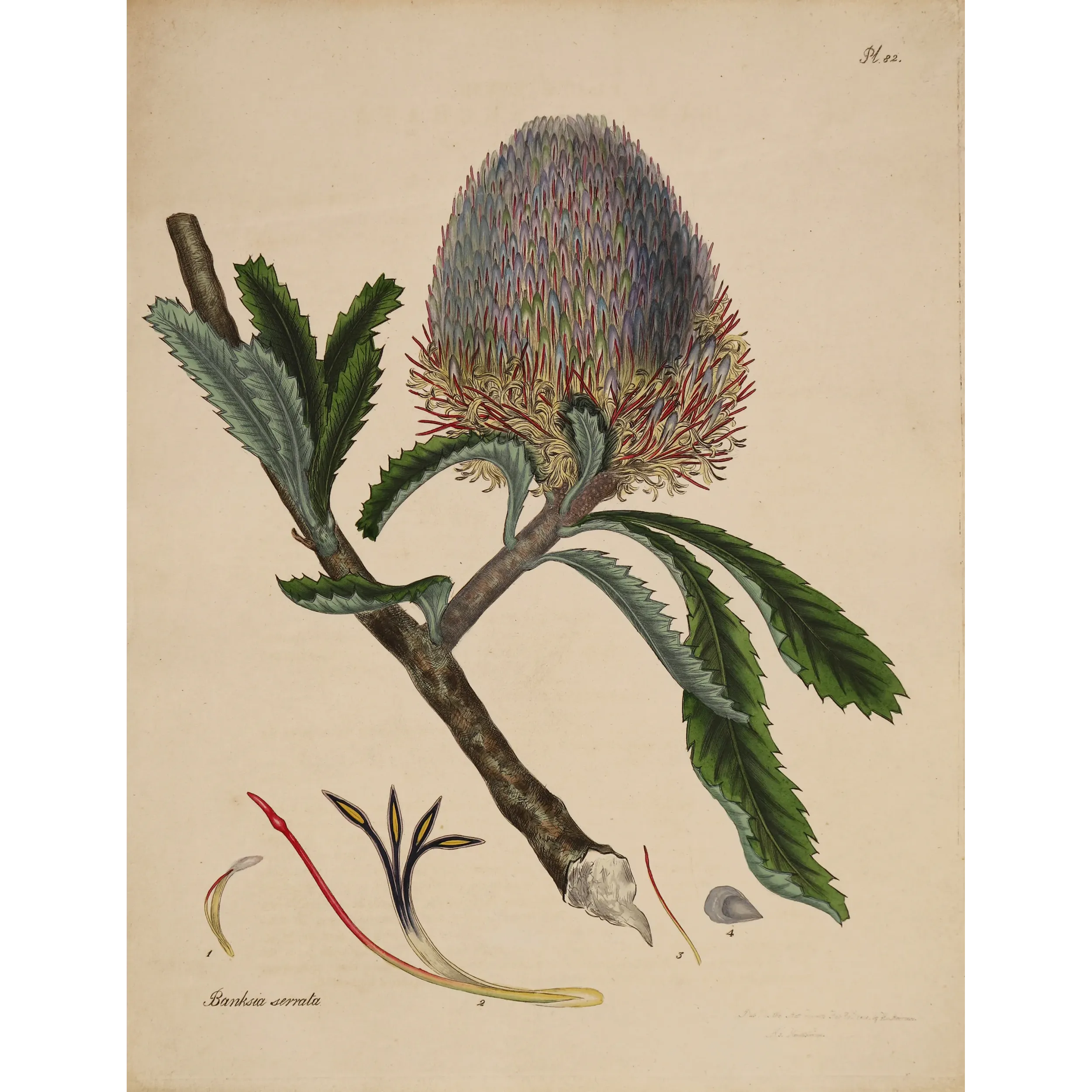
An original hand-coloured copper engraving depicting Banksia serrata, published by Henry Charles Andrews in The Botanist's Repository in 1799. Celebrated for its remarkable luminous flower head, delicate transparent watercolour and refined botanical observation.
 Delivery policy
Your print will be carefully prepared and shipped worldwide via trusted couriers (UPS or similar).
 Authentic antique prints
Original engravings from the 17th–19th century.
This exceptional original hand-coloured engraving from Henry Charles Andrews’ The Botanist’s Repository depicts the Saw-Leaf Banksia, Banksia serrata, an Australian member of the Proteaceae distinguished by its monumental flower spike and sharply serrated foliage. Published in 1799, the plate combines botanical precision with an extraordinary command of colour and light.
The large flower head rises above the branching stem as a luminous, almost self-contained presence. Hundreds of closely arranged floral structures are individually modulated through pale blue, grey, green, rose and violet washes. Their minute chromatic variations allow the inflorescence to appear illuminated from within, while the darker leaves and woody stem provide a strong natural framework around it.
The composition develops diagonally from the lower centre towards the upper right. A substantial woody branch supports the flower head, while smaller lateral stems and groups of serrated leaves extend in opposing directions, creating a balanced but strongly animated botanical structure.
The flower dominates the image through both scale and luminosity. Its broadly oval form is constructed from hundreds of overlapping floral units, each carefully separated from the next without weakening the visual unity of the whole.
Andrews avoids treating the flower spike as a single uniform mass. Pale blue-grey passages alternate with touches of green, pink, violet and muted red, creating an exceptionally refined surface in which every small element appears to receive and reflect light differently.
The upper part of the inflorescence remains cool and softly illuminated, while warmer red and golden structures animate its lower edge. These projecting forms create a delicate transition between the dense flower spike and the supporting branch beneath it.
The serrated foliage provides a powerful contrast. Deep green leaves extend from the branch in broad, irregular groups, their sharply cut margins introducing a more graphic rhythm around the softly modelled flower.
Several leaves turn partially away from the viewer, revealing cooler, silvery-green undersides. This alternation between dark upper surfaces and paler reverses strengthens the spatial depth of the composition and prevents the foliage from appearing flat.
The woody branch is rendered with remarkable naturalism. Brown, grey and olive tones describe its irregular bark, while the cut and broken ends reinforce the impression that Andrews worked from a carefully selected living specimen rather than from an idealised botanical formula.
The enlarged botanical details arranged along the lower margin isolate the reproductive structures and seed. Their precise linear forms provide a scientific counterpoint to the visual richness of the complete plant and reveal the complex construction concealed within the flower spike.
Banksia serrata belongs to the Proteaceae and is native to eastern Australia. Its historical English name, Sawed-Leaved Banksia, refers to the strongly serrated margins of the long, leathery leaves.
The species develops substantial cylindrical flower spikes formed from a dense concentration of individual flowers. As the inflorescence matures, it may produce a woody seed-bearing structure whose durable follicles can remain attached to the plant for an extended period.
In the accompanying text, Andrews records that seeds of this Banksia were received by the celebrated Lee and Kennedy nursery from Botany Bay in 1788. He presented the species as one of the earliest representatives of the genus to flower successfully in British cultivation.
Andrews made his illustration from a flowering plant cultivated in the Lee and Kennedy greenhouse. His account reflects the importance of specialist nurseries in transforming newly collected Australian plants into living subjects for botanical study, horticulture and illustrated publication.
The historical text also notes that the plant grew successfully in different soils and described it as relatively easy to increase from cuttings. Such practical observations demonstrate that The Botanist’s Repository was intended not only to record botanical form, but also to support the cultivation of unfamiliar exotic plants in Britain.
The arrival of Banksias from Botany Bay formed part of a wider movement of seeds, plants and botanical knowledge between Australia and Europe during the late eighteenth century. Their unfamiliar flower spikes, woody fruits and distinctive foliage made them important symbols of the rapidly expanding geographical horizons of British horticulture.
Close examination reveals an exceptionally restrained engraved framework beneath the hand colouring. The copperplate establishes the essential outlines and minute botanical divisions, but remains deliberately subordinate to the transparent watercolour that creates most of the volume, surface and luminosity.
The engraved marks are extraordinarily light across the flower spike. Rather than constructing its rounded form through dense hatching, Andrews uses fine lines only where they are required to distinguish individual floral structures and preserve botanical legibility.
The modelling of the flower is therefore achieved predominantly through colour. Numerous finely controlled washes shift almost imperceptibly between blue-grey, green, violet, rose and muted red, allowing the densely packed surface to remain both complex and remarkably luminous.
The white paper beneath the transparent pigment plays an essential role in this effect. Light passes visually through the pale washes and returns from the paper, giving the flower a soft internal brilliance that could not have been produced through opaque colouring.
Individual floral units are not coloured mechanically. Small differences in tone, saturation and temperature create a constantly changing surface, while the repetition of their pointed forms preserves the architectural unity of the flower head.
The lower flowering structures are treated with warmer and more linear accents. Red styles and pale golden curled forms extend outward from the base of the spike, introducing movement and creating a vivid transition between the luminous flower and the darker woody branch.
The serrated leaves are built from finely layered green watercolour, reinforced by selective engraved details along their veins and sharply cut margins. The darkest passages are concentrated on the upper surfaces, while cooler and paler tones distinguish leaves seen from beneath.
Selective gum arabic appears to have been applied to portions of the upper foliage. Its gentle reflective quality evokes the living surface of the leaves and creates a material contrast with the flower spike, whose luminosity is produced primarily through the transparent handling of colour rather than through gloss.
This distinction is technically significant. Andrews allows the flower to appear illuminated through chromatic modulation and the exposed brilliance of the paper, while using gum arabic selectively where actual surface reflection could strengthen the botanical character of the foliage.
The woody branch is rendered through a similarly economical relationship between engraving and colour. Fine marks establish the irregular bark and changes in texture, while transparent brown, grey and olive washes create volume without obscuring the underlying paper.
The finished impression therefore depends upon the precise interaction of three elements: an almost invisible engraved structure, exceptionally refined transparent watercolour and selective applications of gum arabic. Each material performs a distinct function within the representation.
At the lower right, the sheet preserves Andrews’ characteristic handwritten publication inscription. The notation remains legible and forms an original component of the engraving’s publication history rather than a later annotation.
The inscription commonly includes the wording “Published as the Act directs”, together with the date, Andrews’ name and his address at 5 Knightsbridge, London. It records both the legal publication and the commercial circulation of the plate.
The wording referred to the British Engravers’ Copyright Act of 1735, widely known as Hogarth’s Act. The legislation was created to protect engravers and graphic artists against unauthorised copying and required publication information capable of establishing ownership of the design.
The plate mark is not visible on this individual impression. Its absence should not be interpreted as evidence of severe trimming, since the sheet retains substantial surrounding paper and the visibility of a plate mark may vary according to printing pressure, historical binding and the later material history of the sheet.
No watermark has been observed on this individual impression. Examination of another original sheet belonging to this Prantique group of Andrews engravings, however, revealed a clearly legible J. Whatman 1794 watermark, documenting the use of fine English Whatman paper within the publication.
Although the watermark is a collection-level observation rather than a feature recorded on this sheet, it provides valuable material context. Together with the restrained engraving, original hand colouring, selective gum arabic and handwritten publication inscription, it helps reconstruct the sophisticated artisanal production of The Botanist’s Repository.
Henry Charles Andrews was unusual among botanical artists because he maintained close control over almost every stage of production. He drew from living specimens, engraved the copperplates, supervised or executed the colouring and published the work himself. This integration enabled him to adapt line, colour and surface finishing to the distinctive optical and botanical character of each plant.
This engraving belongs to Henry Charles Andrews’ extraordinary world of new and rare plants, created during Britain’s great age of botanical exploration. Discover Andrews’ unusual working method and the material evidence preserved within original impressions, including hand colouring, engraved structure, handwritten publication inscriptions, selective applications of gum arabic and historical Whatman paper.
Henry Charles Andrews and Britain’s Passion for Exotic Plants →
Excellent condition. Exceptionally clean original late eighteenth-century paper with remarkably fresh and finely preserved hand colouring. No visible stains, foxing or significant signs of use are present. A very faint horizontal crease is visible near the upper part of the sheet; it is almost imperceptible to the unaided eye during normal viewing and does not interfere with the botanical image. The delicate engraved details remain clearly defined, while the selective gum arabic on portions of the upper foliage retains its subtle reflective quality. The original handwritten publication inscription remains legible. Please examine the professional high-resolution photographs for a complete visual assessment.
Historical botanical name: Banksia serrata
Accepted botanical name: Banksia serrata L.f.
Common name: Saw-Leaf Banksia
Historical English name: Sawed-Leaved Banksia
Work: The Botanist’s Repository, for New, and Rare Plants
Author, artist and engraver: Henry Charles Andrews
Publisher: Henry Charles Andrews, 5 Knightsbridge, London
Date: 1799
Technique: Original copper engraving with hand-applied watercolour and selective gum arabic finishing
Surface finishing: Selective gum arabic applied to portions of the upper foliage
Publication inscription: Original handwritten publication inscription present and legible at the lower right
Plate mark: Not visible on this impression
Watermark: Not observed on this individual impression
Plate: LXXXII (82)
Plant family: Proteaceae
Historical introduction: Seeds received by Lee and Kennedy from Botany Bay in 1788
Native region: Eastern Australia
Sheet size: approx. 28 × 22 cm
Specific References
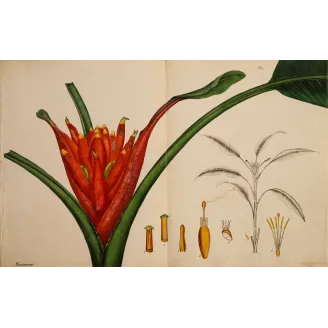
An original double-page hand-coloured copper engraving depicting Musa coccinea, published by Henry Charles Andrews in The Botanist's Repository in 1799. Distinguished by its spectacular horizontal composition, luminous scarlet inflorescence and original paper watermark.
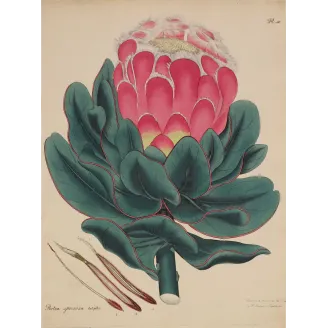
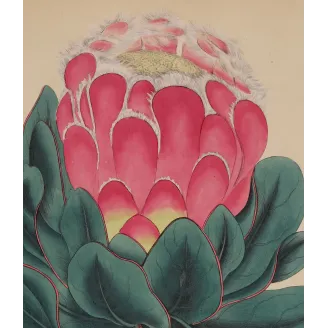
Monumental original hand-coloured engraving of the Broad-Leaved Showy Protea, published as Plate 110 in Henry Charles Andrews’ The Botanist’s Repository. Its sculptural blue-green foliage and extraordinary rose-pink flower make this one of the most iconic botanical images in the collection.
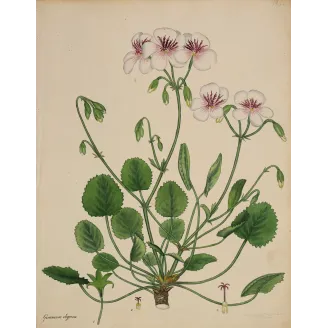
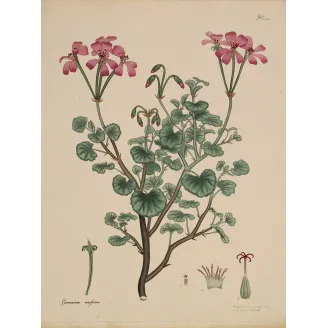
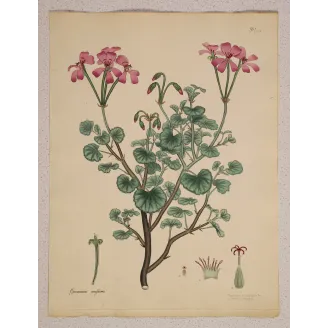
An elegant original botanical engraving depicting Geranium reniforme, distinguished by softly coloured flowers, rounded foliage and the refined hand-coloured style that characterises Henry Andrews' celebrated Botanist's Repository.
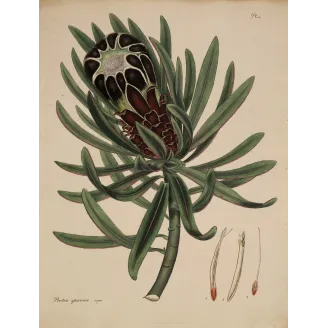
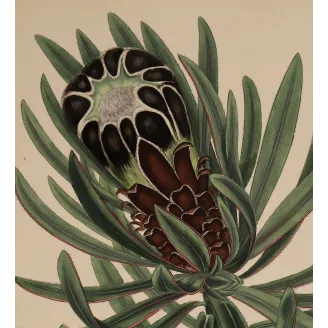
A striking original hand-coloured engraving depicting the Black-Flowered Showy Protea, published by Henry Charles Andrews in The Botanist's Repository in 1799. Monumental foliage, sculptural flower structure and beautifully preserved hand colouring make this one of the most architecturally impressive plates of the series.
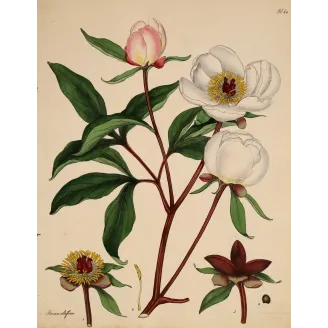
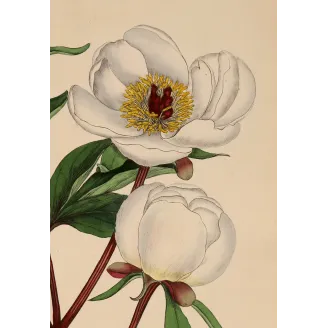
An exceptionally refined original hand-coloured engraving depicting the White Peony, published by Henry Charles Andrews in The Botanist's Repository in 1799. Delicate grey modelling, luminous white petals and beautifully preserved gum arabic finishing make this one of the finest botanical plates of the series.
An original hand-coloured copper engraving of Protea formosa, published by Henry Charles Andrews in The Botanist's Repository (1799). Distinguished by its spectacular upward flowering styles, exceptionally delicate watercolour and refined botanical execution, this plate represents one of the most elegant Protea engravings of the series.
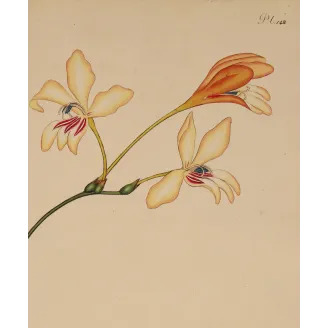
Original hand-coloured copper engraving depicting Gladiolus versicolor, published by Henry Charles Andrews in The Botanist's Repository in 1799. An elegant botanical study distinguished by its graceful composition, delicately modelled flower and luminous green foliage.
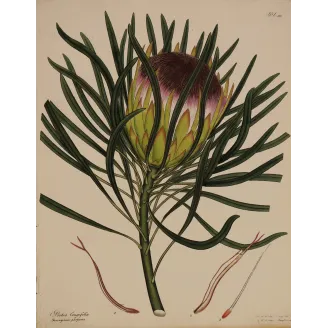
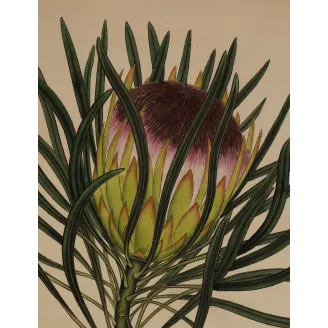
An original hand-coloured copper engraving depicting Protea longifolia (Rusty-purple Flower), published by Henry Charles Andrews in The Botanist's Repository in 1801. Distinguished by its protective arrangement of evergreen foliage, subtle engraved structure and exceptionally refined transparent watercolour.
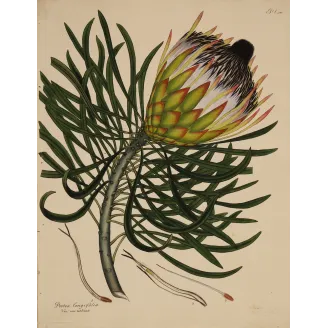
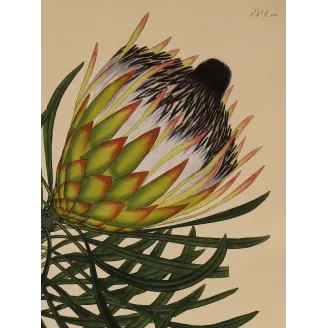
An original hand-coloured copper engraving depicting the Long-Leaved Protea (Protea longifolia), published by Henry Charles Andrews in The Botanist's Repository in 1801. Elegant linear foliage, a dramatic emerging flower head and exceptionally refined hand colouring distinguish one of the most dynamic Protea compositions of the series.
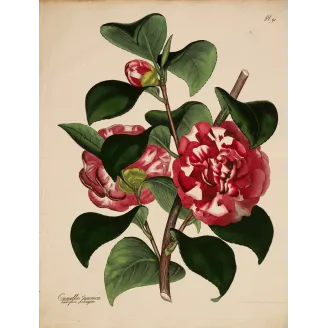
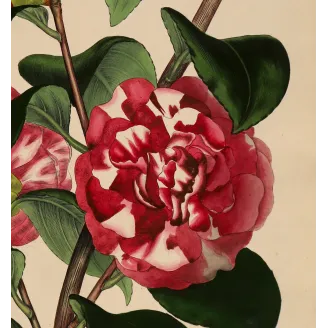
An original hand-coloured engraving of Camellia japonica from Henry Charles Andrews' celebrated The Botanist's Repository. Published around 1799, this elegant botanical print combines exceptionally refined hand colouring, selective gum arabic finishing on the foliage and Andrews' characteristic handwritten publication inscription.
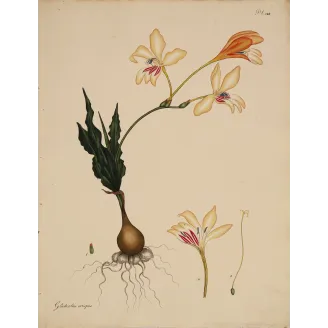
Original hand-coloured copper engraving of Gladiolus crispus (Curled-Leaved Gladiolus), engraved, coloured and published by Henry Charles Andrews for The Botanist's Repository, Plate CXLII, 1804. This elegant botanical print combines remarkably delicate transparent watercolour, restrained engraving and selective gum arabic applications that give the foliage a subtle natural lustre. A refined example of British botanical illustration from the early nineteenth century.
An original botanical engraving from Henry Andrews' celebrated The Botanist's Repository, depicting Geranium quinquevulnerum with richly coloured velvety flowers, transparent hand colouring and refined eighteenth-century botanical craftsmanship.
An original hand-coloured copper engraving depicting Banksia serrata, published by Henry Charles Andrews in The Botanist's Repository in 1799. Celebrated for its remarkable luminous flower head, delicate transparent watercolour and refined botanical observation.