- New
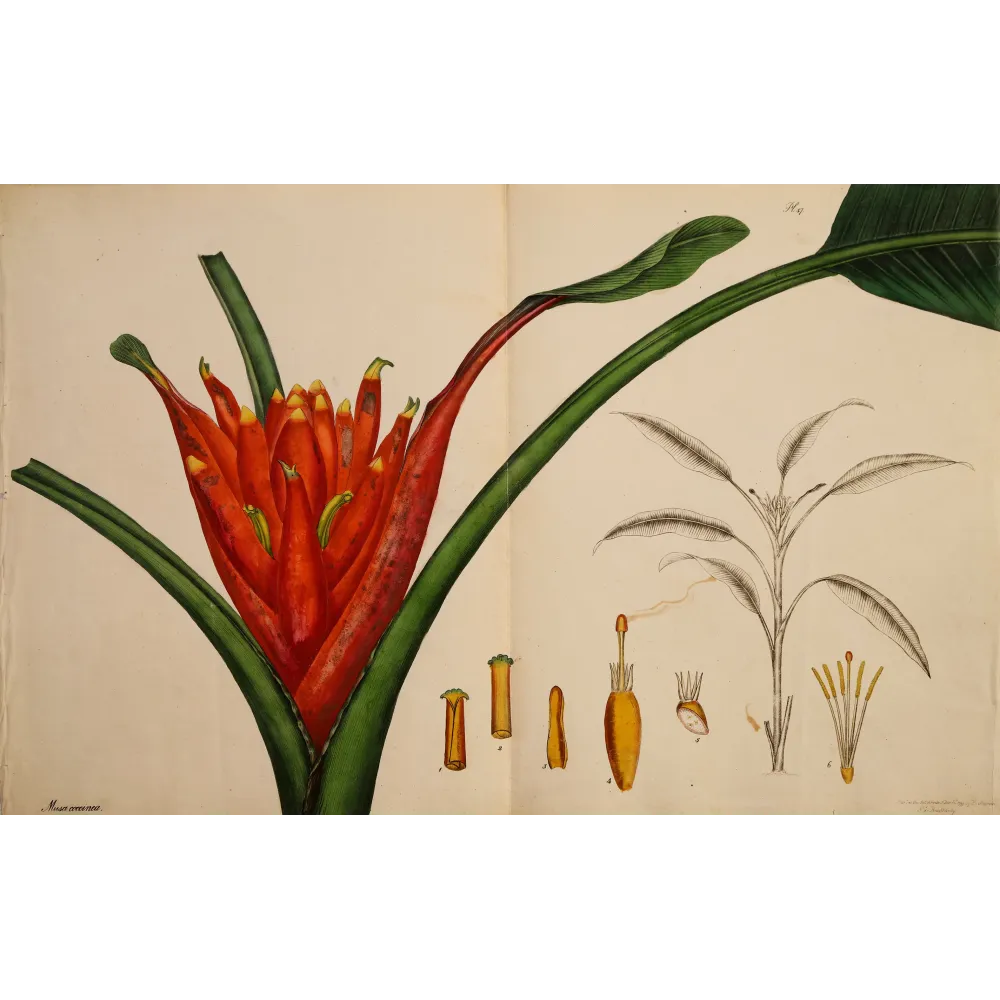
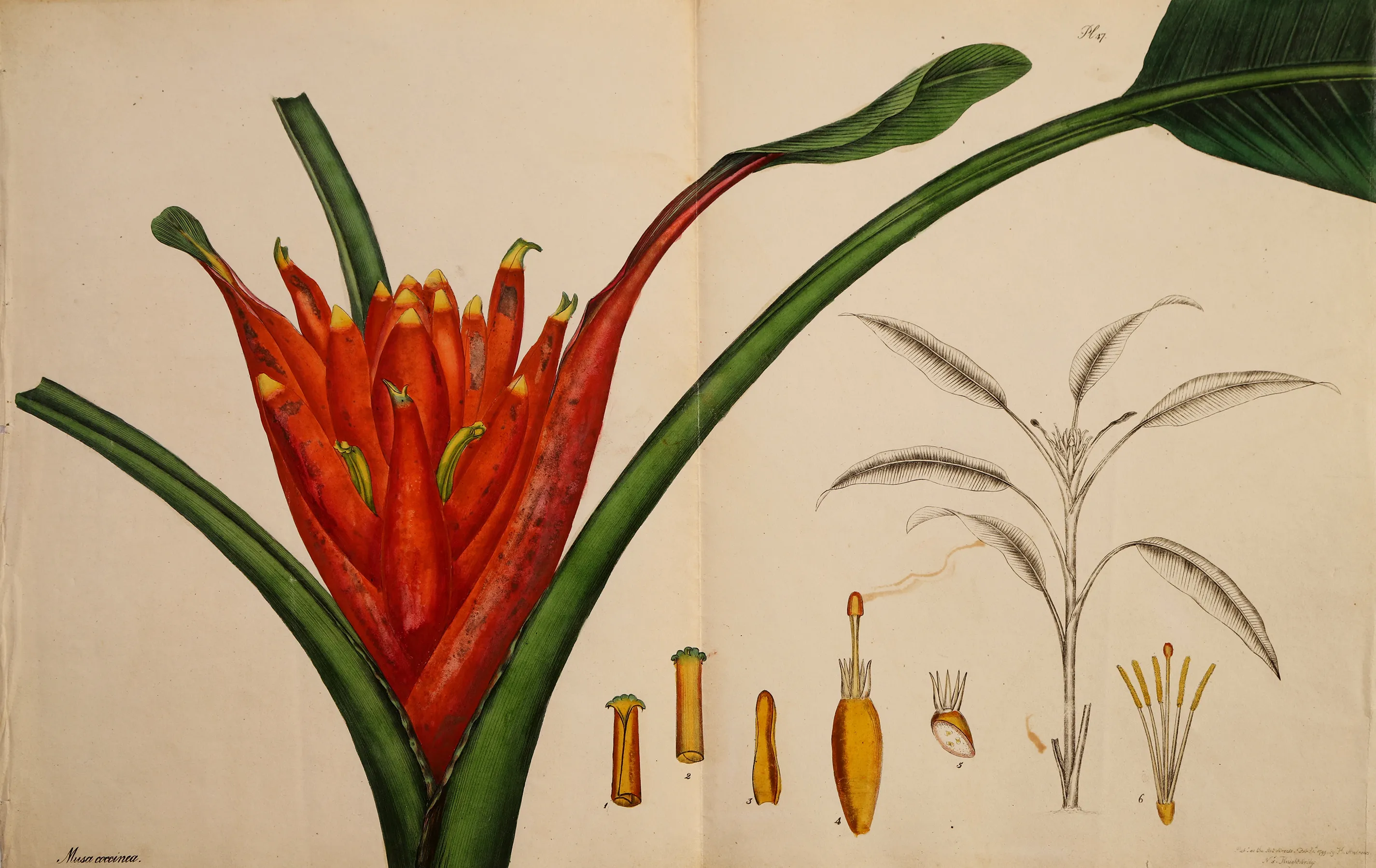
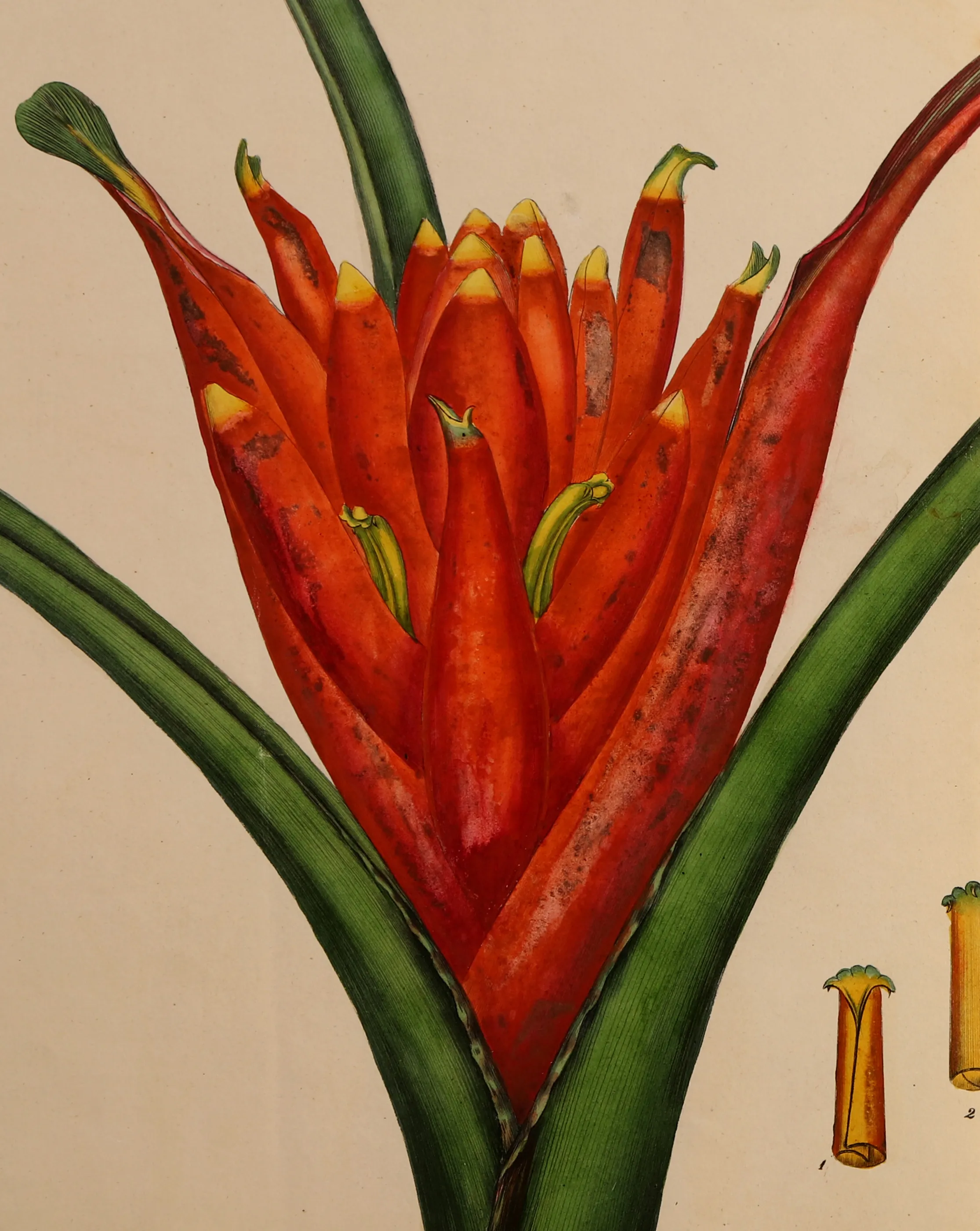
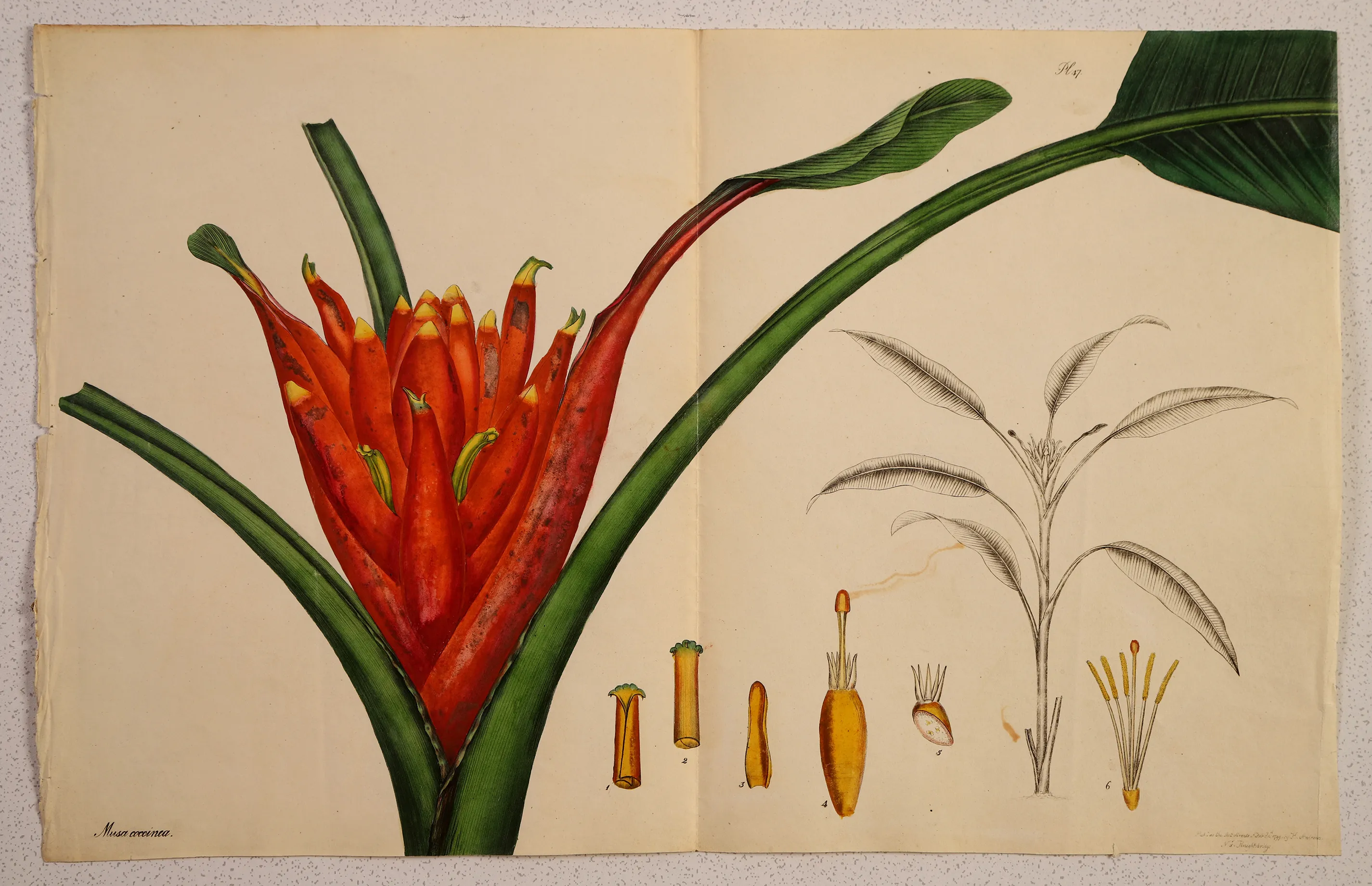
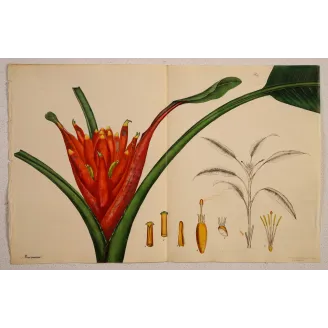
An original double-page hand-coloured copper engraving depicting Musa coccinea, published by Henry Charles Andrews in The Botanist's Repository in 1799. Distinguished by its spectacular horizontal composition, luminous scarlet inflorescence and original paper watermark.
 Delivery policy
Your print will be carefully prepared and shipped worldwide via trusted couriers (UPS or similar).
 Authentic antique prints
Original engravings from the 17th–19th century.
This exceptional original hand-coloured engraving from Henry Charles Andrews’ The Botanist’s Repository depicts the Scarlet-Flowered Plantain Tree, Musa coccinea. Published in 1799 as an original double-page plate, the composition abandons the conventional vertical format in order to accommodate the expansive scale and strongly horizontal movement of this remarkable tropical plant.
The brilliant scarlet inflorescence occupies the left half of the sheet, while the elongated green stems and foliage extend dramatically towards the upper right. Rather than compressing the plant within a conventional botanical frame, Andrews allows it to unfold across the complete double-page surface, creating one of the most unusual and visually commanding compositions in The Botanist’s Repository.
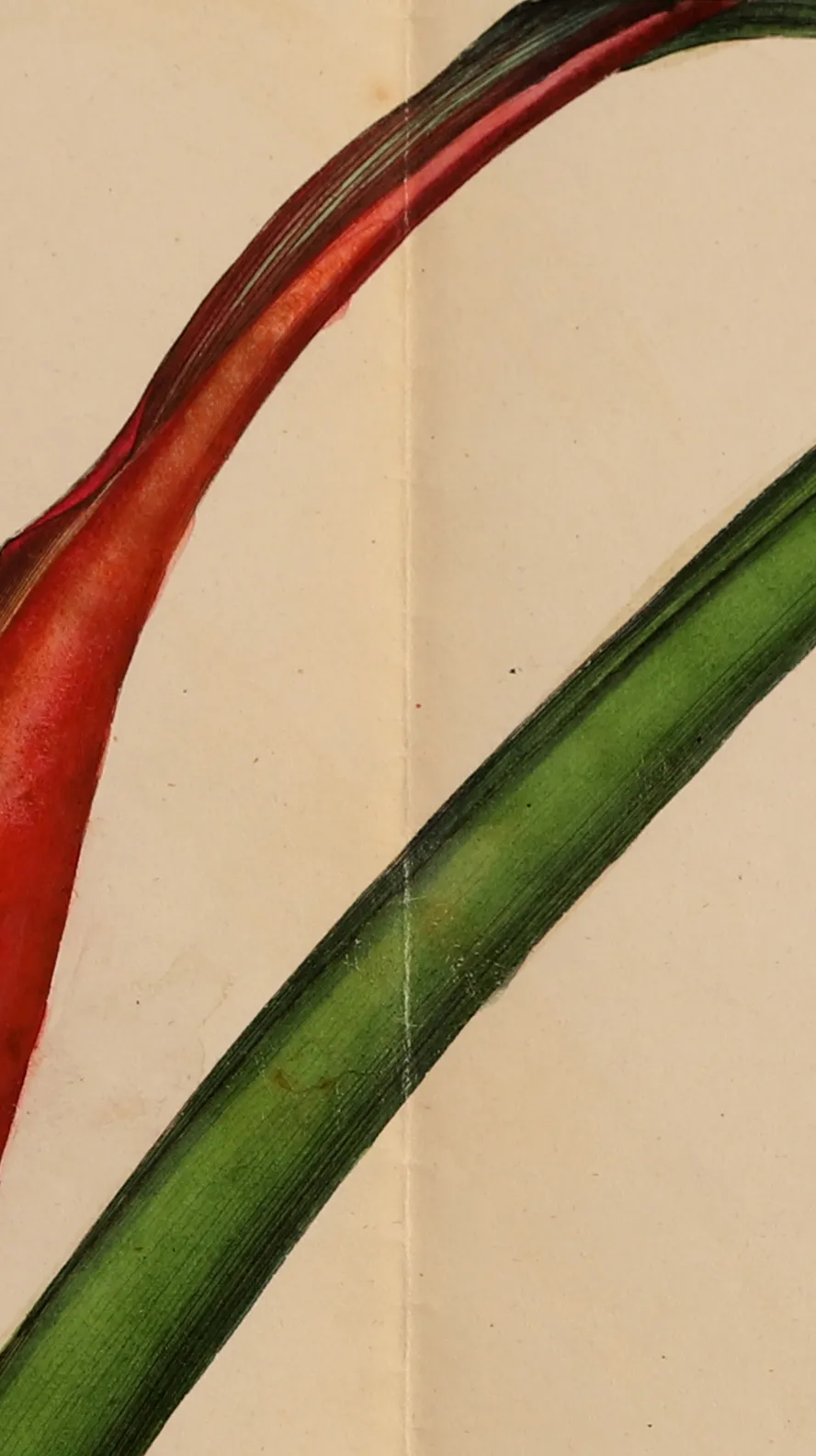
The composition is governed by an expansive horizontal movement. Broad green stems rise from the lower left before extending diagonally across the double-page sheet, leading the eye from the dense scarlet inflorescence towards the large tropical leaves at the upper right.
The unusual width of the plate gives the plant a physical presence that could not have been achieved within a standard single-page format. The stems appear to continue beyond the boundaries of the sheet, suggesting that the represented specimen exceeds the conventional limits of botanical illustration.
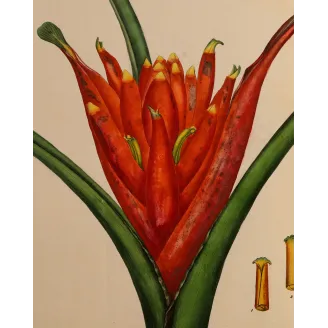
At the left, the inflorescence is constructed from a succession of upright scarlet bracts. Their forms overlap and rise at different heights, creating a compact but animated structure whose vivid colour immediately dominates the composition.
The transition from deep crimson to scarlet, vermilion and orange-yellow produces an exceptional sense of material richness. Andrews does not treat the red surfaces as uniform areas of colour; instead, he builds their volume through numerous transparent tonal variations, allowing individual folds, edges and recesses to remain clearly distinguishable.
The inflorescence appears both floral and architectural. Its pointed structures rise like a sequence of overlapping flames, while the warm yellow accents concentrated at their tips introduce points of light within the deeper red mass.
The surrounding foliage creates a powerful chromatic contrast. Deep green stems and leaves frame the scarlet flower while directing the composition outward. Their elongated forms reinforce the horizontal development of the plate and give the tropical plant an imposing sense of scale.
A particularly refined feature of the image is the gradual visual relationship between the flower and the developing leaves. The upright red structures seem to pass through successive stages of elongation and opening, suggesting an organic transformation from tightly enclosed floral form towards the broad, unfurling foliage above.
The botanical details placed across the lower centre and right side of the sheet provide a precise analytical counterpoint to the monumental plant. Individual floral structures are isolated and enlarged, while a lightly engraved study of the complete plant reveals its broader growth habit and relationship between leaves, stems and flowers.
Musa coccinea belongs to the Musaceae and is native to tropical regions of southern China and Southeast Asia. It is distinguished by its upright scarlet inflorescence, elongated green leaves and strongly ornamental character.
The historical English name recorded by Andrews, Scarlet-Flowered Plantain Tree, reflects the vivid colouring of the plant’s floral bracts. The specific epithet coccinea similarly refers to their intense scarlet-red colour.
In the accompanying text, Andrews credits Thomas Evans of Stepney with introducing the plant into British cultivation. He records that Evans received it, together with other plants, from China in 1792.
Andrews also notes that flowering specimens were subsequently cultivated in several important British collections, including those associated with James Vere, Lee and Kennedy, and John Fairbairn. These references document the rapid circulation of newly introduced tropical plants among specialist nurseries and private collectors.
The plant’s successful cultivation required protection from severe cold, but Andrews described it as vigorous under suitable conditions. His account combines botanical description with practical horticultural observation, reflecting the broader purpose of The Botanist’s Repository as both an illustrated record and a guide to newly introduced ornamental plants.
The presence of Musa coccinea in Georgian collections reflects Britain’s expanding fascination with tropical vegetation. Its brilliant colour, unusual floral structure and dramatic scale made it an ideal subject through which Andrews could demonstrate both botanical knowledge and artistic ambition.
The double-page format is fundamental to the identity of this engraving. Rather than reducing the plant to fit the normal dimensions of The Botanist’s Repository, Andrews enlarged the available field, allowing the stems, foliage and inflorescence to develop across a broad horizontal surface.
The original central fold is therefore not an accidental later alteration. It records the manner in which the engraving was historically folded and bound within the publication and remains an integral feature of its original editorial format.
Close examination reveals an exceptionally restrained engraved framework beneath the colour. The copperplate establishes essential contours, internal divisions and botanical details, but remains deliberately subordinate to the transparent hand-applied watercolour.
Within the scarlet inflorescence, the engraved marks become particularly rarefied. Andrews avoids dense hatching and allows finely layered colour to construct almost the entire sense of volume, depth and material presence.
The flower is modelled through a sophisticated modulation of reds. Deep crimson and brown-red passages define recessed areas, while scarlet, vermilion and orange tones create illuminated surfaces and projecting edges. Small yellow accents provide the brightest points within the composition.
Because the pigment remains transparent, the pale paper beneath contributes directly to the luminosity of the colouring. The inflorescence appears intensely saturated without becoming opaque, preserving both chromatic brilliance and the delicate articulation of its individual structures.
Selective gum arabic appears across the green foliage, where its gentle reflective quality strengthens the impression of smooth, living leaf surfaces. As light moves across the sheet, these areas produce subtle highlights that contrast with the more softly painted passages.
Within the inflorescence, gum arabic is more selectively concentrated in certain darker areas. Rather than creating a uniform gloss, these discreet applications intensify the deepest red passages and contribute to the remarkable material richness of the flower.
Andrews therefore uses surface finishing according to the optical character of each botanical element. The leaves receive a more continuous reflective quality, while the flower retains the predominantly luminous effect of transparent watercolour, enriched only by selected accents of gum arabic.
The lightly engraved plant study on the right demonstrates a different aspect of Andrews’ technique. Here the copperplate remains visible and analytical, defining the growth habit and structure of the plant without the visual intervention of fully applied colour.
The contrast between this restrained study and the brilliantly coloured specimen is especially revealing. One side of the plate records botanical structure through line; the other transforms the same plant into a monumental coloured presence. Together they unite scientific analysis and artistic interpretation within a single composition.
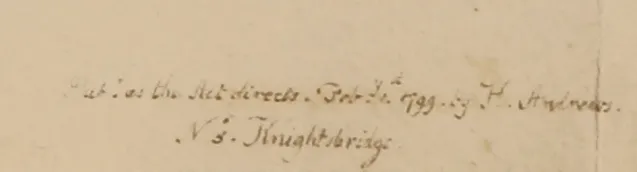
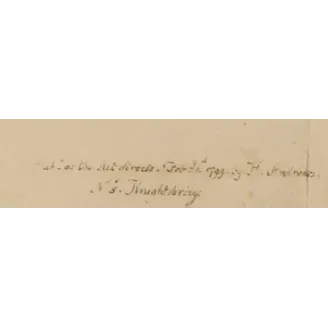
At the lower right, the sheet preserves Andrews’ characteristic handwritten publication inscription. The notation remains legible and forms an original component of the engraving’s publication history rather than a later annotation.
The inscription commonly includes the wording “Published as the Act directs”, together with the date, Andrews’ name and his address at 5 Knightsbridge, London. It records both the legal publication and the commercial circulation of the plate.
The wording referred to the British Engravers’ Copyright Act of 1735, widely known as Hogarth’s Act. Created to protect engravers and graphic artists against unauthorised copying, the legislation required publication information capable of establishing ownership of the design.
The plate mark is not visible on this impression. The sheet nevertheless preserves the complete double-page composition and generous surrounding paper, indicating that the absence of the plate mark should not be interpreted as evidence of severe trimming.
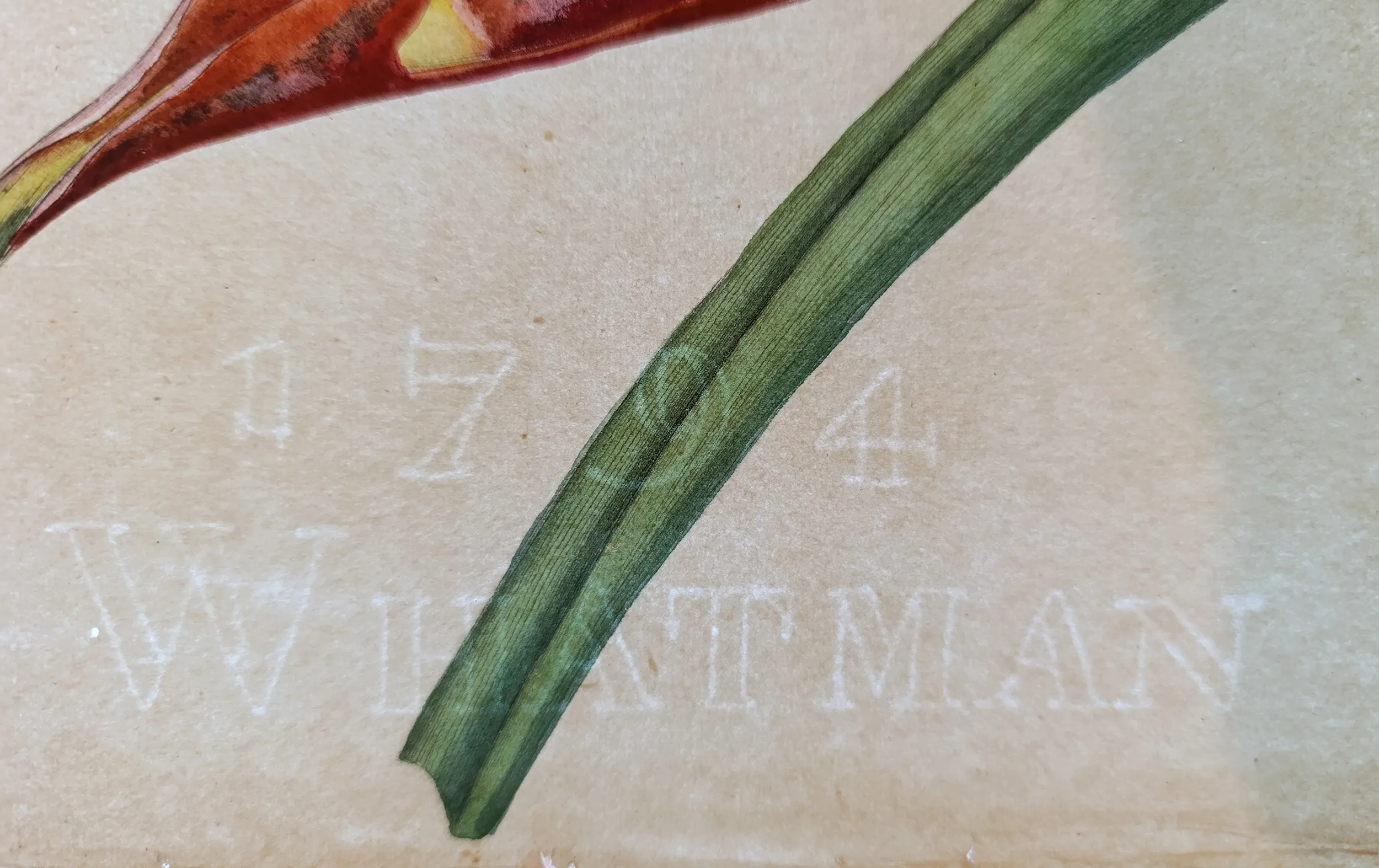
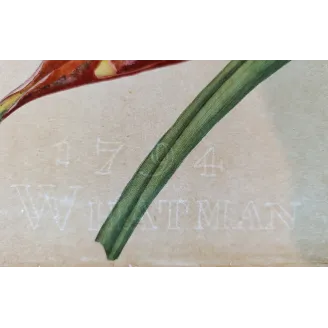
An original watermark is present within the paper. Its survival provides valuable material evidence relating to the manufacture of the sheet and reinforces the historical integrity of this original impression.
The combination of double-page format, original central fold, surviving watermark, restrained copperplate engraving, transparent hand colouring, selective gum arabic and handwritten publication inscription makes this an especially informative example of the artisanal production of The Botanist’s Repository.
Henry Charles Andrews was unusual among botanical artists because he maintained close control over almost every stage of production. He drew from living specimens, engraved the copperplates, supervised or executed the colouring and published the work himself. This integration enabled him to adapt the scale, composition and technical treatment of each plate to the distinctive character of the plant represented.
This engraving belongs to Henry Charles Andrews’ extraordinary world of new and rare plants, created during Britain’s great age of botanical exploration. Discover Andrews’ unusual working method and the material evidence preserved within original impressions, including hand colouring, engraved structure, handwritten publication inscriptions, selective applications of gum arabic, historical watermarks and original double-page formats.
Henry Charles Andrews and Britain’s Passion for Exotic Plants →
Excellent condition. Exceptionally clean original late eighteenth-century paper with remarkably fresh and finely preserved hand colouring. No visible stains, foxing or signs of use are present. The original central fold is entirely consistent with the historical double-page format and forms an integral part of the engraving’s original publication within The Botanist’s Repository. The delicate engraved details remain clearly defined, while selective gum arabic across the foliage and darker passages of the inflorescence retains its subtle reflective quality. An original watermark is present, and the handwritten publication inscription remains clearly legible. Please examine the professional high-resolution photographs for a complete visual assessment.
Historical botanical name: Musa coccinea
Accepted botanical name: Musa coccinea Andrews
Common name: Scarlet-Flowered Plantain Tree
Work: The Botanist’s Repository, for New, and Rare Plants
Author, artist and engraver: Henry Charles Andrews
Publisher: Henry Charles Andrews, 5 Knightsbridge, London
Date: 1799
Technique: Original copper engraving with hand-applied watercolour and selective gum arabic finishing
Format: Original double-page folding plate
Surface finishing: Selective gum arabic applied to the foliage and darker passages of the scarlet inflorescence
Publication inscription: Original handwritten publication inscription present and legible at the lower right
Plate mark: Not visible on this impression
Watermark: Original watermark present
Plate: XLVII (47)
Plant family: Musaceae
Historical introduction: Introduced into British cultivation by Thomas Evans of Stepney from plants received from China in 1792
Historical cultivation: Recorded in collections associated with James Vere, Lee and Kennedy, and John Fairbairn
Native region: Southern China and Southeast Asia
Sheet size: approx. 28 × 44 cm, double-page format
Specific References
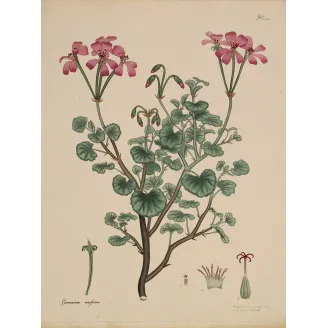
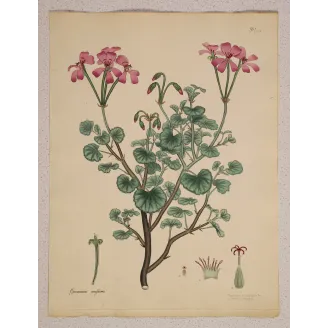
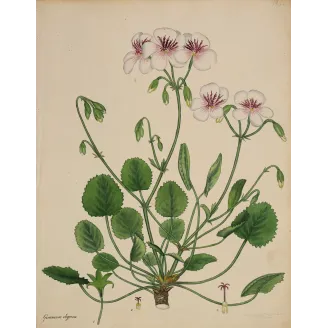
An elegant original botanical engraving depicting Geranium reniforme, distinguished by softly coloured flowers, rounded foliage and the refined hand-coloured style that characterises Henry Andrews' celebrated Botanist's Repository.
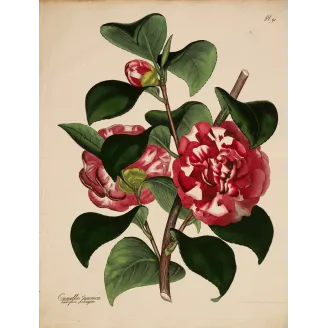
An original hand-coloured engraving of Camellia japonica from Henry Charles Andrews' celebrated The Botanist's Repository. Published around 1799, this elegant botanical print combines exceptionally refined hand colouring, selective gum arabic finishing on the foliage and Andrews' characteristic handwritten publication inscription.
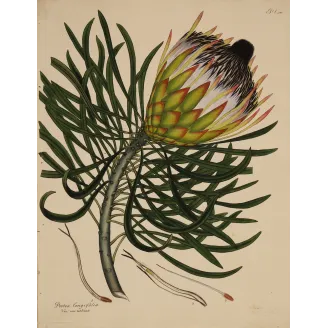
An original hand-coloured copper engraving depicting the Long-Leaved Protea (Protea longifolia), published by Henry Charles Andrews in The Botanist's Repository in 1801. Elegant linear foliage, a dramatic emerging flower head and exceptionally refined hand colouring distinguish one of the most dynamic Protea compositions of the series.
A striking original hand-coloured engraving depicting the Black-Flowered Showy Protea, published by Henry Charles Andrews in The Botanist's Repository in 1799. Monumental foliage, sculptural flower structure and beautifully preserved hand colouring make this one of the most architecturally impressive plates of the series.
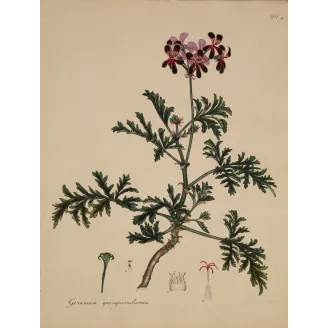
An original botanical engraving from Henry Andrews' celebrated The Botanist's Repository, depicting Geranium quinquevulnerum with richly coloured velvety flowers, transparent hand colouring and refined eighteenth-century botanical craftsmanship.
An original hand-coloured copper engraving of Protea formosa, published by Henry Charles Andrews in The Botanist's Repository (1799). Distinguished by its spectacular upward flowering styles, exceptionally delicate watercolour and refined botanical execution, this plate represents one of the most elegant Protea engravings of the series.
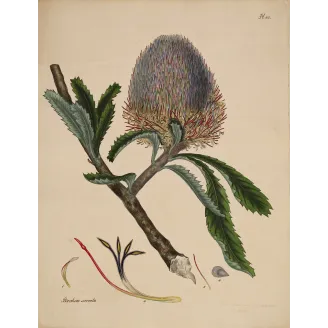
An original hand-coloured copper engraving depicting Banksia serrata, published by Henry Charles Andrews in The Botanist's Repository in 1799. Celebrated for its remarkable luminous flower head, delicate transparent watercolour and refined botanical observation.
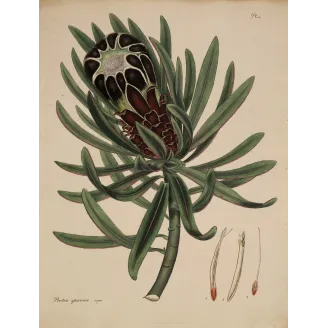
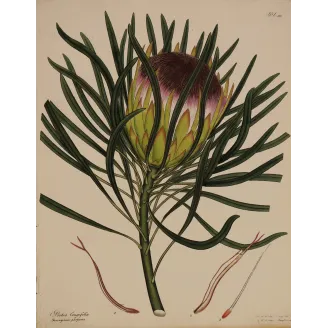
An original hand-coloured copper engraving depicting Protea longifolia (Rusty-purple Flower), published by Henry Charles Andrews in The Botanist's Repository in 1801. Distinguished by its protective arrangement of evergreen foliage, subtle engraved structure and exceptionally refined transparent watercolour.
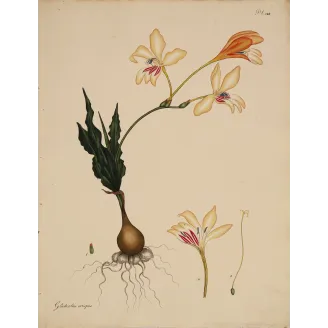
Original hand-coloured copper engraving of Gladiolus crispus (Curled-Leaved Gladiolus), engraved, coloured and published by Henry Charles Andrews for The Botanist's Repository, Plate CXLII, 1804. This elegant botanical print combines remarkably delicate transparent watercolour, restrained engraving and selective gum arabic applications that give the foliage a subtle natural lustre. A refined example of British botanical illustration from the early nineteenth century.
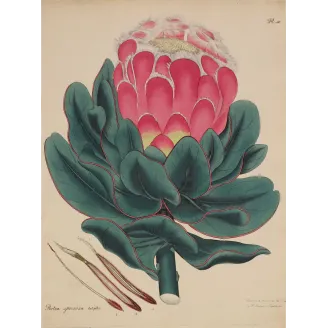
Monumental original hand-coloured engraving of the Broad-Leaved Showy Protea, published as Plate 110 in Henry Charles Andrews’ The Botanist’s Repository. Its sculptural blue-green foliage and extraordinary rose-pink flower make this one of the most iconic botanical images in the collection.
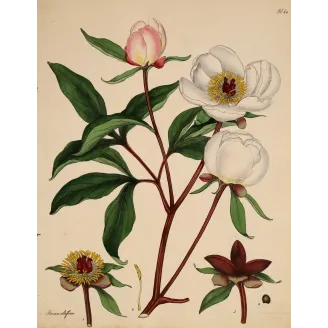
An exceptionally refined original hand-coloured engraving depicting the White Peony, published by Henry Charles Andrews in The Botanist's Repository in 1799. Delicate grey modelling, luminous white petals and beautifully preserved gum arabic finishing make this one of the finest botanical plates of the series.
Original hand-coloured copper engraving depicting Gladiolus versicolor, published by Henry Charles Andrews in The Botanist's Repository in 1799. An elegant botanical study distinguished by its graceful composition, delicately modelled flower and luminous green foliage.
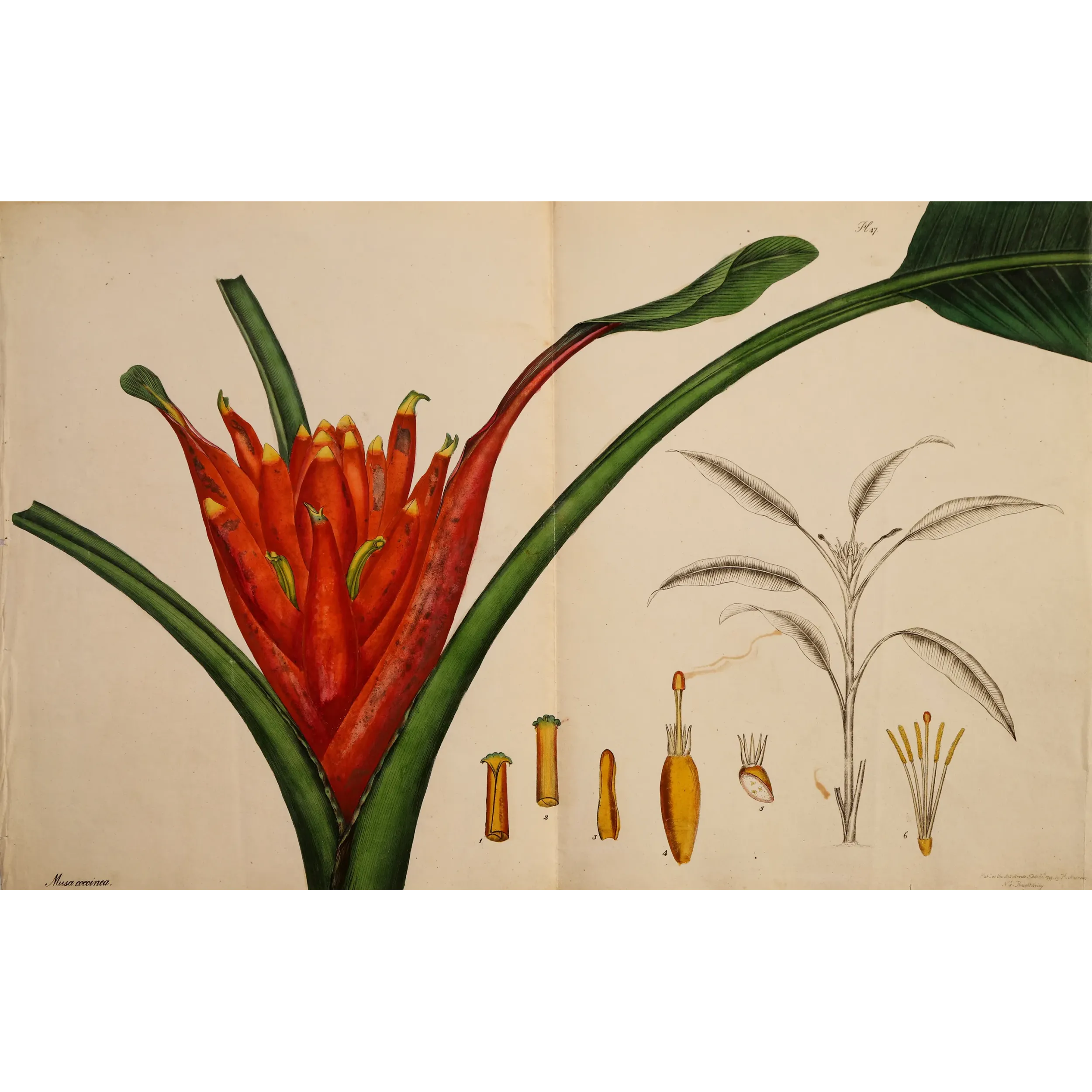
An original double-page hand-coloured copper engraving depicting Musa coccinea, published by Henry Charles Andrews in The Botanist's Repository in 1799. Distinguished by its spectacular horizontal composition, luminous scarlet inflorescence and original paper watermark.