- New
 Delivery policy
Your print will be carefully prepared and shipped worldwide via trusted couriers (UPS or similar).
 Authentic antique prints
Original engravings from the 17th–19th century.
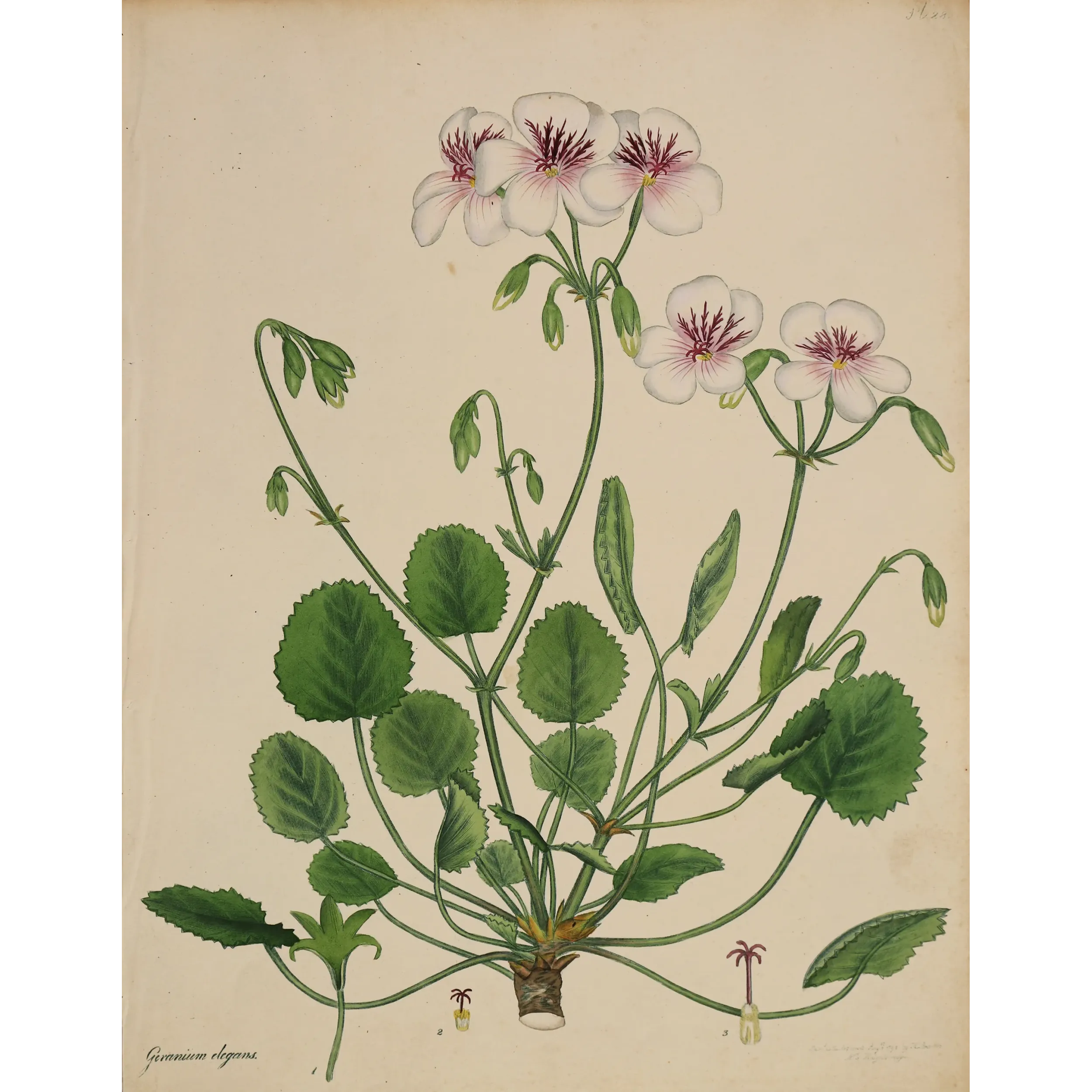
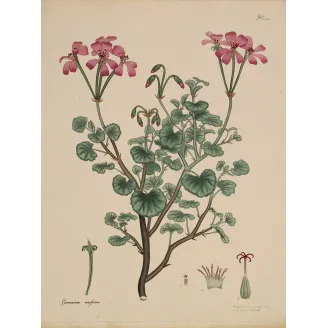
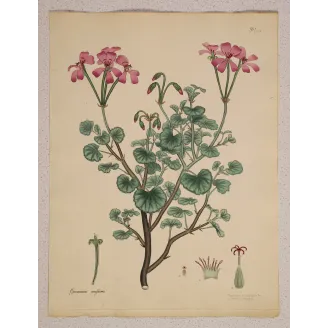
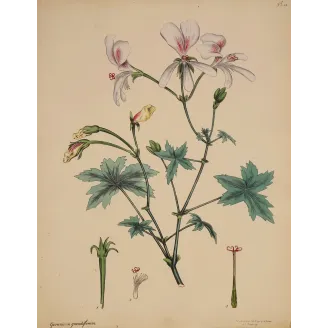
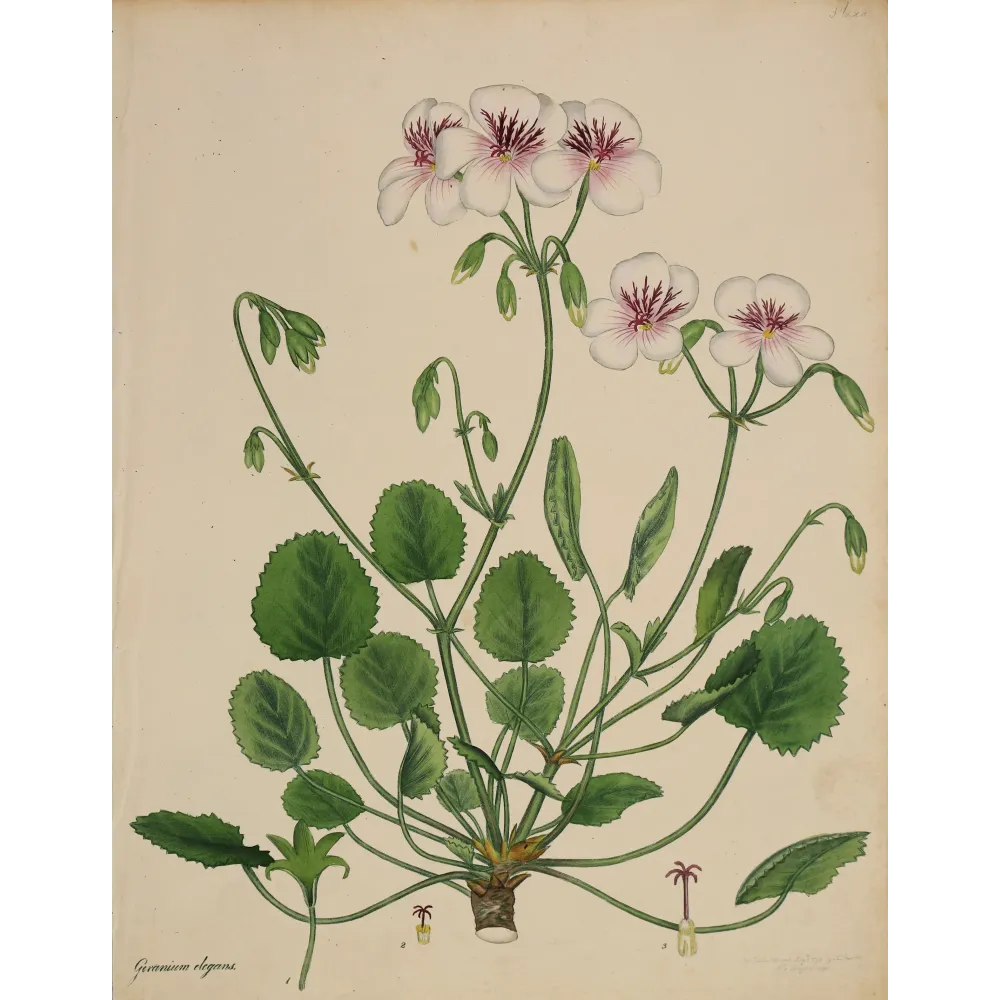
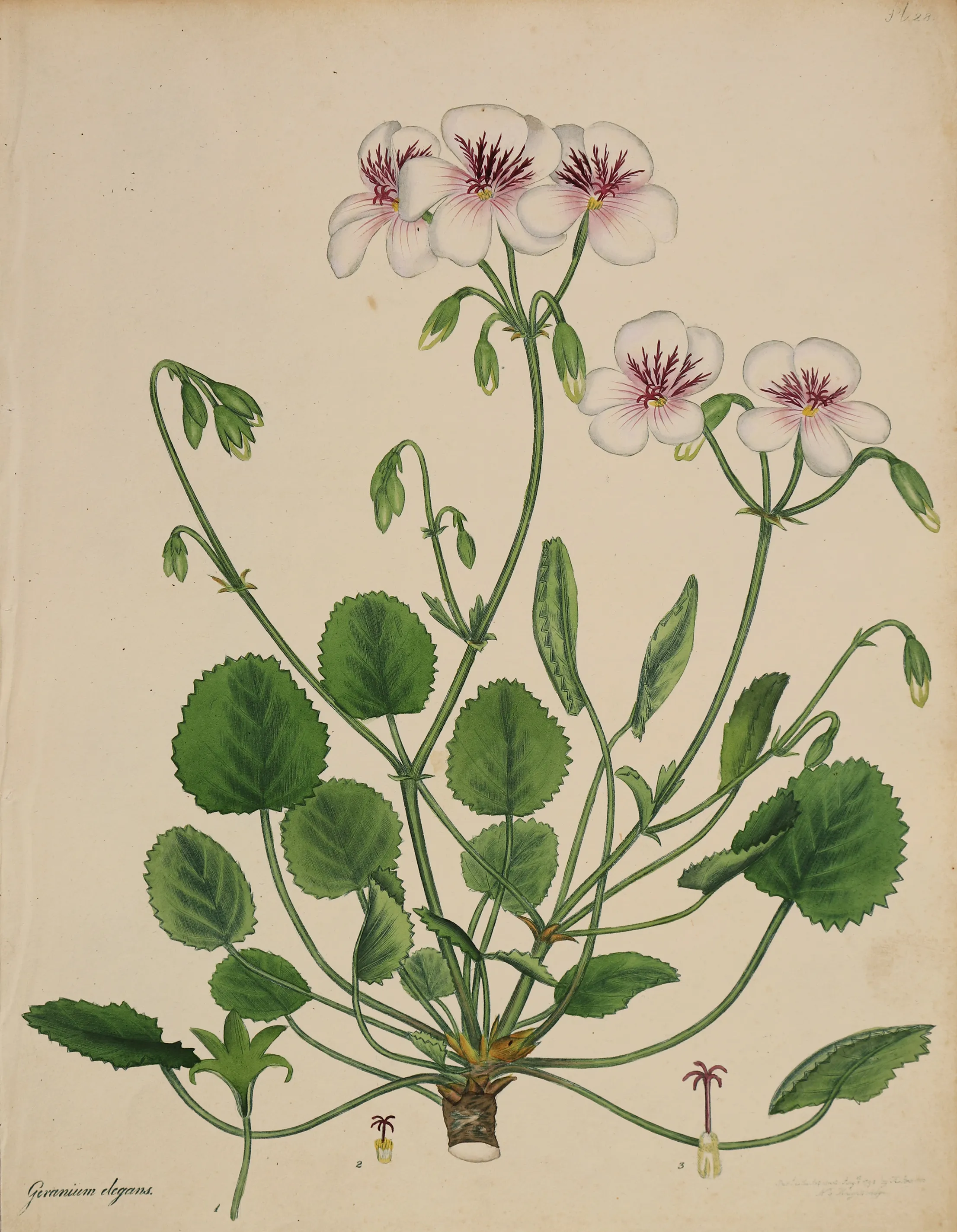
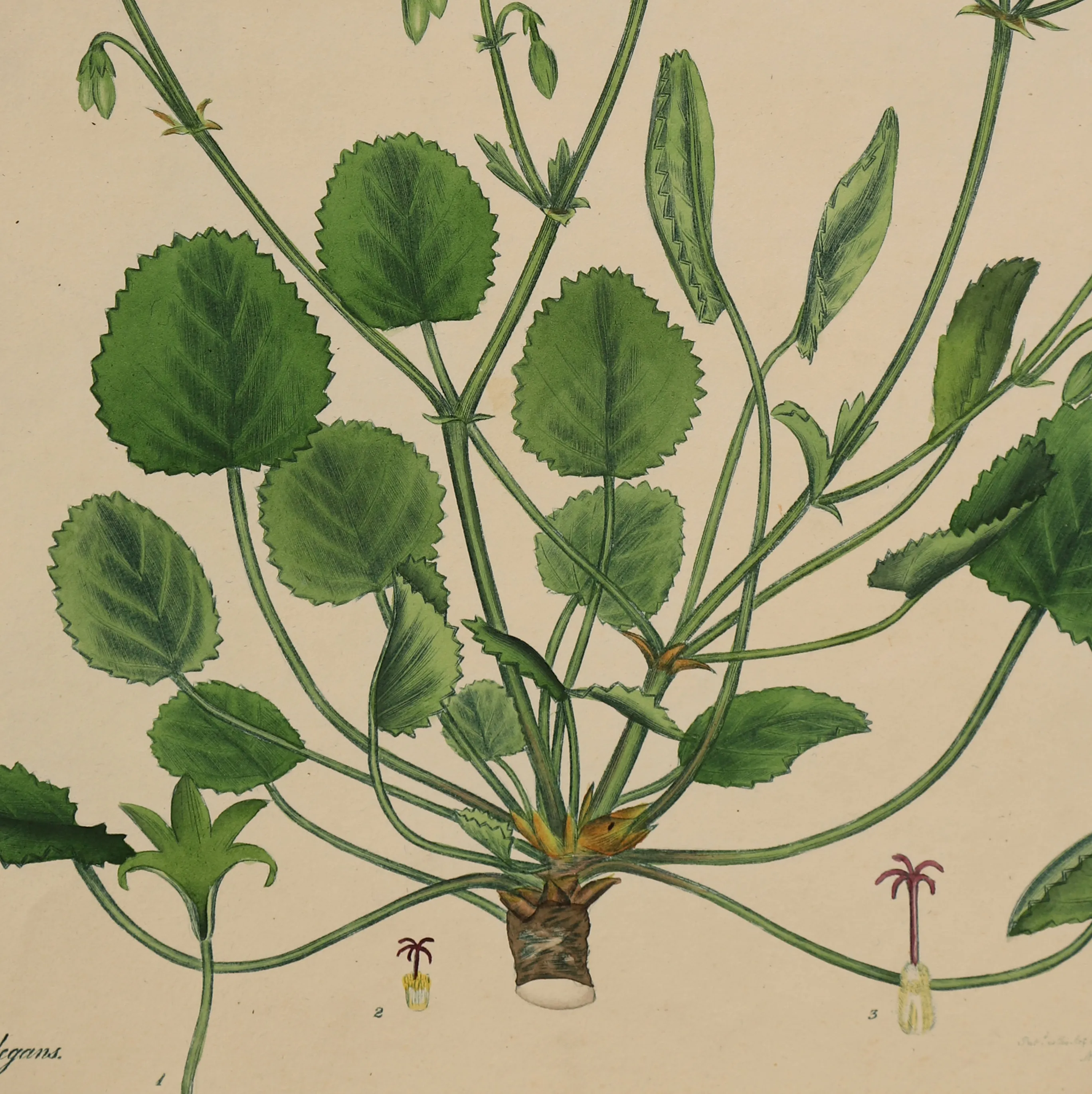
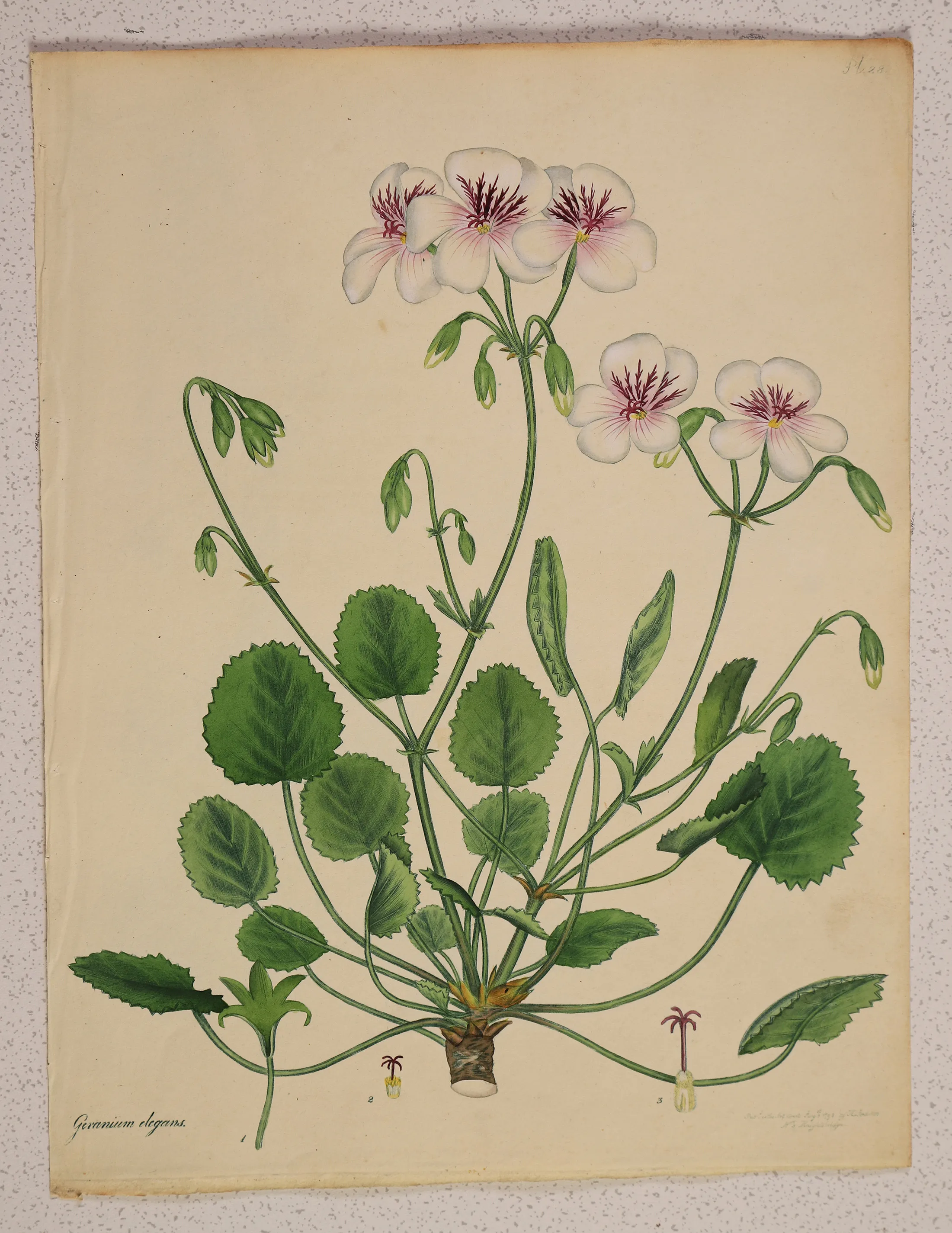
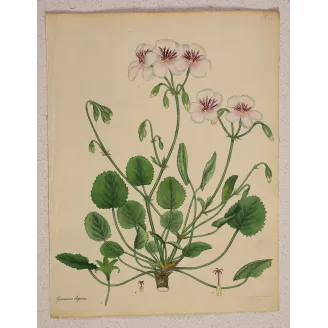
This refined original hand-coloured engraving from Henry Charles Andrews’ The Botanist’s Repository depicts the Round-Leaved Geranium, historically identified as Geranium elegans. Published in 1799 as Plate XXVIII, the composition combines luminous white blossoms, graceful flowering stems and richly articulated rounded foliage.
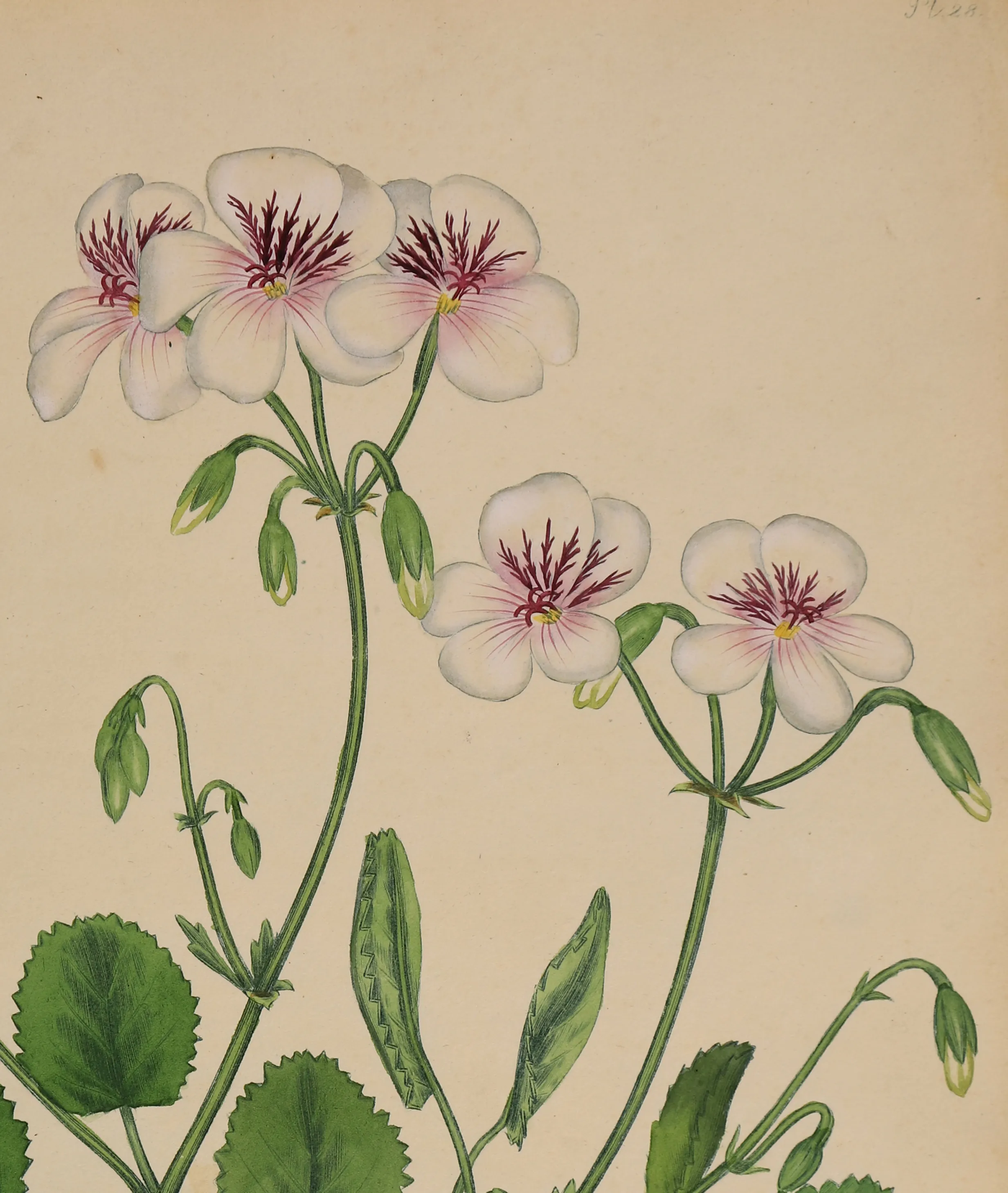
The flowers appear almost weightless above the darker green leaves. Andrews creates their delicate presence not through opaque white pigment, but through the exposed paper itself, gently modelled with pearl-grey, pale rose and faint blue-grey washes. Fine crimson markings radiate from the centre of each blossom, giving structure and chromatic focus to the otherwise luminous petals.
The composition develops from a compact central base before opening into a wide arrangement of long, slender stems. Rounded leaves occupy the middle and lower portions of the sheet, while flowering branches rise into the generous open space above.
The foliage creates a stable visual foundation without becoming dense or heavy. Individual leaves vary in scale and direction: some face the viewer directly, others turn laterally, while several appear folded or partially concealed behind neighbouring stems.
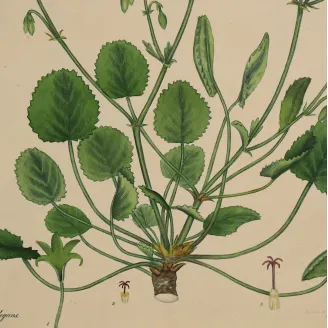
Their rounded and finely serrated forms are modelled through transparent layers of deep green, olive and softer grey-green. Subtle tonal transitions radiate from the central veins, creating volume while preserving the delicacy of the watercolour.
The flowers are arranged in two principal groups. A larger cluster rises towards the upper centre, while a smaller group opens at the upper right. Their asymmetrical placement introduces natural rhythm and prevents the composition from becoming formally balanced or static.
Each blossom is constructed from softly rounded white petals. Andrews leaves much of the paper untouched, using only the lightest pearl-grey shadows to indicate overlap, curvature and changing orientation.
Very pale pink washes emerge around the floral centres and gradually dissolve across the petals. Fine crimson lines radiate outward from the centre, introducing a controlled burst of colour within the otherwise restrained palette.
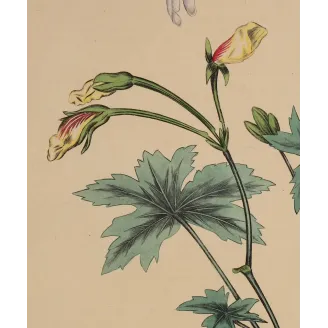
The hanging buds and curved stems record several stages of development. Some buds remain tightly closed, while others begin to open, creating a gentle sequence between vegetative growth and full flowering.
The botanical details arranged along the lower margin isolate the floral sheath, reproductive structures and pistil. Their analytical clarity reinforces the scientific purpose of the plate while preserving the visual lightness of the complete composition.
Geranium elegans, historically known as the Round-Leaved Geranium, belongs to the Geraniaceae and originated in the Cape region of South Africa. Andrews described the plant as having rounded, rigidly toothed leaves and long flowering stalks supporting numerous blossoms.
The accompanying text records that the species was introduced into Britain from the Cape of Good Hope in 1796. It was raised from seed received by the celebrated Lee and Kennedy nursery, whose collection provided many of the living specimens illustrated in The Botanist’s Repository.
Andrews notes that the plant flowered for the first time in Britain in 1799, towards the end of May. His drawing was made from that flowering specimen, preserving the appearance of a plant that was still new to British horticulture.
The historical account also reflects contemporary changes in botanical classification. Andrews observed that the floral structure suggested the plant should be placed within the genus Pelargonium, rather than retained within the broader historical genus Geranium.
He described the plant as having a naturally bushy growth and noted that it required greenhouse protection. Propagation from seed was considered the most effective method, since the plant produced relatively few branches suitable for cuttings.
The plate therefore documents both botanical beauty and horticultural novelty. It records a Cape species at the moment of its early cultivation in Britain, interpreted through Andrews’ direct observation of a living plant.
Close examination reveals an exceptionally restrained engraved framework beneath the hand colouring. The copperplate defines the essential botanical contours and selected internal structures, but remains deliberately subordinate to the transparent watercolour.
Across the blossoms, the engraved line is reduced almost to disappearance. Andrews avoids dense hatching and allows the white paper, delicate tonal washes and fine crimson markings to create the flowers’ volume and identity.
The petals are formed primarily from untouched paper. Pearl-grey and faint blue-grey washes are applied sparingly along overlapping edges and recessed areas, allowing the natural luminosity of the sheet to become the principal source of light.
This treatment differs from the more sculptural white modelling found in Andrews’ White Peony. Here the colour remains lighter and more diffuse, creating blossoms that appear airy, intimate and softly illuminated rather than monumental.
Restrained pale rose washes near the centre of each flower provide warmth, while the crimson veining creates precise linear accents. These markings clarify the structure of the petals and draw the eye towards the reproductive centre without disturbing the quiet harmony of the composition.
The leaves are modelled through transparent green watercolour supported by fine engraved venation. Deeper tones define the principal folds and shaded areas, while softer passages preserve a sense of living surface and botanical softness.
Selective applications of gum arabic enrich portions of the foliage with a restrained, softly reflective finish. Rather than creating pronounced gloss, the treatment deepens the green tones and gives the leaves a discreet material refinement.
The gentle surface finish establishes a subtle contrast with the flowers. The foliage responds softly to external light, while the blossoms derive their luminosity from transparent colour and the exposed paper beneath.
The final effect depends upon a carefully calibrated relationship between engraving, watercolour and surface finishing. The engraved framework provides botanical precision, the transparent washes create colour and modelling, and the soft gum arabic finish lends quiet richness to the foliage.
At the lower right, the sheet preserves Andrews’ characteristic handwritten publication inscription. The notation remains legible and forms an original component of the plate’s publication history rather than a later annotation.
The inscription commonly includes the wording “Published as the Act directs”, together with the date, Andrews’ name and his address at 5 Knightsbridge, London. It records both the legal publication and commercial circulation of the engraving.
The wording referred to the British Engravers’ Copyright Act of 1735, widely known as Hogarth’s Act. Created to protect engravers and graphic artists against unauthorised copying, the legislation required publication information capable of establishing ownership of the design.
The plate mark is not visible along the long vertical edges of the sheet, while a horizontal portion of the copperplate impression remains visible near the lower margin. This partial survival preserves direct material evidence of the original printing process.
The absence of the vertical plate mark is consistent with the historical trimming frequently encountered in bound impressions of The Botanist’s Repository. The surviving horizontal impression demonstrates that the sheet was printed from an engraved copperplate even though the longer edges are no longer visible.
No watermark has been observed on this individual impression. Examination of another original sheet belonging to this Prantique group of Andrews engravings, however, revealed a clearly legible J. Whatman 1794 watermark, documenting the use of fine English Whatman paper within the publication.
Although the watermark is a collection-level observation rather than a feature recorded on this sheet, it provides valuable material context. Together with the restrained engraving, original hand colouring, partial plate mark, soft gum arabic finish and handwritten publication inscription, it helps reconstruct the sophisticated artisanal production of The Botanist’s Repository.
Henry Charles Andrews was unusual among botanical artists because he maintained close control over almost every stage of production. He drew from living specimens, engraved the copperplates, supervised or executed the colouring and published the work himself. This integration allowed him to adapt the visual treatment of each plate to the distinctive optical and botanical character of the plant represented.
This engraving belongs to Henry Charles Andrews’ extraordinary world of new and rare plants, created during Britain’s great age of botanical exploration. Discover Andrews’ unusual working method and the material evidence preserved within original impressions, including transparent hand colouring, restrained engraved structure, handwritten publication inscriptions, historical plate marks, selective applications of gum arabic and fine English Whatman paper.
Henry Charles Andrews and Britain’s Passion for Exotic Plants →
Excellent condition. Exceptionally clean original late eighteenth-century paper with finely preserved hand colouring. No visible stains, foxing or signs of use are present. The luminous white blossoms, pearl-grey modelling and crimson floral markings remain remarkably fresh, while selective gum arabic across portions of the foliage retains its soft reflective finish. The original handwritten publication inscription remains legible at the lower right. The plate mark is absent along the long vertical edges but remains partially visible near the lower margin. No watermark has been observed on this impression. Please examine the professional high-resolution photographs for a complete visual assessment.
Historical botanical name: Geranium elegans
Accepted botanical name: Pelargonium elegans (Andrews) Willd.
Historical English name: Round-Leaved Geranium
Work: The Botanist’s Repository, for New, and Rare Plants
Author, artist and engraver: Henry Charles Andrews
Publisher: Henry Charles Andrews, 5 Knightsbridge, London
Date: 1799
Plate: XXVIII (28)
Technique: Original copper engraving with hand-applied transparent watercolour and selective gum arabic finishing
Surface finishing: Selective gum arabic applied to portions of the foliage, producing a soft satin-like reflection
Publication inscription: Original handwritten publication inscription present and legible at the lower right
Plate mark: Not visible along the long vertical edges; partially visible near the lower margin
Watermark: Not observed on this individual impression
Plant family: Geraniaceae
Historical introduction: Introduced from the Cape of Good Hope in 1796
Historical cultivation: Raised from seed by Lee and Kennedy and first recorded flowering in Britain in May 1799
Native region: South Africa, Cape region
Sheet size: approx. 28 × 22 cm
Specific References
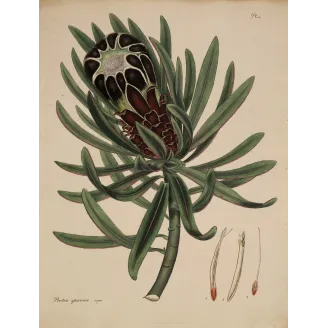
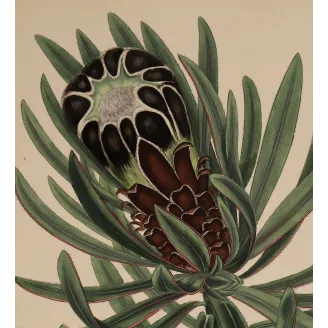
A striking original hand-coloured engraving depicting the Black-Flowered Showy Protea, published by Henry Charles Andrews in The Botanist's Repository in 1799. Monumental foliage, sculptural flower structure and beautifully preserved hand colouring make this one of the most architecturally impressive plates of the series.
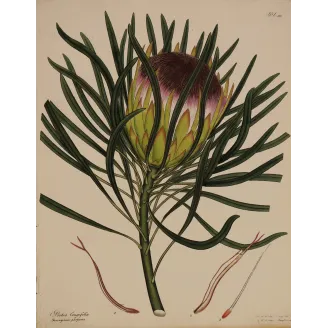
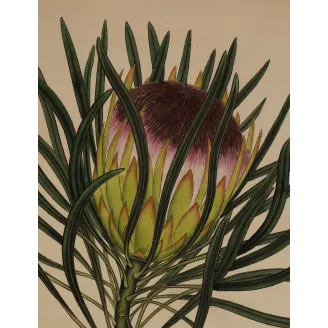
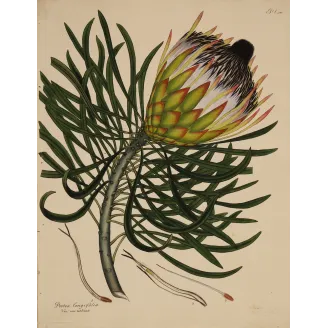
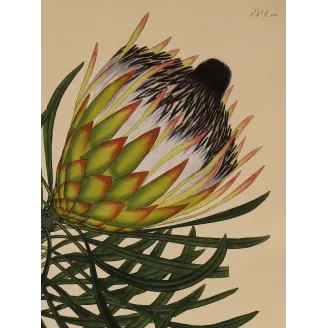
An original hand-coloured copper engraving depicting Protea longifolia (Rusty-purple Flower), published by Henry Charles Andrews in The Botanist's Repository in 1801. Distinguished by its protective arrangement of evergreen foliage, subtle engraved structure and exceptionally refined transparent watercolour.
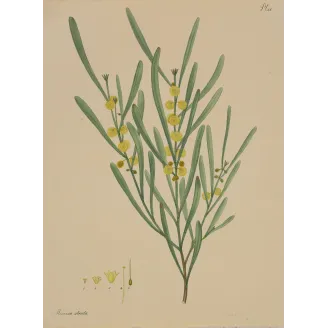
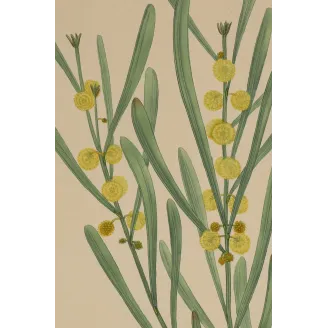
An original hand-coloured botanical engraving from Henry Charles Andrews' The Botanist's Repository, depicting Mimosa stricta through delicate golden flower heads, slender blue-green foliage and a remarkably balanced botanical composition published in 1799.
An elegant original botanical engraving depicting Geranium reniforme, distinguished by softly coloured flowers, rounded foliage and the refined hand-coloured style that characterises Henry Andrews' celebrated Botanist's Repository.
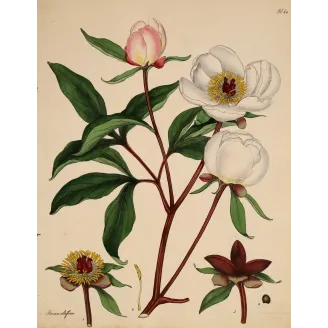
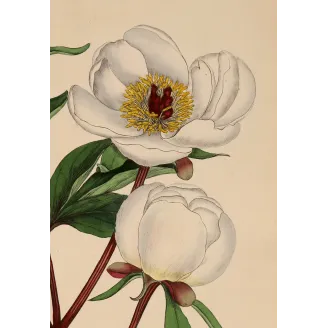
An exceptionally refined original hand-coloured engraving depicting the White Peony, published by Henry Charles Andrews in The Botanist's Repository in 1799. Delicate grey modelling, luminous white petals and beautifully preserved gum arabic finishing make this one of the finest botanical plates of the series.
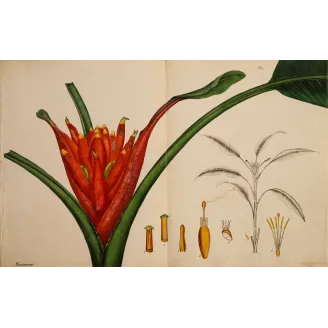
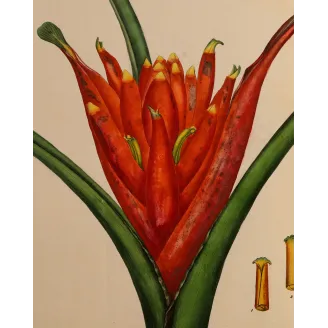
An original double-page hand-coloured copper engraving depicting Musa coccinea, published by Henry Charles Andrews in The Botanist's Repository in 1799. Distinguished by its spectacular horizontal composition, luminous scarlet inflorescence and original paper watermark.
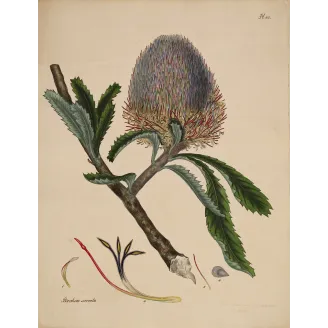
An original hand-coloured copper engraving depicting Banksia serrata, published by Henry Charles Andrews in The Botanist's Repository in 1799. Celebrated for its remarkable luminous flower head, delicate transparent watercolour and refined botanical observation.
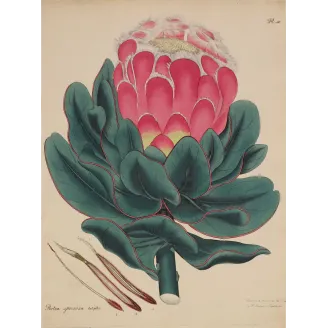
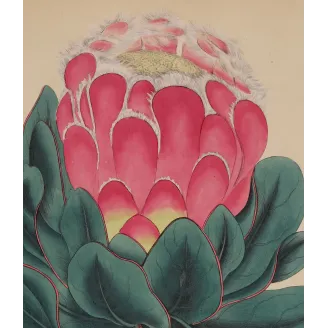
Monumental original hand-coloured engraving of the Broad-Leaved Showy Protea, published as Plate 110 in Henry Charles Andrews’ The Botanist’s Repository. Its sculptural blue-green foliage and extraordinary rose-pink flower make this one of the most iconic botanical images in the collection.
An original hand-coloured copper engraving depicting Geranium grandiflorum, the Large-Flowered Crane’s-Bill, published by Henry Charles Andrews in The Botanist’s Repository in 1797. The luminous white flowers are delicately modelled with pearl-grey washes and vivid crimson veining, while the blue-green foliage retains a refined matte surface.
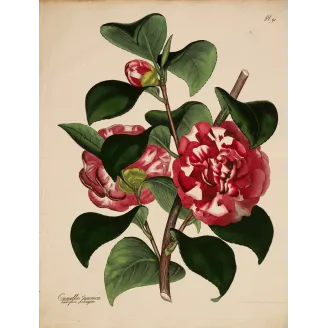
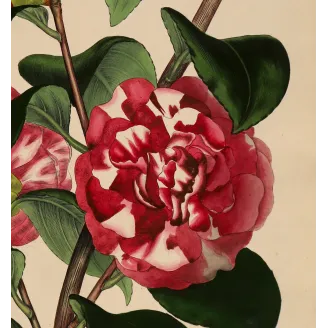
An original hand-coloured engraving of Camellia japonica from Henry Charles Andrews' celebrated The Botanist's Repository. Published around 1799, this elegant botanical print combines exceptionally refined hand colouring, selective gum arabic finishing on the foliage and Andrews' characteristic handwritten publication inscription.
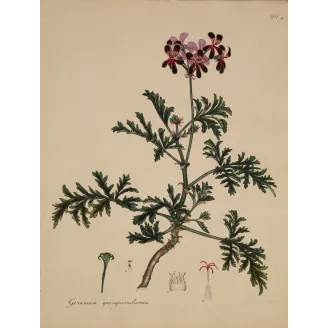
An original botanical engraving from Henry Andrews' celebrated The Botanist's Repository, depicting Geranium quinquevulnerum with richly coloured velvety flowers, transparent hand colouring and refined eighteenth-century botanical craftsmanship.
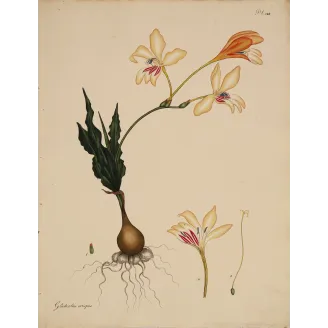
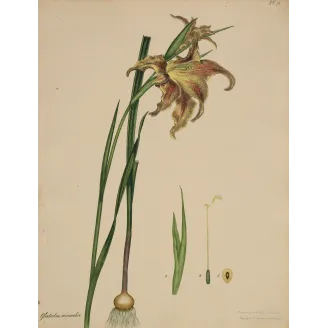
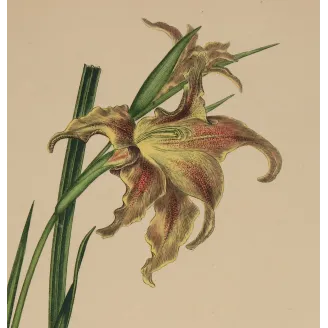
Original hand-coloured copper engraving of Gladiolus crispus (Curled-Leaved Gladiolus), engraved, coloured and published by Henry Charles Andrews for The Botanist's Repository, Plate CXLII, 1804. This elegant botanical print combines remarkably delicate transparent watercolour, restrained engraving and selective gum arabic applications that give the foliage a subtle natural lustre. A refined example of British botanical illustration from the early nineteenth century.
An original hand-coloured copper engraving of Protea formosa, published by Henry Charles Andrews in The Botanist's Repository (1799). Distinguished by its spectacular upward flowering styles, exceptionally delicate watercolour and refined botanical execution, this plate represents one of the most elegant Protea engravings of the series.
Original hand-coloured copper engraving depicting Gladiolus versicolor, published by Henry Charles Andrews in The Botanist's Repository in 1799. An elegant botanical study distinguished by its graceful composition, delicately modelled flower and luminous green foliage.
An original hand-coloured copper engraving depicting the Long-Leaved Protea (Protea longifolia), published by Henry Charles Andrews in The Botanist's Repository in 1801. Elegant linear foliage, a dramatic emerging flower head and exceptionally refined hand colouring distinguish one of the most dynamic Protea compositions of the series.
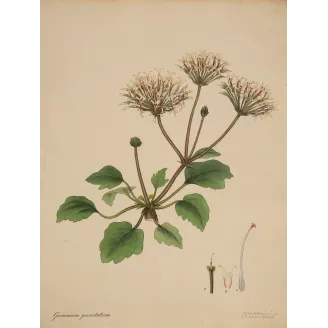
An original botanical engraving from Henry Andrews' The Botanist's Repository, portraying Geranium punctatum through graceful floral umbels, transparent hand colouring and refined eighteenth-century botanical artistry.