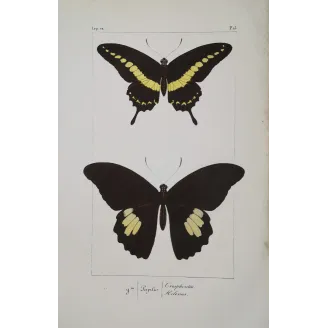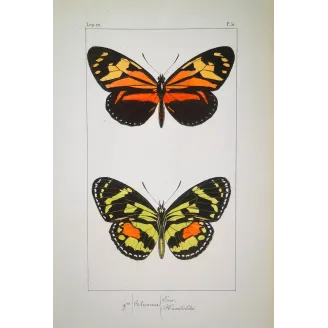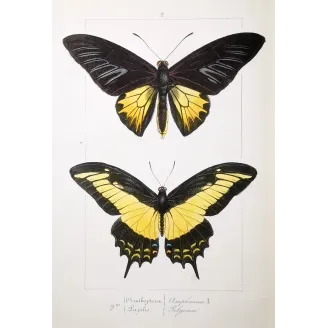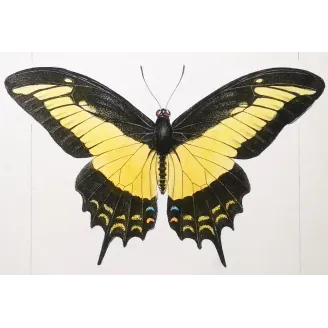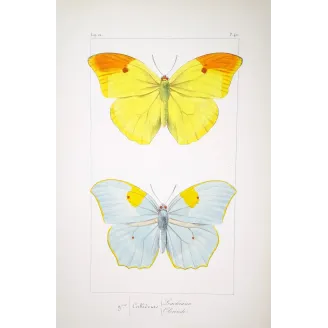
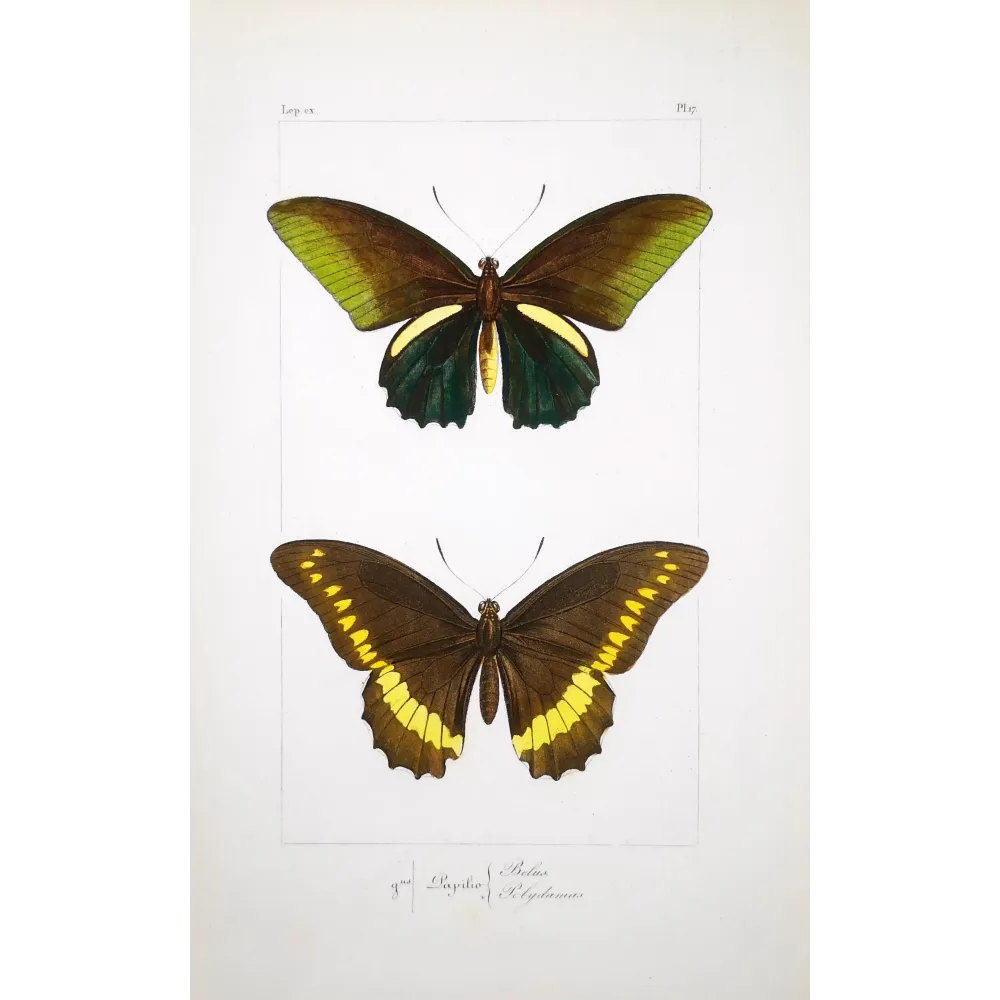
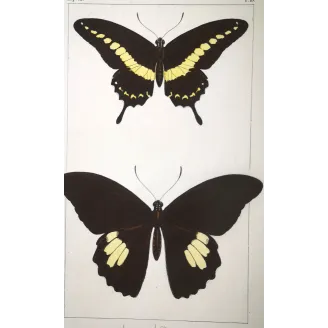
Elegant golden and yellow swallowtail butterflies with luminous contrast and flowing wing shapes. A refined antique engraving from 1835.
 Delivery policy
Your print will be carefully prepared and shipped worldwide via trusted couriers (UPS or similar).
 Authentic antique prints
Original engravings from the 17th–19th century.
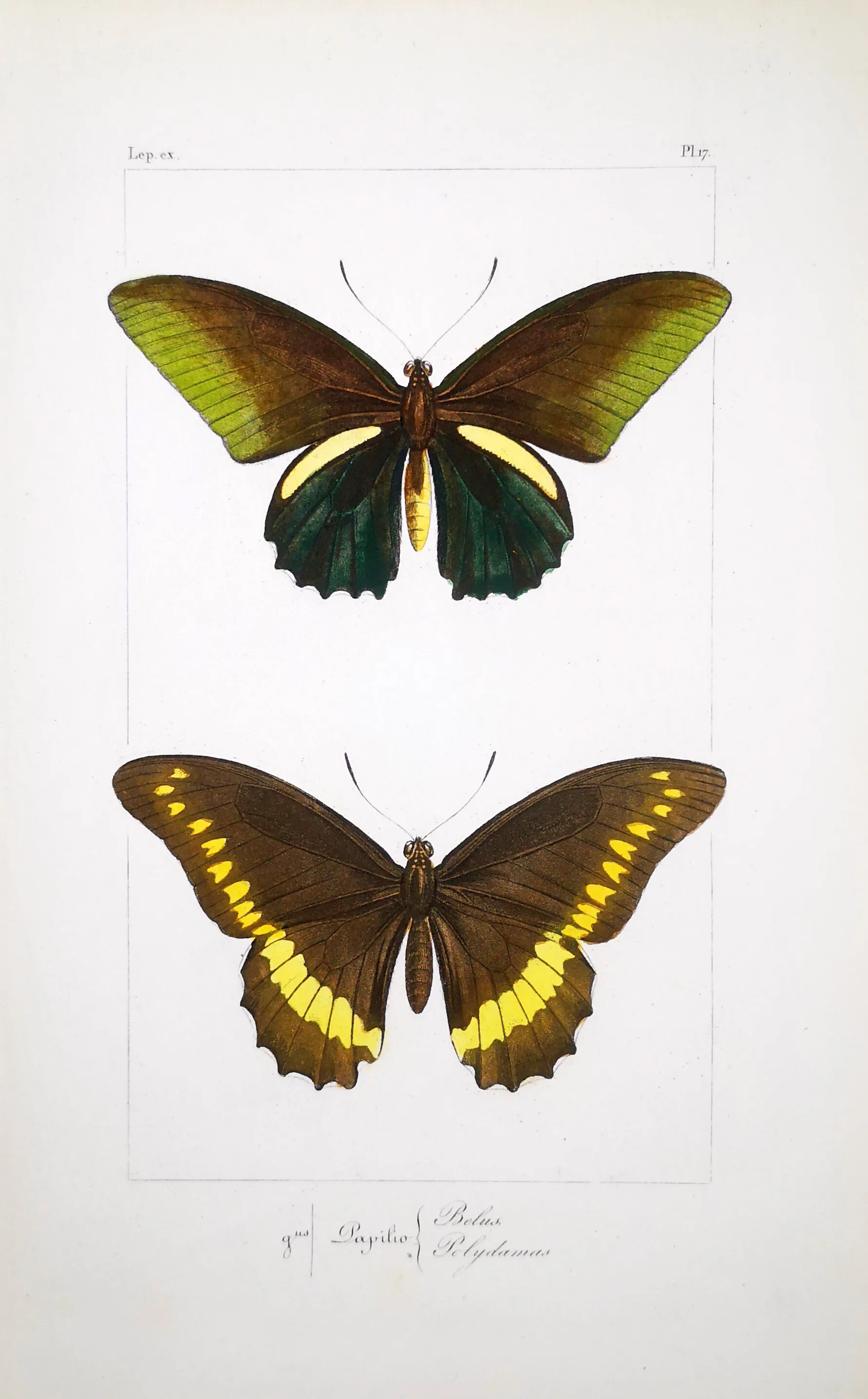
This original 1835 hand-colored copper engraving depicts two elegant swallowtail butterflies identified on the plate as Papilio belus and Papilio polydamas. The composition forms part of Exotic Butterflies, produced under the scientific direction of Hippolyte Lucas and engraved by Pauquet. Both species were admired in nineteenth-century natural history for their graceful silhouettes and the rich contrast of warm brown, golden yellow, and luminous greenish tones.
Presented in a balanced vertical arrangement against a clean ground, the two specimens offer complementary expressions of swallowtail beauty. The upper butterfly has a more atmospheric and velvety appearance, with olive-gold reflections and pale cream markings set against darker wings, while the lower specimen is more graphic and decorative, with bright yellow bands that immediately structure the composition.
Together, the two butterflies create an engraving of unusual refinement, where warmth, elegance, and clarity are perfectly balanced. This makes the plate especially appealing today as antique butterfly wall art, ideal for interiors drawn to natural history, understated luxury, and sophisticated color contrast.
— • —
The upper specimen, Papilio belus, is distinguished by a remarkably subtle palette. Soft olive-green and golden reflections spread across the forewings, while the lower wings deepen into rich teal-black tones interrupted by pale cream patches. The overall effect is atmospheric and almost painterly, giving the butterfly a luxurious and velvety presence.
Below, Papilio polydamas introduces a bolder and more decorative rhythm. Bright yellow bands arc across deep brown wings, creating a strong and immediately legible pattern. This contrast gives the lower specimen a more graphic character, while the elongated shape of the wings preserves the elegance typical of swallowtail butterflies.
Papilio polydamas, often known today as the Gold Rim Swallowtail, is one of the most recognizable tropical swallowtails of the Americas. Unlike many swallowtails, it lacks the long tails commonly associated with the group, yet compensates with broad wings and powerful yellow markings that make it instantly distinctive. Its larvae feed on Aristolochia species, from which they derive chemical defenses, a biological trait that fascinated naturalists long before the mechanisms of toxicity were fully understood.
Papilio belus was equally appreciated for its softer tonal harmonies and more atmospheric beauty. Butterflies of this kind demonstrate how nineteenth-century entomology was not driven by taxonomy alone, but also by a genuine appreciation for variation in color, mood, and form. Collectors valued such plates not only for scientific reference, but because they captured the astonishing diversity of tropical Lepidoptera in visually compelling ways.
For a modern viewer, this engraving remains particularly appealing because it combines two different decorative registers: one quieter and luminous, the other stronger and more graphic. In this sense, it is both a fine natural history illustration and an enduring example of antique butterfly engraving with strong visual presence.
This engraving forms part of the celebrated series Lucas – Exotic Butterflies , published in 1835 under the scientific direction of Hippolyte Lucas — a period when nature was explored, classified, and artistically interpreted through monumental illustrated works of exceptional refinement.
Discover the broader historical context in our editorial feature: Hippolyte Lucas: Scientific Vision and the Golden Age of Exotic Butterflies .
The plate was drawn and engraved by Pauquet, whose refined copperplate technique translated rare tropical specimens into enduring images of exceptional clarity and beauty: Pauquet: The Engraver Behind the Exotic Butterflies .
Very good antique condition. Fresh original hand-coloring with well-preserved tonal depth and strong engraved impression. Printed on fine original nineteenth-century paper. Minor age toning consistent with the 1835 publication. Examples preserving this level of color freshness, subtle contrast, and overall integrity are increasingly difficult to find.
Specific References
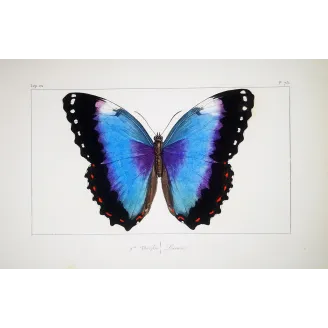
An original 19th-century hand-colored engraving of Morpho leonte, the striking Blue Morpho butterfly, drawn and engraved by Pauquet under the scientific direction of Hippolyte Lucas.
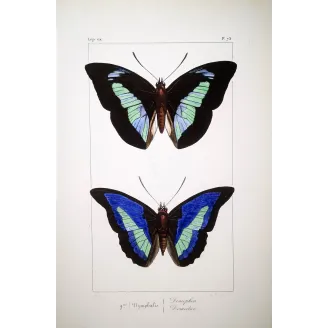
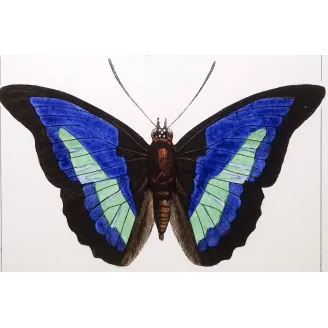
Demophon & Demodice Butterflies (Archaeoprepona demophon, Prepona laertes demodice) – Antique Hand-Colored Engraving, Exotic Butterflies (1835).
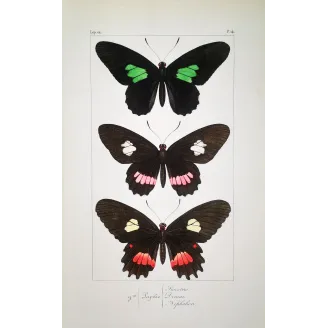
Striking black butterflies with vivid green, pink, and red accents. A dramatic 1835 engraving with strong contrast and bold decorative appeal.
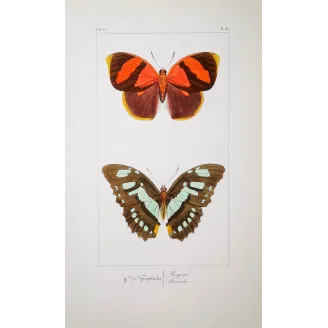
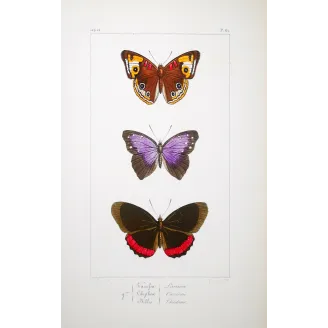
This vivid 1835 hand-colored engraving presents two striking tropical butterflies: the intensely colored Agrias rogeri, with its brilliant red and orange wings, and the elegant Adelpha stenele, known for its intricate pattern and pale blue markings. The strong chromatic contrast between the two species creates a visually compelling composition, making this piece a refined example of antique butterfly wall art and natural history illustration.
Elegant black swallowtail butterflies with soft yellow markings and refined contrast. A sophisticated 1835 engraving, ideal as antique butterfly wall art.
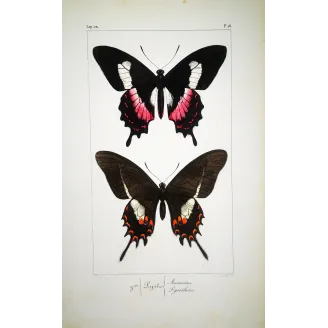
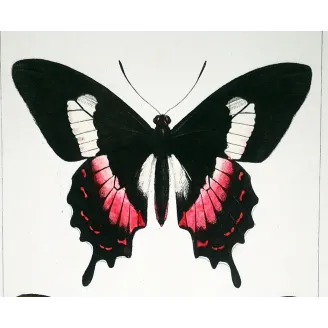
Elegant black butterflies with luminous pink and orange accents, creating a refined yet dramatic visual composition. A distinctive 1835 antique butterfly engraving.
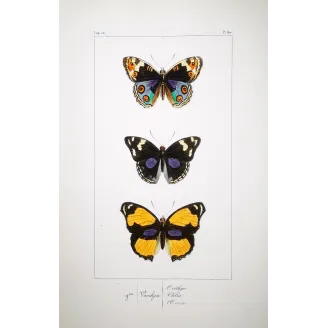
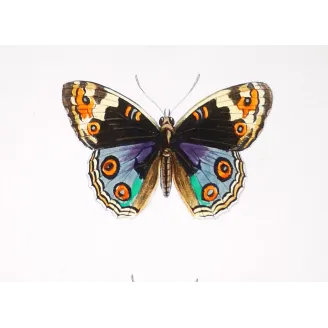
Vivid butterflies with striking eye-spots, deep purple, and bright orange tones. A bold 1835 engraving with strong decorative appeal.
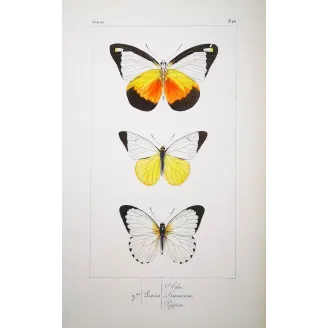
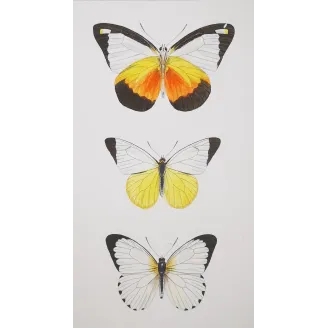
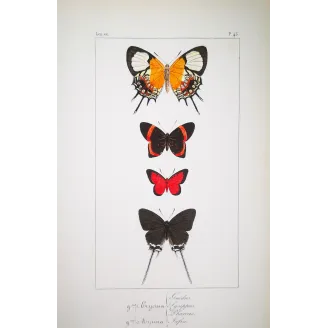
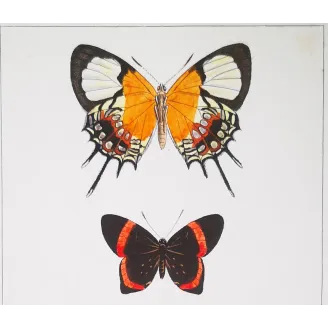
Elegant white and yellow butterflies with a striking orange-accented specimen. A refined 1835 engraving with bright and balanced decorative appeal.
Metalmark & Long-Tailed Butterflies (Erycina cnidus, Lysis iphron, Moyina sapra) – Antique Hand-Colored Engraving (1835).
Cattleheart Swallowtail Butterflies (Parides lysithous group) – Antique Hand-Colored Engraving, Exotic Butterflies (1835)
Striking black butterflies with vivid orange and yellow bands. A bold 1835 engraving with strong contrast and exceptional decorative impact.
Golden Birdwing butterflies with bold yellow and black contrast and elegant swallowtail forms. A striking 1835 engraving, ideal as antique butterfly wall art.
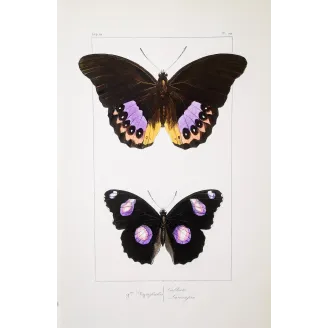
A striking 19th-century hand-colored engraving depicting two tropical pansy butterflies: the Golden Pansy (Junonia callista) and the Purple Pansy (Junonia laomedia). Published in Hippolyte Lucas’s Exotic Butterflies (1835), the plate highlights their dramatic wing contrasts and luminous violet eye-spots.
Striking butterflies in deep red, violet, and dark tones with eye-like markings. A refined 1835 engraving with strong decorative character.
Soft yellow and pale blue butterflies with delicate orange accents. A refined 1835 engraving with elegant tones and subtle decorative appeal.
Sulphur Butterflies (Terias hecabe, candida, nicippe) – Antique Hand-Colored Engraving (1835)
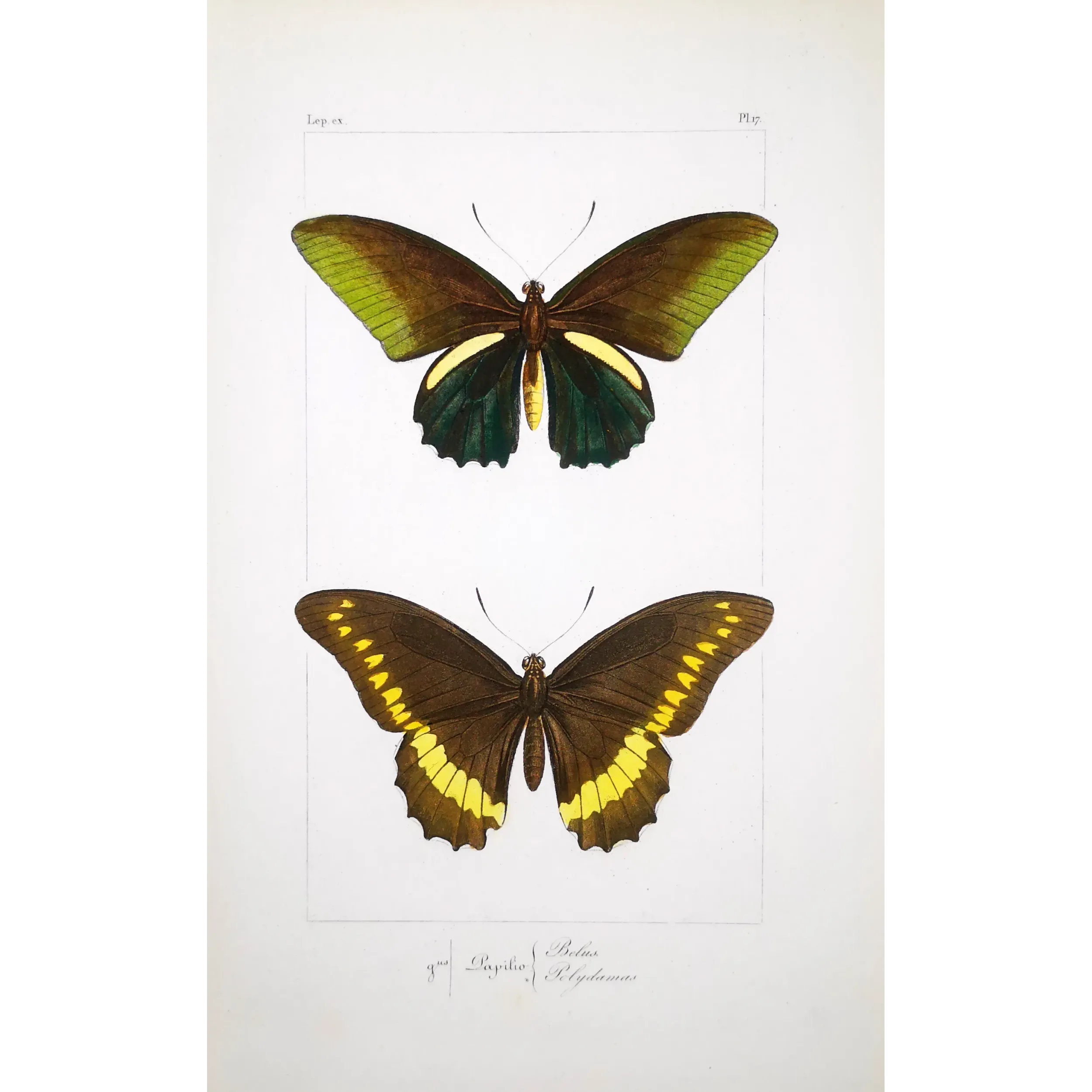
Elegant golden and yellow swallowtail butterflies with luminous contrast and flowing wing shapes. A refined antique engraving from 1835.