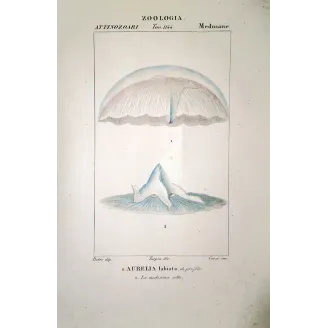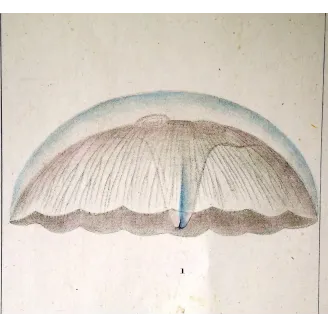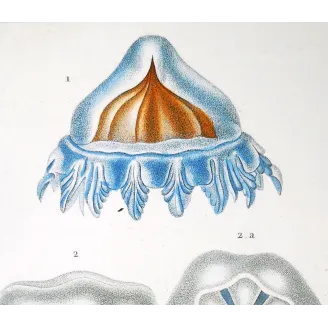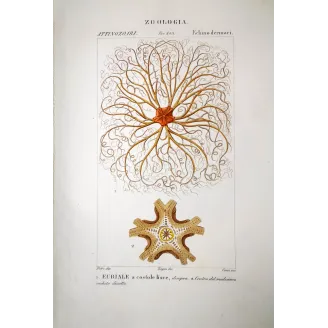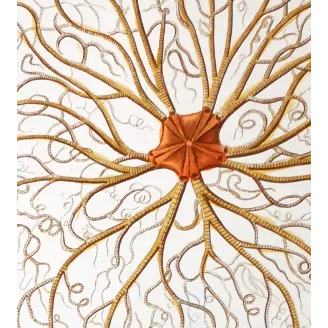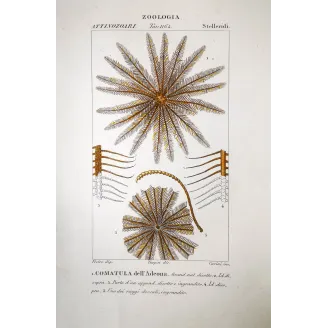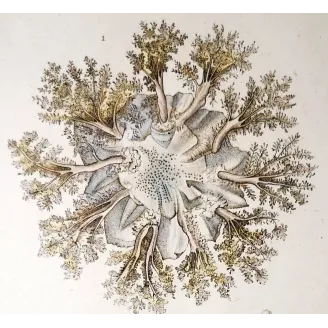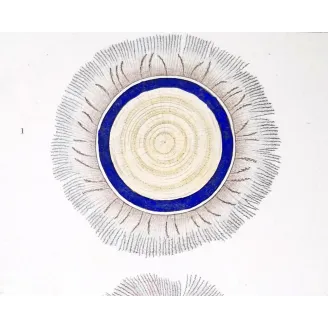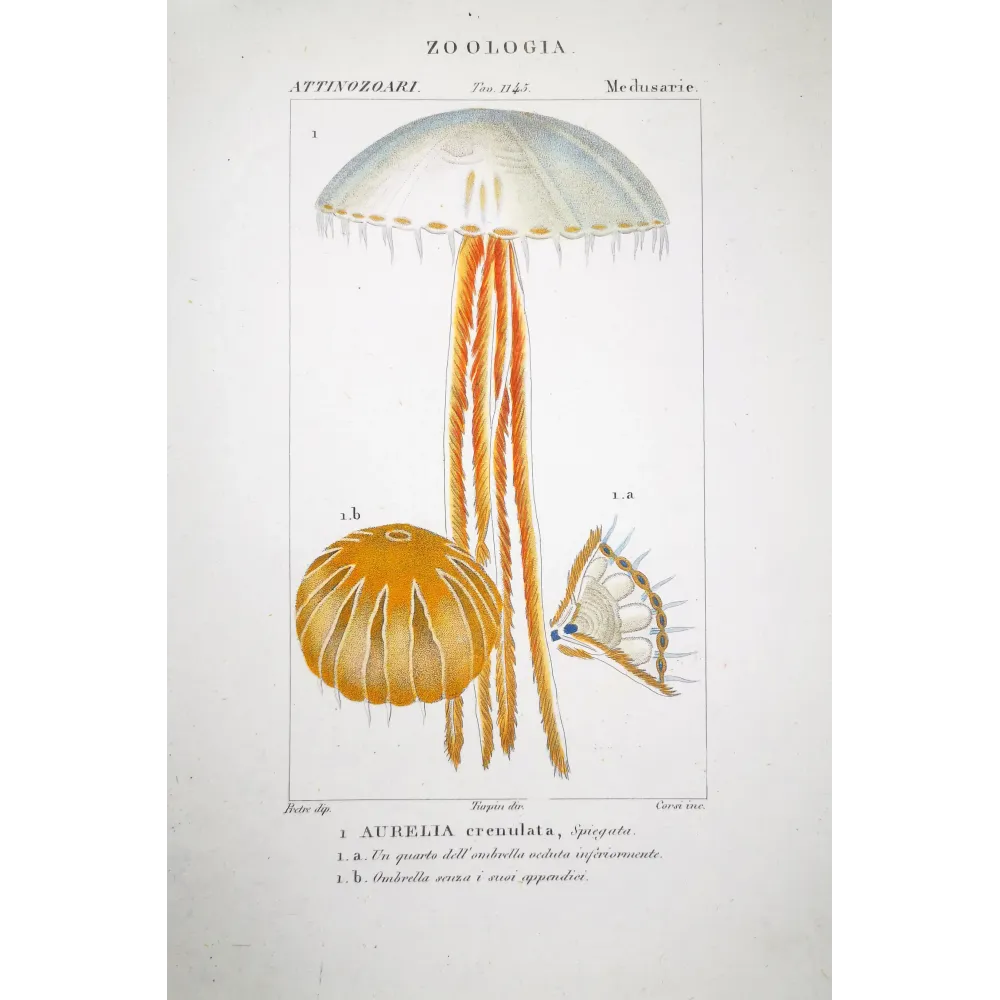
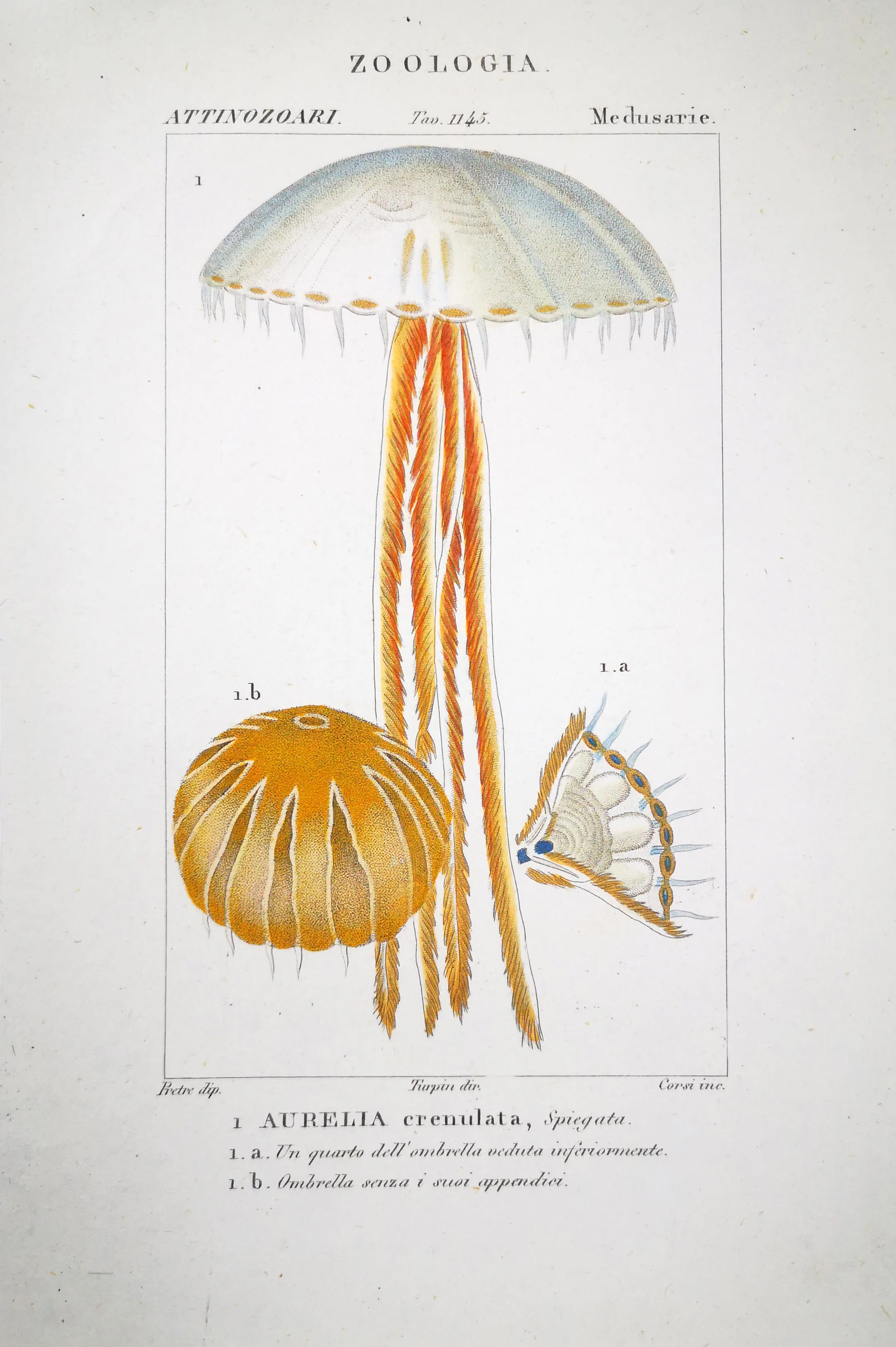
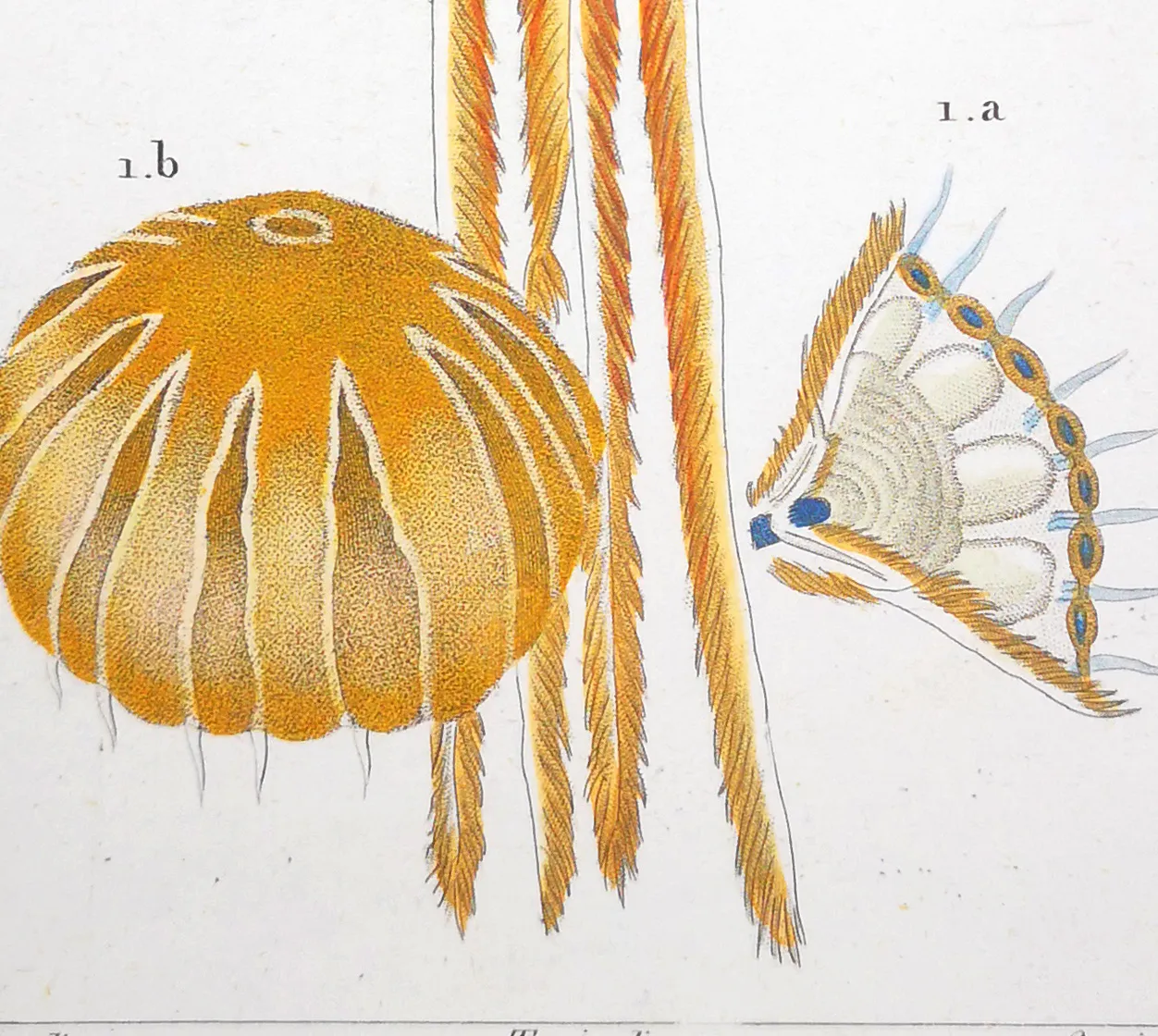
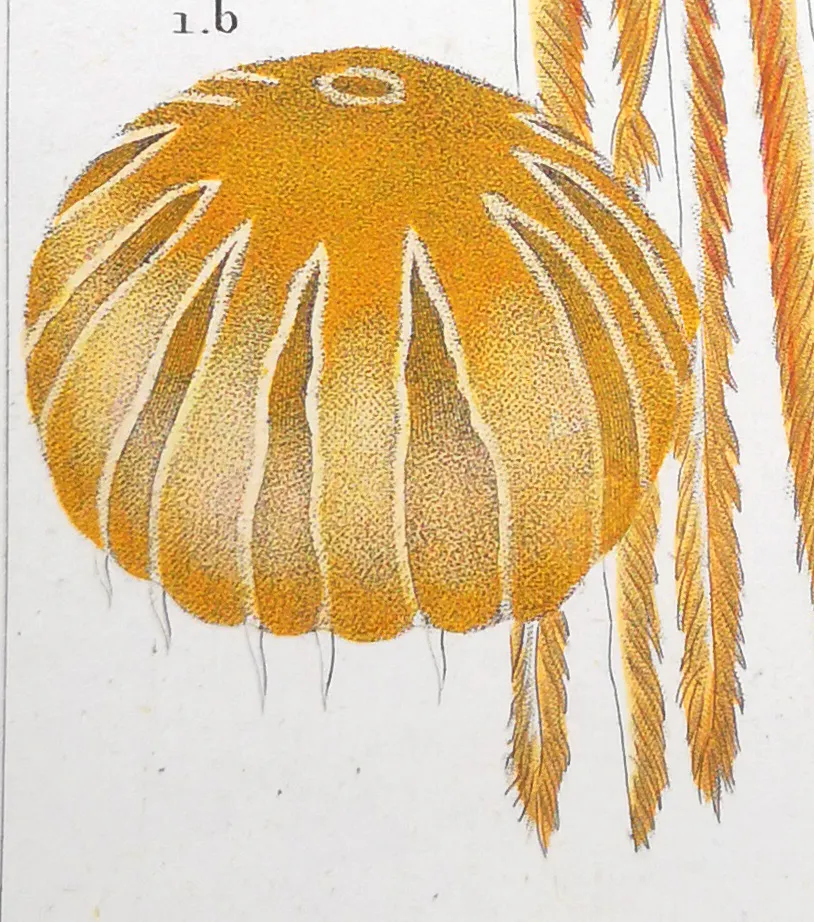
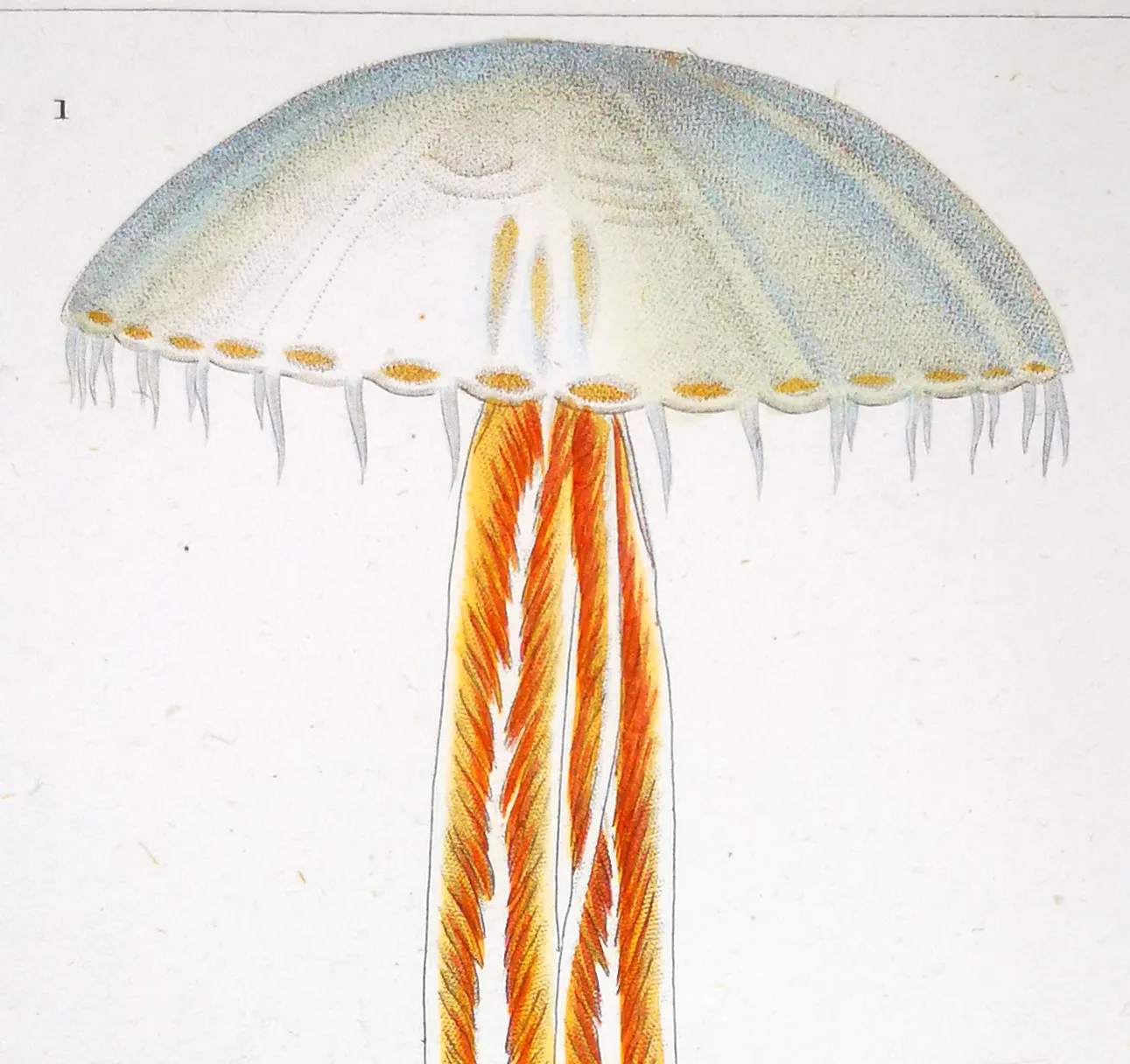
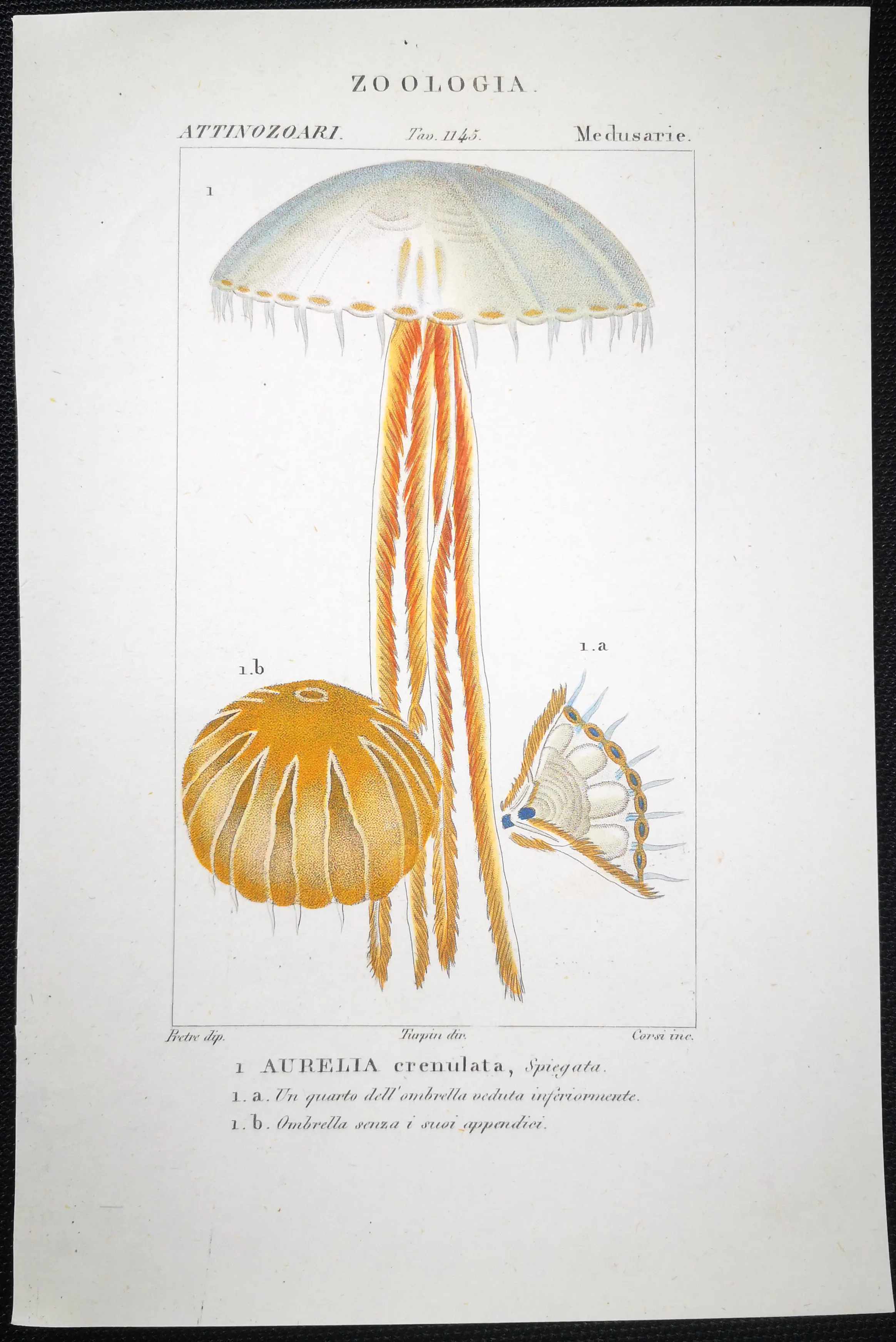
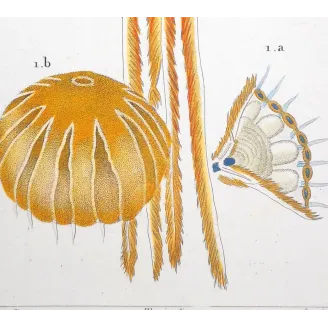
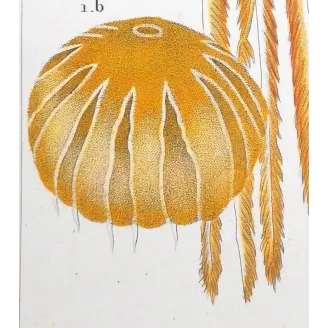
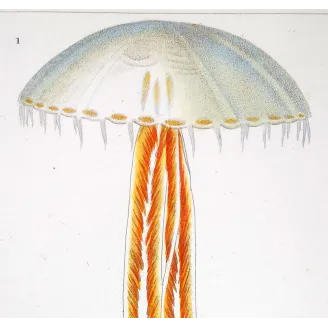
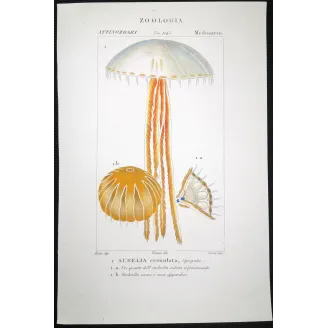
Hand-colored engraving of Aurelia crenulata, with detailed anatomical illustrations.
 Delivery policy
Your print will be carefully prepared and shipped worldwide via trusted couriers (UPS or similar).
 Authentic antique prints
Original engravings from the 17th–19th century.
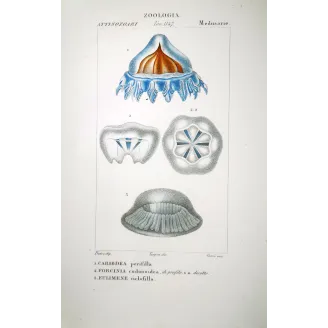
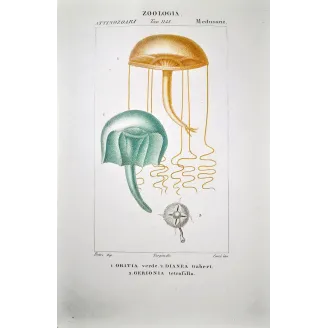
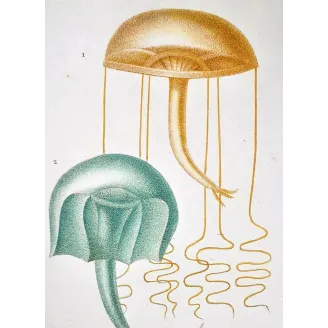
This early nineteenth-century engraving presents three distinct medusarian forms — Caribdea perifilla, Forcinia cudonoidea, and Eulimine ciclolilla — illustrated for the marine zoology section of the Dizionario di Scienze Naturali by Pierre Antoine Prêtre.
The plate juxtaposes elevated and sectional views, transforming biological observation into a study of marine geometry and structural symmetry.
— • —
Soft blue tonal gradations dominate the upper specimen, crowned by a warm amber interior that creates chromatic contrast. The lower sectional views emphasize radial order and translucent layering.
The disciplined arrangement of forms evokes architectural precision, making the engraving particularly appealing for interiors drawn to minimalist marine elegance.
Caribdea belongs to the box jellyfish group, recognized for their cubical bell shape and advanced sensory structures, including primitive visual organs — a rarity among gelatinous marine life.
The analytical cross-sections of Forcinia and Eulimine illustrate the growing nineteenth-century interest in comparative anatomy, particularly within gelatinous zooplankton.
Such engravings reflect a moment when marine biology expanded beyond surface observation into structural interpretation.
The Sacchetti edition of the Dizionario di Scienze Naturali represents one of the most ambitious illustrated scientific projects of its century.
Its medusarian plates document early attempts to classify some of the ocean’s most elusive organisms.
Nobility of Natural History Prints – The Sacchetti Collection
Excellent antique condition. Clean margins and well-balanced hand coloring. No watermark observed.
Discover more about Pierre Antoine Prêtre and his contribution to natural history illustration
Looking for: Caribdea engraving, antique cube jellyfish print, 19th-century marine zoology illustration, natural history sea life art.
Specific References
Hand-colored engraving of the moon jellyfish Aurelia labiata, drawn by Prêtre for a 19th-century zoological publication.
Three jellyfish species illustrated in fine hand-colored lithography by Prêtre.
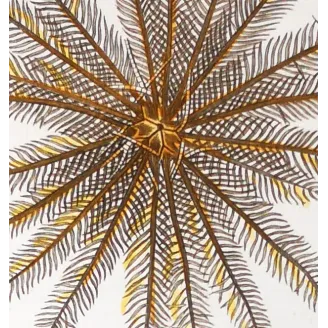
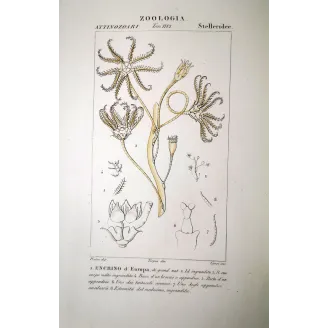
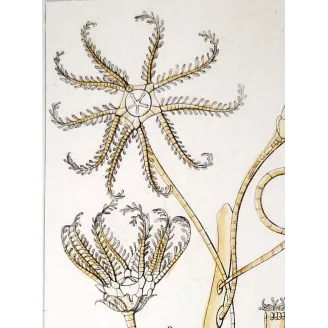
Antique engraving of a delicate feather star, vividly colored and highly detailed.
Rare 19th-century print of the feather star Comatula of the Adeona, with anatomical details.
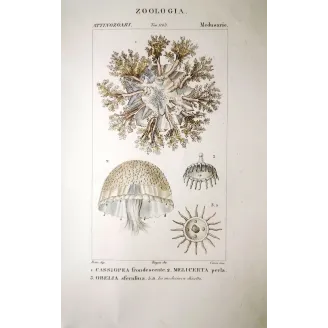
Scientific engraving of Cassiopea, Melicerta and Obelia jellyfish from the Dizionario di Scienze Naturali.
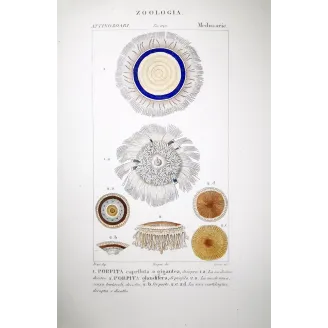
Antique illustration of the jellyfish Porpita capelluta and Porpita glandifera, from the Dizionario di Scienze Naturali.
Trio of rare jellyfish types in soft tones, hand-colored lithograph by Prêtre.
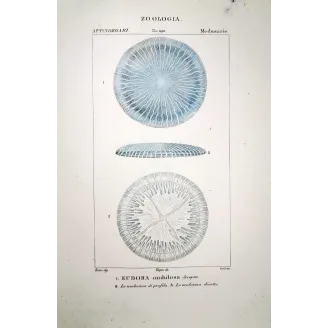
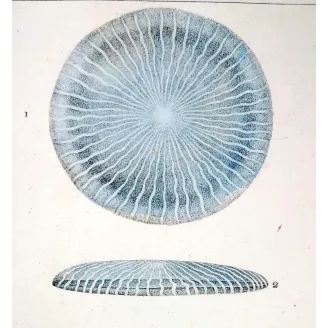
Delicate blue-toned depiction of Eudora ondulosa from three perspectives.
Elegant antique depiction of a crinoid with anatomical studies and fine detailing.
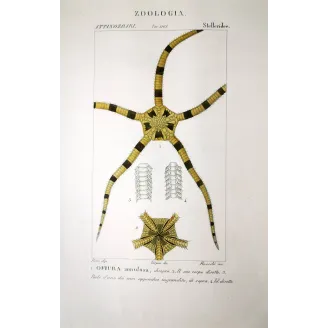
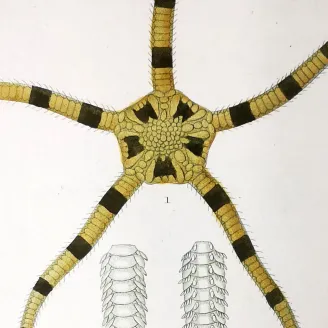
Antique print of Ophiura annulosa (brittle star) with anatomical details from a 19th-century zoological dictionary.
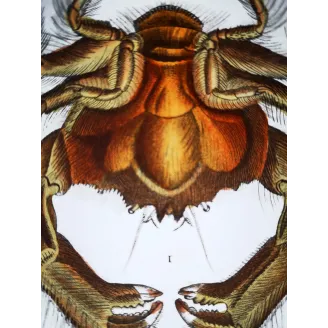
19th-century hand-colored engraving of *Dromia invadissima*, a rare crab with rich orange tones, illustrated by Prêtre with refined marine detail.
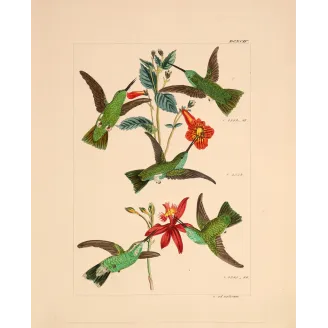
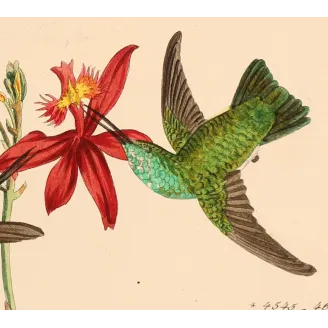
An exceptional original hand-colored engraving from Ludwig Reichenbach's Trochilinarum Enumeratio, depicting five brilliant hummingbirds feeding among scarlet tropical flowers. Featuring Esmeralda, Euchloris and Maculicollis, this dynamic nineteenth-century composition beautifully combines botanical richness with the elegance of Victorian ornithological illustration.
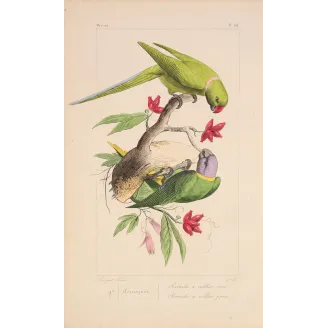
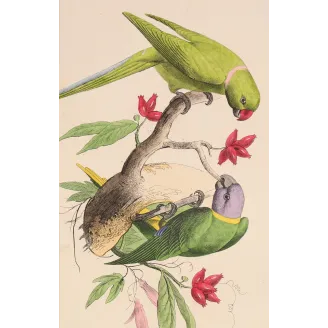
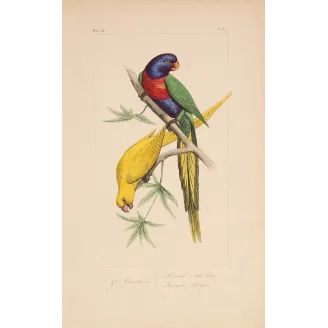
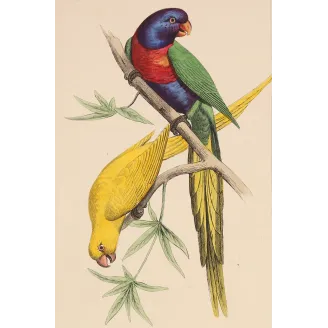
Vivid 19th-century hand-colored engraving depicting two parakeets in dynamic interaction, with striking green plumage and contrasting red and violet accents. A highly decorative exotic bird composition.
A striking 19th-century engraving depicting two vividly colored parakeets in a dynamic composition. The intense contrast of blue, red, green and yellow creates a highly decorative work, ideal as a focal piece in refined interiors.
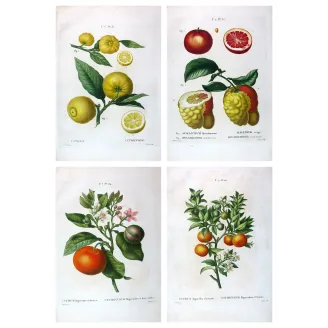
A coherent ensemble of eight original orange and bigarade engravings by Pancrace Bessa, reflecting the cultivated discipline of French orangeries in the Napoleonic era. Botanical precision and architectural composure unite in a refined citrus portfolio preserved as a complete series.
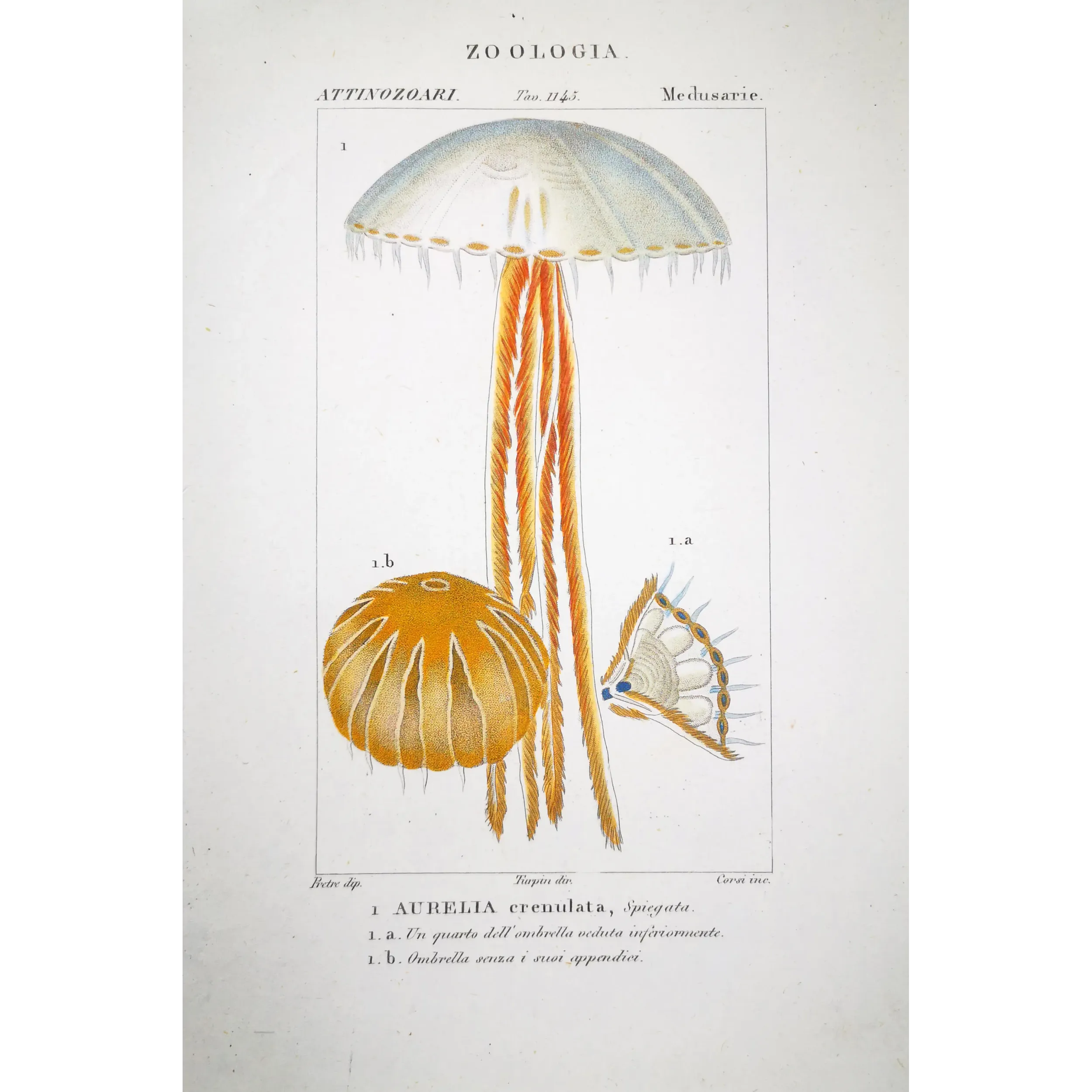
Hand-colored engraving of Aurelia crenulata, with detailed anatomical illustrations.