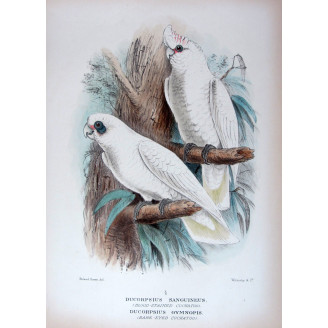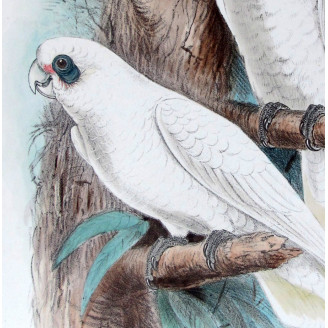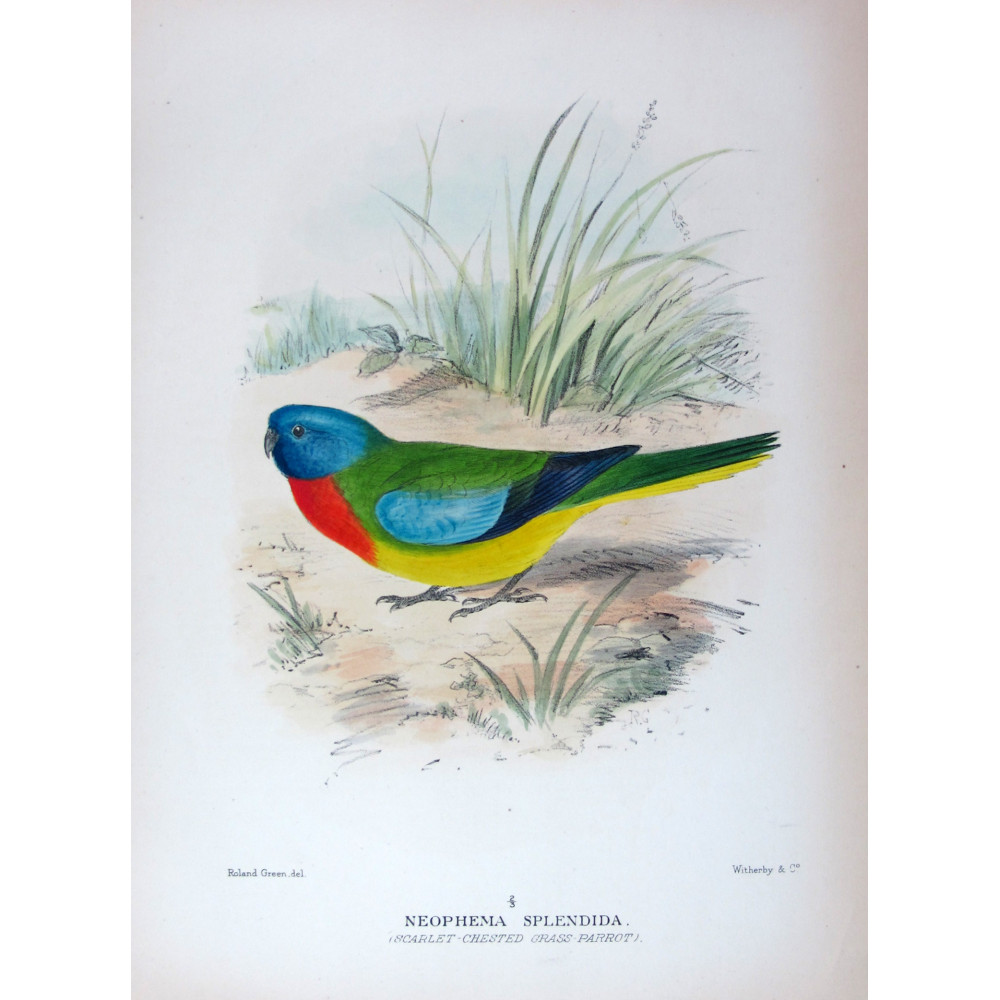
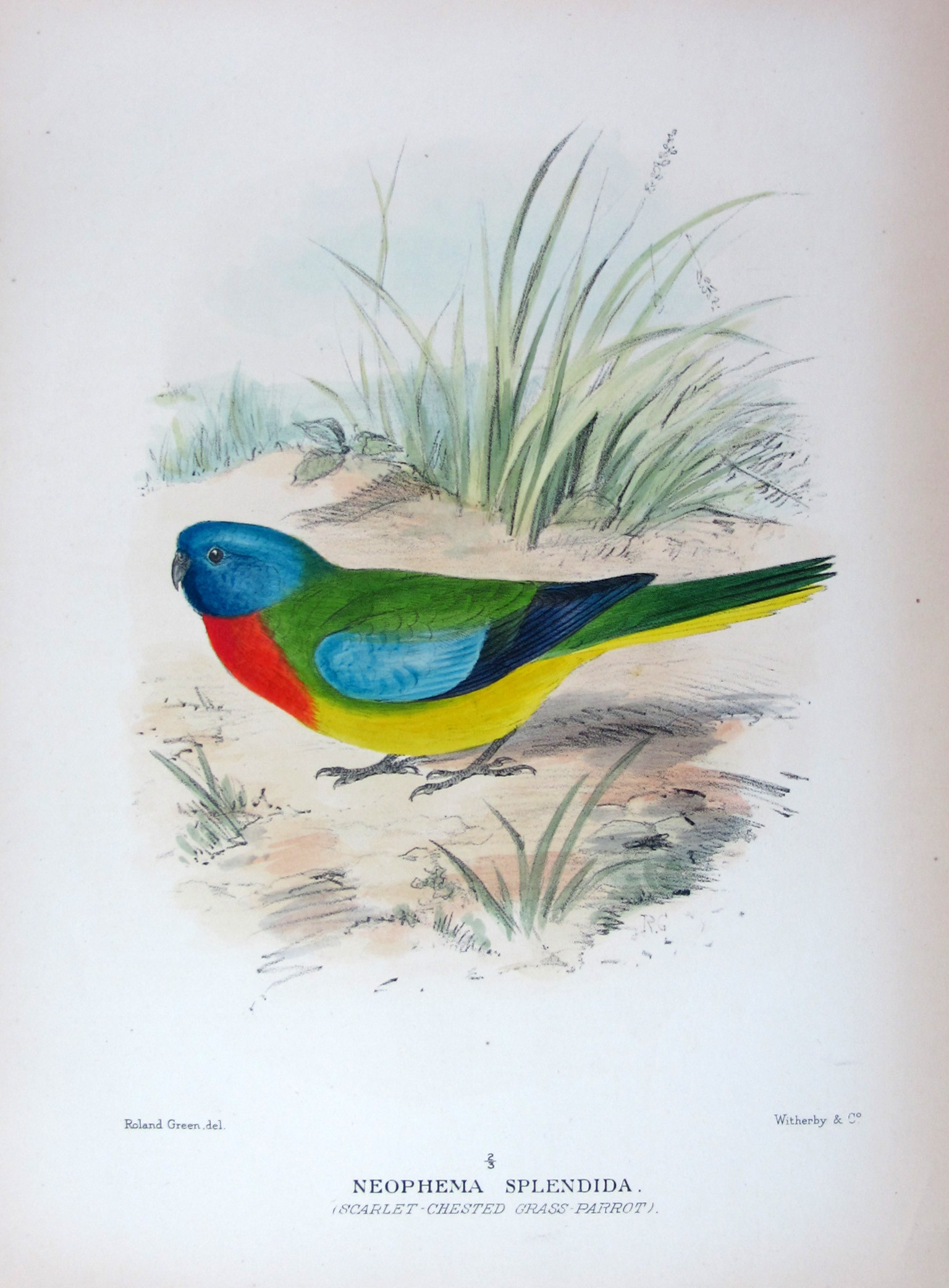
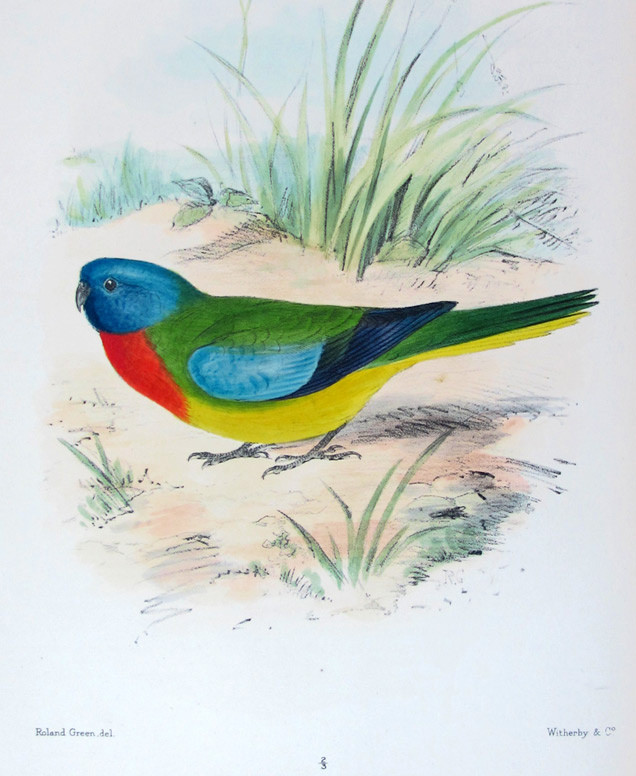
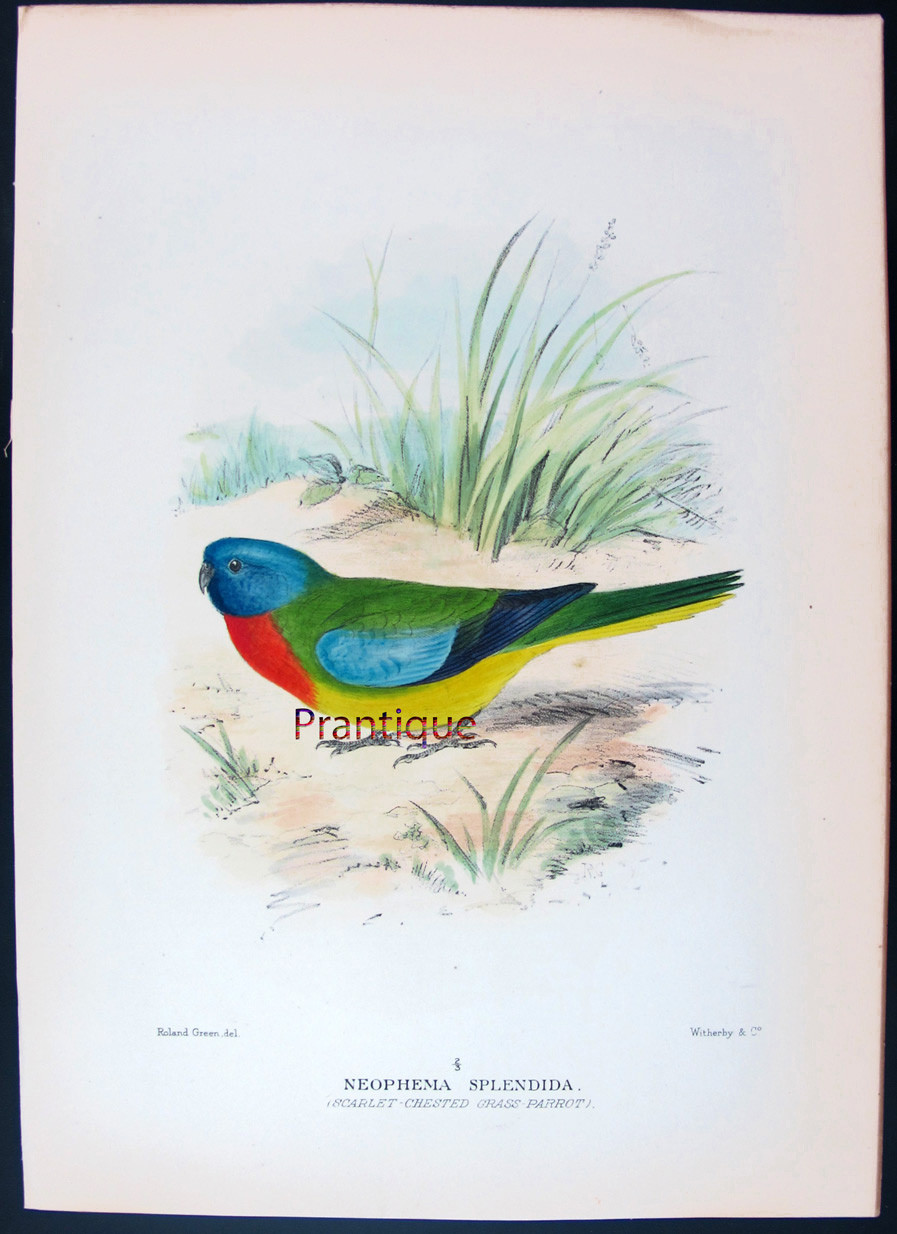

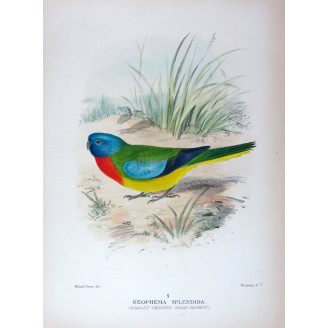
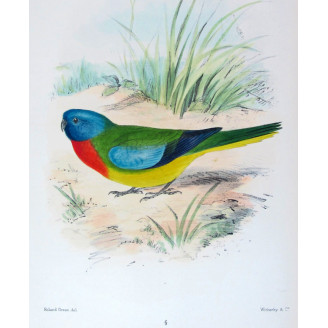
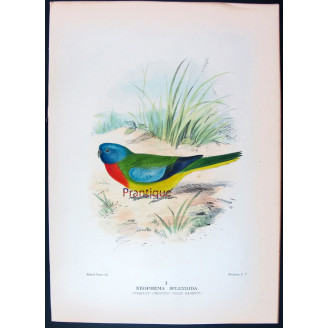
Antique lithograph of the Scarlet-chested Grass Parrot by Roland Green.
 Delivery policy
Your print will be carefully prepared and shipped worldwide via trusted couriers (UPS or similar).
 Authentic antique prints
Original engravings from the 17th–19th century.
This original early twentieth-century hand-colored lithograph depicts Neonanodes petrophilus, titled on the plate as the Western Rock-Parrot. The sheet forms part of Gregory M. Mathews’ monumental publication The Birds of Australia, illustrated by Roland Green and issued by Witherby & Co.
Set against a spare coastal landscape of rock and water, the parrot appears not as a decorative emblem on a branch, but as a true inhabitant of place—an image defined by atmosphere, restraint, and the quiet geometry of shoreline forms.
— • —
Roland Green constructs the plate around tonal harmony rather than high contrast. The bird’s olive-green plumage is subtly modelled with fine feather texture, while cool blue panels along the wing and tail echo the sea tones behind. This repetition of blue across subject and setting creates a coherent chromatic architecture that feels calm and modern.
The rocks are rendered with restrained graphite-like shading, providing weight and structure without visual clutter. Beneath, the water is treated in broken, luminous strokes—enough to suggest movement and salt air, yet kept deliberately understated so the parrot remains the clear focal point.
The Western Rock-Parrot is associated with coastal and offshore environments in southern and western Australia, often linked to rocky shorelines and nearby islands. Its habitat specificity makes it an especially evocative subject within Australian ornithology, where place and ecology are inseparable from identification.
In Mathews’ early twentieth-century survey, plates like this extend beyond taxonomy: they preserve a sense of landscape and ecological character, revealing how natural history illustration could document not only species, but the world it belongs to.
This lithograph originates from The Birds of Australia, Gregory M. Mathews’ ambitious early twentieth-century ornithological enterprise. Conceived as a definitive scientific record, the work united rigorous taxonomy with the refined artistry of leading wildlife illustrators, producing one of the most authoritative visual catalogues of Australian birdlife. Explore the broader historical scope in our editorial feature: Gregory M. Mathews and The Birds of Australia .
Within the series, habitat-driven plates such as this offer a distinctive register—less about spectacle, more about atmosphere—capturing the poetic relationship between species and landscape.
Very good antique condition. Fresh original hand-coloring with strong lithographic impression. Printed on fine early twentieth-century wove paper. Minor age toning slightly more visible along the outer margins, consistent with age.
For further insight into Roland Green’s contribution to ornithological illustration: Roland Green – Dynamic Vision and Field-Born Precision in Bird Art
Specific References
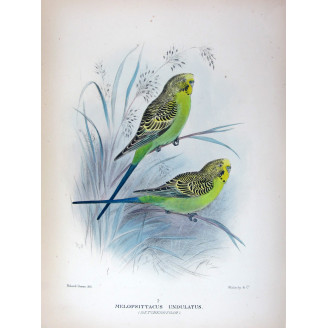
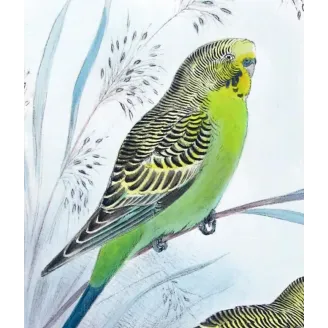
Original lithograph of the Budgerigar (Melopsittacus undulatus) by Roland Green.
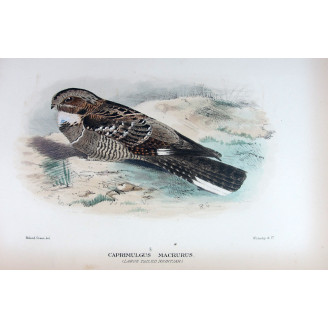
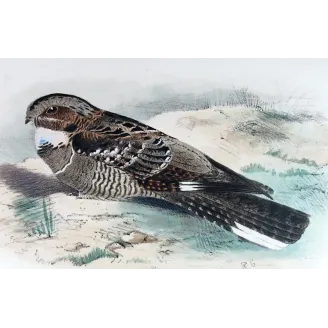
Original lithograph of the Large-tailed Nightjar by Roland Green from Mathews' Birds of Australia.
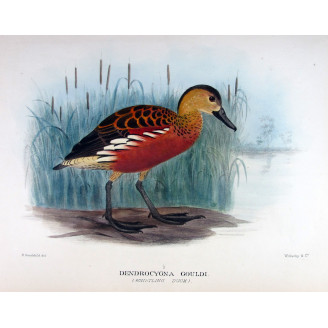
Original lithograph of the Whistling Duck by H. Goodchild (Dendrocygna gouldi).
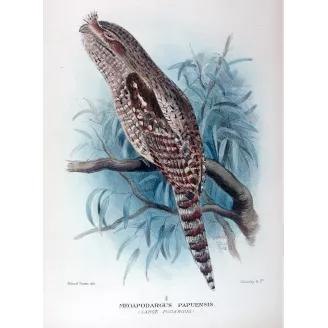
Original lithograph of the Large Podargus by Roland Green from Mathews' Birds of Australia.
White-breasted Cormorant from Mathews' Birds of Australia, drawn by Grönvold.
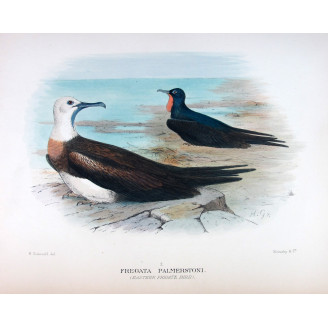
Eastern Frigate Bird from Mathews' Birds of Australia, drawn by Grönvold.
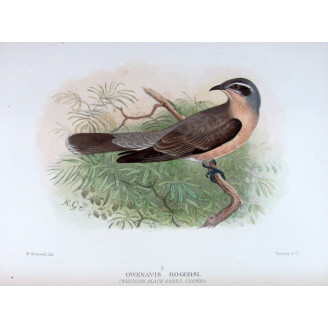
Western Black-eared Cuckoo (Owenavis rogersi) – Original lithograph by Henrik Grønvold.
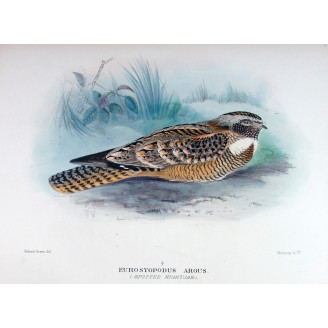
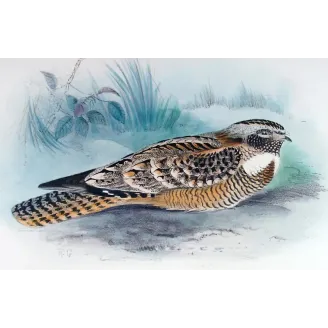
Original lithograph of the Spotted Nightjar by Roland Green from Mathews' Birds of Australia.
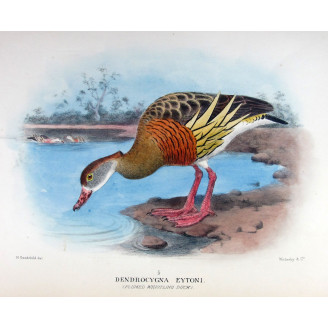
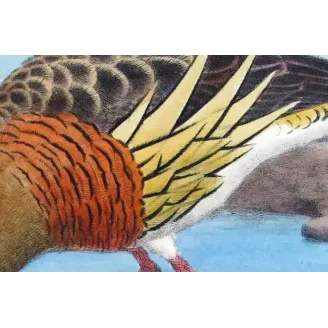
Original lithograph of the Plumed Whistling Duck by H. Goodchild (Dendrocygna eytoni).
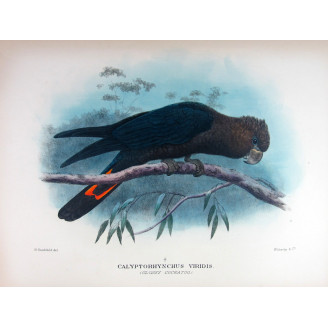
Glossy Cockatoo print by H. Goodchild, dark tones and rare presence on the plate
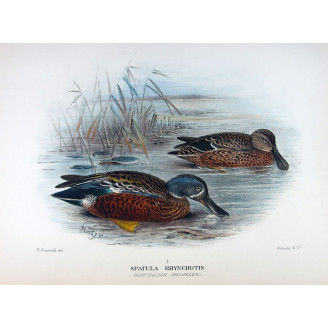
Australian Shoveler (Spatula rhynchotis) – Original antique bird print by H. Grønvold.
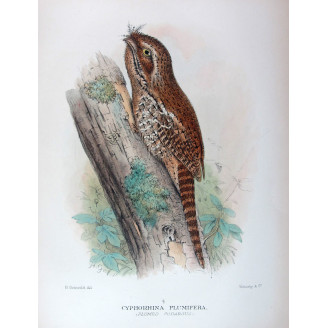
Original lithograph of the Plumed Podargus by H. Grönvold from Mathews' Birds of Australia.
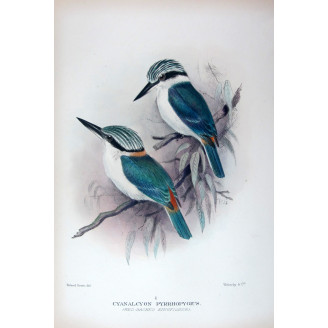
Original lithograph of the Red-backed Kingfisher (Cyanalcyon pyrrhopygus) by Roland Green
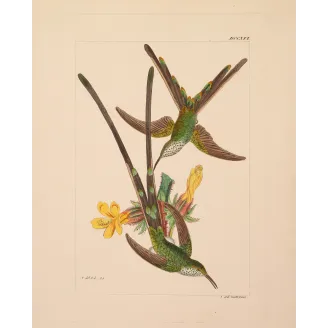
Original nineteenth-century hand-colored engraving depicting the Green-tailed Trainbearer (Lesbia bifurcata), one of Ludwig Reichenbach’s most elegant hummingbird compositions from Trochilinarum Enumeratio.
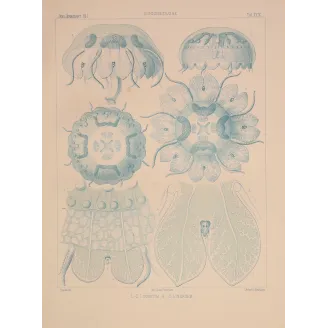
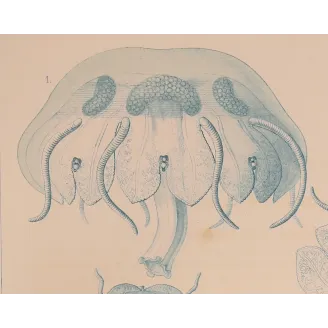
Original 1879 lithograph from Ernst Haeckel's Das System der Medusen, depicting Linantha and Linerges jellyfish in a refined pale-blue palette. A striking combination of scientific precision, marine symmetry and decorative elegance.
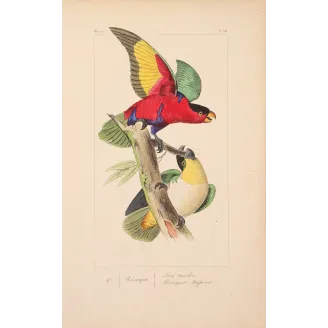
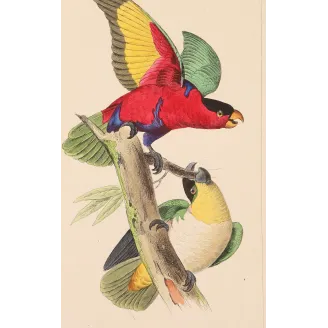
A highly dynamic 19th-century engraving depicting a tricolour lory in flight above a contrasting parakeet. The vivid interplay of red, yellow, green and blue creates a striking decorative composition with exceptional visual energy and presence.
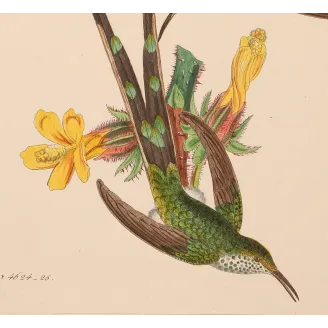
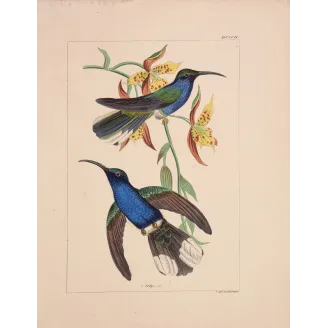
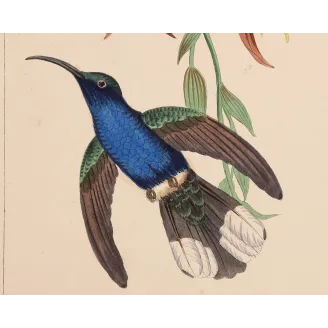
Original 19th-century hummingbird engraving depicting Cuvier’s Sabrewing (*Campylopterus cuvierii*), published by Ludwig Reichenbach for *Trochilinarum Enumeratio*. A refined composition marked *ad naturam* — drawn from life — combining scientific observation with remarkable decorative elegance.
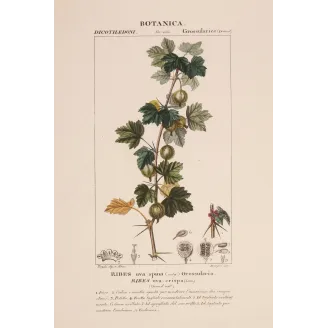
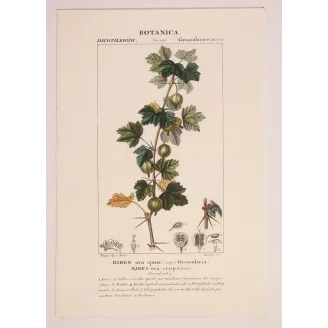
A charming depiction of *Ribes uva-crispa*, the gooseberry plant, detailed with its spiny stems and translucent green fruits.
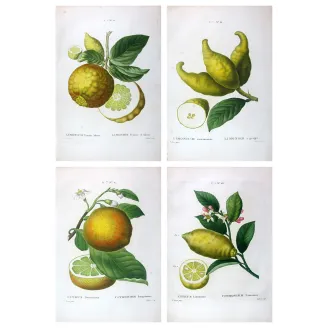
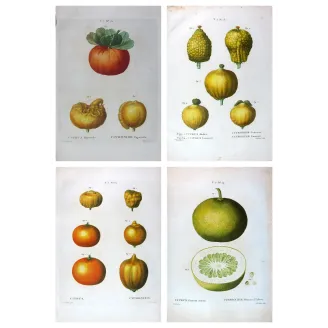
Nine original citrus engravings by Pancrace Bessa, uniting rare cedrats, sculptural lemons, and monumental Pomme d’Adam varieties into a coherent Napoleonic-era ensemble. Botanical study and refined color harmonize in a portfolio conceived to be read as a whole.
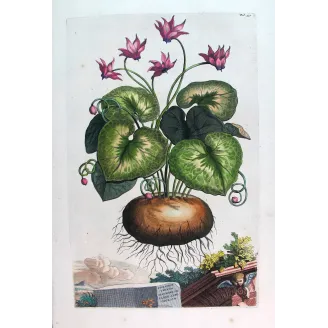
A rare 17th-century botanical engraving from Abraham Munting’s Nauwkeurige Beschryving der Aardgewassen - Phytographia Curiosa, depicting a cyclamen plant with exposed tuber, delicate pink flowers and richly patterned leaves. An expressive example of early botanical art combining scientific curiosity with striking decorative presence.
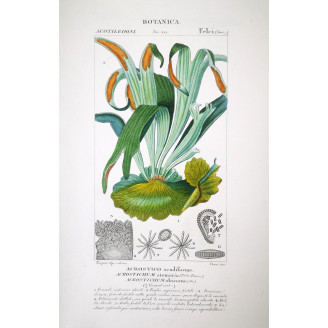
A complete set of 22 original hand-colored Engravings of ferns by Turpin, from the Dizionario di Scienze Naturali (c. 1830).
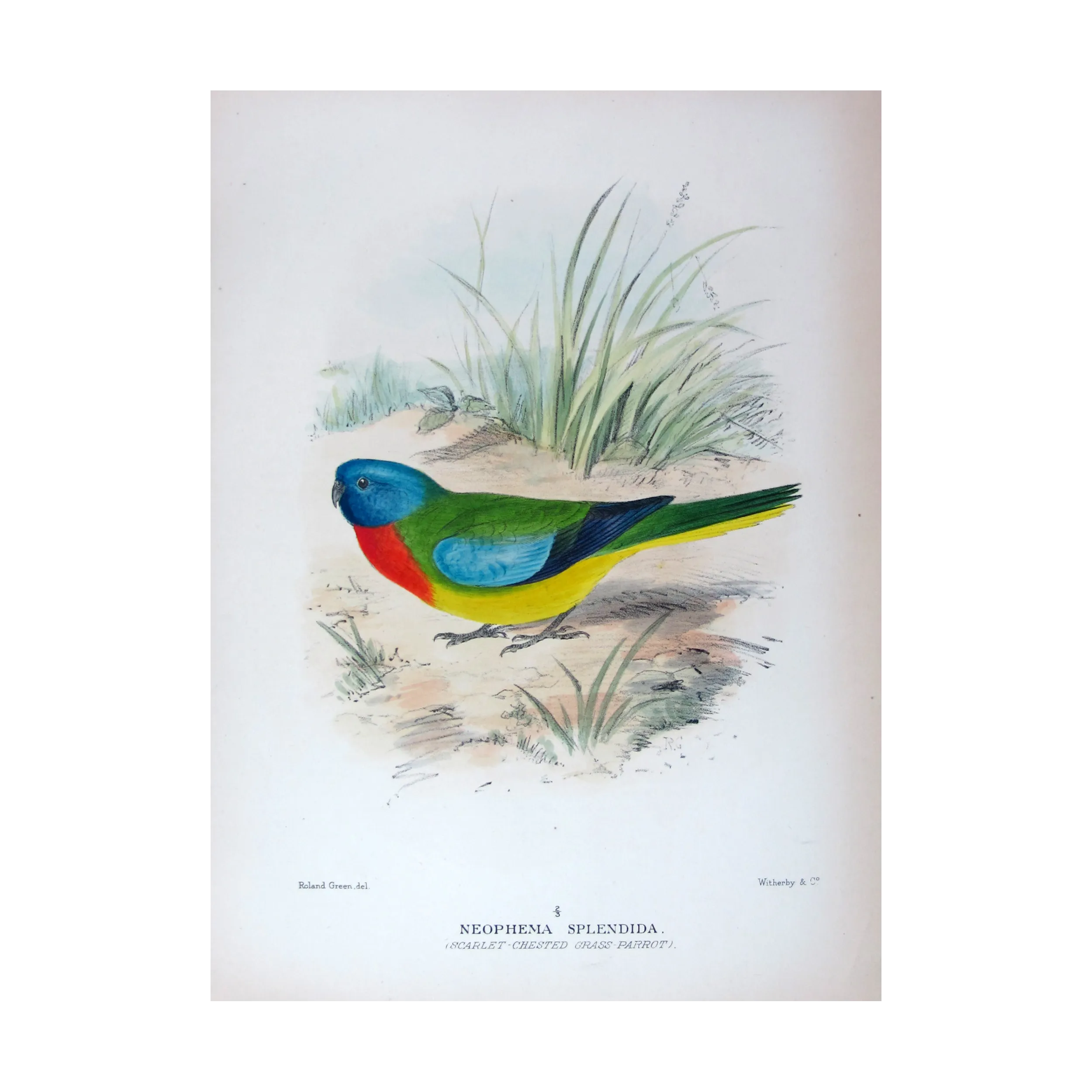
Antique lithograph of the Scarlet-chested Grass Parrot by Roland Green.