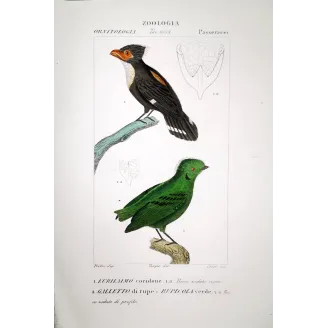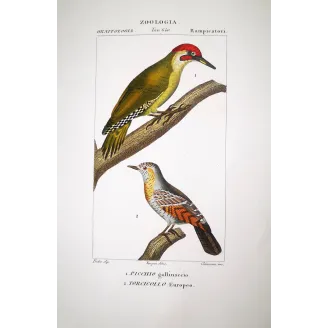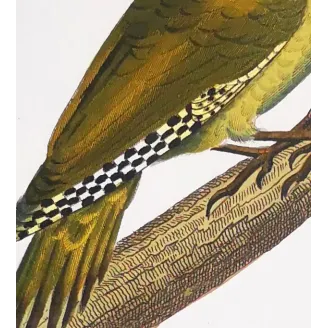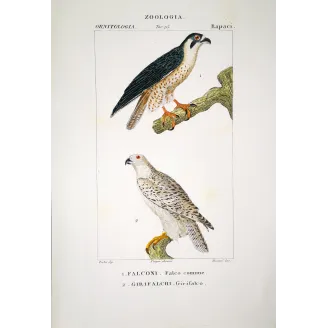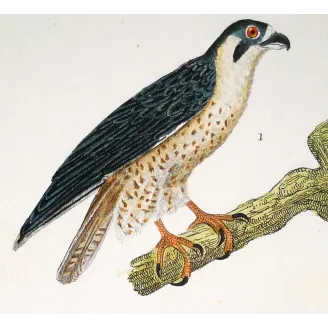




Vividly colored engraving of a European Green Woodpecker and a Eurasian Wryneck, masterfully rendered by Prêtre.
 Delivery policy
Your print will be carefully prepared and shipped worldwide via trusted couriers (UPS or similar).
 Authentic antique prints
Original engravings from the 17th–19th century.
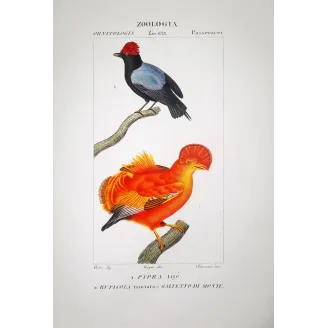
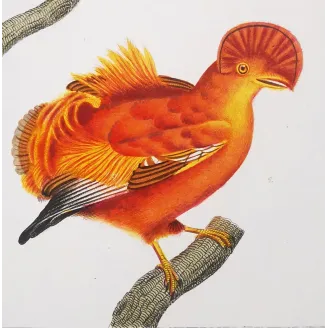
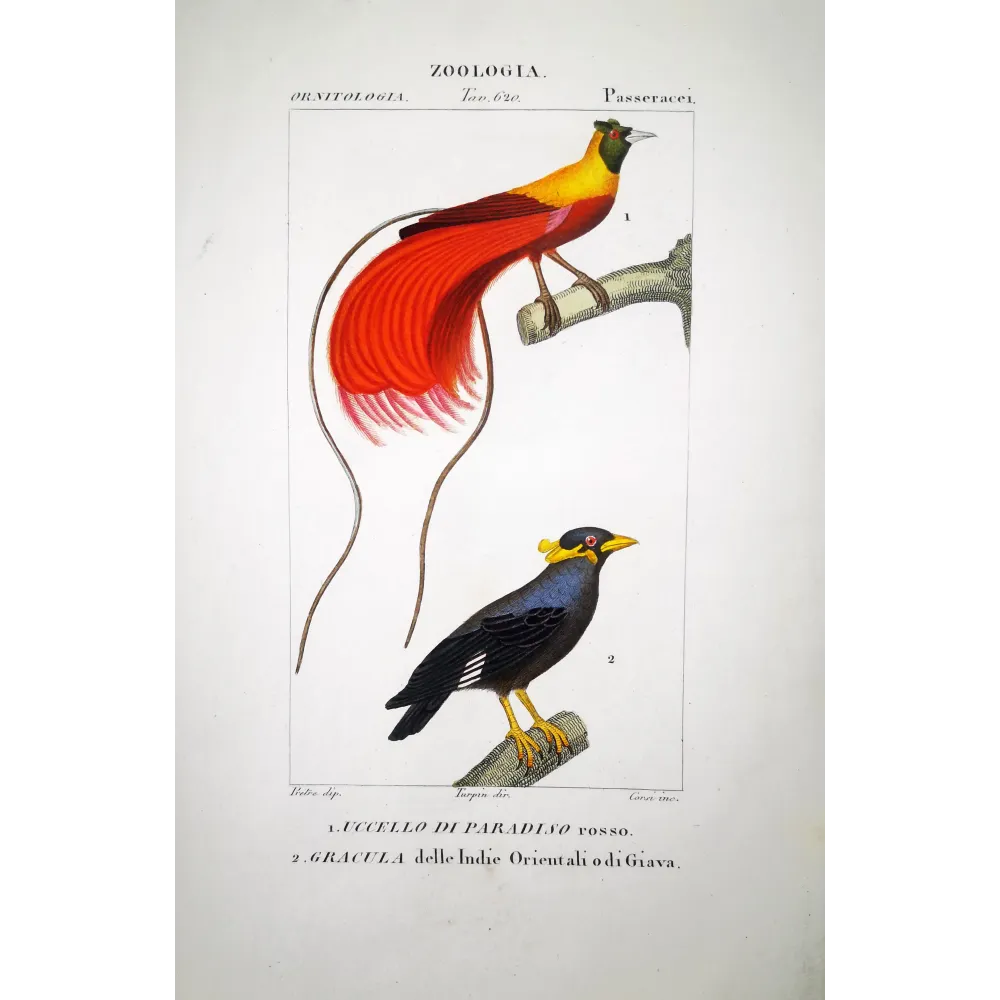
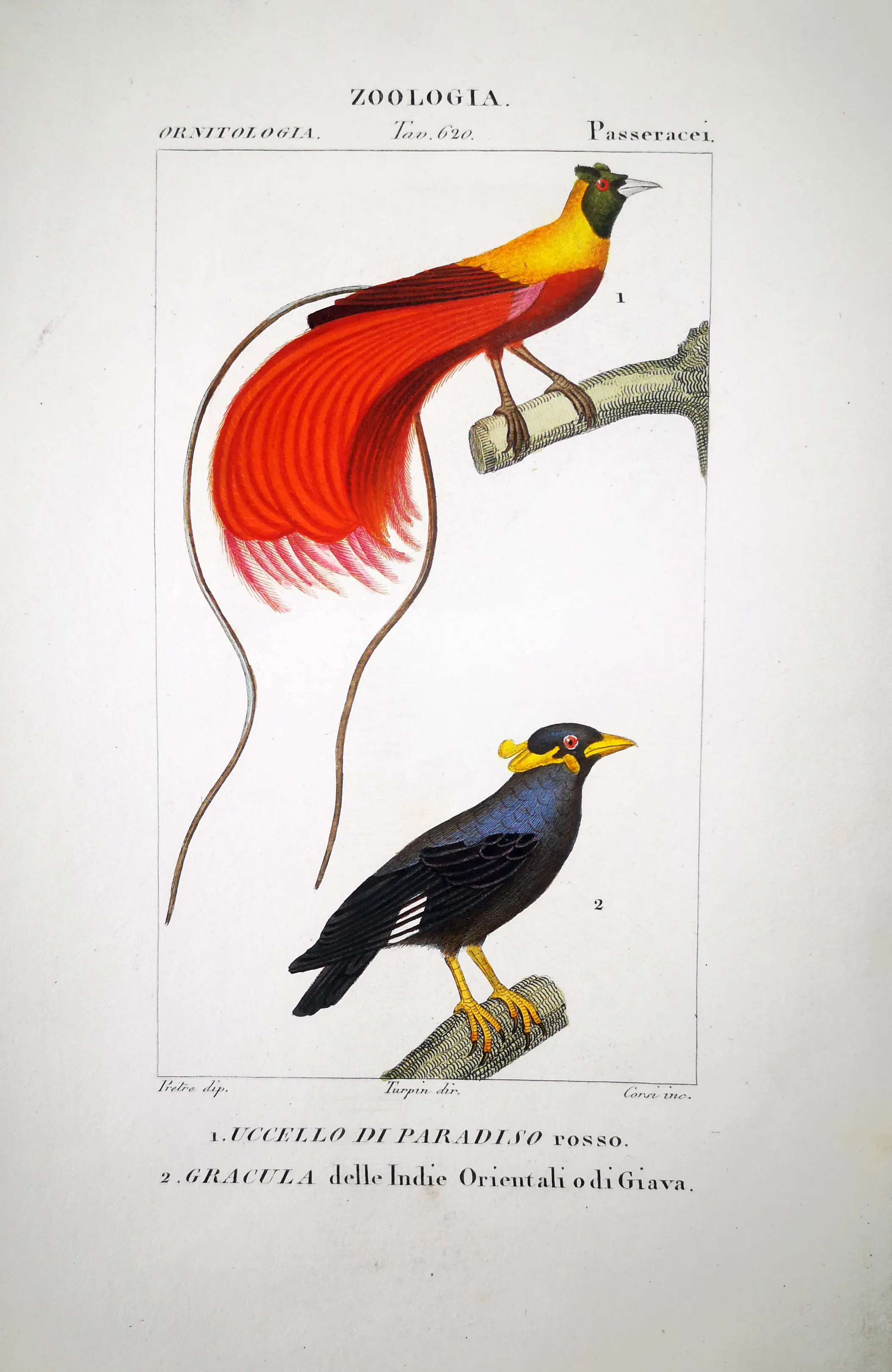
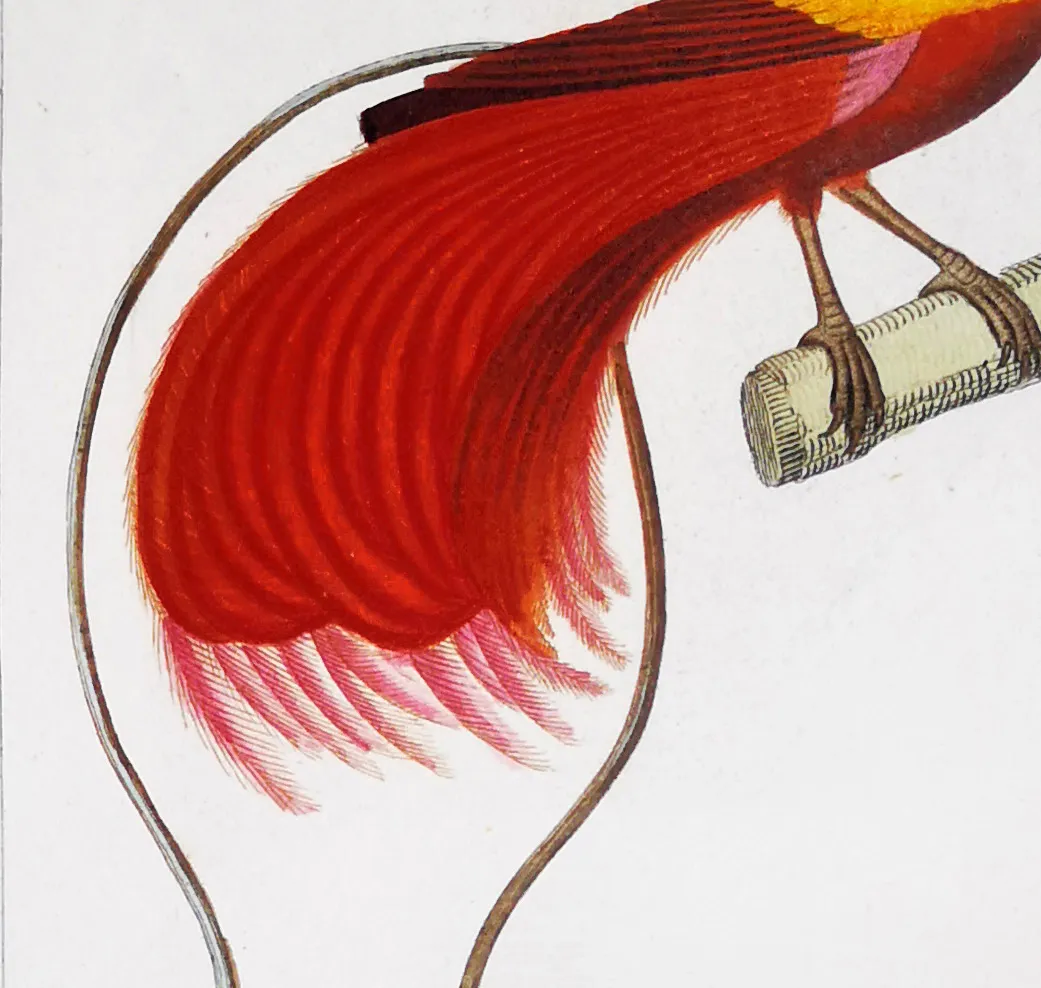
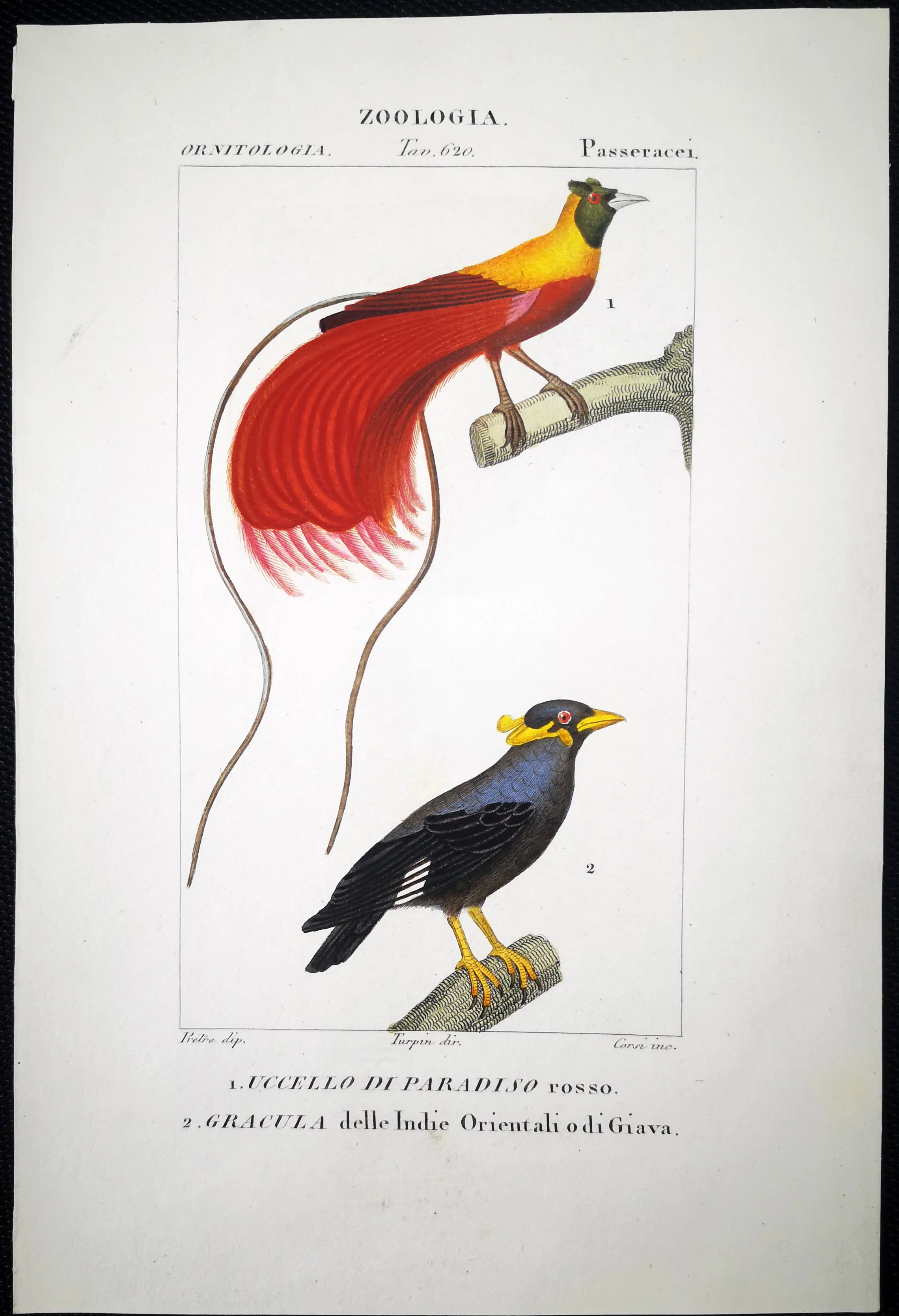
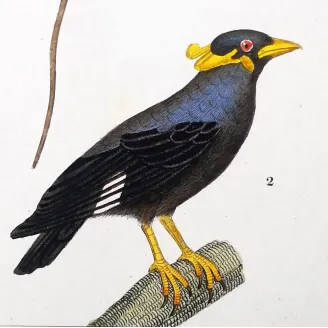
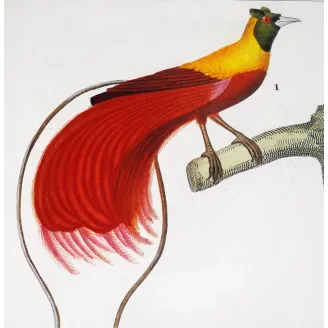
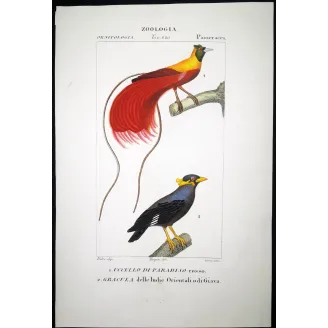
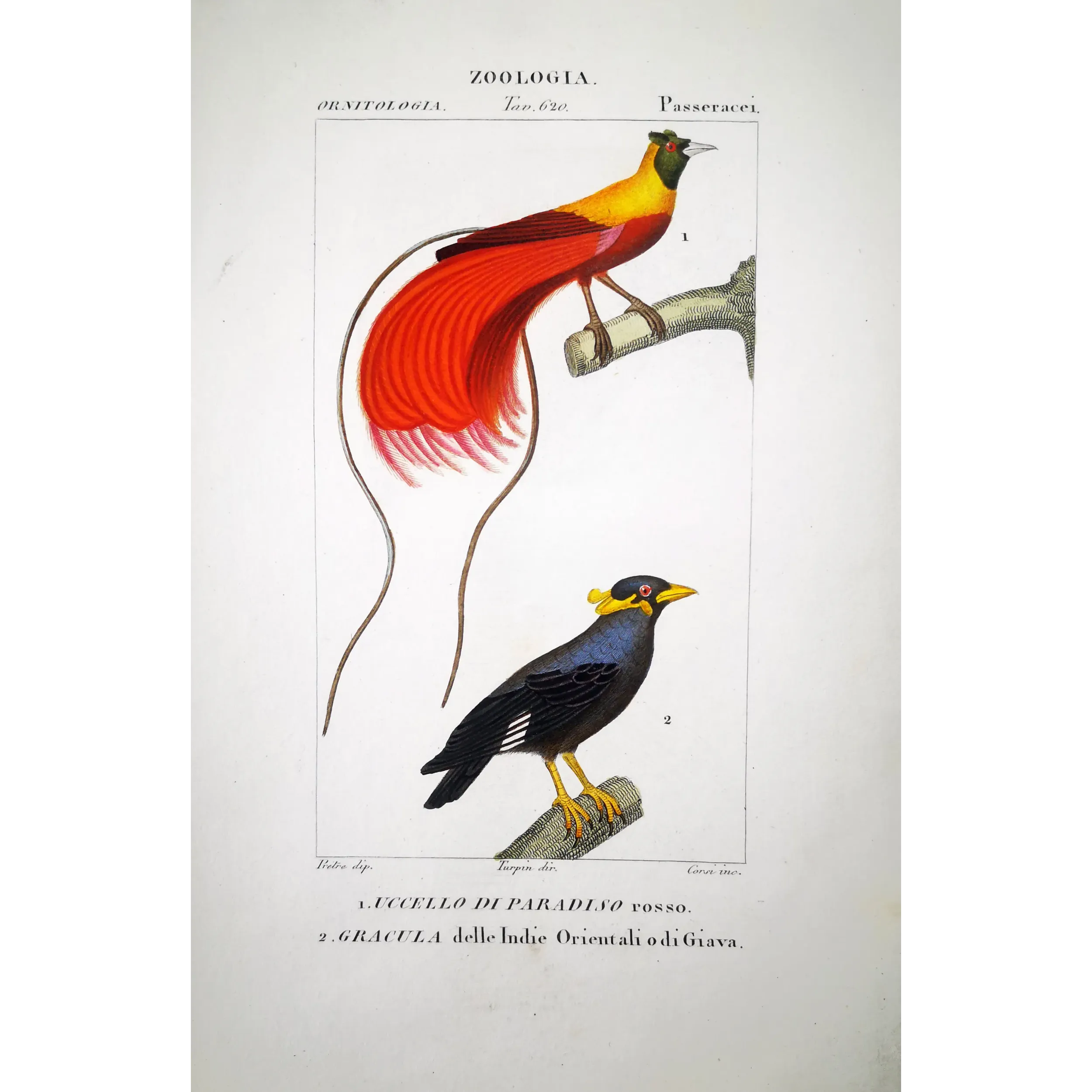
This dramatic ornithological engraving presents two striking tropical species: the “Uccello di Paradiso rosso” (Red Bird of Paradise) and the “Gracula delle Indie Orientali o di Giava” (Javan Myna). Conceived within the ornithological section of the Dizionario di Scienze Naturali, the composition juxtaposes ornamental extravagance with structural restraint, offering a compelling visual dialogue between spectacle and solidity.
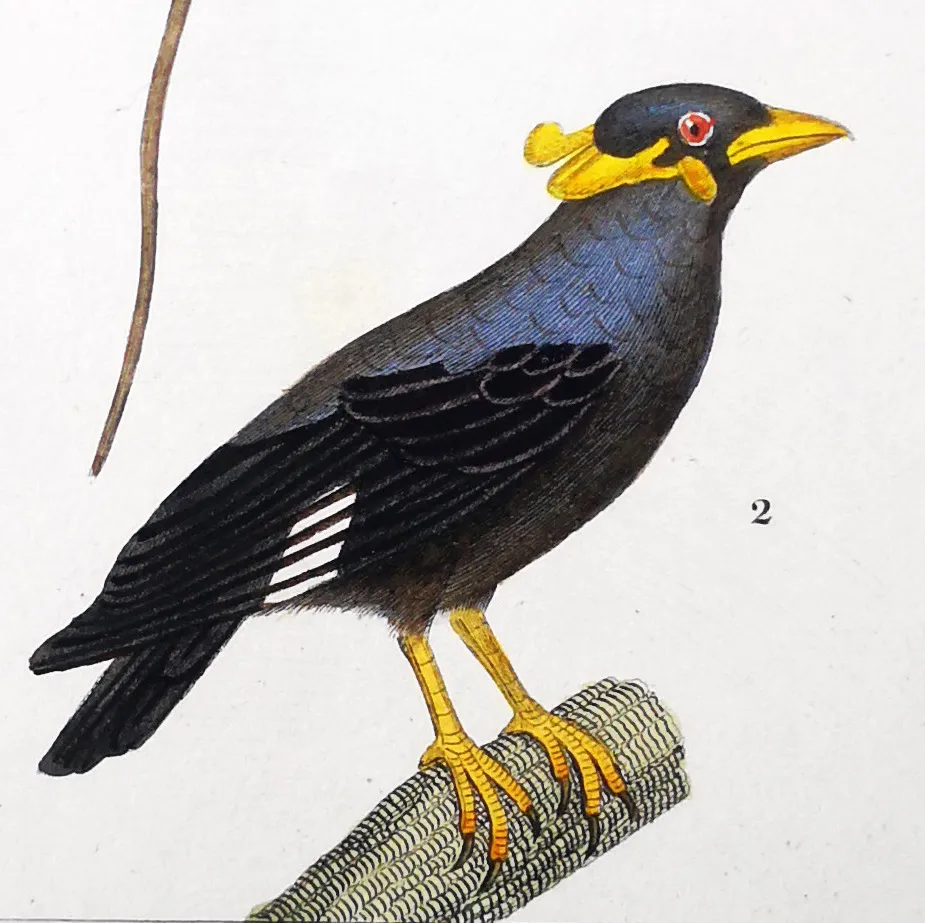
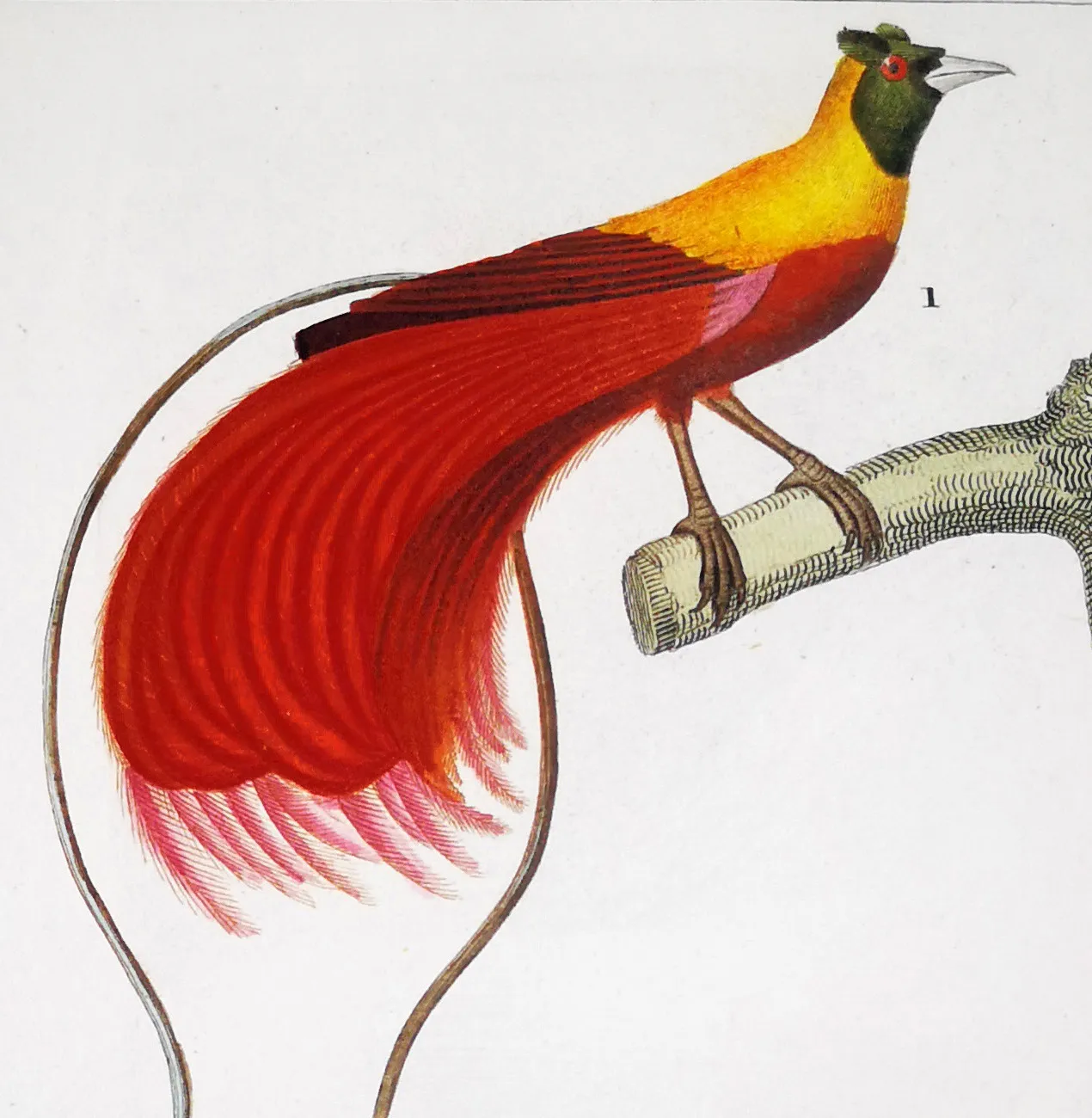
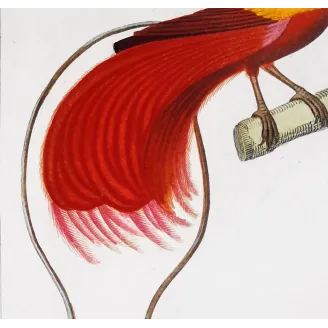
The upper figure dominates the plate with sweeping crimson flank plumes and elongated filamentous tail wires—forms that transform the bird into a sculptural presence. Below, the darker Gracula anchors the composition with compact mass, glossy plumage, and vivid yellow facial ornamentation, restoring chromatic balance and compositional stability.
— • —
The plate is structured around vertical drama. The Bird of Paradise—likely corresponding to forms within the genus Paradisaea—is rendered with extraordinary linear elegance. The cascading red plumes create rhythmic curvature, while the fine tail filaments extend downward like calligraphic strokes against the pale ground. The yellow collar and dark head introduce contrast without interrupting the chromatic authority of the red body.
In contrast, the Gracula (family Sturnidae) presents a compact, almost architectural silhouette. Its deep bluish-black plumage absorbs light, allowing the yellow facial wattles and beak to punctuate the lower register. Together, the two birds establish a refined compositional balance: exuberance above, composure below. The result is both scientifically legible and decoratively powerful.
Birds of Paradise (Paradisaea and related genera) became emblematic of exotic natural history in eighteenth- and nineteenth-century Europe. Their elongated flank plumes and ornamental tail structures fascinated collectors and naturalists alike, symbolizing distant tropical landscapes and the expanding geographical horizons of scientific inquiry.
The Gracula, often associated with the myna group, represents a different but equally compelling branch of passerine diversity. Native to parts of South and Southeast Asia, these birds were admired for their glossy plumage and distinctive facial skin ornamentation. By pairing these two species, the plate exemplifies the encyclopedic method: contrast, comparison, and clarity within a unified visual field.
This engraving forms part of the historic Dizionario di Scienze Naturali, a monumental early nineteenth-century encyclopedic enterprise once preserved within a noble library and today housed in the Sacchetti Collection. Each plate reflects a period in which scientific ambition was matched by exceptional artisanal execution — from disciplined copperplate linework to luminous hand-applied color.
These works are not merely zoological documents, but refined syntheses of scholarship and craftsmanship. To discover the full story behind these rare prints and their noble provenance, we invite you to read our editorial feature “Not Just Another Print”.
The engraving is in very good to excellent antique condition. The impression remains clear and well-defined, with carefully preserved original hand-coloring. The paper is smooth early nineteenth-century wove paper (non-laid), consistent with Italian scientific editions of the period. No watermark has been observed. Minor age toning, if present, is consistent with antique paper and does not detract from the visual impact.
For further context on Pierre Antoine Prêtre and his contribution to nineteenth-century zoological illustration, see our editorial feature:
Pierre Antoine Prêtre – Illustrator of Natural Science and Marine Life
Specific References
Charming illustration of two aquatic birds with accurate anatomical and marine details.
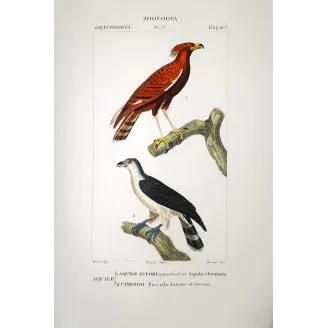
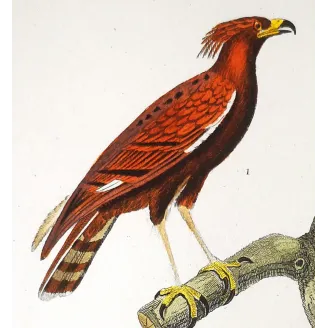
A lively contrast between a fiery red hawk-eagle and a smaller black-and-white goshawk.
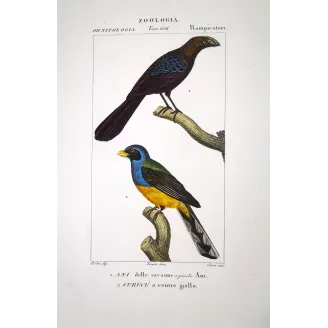
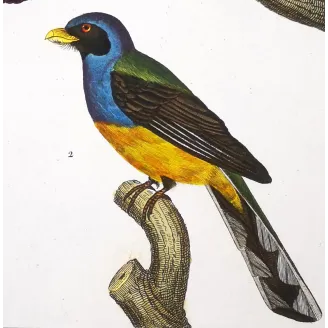
Colorful engraving of two exotic birds: the Ani and the vibrant Yellow-bellied Curuçu.
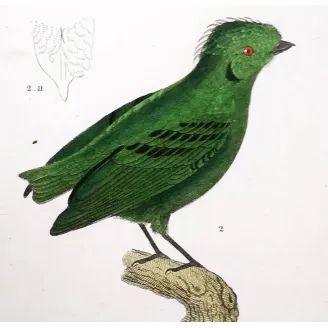
Rare birds of the jungle: the crest-faced Corydon and a luminous green Rupicola.
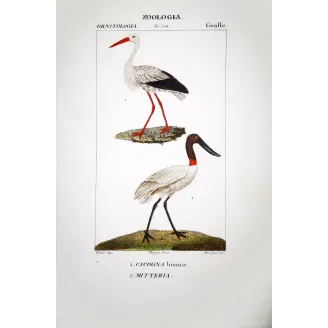
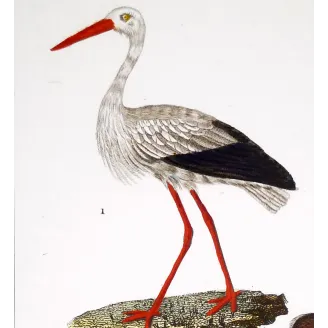
Graceful stork and robust jabiru presented with classic naturalistic balance.
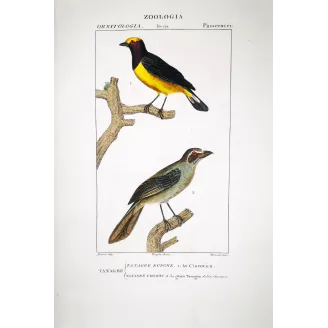
Graceful composition of a Yellow Tanager and a more subtly colored species from the Guyana region.
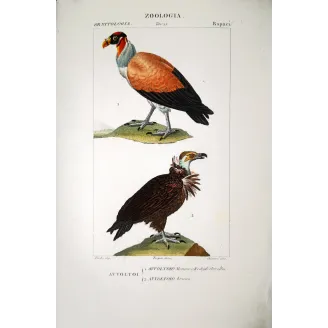
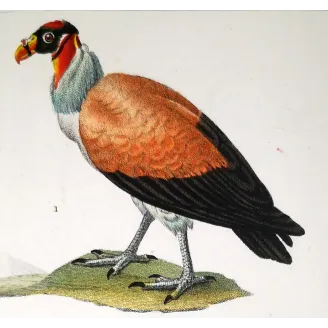
Original early 19th-century hand-colored engraving depicting King Vulture and Brown Vulture from the Dizionario di Scienze Naturali.
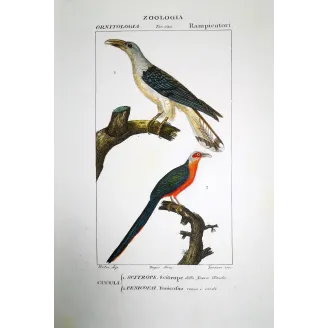
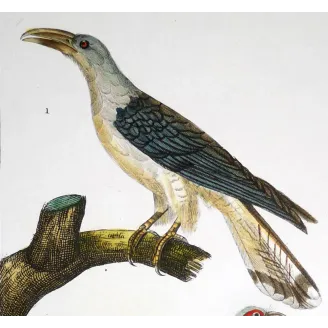
Elegant depiction of a Scythrope and a vividly colored red-and-green Trogon perched on branches.
Exquisite depiction of the ornate Greater Bird-of-Paradise alongside the striking Common Hill Myna.
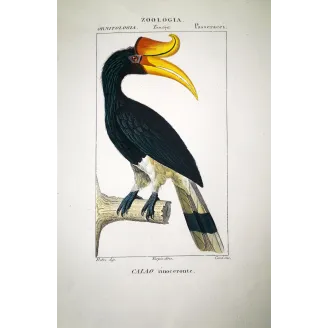
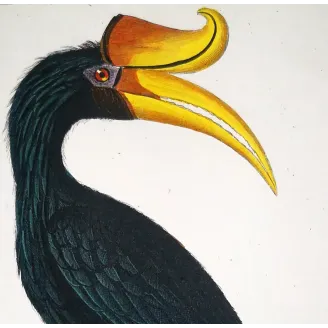
Beautiful 19th century illustration of the Buceros rhinoceros, commonly known as the Rhinoceros Hornbill.
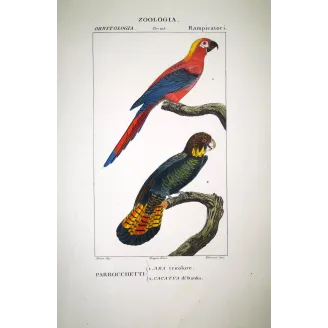
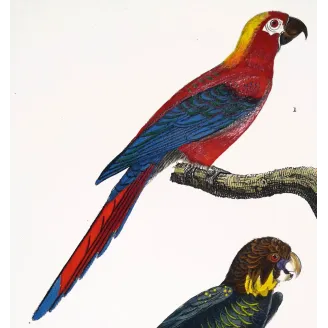
Vibrant parakeets perched on branches: a scarlet macaw and a black cockatoo with yellow and red highlights.
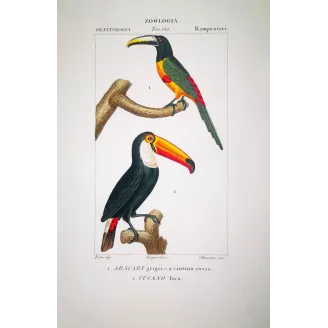
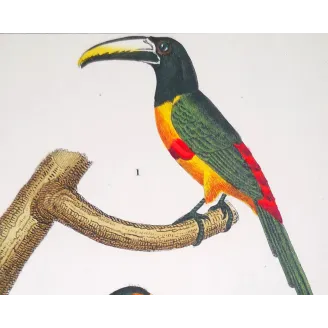
Colored illustration depicting two South American toucans: the Toco and the Red-belted Aracari.
Vividly colored engraving of a European Green Woodpecker and a Eurasian Wryneck, masterfully rendered by Prêtre.