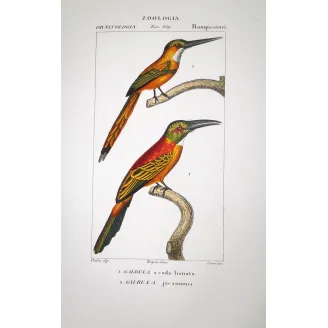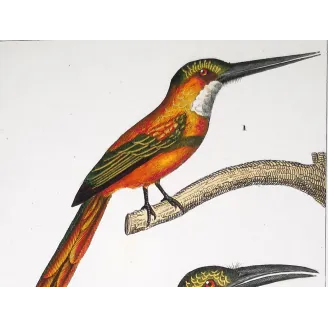
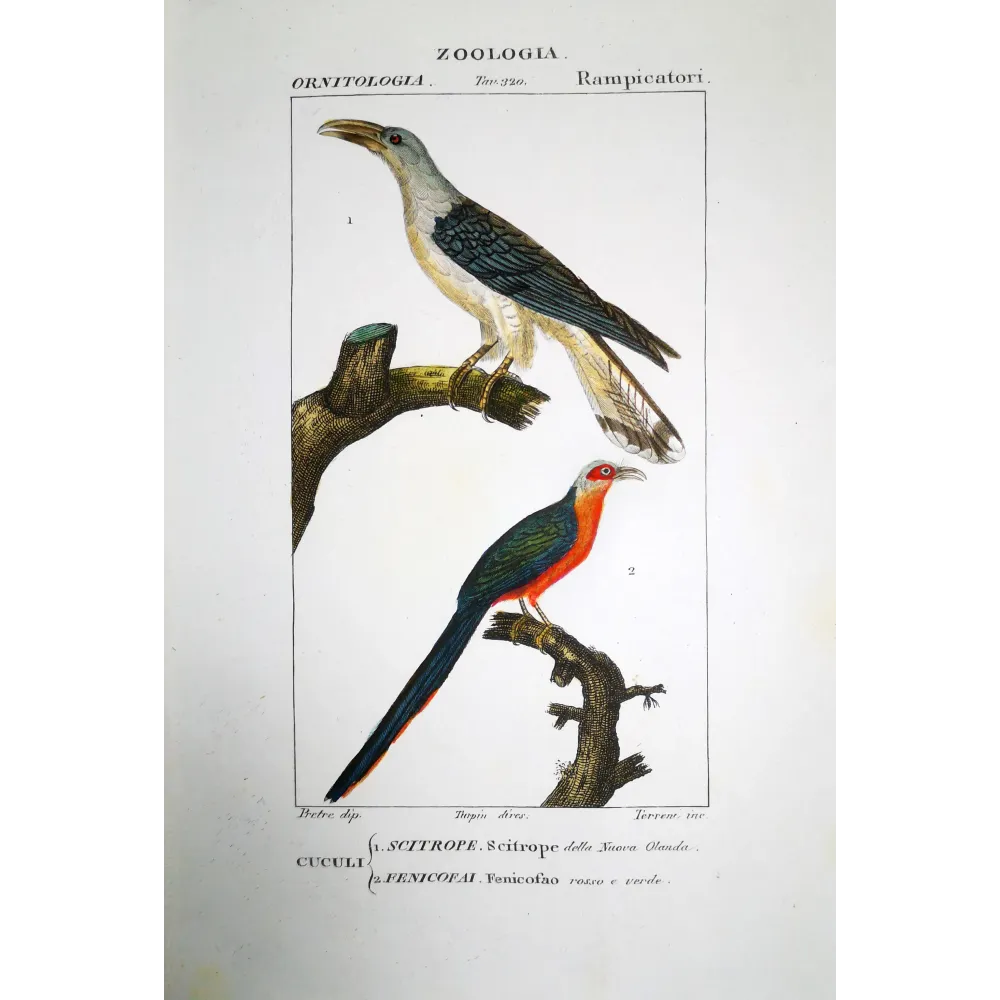
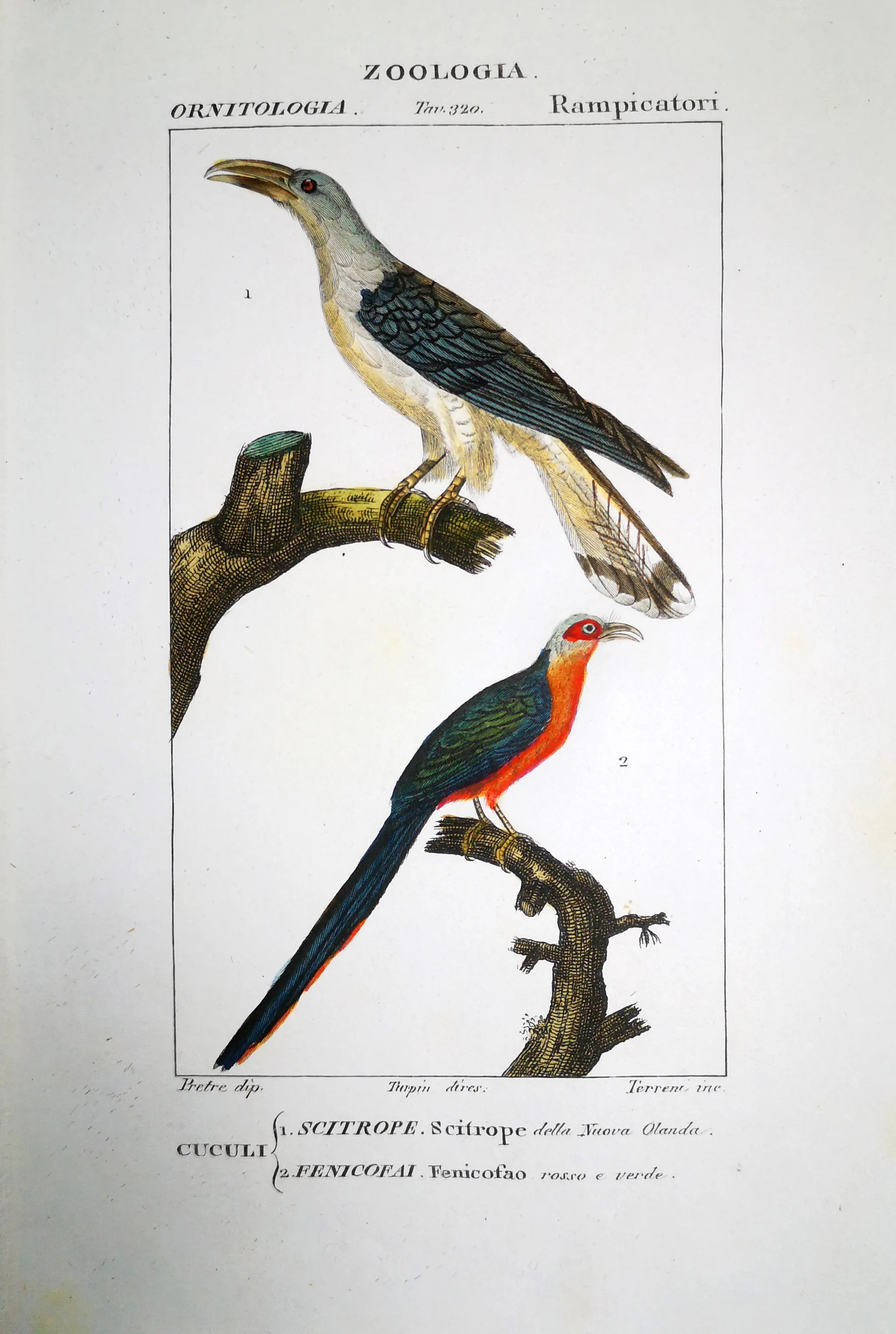
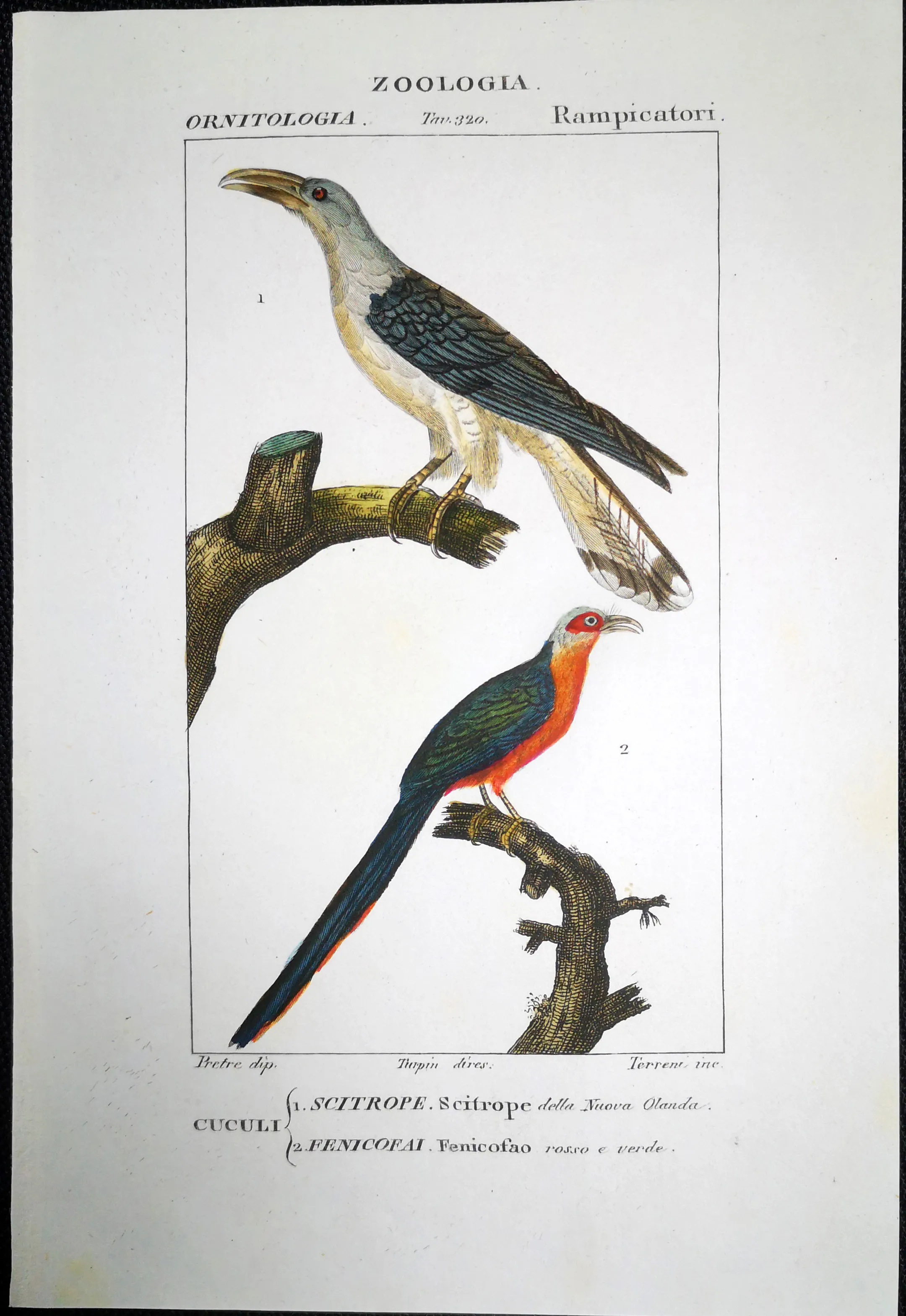



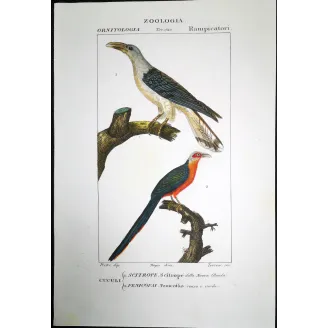
Elegant depiction of a Scythrope and a vividly colored red-and-green Trogon perched on branches.
 Delivery policy
Your print will be carefully prepared and shipped worldwide via trusted couriers (UPS or similar).
 Authentic antique prints
Original engravings from the 17th–19th century.
This refined ornithological engraving presents two exotic birds rendered with the clarity of a curated cabinet plate: the Scitrope della Nuova Olanda (associated with the Channel-billed Cuckoo, Scythrops novaehollandiae) and the Fenicofai rosso e verde (a tropical cuckoo commonly identified within the genus Phenicophaeus). The plate belongs to the ornithological section of the Dizionario di Scienze Naturali, where Pierre Antoine Prêtre’s disciplined linework and delicate hand-coloring elevate scientific illustration into an object of quiet decorative authority.
Against the pale ground, the two figures create a balanced vertical dialogue. The upper bird reads as restrained and architectural—cool greys, soft teal, and warm ochre—while the lower Fenicofai introduces vivid chromatic intensity, with deep emerald wings and a luminous crimson breast that anchors the composition with unmistakable presence.
— • —
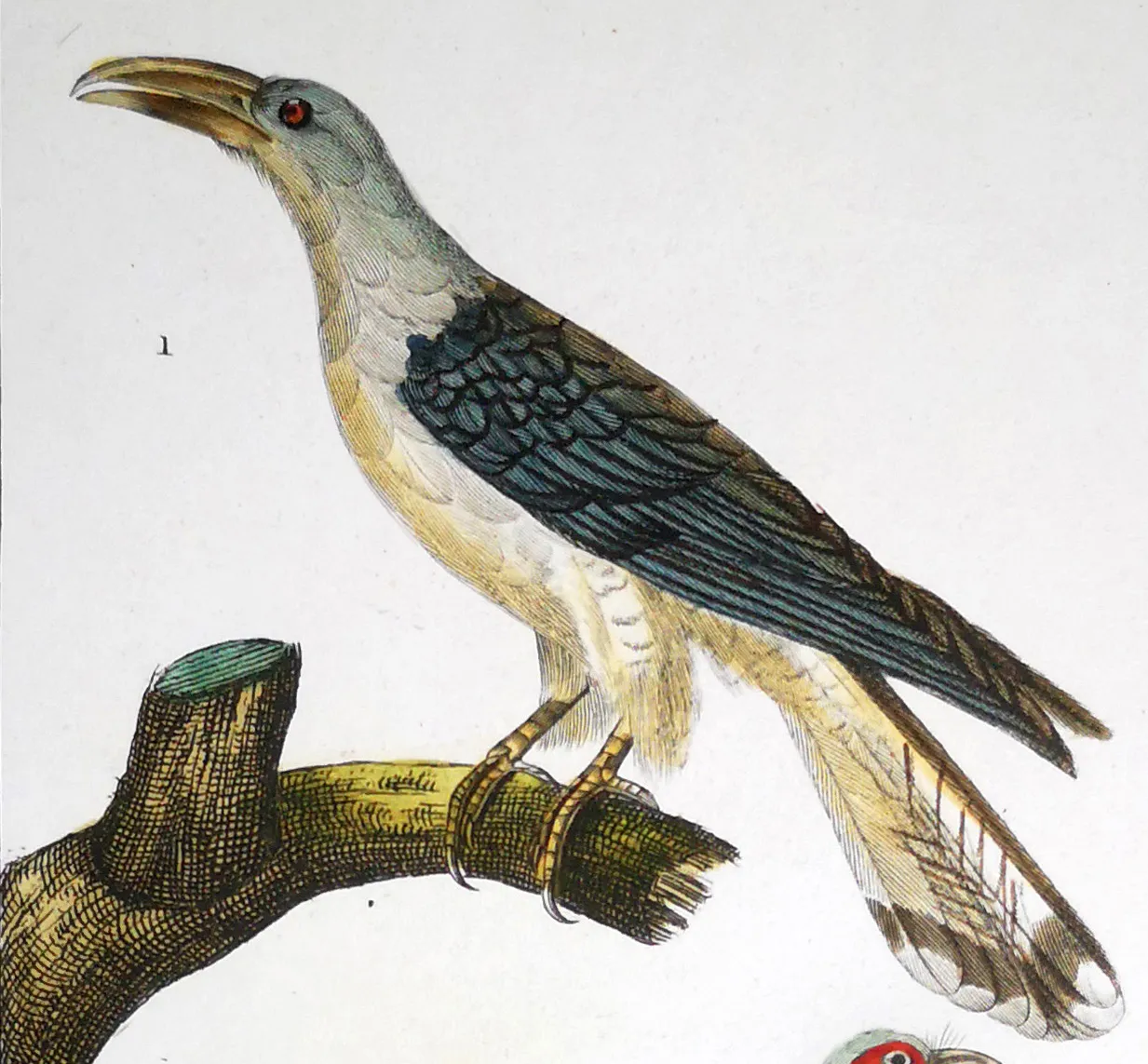
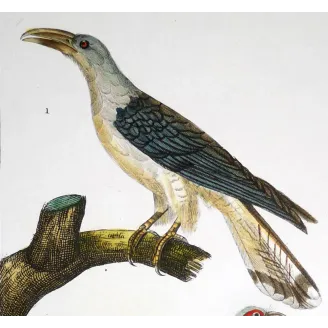
The composition is built on contrast in both tone and temperament. Above, the Scitrope is treated with controlled modulation: the elongated bill, the layered wing feathers, and the calm posture emphasize structure over ornament. Subtle shading gives volume without sacrificing the analytical clarity expected of early nineteenth-century zoological plates.
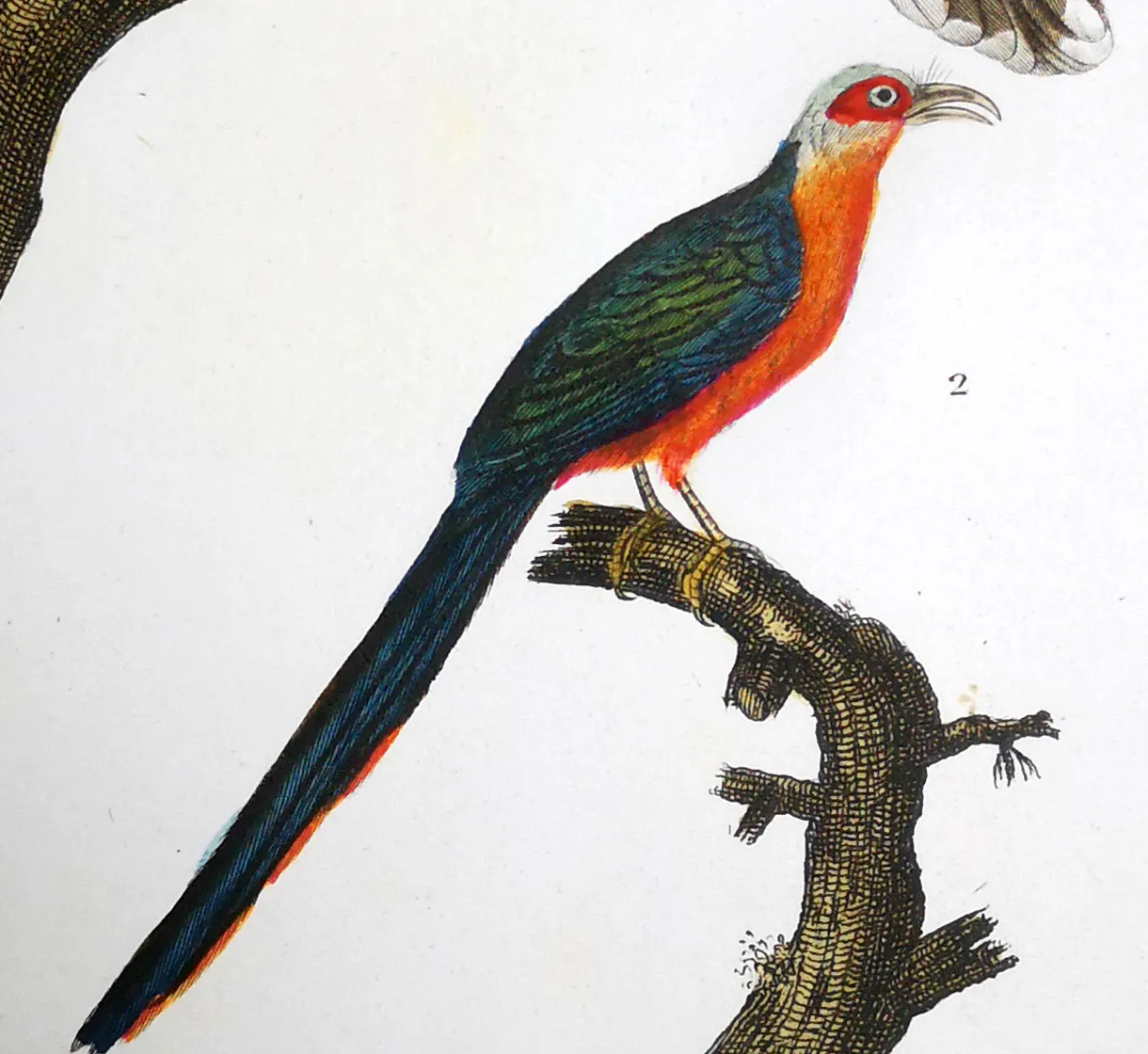
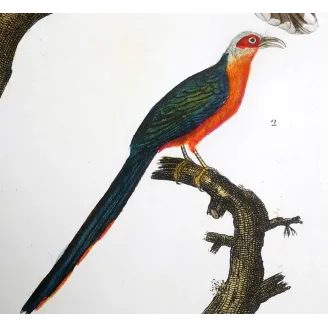
Below, the Fenicofai becomes the chromatic focal point. The hand-coloring moves confidently between saturated green and rich red, with the long tail extending in a clean, tapering line. The birds are separated on distinct branches with generous white space, reinforcing the “museum specimen” aesthetic: clean, curated, and exceptionally suitable for interiors where color should feel intentional rather than crowded.
The “Scitrope della Nuova Olanda” is associated with Scythrops novaehollandiae, a large cuckoo native to Australia and adjacent regions, known for its distinctive heavy bill and strong silhouette when perched in the canopy. Its presence in nineteenth-century encyclopedic works reflects European curiosity toward the fauna of the Southern Hemisphere, then still perceived as both remote and scientifically compelling.
“Fenicofai” is an older Italian term historically used for tropical cuckoos and related forms; this subject is commonly identified with the genus Phenicophaeus, admired for contrasting plumage and elongated tails. Such birds were particularly prized by natural history publishers because their bold color blocks translated beautifully into hand-colored engraving, offering collectors a rare balance between scientific interest and decorative impact.
This engraving forms part of the historic Dizionario di Scienze Naturali, a monumental early nineteenth-century encyclopedic enterprise once preserved within a noble library and today housed in the Sacchetti Collection. Each plate reflects a period in which scientific ambition was matched by exceptional artisanal execution — from disciplined copperplate linework to luminous hand-applied color.
These works represent a moment when natural history illustration achieved both scientific rigor and aesthetic refinement. To discover the full story behind these rare prints and their noble provenance, we invite you to read our editorial feature “Not Just Another Print”.
The engraving is in very good antique condition. The impression is clean and well-defined, with preserved original hand-colouring. The paper is smooth early nineteenth-century wove paper (non-laid), consistent with Italian scientific editions of the period. No watermark has been observed. Minor age toning, if present, is consistent with antique paper and does not affect the legibility or decorative quality of the plate.
For further context on Pierre Antoine Prêtre and his contribution to nineteenth-century zoological illustration, see our editorial feature:
Pierre Antoine Prêtre – Illustrator of Natural Science and Marine Life
Specific References
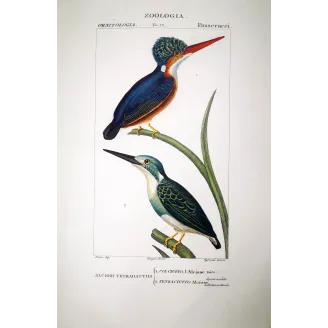
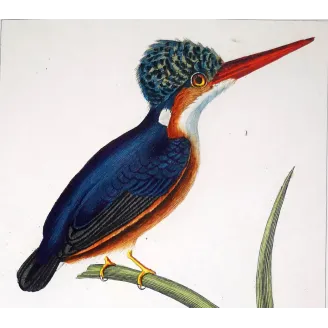
Refined old print with two specimens of South American halcyons: one crested and one with a green-blue livery.
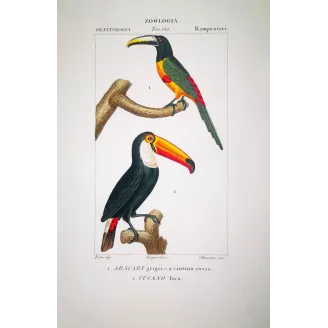
Colored illustration depicting two South American toucans: the Toco and the Red-belted Aracari.
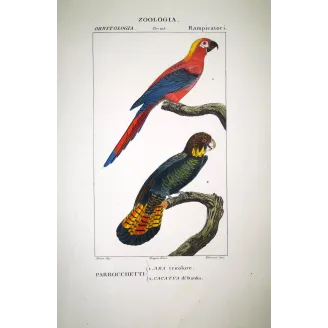
Vibrant parakeets perched on branches: a scarlet macaw and a black cockatoo with yellow and red highlights.
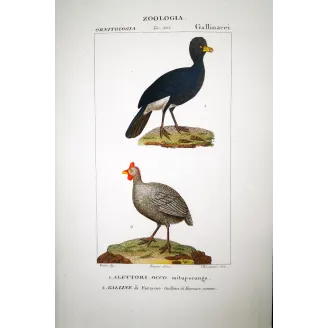
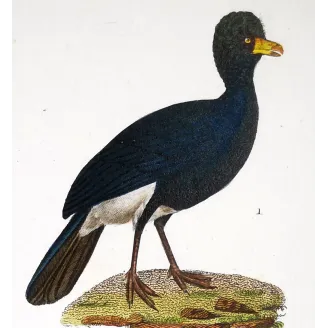
Elegant engraving of a guinea fowl and a Mituporanga, with rich textures and natural posture.
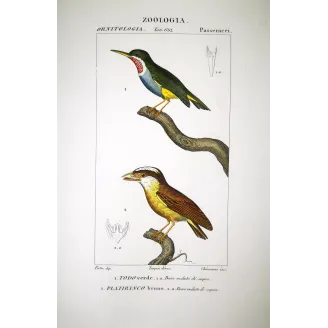
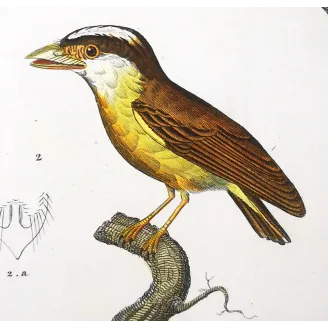
Delicate birds from the New World: the vibrant Green Todus and a brown Platyrinchus with unique beak features.
Two vibrant Jacamar birds with metallic plumage and long sharp beaks on stylized branches.
Beautiful 19th century illustration of the Buceros rhinoceros, commonly known as the Rhinoceros Hornbill.
Majestic raptor captured in perfect hunting pose with detailed feathers.
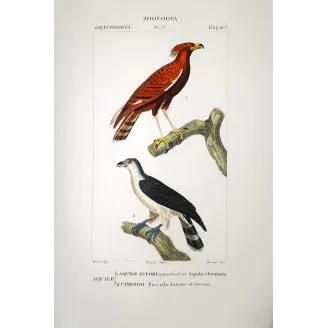
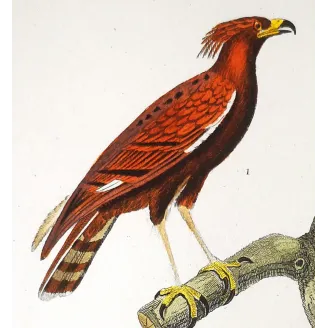
A lively contrast between a fiery red hawk-eagle and a smaller black-and-white goshawk.
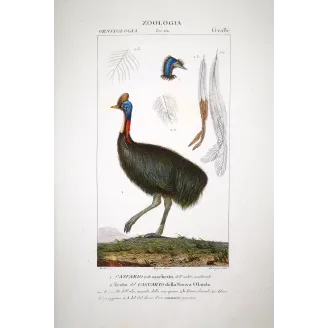
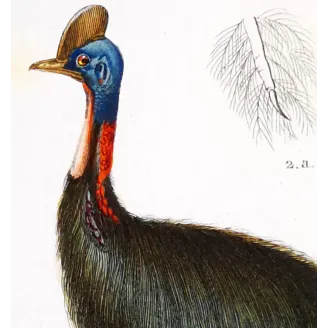
Impressive antique engraving of the Southern Cassowary, a striking flightless bird from New Guinea and northern Australia.
Finely drawn buzzards with a harmonious and naturalistic composition.
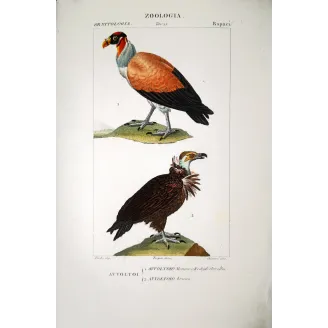
Original early 19th-century hand-colored engraving depicting King Vulture and Brown Vulture from the Dizionario di Scienze Naturali.
Exquisite depiction of the ornate Greater Bird-of-Paradise alongside the striking Common Hill Myna.
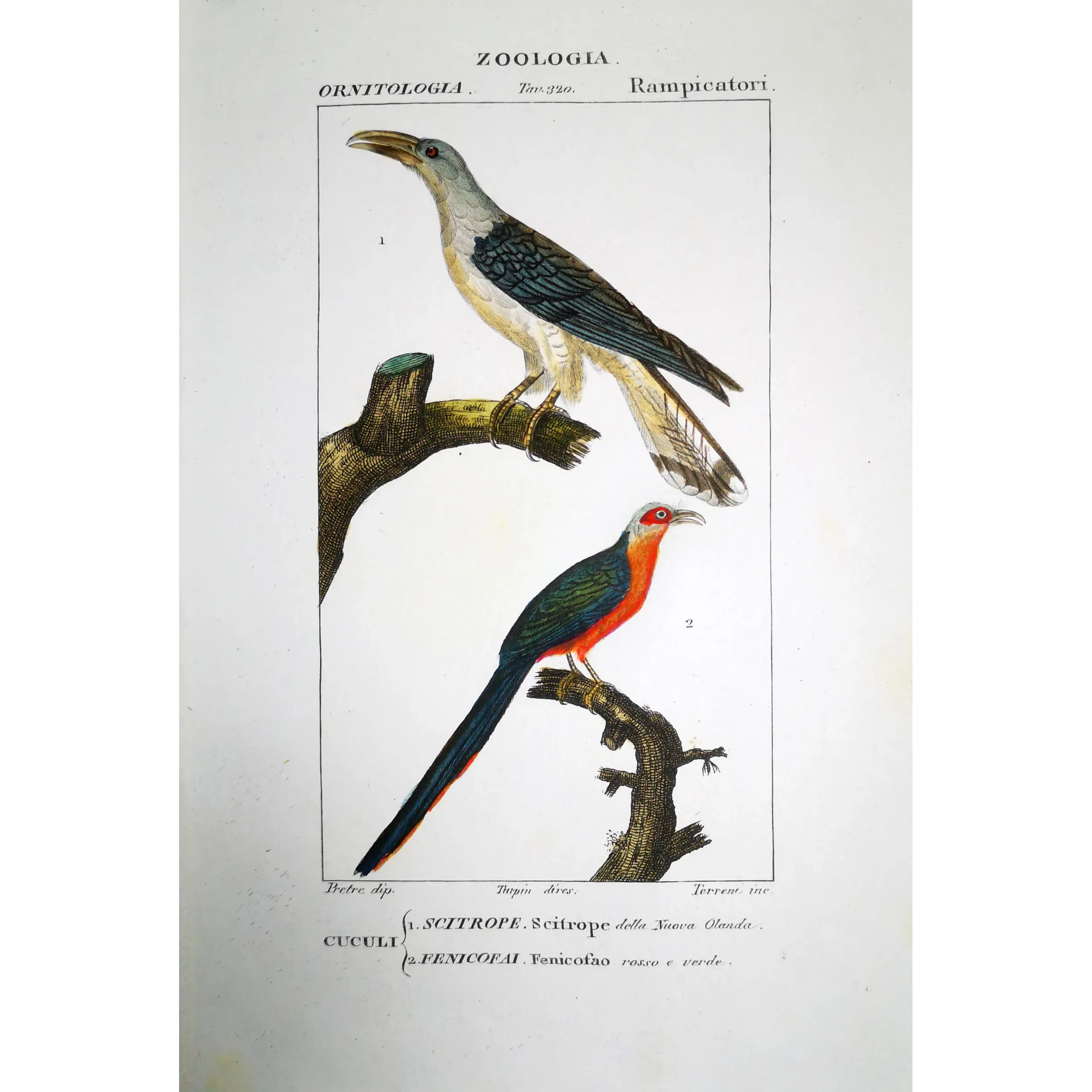
Elegant depiction of a Scythrope and a vividly colored red-and-green Trogon perched on branches.