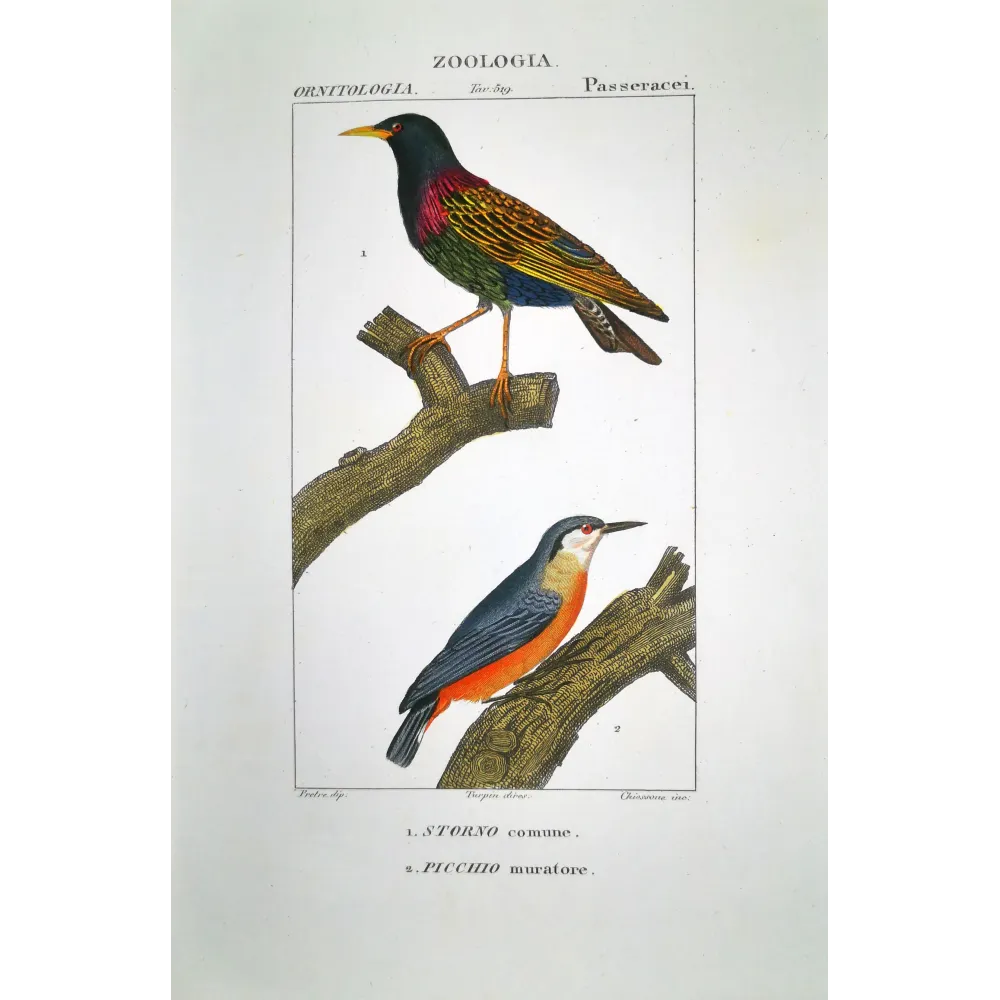
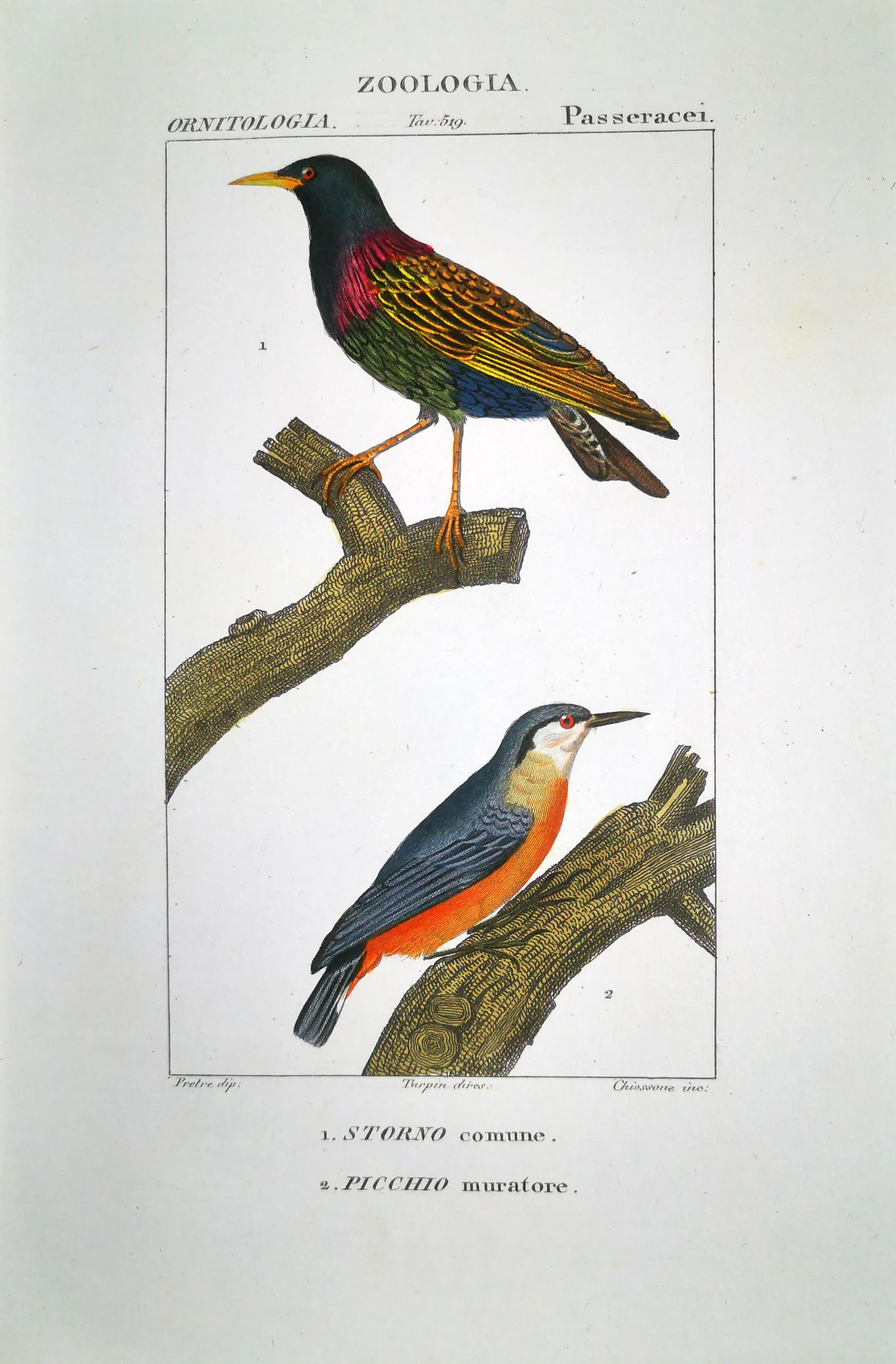
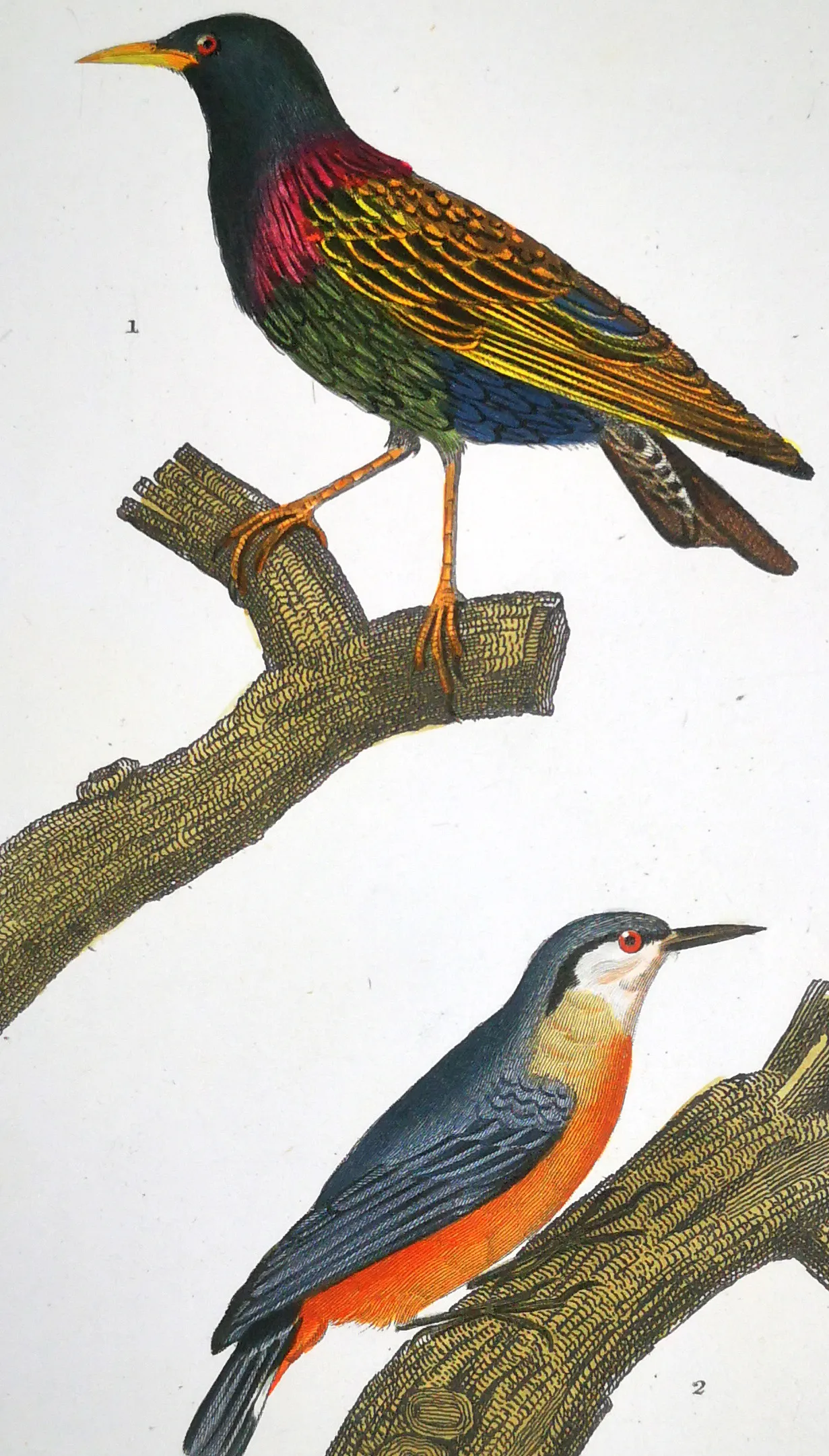
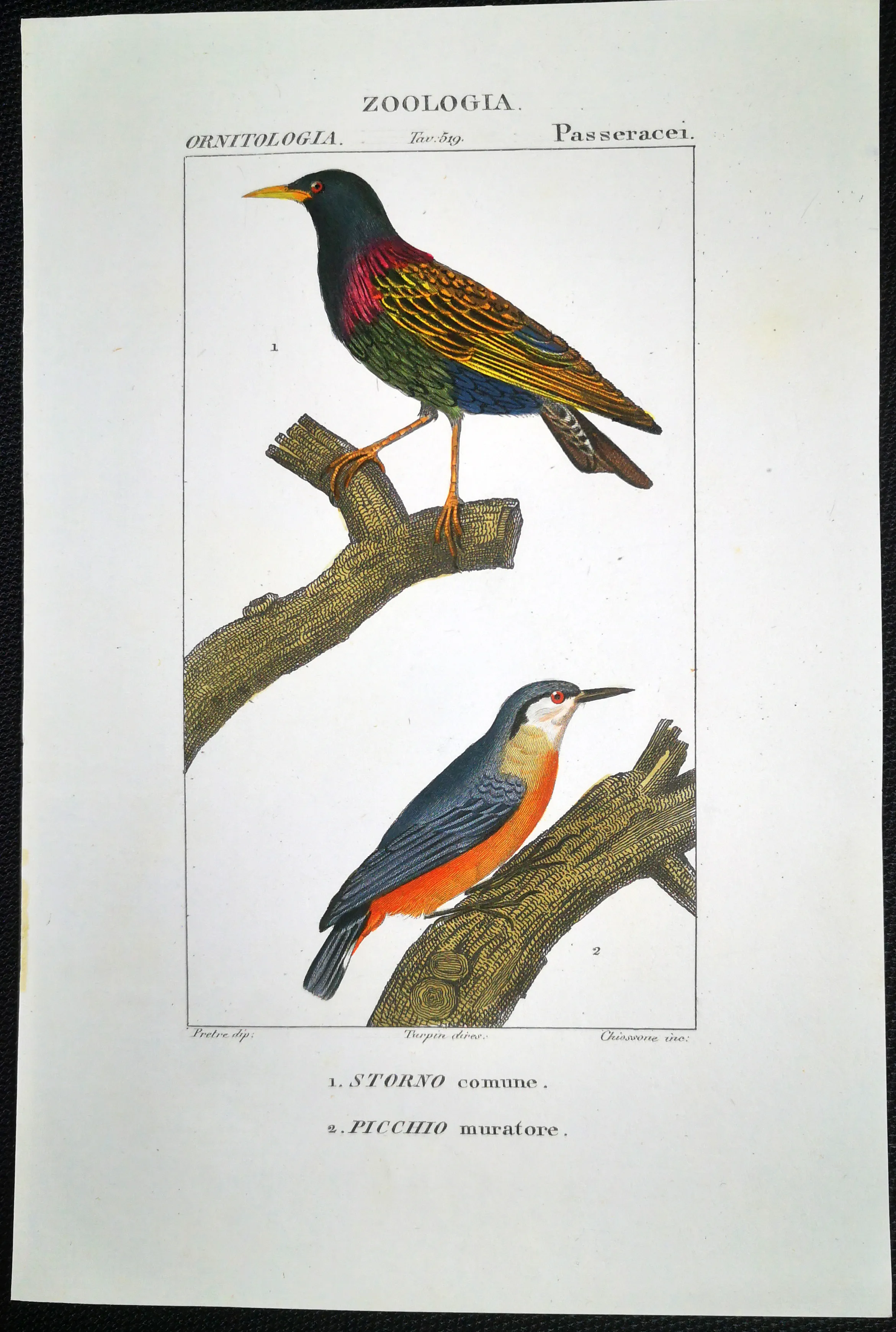



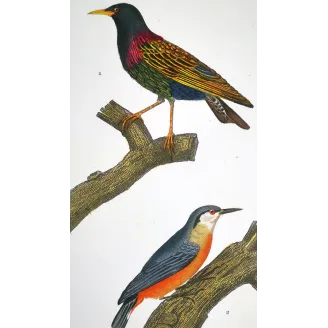
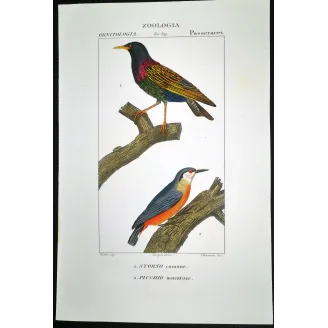
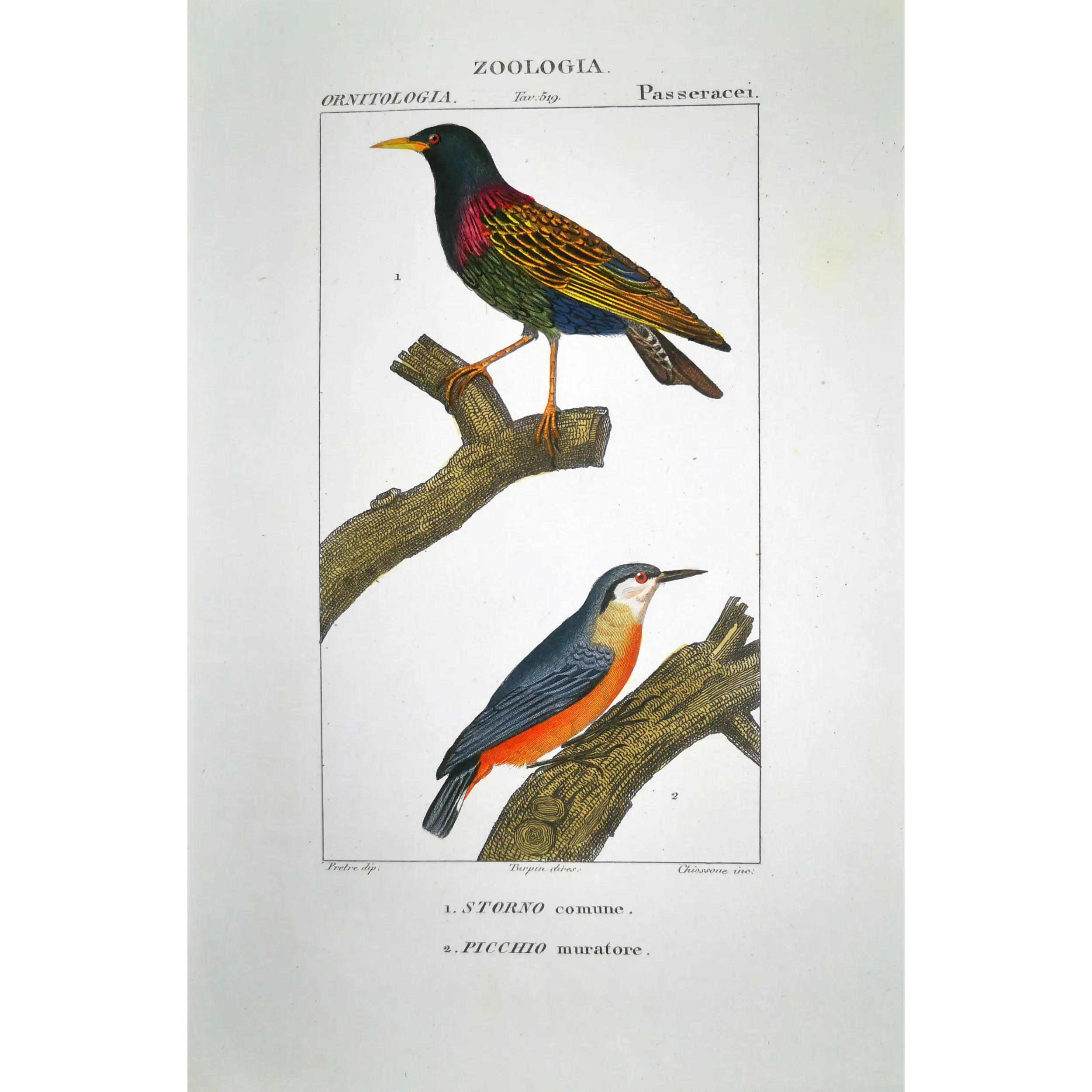
Engraving of two European birds with vivid plumage by Prêtre.
 Delivery policy
Your print will be carefully prepared and shipped worldwide via trusted couriers (UPS or similar).
 Authentic antique prints
Original engravings from the 17th–19th century.
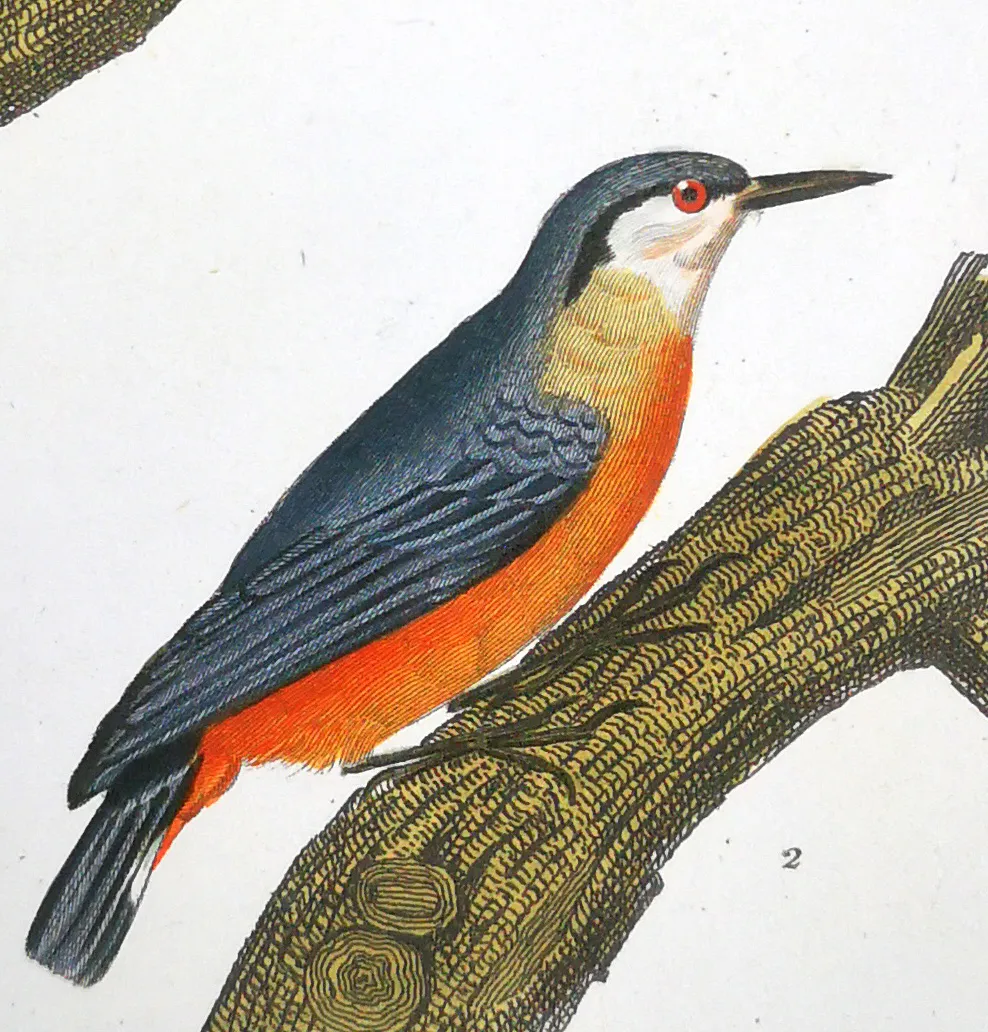
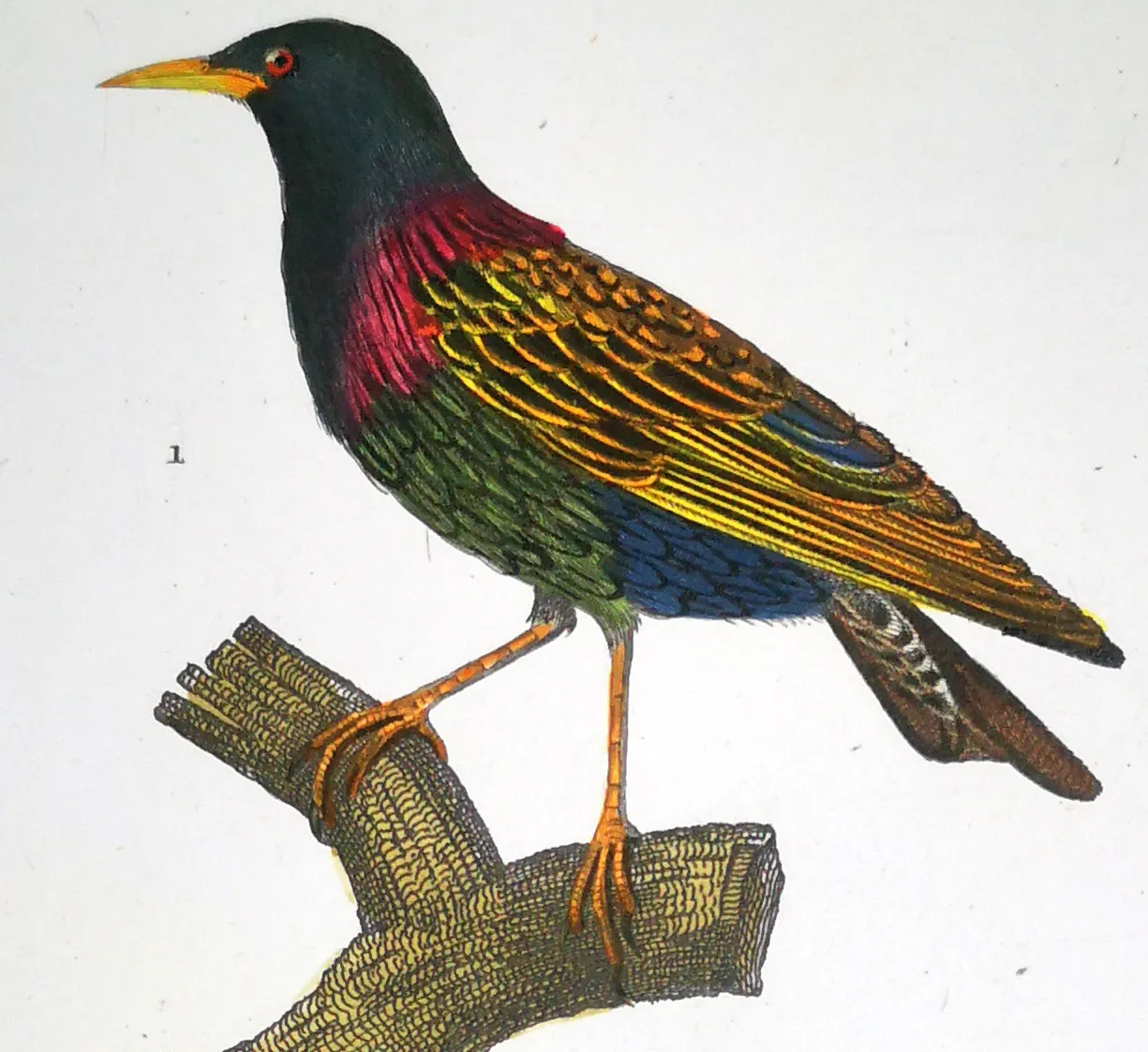
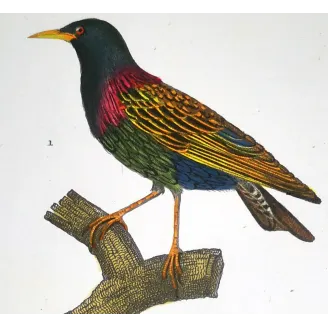
This refined ornithological engraving presents two familiar yet beautifully distinct European birds: the Storno comune (Common Starling, Sturnus vulgaris) and the Picchio muratore (European Nuthatch, Sitta europaea). Rendered with the clarity of a cabinet specimen, both figures are set against a clean ground so that plumage structure, posture, and colour logic can be studied without distraction.
The plate belongs to the Italian edition of the Dizionario di Scienze Naturali (Florence, Battelli press), illustrated by Pierre Antoine Prêtre under the scientific direction of Turpin and engraved with disciplined precision. It exemplifies the nineteenth-century ideal of natural history: faithful observation elevated by compositional elegance.
— • —
The upper starling is treated almost like a study in iridescence. Its dark plumage is layered with subtle green, gold, and violet tones that suggest the metallic sheen for which the species is known. The wing coverts are articulated with a decorative, scale-like rhythm, creating a rich surface texture that reads beautifully even at a distance.
Below, the nuthatch introduces a cooler, quieter harmony: blue-grey upperparts, a clean pale breast, and a warm orange wash along the flanks. The contrast between the two birds—one jewel-dark and iridescent, the other crisp and softly coloured—creates a balanced, interior-friendly composition suited to curated spaces where natural detail and restrained colour carry the aesthetic weight.
The Common Starling (Sturnus vulgaris) has long attracted attention for its shimmering plumage and social behaviour. In nineteenth-century natural history, its iridescence posed an artistic challenge: translating shifting metallic tones into stable pigment. Plates like this demonstrate how hand-colouring could suggest reflective depth through layered greens, purples, and warm highlights.
The European Nuthatch (Sitta europaea) is equally distinctive, known for its ability to climb both up and down tree trunks and to wedge seeds into bark crevices. Its compact body and sharp bill made it a model subject for comparative observation—an example of how behaviour and morphology align. As a pair, starling and nuthatch offer a concise portrait of European woodland life, presented with museum-like clarity.
This engraving forms part of the historic Dizionario di Scienze Naturali, a monumental early nineteenth-century encyclopedic enterprise once preserved within a noble library and today housed in the Sacchetti Collection. Each plate reflects a period in which scientific ambition was matched by exceptional artisanal execution — from disciplined copperplate linework to luminous hand-applied color.
These works represent a moment when natural history illustration achieved both scientific rigor and aesthetic refinement. To discover the full story behind these rare prints and their noble provenance, we invite you to read our editorial feature “Not Just Another Print”.
The engraving is in very good antique condition. The impression is clean and well-preserved, with carefully retained original hand-colouring. The paper is smooth early nineteenth-century wove paper (non-laid), consistent with Italian scientific editions of the period. No watermark has been observed. Minor age toning, if present, is consistent with antique paper and does not affect the legibility or decorative quality of the plate.
For further context on Pierre Antoine Prêtre and his contribution to nineteenth-century zoological illustration, see our editorial feature:
Pierre Antoine Prêtre – Illustrator of Natural Science and Marine Life
Specific References
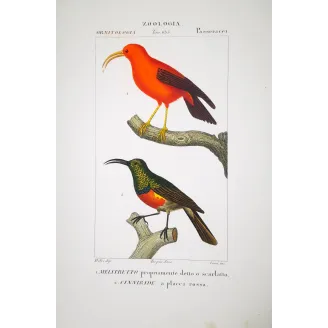
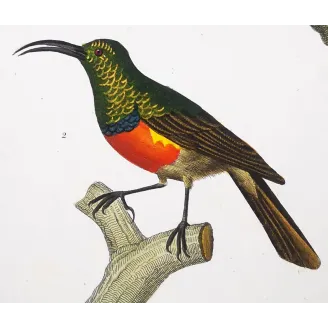
Brilliantly colored honeycreeper and sunbird illustration with tropical vibrancy, captured by Prêtre.
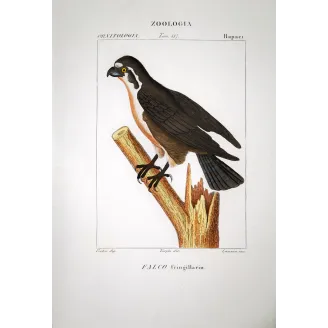
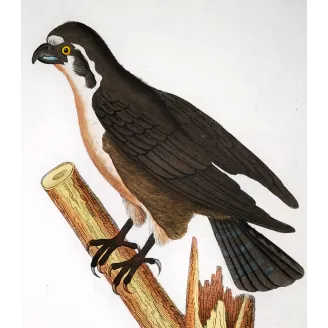
Majestic raptor captured in perfect hunting pose with detailed feathers.
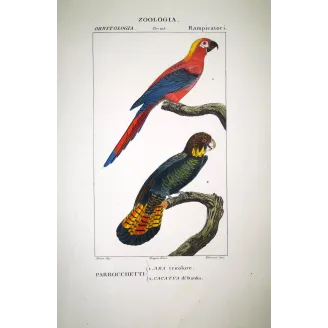
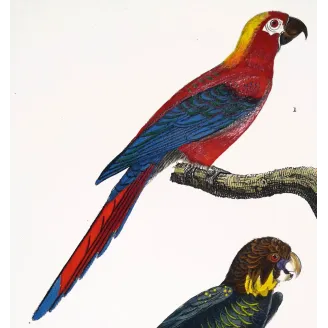
Vibrant parakeets perched on branches: a scarlet macaw and a black cockatoo with yellow and red highlights.
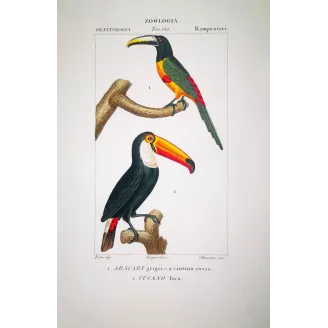
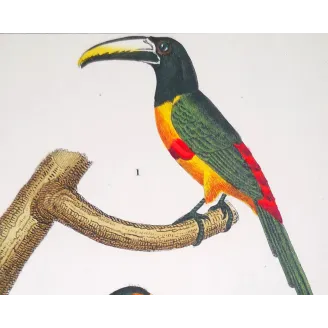
Colored illustration depicting two South American toucans: the Toco and the Red-belted Aracari.
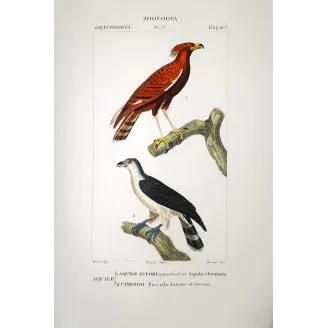
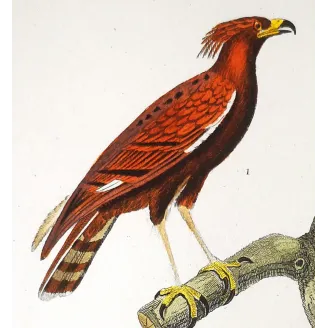
A lively contrast between a fiery red hawk-eagle and a smaller black-and-white goshawk.
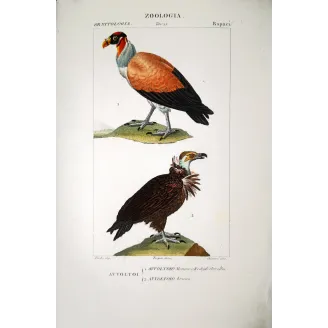
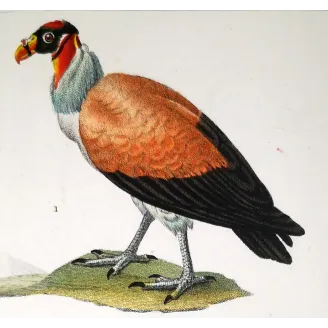
Original early 19th-century hand-colored engraving depicting King Vulture and Brown Vulture from the Dizionario di Scienze Naturali.
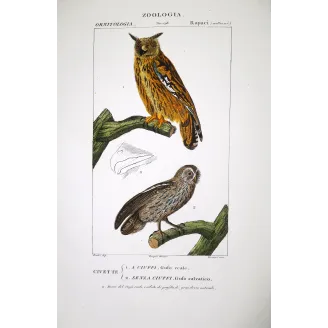
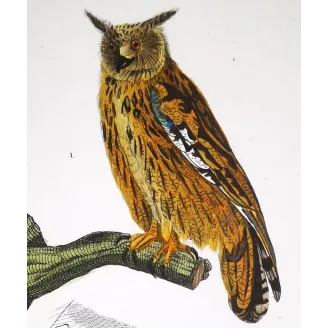
Nocturnal birds of prey elegantly rendered, showing sharpness and grace.
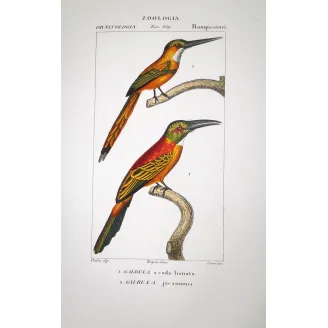
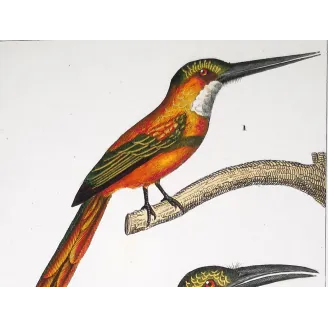
Two vibrant Jacamar birds with metallic plumage and long sharp beaks on stylized branches.
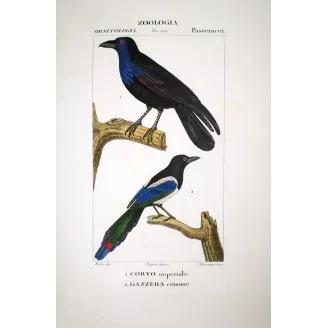
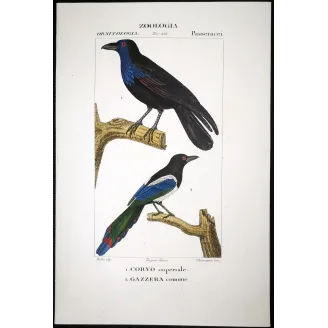
Striking contrast between the dark Imperial Crow and the vividly patterned Common Magpie.
Vividly colored engraving of a European Green Woodpecker and a Eurasian Wryneck, masterfully rendered by Prêtre.
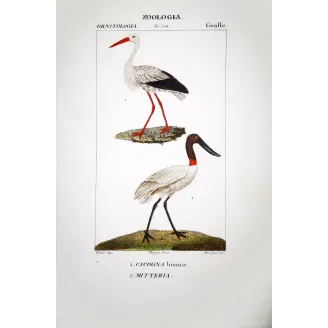
Graceful stork and robust jabiru presented with classic naturalistic balance.
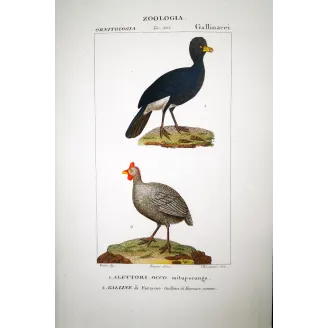
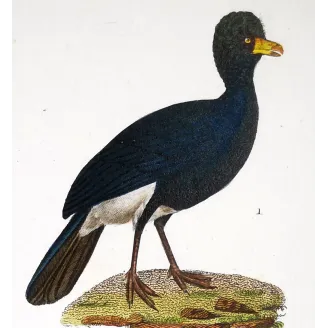
Elegant engraving of a guinea fowl and a Mituporanga, with rich textures and natural posture.
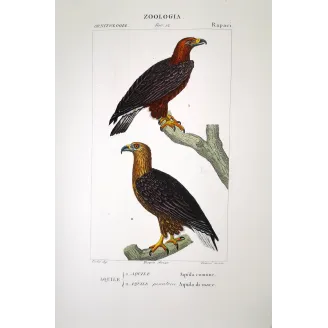
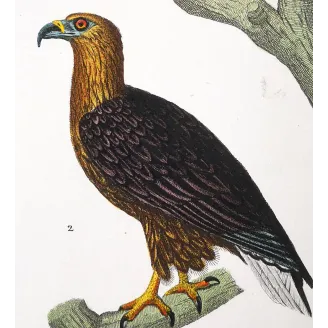
Impressive pairing of two majestic eagles, captured with remarkable precision and power.
Engraving of two European birds with vivid plumage by Prêtre.