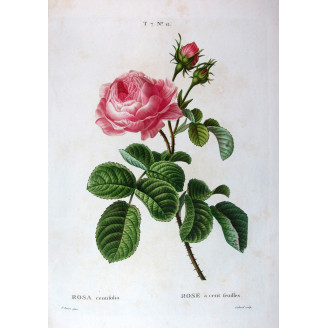
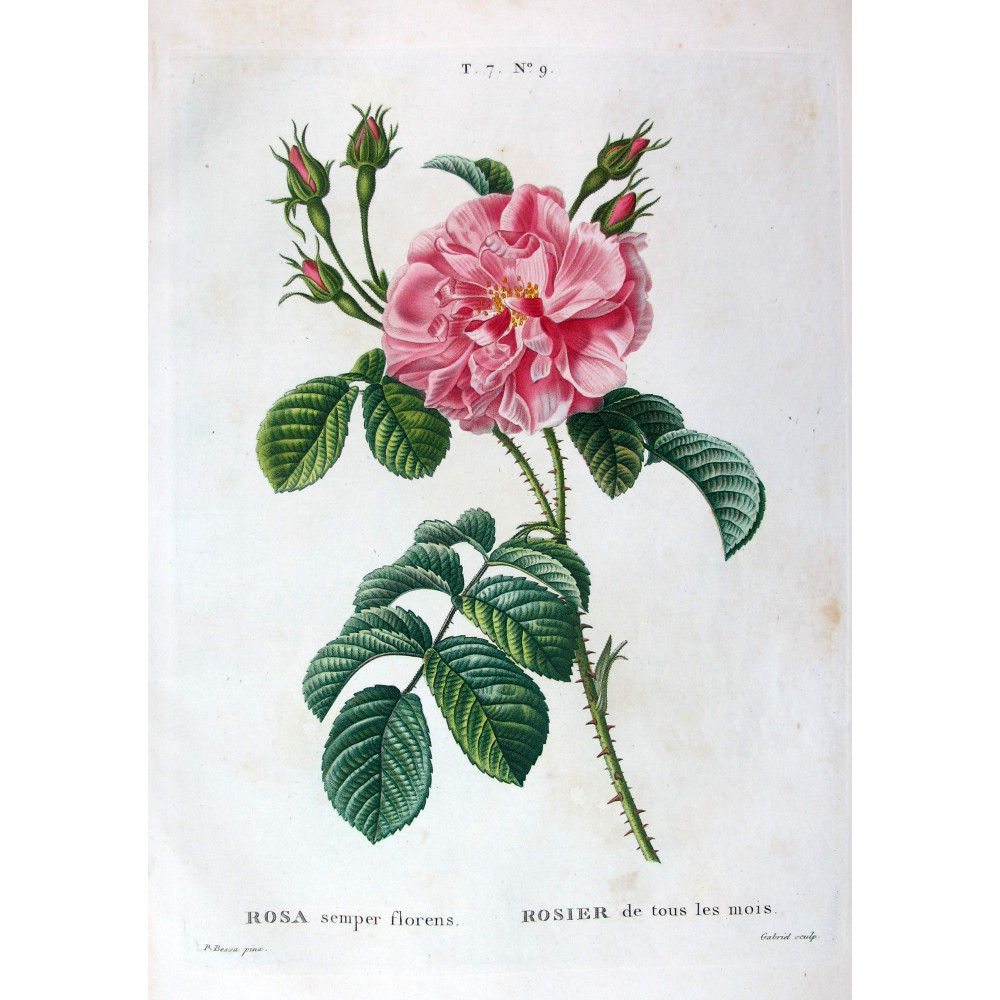
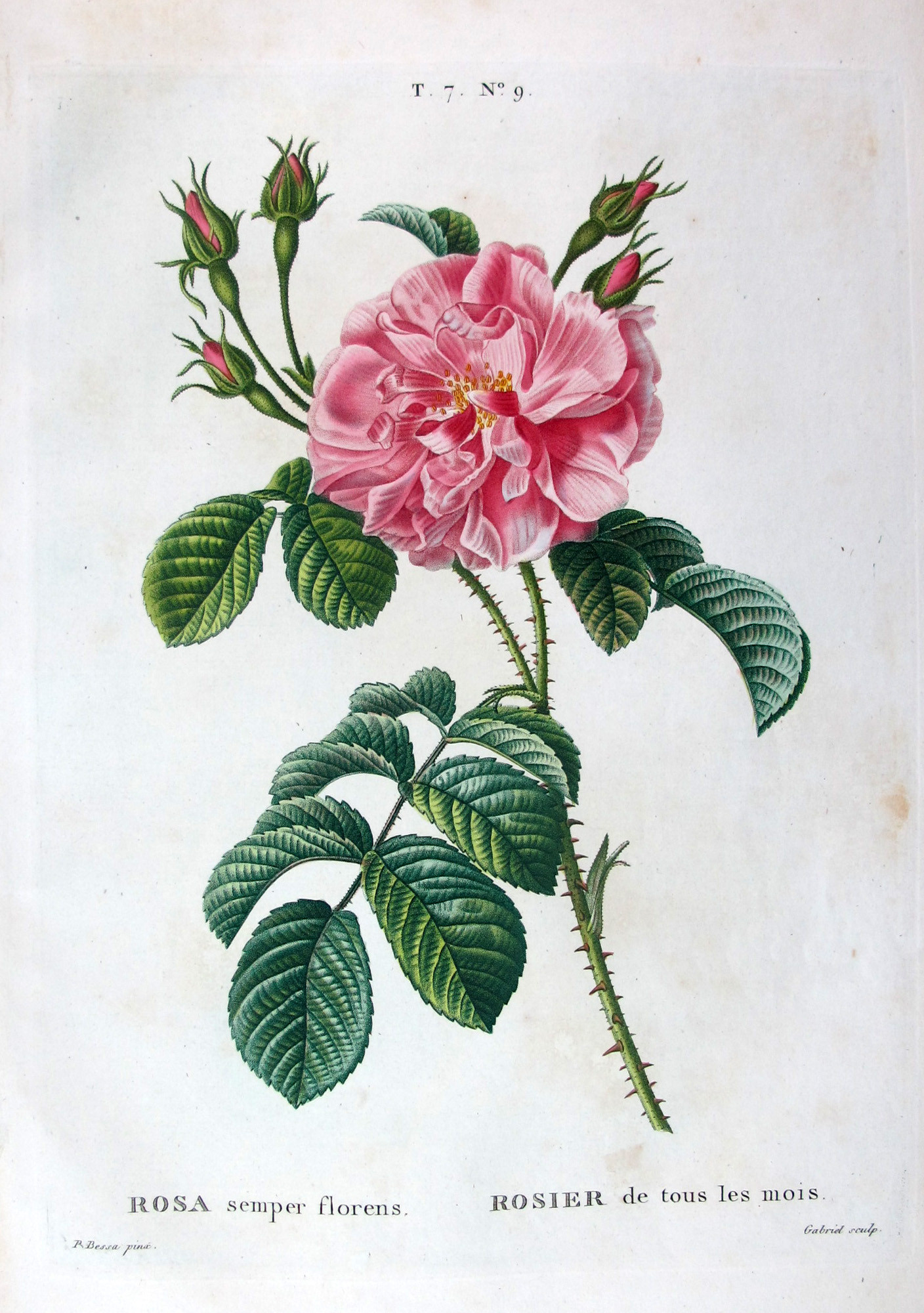
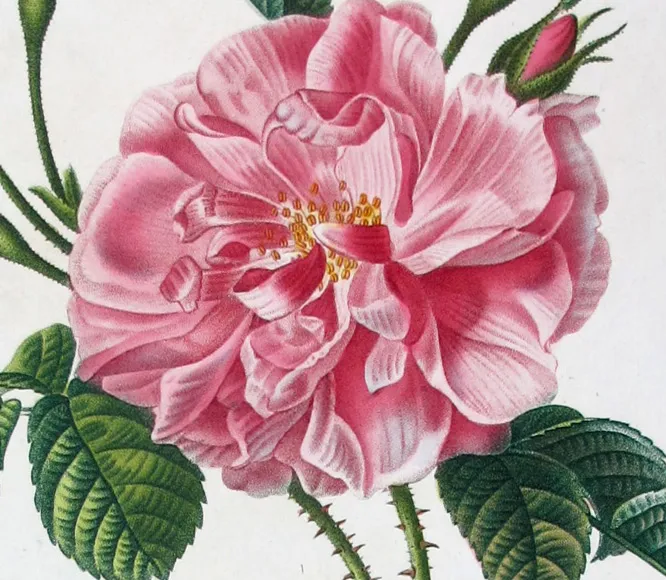
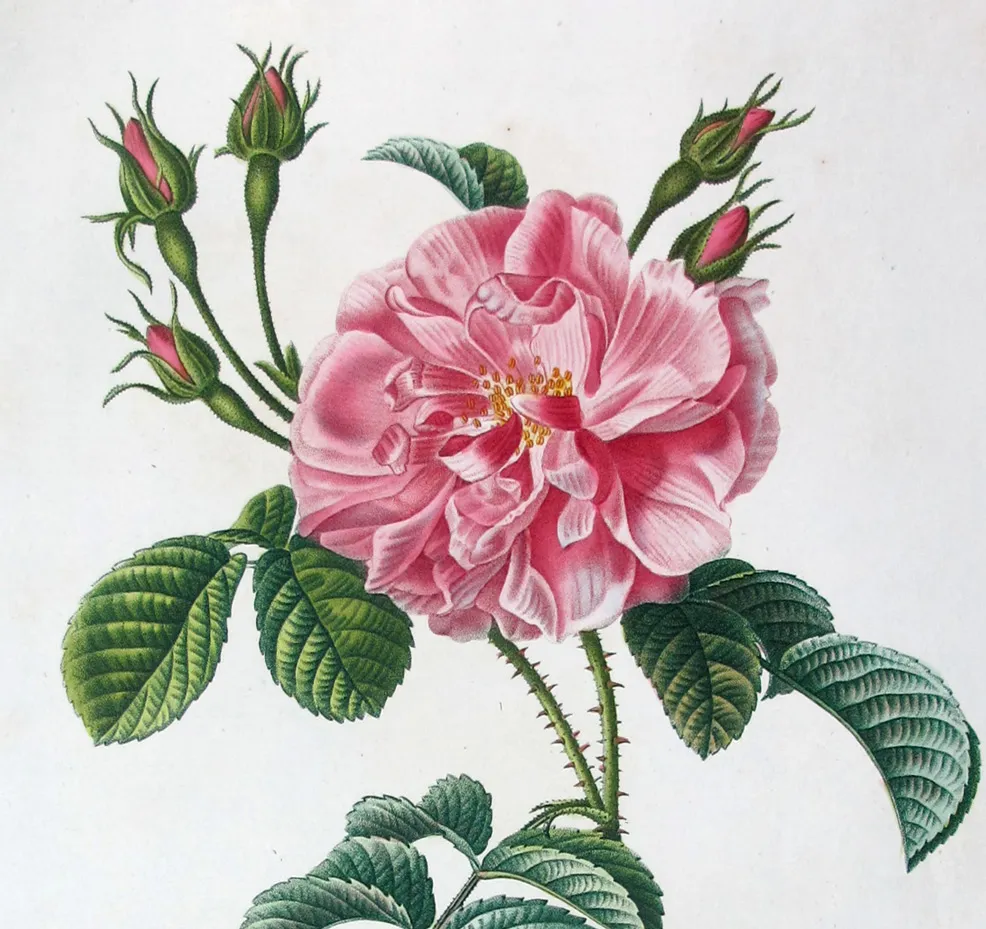
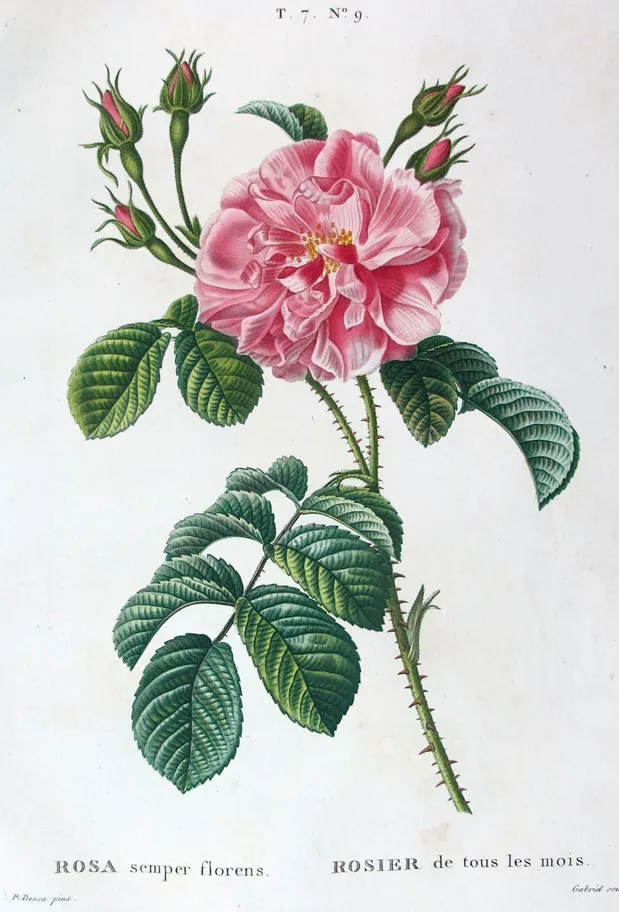
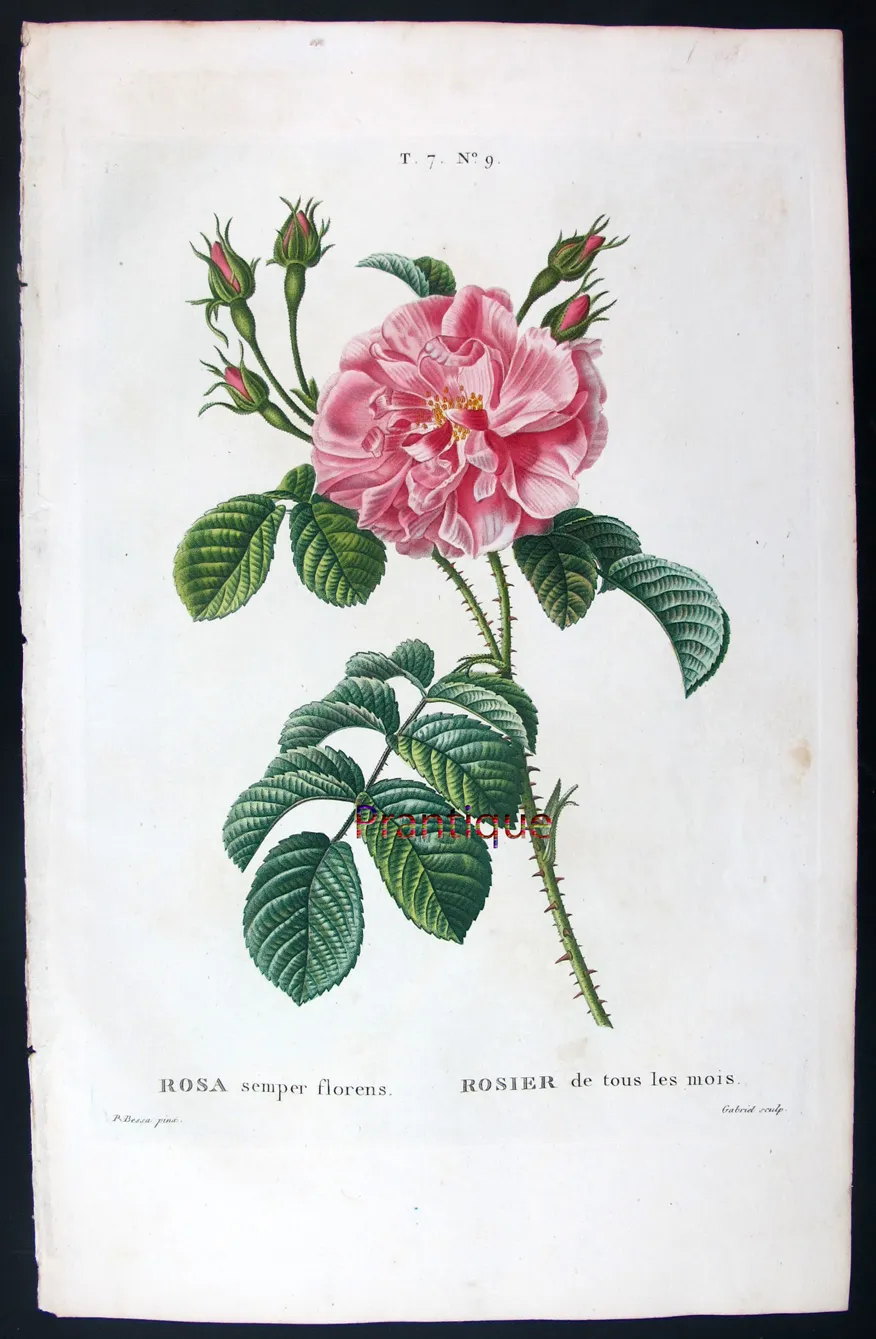

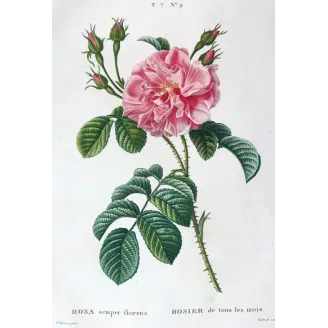
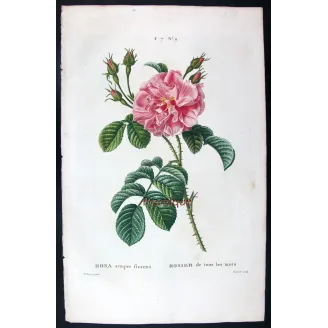
Monthly Rose Rosier de tous les mois Original hand-colored botanical engraving by Pancrace Bessa.
 Delivery policy
Your print will be carefully prepared and shipped worldwide via trusted couriers (UPS or similar).
 Authentic antique prints
Original engravings from the 17th–19th century.
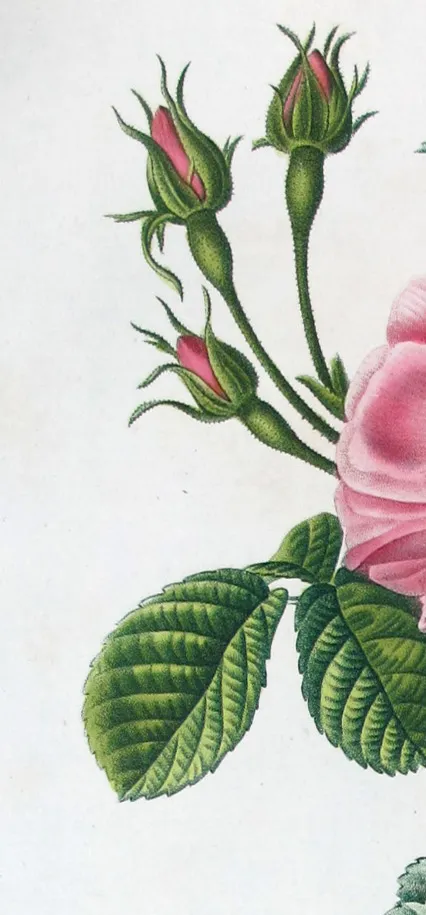
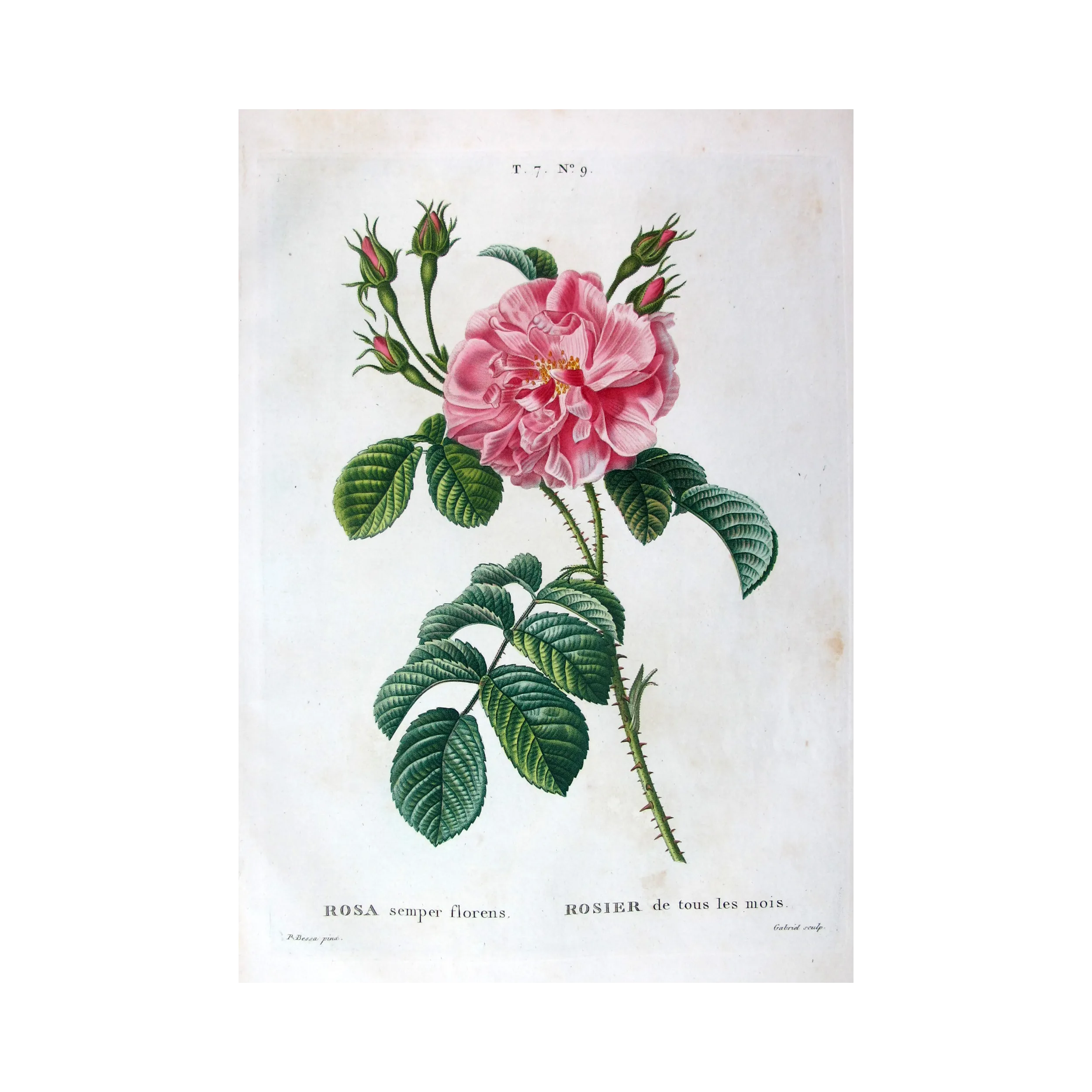
This refined botanical engraving depicts Rosa semper florens, presented with a poised balance between softness and structure. The central bloom is shown in full, layered expansion, while a crown of buds rises above it, suggesting successive flowering and a sense of continuity that feels both botanical and quietly symbolic.
Bessa’s approach remains measured and painterly. The petals are modelled through gentle tonal gradations of pale rose and warmer accents, giving the flower volume without theatricality, while the foliage—dense, textured, and precisely veined—anchors the composition with confident green mass. The result is a plate of cultivated elegance, immediately legible and highly decorative.
This plate belongs to Arbres et Arbustes, one of the most celebrated French botanical publications of the early nineteenth century, where Pancrace Bessa’s work consistently balances botanical accuracy with a refined ornamental sensibility.
— • —
The composition is airy and vertically oriented, with the bloom occupying the upper centre and the long stem descending in a gentle diagonal. The buds form a secondary crown-like axis that lightens the silhouette and introduces rhythmic variation, while the leaves are arranged in overlapping clusters that create visual cadence without crowding the page.
Hand-colouring is controlled and luminous. The flower’s tonal range moves from soft highlights to deeper rose folds, producing a sense of depth and velvety texture, while the foliage is rendered in cooler greens with crisp veining and serrated edges. This disciplined palette reinforces the cultivated character of the subject, making the plate equally suitable as a botanical document and as a refined decorative artwork for libraries, studies, and elegant interiors.
Rosa semper florens, often associated with repeat or continuous flowering garden roses, was valued in cultivation for its capacity to renew bloom over time rather than concentrating its display in a single brief season. For early nineteenth-century horticulture, such roses represented a form of controlled abundance—plants shaped by gardening practice to offer sustained ornament. Their combination of recognizable form, recurring buds, and decorative richness made them natural subjects for botanical artists seeking to capture cultivated refinement within works such as Arbres et Arbustes.
The engraving is in very good antique condition. Light, even browning is visible, consistent with the natural ageing of early nineteenth-century paper. A very light toning is present along the upper margin, and a small, discreet spot of light toning can be observed near the plate mark on the right side; both are minor and do not affect the image. No watermark has been observed. The original hand-colouring remains fresh and well preserved, with strong definition across the bloom, buds, and foliage. The overall impression is clean and balanced. The engraved credits “P. Bessa pinx.” and “Gabriel sculp.” are present, attesting to the original drawing by Pancrace Bessa and the engraving executed by Gabriel.
For further context on Pancrace Bessa and his distinctive contribution to French botanical illustration, see our editorial feature:
Specific References
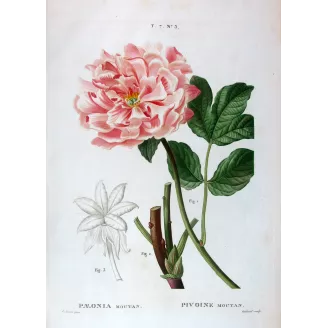
Tree Peony Pivoine moutan Original hand-colored botanical engraving by Pancrace Bessa.
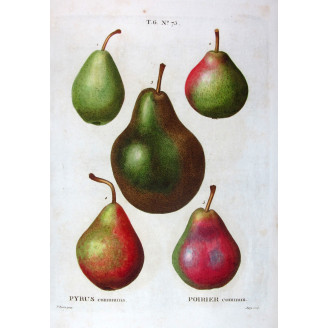
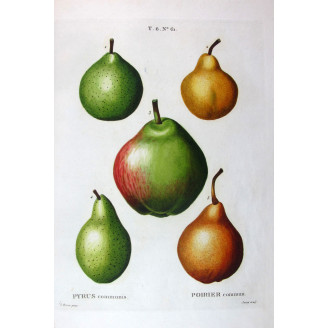
A refined study of cultivated pears, presenting five distinct fruit forms arranged in a balanced and harmonious composition. Subtle variations in shape, colour, and surface texture create a quiet visual rhythm, reflecting Pancrace Bessa’s ability to transform orchard subjects into works of enduring elegance.
Hundred-petaled Rose Rose à cent feuilles Original hand-colored botanical engraving by Pancrace Bessa.
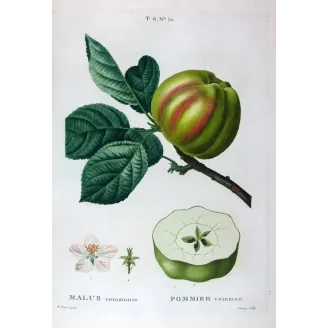
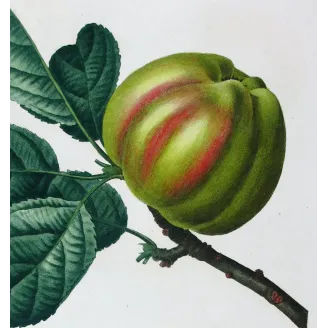
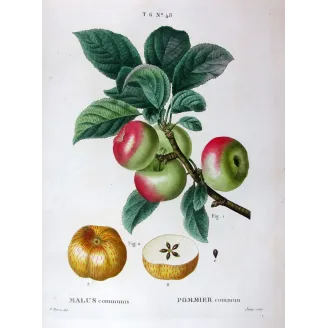
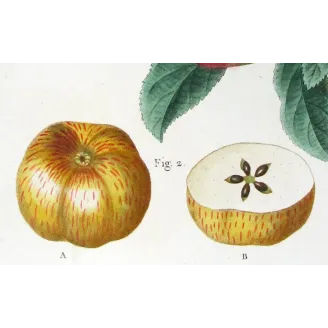
A finely executed early 19th-century botanical engraving illustrating a cultivated apple variety (Malus communis), drawn by Pancrace Bessa for Arbres et Arbustes. The composition combines precise botanical observation with refined decorative balance, presenting fruit and foliage with clarity and quiet elegance. Exceptional hand-colouring and careful modelling reflect the sophistication of French pomological illustration at its height.
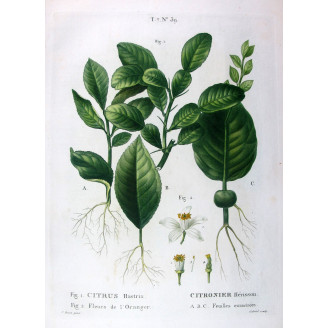
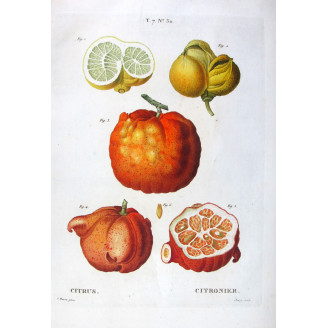
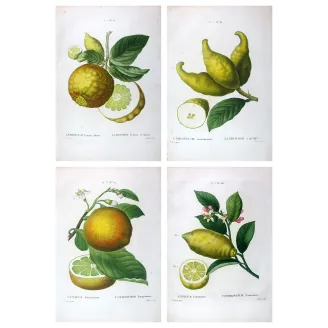
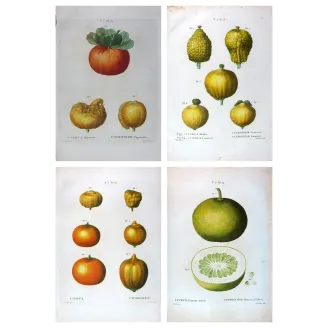
Nine original citrus engravings by Pancrace Bessa, uniting rare cedrats, sculptural lemons, and monumental Pomme d’Adam varieties into a coherent Napoleonic-era ensemble. Botanical study and refined color harmonize in a portfolio conceived to be read as a whole.
A refined study of five historic pear cultivars, combining varietal precision with sculptural balance and luminous hand-colouring.
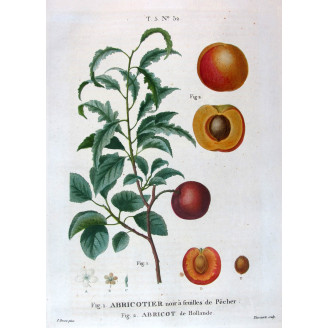
Dutch Apricot Abricot de Hollande Original hand-colored botanical engraving by Pancrace Bessa.
A finely executed early 19th-century botanical engraving illustrating a cultivated apple variety (Malus communis), drawn by Pancrace Bessa for Arbres et Arbustes. The composition combines precise botanical observation with refined decorative balance, presenting fruit and foliage with clarity and quiet elegance. Exceptional hand-colouring and careful modelling reflect the sophistication of French pomological illustration at its height.
Botanical illustration of the Saint Catherine plum, a delicate fruit-bearing tree, by Pancrace Bessa.
A sculptural study of cultivated fruit, defined by rounded volumes and restrained modelling, rendered with quiet elegance and visual balance.
Monthly Rose Rosier de tous les mois Original hand-colored botanical engraving by Pancrace Bessa.