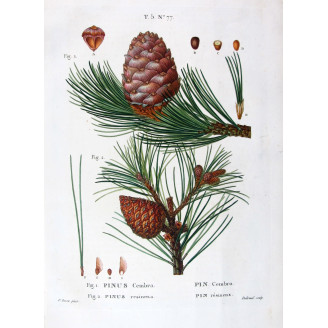
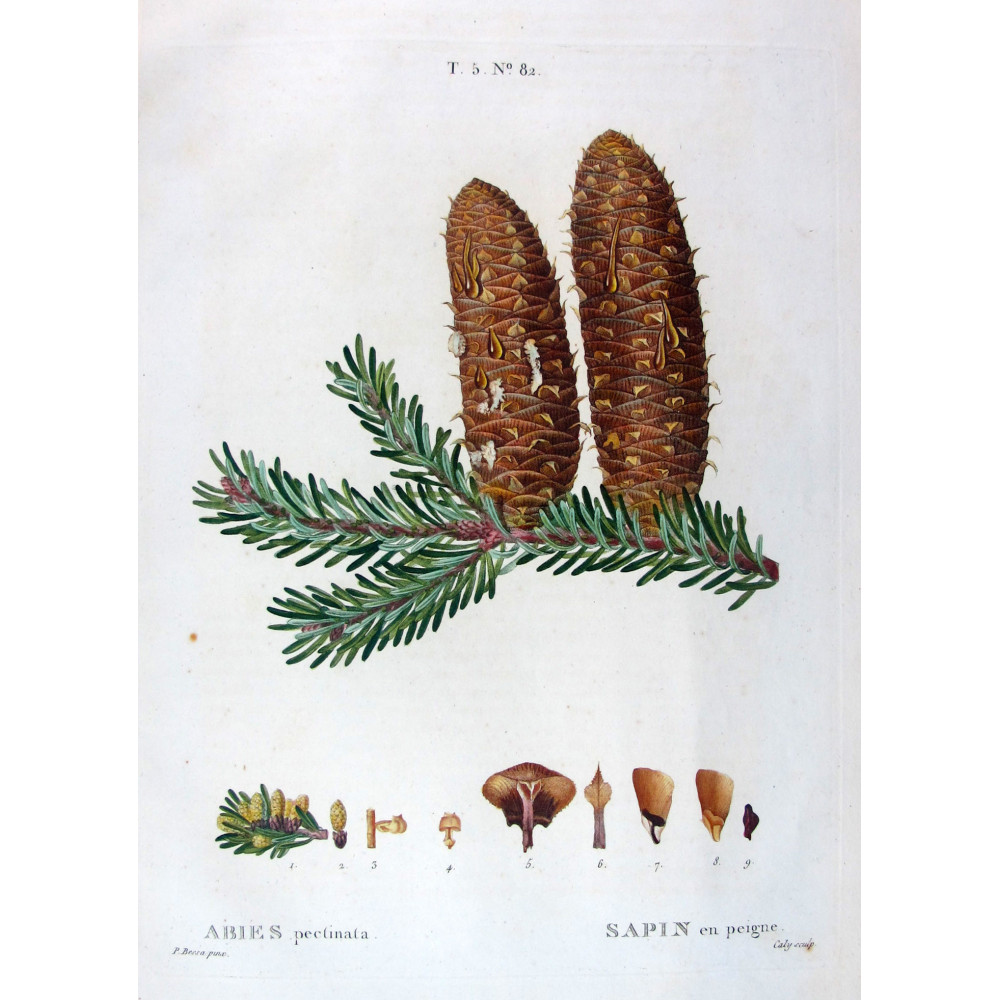
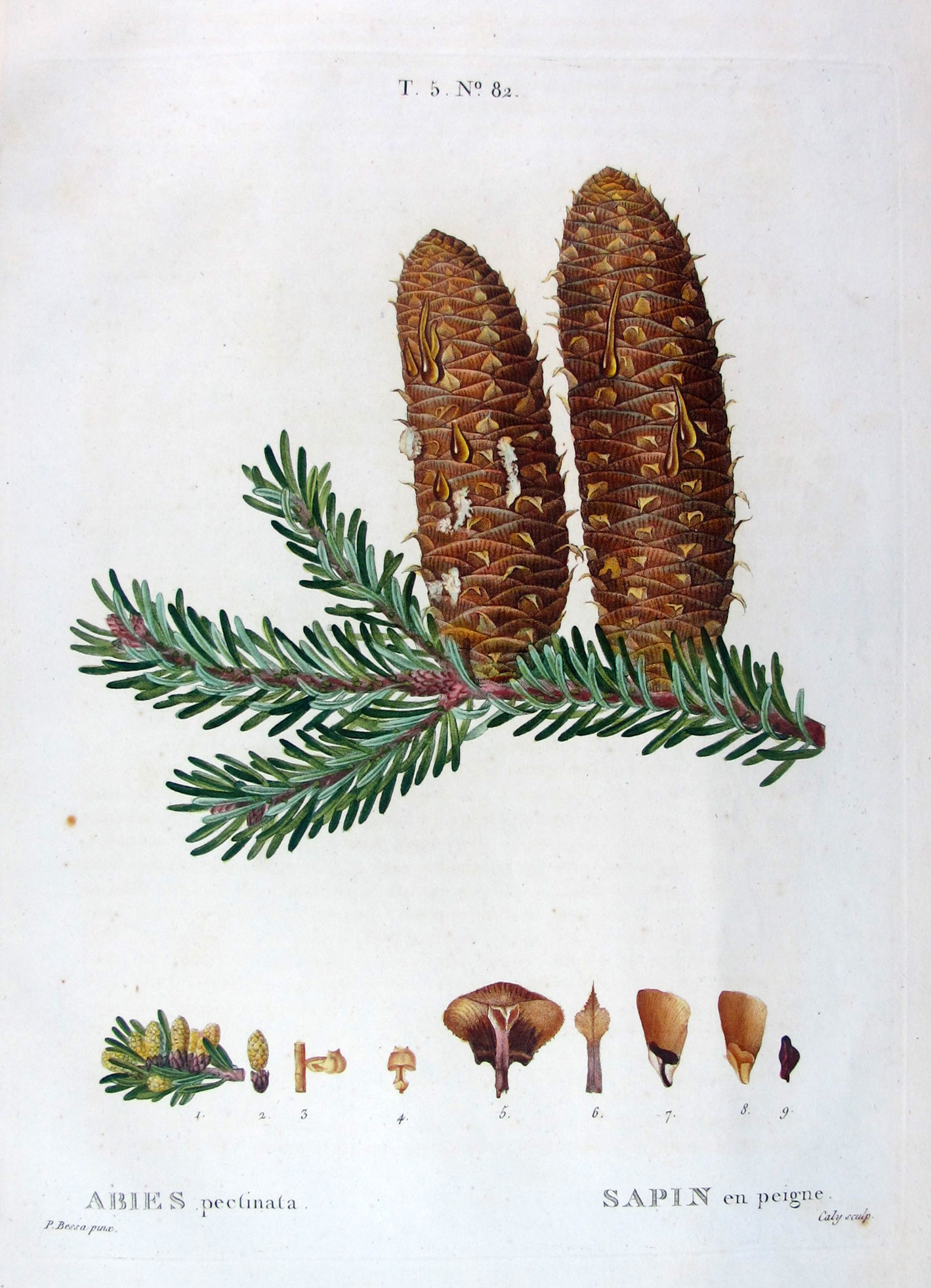
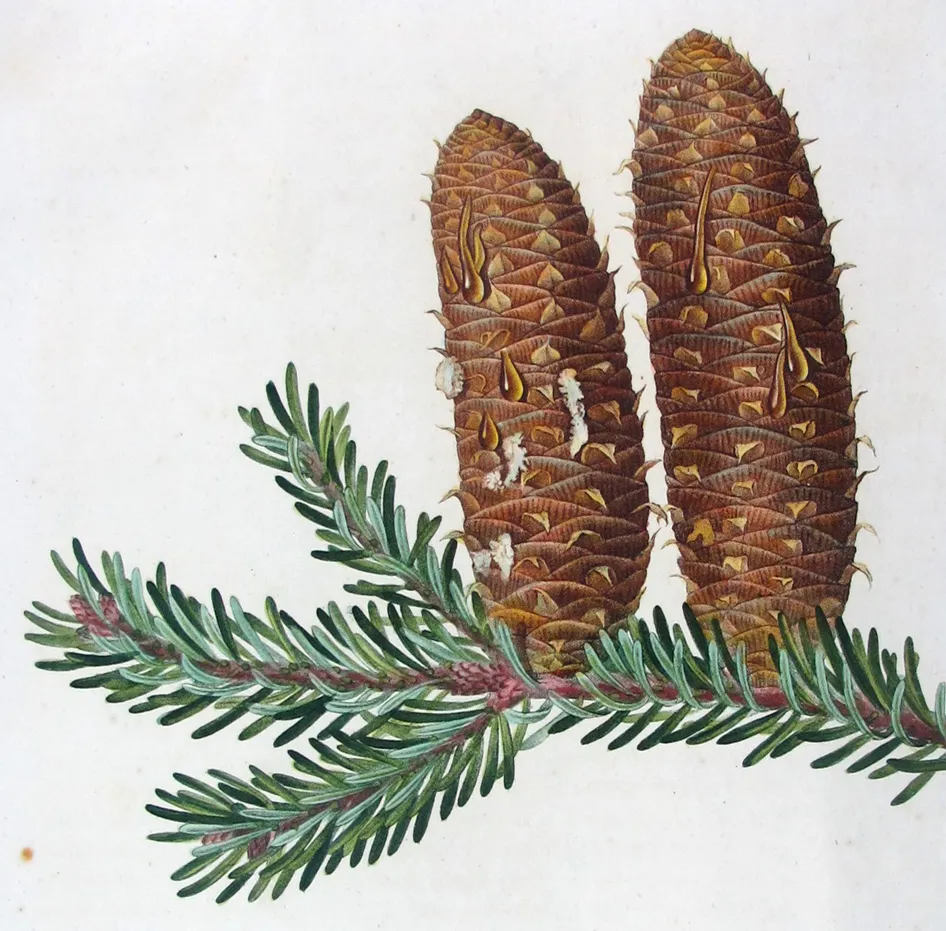
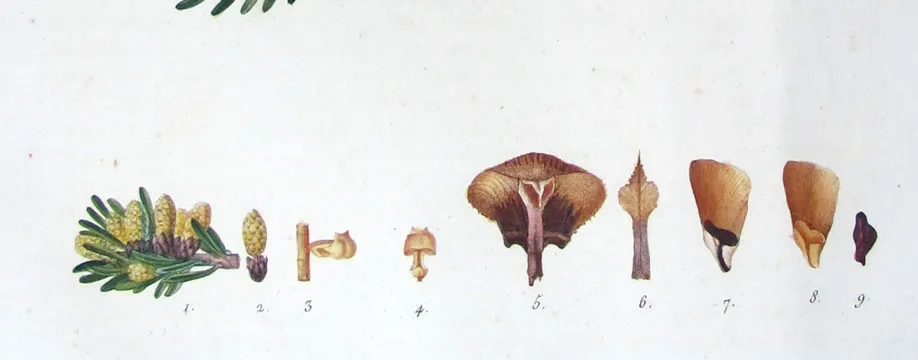
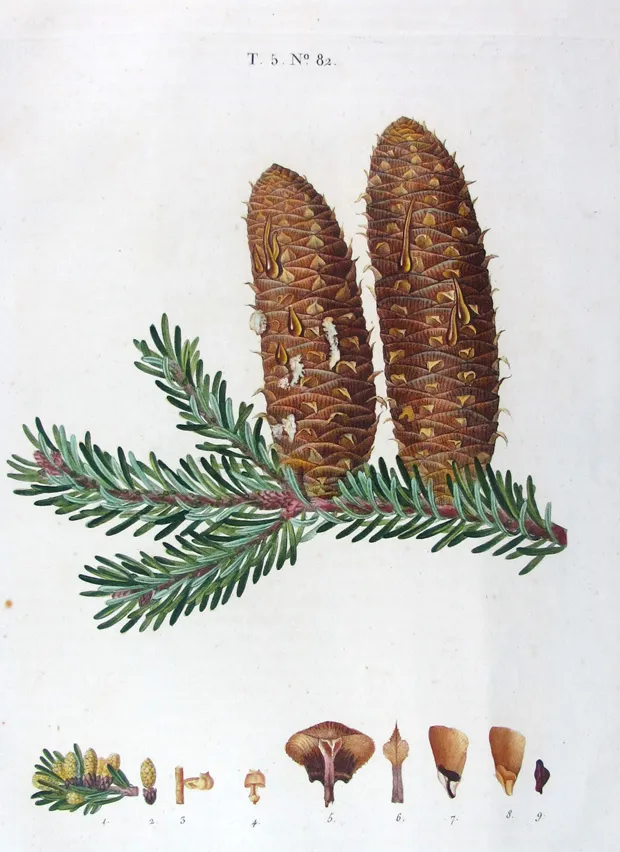
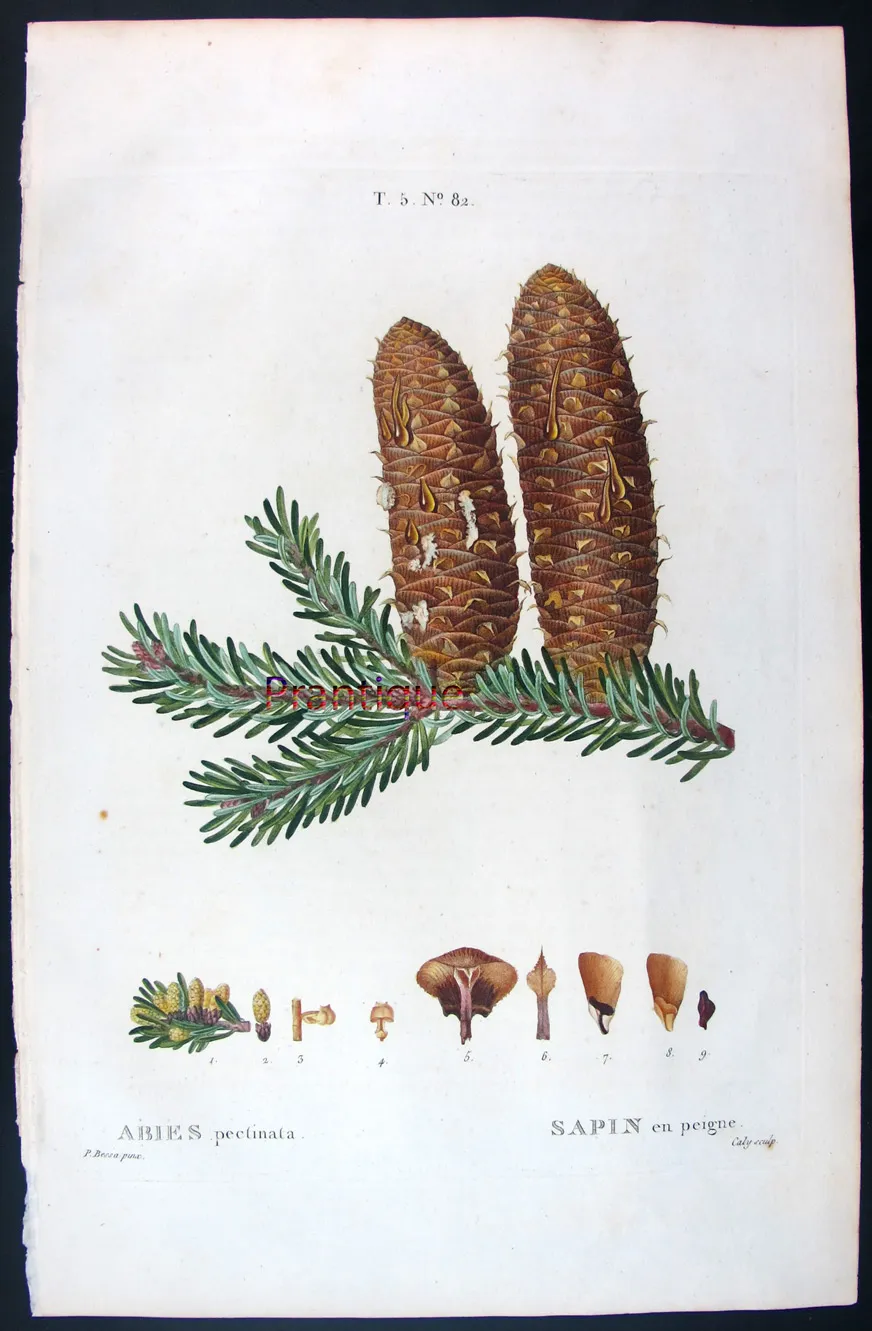


19th-century depiction of silver fir cones and foliage.
 Delivery policy
Your print will be carefully prepared and shipped worldwide via trusted couriers (UPS or similar).
 Authentic antique prints
Original engravings from the 17th–19th century.
This original engraving depicts Abies pectinata, commonly known as the European Silver Fir, presented with two mature upright cones and a detailed branch study. The vertical cones rise with quiet architectural authority, balanced by the finely arranged needles below.
The composition is restrained yet powerful. The paired cones dominate the upper register, their scales rendered with meticulous shading that conveys depth and structure. The lower botanical details provide analytical clarity, reinforcing the scientific precision characteristic of Bessa’s plates.
A particularly refined detail can be observed in the resin exudations visible on the cone scales. These small amber-like droplets are not decorative inventions but faithful botanical observations. In fir species, resin plays a protective role against insects and environmental stress — a subtle yet telling reminder of the tree’s defensive biology.
— • —
Unlike pines, whose cones hang downward, fir cones stand upright on the branches. This botanical distinction is clearly illustrated here, contributing to the vertical compositional strength of the plate. The textured scales are engraved with controlled stipple, creating a rhythmic surface pattern enhanced by subtle tonal gradation.
The needles are arranged in flattened rows along the twig — the “pectinate” formation that gives the species its name. This orderly alignment introduces visual calm beneath the sculptural cones, producing a composition that feels both balanced and dignified.
Abies pectinata, now generally known as Abies alba, is native to mountainous regions of Central and Southern Europe. It has long been valued for its straight trunk and durable timber, as well as for its aromatic resin. The species plays an important ecological role in highland forests and remains emblematic of European alpine landscapes.
The engraving is in Like Brand New condition. The sheet remains clean and well preserved, with fresh original hand-colouring and a strong, even paper tone. No watermark has been observed. The engraved credits confirm the original drawing by Pancrace Bessa and the engraving executed by Calès, verifying its authenticity as an original early nineteenth-century plate.
For further context on Pancrace Bessa and his distinctive contribution to French botanical illustration, see our editorial feature:
Specific References
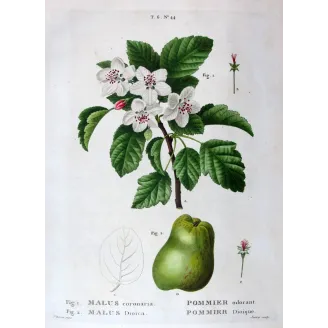
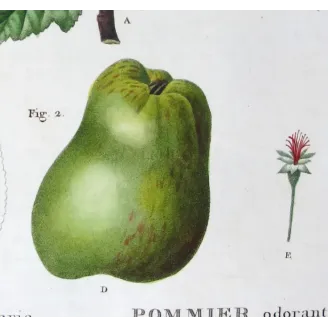
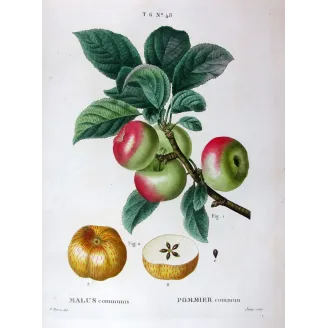
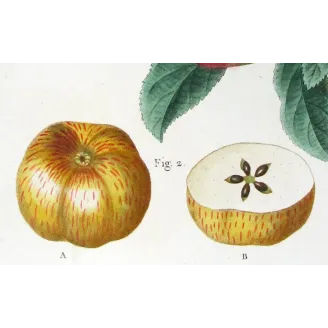
A finely executed early 19th-century botanical engraving illustrating a cultivated apple variety (Malus communis), drawn by Pancrace Bessa for Arbres et Arbustes. The composition combines precise botanical observation with refined decorative balance, presenting fruit and foliage with clarity and quiet elegance. Exceptional hand-colouring and careful modelling reflect the sophistication of French pomological illustration at its height.
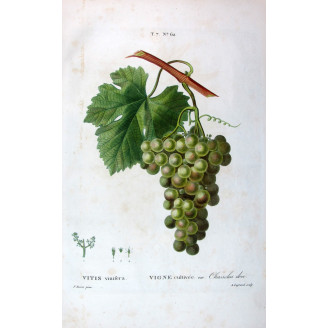
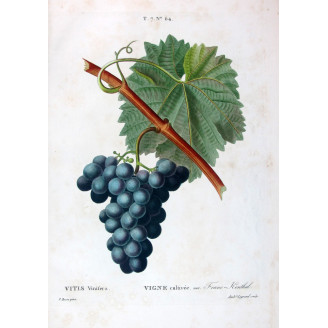
Depiction of golden grapes with vivid green leaves in fine detail.
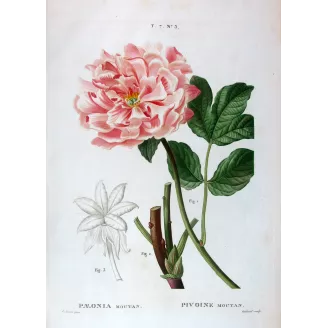
Tree Peony Pivoine moutan Original hand-colored botanical engraving by Pancrace Bessa.
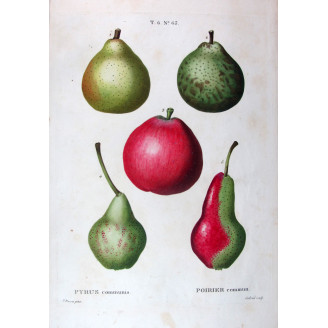
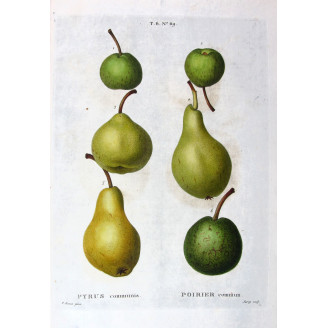
A refined study of French cultivated pear varieties, distinguished by subtle chromatic contrasts and carefully modelled forms. This hand-colored engraving reflects Pancrace Bessa’s ability to elevate orchard subjects through balance, restraint, and quiet visual authority.
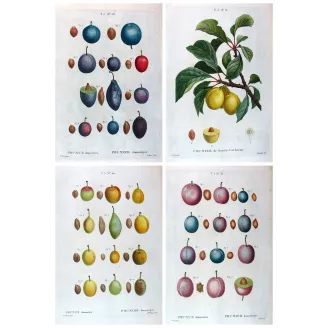
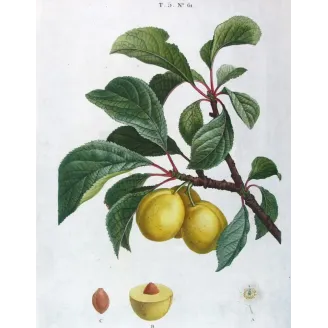
Botanical illustration of the Saint Catherine plum, a delicate fruit-bearing tree, by Pancrace Bessa.
A finely executed early 19th-century botanical engraving illustrating a cultivated apple variety (Malus communis), drawn by Pancrace Bessa for Arbres et Arbustes. The composition combines precise botanical observation with refined decorative balance, presenting fruit and foliage with clarity and quiet elegance. Exceptional hand-colouring and careful modelling reflect the sophistication of French pomological illustration at its height.
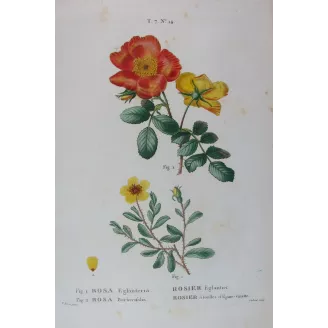
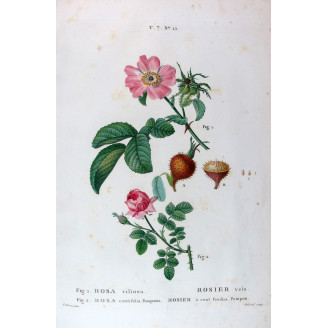
Eglantine & Berberis-leaved Rose Rosier à feuilles d'Épine-vinette Original hand-colored botanical engraving by Pancrace Bessa.
Velvet Rose & Pompon Centifolia Rosier velu & Rosier à cent feuilles, Pompon Original hand-colored botanical engraving by Pancrace Bessa.
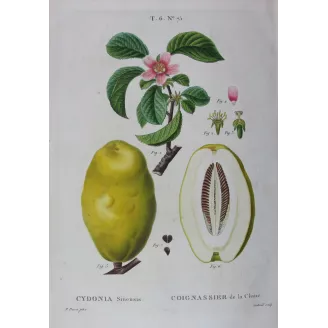
Chinese Quince Coignassier de la Chine Original hand-colored botanical engraving by Pancrace Bessa.
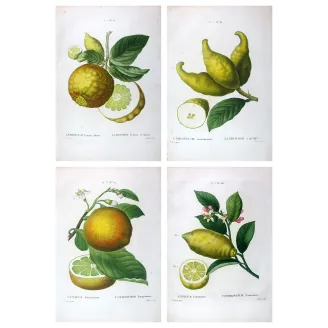
Nine original citrus engravings by Pancrace Bessa, uniting rare cedrats, sculptural lemons, and monumental Pomme d’Adam varieties into a coherent Napoleonic-era ensemble. Botanical study and refined color harmonize in a portfolio conceived to be read as a whole.
Original pochoir print of the peach tree, Prunus persica, with detailed flowering and fruit.
Original 1931 pochoir print by Émile-Allain Séguy. Plate No. 35, from the rare portfolio *Prismes*.
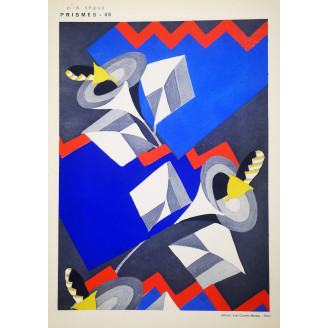
Original 1931 pochoir print by Émile-Allain Séguy. Plate No. 40, from the rare portfolio *Prismes*.
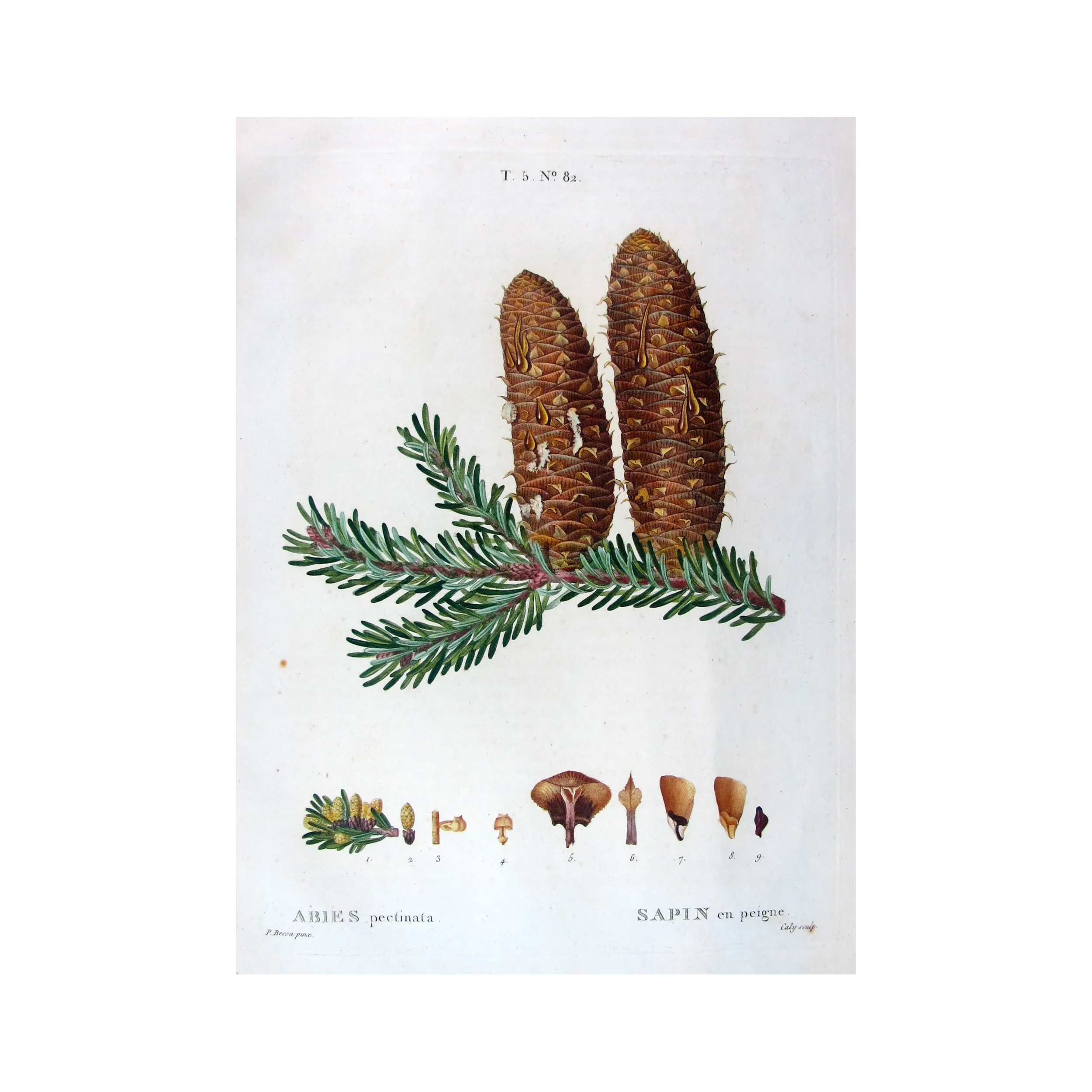
19th-century depiction of silver fir cones and foliage.