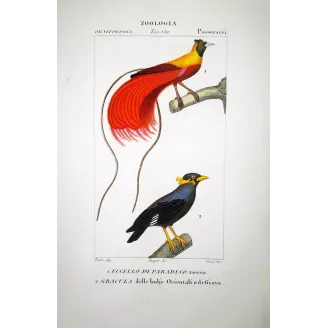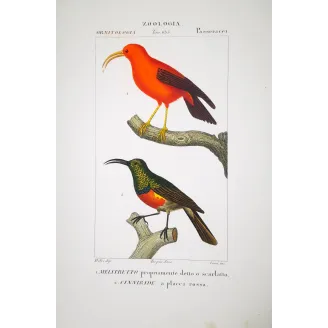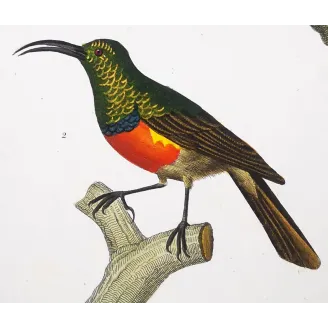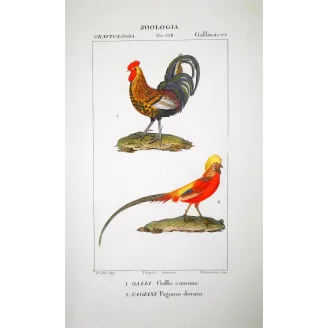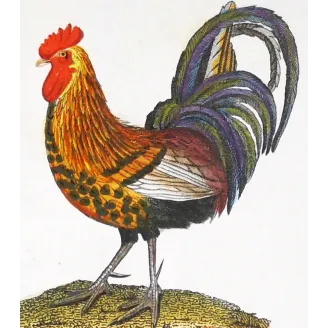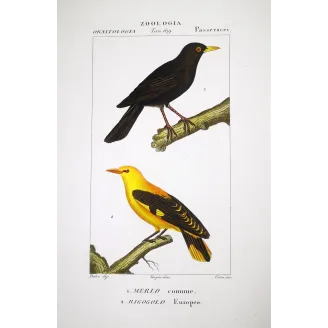
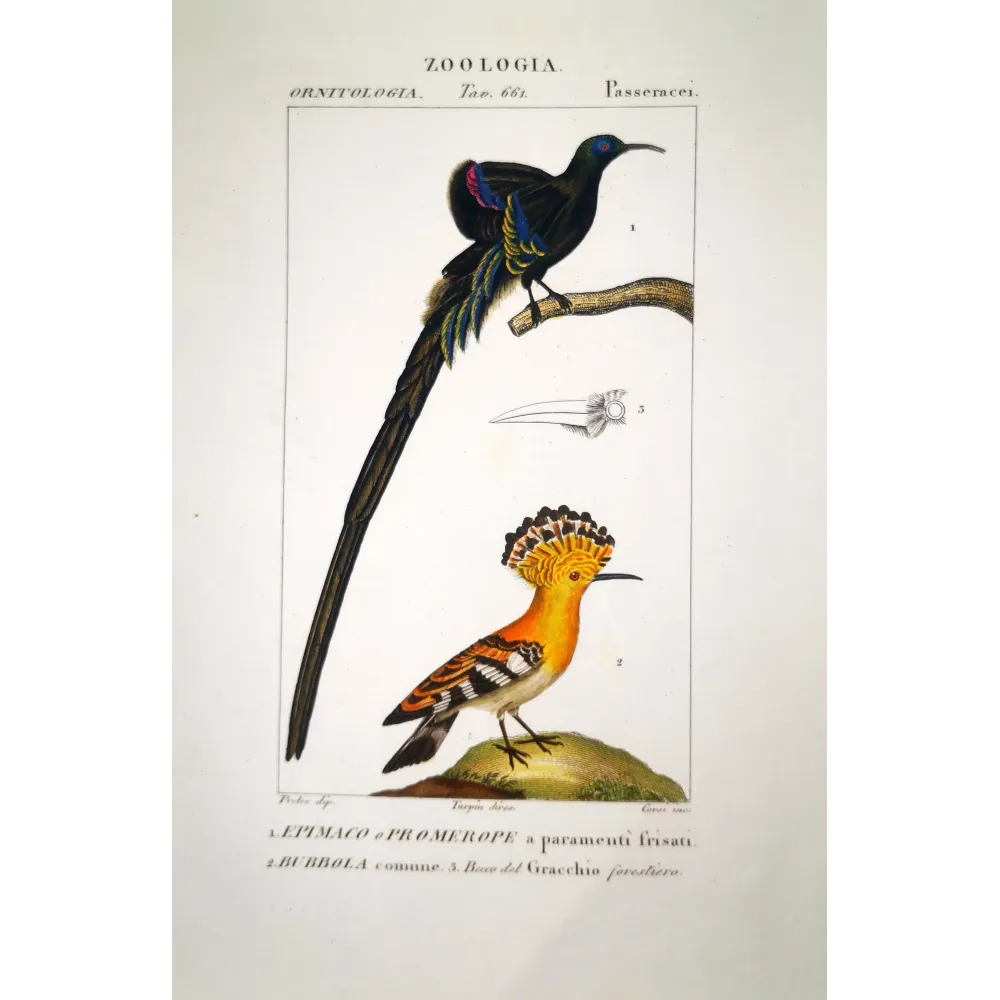
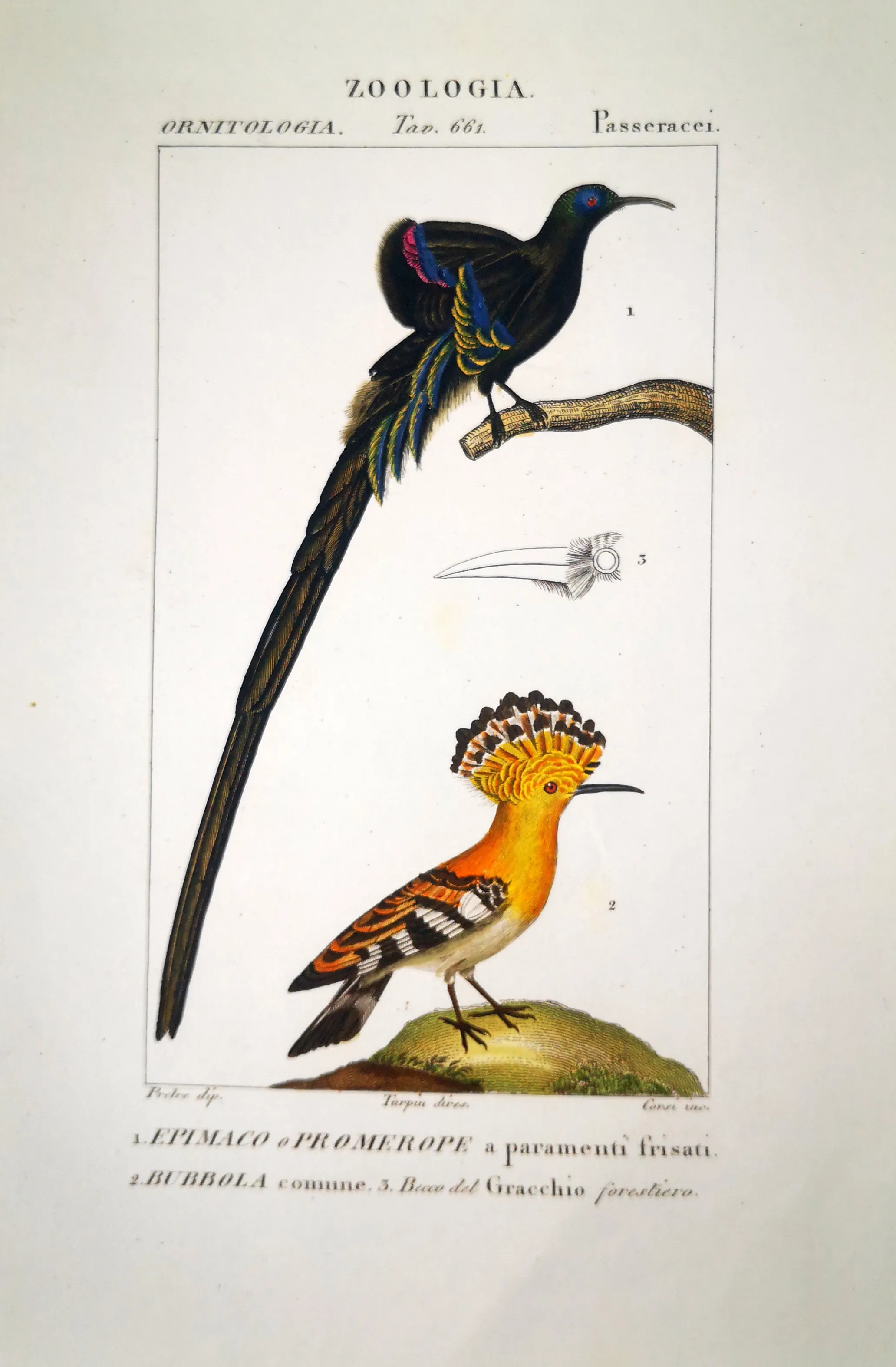
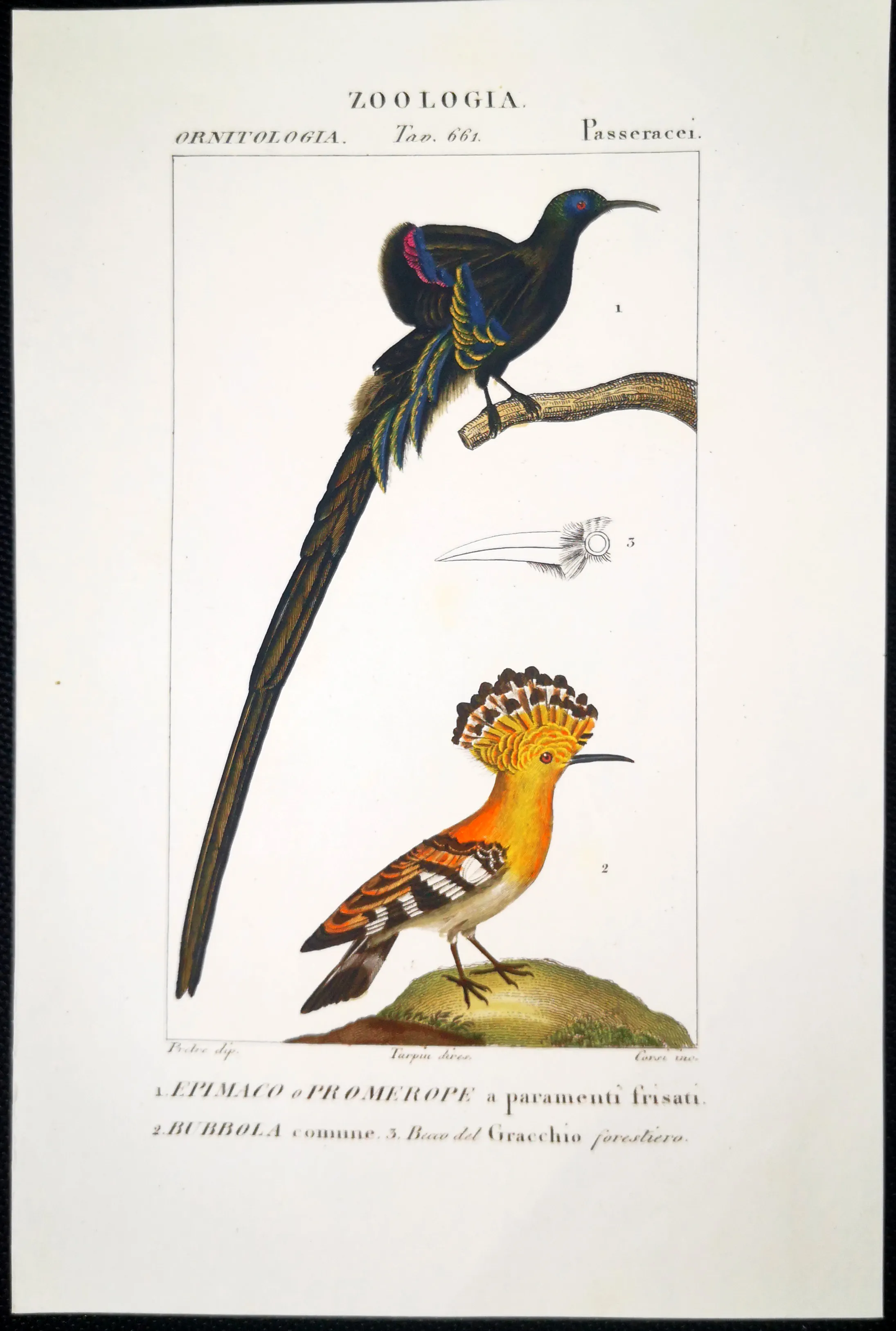


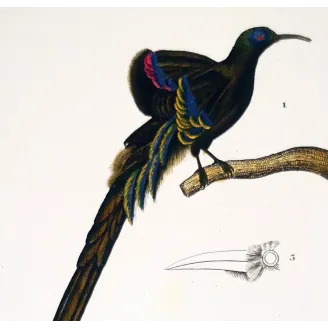
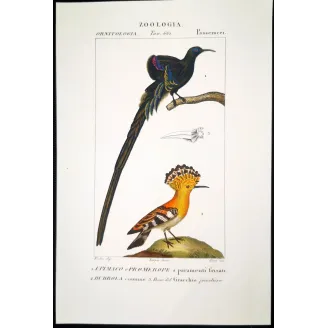

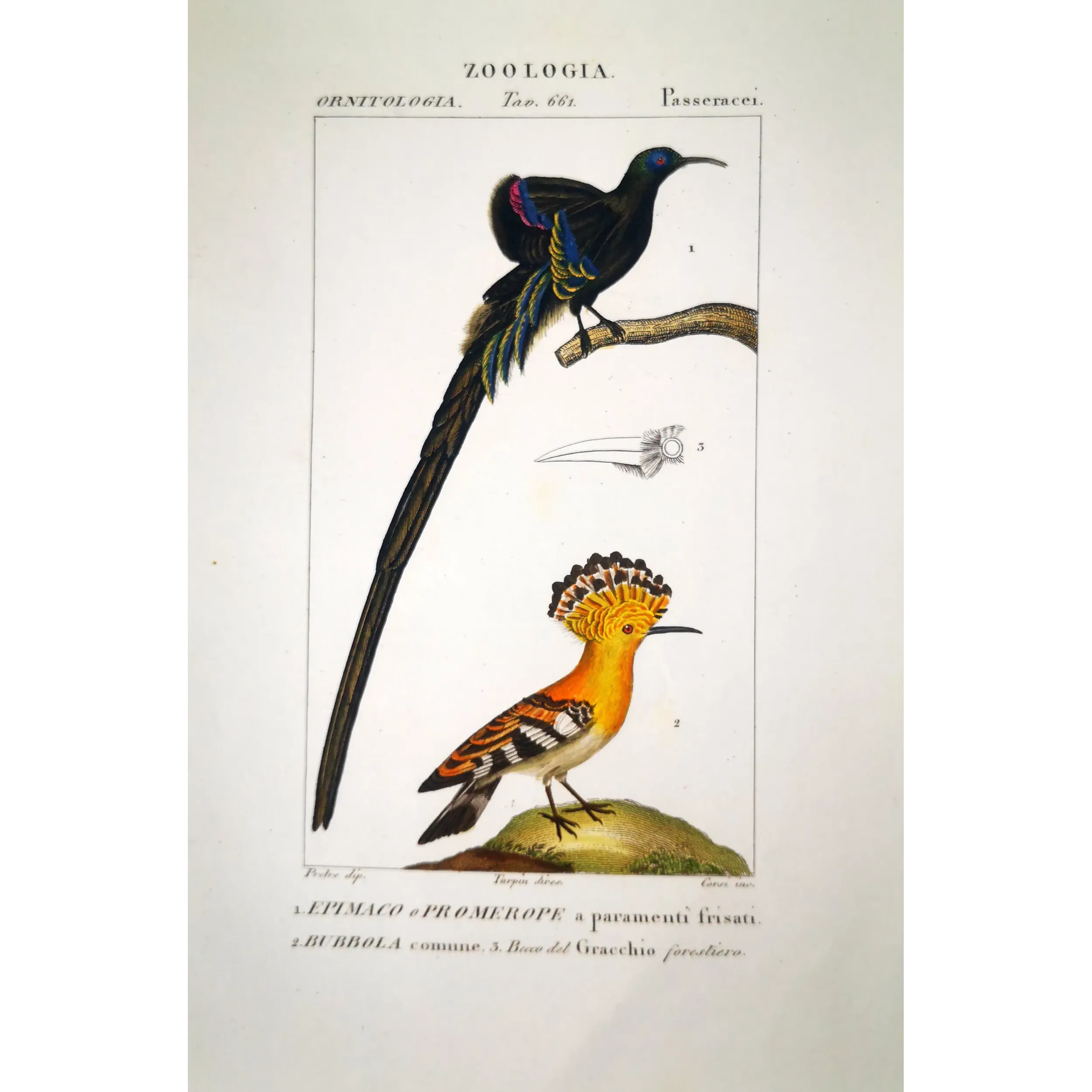
A long-tailed Promerops and a vivid Hoopoe bird, both perched and richly colored against a clean background.
 Delivery policy
Your print will be carefully prepared and shipped worldwide via trusted couriers (UPS or similar).
 Authentic antique prints
Original engravings from the 17th–19th century.
This exceptional ornithological engraving brings together two dramatically contrasting subjects: an Epimaco / Promerope (a bird-of-paradise type, titled in the plate “Epimaco o Promerope a paramonti frizzati”) and the Common Hoopoe (historically named “Bubbola comune”, Upupa epops). A small anatomical study of a bill (“Becco del Gracchio forestiero”) completes the plate, reflecting the encyclopedic method of the period—beauty presented through comparison, morphology, and detail.
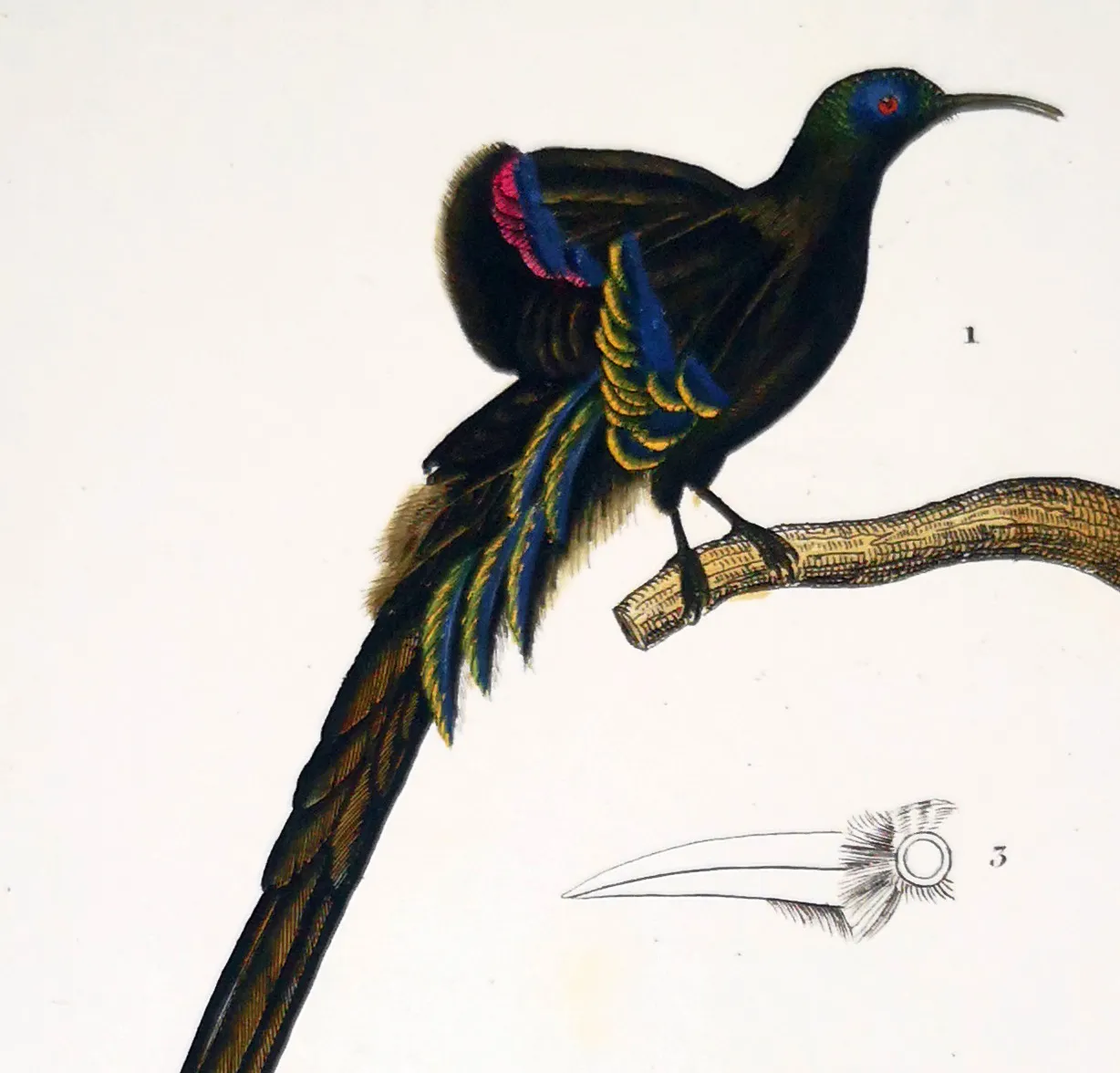
The upper figure is pure vertical drama: a dark, iridescent body with an extraordinarily elongated tail that reads like a calligraphic stroke across the sheet. The lower hoopoe offers the perfect counterpoint—compact, luminous, and crowned with an architectural crest. What elevates this plate into top-tier collecting territory is the presence of true gold enhancement, applied to feather details of the Promerope figure, creating a discreet but unmistakable brilliance when the sheet catches light.
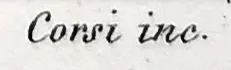
The engraving belongs to the Italian edition of the Dizionario di Scienze Naturali (Florence, Battelli press), one of the most ambitious encyclopedic scientific enterprises of its time, for which Pierre Antoine Prêtre produced some of the most accomplished zoological illustrations of the early nineteenth century.
— • —
The composition is designed around contrast in scale, palette, and gesture. The bird-of-paradise type occupies the upper register with commanding elegance: a near-black body with subtle colour vibration, accented by jewel-like wing flashes, and a tail that descends in a long, sculptural line. The branch is minimal, allowing the silhouette to dominate like an emblem.
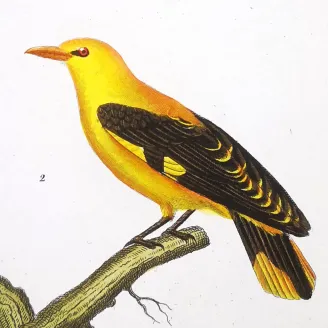
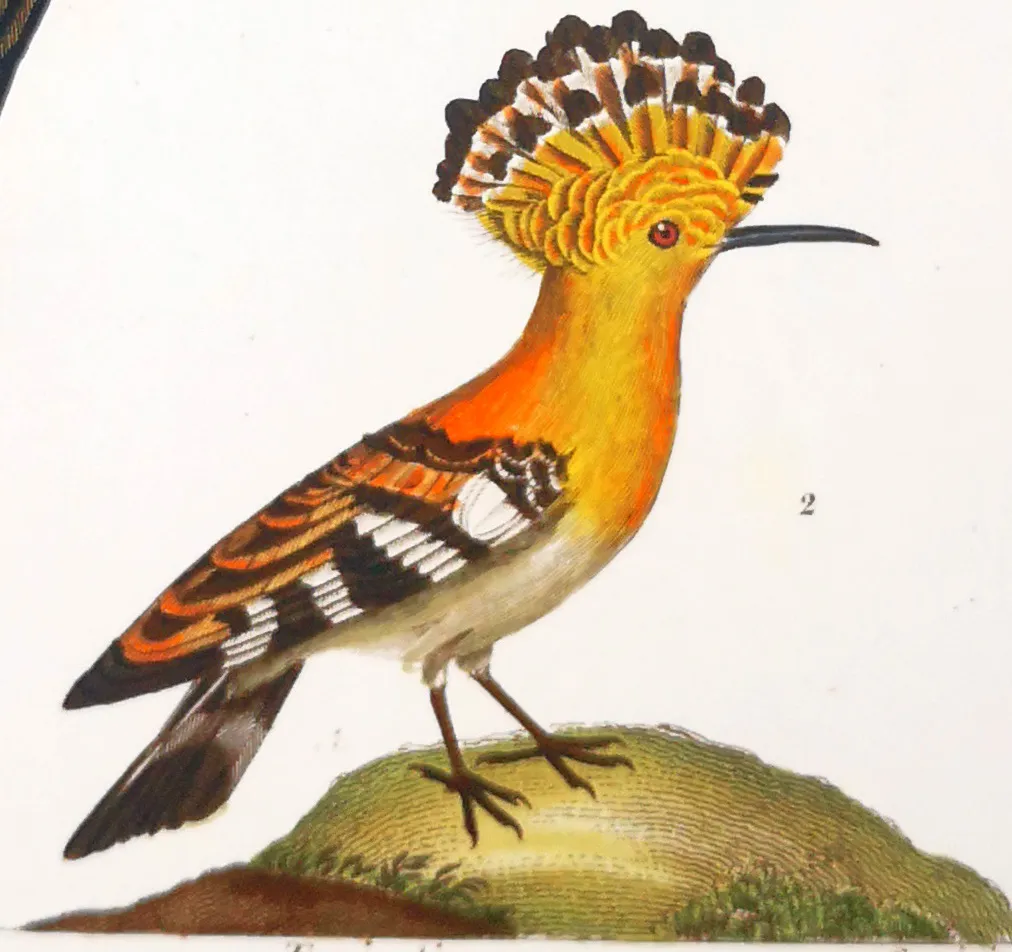
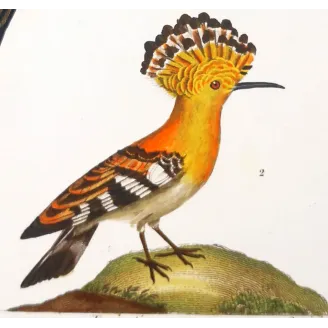
Below, the hoopoe introduces warmth and ornament: glowing ochres, crisp black-and-white barring, and a fan-like crest that feels almost ceremonial. The plate’s refinement lies in its restraint—ample white space, clean separation between subjects, and a disciplined colour logic. The true gold enhancement on the Promerope feathers adds an additional layer of luxury without ever becoming ostentatious.
The “Epimaco / Promerope” in this plate belongs to the nineteenth-century European fascination with birds of paradise—species celebrated for extreme tail structures, iridescent plumage, and display-oriented ornament. Historical names and classifications shifted frequently in early sources; today, many comparable forms are associated with the birds-of-paradise family (Paradisaeidae), often placed within or near the genus Epimachus. Regardless of modern taxonomy, the subject was chosen for a clear reason: it represents nature at its most theatrical, an ideal specimen for both scientific comparison and collector appeal.
The “Bubbola comune” is the Common Hoopoe (Upupa epops), a bird admired across Europe for its unmistakable crest and striking wing pattern. In natural history illustration, hoopoes offered “readable” diagnostic traits—crest structure, barring, and bill shape—making them ideal for encyclopedic plates. The additional bill study (“Becco del Gracchio forestiero”) reflects the period’s comparative method: isolating anatomical features so they could be examined with clarity, independent of the full figure.
This plate forms part of the historic Dizionario di Scienze Naturali, a monumental early nineteenth-century encyclopedic enterprise once preserved within a noble library and today housed in the Sacchetti Collection. Each engraving reflects a period in which scientific ambition was matched by exceptional artisanal execution — from the disciplined copperplate line to the luminous hand-colouring applied individually to every impression.
The result is not merely zoological documentation, but a refined synthesis of scholarship and craftsmanship. To discover the full story behind these rare prints and their noble provenance, we invite you to read our editorial feature “Not Just Another Print”.
The engraving is in excellent antique condition. The impression is clean and fresh, with well-preserved period hand-colouring and a notably crisp presentation. The sheet also features true gold enhancement on feather details of the Promerope (bird-of-paradise type), visible as a refined metallic brilliance under light. The paper is smooth early nineteenth-century wove paper (non-laid), consistent with Italian scientific editions of the period. No watermark has been observed. Any minor age toning is consistent with antique paper and does not affect the plate’s visual impact.
For further context on Pierre Antoine Prêtre and his contribution to nineteenth-century zoological illustration, see our editorial feature:
Pierre Antoine Prêtre – Illustrator of Natural Science and Marine Life
Specific References
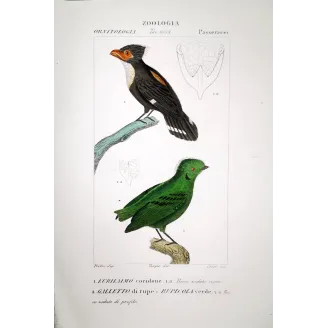
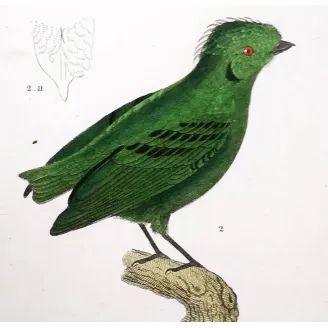
Rare birds of the jungle: the crest-faced Corydon and a luminous green Rupicola.
Vividly colored engraving of a European Green Woodpecker and a Eurasian Wryneck, masterfully rendered by Prêtre.
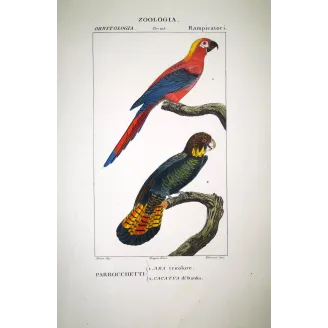
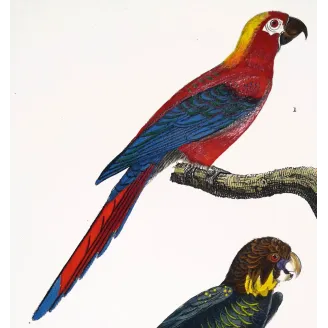
Vibrant parakeets perched on branches: a scarlet macaw and a black cockatoo with yellow and red highlights.
Two exotic birds from Australia, depicted with vivid hand-coloring.
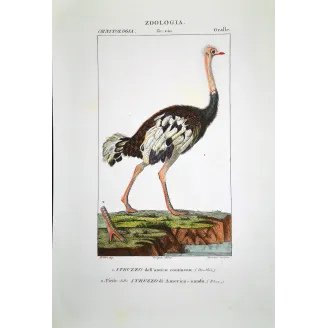
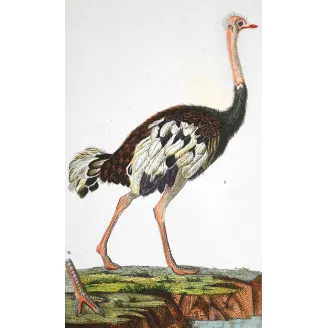
Imposing rendering of the Old World Ostrich and anatomical study of a Rhea foot.
Beautiful engraving combining sacred symbolism and elegant coastal shapes.
Two striking hawks from Australia, finely illustrated with warm natural tones.
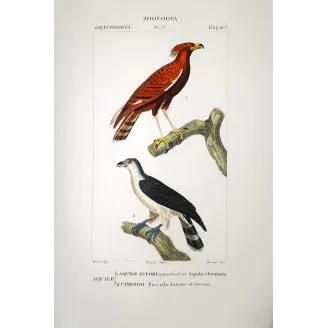
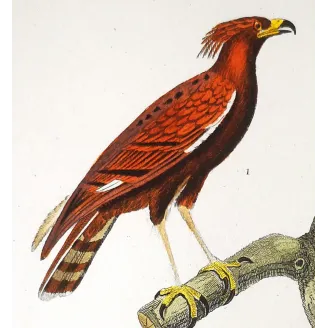
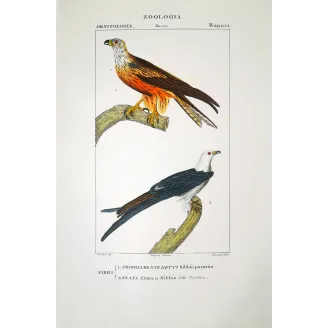
A lively contrast between a fiery red hawk-eagle and a smaller black-and-white goshawk.
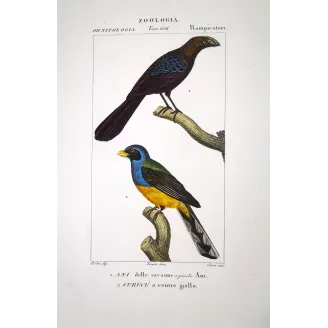
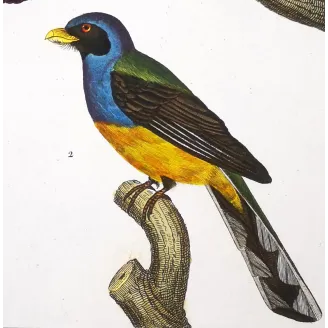
Colorful engraving of two exotic birds: the Ani and the vibrant Yellow-bellied Curuçu.
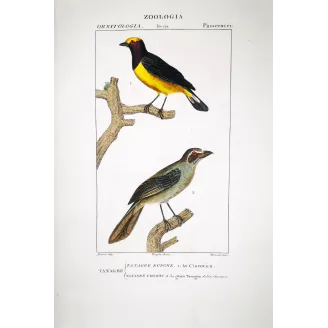
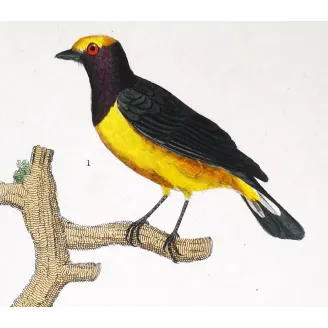
Graceful composition of a Yellow Tanager and a more subtly colored species from the Guyana region.
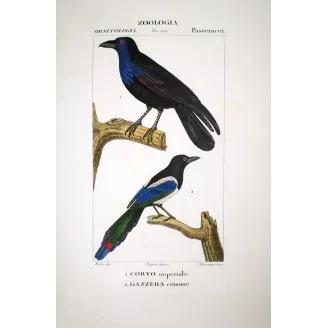
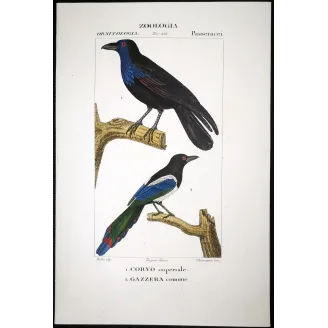
Striking contrast between the dark Imperial Crow and the vividly patterned Common Magpie.
Brilliantly colored honeycreeper and sunbird illustration with tropical vibrancy, captured by Prêtre.
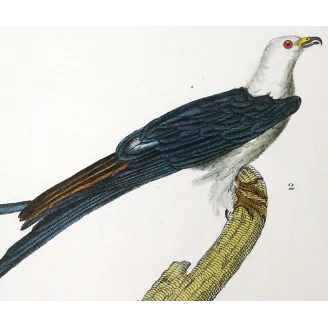
Parasitic Kite & Elanus (Milvus sp. & Elanus sp.) – Original Hand-Colored Engraving by Prêtre, Antique Print.
A long-tailed Promerops and a vivid Hoopoe bird, both perched and richly colored against a clean background.