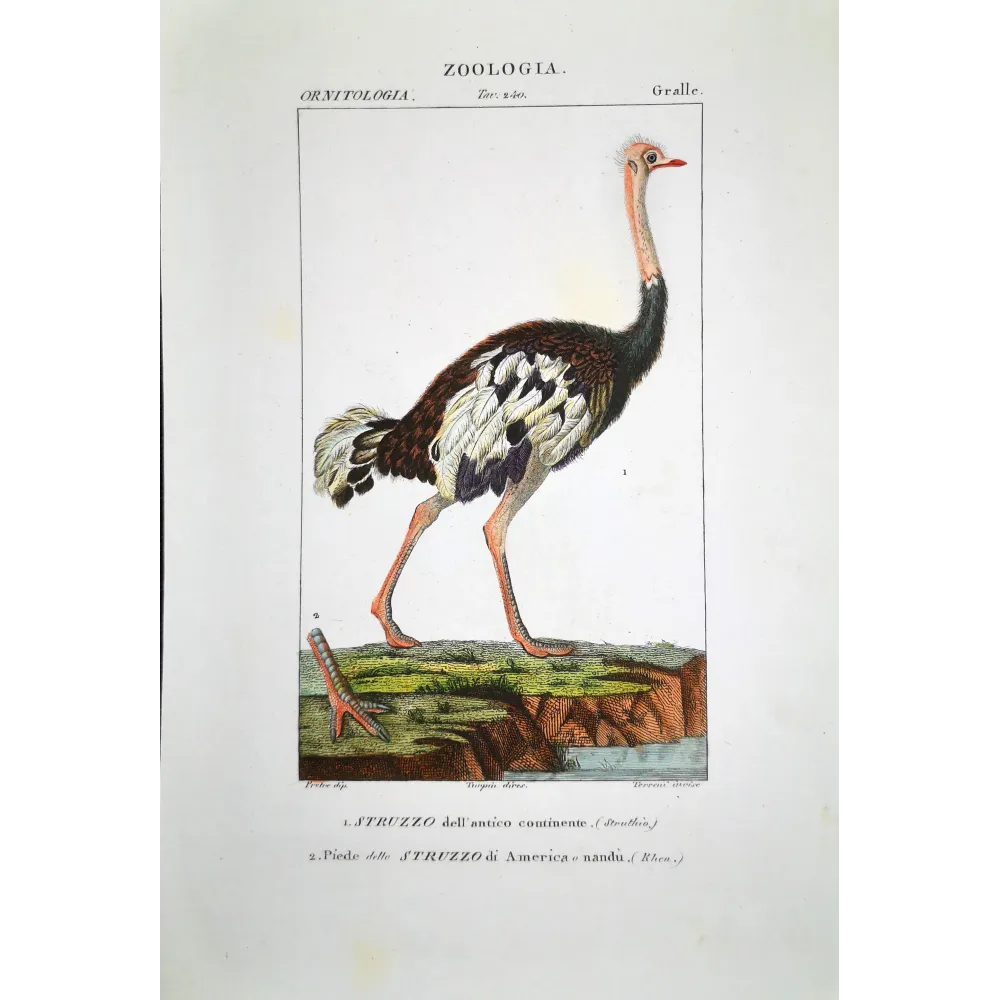
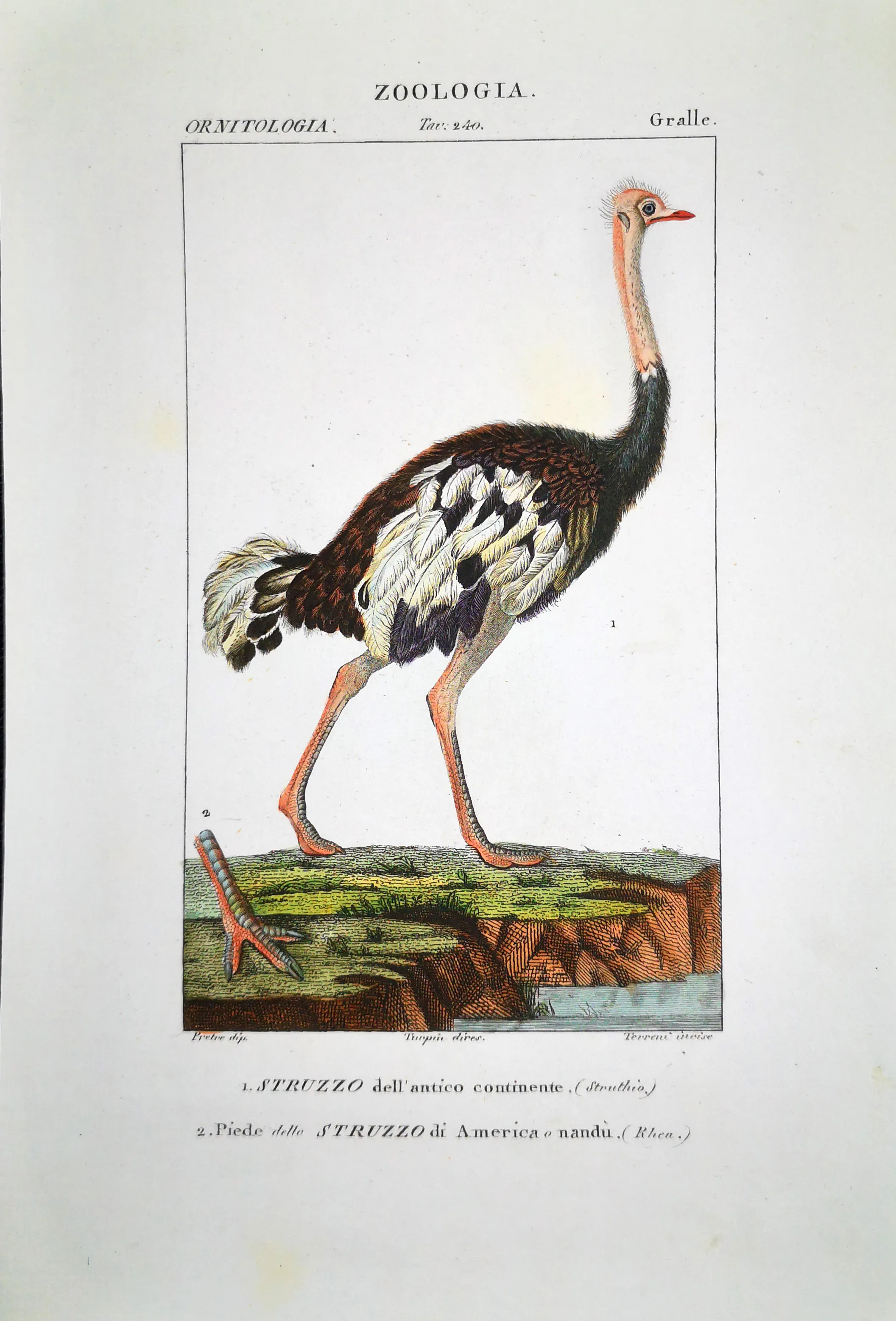
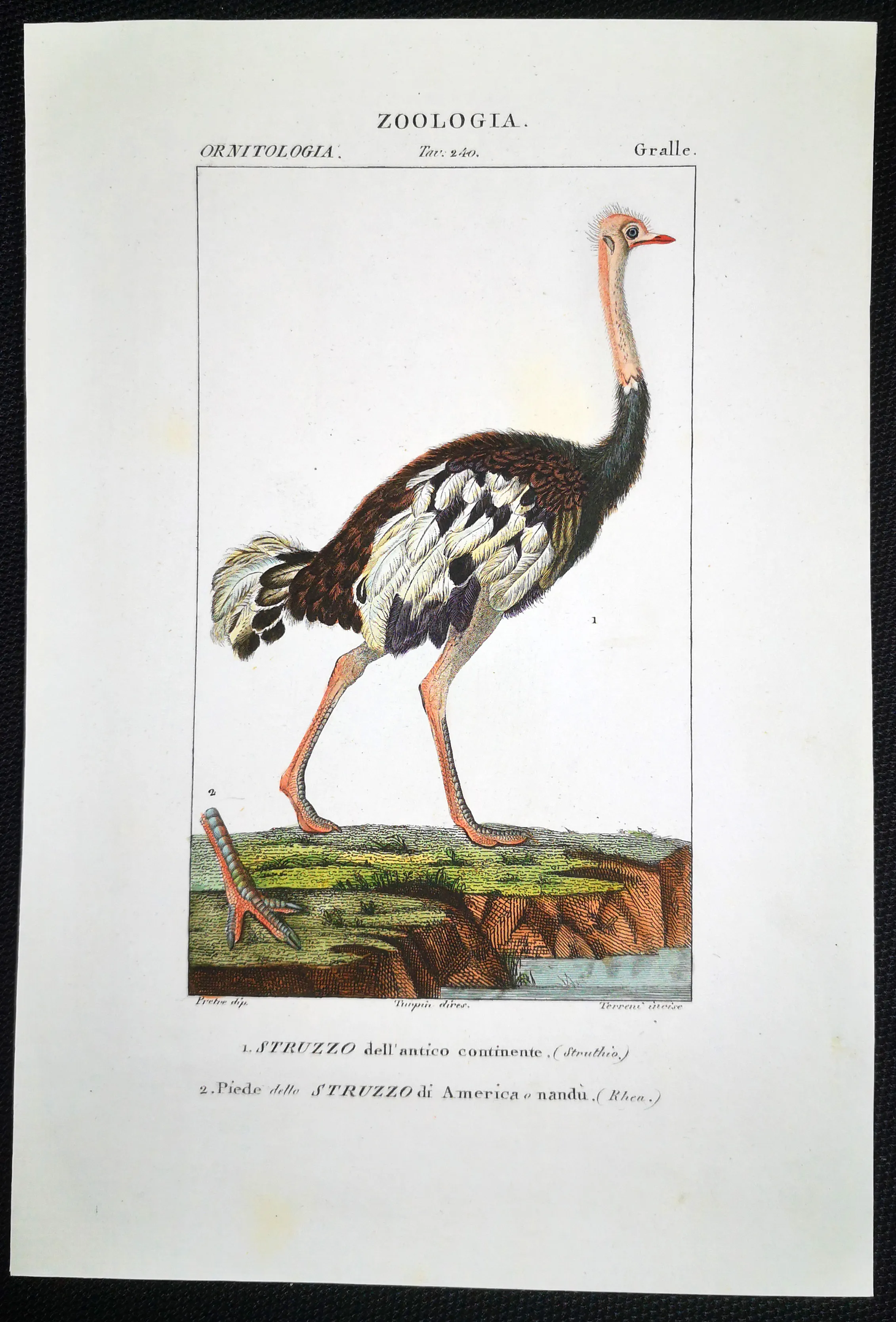



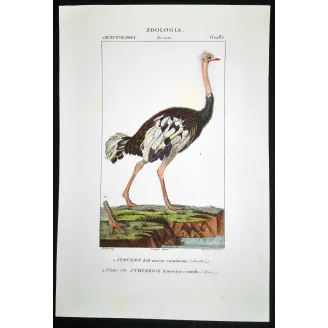
Imposing rendering of the Old World Ostrich and anatomical study of a Rhea foot.
 Delivery policy
Your print will be carefully prepared and shipped worldwide via trusted couriers (UPS or similar).
 Authentic antique prints
Original engravings from the 17th–19th century.
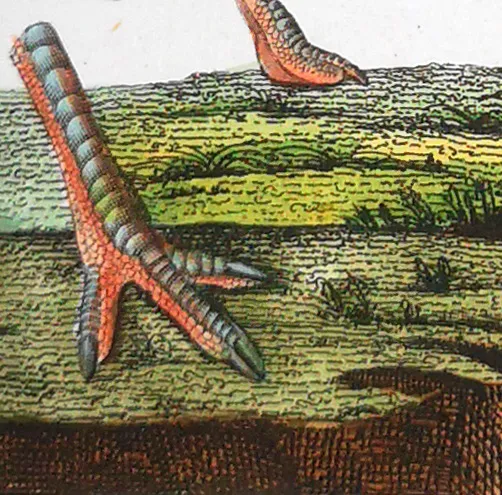
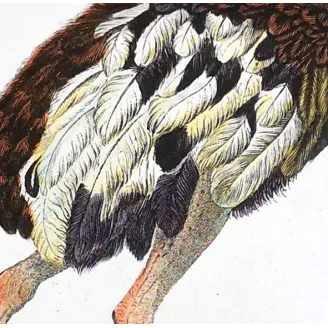
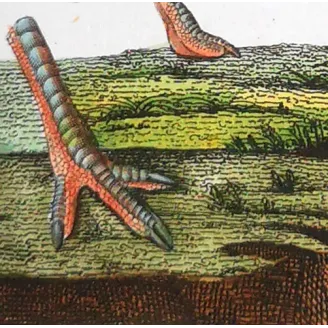
This refined zoological engraving presents the Struzzo dell’antico continente (the African ostrich, Struthio camelus) accompanied by a detailed study of the foot of the American nandù (associated with the genus Rhea). The plate belongs to the ornithological section of the Dizionario di Scienze Naturali, where Pierre Antoine Prêtre’s disciplined draftsmanship combines anatomical clarity with elegant compositional balance.
Isolated against a luminous ground, the ostrich stands with sculptural authority. The secondary study of the nandù foot reinforces the scientific purpose of the engraving, transforming the sheet into both a decorative object and a pedagogical instrument.
— • —
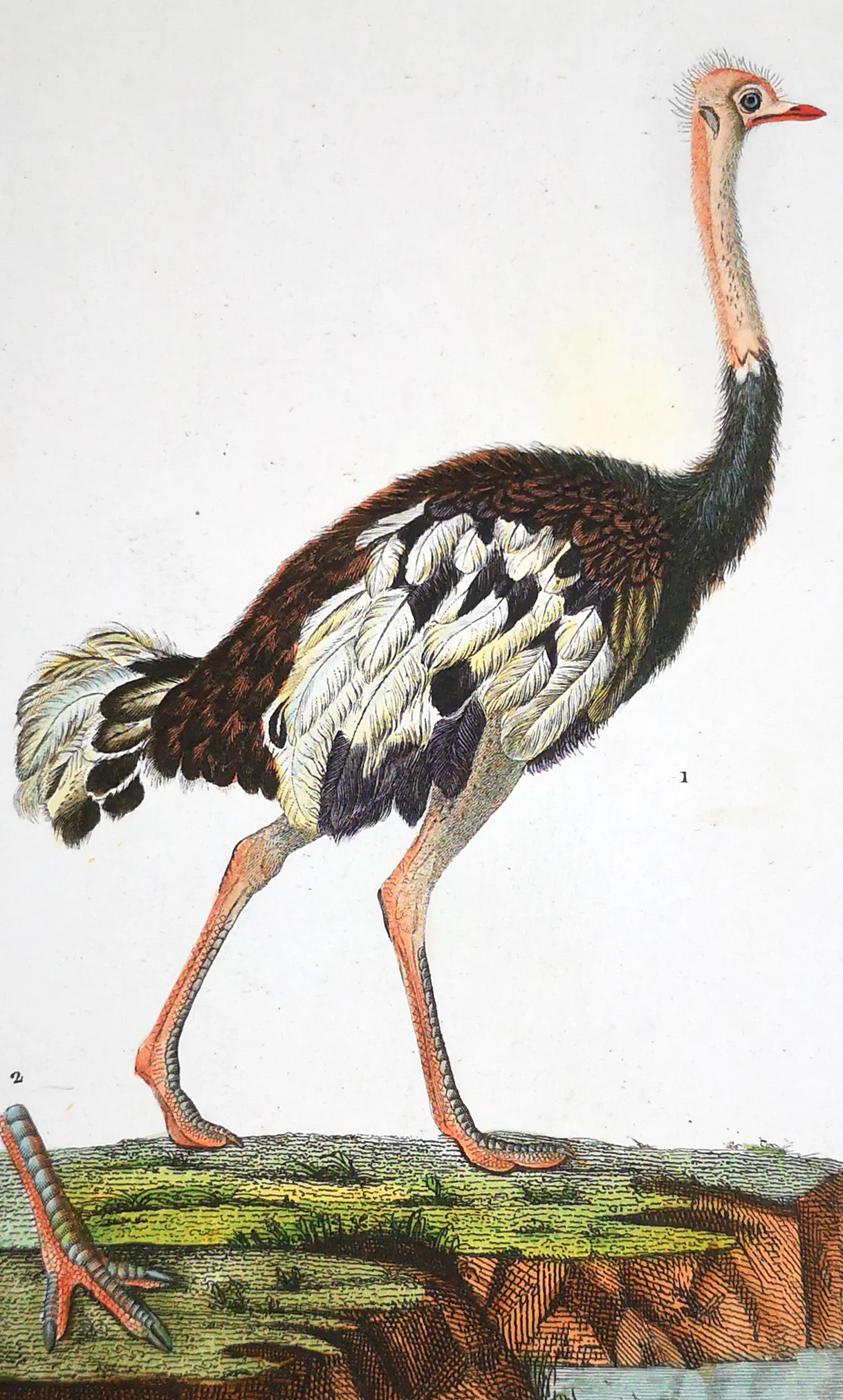
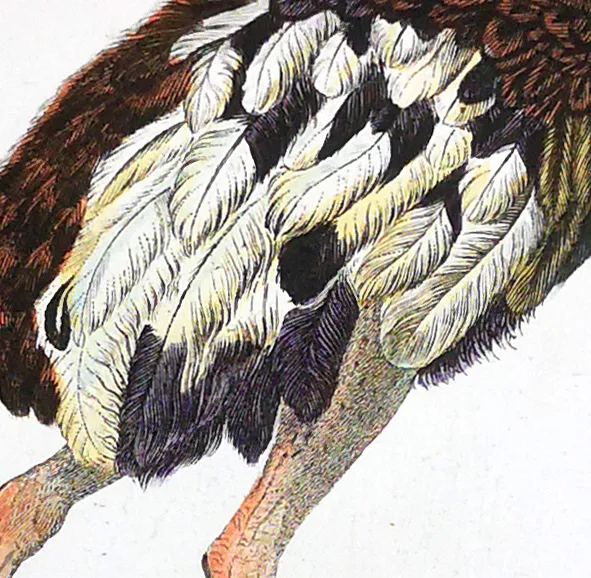
The ostrich is rendered with architectural clarity. The elongated neck rises vertically, drawing the eye upward and giving the composition a sense of poised monumentality. The plumage is articulated through controlled modulation of brown, black, and ivory tones, while the pale neck and alert eye introduce a refined focal contrast.
The landscape base—subtly indicated with green plateau and exposed earth—anchors the bird in space without distracting from its silhouette. The inclusion of the nandù foot study in the lower register adds visual rhythm and reinforces the encyclopedic rigor characteristic of early nineteenth-century natural history illustration.
The African ostrich (Struthio camelus) is the largest living bird and has long fascinated naturalists for its scale, speed, and distinctive morphology. In European visual culture, the ostrich symbolized both exotic geography and the expanding reach of scientific inquiry into the fauna of Africa.
The reference to the American nandù (associated with Rhea species) reflects early nineteenth-century comparative zoology, when illustrators frequently juxtaposed related species to clarify anatomical differences. Such plates served as visual tools in an era when scientific knowledge was disseminated through meticulously engraved and hand-colored works.
This engraving forms part of the historic Dizionario di Scienze Naturali, a monumental early nineteenth-century encyclopedic enterprise once preserved within a noble library and today housed in the Sacchetti Collection. Each plate reflects a period in which scientific ambition was matched by exceptional artisanal execution — from disciplined copperplate linework to luminous hand-applied color.
These works represent a moment when natural history illustration achieved both scientific rigor and aesthetic refinement. To discover the full story behind these rare prints and their noble provenance, we invite you to read our editorial feature “Not Just Another Print”.
The engraving is in very good antique condition. The impression is clean and well-defined, with preserved original hand-colouring. The paper is smooth early nineteenth-century wove paper (non-laid), consistent with Italian scientific editions of the period. No watermark has been observed. Minor age toning, if present, is consistent with antique paper and does not affect the legibility or decorative quality of the plate.
For further context on Pierre Antoine Prêtre and his contribution to nineteenth-century zoological illustration, see our editorial feature:
Pierre Antoine Prêtre – Illustrator of Natural Science and Marine Life
Specific References
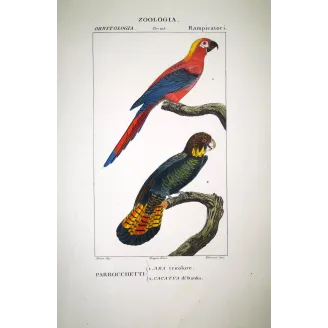
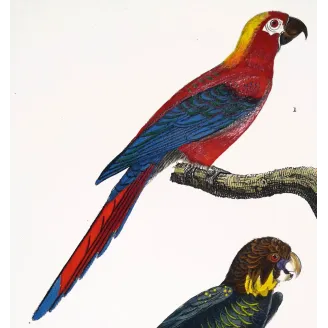
Vibrant parakeets perched on branches: a scarlet macaw and a black cockatoo with yellow and red highlights.
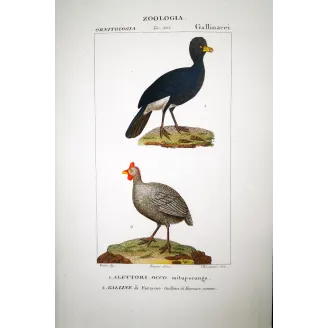
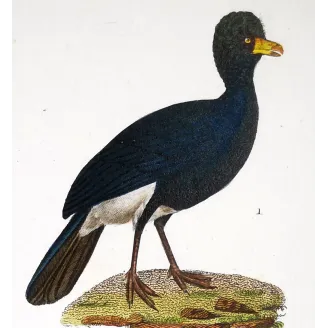
Elegant engraving of a guinea fowl and a Mituporanga, with rich textures and natural posture.
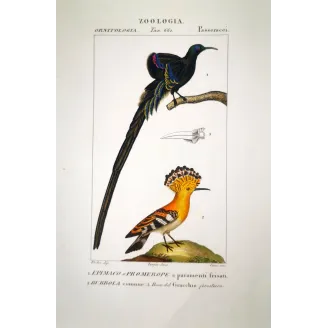
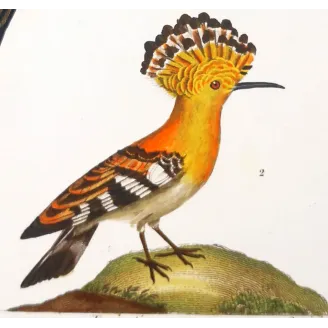
A long-tailed Promerops and a vivid Hoopoe bird, both perched and richly colored against a clean background.
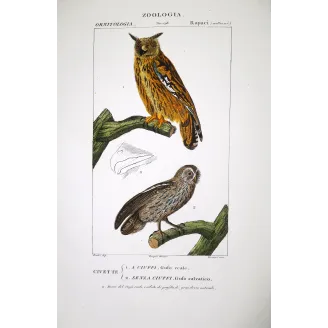
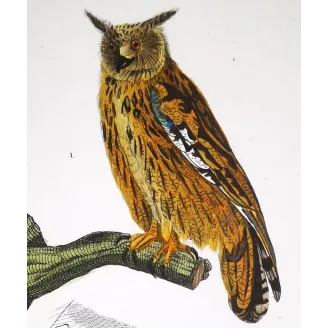
Nocturnal birds of prey elegantly rendered, showing sharpness and grace.
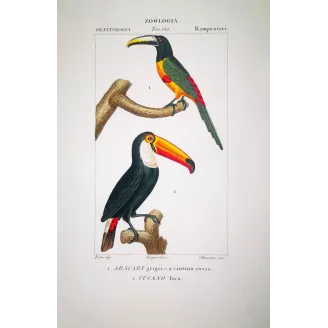
Colored illustration depicting two South American toucans: the Toco and the Red-belted Aracari.
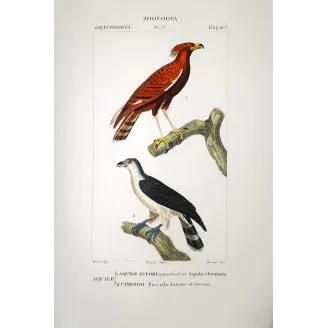
A lively contrast between a fiery red hawk-eagle and a smaller black-and-white goshawk.
Beautiful engraving combining sacred symbolism and elegant coastal shapes.
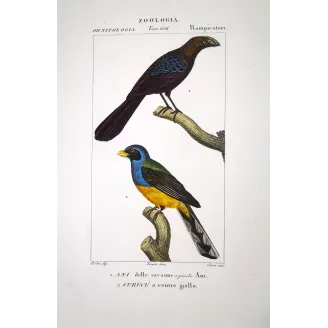
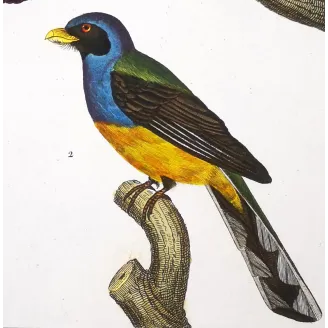
Colorful engraving of two exotic birds: the Ani and the vibrant Yellow-bellied Curuçu.
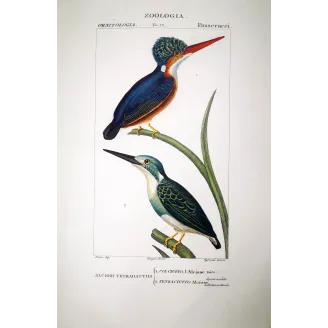
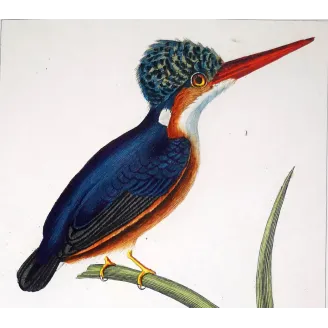
Refined old print with two specimens of South American halcyons: one crested and one with a green-blue livery.
Exquisite depiction of the ornate Greater Bird-of-Paradise alongside the striking Common Hill Myna.
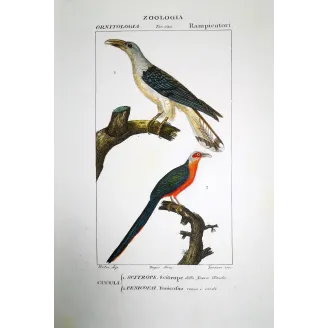
Elegant depiction of a Scythrope and a vividly colored red-and-green Trogon perched on branches.
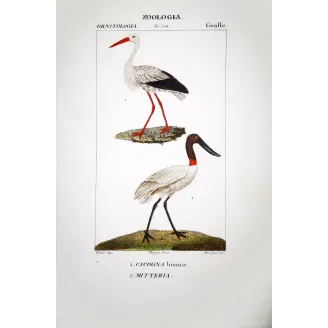
Graceful stork and robust jabiru presented with classic naturalistic balance.
Two exotic birds from Australia, depicted with vivid hand-coloring.
Rare birds of the jungle: the crest-faced Corydon and a luminous green Rupicola.
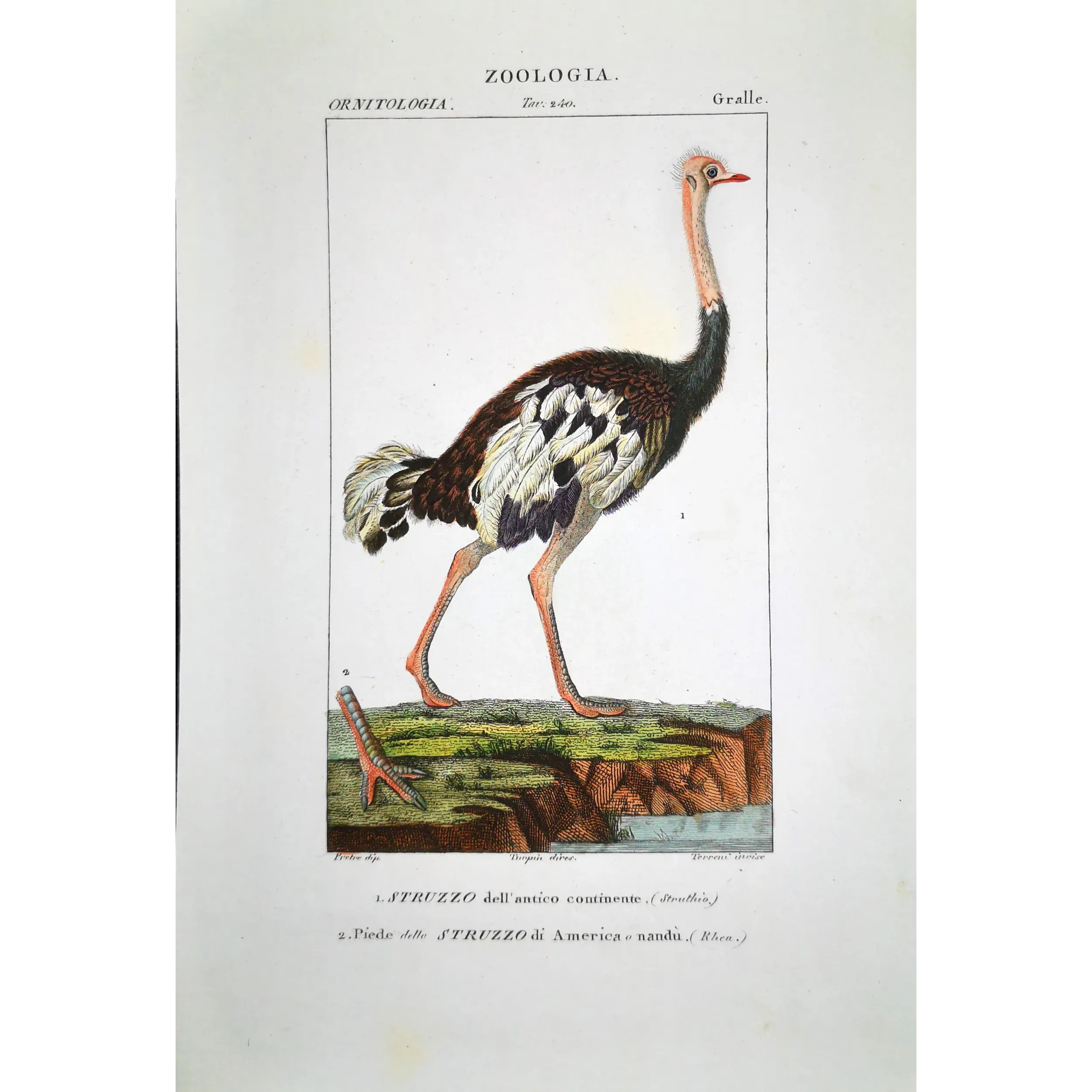
Imposing rendering of the Old World Ostrich and anatomical study of a Rhea foot.